










In This Article (9 sections)
AMD Radeon RX 9070 GRE Review and Specifications: Introduction to AMD’s New Midrange RDNA 4 GPU
The AMD Radeon RX 9070 GRE represents AMD’s anticipated push into the upper midrange GPU segment within its RDNA 4 architecture lineup. Positioned as a “GRE” (Golden Rabbit Edition) model, it is expected to serve as a slightly cut-down, value-oriented alternative to the standard RX 9070 while still delivering strong performance for modern AAA gaming.
The GRE branding typically signals a GPU tuned for efficiency, slightly reduced compute units, and competitive pricing, making it attractive to gamers targeting 1080p and 1440p high-refresh-rate gaming without stepping into premium pricing tiers. In the broader GPU market landscape of 2025–2026, this card is positioned to compete directly with NVIDIA’s midrange RTX 50-series offerings, balancing raster performance, improved ray tracing capabilities, and AMD’s increasingly mature FSR upscaling ecosystem.
While official final specifications may vary by AIB partner, the RX 9070 GRE is widely expected to follow a trimmed RDNA 4 configuration with the following approximate specifications:
- Architecture: RDNA 4
- Compute Units: 48–56 CUs (estimated cut-down from full RX 9070)
- Stream Processors: ~3,000–3,500
- VRAM: 12GB GDDR6
- Memory Bus: 192-bit
- Memory Speed: Up to ~18–20 Gbps effective
- Boost Clock: 2.6–3.0 GHz range (typical RDNA 4 uplift)
- TBP (Total Board Power): ~200–230W
The 12GB VRAM configuration positions it firmly in the modern gaming standard range, though it may begin to show limitations in future 4K ultra texture workloads. RDNA 4 is also expected to bring efficiency improvements, better ray tracing throughput, and enhanced AI acceleration for FSR-based technologies.ficiency improvements, better ray tracing throughput, and enhanced AI acceleration for FSR-based technologies.
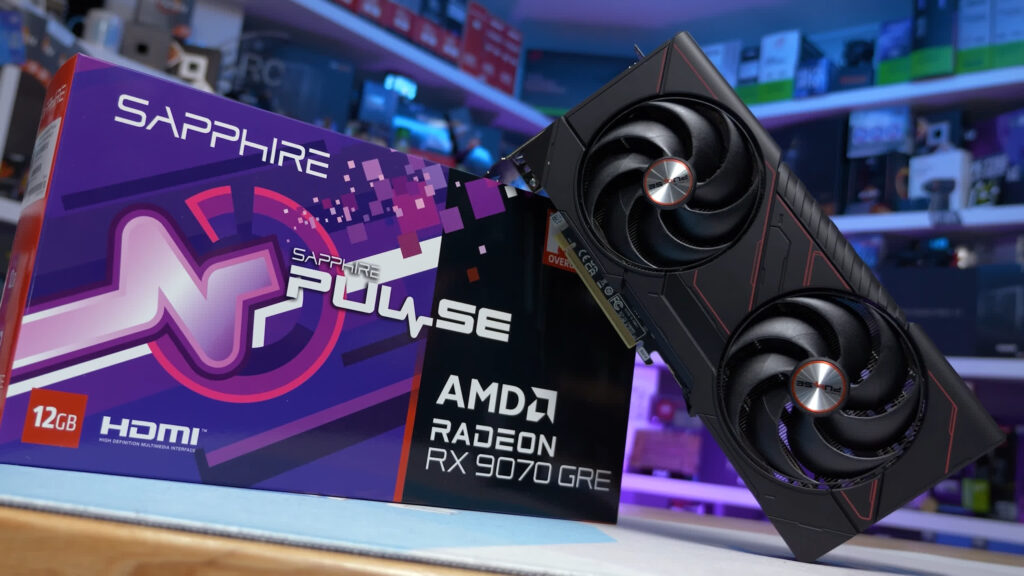
RX 9070 GRE vs RX 9070 and RTX 5070: Performance, Hardware Differences, and Real-World Comparison
The RX 9070 GRE is essentially a scaled-down version of the RX 9070, positioned to target a lower price bracket while maintaining strong upper-midrange performance.
Key differences include reduced compute units (about 10–20% fewer cores), slightly lower boost clock ceilings, narrower memory bandwidth, lower power consumption, and reduced ray tracing throughput. These adjustments define its role as a more efficient and affordable alternative rather than a full-performance flagship-tier GPU.
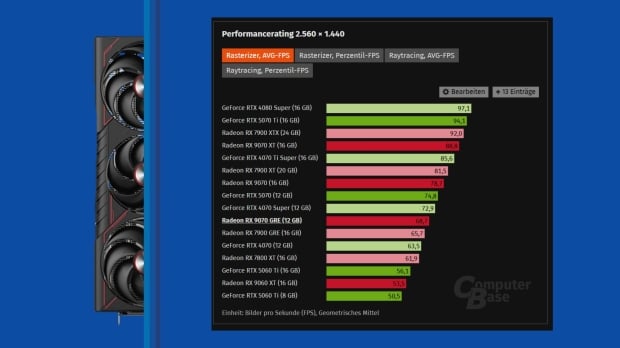
In gaming performance, the RX 9070 GRE delivers roughly 85–90% of RX 9070 rasterization performance and around 80–85% of its ray tracing performance, while offering better efficiency per dollar. This makes it especially appealing for gamers who prioritize value over absolute top-tier output.
When compared directly to the RTX 5070, the competitive landscape becomes more balanced depending on workload type. In 1080p raster gaming, the RX 9070 GRE is slightly ahead or effectively equal, while at 1440p raster workloads it remains highly competitive with only small margin differences between the two. At 4K, the RTX 5070 may edge ahead due to stronger upscaling support and optimization advantages from DLSS technologies, while ray tracing performance clearly favors NVIDIA due to more mature RT cores.
Upscaling also becomes a major differentiator, with FSR 4 competing against DLSS 3.5/4, and often influencing real-world performance outcomes depending on game support and implementation. In practice, competitive esports titles tend to favor AMD due to raw FPS consistency, while cinematic AAA ray-traced games tend to favor NVIDIA. Overall value can swing toward AMD if MSRP pricing remains competitive.

RX 9070 GRE Gaming Performance Breakdown: 1440p, 1080p, and 4K Benchmarks + Ray Tracing Analysis
At 1440p resolution, the RX 9070 GRE is expected to reach its optimal performance range, functioning as a high-refresh 1440p gaming GPU.
Estimated raster performance at 1440p (Ultra settings):
- Cyberpunk 2077 (no RT): 95–120 FPS
- Starfield: 85–105 FPS
- Hogwarts Legacy: 90–115 FPS
- Call of Duty: Modern Warfare III: 140–170 FPS
- Assassin’s Creed Shadows (estimated): 80–100 FPS
With FSR enabled, the GPU sees an average uplift of around 25–45% FPS depending on mode, while frame generation can significantly increase perceived smoothness, sometimes doubling frame rates in supported titles. This firmly positions the RX 9070 GRE as a strong 1440p high-refresh-rate GPU.
At 1080p, performance becomes heavily CPU-limited in many scenarios, but the GPU still delivers extremely high frame rates. Esports titles such as Valorant, CS2, and Fortnite Performance Mode can exceed 250, 400+ FPS, while AAA games on high settings typically range from 120, 200 FPS. CPU-heavy simulation titles generally sit around 100–160 FPS. This makes the card ideal for 240Hz 1080p competitive setups and streaming workloads, although it may be overkill for users who only play less demanding games.
At 4K, the RX 9070 GRE begins to show its limitations. AAA titles on ultra settings typically deliver 45, 65 FPS, while optimized games may reach 60, 75 FPS. Heavy ray tracing scenarios can drop to 30–45 FPS. With FSR 4 enabled, performance mode scaling can push results to 60–90 FPS depending on the title, and frame generation may raise perceived gameplay to 80–120 FPS. However, 4K remains playable rather than ideal without upscaling technologies.
Ray tracing performance sees noticeable improvement over RDNA 3, but NVIDIA still maintains a lead. The RX 9070 GRE sits in a mid-tier ray tracing category, while the RTX 5070 is estimated to be 15–30% faster in RT-heavy workloads. In demanding titles such as Cyberpunk 2077 RT Overdrive, Alan Wake 2, and Metro Exodus Enhanced Edition, AMD can deliver playable performance, but typically relies on FSR and optimized settings to maintain smooth frame rates.
RX 9070 GRE 12GB VRAM, Efficiency, and Cooling Analysis: Future-Proofing, Thermals, and Power Behavior
12GB VRAM is increasingly becoming the new baseline for modern gaming, and the RX 9070 GRE fits squarely into that standard for upper-midrange GPUs.
In terms of advantages, the 12GB buffer is sufficient for 1080p and 1440p gaming at ultra texture settings, handling most modern AAA titles comfortably without immediate bottlenecking. It also provides a reasonable level of future-proofing for the next 2–3 years within the midrange segment, especially as game asset sizes and texture demands continue to grow.
However, there are clear limitations. At 4K resolution with ultra textures, future titles may exceed available VRAM, leading to potential performance constraints or texture streaming issues. Heavily modded games can also push memory usage beyond comfortable limits, and ray tracing workloads tend to increase VRAM pressure further. As a result, while 12GB is adequate for current needs, it is not considered luxury-tier future-proofing for long-term 4K gaming.
On the efficiency side, RDNA 4 continues AMD’s focus on power optimization. The RX 9070 GRE is expected to draw around 200–230W under load, with idle power consumption dropping to low single-digit watts. Gaming temperatures typically range between 60–75°C depending on the cooling solution, and noise levels remain generally quiet on well-designed triple-fan models. Thermal performance is expected to be stable overall, though actual results will depend heavily on AIB partner cooling designs and factory tuning.

RX 9070 GRE Features, Value, and Overclocking: FSR 4 Performance, Pricing Analysis, and Competitive Alternatives
FSR 4 plays a central role in the RX 9070 GRE’s performance positioning, significantly improving its competitiveness in high-refresh gaming scenarios. Compared to previous versions, FSR 4 delivers higher image quality than FSR 3, with improved temporal reconstruction, better motion clarity, and reduced ghosting artifacts. Frame generation also has a major impact on perceived performance, with a 60 FPS base potentially scaling to 100–140 FPS and a 90 FPS base reaching 150–200 FPS in supported titles. This makes the GPU far more capable in demanding modern games when upscaling and frame generation are enabled.
From a pricing perspective, the RX 9070 GRE is expected to launch around a $549 MSRP, placing it in a highly competitive value bracket. Its strengths include strong 1440p raster performance, efficient power consumption, competitive performance versus NVIDIA in non-ray-traced workloads, and a solid 12GB VRAM buffer. However, it is weaker in ray tracing compared to NVIDIA alternatives, relies more heavily on FSR for 4K viability, and may overlap in pricing with discounted RX 9060 or RX 9070 models depending on market conditions. Overall, it represents strong value if pricing remains under $600.
In terms of alternatives, the closest competitors include the RTX 5070, which offers stronger ray tracing and DLSS advantages, the higher-tier RX 9070 for users wanting more raw performance, Intel’s Arc Battlemage high-end GPUs as value-oriented alternatives, and the RX 9060 XT for budget-conscious buyers. The final choice depends heavily on priorities: NVIDIA leads in ray tracing, AMD offers better raster performance per dollar, and Intel or lower-tier AMD options serve tighter budgets.
Overclocking potential on the RX 9070 GRE is expected to be moderate, consistent with typical RDNA 4 behavior. Users can expect around a 5, 10% increase in core clocks, 8, 12% gains from VRAM tuning, and overall real-world FPS improvements in the range of 5, 12%. However, gains are limited by power ceilings, thermal constraints in smaller builds, and diminishing returns beyond mild tuning. In practice, overclocking is safe and stable but not transformative enough to significantly change the GPU’s performance tier.

Frequently Asked Questions (FAQs)
- Who should buy it?
The RX 9070 GRE is best suited for gamers who want strong high-refresh 1440p performance at a midrange price point. It is ideal for users who prioritize smooth raster performance and efficiency over maximum ray tracing performance or premium-tier 4K gaming capability. - Is the RX 9070 GRE good for 1440p gaming?
Yes, the RX 9070 GRE is primarily designed for high-refresh 1440p gaming and is expected to perform very well in this resolution. Most modern AAA titles should run smoothly on high or ultra settings, and when paired with technologies like FSR, it can maintain high frame rates suitable for 144Hz to 240Hz monitors depending on the game. - Does the RX 9070 GRE support ray tracing?
Yes, it does support ray tracing, but performance is considered midrange compared to NVIDIA alternatives. This means it can handle ray-traced effects in many games, but you will often need to adjust settings or rely on upscaling technologies like FSR to maintain smooth performance in demanding titles. - How much VRAM does it have?
It is expected to feature 12GB of GDDR6 VRAM. This amount is currently the standard for upper-midrange GPUs and is sufficient for most 1080p and 1440p gaming workloads, including high-resolution textures in modern AAA games. - Is RX 9070 GRE better than RTX 5070?
It depends on what you value most. The RX 9070 GRE generally performs better or similarly in rasterized (non-ray-traced) gaming, which is the most common workload in games. However, the RTX 5070 has an advantage in ray tracing performance and benefits from NVIDIA’s DLSS technology, which can provide better performance and image quality in supported titles. - Can it run 4K games?
Yes, it can run 4K games, but it is not primarily designed for that resolution. Most AAA games at 4K will require reduced settings or the use of FSR upscaling to maintain playable frame rates, especially in more demanding modern titles. - What is the power consumption?
The RX 9070 GRE is expected to consume around 200–230W under load. This is relatively efficient for its performance class and means it can run comfortably in most midrange PC builds without requiring extremely high-capacity power supplies. - Is FSR 4 supported?
Yes, it is expected to support AMD’s FSR 4 upscaling technology. This improves performance significantly by boosting frame rates while maintaining better image quality than previous FSR versions, especially in motion-heavy or high-resolution scenarios. - Is 12GB VRAM enough for 2026 games?
Yes, 12GB VRAM is generally enough for 1440p gaming in 2026 and should remain sufficient for the next few years. However, at 4K resolution with ultra textures or in heavily modded games, VRAM usage may approach or exceed limits, making it less ideal for long-term 4K ultra gaming. - Is it good for streaming?
Yes, it is well-suited for streaming. The GPU is expected to include modern hardware encoding support, allowing smooth gameplay while streaming at high quality. Combined with its strong overall performance, it can handle gaming and broadcasting simultaneously without major performance loss in most cases.
Conclusion
The RX 9070 GRE represents AMD’s continued refinement of its midrange GPU strategy, combining RDNA 4 efficiency improvements with strong raster performance and competitive pricing potential. While it does not fully surpass NVIDIA in ray tracing or AI-driven rendering technologies, it delivers excellent value for 1440p gaming and remains a compelling choice for performance-focused users who prioritize frame rates over graphical overhead features.
Sources and Citations
- AMD RDNA architecture documentation
https://www.amd.com/en/technologies/rdna - NVIDIA GeForce RTX specifications
https://www.nvidia.com/en-us/geforce/graphics-cards/ - TechPowerUp GPU database
https://www.techpowerup.com/gpu-specs/ - TechPowerUp GPU review methodology
https://www.techpowerup.com/review/ - AnandTech graphics card reviews
https://www.anandtech.com/tag/gpus - Tom’s Hardware GPU benchmarks hierarchy
https://www.tomshardware.com/reviews/gpu-hierarchy,4388.html - Windows Central AI PC and GPU market coverage
https://www.windowscentral.com/tag/ai-pc - Jon Peddie Research graphics market reports
https://www.jonpeddie.com/ - Mercury Research market share reports
https://www.mercuryresearch.com/ - IDC PC and AI hardware market research
https://www.idc.com/ - Gartner semiconductor industry research
https://www.gartner.com/en/industries/semiconductors - IEEE computer graphics and GPU research
https://www.computer.org/technical-committees/visualization-and-graphics/
Recommended
- Arena Breakout: Infinite X Cyberpunk 2077 Collaboration Return Trailer, Full Breakdown, Rewards, Skins, and Everything We Know
- Resident Evil Requiem is likely the series’ biggest launch ever — 5 million units sold in under a week
- Sony Banned The Jesus Game Right Before Easter: Why “Jesus Simulator” Was Delisted From the PlayStation Store
- Who is GameStop CEO Ryan Cohen and Why He is Trying to Buy EBay
- How to Make Stylized Anime Hair Naturally in Blender
- Duet Night Abyss Apologizes After Malware-Infected Launcher Update, Offers Free Loot Boxes (10 Pulls)
- Pokémon Pokopia Update 1.0.4 Expands Ability to Move Pokémon Centers During In-Game Events
- Get A Free Fortnite Skin And Car During Rocket League Crossover Event (Rivals & Rockets) — How to Unlock Dueling Dragons Jackie + Havoc Car Body
- Euphoria Season 3 Review: First Reactions to HBO’s Time-Jump Return
- Family Guy Stewie Spinoff Series Greenlit for 2 Seasons: Release Date, Plot, Cast, and Everything We Know



































































































