





In This Article (15 sections)
How to Unlock Avatar State Aang and Nightmare Korra in Avatar Legends: The Fighting Game
Avatar Legends: The Fighting Game: Avatar State Aang And Nightmare Korra Unlock Guide explains the two confirmed ways to add the game’s secret fighters to the roster. Players can either unlock both characters instantly by entering a hidden main-menu cheat code or unlock each one naturally by progressing through Story Mode. Avatar State Aang and Nightmare Korra are separate playable characters rather than alternate costumes, each featuring unique attacks, movement options, special abilities, and distinct playstyles. Avatar State Aang specializes in elemental projectiles, aerial mobility, and battlefield control, while Nightmare Korra relies on phantom movement and teleportation to create unpredictable offensive pressure.
The game features 12 playable characters when both secret fighters are unlocked. It is a hand-drawn 2D fighting game featuring one-on-one battles, rollback netcode, cross-platform multiplayer, Story Mode, Arcade Mode, Local VS, Training Mode, and an unlockable gallery. It launched on PlayStation 5, Nintendo Switch, and PC on July 23, 2026, with the Xbox version releasing later on September 3, 2026.
There are two confirmed methods for unlocking Avatar State Aang and Nightmare Korra:
- Story Mode: Progress through the campaign and complete each character’s required battle.
- ATLA Cheat Code: Enter a hidden menu sequence to unlock both fighters immediately.
Nightmare Korra is unlocked first through Story Mode. Players gain permanent access to her after completing “A Cold Welcome” in Chapter 6. Avatar State Aang is unlocked later by reaching Chapter 11 and completing “The Inner Battle” (battle 11-1). Once the battle and its result sequence finish, he becomes available in all supported game modes. Players do not need to complete all 27 Story Mode chapters to unlock either character.
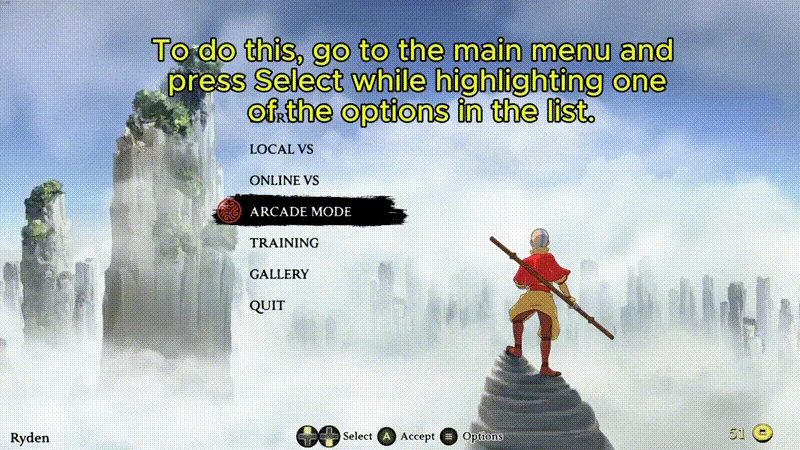
The faster method is the hidden ATLA menu code, which unlocks both fighters in seconds without requiring Story Mode progress. From the main menu, highlight the following options in order:
- Arcade
- Training
- Local VS
- Arcade
At each highlighted menu option, press the platform’s Select-equivalent button rather than the normal confirm button:
- PS5: DualSense touchpad
- Xbox-style controllers: View/Back button
- PC (default controls): Backspace
The sequence is commonly summarized as ATLA because the initials of the highlighted menu options spell the familiar Avatar abbreviation. The complete input is:
- Arcade + Select
- Training + Select
- Local VS + Select
- Arcade + Select
Do not open the highlighted game mode by pressing the normal confirm button, as doing so will interrupt the sequence. Timing also matters. Community testing and published guides indicate there should be less than two seconds between each input, making a smooth, continuous sequence more reliable than pausing between steps.
If entered correctly, the game plays a confirmation sound. Both Avatar State Aang and Nightmare Korra are unlocked simultaneously, appearing as separate playable roster entries. Players who have not already earned it should also receive the “A New Challenger Approaches!” achievement or trophy. The code only changes each character’s locked status—it does not alter Story Mode progress, skip chapters, or affect campaign completion—so players can still experience the story normally afterward.
Players who prefer to unlock Avatar State Aang through Story Mode must reach Chapter 11 and complete “The Inner Battle” (battle 11-1). During the encounter, the game temporarily allows players to control Avatar State Aang, introducing his enhanced movement, elemental attacks, and Avatar State abilities. After the battle concludes and the game records the result, he becomes permanently selectable outside Story Mode.
To avoid losing progress, players should wait for the results screen and autosave process to finish before exiting Story Mode. Closing the game during the transition immediately after the battle may prevent the unlock from being saved correctly.
The primary drawback of the Story Mode method is the time required to reach Chapter 11, since players must complete all preceding story encounters. However, they do not need to finish the remainder of the campaign after unlocking Avatar State Aang. Players focused on competitive play, Training Mode, or experimenting with the full roster will save considerable time by using the ATLA cheat code instead, while those seeking a spoiler-free experience may prefer unlocking the character naturally through the campaign, where the story also provides narrative context for his transformation.
How to Unlock Avatar State Aang and Nightmare Korra Fast (Story Mode and ATLA Cheat Code)
There are two ways to unlock the game’s secret characters, Avatar State Aang and Nightmare Korra. You can unlock them naturally by progressing through Story Mode or unlock both almost instantly by entering the hidden ATLA cheat code from the main menu.
Nightmare Korra is unlocked by reaching Chapter 6 of Story Mode and completing the chapter’s first battle, “A Cold Welcome.” During this encounter, players temporarily control Nightmare Korra, providing an introduction to her unique movement and phantom-based abilities. Once the battle is completed and the game transitions to the results or next story sequence, Nightmare Korra is permanently added to the playable roster. She can then be used in Training Mode, Local VS, and other game modes outside the campaign.
Because her unlock occurs in Chapter 6, Nightmare Korra becomes available much earlier than Avatar State Aang during a normal Story Mode playthrough. Players who prefer not to use the cheat code can unlock Korra first, practice with her in Training Mode, and continue progressing toward Aang’s Chapter 11 unlock. The battle also serves as a useful tutorial for her unconventional playstyle, as she relies less on standard movement and jumping than most fighters. Instead, her teleport-based mobility allows her to reposition quickly, although careless movement can leave her vulnerable.
If you want immediate access to both secret characters, the fastest method is the hidden ATLA menu code. The entire process takes only a few seconds when performed correctly. From the main menu, keep the cursor on the menu options without opening them and press the platform’s Select-equivalent button in the following order:
- Arcade
- Training
- Local VS
- Arcade
The sequence spells ATLA, making it easy to remember. However, players are not entering the letters themselves. Instead, the game checks which menu option is highlighted each time the Select-equivalent button is pressed. If the correct four-option pattern is entered within the required time limit, both Avatar State Aang and Nightmare Korra are immediately unlocked.
It is important to use the same Select-equivalent button for all four inputs. On PS5, this is the touchpad click. On PC with the default keyboard controls, it is Backspace. On an Xbox-style controller connected to PC, it is the View/Back button (the button with two overlapping rectangles). Do not substitute these with the normal confirm button, such as Enter, A, or X, and do not allow any of the menu options to open.
The inputs must also be entered quickly, with less than two seconds between each button press. A reliable method is to move the cursor to the correct menu option and immediately press the Select-equivalent button before moving to the next one. Avoid pressing unnecessary buttons during the sequence, as an extra input can interrupt the pattern. If the attempt fails, return the cursor to Arcade, wait briefly so the sequence resets, and try again.
After the fourth input, listen for the confirmation sound. If the code is accepted, Avatar State Aang and Nightmare Korra will immediately be unlocked. Players who have not already earned it should also receive the “A New Challenger Approaches!” achievement or trophy. You can verify the unlock by opening Training Mode or any character-select screen and confirming that both fighters are now available.
Compared to reaching Chapter 11 through Story Mode, this method is dramatically faster and is especially useful for tournament preparation, local multiplayer, practicing character combos, testing movesets, or simply accessing the full launch roster before starting the campaign.
Avatar Legends Avatar State Aang and Nightmare Korra Unlock Code for PS5, Xbox, and PC
The Avatar Legends Avatar State Aang and Nightmare Korra unlock code uses the same menu sequence across every platform, but the required button depends on your controller or input device. The sequence must always be entered from the main menu by highlighting Arcade, Training, Local VS, and then Arcade again, pressing the correct Select-equivalent button at each destination. The four inputs should be completed quickly, with less than two seconds between each press.
PS5
On PS5, the code uses the DualSense touchpad button. Highlight Arcade and click the touchpad, move to Training and click it again, move to Local VS and click it a third time, then return to Arcade and click the touchpad for the fourth and final input.
The complete PS5 sequence is:
- Arcade + Touchpad
- Training + Touchpad
- Local VS + Touchpad
- Arcade + Touchpad
The touchpad must be physically clicked. Swiping across its surface will not register the input. Players should also avoid pressing Cross, as it normally confirms the highlighted mode and may open it instead of contributing to the unlock code.
PS5 players have independently confirmed that this touchpad sequence unlocks both Avatar State Aang and Nightmare Korra, and it can also trigger the “A New Challenger Approaches!” trophy. After hearing the confirmation sound, open the character select screen to verify that both fighters have been added as separate playable characters.
Xbox Controllers
On Xbox-style controllers, the code uses the View (also known as Back or Select on some controllers and software) button. On modern Xbox controllers, this is the small button with two overlapping rectangles located to the left of the Menu button.
The complete sequence is:
- Arcade + View
- Training + View
- Local VS + View
- Arcade + View
As with the PS5 version, the four button presses should be completed with less than two seconds between each input. Use the View/Back/Select-equivalent button rather than the A button, since A is the normal menu confirmation button and will not register the hidden code correctly.
As of July 31, 2026, the native Xbox version of Avatar Legends: The Fighting Game had not yet launched after being delayed from July 23 to September 3, 2026. These instructions are therefore intended for players using an Xbox controller with the PC version and are also expected to apply to the native Xbox release unless the menu controls change before launch.
If you use Steam Input, controller remapping software, or a third-party controller, verify that the View button has not been reassigned, as remapped controls may prevent the sequence from registering.
PC
On PC, the published default keyboard input is Backspace. Highlight each required menu option and press Backspace before moving to the next destination.
The complete keyboard sequence is:
- Arcade + Backspace
- Training + Backspace
- Local VS + Backspace
- Arcade + Backspace
Complete the sequence with less than two seconds between each press. Players using a DualSense controller on PC should use the touchpad, while those using an Xbox-style controller should use the View/Back button. Third-party gamepads should use whichever physical button is mapped to the game’s Select/View/Back command.
If Backspace does not work, check your control configuration. Custom keybindings, accessibility software, keyboard remapping tools, or controller profiles may have reassigned the game’s Select-equivalent input. Do not use the normal confirm key such as Enter or Space, since opening a menu interrupts the sequence. If that happens, return to the main menu and restart the code from the beginning.
After the fourth input, wait for the confirmation sound, then check the character roster. Both Avatar State Aang and Nightmare Korra should unlock together.
How to Fix the Avatar Legends Unlock Code Not Working
If the Avatar Legends unlock code is not working, the most common cause is using the wrong button. Every menu option must be paired with the Select-equivalent input for your platform rather than the normal confirm button. On PS5, use the touchpad click instead of Cross. On Xbox-style controllers, use View/Back instead of A. On PC, use Backspace by default instead of Enter.
Timing is another frequent issue. The complete sequence must be entered with less than two seconds between consecutive inputs. Even if the order is correct, pausing too long while navigating to Local VS or back to Arcade can cause the game to reject the sequence. Practicing the menu navigation before attempting the code can help.
Make sure the order is entered exactly as Arcade → Training → Local VS → Arcade. Local VS must always be the third destination, and Arcade must be both the first and last menu option. Similar modes, such as Online Versus, cannot replace Local VS.
The code only works from the main menu. It will not register if entered from character select, Story Mode, the pause menu, Options, or any submenu. If a game mode opens during the attempt, return to the main menu and restart the sequence.
Extra or accidental inputs can also invalidate the code. Press the Select-equivalent button only once at each destination, and avoid unnecessary directional inputs after highlighting a menu option. Faulty controllers, button chatter, or aggressive remapping profiles may cause unintended double inputs that break the sequence.
If you have customized your controls, verify that the required View, Back, touchpad, or Select command has not been reassigned by Steam Input, accessibility settings, controller software, or third-party hardware. Likewise, overlays from recording software, controller utilities, or platform launchers may intercept the required button for screenshots or shortcuts, so temporarily disabling those overlays can help.
You should also ensure you are signed into the correct user profile, since unlocked characters may be tied to the active save or account. After a successful attempt, the game will play a confirmation sound. If you hear the sound but do not receive a trophy notification, check the character roster first, as the trophy may have already been earned or platform notifications may be disabled.
Once both fighters appear on the character select screen, the unlock is intended to remain available for that saved profile, so the code does not need to be entered again. Allow the game to autosave before closing the application. If every step appears correct but the sequence still fails, restart the game, reconnect your controller if necessary, return to the main menu, and try the code again using a steady but fast rhythm to clear any temporary input issues.

Can You Unlock Avatar State Aang and Nightmare Korra Without Story Mode?
Yes. Avatar State Aang and Nightmare Korra can be unlocked without playing or completing Story Mode. The ATLA main-menu code immediately unlocks both characters when entered correctly.
The code is not merely a temporary character preview. Both fighters become available as normal roster selections, allowing players to use them in Training Mode and other supported battle modes. Published guides also report that the unlock remains applied, meaning the code does not need to be re-entered every time the game starts.
Using the code does not prevent players from experiencing the campaign. Story Mode remains playable from the beginning, and its chapters can still be completed in the normal order. The only major difference is that the two character rewards will already be present when their designated battles are reached.
This makes the cheat-code method suitable for players who want to avoid story spoilers while still accessing the entire competitive roster. It is also useful for local tournaments, multiplayer gatherings, secondary profiles, or situations where a fresh installation does not have completed story data.
Players who enjoy unlocking content through progression can ignore the code and obtain Nightmare Korra in Chapter 6 and Avatar State Aang in Chapter 11. Both methods lead to the same playable characters; the difference is whether the player values immediate access or campaign-based progression.
What Happens After Unlocking Avatar State Aang and Nightmare Korra?
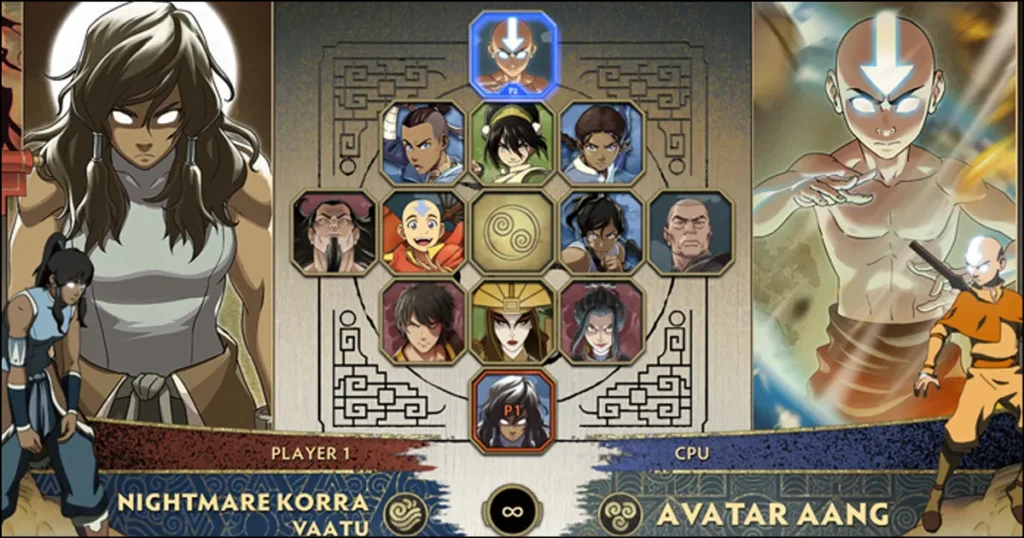
After the unlock is completed, Avatar State Aang and Nightmare Korra become separate entries on the character-select screen. They are not applied as costume changes to the standard versions of Aang and Korra.
Their addition brings the complete launch roster to 12 playable fighters. Official store listings identify 12 characters in the game, while the two secret variants account for the roster slots that are initially unavailable.
Both characters can be used outside Story Mode. Players can bring them into Training Mode to study their attacks, experiment with movement, and compare them with standard Aang and Korra. They can also be selected for compatible versus and arcade activities.
Unlocking both characters satisfies the condition for the “A New Challenger Approaches!” achievement or trophy. Its official description is to unlock Nightmare Korra and Avatar State Aang.
The game should play an audible confirmation when the ATLA code succeeds. However, the safest verification is to enter a character-select screen and look for both roster entries.
Players should not assume that the secret versions are universally stronger than their standard counterparts. Each has a specialized design. Avatar State Aang leans more heavily into elemental screen control and aerial branching attacks, while Nightmare Korra sacrifices conventional movement for phantom-based mobility and unusual approach patterns.
Avatar State Aang Moves, Abilities, and Fighting Style Explained
Avatar State Aang is a specialized version of Aang built around elemental attacks, aerial mobility, and control of the screen. He should be treated as an alternative character rather than a direct power upgrade to the standard Aang roster entry.
One of his defining changes is Avatar’s Ascension, which replaces the standard version’s Air Scooter. Avatar’s Ascension carries Aang into the air and can branch into different elemental actions. Early move descriptions identify options that include a rock volley, a fire projectile with an unusual travel path, and a water-based grab. These branches allow Aang to alter his response according to the opponent’s location and anticipated movement.
The rock option supports space control by placing a threatening elemental attack in the opponent’s path. The fire option can complicate movement because of its upward and returning trajectory. The water grab gives Aang a different kind of threat against opponents who expect him to rely entirely on projectiles.
Avatar State Aang’s broader strength is zoning. Early competitive descriptions characterize him as a dedicated screen-control fighter who can limit routes of approach with elemental attacks and multidirectional movement. His Flow and Harmonic Drift mobility help him adjust his aerial position, making his projectile patterns harder to challenge through a single predictable route.
Fire Fist is another important part of his ranged control. The attack allows him to threaten space without immediately committing to close-range offense. It can discourage opponents from advancing carelessly and create opportunities for Aang to reposition.
Avatar’s Wrath is identified as one of his powerful finishing tools and is associated with his Avatar’s Ascension offense. Players should learn when the move is guaranteed rather than using it as an unsupported gamble. The character is strongest when his elemental attacks have already restricted the opponent’s movement and made the next defensive choice easier to predict.
A practical Avatar State Aang strategy begins at the range where the opponent must respect his projectiles. Use elemental attacks to observe whether the opponent prefers jumping, blocking, retreating, or rushing forward. Once that habit becomes visible, select the Avatar’s Ascension branch that covers the likely response.
Players should avoid entering Avatar’s Ascension automatically every time they create distance. An opponent who recognizes the pattern may move underneath Aang, challenge the startup, or wait to punish his landing. The value of the stance comes from its multiple branches and the uncertainty they create.
Avatar State Aang can also change altitude and horizontal position in ways that complicate anti-air timing. This mobility is useful for escaping corners, changing the angle of an attack, and forcing the opponent to turn around. However, movement without an offensive purpose can surrender initiative. Aang still needs to place a projectile, threaten a grab, or establish a safe landing after repositioning.
Standard Aang may feel more straightforward for beginners because his familiar movement and balanced toolkit are easier to understand immediately. Avatar State Aang requires players to think about screen coverage, branch selection, aerial drift, and the relationship between one elemental attack and the next.
Training Mode is the best place to study each Avatar’s Ascension follow-up separately. Practice the rock volley, fire attack, and water grab against different defensive recordings. Then learn which branch reaches a grounded opponent, catches movement, or punishes passive blocking.
The central principle is to make the opponent navigate Aang’s elemental threats before they can begin their own offense. When played effectively, Avatar State Aang does not simply throw projectiles. He closes specific lanes, watches how the opponent reacts, and converts the forced response into his next attack.

Nightmare Korra Moves, Phantom Abilities, and Fighting Style Explained
Nightmare Korra is one of the most unconventional characters in Avatar Legends: The Fighting Game. Her design revolves around phantom movement, sudden teleports, unusual positioning, and attacks that can begin from locations the opponent does not expect.
She is not an automatically superior version of standard Korra. The regular character has a more traditional, balanced toolkit and an Avatar State-related mechanic. Nightmare Korra changes the fundamental way the player navigates the arena, creating a high-risk, high-reward style that demands accurate movement and strong awareness.
Early descriptions emphasize that Nightmare Korra moves extensively through teleports. Instead of relying only on standard walking, dashing, or jumping, she can disappear and reappear to alter her position. This makes it difficult for an opponent to determine where an attack will originate, but it can also make Korra vulnerable when the player teleports predictably.
Named techniques shown in launch-era move information include Phantom Step, Ignition Step, Phantom Fall, and Arctic Surge. Together, these abilities reflect her combination of supernatural movement and elemental offense.
Phantom Step is closely associated with her teleport-centered positioning. It can help her change sides, escape a threatened area, or approach from an unexpected direction. The move’s strategic value depends on making the destination difficult to anticipate.
Ignition Step supports aggressive movement and mix-up opportunities. Competitive move discussions have noted that Nightmare Korra can create pressure after Ignition Step, particularly when the opponent is uncertain whether to defend against an attack, throw, or low option.
Phantom Fall contributes to her airborne or descending movement pattern. It reinforces the need to watch both horizontal and vertical space when defending against her. An opponent who focuses only on the ground may be caught by a sudden change in height or an attack delivered after a phantom reposition.
Arctic Surge represents the more directly offensive side of Nightmare Korra’s toolkit. It gives her a named elemental special to combine with her teleport approaches, although its effectiveness still depends on spacing and timing rather than repeated use without preparation.
Nightmare Korra players should first learn where each teleport places the character. A move that appears confusing to the opponent can be equally confusing to an inexperienced user. Enter Training Mode, mark Korra’s starting position, and repeat each movement option until its direction and recovery become predictable to the player.
The next step is learning to disguise intent. Teleporting behind the opponent every time may work briefly, but the pattern becomes punishable. Alternate between crossing behind, remaining on the same side, changing height, approaching with Ignition Step, and waiting for the opponent to commit.
Her fast low attack is valuable in these situations because teleport movement encourages opponents to stand and watch for an overhead or side-switching attack. A low option can punish a defender who focuses exclusively on reacting to Korra’s reappearance. Competitive notes specifically identify mix-up opportunities after Air Teleport or Ignition Step-related situations.
Nightmare Korra also benefits from psychological pressure. The opponent may hesitate because they do not know whether she will appear in front, behind, above, or at a safer distance. That hesitation can create time for Korra to begin offense. However, the player should not mistake confusion for guaranteed safety. Teleports can still be challenged or punished when used at predictable times.
Defensively, Nightmare Korra can use phantom movement to escape positions where a standard character might need to block. This does not mean she can ignore pressure. An opponent who anticipates the exit location may follow the teleport and punish the recovery.
The best Nightmare Korra players will combine conventional fighting-game fundamentals with her unusual mobility. Spacing, blocking, throw awareness, hit confirmation, and resource management remain important. Her phantom abilities add uncertainty, but they do not replace those fundamentals.
Compared with Avatar State Aang, Nightmare Korra is less focused on filling the screen with layered projectiles. Her strength is forcing the opponent to repeatedly reassess her location. Aang controls where the opponent can move, while Nightmare Korra changes where the attack is coming from.
10 FAQ Questions and Answers
- What is the cheat code for Avatar State Aang and Nightmare Korra? The code is Arcade, Training, Local VS, and Arcade. While highlighting each menu option, press the platform’s Select-equivalent button. Use the DualSense touchpad on PS5, the View/Back button on an Xbox-style controller, or Backspace with the published default PC keyboard controls. Complete the sequence quickly, leaving less than two seconds between each input. If entered correctly, a confirmation sound should play after the fourth input, and both characters will be unlocked immediately.
- Why is the Avatar Legends unlock code called the ATLA code? The code is called ATLA because the menu sequence spells the abbreviation: A stands for Arcade, T stands for Training, L stands for Local VS, and the final A stands for Arcade. The name is also a reference to Avatar: The Last Airbender, which is commonly abbreviated as ATLA. This makes the code much easier for players to remember than a random sequence of menu options.
- Do I need to finish Story Mode to unlock both characters? No. The hidden main-menu code unlocks Avatar State Aang and Nightmare Korra immediately without requiring any Story Mode progress. You can use them in supported game modes right away. However, players who prefer unlocking characters through normal gameplay can still obtain Nightmare Korra in Chapter 6 and Avatar State Aang in Chapter 11 by completing their respective Story Mode battles.
- What Story Mode chapter unlocks Nightmare Korra? Nightmare Korra is unlocked during Chapter 6. To earn her permanently, you must complete the first battle in the chapter, titled “A Cold Welcome.” During this fight, you control Nightmare Korra, and once the battle ends successfully, she becomes available as a selectable character in other supported game modes. Simply reaching Chapter 6 without clearing the battle will not unlock her.
- What Story Mode chapter unlocks Avatar State Aang? Avatar State Aang is unlocked during Chapter 11 by completing “The Inner Battle” (Battle 11-1). Players control this version of Aang during the encounter, and after finishing the battle and viewing the results screen, he is permanently added to the roster. You do not need to complete the remaining Story Mode chapters to unlock him.
- Which button enters the unlock code on PS5? PS5 players must click the DualSense touchpad at each step of the sequence. Highlight Arcade, click the touchpad, then repeat the process on Training, Local VS, and Arcade. Avoid pressing the Cross (X) button, as it will usually launch the highlighted mode instead of registering the hidden code. Timing also matters, so keep the inputs under two seconds apart.
- Which button enters the unlock code on PC? The reported default keyboard input is Backspace. Press Backspace while highlighting Arcade, Training, Local VS, and Arcade in that order. If you’re using a controller on PC, use its Select-equivalent input instead, such as the DualSense touchpad or the Xbox View button. If you’ve changed your controls, check your input settings to confirm the correct button before entering the sequence.
- What achievement unlocks with Avatar State Aang and Nightmare Korra? Unlocking both fighters satisfies the requirement for “A New Challenger Approaches!” The achievement or trophy is awarded after both Nightmare Korra and Avatar State Aang have been unlocked on your profile. If you use the cheat code before earning them through Story Mode, the achievement should unlock automatically after the successful code entry, provided it hasn’t already been earned.
- Are Avatar State Aang and Nightmare Korra only cosmetic skins? No. They are fully separate playable roster characters, not simple cosmetic skins. Each has unique moves, animations, and gameplay mechanics that distinguish them from their standard versions. Avatar State Aang specializes in elemental screen control, aerial mobility, and Avatar’s Ascension abilities, while Nightmare Korra focuses on teleportation, phantom steps, side switches, and unpredictable movement to create aggressive mix-up opportunities.
- Does the code unlock both characters permanently? Yes. Once the ATLA code is entered correctly, Avatar State Aang and Nightmare Korra remain unlocked for that saved profile, so the code does not need to be entered again whenever the game starts. After hearing the confirmation sound, verify that both fighters appear on the character-select screen and allow the game to autosave before closing it.

Conclusion
Avatar State Aang and Nightmare Korra can be unlocked either through Story Mode progression or with the hidden ATLA main-menu code. Nightmare Korra is earned by completing “A Cold Welcome,” the first battle of Chapter 6. Avatar State Aang is earned later by completing “The Inner Battle,” identified as battle 11-1.
The fastest method is to highlight Arcade, Training, Local VS, and Arcade while pressing the Select-equivalent button at each stop. Use the touchpad on PS5, View or Back on an Xbox-style controller, or Backspace with the default PC keyboard configuration. The inputs must be entered rapidly, with less than two seconds between each one.
A successful code unlocks both fighters, plays a confirmation sound, and can award the “A New Challenger Approaches!” achievement or trophy. The characters then become separate roster entries rather than cosmetic variations of standard Aang and Korra.
Avatar State Aang is best suited to players who enjoy projectiles, elemental space control, aerial branching attacks, and deliberate zoning. Nightmare Korra is designed for players who prefer teleportation, confusing movement, sudden side changes, and high-risk offensive pressure.
Players who encounter problems should verify the menu order, use Select rather than confirm, check their controller mapping, and enter the sequence more quickly. Once both fighters appear on character select, the complete 12-character launch roster is ready for Training Mode, local competition, and online play.
Sources and Citations
- Steam: Avatar Legends: The Fighting Game
Confirms Gameplay Group International as the developer; PM Studios, Inc. and Paramount Games as publishers; the July 23, 2026 release; hand-drawn 2D animation; rollback netcode; cross-play; offline and online Versus, Story, Arcade, Training, and Art Gallery modes; and the 12-character launch roster. (Steam Store) - PlayStation Store: Avatar Legends: The Fighting Game
Confirms the PS5 edition, PM Studios as publisher, July 23 release date, 12 playable characters, hand-drawn presentation, Story, Arcade, Training, Spectator, offline and online play, rollback netcode, cross-play, lobbies, replays, and ranked and casual matches. (PlayStation Store) - Nintendo: Avatar Legends: The Fighting Game
Confirms the Nintendo Switch edition, PM Studios as publisher, July 23 release date, 12-character roster, hand-drawn 2D animation, supported modes, one-to-two-player local play, and two-player online play. (Nintendo Co., Ltd.)- Important cross-play qualification: Nintendo’s store description uses the general cross-platform-play marketing copy, but the launch statement reproduced by Gematsu says that Nintendo Switch cross-play was not available at launch and would be added later. Cross-play should therefore not be described as a confirmed Switch launch feature. (Gematsu)
- Xbox Delay Report
- Gematsu: Avatar Legends for Xbox Series Delayed to September 3
Confirms that the Xbox Series version moved from the planned July 23, 2026 launch to September 3, 2026, owing to what the developer described as unforeseen circumstances involving “a backend feature.” It also confirms that the PS5, Switch, and Steam versions retained their July 23 date. (Gematsu) - Story Unlock Requirements and Main-Menu Code
- Gematsu: Avatar Legends for Xbox Series Delayed to September 3
- Prima Games: How to Unlock Avatar Aang and Nightmare Korra
This is the strongest single source for the complete unlock information. It confirms:- Nightmare Korra: complete Chapter 6, “A Cold Welcome” (6-1).
- Avatar State Aang: complete Chapter 11, “The Inner Battle” (11-1).
- Both characters become playable in the game’s other modes.
- The main-menu sequence is Arcade, Training, Local VS, Arcade, spelling ATLA.
- Press View on Xbox, Backspace on PC, or the touchpad on PlayStation at each menu selection.
- A successful entry produces a confirmation sound and unlocks both characters immediately. (Prima Games)
- Steam Community Discovery and Published Guide
- Steam Discussion: Unlock Avatar Aang and Nightmare Korra Early
This is the original community discovery credited to SingRealSongs. It records the Arcade, Training, Local VS, Arcade sequence; explains the ATLA mnemonic; says there must be less than two seconds between each input; identifies Backspace for keyboard; and identifies the Xbox Back/View button, described by another player as the button with two overlapping squares. (Steam Community) - Steam Guide: Unlock Code for Nightmare Korra and Avatar Aang
The published Steam guide repeats the four-menu ATLA sequence, the fewer-than-two-seconds timing requirement, the confirmation sound, and the achievement awarded when the characters are successfully unlocked. (Steam Community) - The modern Xbox button is officially called View, while older players and some community posts still call it Back. These names refer to the same left-side menu button represented by two overlapping rectangles.
- Steam Discussion: Unlock Avatar Aang and Nightmare Korra Early
- Trophy and Achievement Records
- PSNProfiles: “A New Challenger Approaches!”
Confirms the exact trophy name, “A New Challenger Approaches!”, and its requirement: “Unlock Nightmare Korra and Avatar State Aang.” (PSNProfiles) - Official Steam Global Achievements
Confirms that “A New Challenger Approaches!” is part of the game’s official 42-achievement list. Steam hides the description on the global page because it is treated as a hidden achievement. (Steam Community) - Public Steam Achievement Record Showing the Requirement
A public unlocked-achievement record exposes the hidden Steam description as “Unlock Nightmare Korra and Avatar State Aang.” (Steam Community) - The correct title is “A New Challenger Approaches!” Player.One incorrectly calls it “Here Comes A New Challenger!” in part of its article, so PSNProfiles and the Steam records should be used for the exact wording. (Player One)
- PSNProfiles: “A New Challenger Approaches!”
- Avatar State Aang and Nightmare Korra Move References
- Esports.gg: Support Characters and Their Effects
Supplies additional competitive context for both unlockable fighters. It documents Avatar State Aang’s elemental support enhancements and Nightmare Korra’s additional combo, escape, chip-damage, and enhanced-special options. (Esports.gg) - Player.One: How to Unlock Nightmare Korra and Avatar State Aang
Describes Nightmare Korra’s Phantom abilities, battlefield teleportation, unpredictable movement, and mobility-oriented playstyle. It also describes Avatar State Aang’s elemental space control, Avatar’s Ascension, the rock-volley, returning fireball and water-grab branches, Fire Fist, and Avatar’s Wrath. (Player One) - TheGamer: Avatar State Aang and Nightmare Korra Unlock Guide
Covers the Story Mode unlocks and describes Nightmare Korra’s Phantom teleportation abilities and Avatar State Aang’s modified Air Scooter, renamed Avatar’s Ascension, along with his elemental follow-ups and Avatar’s Wrath finisher. (The Gamer) - SuperCombo Wiki: Avatar State Aang Move List
Community-maintained move data confirms names including Fire Fist, Avatar’s Ascension, its EX version, and Avatar’s Wrath. It also characterizes Aang’s projectile use as potentially committal zoning that can be punished when poorly placed. (SuperCombo Wiki) - SuperCombo Wiki: Nightmare Korra Move List
Confirms that Nightmare Korra’s Flow movements are teleports and lists named techniques including Phantom Step, Phantom Retreat, and Phantom Blink. The resource also describes teleport invulnerability while she is invisible and cross-up potential from her movement. (SuperCombo Wiki) - Esports.gg: Avatar Legends Character Playstyles
Provides an early competitive overview. It describes Avatar State Aang as a high-risk, high-damage multi-element fighter and Nightmare Korra as a low-health, high-damage character whose teleports replace conventional movement. (Esports.gg) - Final Weapon: Character Overview Guide
Describes Nightmare Korra as a technically demanding rushdown character whose unusual movement creates layers of unpredictability, while also discussing how her support choices expand offensive pressure and combo routes. (Final Weapon)
- Esports.gg: Support Characters and Their Effects
Recommendations
- Silent Hill: Townfall Preorders Now Available at Amazon and Best Buy Explained
- Marathon Surpasses Crimson Desert in U.S. Revenue for March, According to New Analytics Data
- Gears of War Movie Director Shares Major Netflix Update
- Xbox Denies Last-Minute Gears of War: E-Day PS5 Cancellation Claims Amid Growing Evidence of Cut Release
- Everything at PlayStation’s Big Summer State of Play Showcase 2026: Full Game List and Highlights
- Yu-Gi-Oh Tournament Postponed Because Players Were Too Smelly: What Happened at the Oregon Card Shop
- Persona 5 Royal Confidant Guide: Death, Tae Takemi Full Rank Guide, Unlock Requirements, Best Choices & Rewards Explained
- Halo 2 and Halo 3 Remakes Are Coming, Report Says: Leak Details, Release Window Rumors, and What Halo Studios Is Building Next
- Battlefield 6 Helped EA Achieve the Highest Annual Revenue in the Company’s History: Inside EA’s FY26 Record Year
- DigDigDrill Guide: Best Drills, Enchantments, Blueprint Crafting, and Fast Progression to Floor 999



































































































