








In This Article (8 sections)
Balitti’s Hollow Worlds, Campaign, and Manga-Inspired Presentation
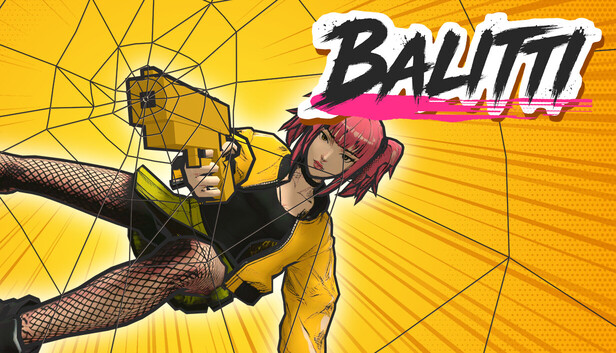
Balitti is an upcoming first-person movement shooter developed and published by sembask using Godot. Steam classifies it under Action and Indie, with combat built around shooting, rapid traversal, and an end-of-level style grade. The pistol and rope-mounted kunai are its most prominently advertised tools, combining direct fire with the ability to change position quickly. Its opening campaign stage takes place inside a hollow planet, where gravity pulls players outward toward the shell. Looking across the interior reveals terrain overhead that becomes the ground when reached from the other side. The arena itself stays fixed while the player’s body and first-person camera adjust to the changing direction of gravity.
The developer’s campaign description extends beyond that opening sphere to floating platforms occupied by alien enemies. It also describes a desert canyon with sandworms and a spherical temple containing a god-king seated on a throne. Steam advertises multiple worlds with their own physics and gravity. The hollow planet therefore introduces one environment whose rules players can learn, rather than establishing that every stage works identically. Later settings suggest different uses for the same movement tools, although their individual mechanics remain less fully described than those of the opening level.
Balitti’s manga ink aesthetic uses hatching and loose linework, according to its Steam description. Repeated strokes suggest shading and depth, giving surfaces a drawn appearance as players see them underfoot, beside them, or across the interior. Gold weak points and ground attack warnings provide more direct gameplay information within that presentation. Weak points identify valuable shooting opportunities, while ground markings help players judge where an attack is about to land. Their readability matters when aiming and movement occur alongside changes in camera orientation. The developer describes the music as ’90s arcade-style, matching a structure built around graded runs and repeated attempts. Specific tracks and soundtrack-release plans remain unspecified.

Radial Gravity, Godot Physics, and Camera Orientation
Inside Balitti’s hollow planet, gravity points from the center through the player’s position and outward toward the shell. Local “up” points in the opposite direction, back into the open interior. Sembask describes the gravity-strength multiplier as (d/R)1.5(d/R)^{1.5}, where dd is the distance from the center and RR is the sphere’s radius. At the shell, the multiplier is one, giving full strength. Halfway from the center to the shell, it is approximately 35%, while a quarter of the way out it is 12.5%. These percentages describe the strength of the field, not the character’s movement speed. Walking around the shell mainly changes gravity’s direction, while traveling inward substantially reduces its influence on the trajectory.
The phrase “every wall becomes a floor” describes how the shell appears from different positions. A surface that looks overhead from one side becomes the ground beneath the player after they travel around to it. Godot’s CharacterBody3D uses up_direction as the reference for classifying collisions as floors, walls, or ceilings. That changing local reference allows the controller to interpret the shell consistently without making every obstacle, slope, or ledge equivalent to flat ground. A direct view across the sphere can also reveal terrain that requires a much longer walking route around its surface. The developer’s browser-demo description includes portals to the other side of the planet, providing shortcuts through this unusual geography.
Gravity reaches zero at the exact center under the developer’s stated strength curve. A player passing nearby can experience a floatier stretch of movement, although existing momentum still affects how that crossing unfolds. The center also creates an orientation problem because a zero-length gravity vector cannot supply a direction to normalize. Close to the center, small position changes can produce large directional changes even while the field remains weak.
Sembask says the controller skips orientation updates when gravity becomes sufficiently close to zero and preserves its current up direction. This also maintains the nonzero up_direction required by Godot’s character-body collision classification. The reduced pull can change when a player returns to the shell, affecting the timing of a landing, slide, or other ground-dependent move.
Sembask describes using an Area3D with negative point gravity centered on the sphere, producing an outward pull within that region. The field’s direction and its strength curve are separate parts of the setup. Godot’s standard point-gravity documentation describes inverse-square falloff, or constant strength when unit distance is zero, whereas Balitti’s reported curve grows with distance from the center.
The developer’s posted camera example covers orientation and does not establish the complete implementation of that gravity curve. Enemies also query gravity through getgravity() and update their own updirection so they can move along the shell. When an enemy only needs to turn sideways toward a target, the developer projects the target direction onto the plane perpendicular to local up, keeping its facing aligned with the ground beneath it.
The player controller gradually turns the body so its up axis follows the direction opposite gravity. On each physics update, the public example calculates the shortest rotation toward the desired up direction and applies a smoothed portion of that correction. Because it starts from the current orientation, the correction carries the player’s heading along rather than replacing it. Looking left or right rotates the body around its local up axis, while looking higher or lower changes the camera’s pitch. This lets the player continue making aiming adjustments as the controller follows the shell’s curvature. When the existing and desired up directions are exactly opposite, the controller resolves the ambiguous half-turn by choosing the body’s own X axis.

Movement Tools, Arena Combat, and Style-Based Encounters
Balitti advertises sprinting, sliding, jumping, and climbing as part of its movement kit. The browser training description also covers vaulting and using the long shotgun’s blast for propulsion. Jumping, vaulting, and head tilt follow the character’s local up direction, keeping those actions consistent from the player’s viewpoint as the surrounding world curves. A jump from the shell therefore sends the player into the interior relative to their feet. Staying on the surface preserves access to ground moves such as slides, while an airborne route can create a better firing angle or provide separation from nearby threats. The trade-off is that leaving the shell changes when and where the next ground move becomes available.
The kunai rope pulls the player toward a point where the thrown kunai sticks. Its browser-demo controls list Q and right click as default inputs, with remapping available. An anchor that appears to be on a ceiling can still be useful because the player’s local orientation changes as they move around the sphere.
A short pull can improve the angle on a nearby enemy, while a longer route into the interior may pass through weaker gravity. The published descriptions establish the pulling mechanic but leave its precise range and valid anchoring surfaces to the game. Kills made while using the rope also contribute to the scoring system, giving a grapple value both as movement and as an opportunity to extend an attack sequence.
The opening arena combines the signature pistol with stone creatures that apply different kinds of pressure. Charging rhinos threaten routes along the ground, while golems can rise beneath the player. Burrowing creatures approach underground, and flying enemies throw shards. Raptors hunt in packs, while a mortar tortoise supplies ranged pressure. The demo description says attacks are marked on the ground before they land and also identifies recurring rock-spike quakes. Healing crystals and crystals granting speed, fury, or a shield add resources to consider while choosing a route. A shrine encounter gives the horde a particular point of focus and encourages players to return after moving through other parts of the arena.
Those threats make traversal part of the combat decision rather than simply a way to reach another location. Sliding along the shell can preserve a close angle on a target while moving out of a marked attack area. Pulling into the interior can instead change the line of approach and create more distance from converging enemies. Because the arena curves around the player, a retreat can lead back toward the encounter from a direction that would be harder to reach on a flat map. The most useful route therefore depends on the enemies approaching, the next available shot, and where the player can safely land.
Balitti’s style system links eliminations, movement, and weak-point shots. The demo highlights gold weak points and kills made while airborne, on the rope, or mid-slide. The combo builds during combat, while the grade summarizes the completed level. Steam describes grades from D through S, with P reserved for the strongest runs. A sequence might involve sliding out of an attack warning, shooting a weak point, and using the rope to reach the next target before landing. Exact point values and the threshold for P remain unspecified, so the documented goals are to learn enemy positions, connect movement and shooting opportunities, and compare the resulting level grades across attempts.
Balitti also advertises giant bosses with patterns players can learn and disrupt. The clearest campaign example is the god-king on a throne in a spherical temple. Sandworms appear in the desert-canyon description, but that alone does not establish whether they are bosses, recurring enemies, or another kind of encounter.
Movement and gravity could make a boss fight a question of timing an approach or choosing a landing point, although individual phases and weak-point rules have not been detailed. The opening demo provides clearer information about ordinary encounter timing through ground warnings, the shrine fight, and varied enemy behavior. The boss descriptions add the expectation of learning a large opponent’s patterns over successive attempts rather than simply repeating the opening horde format.
Single-Player, Online Co-Op, Demo Content, and Steam Release
Steam lists single-player and online co-op, while the developer’s itch.io description specifies up to four players for the planned full game. Each player has an orientation determined by their own position within the same fixed world. Two players on opposite sides can therefore appear overhead to one another while both remain upright relative to local gravity. This makes landmarks such as a shrine, portal, or distinctive terrain feature more useful for coordination than a direction like “above me.” That is a consequence of the geometry, not confirmation of a particular communication or ping system. The published descriptions leave hosting, synchronization, public matchmaking, split-screen, and progression between solo and co-op sessions unspecified.
The browser demo is described as covering training and the hollow-planet opening stage. Training introduces the controls before the arena combines traversal with attack warnings, weak-point aiming, and combo building. Its description specifies a desktop keyboard-and-mouse setup. It also lists options for reducing shadows and antialiasing if performance is uneven. The four-player capacity belongs to the full-game description and should not be treated as confirmation that the browser preview supports the same mode.
As of November 19, 2026, Balitti’s Steam page displays “Coming soon” without an announced release date. Players can sign in to Steam, find the game’s store page, and select Add to your wishlist. Release notifications depend on the account’s notification preferences. The listed minimum requirements are 64-bit Windows 10 or 11, an Intel Core i3 or AMD equivalent, graphics supporting Vulkan 1.0 or OpenGL 3.3, and 600 MB of available storage. Those requirements apply to the Steam game, while the browser-demo controls and performance settings describe that separate preview.
Frequently Asked Questions (FAQs)
- Who developed Balitti?
Sembask is listed as both Balitti’s developer and publisher on Steam. The developer’s itch.io page also describes the campaign and browser demo. Sembask has shared a technical breakdown of the hollow planet’s gravity system. Those posts explain how Godot handles the outward pull and how character and camera orientation follow it. They clarify that the arena stays fixed while characters adjust to the local direction of gravity. - What game engine does Balitti use?
Balitti uses Godot. Sembask describes an Area3D with negative point gravity that creates an outward pull toward the hollow planet’s shell. Characters use a changing local up direction rather than one fixed upright orientation throughout the world. This allows the controller to recognize different parts of the shell as the ground beneath the character. The first-person camera adjusts with the player’s body as that local orientation changes. - Is the hollow planet Balitti’s entire campaign?
No, the developer describes the hollow planet as the opening campaign stage. The public overview also mentions floating platforms occupied by alien enemies. Other settings include a desert canyon with sandworms and a spherical temple containing a god-king. Steam describes multiple worlds with their own physics and gravity. The opening sphere therefore introduces one set of environmental rules rather than establishing that every later stage uses the same outward-gravity setup. - Does the planet rotate while players run around it?
No, the planetary arena stays fixed. Gravity’s direction changes according to the player’s position relative to the sphere’s center. The character’s body gradually aligns its up direction opposite gravity, and the camera follows that orientation. Walking around the shell can therefore make the landscape appear to rotate from the player’s viewpoint without the world itself turning. In co-op, different players can have different upright orientations within that same fixed arena. - Can enemies walk around the spherical arena too?
Yes, sembask says enemies read the local gravity and update their own up direction. This allows them to stand and move on different parts of the inner shell. They do not need to share one fixed upright orientation across the arena. For sideways turning, the developer projects the target direction onto the plane perpendicular to the enemy’s local up. That keeps its facing aligned with the nearby ground while it turns toward a target. - How do you use the kunai in the Balitti browser demo?
Use Q or right click with the browser demo’s default controls. When the kunai sticks, its rope pulls the player toward that point. This can change your firing angle or move you into the interior without following a longer route along the shell. Kills made while using the rope are also among the movement-based actions described in the combo system. The controls can be remapped in the options if the default bindings do not suit you. - What is the highest style grade in Balitti?
P is the highest advertised style grade. Steam describes the regular range as D through S, with P reserved for the strongest runs. The grade appears at the end of a level and is distinct from the combo built during combat. The scoring description emphasizes eliminations, weak-point shots, and kills made while sliding, airborne, or using the rope. The published materials do not specify the exact score or conditions required to earn P. - How many players can play Balitti online?
The planned full game supports online co-op for up to four players, according to the developer’s description. Steam also lists online co-op alongside single-player. Each player can occupy a different part of the spherical arena while remaining upright relative to their own local gravity. However, the four-player figure belongs to the full-game description and does not confirm equivalent support in the browser demo. Public matchmaking, split-screen, and shared progression details remain unconfirmed in the published descriptions. - What does the Balitti demo include?
The browser demo is described as containing movement training and the hollow planet, which serves as the first campaign stage. Training introduces the controls and traversal tools before players apply them during combat. The stage includes waves of stone creatures, gold weak points, portals, and crystals. A shrine-defense encounter provides a focal point for fighting, while ground warnings help players react to incoming attacks. The later campaign environments are described separately and are not listed as part of the demo’s content. - When does Balitti release on Steam?
As of November 19, 2026, Balitti’s Steam page displays “Coming soon.” No specific Steam release date has been announced in the supplied information. Players can sign in to Steam, find Balitti’s store page, and select Add to your wishlist. Release notifications depend on the account’s notification preferences. For an early look, the developer describes a browser demo containing training and the opening hollow-planet stage.

Conclusion
Balitti gives a movement shooter a distinctive arena by making gravity point outward through a hollow planet. The same surface can be the floor beneath one player and the terrain overhead to someone across the sphere. Godot’s local gravity and the developer’s per-player orientation system make that possible while preserving familiar actions such as looking, jumping, sliding, and aiming. The weaker field near the center gives routes across the interior a different feel from routes along the shell. reddit.com
The kunai rope and style grade make that geometry matter in a fight. A route can create an angle on a gold weak point, carry the player away from a marked attack, or put another enemy within reach before the combo ends. The browser demo description places those mechanics together in the opening stage. The full game remains listed as “Coming soon” on Steam, with solo play, online co-op, additional worlds, and giant bosses among its advertised features. sembask.itch.io
Sources and Citations
- Steam, Balitti: Official store listing confirming sembask as developer and publisher, Balitti’s movement FPS design, manga inspired presentation, style ranking, boss battles, single player and online co op support, system requirements, and its current “Coming soon” release status.
Balitti on Steam - sembask on itch.io, Balitti: Developer page describing the free browser demo, training section, hollow planet stage, outward gravity, kunai movement, enemy types, crystals, portals, style grading, later campaign environments, and planned online co op for up to four players.
Balitti by sembask on itch.io - sembask on r/godot, Radial gravity in Godot: Primary developer explanation of the hollow sphere’s radial gravity. Sembask describes using negative point gravity to push characters toward the shell, a gravity strength curve that falls toward zero near the center, local player orientation, and enemies that adjust to the same gravity system.
Radial gravity in Godot discussion - sembask on r/godot, Camera and body rotation explanation: Developer follow up explaining how Balitti gradually corrects character orientation instead of rebuilding the player basis from scratch, producing smoother body and camera rotation while gravity direction changes.
sembask camera and rotation explanation - 80 Level, November 14, 2026: Coverage of Balitti’s Godot implementation, manga style presentation, hollow spherical environment, outward radial gravity, per player orientation, and the mechanic that allows walls to become floors as players move around the world.
80 Level Balitti coverage - Godot Engine Documentation, Area3D: Official documentation explaining that Area3D regions can locally alter or override physics parameters including gravity, supporting the technical background for Balitti’s custom gravity environment.
Godot Area3D documentation - Godot Engine Documentation, CharacterBody3D: Official documentation for Godot’s character physics body, including movement, wall and slope detection, floor handling, and properties used when defining how a character interprets its surroundings.
Godot CharacterBody3D documentation - DebutPlay, Balitti: Additional coverage of the free browser demo, including its training content, hollow planet stage, pistol and rope kunai traversal, stone enemy encounters, crystals, shrine defense, manga ink presentation, and style grading.
Play Balitti free online on DebutPlay - Steamworks Documentation, Wishlists: Valve’s official documentation explaining Steam’s wishlist system and the mechanisms surrounding wishlisted games and release related notifications.
Steamworks Wishlist documentation
Recommendations
- Subnautica 2 Early Access Roadmap: Co-Op Updates, Sprinting, and More
- Virtua Fighter 6 Leak Explained
- Best Gaming Headsets for 2026: Top Wireless, Wired, PC, PS5, and Xbox Picks
- Take-Two CEO Comments on Roblox and GTA Explained
- All characters and color variations in Mario Tennis Fever: Full roster, unlocks, and alternate colors
- Assassin’s Creed Black Flag Remake
- How to Make a 3D VTuber Avatar: The Complete Guide for Beginners and Content Creators
- Farm to Table Grow Your Own Food & Make Fine Dishes in Cozy Restaurant Simulator: Complete Gameplay Guide
- Don’t Fret Hits All the Right Notes for a Frightening Survival-Horror Experience
- Assassin’s Creed Black Flag Resynced Post-Game Support Teased Ahead of GTA 6



































































































