








In This Article (8 sections)
Bloomberg ASKB Expands Conversational and Agentic AI Across the Terminal
Bloomberg ASKB AI is now available across the Bloomberg Terminal user base, expanding the conversational and agentic research system beyond its earlier limited rollout. The interface lets financial professionals use natural-language questions to search, analyse and synthesise Bloomberg data, company documents, news, research and analytics while maintaining source attribution and existing data entitlements. Users can access ASKB directly through the Terminal and continue supported research workflows through Bloomberg Professional mobile.
Bloomberg announced general availability on October 15, 2026, following the beta introduction in February. The Wall Street Journal reported on October 15 that more than one third of Terminal subscribers were already using ASKB. The expansion therefore builds on an existing user base and places the interface within reach of the wider Terminal community. For research teams, the practical significance is that conversational analysis can become part of a common working process, with colleagues able to develop similar approaches around the information available to their individual accounts.
ASKB is a conversational, agentic AI interface designed to help financial professionals search, analyse and synthesise Bloomberg data, company documents, news, research and analytics through natural-language questions. Rather than requiring every research task to begin with a known Terminal function, security, dataset or document search, users can describe a research objective directly and refine it through follow-up prompts. Bloomberg positions ASKB as a complement to the existing Terminal rather than a standalone general-purpose chatbot, with natural language serving as an additional entry point into the company’s established financial-data and analytics ecosystem.
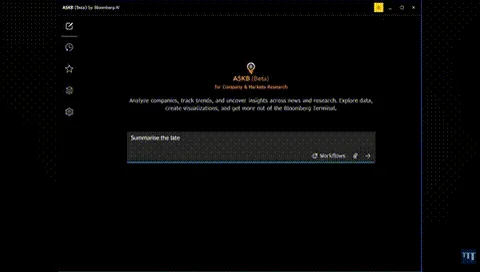
On the Bloomberg Terminal, users can access the interface by entering ASKB and pressing GO. Once inside, research can proceed conversationally instead of requiring the user to translate every objective into specialised Terminal commands. A broad question can lead to cited evidence, follow-up analysis and increasingly specific requests without restarting the workflow from scratch. ASKB has also expanded beyond the desktop Terminal through the Bloomberg Professional mobile app, where eligible Bloomberg Anywhere users can analyse companies, summarise market events and documents, and continue agentic research workflows across supported devices.
Bloomberg’s ASKB product description also specifies that a conversation started on the desktop can continue in the same thread on mobile. ASKB has a dedicated position in the mobile app’s tab bar, while profile personalisation can tailor responses to the user. This continuity could help an analyst move from an initial desktop investigation to a follow-up question between meetings without reconstructing the original request. The benefit is maintaining the context of the research as the user changes devices.
Broad availability does not remove existing data-entitlement restrictions. Bloomberg Terminal content remains governed by subscriptions, licences, organisational permissions and other access controls, so two users may not necessarily receive access to the same underlying sources. The wider rollout makes ASKB a more standard part of the Bloomberg experience, but the information available through it still depends on what each account or organisation is authorised to access.
The difference between ASKB and traditional Terminal search lies largely in how research begins. Conventional Terminal workflows remain effective when a professional already knows the required function, dataset or security, while ASKB allows the user to begin with the research problem itself. A question involving financial statements, news, research reports and management commentary can be expressed naturally, after which the system can retrieve and combine authorised information from several sources. Deterministic Bloomberg functions remain important for precise market data, specialist analytics and repeatable workflows, while ASKB adds a conversational discovery and synthesis layer on top.
How Bloomberg ASKB Uses AI Agents, Financial Data, and Multiple Models
Agentic AI is central to Bloomberg’s description of ASKB. Instead of sending a question to one language model and expecting that model to complete every step, the system can divide a task among specialised agents working in parallel. One component might identify relevant documents, another retrieve structured market or fundamental data, another analyse text, and another assemble the findings into a final response. This architecture is well suited to financial research because many questions require several information types simultaneously, including reported figures, consensus estimates, management transcripts, broker research, historical data and news.
The same approach allows ASKB to handle multi-step objectives rather than simple question answering. A user can ask the system to collect evidence, compare metrics, identify themes and present the results in a reusable structure. Bloomberg’s product direction extends this idea into recurring workflows connected with an institution’s investment process, while keeping the professional user responsible for interpretation and decisions.
ASKB is grounded in Bloomberg’s combination of structured financial information and large-scale document collections. Bloomberg says its AI products can derive insights from market data, documents, news, research and analytics already used by Terminal customers, with attribution back to the underlying sources. Structured data can explain what changed in revenue, valuation, yields or consensus expectations, while documents can provide context for why those changes occurred. Bloomberg says its AI systems can summarise and connect information across hundreds of millions of documents, and its news-related capabilities cover material from more than 30,000 sources. The Bloomberg Professional mobile experience is described as being backed by approximately 450 billion data points.
Licensed third-party content can also become part of the research process when the user is entitled to it. Third Bridge integrated an expert-interview library exceeding 100,000 transcripts with ASKB, allowing mutual customers to connect expert perspectives with financial information and sell-side research. GLG has also announced integration of its expert content. These additions expand the range of information an authorised user can incorporate into an ASKB query without removing the underlying permission requirements.
ASKB is also designed to combine Bloomberg information with proprietary institutional knowledge. Bloomberg has described capabilities for connecting Terminal content with internal research, uploaded documents, investment models, security lists and relevant market colour from authorised Instant Bloomberg communications. This allows the same research question to be examined through public financial information, external research, expert interviews and a firm’s own internal analysis. The value increases as more relevant context becomes available, but so does the importance of maintaining correct entitlements and governance.
The October announcement gives this institutional content a persistent home through Bloomberg Drive in ASKB. Once enabled, users can upload and organise files, then ask questions about a document, folder or their broader collection in later conversations. Bloomberg says previous attachments were limited to the conversation thread. Retaining that material makes it possible to revisit an earlier investment thesis alongside subsequent developments. For example, an analyst could examine which assumptions in a stored company note deserve another look after new guidance, using the original document as a reference point for the comparison.
The system itself is not tied to one large language model. Bloomberg has said its generative AI strategy can use multiple commercial and open-weight models within its Responsible AI framework. Different tasks such as retrieval, summarisation, document interpretation, numerical reasoning and code generation may be handled by different underlying systems. Users should therefore think of ASKB as a Bloomberg product layer built from model orchestration, financial datasets, permissions, retrieval infrastructure, source attribution, analytical tools and domain-specific validation rather than as a wrapper around a single chatbot.
This model-agnostic design also allows Bloomberg to change or add underlying models as new systems become available without forcing customers to rebuild their workflows around a different conversational interface. The value of ASKB therefore depends not only on the individual language models but also on how Bloomberg connects them to its financial-information infrastructure.

Bloomberg ASKB for Research, Earnings, Workflows, BQL, and BQuant
Company and investment research are among the clearest applications for ASKB. Bloomberg says the system can assemble financial data, news, research and analytics for tasks such as investigating securities, preparing for meetings and examining investment themes. A user might begin with an open-ended question about why a company’s outlook changed, then continue into earnings revisions, valuation comparisons or management commentary. Because responses are connected to Bloomberg content, users can inspect the original evidence instead of relying entirely on the generated summary.
Earnings analysis is particularly suited to this approach because several information sources become relevant at the same time. Analysts may need reported financial data, consensus estimates, company releases, presentation material, earnings-call transcripts, news reaction and sell-side commentary. ASKB can accelerate the first stage of synthesis by comparing reported figures with expectations, analysing management commentary and producing bullish and bearish takeaways grounded in available sources. It can also support workflows for monitoring company calls, releases and subsequent market reactions.
The output still requires professional interpretation. An AI-generated synthesis may identify changes in guidance, tone or financial performance, but analysts remain responsible for judging materiality, verifying important figures and deciding whether markets have already incorporated the information. Bloomberg presents ASKB as research assistance rather than an autonomous investment-decision system.
ASKB Workflows extend this capability beyond individual questions. Users can define multi-step research processes, save them and reuse them instead of rebuilding the same analysis repeatedly. Bloomberg’s 2026 roadmap described recurring research tasks, shared workflow templates, integration with personal and firm-wide security lists, internal research, alternative data and scheduled research processes. Repetitive tasks such as earnings preparation, morning research summaries, portfolio monitoring and thematic reviews can therefore automate more of the retrieval and synthesis process while retaining human oversight.
Bloomberg’s August 31, 2026 earnings article provides concrete examples through two named templates: Thesis Health Evaluator and Prepare for Earnings. The first compares an existing investment thesis with new announcements, results, news and research to identify assumptions that still hold or may need revision. The second assembles an earnings preview from recent performance, company guidance, consensus and relevant developments.
Bloomberg demonstrated the preparation workflow using Porsche, bringing together operating margin, annual guidance and expectations for the following quarter, alongside issues such as China and tariffs. The automotive example also shows how a user can customise the analysis with deliveries by model, regional sales and average revenue per vehicle. These examples explain how a broad research request can develop into analysis of the operating measures that matter to a particular business.
The documented applications also extend into commodity positioning. Bloomberg’s August 19, 2026 webinar description outlines an ASKB workflow for retrieving Commitment of Traders data, identifying weekly and seasonal changes, and examining positions across trader categories. It also describes scheduling the process to run automatically. This provides a concrete example of recurring analysis beyond company earnings and shows that Bloomberg was demonstrating scheduling after its April roadmap announcement. In such a workflow, the recurring task is to gather the latest information and highlight changes for review, giving the user a consistent starting point for investigating how positioning has evolved.
Third-party information can also become part of these repeatable workflows. Third Bridge says its expert research can be incorporated into ASKB workflows for earnings preparation and thematic analysis, demonstrating how licensed external material can participate in an agentic research process alongside Bloomberg content.
Personalized Lists provide another practical connection to a user’s existing work. Bloomberg’s product description says saved Worksheets and Watchlists can become the securities universe for conversational analysis, subject to consent and existing permissions. This could make requests more precise because the relevant group of securities is already defined. An analyst covering a selected group of manufacturers, for example, could focus a research question on that coverage list and then narrow the discussion to particular companies. The list supplies context that would otherwise need to be entered again when framing the request.
ASKB also connects conversational research with Bloomberg Query Language. When the system performs certain structured-data analyses, it can expose the associated BQL code, allowing users to inspect the underlying query rather than treating the result as unexplained output. Reporting on the ASKB launch said generated BQL could be extended into Excel and BQuant. This provides a path from a natural-language question to reproducible quantitative work.
ASKB and BQuant remain distinct products. ASKB handles conversational research and orchestration, while BQuant is Bloomberg’s programmatic analytics environment. A user can describe an analytical requirement in ASKB, inspect the returned data and BQL, then move into BQuant Desktop or BQuant Enterprise for deeper modelling, coding or repeatable analysis. Bloomberg also offers BQuant Assistant, a separate domain-grounded conversational coding agent intended to help users develop financial strategies within BQuant. It is related to Bloomberg’s broader AI strategy but is not another name for ASKB.
This division reflects a wider product strategy. ASKB acts as a natural-language layer for discovery, synthesis and workflow automation, while Bloomberg’s established tools continue to provide specialised quantitative and analytical environments when greater precision or programmability is required.

Source Transparency, Enterprise Controls, and the Limits of Bloomberg ASKB
Source transparency is one of Bloomberg’s central claims for ASKB. Responses are intended to be grounded in Bloomberg’s financial-information ecosystem and accompanied by attribution or links to underlying documents. This reduces one of the major risks of generative AI in professional finance: receiving a plausible answer without an obvious way to verify where it came from. A user can move from the generated synthesis to the relevant filing, transcript, research report or other source and evaluate whether the interpretation is accurate.
BQL provides another form of verification for structured analysis because users can inspect or reuse the query that generated particular figures. These mechanisms improve auditability, but they do not guarantee correctness. Bloomberg has acknowledged the importance of validating factual integrity and citations, while reporting on the product has noted that the system is not flawless. Attribution makes checking an answer easier, but it does not eliminate the need for checking.
Enterprise governance becomes increasingly important as ASKB gains access to internal research, models, documents, watchlists and communications. Bloomberg says the system is designed to preserve the permissions and controls expected in professional financial environments. Reporting on its enterprise AI framework describes fine-grained role-based access rules for content exposed to AI systems. Uploaded documents can also be restricted to the individual who uploaded them within the relevant ASKB context.
The October release also defines the scope of the new chat capability: once enabled, ASKB can examine three months of a client’s own Instant Bloomberg history and cite the messages behind its answers. Bloomberg says it accommodates financial shorthand and acronyms. This supports more specific requests, such as reviewing contacts’ overnight observations or finding a contrary view on a market theme. The resulting evidence remains attributable to the relevant conversations, allowing the user to check who expressed a view and the context in which it appeared.
Bloomberg has further said that client content is not used to train or fine-tune generative AI models for the purpose of generating, displaying, summarising or reproducing that content without additional consent. Reporting on the architecture also indicates that third-party model providers operate under contractual restrictions governing data use and retention. These protections become more important as the system gains access to increasingly sensitive institutional information.
ASKB still inherits the broader limitations of generative AI. Language models can misunderstand questions, omit evidence, overstate conclusions or produce incorrect statements. Bloomberg’s own April 2026 industry research identified source attribution, error checking and human oversight as important requirements for trust in financial AI. Those safeguards are particularly important when research could influence trading, investment recommendations, regulatory decisions or client communication.
Bloomberg has therefore positioned ASKB as an augmentation system rather than a replacement for professional judgement. AI can handle more of the information retrieval, comparison and synthesis work, but users remain responsible for determining whether the sources are current, whether the system interpreted them correctly, whether important context is missing and what action should follow. The broader significance of ASKB lies in making agentic and conversational AI an interface to Bloomberg’s existing financial ecosystem while preserving the permissions, provenance and verification practices institutional users depend on.

Frequently Asked Questions (FAQs)
- What is Bloomberg ASKB?
ASKB is Bloomberg’s conversational, agentic AI interface for the Bloomberg Terminal. It allows users to ask natural-language questions about companies, markets, securities, earnings, and investment themes instead of beginning every task with a specific Terminal function or manually assembled dataset. The system draws on Bloomberg data, documents, news, research, and analytics, then coordinates retrieval and analysis to produce an attributed response that users can investigate further. - Is Bloomberg ASKB available to all Terminal users?
Bloomberg said on October 15, 2026, that ASKB was being made available to all Bloomberg Terminal users, expanding beyond the earlier limited rollout. More than one-third of Terminal subscribers were already using the system before the broader availability announcement. However, universal access to ASKB does not mean every user can retrieve the same information, because Bloomberg content still depends on subscriptions, licences, organisational permissions, and other entitlements. - How do users open ASKB on the Bloomberg Terminal?
Users can launch ASKB by entering the ASKB function on the Bloomberg Terminal and pressing GO. From there, they can type research questions in ordinary language and refine the investigation through follow-up prompts. This conversational format is useful when the user knows the research problem but does not necessarily know which Terminal function, dataset, or document collection contains the answer. - Can ASKB analyse earnings calls?
Yes. ASKB is designed to help users analyse earnings releases and calls by combining reported figures, consensus expectations, company documents, management commentary, news, and research. It can help identify differences between actual results and estimates, summarise management tone, and organise bullish or bearish takeaways. The resulting analysis is intended to speed up the first stage of research rather than replace the analyst’s own judgement. - Does Bloomberg ASKB use only one AI model?
No. Bloomberg describes ASKB as using a coordinated architecture with multiple AI agents and potentially multiple commercial or open-weight models. Different components can handle tasks such as retrieval, document analysis, numerical work, synthesis, or code generation. This means ASKB should be understood as a Bloomberg research and orchestration layer rather than a simple interface built around one external chatbot. - Can ASKB use a company’s internal research?
Yes, when the relevant information is authorised for that user and organisation. Bloomberg has described ASKB as being able to connect Terminal content with proprietary sources such as internal research, documents, investment notes, models, and security lists. This can make responses more relevant to a firm’s own investment process, but the system is still governed by enterprise permissions and access controls. - Does ASKB show where its answers come from?
Yes. Bloomberg places strong emphasis on source attribution and verification. ASKB responses can link users back to the underlying documents, research, filings, or other evidence used in the answer. For structured analysis, the system can also expose Bloomberg Query Language code, giving users another way to inspect how the data result was produced instead of treating the generated answer as an unexplained conclusion. - Does ASKB integrate with BQuant?
Yes, primarily through Bloomberg Query Language. When ASKB produces certain structured analyses, the associated BQL can be inspected and then carried into BQuant Desktop or BQuant Enterprise for deeper modelling, coding, or repeatable quantitative work. ASKB and BQuant remain different products, while Bloomberg’s separate BQuant Assistant provides AI-powered coding support inside the BQuant environment itself. - Is ASKB available on mobile devices?
Yes. Bloomberg has extended ASKB to the Bloomberg Professional mobile app for eligible users. The mobile experience supports company and market research, document and event summaries, visual analysis, and agentic workflows, allowing users to continue parts of their research away from the desktop Terminal. Availability of specific data still depends on account permissions and Bloomberg Anywhere eligibility. - Can investors rely on ASKB without checking its answers?
No. Bloomberg has added source attribution, validation features, and enterprise controls, but generative AI can still misunderstand questions, omit context, or produce incorrect conclusions. Users should review the cited evidence, verify important figures, and apply professional judgement before acting on the result. Bloomberg positions ASKB as a research assistant that reduces retrieval and synthesis work, not as an autonomous investment-recommendation or decision-making system.

Conclusion
Bloomberg’s decision to make ASKB available to all Terminal users marks an important step in bringing generative and agentic AI into institutional financial workflows. The expansion moves ASKB beyond its earlier limited rollout and makes conversational research a more prominent interface to Bloomberg’s market data, news, documents, research, and analytics.
Its significance goes beyond allowing professionals to ask questions in natural language. ASKB combines that conversational layer with Bloomberg’s existing financial infrastructure, allowing coordinated AI agents to search across different information types, connect structured data with documents, analyse earnings, incorporate authorised proprietary research, and turn parts of an exploratory conversation into repeatable workflows.
The product also highlights why professional financial AI requires more than the capabilities of a general-purpose chatbot. Institutional users need source provenance, data entitlements, reproducibility, enterprise permissions, and clear paths back to the underlying evidence. Bloomberg’s emphasis on attribution, together with connections to BQL and BQuant, gives users ways to move from generated research into more structured and verifiable analytical work.
ASKB still requires careful human review. Its answers can be incomplete or incorrect, the quality of its output depends on the question and available evidence, and access to specific research or proprietary information remains controlled by existing permissions. Citations and validation tools can reduce the cost of verification, but they do not replace professional judgement.
The larger change is therefore one of workflow rather than responsibility. ASKB can reduce the time spent locating, reading, comparing, and synthesising financial information, while Terminal users remain responsible for interpreting that information and deciding how to act on it. As ASKB expands across desktop, mobile, proprietary content, and reusable workflows, its long-term value will depend on how effectively AI speed can be combined with source transparency, governance, and human verification.
Sources and Citations
- The Wall Street Journal, October 15, 2026: Bloomberg expands ASKB to all Terminal users. The report confirms that Bloomberg is making ASKB available to all Bloomberg Terminal users after an earlier limited rollout. More than one-third of Terminal subscribers were already using ASKB before the expansion. It also reports Bloomberg’s push to incorporate more user-specific information, including watchlists and authorised communications, into AI-assisted workflows. The Wall Street Journal
Citation: Bloomberg Doubles Down on Conversational AI - Bloomberg Professional Services: “AI on Bloomberg.” Bloomberg’s official product page describes ASKB as a conversational AI interface built into the Terminal. It confirms that the system coordinates multiple AI agents, draws from Bloomberg data, news, research, documents and analytics, provides transparent source attribution, exposes underlying BQL code for certain analyses, supports reusable workflows, and can connect Bloomberg information with proprietary institutional intelligence. It also distinguishes BQuant Assistant from ASKB. Bloomberg Professional
Citation: AI on Bloomberg - Bloomberg Professional Services, February 23, 2026: Original ASKB introduction. Bloomberg’s launch announcement introduced ASKB as a beta conversational and agentic AI interface for the Bloomberg Terminal. It explains that users can pose investment-research questions in everyday language and receive answers synthesised from structured data, documents, news, research and analytics. Bloomberg describes the system as coordinating AI agents rather than relying on a conventional single-step search process. Bloomberg
Citation: Meet ASKB: Bloomberg Introduces Agentic AI to the Bloomberg Terminal - Bloomberg Professional Services, April 16, 2026: ASKB roadmap and institutional workflows. Bloomberg’s official roadmap describes ASKB evolving from a discovery tool into a more deeply integrated institutional research system. Announced capabilities include ASKB Workflows, proprietary house research, portfolio and research-management integrations, alternative data and a coordinated network of Bloomberg AI agents. Bloomberg Professional
Citation: Bloomberg Unveils ASKB Roadmap for Clients to Augment Their Investment Process With Agentic AI - Bloomberg Professional Services: ASKB on the Bloomberg Professional mobile app. Bloomberg’s official mobile materials confirm that ASKB is available through the Bloomberg Professional app for eligible Bloomberg Anywhere users. The mobile implementation supports natural-language company and market research, document and event summaries, visualisations and customised agentic workflows. Bloomberg says the mobile experience is backed by approximately 450 billion data points. Bloomberg Professional
Citation: Bloomberg Professional App and ASKB - Bloomberg Professional Services, August 31, 2026: Earnings-season research with ASKB. Bloomberg’s official article explains how ASKB can combine filings, transcripts, news, consensus estimates and research during earnings season. It describes workflows for preparing before earnings, interpreting reported results, analysing management commentary and examining subsequent market reaction. Bloomberg Professional
Citation: How ASKB Helps Investors Accelerate Learnings During Earnings Season - Bloomberg Professional Services: Earnings workflow demonstration. Bloomberg’s July 8 webinar provides additional first-party documentation of ASKB’s use for pre-earnings preparation, results synthesis, peer comparisons, follow-up questions and scheduled recurring workflows. Bloomberg Professional
Citation: Accelerating Earnings Analysis With ASKB - Third Bridge, April 16, 2026: More than 100,000 expert-interview transcripts integrated with ASKB. Third Bridge confirms that its research became accessible to entitled ASKB users during the beta. Its library contains more than 100,000 interview transcripts covering thousands of public and private companies, with source attribution retained within the Bloomberg research workflow. Third Bridge
Citation: Third Bridge Expert Insights on Bloomberg’s ASKB - GLG, May 14, 2026: Expert Content Library integration. GLG confirms that mutual GLG and Bloomberg Terminal customers can access its unblinded expert transcripts directly through ASKB. The integration extends an earlier Bloomberg collaboration involving Document Search & Analysis and adds GLG expert research to the conversational interface for authorised clients. GLG
Citation: GLG Provides Expert Insights on Bloomberg’s ASKB - WIRED, April 28, 2026: Multi-model architecture, validation and human oversight. Joel Khalili’s report, based on an interview with Bloomberg CTO Shawn Edwards, says ASKB was then available to roughly one-third of the Terminal’s approximately 375,000 users. It describes the system as operating on a mixture of language models and reports Bloomberg’s efforts to validate factual integrity and source citations. Bloomberg also told WIRED that ASKB is intended to increase employee productivity rather than replace critical professional decision-making, and that it does not provide investment recommendations. WIRED
Citation: The Bloomberg Terminal Is Getting an AI Makeover, Like It or Not - Technology Magazine, June 4, 2026: Enterprise controls, privacy and model architecture. Technology Magazine’s interview with Bloomberg AI Strategy and Research head Amanda Stent provides the strongest direct support for the article’s governance claims. It states that Bloomberg uses fine-grained role-based access controls, that uploaded documents are accessible only to the uploader within the relevant ASKB thread, and that Bloomberg does not use client content to train or fine-tune generative AI models for reproducing that material without additional consent. It also says third-party model providers operate under contractual restrictions covering access, usage and retention. Technology Magazine
Citation: Understanding Bloomberg’s Agentic AI for High-Stakes Data - A-Team Insight, April 28, 2026: ASKB architecture, integrations and institutional-data strategy. A-Team Insight examines Bloomberg’s roadmap, including PORT, RMS Enterprise, Bloomberg Second Measure, Third Bridge and ASKB Workflows. It also reports Bloomberg’s explanation that ASKB uses a combination of commercial models, open-weight models and smaller custom models, with different systems selected for different tasks. A-Team further documents Bloomberg’s emphasis on source attribution, underlying BQL and post-processing checks intended to reduce hallucinations. A-Team Insight
Citation: Inside Bloomberg’s ASKB Roadmap: The Data Moat Behind the AI
Recommendations
- Vivian Kubrick Debunks Eyes Wide Shut Deleted Scenes Theory
- Battlefield 6 2026 Roadmap: More Maps, “Legendary” Battlefield 4 & Battlefield 3 Remakes, and Wake Island’s Return
- Apple TV’s Widow’s Bay is the First Breakout TV Hit of 2026: Why Everyone is Talking About the Horror Comedy
- Pitchify Launches New Service to Connect Developers and Publishers: How Pitch Direct Works
- Pokémon Pokopia Bubbly Basin DLC Release: Date, New Pokémon, and Everything You Need to Know
- Nordic Game 2026 (NG26 Spring): Dates, Venue, Passes, Speakers, Expo & Awards in Malmö
- Subnautica 2 Early Access Roadmap: Co-Op Updates, Sprinting, and More
- Virtua Fighter 6 Leak Explained
- The Future of 3D Modeling: Insights on AI Advancements
- GTA 6 is Already Outselling Everything Else: Why Pre-Orders Are Dominating Gaming



































































































