





In This Article (8 sections)
Project Joplin and Mark Darrah’s Original Dragon Age 4 Vision
Dragon Age 4 originally took shape around a substantially different ambition from the game eventually released as Dragon Age: The Veilguard. Former BioWare executive producer Mark Darrah has revisited an internal presentation book assembled in 2016 that outlined an early version of the project known as Joplin. The pitch explored destructible environments, changing weather, expanded interactions with non-player characters, and heist-style missions, all within a world intended to respond more convincingly to player actions. Those ideas help explain the creative direction BioWare was considering at the time, but they were aspirations rather than a guaranteed feature list. The material shows what the team wanted to investigate, not what had already been completed or proven to work.
The central idea behind Joplin was a more reactive role-playing world. Rather than limiting responsiveness to formal dialogue choices, the pitch suggested that environments, locations, and characters could communicate the effects of player decisions in more visible ways. An action might change access to an area, alter how people reacted, or leave consequences that remained noticeable later, although the public material does not provide a complete mechanical specification. Darrah’s presentation therefore captured a desired quality of the game rather than a finished system. It should also not be treated as evidence that every designer supported every proposed implementation in exactly the same way.
Joplin was the internal codename for an earlier incarnation of the fourth Dragon Age and entered preproduction after Inquisition’s Trespasser expansion in 2015. Reporting on its development described a smaller adventure centered on spies operating in the Tevinter Imperium, with more emphasis on consequences and responsive missions. The description of the project as smaller referred to its scope relative to Inquisition rather than proving that it would have offered fewer meaningful choices. A more compact structure could still support considerable variation if locations, characters, and missions changed in response to player decisions. The important distinction is that “Dragon Age 4” refers to several different development phases, including Joplin, the later Morrison project, and the final game released as The Veilguard.
Darrah described the 2016 pitch book as material circulated within BioWare and among senior EA figures. Its purpose was not only to communicate creative goals but also to help keep Dragon Age visible, secure early investment, and justify staffing. In that sense, the document served as both a creative statement and a persuasive argument about why the project deserved resources. Darrah’s use of the word “propaganda” reflects that persuasive role and highlights the distance between an exciting internal proposal and a guaranteed finished product. A pitch can establish priorities and ambitions without resolving the design, technical, staffing, and production questions required to ship them.
Inquisition provided much of the foundation for that argument. Darrah’s introduction framed its success as an opportunity to preserve what had worked, improve what had not, and create a more convincing interactive world instead of simply repeating the same structure on a larger scale. Earlier reporting also described a team that hoped to benefit from its experience with Inquisition and the technology already developed for it. The proposed smaller scope could therefore coexist with greater emphasis on responsiveness, consequences, and stronger connections between missions. However, the available material does not establish exact map sizes, total playtime, or a definitive list of Inquisition systems that Joplin would have retained or removed.

Reactive World Systems, Destruction, Weather, NPC Interactions, and Heists
The broadest idea in the Joplin material was a world capable of reflecting player actions. Reporting on the pitch described consequences from activities such as heists potentially affecting surrounding circumstances rather than disappearing once a mission ended. Reactivity could have taken several forms, including immediate responses during encounters, persistent changes to locations, and narrative consequences that affected later relationships or quest outcomes. Those categories are useful for understanding the ambition, but the disclosed material does not confirm how extensively each would have been implemented. A promise of a responsive world also does not establish that every imported decision from previous Dragon Age games would have been supported.
Destructible environments were one of the most striking concepts discussed in coverage of the pitch. The available information does not establish whether destruction would have involved specific objects, selected combat spaces, scripted sequences, or a much broader environmental system. That distinction matters because breaking a predetermined barrier is very different from allowing players to reshape locations freely. Destruction could theoretically have created alternate routes, changed encounter spaces, or reinforced the sense that player actions affected the world, but those possibilities remain interpretations of the design opportunity. Nothing in the disclosed material proves that entire cities, every wall, or large portions of the environment would have been permanently destructible.
Dynamic weather and terrain changes were another part of the proposed direction. Reporting mentions changing weather as well as mud that players could sink into, suggesting that BioWare was considering an environment that affected movement and atmosphere rather than remaining visually static. Weather could have made repeated visits to familiar locations feel different, but the public information does not establish whether it would have influenced missions, combat, traversal, or only presentation. A rainstorm occurring during exploration would not automatically demonstrate a deep weather simulation, just as one terrain example would not prove a comprehensive environmental system. Questions about frequency, predictability, player response, and lasting consequences remain unanswered.
Darrah also described interest in social interactions extending beyond BioWare’s traditional conversation structure. The goal appears to have been a world in which non-player characters behaved and responded more naturally to what the player had done, rather than reserving every consequence for a formal dialogue scene. That did not necessarily mean removing cinematic conversations, dialogue choices, or companion relationships. It could instead have meant expanding the number of ways the world communicated recognition, such as altered greetings, changed behavior, or reactions before a conversation formally began. The strongest supported interpretation is therefore one of broader interaction rather than any claim of generative dialogue, fully autonomous citizens, or unrestricted social simulation.
Heists fit naturally with the reported premise of spies operating in Tevinter. Earlier accounts described missions intended to support flexible choices instead of always forcing the player through a single tightly scripted route. The structure could have encouraged questions about objectives, available information, risks, alternative approaches, and the consequences of failure. A hypothetical mission might support persuasion, a concealed route, or direct confrontation, but the disclosed material does not confirm those exact options or a finalized planning interface. The evidence supports heists as an experimental mission concept within a fantasy RPG rather than as proof of a completed system or a fixed number of repeatable operations.
A significant qualification is that BioWare was reportedly already moving away from heists in 2017. The available account does not identify a definitive reason for that change, so explanations involving cost, technical failure, publisher rejection, or narrative problems should not be treated as established fact. The shift demonstrates that even before Joplin was canceled, the project was already evolving beyond parts of the 2016 pitch. A feature being reconsidered does not necessarily mean its underlying design goal disappeared, because flexible problem-solving could have survived through other mission structures. However, the evidence does not provide a clear record of how those ideas would have changed if Joplin had continued.

Why Joplin Was Canceled and How Dragon Age 4 Shifted Toward Morrison
The development history of Dragon Age 4 is easier to understand when Joplin’s interruption and cancellation are treated as separate events. The project was paused in late 2016 while developers were reassigned to help finish Mass Effect: Andromeda. In 2017, the original version was canceled and Dragon Age development restarted under different priorities as personnel moved toward Anthem. This sequence prevents the history from being reduced to a single claim that Andromeda immediately killed Joplin. Staffing pressure, competing projects, changing priorities, and a different expected form for Dragon Age all contributed to the transition.
Darrah later argued that the move toward live-service development partly served as a justification for reallocating people. That interpretation comes from his retrospective account and should not be treated as an independently verified explanation of every executive decision involved. The available evidence supports a broader conclusion that BioWare faced resource competition and strategic changes while attempting to determine what the next Dragon Age should become. It does not establish that Joplin was canceled because its weather, destruction, NPC interactions, or heist concepts had failed. A project can lose priority before every creative idea within it receives a final technical or design evaluation.
The restarted project became known as Morrison and pursued a multiplayer or live-service direction. Darrah has described EA requesting that change and the team treating it as a reason to restart much of the project rather than simply continuing Joplin with a few additions. A public BioWare statement from 2018 provides a narrower confirmation that Darrah was focused on Anthem while another team continued work on Dragon Age. That statement did not explain the full internal reboot or describe Morrison in detail. The development path therefore needs to be reconstructed from multiple stages rather than treated as one continuous version of the same game.
Another major strategic reversal became public in February 2021, when reporting indicated that EA had allowed BioWare to remove planned multiplayer elements. Accounts connected that change to Anthem’s difficulties and the commercial success of the single-player Star Wars Jedi: Fallen Order. Returning to a single-player focus did not automatically restore Joplin because years of changes in mission structure, progression, staffing, production priorities, and technology had already altered the project. Morrison was not simply Joplin paused and resumed. By that stage, Dragon Age 4 had gone through several substantially different interpretations.
This development history also explains why the 2016 pitch should not be read as a definitive blueprint for a canceled masterpiece. Heists were already being reduced before cancellation, and Darrah has acknowledged that proposed features could have been challenged, reduced, or removed during normal development. The same uncertainty applies to the eventual scope of destruction, dynamic weather, and expanded NPC interaction. Darrah later imagined a hypothetical scenario in which Joplin might have taken Anthem’s February 2019 release slot, but he also acknowledged that such a version would have involved compromises. That was a retrospective thought experiment rather than evidence of an official release date or completed production schedule.

Project Joplin vs Dragon Age: the Veilguard and the Limits of the Original Pitch
Dragon Age: The Veilguard ultimately launched on October 31, 2024, as a single-player RPG and provides the clearest finished point of comparison with Joplin. The released game follows Rook and seven companions in a conflict involving ancient elven gods, while the earlier Joplin concept had been described as a smaller adventure focused on spies, Tevinter, and more responsive missions. The contrast demonstrates how dramatically the project changed during its long development. However, comparing them is inherently uneven because The Veilguard can be judged as a finished game while Joplin survives mainly through pitches, retrospective accounts, and reported ideas. Joplin’s design ambitions cannot prove how well those ideas would have worked in a completed release.
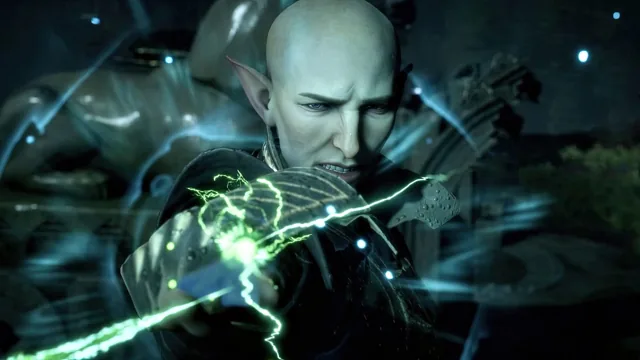
One documented difference concerns imported continuity from earlier Dragon Age games. The Veilguard allows players to establish three major decisions from Inquisition: the Inquisitor’s romance, whether the Inquisition was disbanded, and whether the Inquisitor intended to stop or redeem Solas. It does not recreate the much broader world-state selection seen in earlier parts of the series. That limitation should not be confused with an absence of choices inside The Veilguard itself because its released design still emphasizes relationships, companion stories, and decisions affecting the current adventure. Likewise, the broad idea of Joplin as a reactive game does not prove that it would have supported every historical Dragon Age decision.
The 2016 pitch is most valuable as a record of creative direction rather than a checklist of features that were guaranteed to ship. Heists provide the clearest example because they were reportedly already being phased out before Joplin was canceled. Darrah has also cautioned that ideas in the presentation could have been challenged or removed for practical reasons across different development disciplines. That warning applies equally to environmental destruction, weather systems, and the depth of social interaction. The final scope of those ideas is unknowable because the project never advanced far enough to establish a finished version.
The same caution applies to broader claims that Joplin would necessarily have been better than The Veilguard. A pitch naturally emphasizes possibilities, goals, and the problems its creators hope to solve, while a released game exposes every compromise required to reach completion. Joplin might have produced a more responsive world, but it also would have faced staffing limits, technical challenges, production deadlines, and design tradeoffs of its own. The available evidence cannot establish whether its systems would have worked consistently or whether all of its most appealing concepts would have survived development. What the pitch does show is that BioWare was seriously exploring a different path for Dragon Age 4 before the project was repeatedly restructured.
Joplin’s lasting interest therefore comes from what it reveals about BioWare’s priorities at that moment. The team was considering a smaller, more reactive RPG in which environmental changes, social responses, flexible missions, and familiar locations could work together to make Thedas feel more responsive to player actions. Those ambitions provide useful context for understanding the many versions Dragon Age 4 passed through before becoming The Veilguard. They also demonstrate why canceled projects should be remembered carefully, because internal proposals preserve creative potential but not proof of final quality. Joplin remains an important alternate direction in Dragon Age history, but its ultimate execution can only be imagined.
Frequently Asked Questions (FAQs)
- What was the original Dragon Age 4 called?
The early version of Dragon Age 4 used the internal codename Joplin. That project represented one specific stage of development and had its own creative goals, including a smaller scope and stronger emphasis on reactivity. After Joplin was canceled, development restarted under the codename Morrison with a different direction. The game that eventually reached release was titled Dragon Age: The Veilguard. Joplin, Morrison, and The Veilguard therefore refer to different stages in the development history of the fourth mainline Dragon Age rather than three separate released games. - What did Mark Darrah reveal about Joplin?
Mark Darrah discussed an internal pitch book that presented BioWare’s ambitions for a more responsive Dragon Age experience. The ideas described in the material included destructible environments, changing weather, broader interactions with non-player characters, and heist-style missions. The overall goal was to make the world respond more visibly to what the player did rather than limiting consequences mainly to dialogue and quest outcomes. Darrah’s discussion provides useful insight into what the team wanted to explore at that stage. However, the disclosed material represents only part of Joplin’s design history and should not be treated as a complete specification of the canceled game. - Was the Joplin book a promise to players?
No. The pitch book was an internal and publisher-facing document rather than a public feature commitment. It was created to communicate the project’s creative direction and help make the case for continued investment, staffing, and resources. Features included in a pitch can still change substantially once teams begin testing whether they are technically practical, enjoyable, and affordable to produce. Some ideas may be reduced, redesigned, or removed entirely during development. The book therefore shows what BioWare wanted to investigate, not a guaranteed list of features that would have appeared in a finished game. - Was Joplin supposed to be bigger than Inquisition?
No clear evidence supports describing Joplin as larger than Dragon Age: Inquisition. Reporting instead characterized it as a smaller overall project with more emphasis on responsive missions, consequences, and meaningful player decisions. A smaller scope does not necessarily mean a less ambitious role-playing experience because a game can concentrate more detail and reactivity into fewer locations. The disclosed material does not provide an exact map size, total number of areas, completion time, or final content count. Any attempt to assign precise dimensions to Joplin would therefore go beyond what the available information supports. - Were destructible environments and dynamic weather confirmed features?
They were confirmed as ideas proposed in the pitch, but their final implementation was never established. The coverage does not explain whether environmental destruction would have affected isolated objects, selected mission areas, scripted events, or much larger portions of the world. The same uncertainty applies to dynamic weather and terrain effects such as mud. A proposal can show what kind of experience the team wanted without proving how deeply the feature would have been integrated into gameplay. Because Joplin never reached release, there is no finished version showing how consistently or extensively those systems would have worked. - Would Joplin have been a heist game?
Heists were an important part of Joplin’s early reported direction and fit its premise involving spies operating in Tevinter. They appear to have been considered as a way to support flexible mission approaches and stronger consequences. However, Darrah’s retrospective account indicates that BioWare was already moving away from heists during 2017. That means even an uninterrupted version of Joplin might not have remained centered on that structure. Describing the canceled project simply as a heist game therefore captures only one stage of its development rather than every form it might have taken. - Why were heists being removed?
The available reporting does not provide a definitive reason for BioWare moving away from the heist concept. It would therefore be inaccurate to claim that the idea was dropped because of cost, technical problems, publisher pressure, or narrative concerns unless additional evidence supports one of those explanations. Game development frequently involves testing and revising structures as teams learn what works well in practice. What is established is that heists were already being reconsidered before Joplin itself was canceled. That detail shows that the project was evolving even before the larger development restart occurred. - Why did Joplin become Morrison?
Joplin was canceled during a period when BioWare was shifting staff and resources among several major projects. The development history includes a late-2016 pause while employees helped finish Mass Effect: Andromeda, followed by a 2017 restart under different priorities. The new version, Morrison, pursued a multiplayer or live-service direction rather than simply continuing Joplin unchanged. Darrah later connected that strategic shift to the movement of personnel toward Anthem and described the live-service pivot as part of the justification for those changes. His explanation is a retrospective account of the situation and should not be treated as proof of every internal decision made by BioWare or EA. - Is The Veilguard the multiplayer version of Dragon Age 4?
No. Dragon Age: The Veilguard was released as a single-player role-playing game. The project’s long development history did include a period when BioWare was pursuing multiplayer or live-service elements under the Morrison direction. Reporting in 2021 indicated that EA later allowed those multiplayer components to be removed. That change did not restore Joplin exactly, because years of development and restructuring had already altered the game significantly. The existence of an earlier multiplayer phase therefore does not mean the final released version of The Veilguard was designed as a multiplayer game. - Would Joplin definitely have been better than The Veilguard?
That cannot be established from the available evidence. Joplin’s pitch contains appealing ideas about reactivity, environmental interaction, social behavior, and flexible missions, but those concepts were still proposals rather than finished systems. A completed version would have faced the same kinds of technical limits, staffing pressures, production schedules, and design compromises that affect any large game. The Veilguard can be judged as a finished product, while Joplin is known mainly through internal ambitions and retrospective descriptions. Comparing the best possibilities of an unfinished pitch with the limitations of a released game cannot prove which one would ultimately have been better.

Conclusion
Dragon Age 4’s original Joplin vision offers a revealing look at a very different direction BioWare once considered for the series. Its emphasis on a more reactive world, environmental interaction, changing conditions, broader social responses, and flexible mission structures suggests that the team wanted Thedas to respond more visibly to player actions beyond traditional dialogue choices. Those ideas give the canceled project a distinctive identity and help explain why Joplin continues to attract interest years later. At the same time, they represent ambitions captured during development rather than features proven in a finished game.
The pitch also highlights how much game development depends on factors beyond creative ideas. Joplin still required staffing, investment, experimentation, technical validation, and continued organizational support before its concepts could become a complete product. Some ideas, including the heist-focused direction, were already changing before the project was canceled, showing that the 2016 pitch was never a fixed blueprint. Later resource shifts and strategic changes then pushed Dragon Age through the Morrison phase and eventually toward the game released as The Veilguard. The history demonstrates how dramatically a project can change as studio priorities, production realities, and development goals evolve.
Darrah’s account therefore preserves an important alternative path in Dragon Age history without proving what the finished result would have been. Joplin may have emphasized different strengths from The Veilguard, but its proposed systems would still have faced technical limits, design trade-offs, and production compromises. What can be established is that BioWare was seriously exploring a smaller, more responsive Dragon Age built around meaningful consequences and a world that reacted more visibly to the player. What cannot be known is how successfully those ambitions would have survived the full development process or whether the final game would ultimately have delivered the experience imagined in the pitch.
Sources and Citations
- Games.gg, November 10, 2026, “Former BioWare developer reveals internal Dragon Age 4 pitch”: Games.gg reports that Mark Darrah revealed a mid-2016 internal Joplin pitch book circulated within BioWare and among senior EA staff. It says the book was intended to keep Dragon Age visible, support requests for funding and hiring, and proposed a more reactive world with destructible environments, dynamic weather, social interactions beyond standard conversations, sinking mud, and consequences from heist-style activities. Darrah also cautioned that these were ambitions rather than guaranteed final features. GAMES.GG
Games.gg, Former BioWare developer reveals internal Dragon Age 4 pitch - IGN reporting reproduced by VainSoftGames, November 9, 2026, “Former BioWare Executive Producer Mark Darrah Shares Original Vision for a More ‘Immersive’ Dragon Age 4”: This report gives the most detailed account of Darrah’s explanation of the book’s purpose. He said it was made in mid-2016 for both the development team and senior EA leadership to argue that Dragon Age deserved investment after Inquisition’s success. It also confirms the proposed reactive world, destructible environments, changing weather, broader NPC interactions, and heists, while noting Darrah’s warning that many ideas might have been cut during normal development. VSG
VainSoftGames / IGN reproduction of Mark Darrah’s Joplin reveal - Game Debrief, November 9, 2026: Game Debrief independently summarizes Darrah’s reveal of the internal Joplin presentation book, confirms that it was created in mid-2016 and distributed to BioWare and EA leadership, and notes that Darrah only disclosed part of the document rather than publishing the entire book. It also links to Darrah’s accompanying video, Dragon Age And The Joplin Book: The Real Story. Game Debrief
Game Debrief, Mark Darrah reveals internal Dragon Age 4 document - PC Gamer, April 27, 2016, “Dragon Age Producer Mark Darrah teases something on Twitter”: This contemporary report documents Darrah publicly teasing the distinctive red BioWare/EA “Internal use only” book in April 2016, years before he explained what it contained. PC Gamer noted the red cover, tower and wolf imagery, and the “Property of BioWare/EA” marking. PC Gamer
PC Gamer, Dragon Age Producer Mark Darrah teases something on Twitter - Den of Geek, April 9, 2019, “Dragon Age 4: Original Version Featured Heists, Branching Stories, and More Details”: Den of Geek’s historical coverage describes Joplin as a smaller, more reactive Dragon Age project centered on spies operating in Tevinter. It reports branching consequences, heist-style missions, the late-2016 staffing shift to Mass Effect: Andromeda, and the later move toward the Morrison project with more online-service elements. Den of Geek
Den of Geek, Dragon Age 4 original Joplin version - GamesRadar+, “EA said make this a live service”: GamesRadar reports Darrah’s retrospective explanation that the 2017 move from Joplin to Morrison and live-service development partly served as a rationale for shifting staff toward Anthem. Darrah said Joplin had already been paused to support Mass Effect: Andromeda and was subsequently restarted under a substantially different multiplayer/live-service direction. GamesRadar+
GamesRadar, Mark Darrah on Dragon Age’s live-service pivot - BioWare / Electronic Arts, December 6, 2018, “A Message From Mark Darrah & Matthew Goldman – The Dread Wolf Rises”: BioWare officially confirmed that a new Dragon Age project remained in development. Darrah said he had been focused on Anthem, while another team of Dragon Age veterans continued exploring ways to push BioWare storytelling forward. This is useful contemporary evidence that Dragon Age development continued during the period after Joplin’s cancellation. BioWare Blog
BioWare, The Dread Wolf Rises - TechRadar, February 25, 2021, “Dragon Age 4 is going to be a solo experience after EA’s change of heart”: TechRadar reports that EA and BioWare had removed the multiplayer-heavy direction from Dragon Age 4 and shifted back toward a single-player game, following Anthem’s difficulties and the success of single-player projects such as Jedi: Fallen Order. This supports the article’s account of the later reversal away from Morrison’s live-service focus. TechRadar
TechRadar, Dragon Age 4 shifts back to single player - Electronic Arts, August 15 and October 31, 2024: EA officially announced that Dragon Age: The Veilguard launched October 31, 2024 as a single-player RPG. The released game follows Rook and a party of companions against ancient elven gods and represents the finished endpoint of Dragon Age 4’s long development history. EA News
EA, Dragon Age: The Veilguard release announcement - RPG Site, October 31, 2024, “How to import Dragon Age: Inquisition choices into Dragon Age: The Veilguard”: RPG Site confirms that The Veilguard allows players to configure only three major Inquisition decisions: the Inquisitor’s romance, whether the Inquisition was disbanded or absorbed into the Chantry, and whether the Inquisitor intended to stop or redeem Solas. RPG Site
RPG Site, importing Inquisition choices into The Veilguard - PC Gamer, August 25, 2025: Ted Litchfield reports Darrah’s retrospective thought experiment that an uninterrupted Joplin might have taken Anthem’s February 2019 release slot. Darrah also stressed that such a version would likely have been heavily compromised by schedule and production realities, making this speculation rather than evidence of an official planned Joplin release date. PC Gamer
PC Gamer, Mark Darrah on a hypothetical February 2019 Joplin release - Games for Humans, November 10, 2026, “Dragon Age 4’s scrapped pitch had heists and sinking mud”: This summary confirms the Joplin pitch’s heists, destructible environments, dynamic weather, sinking mud, reactive characters, and world-changing consequences. It also correctly emphasizes that Joplin was never completed and that Darrah explicitly warned some of the pitch’s ideas would likely have been removed during development. gamesforhumans.net
Games for Humans, Dragon Age 4’s scrapped pitch had heists and sinking mud
Recommendations
- Subnautica 2 Early Access Roadmap: Co-Op Updates, Sprinting, and More
- Virtua Fighter 6 Leak Explained
- Best Gaming Headsets for 2026: Top Wireless, Wired, PC, PS5, and Xbox Picks
- Take-Two CEO Comments on Roblox and GTA Explained
- All characters and color variations in Mario Tennis Fever: Full roster, unlocks, and alternate colors
- Assassin’s Creed Black Flag Remake
- How to Make a 3D VTuber Avatar: The Complete Guide for Beginners and Content Creators
- Farm to Table Grow Your Own Food & Make Fine Dishes in Cozy Restaurant Simulator: Complete Gameplay Guide
- Don’t Fret Hits All the Right Notes for a Frightening Survival-Horror Experience
- Assassin’s Creed Black Flag Resynced Post-Game Support Teased Ahead of GTA 6



































































































