







Forensics: Crime Scene Detective Gameplay, Cases, and Forensic Investigation
Forensics: Crime Scene Detective is a single player forensic investigation simulation that brings the methodical work of forensic science into an interactive experience centered on evidence collection, laboratory analysis, documentation, and scientific interpretation. Released on July 13, 2026, the game places players in the role of a forensic specialist rather than a conventional action oriented police detective. Instead of focusing on witness interviews, chases, or combat, investigations revolve around photographing locations, identifying relevant traces, collecting samples, examining digital devices, comparing evidence, and determining which explanation is supported by the available facts.
The launch version contains 14 cases and follows a two part structure. Players first examine and document a crime scene before taking recovered material into a laboratory for further analysis. Environments include apartments, bars, basements, and other enclosed locations where apparently minor details can change the meaning of an entire case.
A fingerprint on a drinking glass may identify who handled it, a deleted message may establish a motive or timeline, blood patterns may challenge an initial account of events, and a projectile with its impact point may reveal where a firearm was discharged and whether a suspect’s statement is physically possible. Depending on the evidence, an apparent murder may ultimately prove to be an accident, an act of self defense, or a deliberately staged scene.
The game emphasizes that investigation involves more than searching for obvious or highlighted objects. Evidence must be recognized, documented, recovered, and interpreted correctly. Overlooking an important trace can leave a case unresolved, while careless handling may reduce the value of the material being examined. Players may work with biological traces, fingerprints, firearms evidence, digital devices, crime scene photography, documentation, and other forms of physical evidence, creating an investigation loop built around the difference between simply finding an object and understanding what it proves.
Authenticity is one of the project’s main priorities. Binary Impact and Alchemical Works developed the game with specialist input from the State Criminal Police Office of Rhineland Palatinate in Germany. That cooperation influenced evidence collection, fingerprint analysis, biological sampling, ballistics, digital forensics, crime scene photography, documentation, and chain of custody concepts. The 14 launch cases are fictional or substantially altered rather than direct recreations of specific real crimes, but they were designed to remain plausible and reflect the kinds of questions forensic specialists encounter. This allows the game to pursue procedural credibility without turning real victims or active investigations into entertainment.
Forensics: Crime Scene Detective is still an entertainment product rather than professional forensic training software. Real procedures have been condensed or simplified to make the experience accessible and to protect sensitive technical information. It is therefore best understood as a forensic work simulator with deduction elements that asks more than who committed a crime. Players must decide how a scene should be documented, which materials should be collected, which tests are appropriate, what conclusions those tests support, and whether the combined evidence is consistent with murder, self defense, an accident, or a staged event.

In This Article (8 sections)
Forensics: Crime Scene Detective Launch Trailer, Release Date, and Platforms
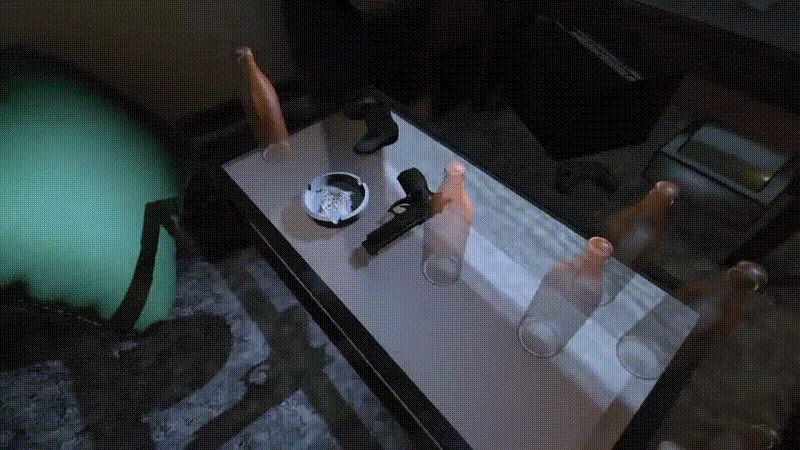
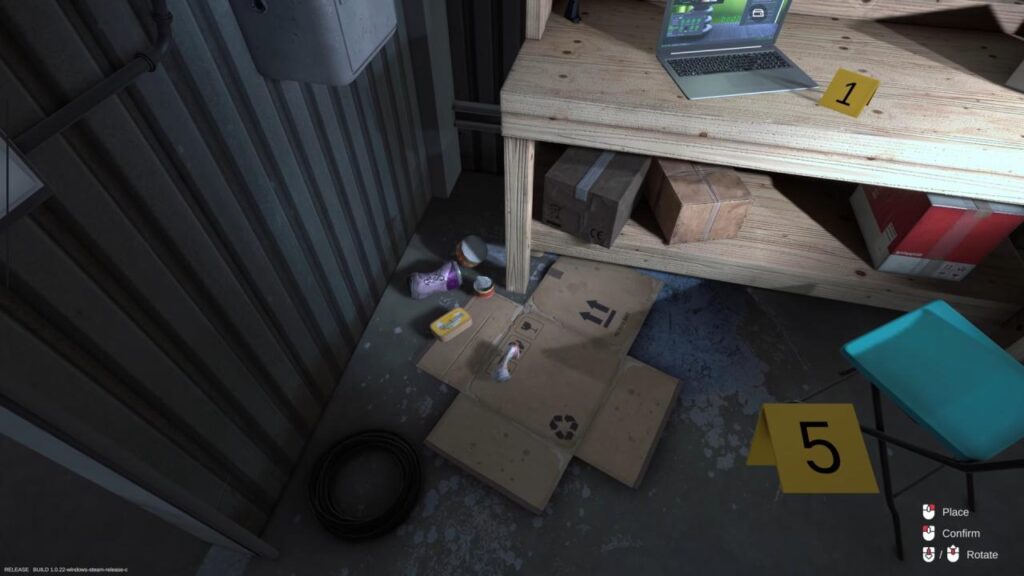
Forensics: Crime Scene Detective officially launched on July 13, 2026, for Windows PC, PlayStation 5, and Xbox Series X|S. Its official launch trailer arrived alongside the release and, at approximately 45 seconds, serves as a compact overview of the game rather than a complete tutorial. The footage quickly establishes the central premise through detailed crime scenes, numbered evidence markers, laboratory equipment, photography, and hands on forensic procedures. Blood stained rooms, displaced objects, bodies, and physical traces create a serious, clinical atmosphere without presenting the player as an armed action hero. Instead, the trailer reinforces the idea that the player arrives after the decisive event and must reconstruct what happened through careful examination and scientific interpretation.
Crime scene photography is one of the most important activities shown because players are expected to document evidence and its surrounding context before disturbing the scene. The trailer and supporting official materials also highlight fingerprints, biological traces, blood patterns, projectiles, cartridge cases, digital devices, and contextual objects. Different evidence categories require different recovery and analysis methods rather than relying on a single repeated hidden object mechanic. Laboratory work forms the second half of this process, with DNA comparisons, fingerprint analysis, ballistic examinations, trajectory reconstruction, test shots, and digital analysis allowing collected material to be tested against competing explanations.
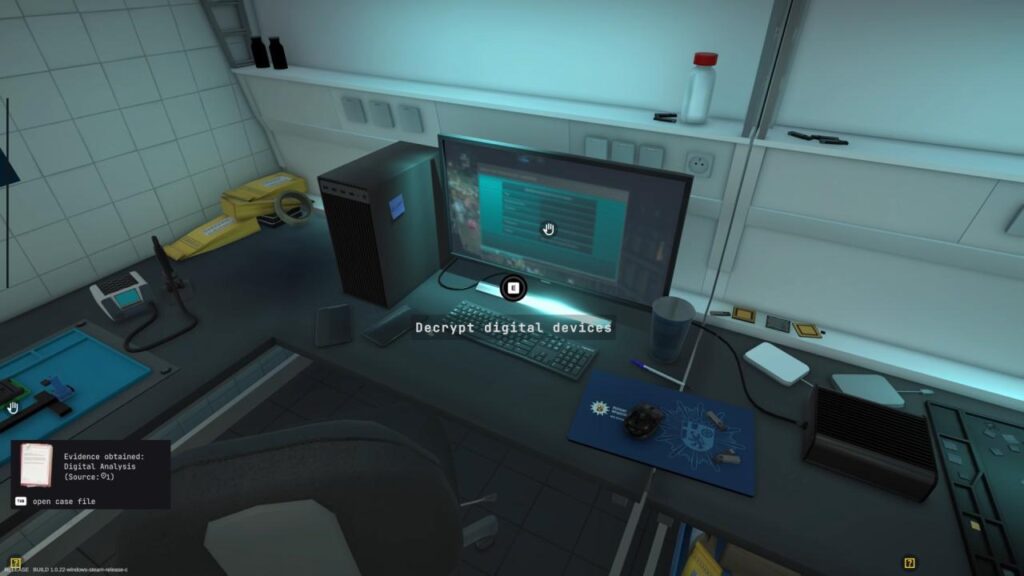
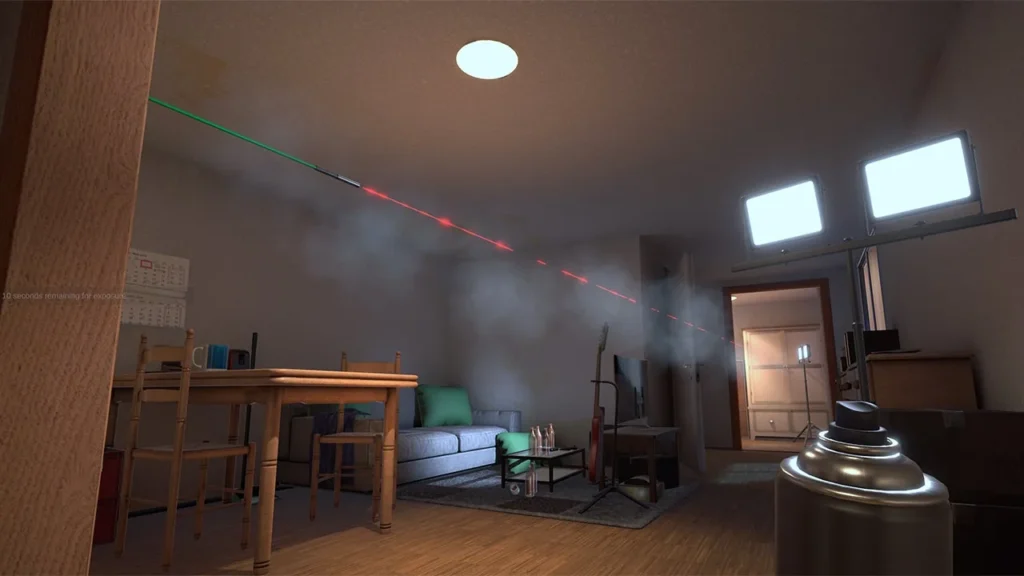
Digital devices such as smartphones can contain deleted messages, protected information, timestamps, or other details relevant to a case. Official achievements refer to device access, password based unlocking, chip related procedures, and the possibility of damaging a device through incorrect handling. These systems are presented as simplified forensic abstractions rather than technically complete digital forensic simulations. Ballistics receives similar attention, allowing players to recover projectiles, examine firearm related traces, conduct test shots, compare bullets, and reconstruct trajectories using impact points and other evidence. The trailer closes with an “Out Now” message, confirming its purpose as a release day presentation designed to establish the game’s tone and demonstrate the breadth of its investigative mechanics.
The July 13 launch covered all three officially supported platform groups simultaneously. The PC edition released through Steam, while the console versions became available through the PlayStation Store and Xbox storefront. Aerosoft also provided direct purchasing options and a physical PlayStation 5 edition in selected regions. A downloadable Steam demo remained available at launch, allowing PC players to sample the investigation format before purchasing the full game.
The supported launch platforms are:
- Windows PC through Steam
- PlayStation 5
- Xbox Series X|S
The Steam requirements list Windows 10 as the minimum operating system and Windows 11 as recommended, with no native macOS or Linux edition listed at launch. The PlayStation release is specifically identified as a PlayStation 5 game, with no PlayStation 4 version, while the Xbox edition is optimized for Xbox Series X|S and does not list an Xbox One release. No Nintendo Switch version was included in the official launch announcement. Future ports remain possible, but none should be assumed unless Binary Impact, Alchemical Works, or Aerosoft announces them separately.
Both console listings describe the game as a single player experience, with no competitive multiplayer, cooperative investigation mode, or online case sharing feature listed for the launch version. The PlayStation and Xbox releases support nine listed languages, including English, French, German, Italian, Spanish, Brazilian Portuguese, Polish, Turkish, and Simplified Chinese. Steam features include achievements, Steam Cloud, and Family Sharing.
The launch was followed by an initial update on July 14, 2026, addressing a case unlocking issue and improving parts of the opening experience and onboarding. This was significant because early player feedback included concerns about guidance, technical roughness, and progression reliability. Since the game had only recently launched at the time of the original research, review totals, ratings, and technical reports were still changing as more players completed cases, meaning early impressions represented the release build rather than a final assessment after months of updates.
Forensics: Crime Scene Detective Gameplay, Crime Scene Investigation, and Evidence Collection
Forensics: Crime Scene Detective is built around a structured cycle of crime scene examination, documentation, evidence recovery, laboratory testing, and interpretation. Each stage depends on the quality of the work performed earlier. Evidence that is never noticed cannot be analyzed, while an object that is poorly documented may lose important contextual information after it is removed. Players therefore examine each scene from a close, hands on perspective and must consider not only individual traces but also how their position, condition, and relationship to surrounding objects contribute to the reconstruction of events.
The investigation normally begins with documentation. The scene must be treated as a connected environment rather than a collection of isolated interactive objects. The position of a body, direction of a blood pattern, location of a projectile impact, placement of a weapon, and arrangement of personal belongings can become meaningful when examined together. Photography preserves the original state of these elements before anything is collected, allowing their location, orientation, condition, and surroundings to remain available for later interpretation. The game incorporates this principle by making evidence photography a recognized part of progression and the investigation process.
Players then search for visible and less obvious traces. Immediately noticeable evidence can include blood, weapons, cartridge cases, projectiles, damaged objects, or electronic devices. Other traces may require closer inspection, including fingerprints, biological residue, deleted digital information, or relationships between objects that only become significant once laboratory results are available. Some ordinary looking items can become important as well. A glass may contain a fingerprint, a smartphone may establish communication or timing, and an object’s position may contradict the apparent sequence of events.
Finding evidence is only the beginning. Players must determine how each trace should be documented, recovered, and analyzed. Major evidence categories include:
- Fingerprints: Suitable surfaces can be examined, prints processed and recovered, and usable impressions compared. The game simplifies real fingerprint techniques into interactive procedures while retaining the idea that fragile or invisible traces require careful handling.
- Biological evidence: Samples can be secured and later examined through DNA comparison. Official achievements confirm that biological traces can be collected and DNA comparison reports generated, while careless handling can compromise a sample.
- Firearms evidence: Projectiles, cartridge cases, weapons, and impact points can contribute to ballistic analysis. Players can recover projectiles, perform test shots, compare results, and reconstruct trajectories.
- Digital evidence: Smartphones and other devices can contain messages, files, timestamps, contacts, and deleted information. Access may involve passwords or hardware related procedures, while incorrect handling can damage or destroy the device.
After scene examination and collection, the investigation moves into the laboratory. Players can generate DNA comparison results, examine fingerprints, compare firearms evidence, conduct test shots, reconstruct trajectories, and access digital information. The developers compress procedures that would take considerably longer in real forensic work, but the underlying purpose remains the same: laboratory findings must be combined with scene observations to determine which explanation is best supported.
The game is therefore not simply about completing every available interaction or collecting every highlighted object. Players must understand what each result actually establishes. A DNA match may show that someone was present without proving when they arrived or what they did. A fingerprint can establish contact with an object, but its significance depends on the object’s location and circumstances. A bullet comparison may link a projectile to a firearm, while trajectory analysis can reveal where the shooter and target were positioned. Similarly, a threatening message can suggest motive without replacing physical evidence.
Context is especially important because individual clues rarely prove an entire case on their own. Finding blood does not automatically establish murder. Finding a firearm does not prove that the nearest person fired it. A fingerprint on a glass may indicate that someone handled it during the incident, or it may have been left during an earlier innocent visit. DNA can connect a person to a location without proving a specific action. Players are therefore encouraged to separate observation from conclusion and combine several forms of evidence before deciding what occurred.
The investigation can also go wrong. Evidence may be missed, mishandled, damaged, or interpreted incompletely. Official descriptions state that overlooked traces can leave a case unsolved, while achievements refer to mistakes such as ruining a fingerprint, compromising a sample, or destroying a digital device. Important clues are therefore not guaranteed to remain permanently available until the player chooses the correct answer.
This consequence based structure supports one of the game’s central ideas: identifying a suspect is not necessarily the same as establishing the nature of the incident. Evidence may ultimately support murder, self defense, an accident, or a staged scene. The most obvious explanation presented by the initial crime scene may therefore be misleading. The strongest approach is to treat each trace as an answer to a specific question, such as identity, presence, contact, timing, direction, ownership, or communication, and then determine whether the combined evidence supports or contradicts the apparent narrative.

Forensics: Crime Scene Detective Laboratory Analysis, Realistic Tools, Cases, and Forensic Methods
The laboratory is where evidence recovered at a crime scene is converted into comparative and interpretive information. It is not presented as a separate optional minigame area but as the second major stage of each investigation, providing the results needed to test theories developed during scene examination. This back and forth relationship between the crime scene and laboratory is one of the game’s strongest structural ideas. The crime scene gives evidence its context, while the laboratory gives that evidence additional meaning, and neither stage is sufficient on its own.
DNA analysis allows biological traces to be compared with reference samples. A matching result can connect a person to a biological trace, but the meaning of that connection depends on where the sample was found and whether there is an innocent explanation for its presence. The game compresses the time required for DNA testing, which in professional laboratories would take substantially longer than the interactive version suggests. Biological evidence collection equipment is used to secure material for this analysis, and although the interaction is simplified, the game retains the need to recover samples properly and protect them from damage. Achievement descriptions confirm both successful biological evidence recovery and the possibility of compromising a sample.
Fingerprint analysis serves a similar comparative purpose. Once a usable print has been recovered, it can help identify who touched a surface or object, but a fingerprint demonstrates contact rather than automatically proving guilt. Its significance must be evaluated alongside location, timing, ownership, and other evidence. Fingerprint examination is represented through tools and procedures used to locate, develop, preserve, and compare impressions. In professional practice, these processes can involve oblique lighting, specialized light sources, powders, chemical treatments, photography, and lifting materials. The game condenses these possibilities into accessible interactions rather than simulating every reagent and surface specific technique independently.
Ballistic analysis can involve projectiles, cartridge cases, test shots, impact documentation, and trajectory calculations. By comparing recovered evidence with controlled test material, players can investigate whether a particular weapon is consistent with a projectile, while trajectory reconstruction can help determine firing direction and possible positions within the scene. Ballistics equipment therefore supports projectile recovery, comparison, test firing, impact analysis, and trajectory reconstruction, allowing the player to examine not only whether a firearm was present but whether the physical evidence is consistent with a particular weapon and shooting position.
Digital laboratory work addresses protected or damaged devices. Players may need to gain access to stored information, recover relevant communications, or perform simplified hardware procedures involving passwords, protected systems, and chip level interactions. The developers have said that this area is deliberately abstracted. It communicates the investigative role of digital evidence without reproducing every technical procedure used by professional specialists or turning the game into a practical guide for bypassing device security.
The game also makes extensive use of laboratory reporting and comparison systems. DNA reports, fingerprint results, projectile comparisons, and digital findings organize the information generated by examinations, but they are not simply rewards for completing a minigame. These findings must be incorporated into the final reconstruction and compared with the original crime scene. A projectile match may identify a weapon while the trajectory challenges the claimed shooting position. DNA may establish that someone was present while smartphone data helps establish timing. A fingerprint may connect someone to an object, while blood patterns suggest that the object was moved after the incident.
The realism of these tools is functional rather than exhaustive. Forensics: Crime Scene Detective represents why a forensic instrument is used, what type of evidence it examines, and what conclusions it can support without reproducing every calibration requirement, laboratory accreditation standard, scientific limitation, or documentation form used in professional casework. Its realism is grounded in genuine forensic fields and investigative principles, supported by formal cooperation between Binary Impact and the State Criminal Police Office of Rhineland Palatinate. Workshops, specialist feedback, practical experience, and discussions of procedural standards helped shape the cases and mechanics.
Areas influenced by that cooperation include crime scene photography, evidence markers, documentation, fingerprints, DNA, biological traces, digital devices, ballistics, and chain of custody. The game also follows the broader forensic principle that evidence must be handled carefully and that conclusions should not exceed what a trace can scientifically establish. Its fingerprint mechanics draw from dactyloscopy, the forensic examination of finger, hand, and foot impressions, while its ballistic mechanics reflect real tasks such as documenting impacts, examining projectiles and cartridge cases, performing comparisons, and calculating trajectories. Digital forensics similarly reflects the need to preserve original data and examine devices under controlled conditions, although the game presents those processes in a more accessible form.
The developers have explicitly stated that the game should not be treated as training software. Laboratory turnaround times are shortened, tool selections are simplified, digital procedures are abstracted, and some steps are combined to make the experience playable. Its strongest realism therefore lies in investigative reasoning. Players are encouraged to document a scene before disturbing it, preserve material, choose appropriate examinations, distinguish presence from guilt, compare different results, and recognize the limitations of individual traces.
The launch version contains 14 cases described as authentic or plausible investigations inspired by real world forensic scenarios. The specific stories are fictional or altered, allowing the developers to create convincing investigative problems without directly recreating identifiable real cases. Crime scene locations include apartments, bars, basements, and other detailed interior environments where objects, surfaces, blood patterns, digital devices, weapons, and personal possessions can all contribute to the reconstruction.
Cases are designed around uncertainty rather than simply confirming the first explanation suggested by a scene. A location that initially appears to show a homicide may ultimately support self defense, an accident, or a staged crime. Case variety comes from the combination of location, evidence type, and possible explanation. One investigation may depend heavily on fingerprints and digital communications, while another may require careful ballistic comparison and trajectory work.
Biological evidence, blood patterns, deleted information, object placement, and contradictory traces can all influence the final conclusion. The game also permits incomplete outcomes, as missing a decisive trace or mishandling evidence can prevent the player from establishing what happened. This creates replay value for players who want to improve their procedure, locate overlooked material, or understand why an earlier conclusion was unsupported.
Forensics: Crime Scene Detective Developers, Publisher, and PC System Requirements
Forensics: Crime Scene Detective was developed by Binary Impact and Alchemical Works, with Aerosoft GmbH serving as the publisher responsible for bringing the game to PC, PlayStation 5, and Xbox Series X|S. Binary Impact is the studio most directly associated with the project’s concept, case construction, game systems, and creative direction, while Alchemical Works is listed as a co developer on the official Steam page. Aerosoft, known for publishing simulation focused games, handles publishing and commercial distribution.
The State Criminal Police Office of Rhineland Palatinate participated as a specialist cooperation partner rather than a commercial developer or publisher. Its experts contributed professional feedback and helped the development team understand relevant procedures, standards, and forensic disciplines, while Binary Impact retained responsibility for the game’s design and creative decisions. This distinction helps explain the balance between authenticity and accessibility. Professional feedback influenced the logic, terminology, and structure of the forensic work, while the developers determined how those processes would be transformed into interactive systems, fictional cases, pacing, and difficulty.
The PC version requires a 64 bit processor and operating system, with both the minimum and recommended specifications calling for DirectX 12 and approximately 15 GB of available storage.
Minimum requirements:
- Windows 10
- Intel Core i3 10100 or AMD Ryzen 3 3100
- 8 GB RAM
- Nvidia GeForce GTX 1050, AMD Radeon RX 560, or AMD Radeon RX 6400 class graphics card
- DirectX 12
- 15 GB available storage
Recommended requirements:
- Windows 11
- Intel Core i7 10700K or AMD Ryzen 7 3700X
- 16 GB RAM
- Nvidia GeForce RTX 2070 Super, Nvidia GeForce RTX 3060 Ti, or AMD Radeon RX 6700
- DirectX 12
- 15 GB available storage
The relatively modest storage requirement reflects the game’s focus on a defined collection of detailed indoor environments rather than a large open world. However, the recommended graphics specification is considerably higher than the minimum, suggesting that higher visual settings and stable performance in detailed crime scenes may benefit from a stronger GPU. This is particularly relevant because the official materials emphasize three dimensional environments in which small visual traces can be important to an investigation.
Players whose computers are close to the minimum specifications should consider trying the Steam demo before buying. A forensic game depends heavily on clear object interaction and careful visual examination, so stable performance and readable image quality can affect more than appearance alone. The demo remained available on the official Steam page at launch.
Frequently Asked Questions (FAQs)
- When was Forensics: Crime Scene Detective released?
Forensics: Crime Scene Detective was released on July 13, 2026. Its Windows PC, PlayStation 5, and Xbox Series X|S versions all launched on the same date, so players on the three supported platforms received access at the same time rather than through a staggered release schedule. - What platforms can run Forensics: Crime Scene Detective?
The official launch platforms are Windows PC through Steam, PlayStation 5, and Xbox Series X|S. The launch listings do not include native versions for macOS, Linux, PlayStation 4, Xbox One, or Nintendo Switch, meaning players need one of the supported current generation platforms or a compatible Windows PC to play the launch version. - Is Forensics: Crime Scene Detective a multiplayer game?
No. Official storefronts describe Forensics: Crime Scene Detective as a single player experience focused on independently examining crime scenes, collecting evidence, performing laboratory analysis, and reaching conclusions. There is no listed cooperative mode, competitive multiplayer mode, or online investigation component in the launch version. - How many cases are included in Forensics: Crime Scene Detective?
The launch version contains 14 cases, giving players multiple investigations with different locations, evidence types, and possible explanations. Crime scenes include places such as apartments, bars, and basements, while the available evidence may point toward murder, self defense, an accident, or an intentionally staged scene that requires closer examination. - Are the cases in Forensics: Crime Scene Detective based on real crimes?
The cases are fictional or substantially altered rather than direct recreations of identifiable real investigations. However, they are designed to remain plausible and draw inspiration from realistic forensic scenarios, with professional input helping the developers make the evidence, investigative procedures, and possible conclusions feel grounded without retelling actual crimes. - Can a player fail a case in Forensics: Crime Scene Detective?
Yes. Players can miss important evidence, accidentally damage material, overlook connections between clues, reach an incomplete conclusion, or leave an investigation unresolved. Simply progressing to the end of a case does not guarantee a perfect outcome, since the quality of the final conclusion depends on how carefully the scene was examined and how accurately the collected evidence was interpreted. - What types of forensic analysis are included?
The game includes several major areas of forensic investigation, including crime scene photography, fingerprint examination, biological evidence and DNA comparison, blood related evidence, ballistic comparison, projectile recovery, trajectory reconstruction, and simplified digital forensic analysis. These systems are used together to help players connect physical and digital evidence to possible events, suspects, and explanations. - Does Forensics: Crime Scene Detective have a free demo?
Yes. A downloadable demo was available through Steam at launch, giving Windows PC players an opportunity to experience the investigation format before purchasing the full game. The demo can be used to evaluate elements such as the controls, overall performance, crime scene examination mechanics, and the slower procedural pace of the forensic gameplay. - How much does Forensics: Crime Scene Detective cost?
The standard digital PC price in the United States was $24.99, although Steam offered an introductory price of $19.99 through July 27, 2026. The official United States Xbox price was also $24.99, while Aerosoft’s United States store listed the physical PlayStation 5 edition at $29.99. Prices can differ by region, platform, retailer, and any discounts available at the time of purchase. - Can Forensics: Crime Scene Detective be used as professional forensic training?
No. Although the game is informed by real forensic methods and was developed with specialist cooperation, it is intended as entertainment rather than certified professional training software. Laboratory timelines, investigative tools, digital procedures, and other technical processes are simplified or compressed to make them practical for gameplay, so they should not be treated as substitutes for formal forensic education or real laboratory procedures.
Conclusion
Forensics: Crime Scene Detective offers an uncommon approach to the investigation genre. Instead of treating scientific analysis as a background activity, it makes documentation, evidence recovery, laboratory work, and cautious interpretation the foundation of the experience. Its 14 cases ask players to examine detailed environments, identify relevant traces, preserve fragile material, compare results, and decide whether the evidence supports murder, self-defense, an accident, or deliberate staging.
The official launch trailer communicates this identity efficiently. Its short montage of marked crime scenes, physical evidence, laboratory procedures, digital devices, and ballistic work shows that the game is aimed at players who enjoy methodical deduction rather than action. The completed game launched on July 13, 2026, for Windows PC, PlayStation 5, and Xbox Series X|S.
Professional cooperation with the State Criminal Police Office of Rhineland-Palatinate strengthens the game’s procedural credibility. Fingerprints, DNA, ballistics, digital forensics, photography, documentation, and chain-of-custody principles are based on genuine forensic fields. At the same time, the game openly simplifies these methods and should not be mistaken for accredited training or a complete representation of laboratory practice.
The launch version is not without problems. Early reviews identified technical roughness, awkward interactions, repetition, and limited guidance, while initial Steam reception was Mixed. A first patch addressing progression and onboarding arrived immediately after launch, suggesting that the release build may continue to improve.
For players fascinated by evidence, crime scene reconstruction, and the limits of scientific conclusions, Forensics: Crime Scene Detective presents a distinctive and potentially rewarding simulation. Its value is greatest for an audience willing to work slowly, accept imperfect outcomes, and approach each scene as a scientific problem rather than a conventional mystery with an automatically revealed answer.
Sources and Citation
- Forensics Crime Scene Detective Official Steam Store Page
https://store.steampowered.com/ - PlayStation Store Forensics Crime Scene Detective
https://store.playstation.com/ - Xbox Forensics Crime Scene Detective Official Store Page
https://www.xbox.com/en-US/games/store/ - Binary Impact Forensics Crime Scene Detective Official Game Page
https://binary-impact.de/ - Aerosoft Forensics Crime Scene Detective Official Game Page
https://www.aerosoft.com/ - Aerosoft Forensics Crime Scene Detective PlayStation 5 Physical Edition
https://www.aerosoft.com/en/shop/ - Rhineland Palatinate State Criminal Police Office Official Website
https://www.polizei.rlp.de/die-polizei/dienststellen/landeskriminalamt - Forensics Crime Scene Detective Official Steam Achievements
https://steamcommunity.com/stats/ - Forensics Crime Scene Detective Official Steam News and Updates
https://store.steampowered.com/news/ - Forensics Crime Scene Detective Steam Community and Developer Announcements
https://steamcommunity.com/ - Aerosoft Official YouTube Channel Forensics Crime Scene Detective Launch Trailer
https://www.youtube.com/@AerosoftOfficial - Binary Impact Official Website
https://binary-impact.de/
Recommendations
- The Mandalorian and Grogu Review
- Star Wars Eclipse: Everything We Know About Quantic Dream’s Ambitious Star Wars Game
- Madden NFL 27 Apple Arcade Edition Arrives August 6: Release Date, Features, and Devices
- Lanterns HBO TV Series Cast and Characters: Who’s Confirmed for the DC Show
- VisionQuest Disney+ Release Date Finally Confirmed: Marvel Reveals Major MCU Return
- Nintendo Switch Online Adds 3 Game Boy Games and 1 GBA Classic
- Scooby-Doo: Origins — First Look at the Cast and Full Title Revealed for Netflix’s Live-Action Series
- Marvel’s Wolverine Shines Again Ahead of September 15, 2026: Gameplay Breakdown and New Details
- The View Keeper Add-on: Why Every Blender Artist Needs It
- Freelance and Indie Commercial License



































































































