









In This Article (16 sections)
What Is Google GNM Head and How Its Parametric Face System Works
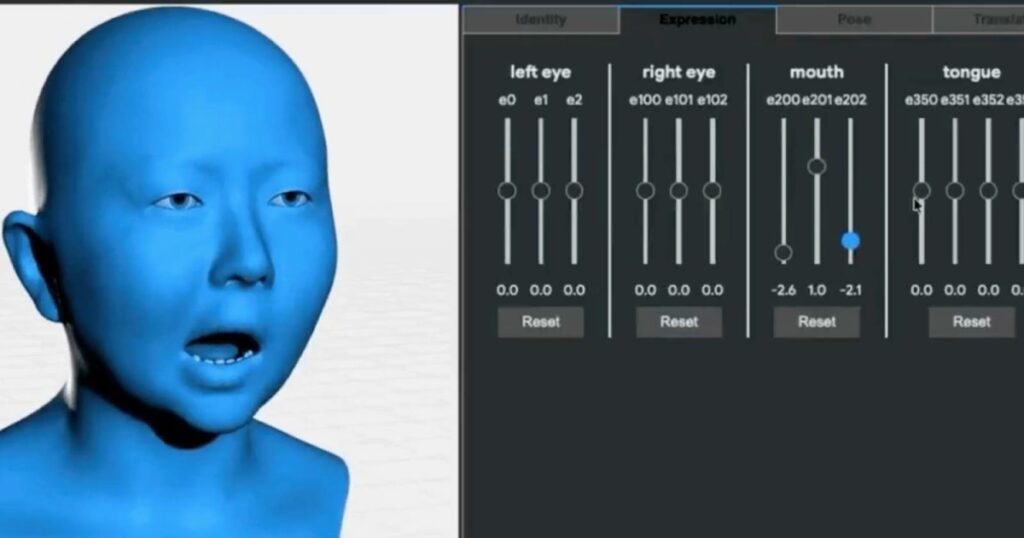
GNM Head is a high fidelity parametric statistical model of human head and facial geometry learned from a large collection of three dimensional scans. Instead of storing every possible face as a separate mesh, it uses a template and mathematical bases that describe how the geometry can change. Identity coefficients modify relatively permanent anatomical characteristics such as head width, jaw structure, eye placement, dental shape, and other distinguishing features, while expression coefficients control temporary changes such as smiling, blinking, opening the mouth, moving the tongue, or altering the lower face.
The system generates vertex positions by combining template geometry with identity and expression variations before applying joint rotations, skinning information, eye orientation, head pose, and global translation. Because these variables are separated, developers can change expressions without altering identity or reposition a head without regenerating its underlying facial structure.
The model contains considerably more anatomy than a visible facial shell. GNM Head includes skin, eyeballs, corneas, teeth, gums, and tongue geometry, making it useful for close up animation, speech deformation, facial tracking, reconstruction, and digital human research. Its current parameter structure includes:
- 253 identity parameters: 170 head components, three eyeball components, and 80 dental components.
- 383 expression parameters: 100 components for the left eye, 100 for the right eye, 150 for the lower face, 32 for the tongue, and one for the iris.
- Additional transformation controls: head pose, eye rotations, joint parameters, and global translation.
The organization gives developers independent control over different anatomical regions. Dental variation can remain specific to an identity while facial expressions change around it, each eye can deform independently, and tongue controls provide a foundation for speech related animation and mouth interior rendering. Statistical components do not always behave like conventional sculpting sliders, however, because one parameter may influence several anatomically related features rather than representing a single familiar adjustment such as jaw width.
Semantic Samplers and Distinctions from Other Models
GNM Head also includes semantic samplers that make these large parameter spaces easier to use. The ExpressionSampler can generate parameter combinations associated with recognizable expressions such as happiness or surprise, while the IdentitySampler can produce identities using supported demographic categories. Expression values can also be blended to create intermediate states or adjust intensity. Google notes an important limitation with the IdentitySampler: its training data uses binary gender classifications and four broad demographic groups, which do not represent the complete range of gender identities or worldwide human diversity. These labels should therefore not be treated as universal descriptions of human populations or used to support unsupported medical, social, demographic, or identity conclusions.
GNM Head follows the same broad statistical principle as traditional 3D morphable models, but expands it through denser head coverage, internal anatomy, extensive expression controls, semantic sampling, and modern software support. Many older morphable models concentrate heavily on the visible front of the face and may provide limited geometry for the full cranium, teeth, tongue, corneas, or mouth interior. GNM Head is intended as a full human head model rather than simply a front facing facial mask.
It also differs from AI generated 3D head systems. Despite the word “Generative” in its name, GNM Head is not a text to 3D or image to 3D system that invents unrestricted geometry through a neural network. It has known topology, defined anatomical components, fixed parameter dimensions, structured UVs, and predictable outputs. Identical parameters should reproduce identical geometry, making the model useful for rigging, testing, dataset generation, animation, and production pipelines where consistency matters.
Neural Integration and Programmable UV Layouts
A neural system can still be built around GNM Head. For example, a network could predict its identity and expression coefficients from photographs, video frames, landmarks, depth information, or another input. The neural model would then drive a structured parametric head rather than directly generating uncontrolled geometry. This approach combines machine learning flexibility with a predictable character representation and makes quality control easier because parameter values can be inspected and constrained.
GNM Head also provides structured UV layouts for the skin, teeth, tongue, eye interiors, and eye exteriors, with both quad and triangulated UV coordinates. The left and right eyes share overlapping UV regions to use texture space efficiently. Together with its geometry, semantic controls, pose parameters, and internal anatomy, these features make GNM Head a programmable digital head foundation rather than simply a downloadable mesh.

How to Download GNM Head and Use It With Blender, PyTorch, TensorFlow, JAX, and NumPy
GNM Head is distributed through Google’s official GNM repository on GitHub. The package includes the Python implementation, model assets, semantic sampler files, fitting helpers, data validation schemas, camera projection tools, visualization utilities, demonstration notebooks, and supporting documentation. The official instructions recommend creating a clean Python environment before installation. The package has been tested with Python 3.13, although community integrations may use other compatible Python versions.
After cloning the repository and entering the relevant gnm/shape package directory, users can perform an editable installation of the core package or add optional framework dependencies. Installing only the frameworks required for a project is generally more practical because full machine learning stacks can consume substantial storage and may introduce GPU, operating system, or hardware specific dependencies.
GNM Head officially supports four computational backends:
- NumPy: Best suited to straightforward mesh generation, data inspection, export utilities, semantic sampling, and workflows that do not require automatic differentiation.
- PyTorch: Useful for neural network training, differentiable fitting, inverse graphics, parameter prediction, and optimization against landmarks, scans, depth data, or rendered images.
- TensorFlow: Offers similar differentiable workflows for projects already based on the TensorFlow ecosystem and is also relevant to the supplied semantic sampler models using H5 data.
- JAX: Suitable for automatic differentiation, vectorization, accelerator based numerical experiments, and high performance research workflows.
The NumPy implementation is described as the primary implementation and is a practical starting point for users who simply want to generate meshes. Loading the Version 3 head gives access to template vertices, triangles, identity dimensions, expression dimensions, joints, and callable mesh generation. Zero identity and expression values return the template head, while changing identity coefficients alters physical characteristics and expression coefficients deform the face. Documentation describes a typical statistical range of approximately minus three to plus three, although extreme parameter values can produce implausible results and should be tested carefully.
Generated geometry can be passed into a mesh library such as Trimesh, exported to OBJ or another supported format, visualized directly, or integrated into a custom rendering or reconstruction pipeline. Demonstration notebooks cover identity sampling, expression sampling, blending, head generation, and related experimentation, making the repository useful for both direct development and research.
Blender Integration and Community Add-ons
Blender integration currently comes primarily from community projects rather than an official Google character interface. The basic workflow is straightforward: developers can generate a head through Python, export the mesh, and import it into Blender. Community add ons provide a more artist friendly alternative by exposing GNM Head controls directly in the Blender interface.
One community extension developed by Alexander Börner uses Blender’s extension format, lists Blender 4.2 or later as a requirement, and was developed using Blender 5.x. Its installation involves downloading the extension archive, opening Blender Preferences, selecting Get Extensions, choosing Install from Disk, and installing the archive. The extension then creates a managed local Python environment and retrieves GNM Head from Google’s repository. A panel in the 3D Viewport allows users to generate and manipulate heads while a local server processes parameter changes.
That integration exposes semantic identity and expression generation, component visibility, identity sliders, expression sliders, pose parameters, region based randomization, and identity baking. Users can display or remove the eyes, teeth, tongue, and corneas while retaining the model’s quad topology. The add on warns that some masked edits are stored only temporarily in memory and may not survive a restart unless the identity is baked, so important variations should be baked or exported before closing a project.
Other free importers have also appeared for newer Blender versions, demonstrating slider based manipulation and direct viewport control. These tools show how easily GNM Head can be wrapped in artist focused interfaces, but they remain community projects rather than official Google Blender products. Requirements, installation procedures, licenses, and supported features can differ between add ons, so users should consult the documentation for the specific integration they choose.
Other DCC Applications and Integrations
The model is also suitable for integration into other digital content creation applications because its geometry and parameters are programmable. Community interest has already extended toward Blender, Houdini, and 3ds Max workflows. However, compatibility should not be confused with official support, and production teams should verify the maturity and maintenance status of third party integrations before building critical pipelines around them.
Best Uses for Google GNM Head in Games, Animation, Research, and Character Pipelines
One of the strongest uses for GNM Head in game development is procedural NPC generation. A studio can sample or author many identities while retaining a common topology, making it easier to reuse rigs, UV layouts, textures, deformation systems, animation transfers, level of detail generation, and automated processing. Instead of manually sculpting every background character from an unrelated base mesh, artists can begin with statistically varied heads that share the same structural foundation.
GNM Head can also serve as a high resolution source for custom hero or supporting characters. Artists can generate a suitable identity, make art directed sculpting changes in Blender, Maya, ZBrush, or another application, retopologize or optimize the result where necessary, bake normal maps, create textures and hair, and then connect it to a production facial rig. It is therefore useful as a starting point rather than a complete finished game character.
Facial animation is another major application. The 383 expression dimensions provide detailed deformation information that can be mapped to performance capture, audio driven animation, facial tracking, or proprietary animation systems. Because these controls are statistical components rather than animator friendly production shapes, studios may want to construct a semantic layer that converts familiar animation controls into combinations of GNM coefficients.
The same approach can be used for player character customization. Rather than exposing hundreds of raw parameters, a game could present controls such as head width, jaw prominence, eye shape, dental variation, facial proportions, or expression presets. Internally, each understandable slider could modify one or more statistical dimensions. Studios could build these mappings manually or learn them from examples and then constrain the resulting ranges to keep characters anatomically plausible.
Synthetic Data and Pipeline Applications
GNM Head is also well suited to synthetic data generation. Teams developing facial tracking, gaze estimation, expression recognition, avatar reconstruction, inverse rendering, landmark prediction, or related perception systems can generate controlled identities and expressions while retaining known ground truth parameters and geometry. This makes it easier to produce labeled datasets without relying entirely on manually annotated real world captures.
Other useful applications include crowd generation, digital doubles, dialogue system prototyping, camera framing tests, facial shader development, rigging research, standardized research meshes, reconstruction experiments, and automated quality assurance. The model’s consistent topology means the same vertex indices represent corresponding anatomical regions across generated identities, which can simplify landmark placement, skinning transfer, blendshape conversion, UV reuse, rig generation, and automated validation.
That shared structure can significantly improve character production pipelines. Traditional approaches may begin with manual sculpting or a small collection of base meshes, which works well for hero characters but becomes expensive when a production needs dozens or hundreds of distinct faces. GNM Head gives artists a consistent statistical starting point from which they can choose promising identities and perform the creative work that remains necessary.
Studios can also create internal art direction layers. Terms used by character designers could be mapped onto validated combinations of GNM parameters, allowing artists to work with meaningful concepts while a technical system controls the statistical dimensions underneath. Once those mappings are established, they can form the basis of a reusable studio character generator.
The framework support also helps bridge research and art departments. Machine learning engineers can manipulate the same model directly through PyTorch, TensorFlow, or JAX, while artists receive exported geometry or work through a Blender interface. Both groups remain connected to the same parameter definitions and topology, reducing the translation problems that can arise when research prototypes and production assets use completely different representations.
Limitations and Intended Users
GNM Head should not be treated as a replacement for character artists, riggers, technical artists, or animators. It does not automatically provide finished hair, production skin textures, clothing, a complete body, final materials, a game ready facial rig, optimized topology for every target platform, or artistic style. Those elements still require substantial production work. Its advantage is reducing repetitive anatomical setup while providing a technically consistent starting point.
The model is particularly relevant to technical artists, research engineers, computer vision specialists, machine learning developers, character pipeline engineers, rigging developers, animation tool creators, game studios, visual effects teams, and academic researchers. Independent Blender artists can also benefit from community interfaces when they want controllable realistic head variation without building the underlying statistical model themselves.
Researchers can apply it to face reconstruction, expression analysis, gaze estimation, inverse rendering, avatar animation, geometric fitting, and comparative machine learning experiments. Film and visual effects teams can investigate digital doubles, background characters, fitting systems, and facial rig development. Game developers can use it for NPC populations, customization, synthetic datasets, and facial animation systems. Users who want an immediately complete textured, haired, clothed, full body character generator may find the official package too technical without additional tools.
GNM Head Licensing and How It Compares With FLAME, SMPL X, and Other Head Models
Google released the GNM ecosystem under the Apache License 2.0, a permissive license intended to support both commercial and noncommercial applications. In general, Apache 2.0 permits users to use, modify, distribute, and incorporate covered material into commercial projects as long as they comply with the license requirements. These commonly include preserving required copyright notices, providing the license when distributing covered material, identifying significant modifications where required, and respecting the associated patent provisions.
Commercial usability does not mean every component surrounding a GNM Head workflow automatically carries the same terms. Community Blender extensions may use licenses such as the GNU General Public License, while additional textures, training datasets, libraries, proprietary tools, or exported assets may have their own conditions. Production teams should document which GNM version they use, preserve required notices, review bundled dependencies, and distinguish Google’s licensing from that of third party integrations.
Open licensing also does not override privacy, biometric, publicity, discrimination, or employment law. A company cannot assume that an Apache licensed head model grants permission to copy a real person’s likeness, process personal scans without authorization, or deploy biometric applications without considering applicable legal requirements. High risk commercial deployments should undergo appropriate legal and privacy review.
Licensing is one area in which GNM Head can differ from traditional academic morphable models. Human model licenses vary significantly. Some permit academic research while placing restrictions on commercial deployment, redistribution, or particular applications. GNM Head was released specifically as an open ecosystem with broader reuse in mind, although the exact Apache terms still need to be followed.
GNM Head vs FLAME and SMPL X
GNM Head can also be compared with established parametric models such as FLAME and SMPL X, but their intended scopes differ. FLAME is a widely used parametric model of the human head and face with identity, expression, jaw, neck, and eye related controls. Its long established research ecosystem gives it extensive compatibility with facial fitting methods, neural rendering work, reconstruction research, and published pipelines.
GNM Head differentiates itself through its large number of identity and expression dimensions, independent eye and lower face controls, dental identity variation, tongue deformation, internal anatomy, semantic samplers, multi framework implementations, and permissive release. These features make it attractive when a project needs highly controllable head geometry and wants the same representation available through several numerical and machine learning environments.
SMPL X serves a different purpose because it represents the entire human body, including expressive facial geometry and hands. It is more appropriate when a production or research system needs a unified body representation. GNM Head focuses specifically on detailed head geometry and is not a complete substitute for a whole body character model.
A production can combine GNM Head with a separate body model, but doing so requires technical work. Teams must reconcile neck geometry, scale, pose definitions, joints, skinning, topology, textures, coordinate systems, and animation conventions. Combining two parametric systems is therefore possible but not automatically seamless.
Neural Alternatives and Selecting the Right Model
Neural approaches based on radiance fields, signed distance fields, or 3D Gaussian representations offer another alternative. They can produce highly realistic appearance, including complex hair, skin detail, and view dependent effects, particularly when trained from captured imagery. However, they may require greater computational resources and often lack the same predictable editable mesh topology provided by a conventional statistical head model.
The best choice depends on the objective. GNM Head is particularly attractive when projects need structured, controllable, consistently indexed head geometry, detailed internal facial anatomy, broad framework interoperability, and flexible licensing. FLAME remains valuable for compatibility with a large existing facial research ecosystem. SMPL X is stronger when unified full body representation is essential, while neural head systems may be preferable when photorealistic rendering from captured data matters more than conventional mesh editing and deterministic topology.

Frequently Asked Question (FAQs)
- What does GNM Head stand for?
GNM stands for Generative aNthropometric Model. Google says the name is pronounced “genome,” which reflects the project’s goal of building a broader ecosystem of accurate parametric models for representing human anatomy rather than treating GNM Head as an isolated facial mesh. - Is GNM Head a generative AI model?
GNM Head is primarily a parametric statistical geometry model learned from three dimensional scan data. It generates head shapes by adjusting structured identity and expression parameters, so it is different from text to 3D or image generation systems that synthesize unrestricted geometry. It can still be used inside AI pipelines, such as systems that predict GNM parameters from images or video. - How many parameters does GNM Head have?
The current Version 3 model includes 253 identity parameters and 383 expression parameters. The identity controls cover the head, eyeballs, and teeth, while expression controls are divided across the eyes, lower face, tongue, and iris. The model also accepts joint rotations and global translation values for posing and positioning the generated head. - Does GNM Head include teeth and a tongue?
Yes. GNM Head includes more than the visible facial surface, with geometry for the skin, eyes, corneas, teeth, gums, and tongue. Its identity space includes dental variation, while its expression system contains dedicated tongue controls, making the model more useful for speech animation, close up facial work, and digital human research. - Can GNM Head create facial expressions?
Yes. The expression system contains separate controls for the left eye, right eye, lower face, tongue, and iris, allowing different regions to change independently. Google also provides a semantic expression sampler that can generate recognizable expression categories and blended states without requiring users to manually adjust hundreds of raw parameters. - Can GNM Head be used in Blender?
Yes. GNM Head meshes can be generated through Python, exported in a standard mesh format, and then imported into Blender. Community developers have also created Blender add ons that expose identity, expression, pose, and component controls directly in the interface. These integrations are not official Google Blender tools, so their compatibility, installation requirements, and licenses can differ. - Does GNM Head work with PyTorch?
Yes. The official package includes an optional PyTorch implementation, making it suitable for differentiable optimization, neural network training, fitting, and parameter prediction. GNM Head also supports NumPy, TensorFlow, and JAX, allowing developers to choose the framework that best matches their existing research or production pipeline. - Is Google GNM Head free for commercial projects?
The official GNM repository uses the Apache 2.0 license and is intended for both commercial and non commercial use. Developers still need to comply with the license requirements, preserve required notices, and separately review the terms of any third party add ons, libraries, textures, or other tools used alongside GNM Head. - Can GNM Head generate a complete human body?
No. The currently released GNM Head package focuses specifically on detailed human head geometry rather than a complete body. Google describes GNM as a broader ecosystem and has indicated that additional parametric human models are part of the wider direction, but specific future body models, features, or release dates should not be assumed until they are officially announced. - What are the main limitations of GNM Head?
GNM Head is a technical foundation rather than a complete ready to ship digital human. It does not automatically provide finished hair, clothing, full body geometry, production textures, or a final animation rig, so artists and developers still need to build those parts of the character pipeline. Google also notes that the released training categories use binary gender labels and four broad demographic groups, which do not represent the full diversity of the global population.

Conclusion
Google Open-Sources GNM Head, 3D Parametric Human Head Model gives developers and artists access to a highly controllable statistical representation of human head geometry. Its 253 identity parameters, 383 expression parameters, internal anatomical components, UV data, semantic samplers, and support for NumPy, JAX, PyTorch, and TensorFlow make it a versatile foundation for research and production-tool development.
GNM Head is not a complete character creator, a full human-body model, or a replacement for character artists. It is a structured geometry system that can support custom head generators, facial rigs, game characters, digital doubles, synthetic datasets, animation tools, and reconstruction pipelines.
Its Apache 2.0 license significantly expands the ways in which companies and independent developers can experiment with the technology. Community Blender and digital content creation integrations are already making the model easier to use outside Python based research environments.
The release also comes with important responsibilities. Users must consider demographic limitations, representation, privacy, likeness rights, dependency licensing, and the differences between statistical components and intuitive artistic controls.
As the GNM ecosystem develops, GNM Head could become an important bridge between classical morphable models, modern machine learning, and practical digital character creation. Its long term impact will depend not only on the accuracy of the model but also on the quality of the tools, documentation, research, and responsible applications built around it.
Sources and Citation
- Google GNM GitHub Repository Generative aNthropometric Model and Ecosystem
https://github.com/google/GNM - Google GNM Official Repository README
https://github.com/google/GNM/blob/main/README.md - Google GNM Shape Official Documentation
https://github.com/google/GNM/blob/main/gnm/shape/README.md - Google GNM Apache License 2.0
https://github.com/google/GNM/blob/main/LICENSE - Google GNM Head Technical Report
https://arxiv.org/abs/2607.23687 - CG Channel Google Open Sources GNM Head Its Parametric Human Head Model
https://www.cgchannel.com/2026/07/google-open-sources-gnm-head-its-parametric-human-head-model/ - Alexander Börner GNM Head Add-on for Blender
https://github.com/derQwertzus/GNM-Head-Add-on-for-Blender - Alexander Börner GNM Head Blender Add-on Documentation
https://github.com/derQwertzus/GNM-Head-Add-on-for-Blender/blob/main/README.md - Google XR Blocks GNM Head Explorer
https://github.com/google/xrblocks/blob/main/demos/gnm/README.md
Recommendations
- Assassin’s Creed: Black Flag Resynced – Havana 100% Collectibles Guide
- Wonder Dynamics: VFX with AI-Powered Wonder Studio
- First Look at Modern Warfare 4 on Switch 2: Gameplay, 60 FPS, Controls and Features
- Sony Honda Mobility Wants Game Devs To Build Apps for the Afeela EV: AFEELA Creator Hub, SDK, and In-Car App Platform Plans
- WWE 2K26 Ringside Pass Season 4 Adds The Hardy Boyz, Jelly Roll and Lady Shani
- Pokopia Metacritic Score Explained: Why It’s 2026’s Highest-Rated Pokémon Game and the Best Pokémon Title of All Time
- Hack 95: Release Date, Gameplay, Demo, Story, and More
- Nintendo Seeks Dismissal of Consumer Lawsuit Over Switch Tariff Refund
- Belkin Charging Case Pro for Switch 2 Review: Price, Battery Life, Features, and Is It Worth It?
- “Our Goal Is to Not Have a Huge Gap”: Boss Confirms Harry Potter Series Won’t Be Annual as Season 2 Scripts Remain Unfinished



































































































