







In This Article (11 sections)
Hearth and Hamlet Release Date, Launch Details, and Kingdom-Building Premise
Hearth and Hamlet was released on August 19, 2026, as a complete PC game on Steam rather than an Early Access title. Developed by Phorust Studios and published by Runic Forge and Gamersky Games, the cozy incremental city builder officially launched after attracting substantial attention through its free demo and prerelease campaign. An official announcement listed the launch time as 17:00 UTC+1, which is equivalent to 16:00 UTC.
Steam’s recorded unlock timestamp also placed the release at approximately 16:00 UTC on August 19, confirming that the apparent difference resulted from the time zone notation rather than a launch delay. Although the game arrived as a full release, Phorust Studios began issuing patches shortly afterward to address bugs, improve performance, and refine parts of the interface. The first updates adjusted research book navigation, resource gathering controls, portals, tutorials, and memory use.
Interest in Hearth and Hamlet was already significant before its release. The free demo surpassed 100,000 lifetime unique players, while the full game accumulated more than 150,000 Steam wishlists shortly before launch. According to a postlaunch announcement distributed on behalf of the developers and publishers, Hearth and Hamlet sold approximately 50,000 copies during its first 24 hours and reached 100,000 sales within seven days.
These figures indicate that the game found an audience beyond traditional city-building enthusiasts, with its pixel-art presentation, accessible controls, and incremental progression appealing to players who enjoy watching settlements develop without individually managing every road, production building, or citizen. Hearth and Hamlet is exclusively a single-player experience, with no cooperative or competitive multiplayer mode, and players do not need to maintain an active multiplayer connection to operate their kingdom.
Hearth and Hamlet is a medieval fantasy city-builder clicker centered on transforming a small frontier camp into a prosperous magical kingdom. The settlement begins with little more than a campfire, a tent, and a small population. Through resource gathering, construction, research, and government decisions, that modest camp gradually develops into a village, a town, and eventually a larger civilization. The central fantasy involves more than creating a visually attractive medieval settlement, as players must also govern the community by deciding how workers are assigned, which technologies receive priority, what laws should be introduced, and how the population should respond to economic or military pressure.
The game presents this progression within a warm pixel-art world filled with rivers, lakes, forests, swamps, and distant territories. Although the atmosphere is designed to feel welcoming and relaxing, the expanding kingdom gradually introduces more complicated systems. Players must produce food, collect construction materials, generate gold, maintain happiness, research upgrades, establish trade, and prepare defenses. Magic becomes increasingly important as the settlement advances, allowing a community that initially depends on ordinary gathering and basic medieval buildings to eventually support alchemical facilities, magical academies, portals, and other supernatural developments. This transition creates a sense of escalation beyond the usual progression from wooden huts to stone castles.
Hearth and Hamlet does not operate like a narrative-heavy role-playing game built around a fully controlled protagonist. Its story emerges largely through the kingdom’s growth, the appearance of new locations, progression events, and the problems encountered by the settlement. Players oversee an entire civilization rather than directly controlling one resident, making visible transformation the foundation of the experience. Every important upgrade moves the settlement closer to becoming the promised kingdom, while newly introduced systems steadily broaden the player’s responsibilities. This approach keeps progress easy to understand even as the economy and management systems become more complicated.

Hearth and Hamlet Gameplay, Resource Management and Kingdom Expansion
Hearth and Hamlet combines manual resource gathering, automated production, worker management, construction and incremental upgrades. Early progress depends on collecting enough food and materials to support the first residents and structures, but more of the process can be automated as additional workers and buildings become available. The main decisions revolve around priorities, since resources can be invested in new buildings, storage improvements, population growth, research or defensive preparations.
Spending everything on rapid expansion may create shortages elsewhere, while saving excessively can delay access to new features. The progression loop is deliberately gradual: gathering enables construction, construction increases capacity, capacity supports population growth, and a larger population provides more workers. Those workers then accelerate production, opening the way to further research and increasingly sophisticated buildings.
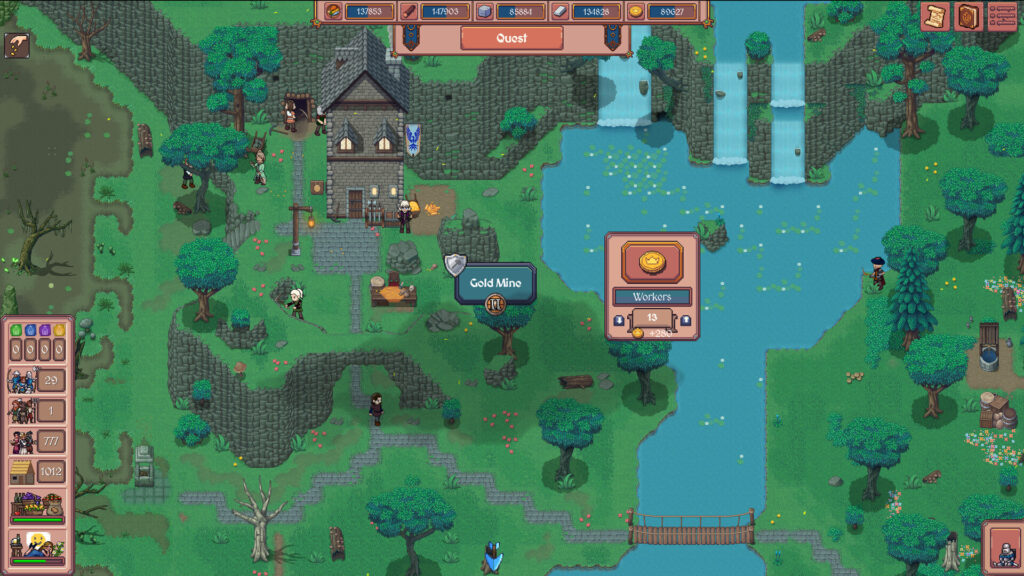
Resource gathering begins as a hands-on process, with players interacting with gathering locations to collect essential materials before assigning workers to maintain production over time. This mixture of active and passive income is one of the game’s defining features. Food, wood, stone and gold are among the fundamental resources identified in the official description. Food sustains population growth, wood and stone support construction, and gold becomes increasingly important for government, trade and advanced development. Other materials appear as the kingdom reaches more complicated economic and military stages.
Manual gathering remains useful for accelerating progress whenever a particular material becomes a bottleneck, allowing players who prefer a more active experience to continue interacting with resource locations while those seeking a slower rhythm rely more heavily on automated production. Post launch patches also introduced a “Hover to Click” setting to reduce the need for constant clicking or holding, showing that the developer responded to concerns about repetitive interaction.
Workers can be assigned to tasks that generate resources over time, but effective management requires maintaining enough labor in every necessary sector without creating serious shortages elsewhere. A large construction project may require greater wood or stone output, while population expansion places additional pressure on the food supply. Production must also be considered alongside storage because a resource generator cannot deliver its full value when the settlement repeatedly reaches its stockpile limit. Increasing storage capacity therefore becomes important before saving for expensive buildings or research. Worker management grows more demanding as the kingdom expands because new buildings, trade systems and military units compete for the same productive capacity.
Soldiers consume resources that could otherwise support civilian growth, meaning that recruiting too many defenders too early can weaken the economy even if it makes the settlement safer. Happiness also affects productivity, so policies that improve morale can strengthen output, while decisions that frustrate residents may reduce the value of aggressive taxation or rapid expansion. Workers are consequently part of a broader social and economic system rather than simple production multipliers.
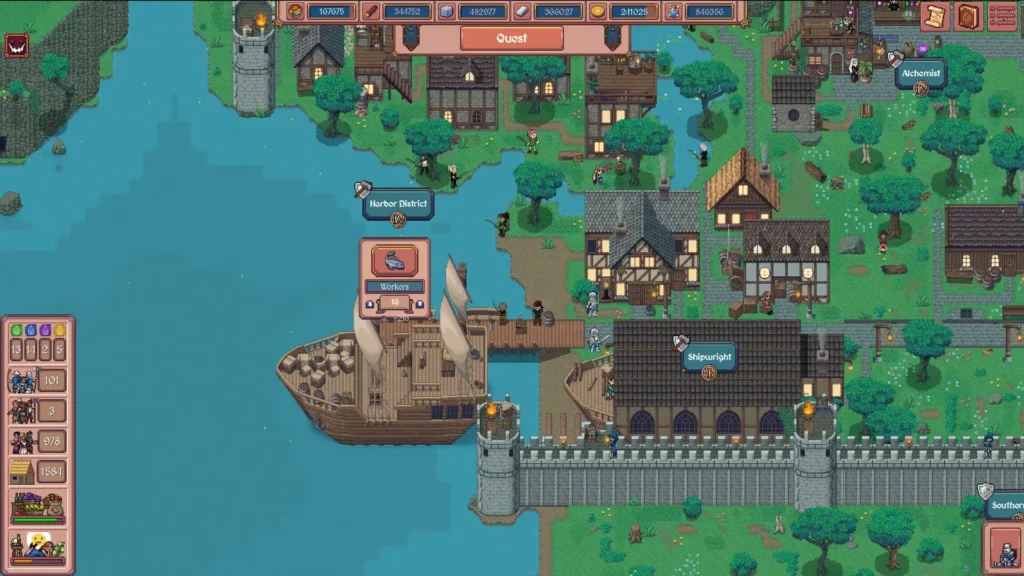
Construction is closely tied to progression because players do not receive unrestricted access to every building at the beginning. New structures become available as the settlement develops and technologies are researched, with the confirmed selection ranging from simple tents and taverns to markets, town halls, banks, barracks, castles, magical academies and defensive fortifications. Roads support the kingdom’s wider growth, while commercial and specialist buildings create opportunities for more advanced resource chains. These structures also contribute to the kingdom’s visual development, allowing the surroundings to evolve from a wilderness camp into a dense medieval and magical civilization filled with increasingly impressive and active locations.
The city building is less spatially freeform than games centered on manually designing street grids and zoning districts. Hearth and Hamlet emphasizes predetermined settlement development, production values and upgrade choices. Players influence how quickly the kingdom expands and which systems receive resources, but they do not have unlimited control over the physical placement of every structure. This distinction is important when setting expectations. The game provides the satisfaction of watching a city grow, but its mechanics are closer to an incremental management game than a conventional urban planning simulator.
Kingdom expansion follows a layered path in which players first secure basic survival, improve resource generation, increase population capacity and then unlock more advanced institutions. Reliable food and building material production should be established first because population growth becomes difficult without sufficient food, while the settlement cannot create additional jobs, storage or government functions without wood and stone. New structures should be treated as economic investments rather than visual decorations. A building may increase production, unlock another resource or provide access to an entirely new system, while construction upgrades can also influence which technologies become available through the research tree.
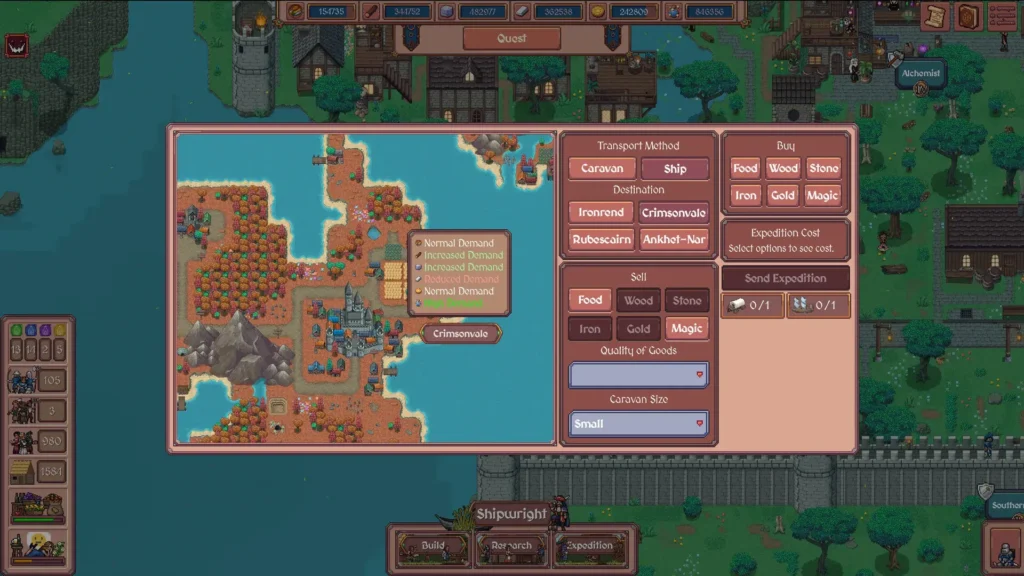
Expansion eventually moves beyond the immediate settlement. Trade allows the kingdom to obtain resources from distant territories, while ships and routes extend its economic reach. Magical progression later introduces locations and mechanisms that would not exist in an ordinary medieval economy. A balanced kingdom generally requires several systems to develop together because economic growth without storage can waste production, population growth without food can become unsustainable, and research without a strong resource base may unlock upgrades the player cannot afford.
Military expansion can similarly drain the treasury when civilian production is unable to support it. Hearth and Hamlet therefore rewards patience and careful attention to the current bottleneck. A modest storage increase or worker reassignment may be more valuable than purchasing the most visually impressive building. The journey from campfire to kingdom is built around accumulating these small advantages until the original frontier camp becomes the center of a sprawling magical realm.
Hearth and Hamlet Laws, Research, Magic and Technology Progression
Laws and policies allow players to shape how the kingdom operates by influencing taxation, worker conditions, morale, military recruitment and the broader character of the settlement. Taxation can increase income, but it is not an unlimited source of free gold. Aggressive taxes place pressure on happiness, creating a trade-off between immediate revenue and long term productivity. A policy that generates more money may become less valuable when the resulting dissatisfaction weakens production throughout the kingdom. Worker focused rules can help preserve morale or improve economic performance, and their importance grows as the settlement expands because small percentage changes have a greater effect when applied to a large workforce and several production systems.
Military policies include the ability to draft city guards to protect the kingdom from monsters, animals, raiders or hostile armies. However, workers redirected into defense are no longer fully available for civilian production, so maintaining security requires an economy capable of supporting it. Civic decisions also give the kingdom more identity than it would have if progression were limited to construction. Two settlements at a similar architectural stage may operate differently because their rulers selected different policies or accepted different levels of taxation.
Policies should therefore be judged by their total effect rather than their most obvious benefit. Additional gold may appear attractive, but its influence on happiness, production and population growth must also be considered. A generous law may initially seem inefficient while still producing indirect advantages through improved morale. The system does not attempt to simulate every aspect of medieval government. Instead, it incorporates political choices into the incremental loop, treating laws as strategic upgrades with benefits and costs that affect resource accumulation. Building a kingdom consequently involves more than constructing walls and castles, since the ruler must also determine how residents work, what they contribute and how the state protects them.
Research provides permanent technologies and upgrades that expand the kingdom’s capabilities, with each significant stage of development creating opportunities to unlock new buildings, policies, magic and production improvements. The research tree gives the campaign long term structure by allowing players to invest in technologies that improve several parts of the settlement or open an entirely new progression branch instead of gathering resources only to purchase the next visible building. Research choices should reflect the kingdom’s immediate needs. A settlement limited by storage may benefit more from capacity upgrades than from specialized production technology, while a kingdom approaching a military threat may require defensive research. A stable economy, by comparison, may be able to pursue trade or magic.
Permanent upgrades are especially valuable within an incremental structure because their benefits continue operating as the settlement grows. Even a modest improvement obtained early can produce a substantial cumulative effect over the course of the campaign. Research is also closely connected to construction because certain structures unlock new options, while researched technologies make additional buildings available. This creates a feedback loop in which construction expands research and research enables further construction.
Available technologies are organized through a research book, and an early post launch patch adjusted the placement of its tabs to reduce confusion, showing that the developer continued refining how players navigate the system. The research tree should not be treated as a checklist that must be completed in a fixed order. Its practical value comes from matching technologies to the settlement’s current limitations, since the best upgrade is often the one that removes a bottleneck rather than the one offering the largest headline bonus.
Technology also controls the transition from ordinary medieval development to a magical civilization. Magic does not appear immediately during the campfire stage. Players must first establish a settlement capable of supporting advanced institutions, giving supernatural progression a sense of achievement and ensuring that it develops alongside the kingdom rather than replacing its foundational economy. Advanced research eventually unlocks alchemy, magical academies and stronger supernatural capabilities, making the research tree responsible for both numerical growth and the settlement’s thematic transformation.
Alchemy expands the range of specialist facilities and resources that must be managed, while magical academies represent another level of institutional growth as the settlement progresses from survival into scholarship and supernatural experimentation. Magic can also influence transportation and exploration. Post launch patch notes refer to one way and stable portals, along with a Wizard Academy shop, confirming that magical infrastructure eventually extends beyond simple production bonuses. These fantasy systems fit naturally into the incremental structure by creating another tier of increasingly powerful unlocks. Basic workers gather ordinary materials, established towns produce more advanced goods, and mature kingdoms gain access to magical options that would have been impossible at the beginning.
Players should not expect the freeform spellcasting of an action role playing game. Magic is primarily incorporated into Hearth and Hamlet’s management, research and building systems, changing how the kingdom functions rather than turning the player into a directly controlled wizard. The supernatural elements also distinguish the game from historically grounded medieval city builders because castles, taxation and barracks coexist with alchemy, portals and magical academies. For players drawn to cozy fantasy, this gradual transformation is one of the game’s most appealing features. The settlement does not begin as a fully formed magical metropolis but earns that identity through sustained economic and technological development.
Hearth and Hamlet Gameplay, Resource Management and Kingdom Expansion
Hearth and Hamlet combines manual resource gathering, automated production, worker management, construction and incremental upgrades. Early progress depends on collecting enough food and materials to support the first residents and structures, but more of this work can be automated as additional workers and buildings become available. The progression loop is deliberately gradual: gathering enables construction, construction increases capacity, capacity supports population growth, and a larger population provides more workers. Those workers then accelerate production, allowing players to pursue further research and construct increasingly sophisticated buildings.
Resource gathering begins as a hands on process, with players interacting with gathering locations to collect essential materials. Food, wood, stone and gold are among the fundamental resources identified in the official description. Food supports population growth, wood and stone are needed for construction, and gold becomes increasingly important for government, trade and advanced development. Other materials emerge as the kingdom reaches more complicated economic and military stages. Workers can eventually be assigned to tasks that generate resources over time, creating a mixture of active and passive income that defines much of the game’s progression.
Effective worker management requires players to maintain production across several competing sectors. A major construction project may require additional wood or stone output, while population expansion places greater pressure on the food supply. New buildings, trade systems and military units also compete for the settlement’s productive capacity. Soldiers consume resources and remove workers from civilian production, so recruiting too many defenders too early can weaken the economy even if it improves security. Happiness further affects productivity, with morale improving or undermining the results of taxation, worker assignments and rapid expansion. Workers are therefore part of a broader social and economic system rather than simple production multipliers.
Production must also be balanced against storage. A resource generator cannot provide its full value when the settlement repeatedly reaches its storage limit, making stockpile improvements especially important before saving for expensive buildings or research. Manual gathering remains useful because it can accelerate progress whenever a particular material becomes a bottleneck. Players seeking a more active experience can continue interacting with resource locations, while those who prefer a slower rhythm can rely more heavily on automated production. Post launch patches also introduced options intended to make repeated collection more comfortable. The “Hover to Click” setting reduced the need for constant clicking or holding, showing that the developer was responding to concerns about repetitive interaction.
The player’s main decisions revolve around how available resources should be prioritized. Materials and gold can be invested in new buildings, storage improvements, population growth, research or defensive preparations. Spending everything on rapid expansion may create shortages elsewhere, while saving too aggressively can delay access to new systems. A balanced kingdom generally needs several areas to develop together. Economic growth without sufficient storage can waste production, population growth without enough food can become unsustainable, and research without a strong resource base may unlock upgrades that remain unaffordable. Military expansion can similarly drain the treasury when civilian production is not strong enough to support it.
Construction is closely connected to progression because players do not receive unrestricted access to every building at the beginning. New structures become available as the settlement develops and technologies are researched. Buildings should be treated as economic investments rather than visual decorations, since a new structure may increase production, unlock another resource or provide access to an entirely new system. Construction can also determine which technologies become available next because buildings and upgrades feed into the research tree. The confirmed selection ranges from simple tents and taverns to markets, town halls, banks, barracks, castles, magical academies and defensive fortifications. Roads support the wider growth of the kingdom, while commercial and specialist buildings create opportunities for more advanced resource chains.
The city building system is less spatially open than games focused on manually designing street grids and zoning districts. Hearth and Hamlet emphasizes predetermined settlement development, production values and upgrade choices. Players influence how quickly the kingdom grows and which systems receive resources, but they are not given unlimited control over the placement of every structure. The game still provides the satisfaction of watching a city expand, although its mechanics are closer to an incremental management game than a conventional urban planning simulator. Buildings also contribute to the kingdom’s visual evolution, gradually transforming the environment from a wilderness camp into a dense medieval and magical civilization.
Kingdom expansion follows a layered path that begins with securing food and building materials before increasing population capacity and unlocking more advanced institutions. Each stage depends on the strength of the previous one. Tents and basic gathering sites eventually give way to taverns, markets, civic buildings, barracks, noble residences, academies and castles, making the visible transformation of the settlement a major part of the game’s appeal. Expansion ultimately extends beyond the immediate settlement through trade, ships and routes that connect the kingdom to distant territories. Magical progression later introduces additional locations and mechanisms that would not exist in an ordinary medieval economy.
Hearth and Hamlet rewards patience because its systems are closely interconnected. Instead of purchasing every available upgrade immediately, players are encouraged to identify the current bottleneck and address it directly. The best next step may be a modest storage increase, a worker reassignment or improved food production rather than the most visually impressive building. The journey from campfire to kingdom is structured around accumulating these small advantages, with every improvement contributing to a larger chain of progress until the original frontier camp becomes the center of a sprawling magical realm.
Hearth and Hamlet Laws, Research, Magic and Advanced Progression
Laws and policies allow players to shape how the kingdom operates by influencing taxation, worker conditions, morale, military recruitment and the broader character of the settlement. Taxation provides additional income, but it is not an unlimited source of free gold. Aggressive taxes can reduce happiness, creating a tradeoff between immediate revenue and long term productivity. A policy that generates more money may become less valuable when the resulting dissatisfaction weakens production across the kingdom. Worker focused rules can help maintain morale or improve economic performance, and their importance increases as the settlement grows because even small percentage changes can have a substantial effect when applied to a large workforce and several production systems.
Military policies include the ability to draft city guards to protect the settlement from monsters, animals, raiders and hostile armies. Drafting defenders improves security, but the workers redirected into military service are no longer fully available for civilian production. Maintaining a capable defense therefore requires an economy strong enough to support it without slowing the kingdom’s development. Policies should be evaluated according to their total effect rather than their most obvious benefit. Additional gold may initially appear attractive, but players must also consider its effects on happiness, production and population growth. A generous law may seem inefficient at first while still producing indirect benefits through improved morale and stronger productivity.
Civic decisions give the kingdom more identity than it would have if progression were limited to construction. Two settlements at a similar architectural stage may function differently because their rulers selected different policies or accepted different levels of taxation. The system does not attempt to simulate every aspect of medieval government. Instead, political choices are incorporated into the incremental progression loop, with each law functioning as another strategic upgrade that provides benefits while imposing costs. This approach supports the broader theme that building a kingdom involves more than constructing walls and castles. The ruler must also decide how residents work, what they contribute and how the state protects them.
Research provides permanent technologies and upgrades that expand the kingdom’s capabilities. Every major stage of development creates opportunities to unlock new buildings, policies, production improvements and magical systems. The research tree gives the campaign long term structure by allowing resources to be invested in technologies that improve several parts of the settlement or open entirely new progression branches. Rather than gathering materials only to purchase the next visible building, players can use research to prepare the kingdom for later stages of economic, military or supernatural development.
Research choices should reflect the kingdom’s immediate needs. A settlement limited by storage may benefit more from capacity improvements than from a specialized production technology, while a kingdom facing a military threat may need defensive research. A stable economy can afford to invest in trade, magic or other advanced branches. Permanent upgrades are especially valuable in an incremental game because their benefits continue operating as the settlement grows. Even a modest improvement acquired early can create a large cumulative effect over the course of the campaign.
Technology also controls the transition from ordinary medieval development to a magical civilization. Advanced research unlocks alchemy, academies of magic and stronger supernatural capabilities, making the research tree responsible for both numerical growth and thematic progression. Research and construction support one another because buildings can reveal new research options, while completed technologies can make additional structures available. This creates a continuing feedback loop in which construction expands research and research enables further construction. Available technologies are organized through a research book, and an early post launch patch adjusted the placement of its tabs to reduce confusion when navigating the system.
The research tree is not intended to be treated as a checklist that must be completed in a fixed order. Its practical value comes from matching technologies to the settlement’s current limitations. The best upgrade is often the one that removes a bottleneck rather than the technology with the largest headline bonus. Storage, food supply, military readiness, worker productivity and access to new structures may all take priority at different stages, so the most effective research path changes according to the condition of the kingdom.
Magic begins to emerge after the settlement advances beyond its basic medieval stage. Players can unlock magical academies, alchemical laboratories and stronger forms of supernatural research, adding new facilities, resources and possibilities to the economy. This content is not immediately available during the campfire stage because the player must first establish a settlement capable of supporting advanced institutions. That requirement gives magical progression a sense of achievement and ensures that it develops alongside the kingdom instead of replacing its foundational economy. Alchemy expands the number of specialist facilities and materials that must be managed, while magical academies represent another level of institutional growth as the settlement moves from survival into scholarship and supernatural experimentation.
Magical development can also affect exploration and transportation. Post launch patch notes refer to one way and stable portals, as well as a Wizard Academy shop, confirming that supernatural infrastructure eventually extends beyond basic production bonuses. These systems fit naturally into the incremental structure by providing another tier of increasingly powerful unlocks. Basic workers begin by collecting ordinary materials, established towns create more advanced goods, and mature kingdoms eventually gain access to magical options that would have been impossible during the opening stages.
Players should not expect freeform spellcasting similar to an action role playing game. Magic is primarily incorporated into the management, building and research systems, changing how the kingdom functions rather than turning the player into a directly controlled wizard. The supernatural elements help distinguish Hearth and Hamlet from historically grounded medieval city builders because castles, taxation and barracks coexist with alchemy, portals and magical academies. For players attracted to cozy fantasy, this gradual transition is one of the game’s defining features. The settlement does not begin as a fully formed magical metropolis but earns that identity through sustained economic and technological development.

Hearth and Hamlet Trade, Economy, Population, Buildings and Defense
Trade allows the kingdom to obtain resources beyond what its immediate surroundings can provide. As the settlement expands, players can form commercial relationships with neighboring and distant lands, gaining access to additional materials and economic opportunities. However, trade should supplement local production rather than conceal fundamental shortages. A kingdom that cannot reliably feed its residents or produce essential construction materials may create further demands by expanding into distant commerce without addressing its original problems. Markets, roads, ships, and other infrastructure support this economic growth. Roads reflect the kingdom’s increasing organization, maritime development extends trade across the water, and the appearance of distant territories gives the wider world greater economic importance.
Population management is inseparable from the economy. Additional residents can become workers, but they also consume more food and require expanded storage and infrastructure. Population growth is therefore beneficial only when production can keep pace. Happiness can provide production bonuses, making citizen welfare economically important rather than purely cosmetic. Policies, taxation, and settlement conditions can influence morale, while players must decide how many residents should remain in productive civilian jobs and how many can be assigned to specialist or military roles. Expanding the army may strengthen security, but it also leaves fewer workers available to produce food, wood, stone, gold, and trade goods.
The kingdom becomes more resilient when it has several dependable sources of income and materials. Local gathering, automated worker production, trade, and researched bonuses can reinforce one another, while excessive dependence on a single method may create problems whenever a new resource requirement appears. Hearth and Hamlet simplifies many aspects of macroeconomics, but its interconnected resource system still requires careful planning. The central challenge is not simply accumulating large totals, but maintaining a productive balance while the kingdom’s population, infrastructure, and material requirements continue to expand.
Buildings provide the clearest visual representation of that expansion. The settlement begins with simple frontier structures before developing commercial, military, governmental, and magical institutions. Basic tents and gathering facilities support the early population, while taverns, markets, and roads make the community feel increasingly permanent. Town halls and banks represent the emergence of formal government and finance, barracks and fortifications support defense, and noble residences and major civic buildings show that the settlement has moved beyond basic survival. Castles become architectural symbols of the kingdom’s rise from humble beginnings, while magic academies and alchemical laboratories demonstrate that the civilization has gained enough knowledge, resources, and organization to pursue supernatural development.
These buildings are more than cosmetic milestones. They increase capacity, employ workers, unlock additional systems, and create new research opportunities, meaning that constructing the right facility can change what the kingdom is capable of producing or managing. The physical settlement follows a largely authored development path instead of allowing completely unrestricted building placement, distinguishing Hearth and Hamlet from sandbox city builders in which layout design is the primary challenge. Its appeal instead comes from watching the environment evolve as accumulated work unlocks each new phase of progression. Rivers, swamps, buildings, ships, and residents gradually form a livelier pixel art scene, making the kingdom’s visual transformation potentially as satisfying as its production bonuses.
Combat and settlement defense add consequences to this growth, although Hearth and Hamlet is not designed as a conventional real time strategy war game. Players recruit soldiers and guards to protect their civilization from dangerous animals, monsters, raiders, enemy armies, and other hostile forces. Military preparation begins as an economic decision because soldiers consume resources and reduce the size of the productive civilian workforce. Recruiting an unnecessarily large army can slow construction, reduce production, or place additional pressure on food supplies, while maintaining insufficient defenses can leave an otherwise prosperous settlement vulnerable when a dangerous event occurs. Players must therefore develop enough military strength to address likely threats without damaging the economy that supports the army.
Defensive fortifications form part of the wider construction system. Barracks and related institutions help train or organize military forces, while guard policies connect defensive preparation to governance. Combat does not primarily involve manually directing individual units through detailed tactical battles. The emphasis remains on preparation, recruitment, resource management, and ensuring that the kingdom has sufficient military capacity before a threat appears. Although resources can accumulate automatically, the presence of danger means players cannot completely ignore the settlement and may need to monitor whether its defenses are keeping pace with economic expansion.
Official post launch notes referenced enemy armies and quests involving hostile forces, showing that military encounters continue beyond the earliest stages of settlement development. Patches also addressed rare situations in which an army failed to appear or a related quest progressed incorrectly. The combat is less intensive than the warfare found in dedicated strategy games, which may suit players attracted to the game’s cozy presentation. Nevertheless, it introduces meaningful consequences and provides reasons to invest in soldiers, guards, barracks, and fortifications rather than directing every available resource toward peaceful growth.
Hearth and Hamlet Gameplay Style, System Requirements, Price and Availability
Hearth and Hamlet is best described as an incremental city builder clicker with idle elements. It includes city building themes and meaningful management decisions, but it does not function like a completely freeform traditional city builder. Players manually gather resources, assign workers, purchase upgrades, unlock research, and watch automated production continue over time. These systems place it firmly within the incremental genre, where rising resource totals and successive layers of progression make each new stage possible. Once residents have been assigned jobs, they produce resources without requiring individual commands, allowing players to consider their next building, upgrade, or investment while the settlement continues operating.
The idle systems do not make the game completely passive. Manual gathering can substantially accelerate progress, and players must continue responding to newly unlocked buildings, research choices, policies, shortages, population demands, and hostile threats. Traditional city builders often emphasize zoning, traffic, infrastructure placement, spatial design, or complicated production networks. Hearth and Hamlet includes buildings and visible settlement growth but gives players less control over the precise layout.
Players looking for a detailed medieval planning simulator may find its progression too predetermined, while those who enjoy incremental games may appreciate its steady unlocks, compact management systems, and visual development. The Steam description identifies it as both a “medieval citybuilder clicker” and an “incremental idle kingdom builder,” accurately presenting it as a hybrid focused on accumulation and progression rather than a substitute for a complex city planning simulation.
Hearth and Hamlet is available through Steam for Windows and SteamOS/Linux. The official store page does not list a native macOS version. Its listed PC requirements are:
- Windows minimum requirements: A 64 bit version of Windows 10, an Intel Core i3 running at 3.2 GHz or an AMD equivalent, 8 GB of RAM, an Nvidia GeForce GTX 650 with 2 GB of VRAM or an AMD Radeon HD 7770 with 2 GB of VRAM, DirectX 11, and 1 GB of available storage.
- Windows recommended requirements: A 64 bit version of Windows 11, an Intel Core i5 2400 running at 3.1 GHz or an AMD equivalent, 16 GB of RAM, an Nvidia GeForce GTX 750 Ti with 2 GB of VRAM or an AMD Radeon R7 260X with 2 GB of VRAM, DirectX 11, and 1 GB of available storage.
- Linux minimum requirements: Ubuntu 20.04 or newer, or SteamOS. The listed processor, memory, graphics, and storage requirements match the corresponding Windows minimum specification.
- Linux recommended requirements: Ubuntu 20.04 or newer, or SteamOS, an Intel Core i5 2400 or AMD equivalent, 16 GB of RAM, a GTX 750 Ti or Radeon R7 260X, and 1 GB of available storage.
The recommended memory requirement was increased from 8 GB to 16 GB in Patch 1.0.06. The developer explained that the game could still operate with 8 GB, but that amount provided less capacity for multitasking. This change is relevant when comparing system requirements published before and after August 28, 2026. Overall, the requirements remain modest by modern PC standards, particularly in their processor, graphics, and storage demands. The pixel art presentation does not require a recent high end graphics card, although additional memory may help maintain stability when other applications are running.
The standard US price is $7.99, with regional pricing varying by country and currency. SteamDB recorded a 10 percent launch discount that reduced the US price to $7.19 when the game debuted. It is sold as a complete premium release rather than a free to play product. A free demo introduced players to its settlement and progression systems before launch, but access to the complete game requires a purchase. Steam bundles may also include Hearth and Hamlet alongside other incremental or cozy games, although bundle availability and pricing can change, so launch era offers may no longer remain active.
Steam identifies Hearth and Hamlet as a single player game with Steam Achievements and Family Sharing. It contains 24 achievements and supports seven listed languages: English, Simplified Chinese, German, Japanese, Russian, Korean, and Traditional Chinese. No PlayStation 5, Xbox Series X|S, Nintendo Switch, or mobile version has been officially announced. Its confirmed releases are Windows and SteamOS/Linux through Steam.
The low base price reflects the game’s compact incremental structure and independent production scale. Hearth and Hamlet was created by Phorust Studios, which is operated by a solo Australian developer, while Runic Forge and Gamersky Games handled publishing. Post launch support began quickly, with several patches released during the first few days to address crashes, resource gathering controls, portals, tutorials, graphical issues, and memory use. This early patch activity does not confirm a specific long term content roadmap, but it demonstrates that the game received active technical support immediately after release.
Frequently Asked Questions[FAQs]
- When did Hearth and Hamlet release?
Hearth and Hamlet released on August 19, 2026. The game launched at approximately 16:00 UTC, although the official countdown advertised the time as 17:00 UTC+1. These times refer to the same launch moment, so the difference resulted from the time zone used in the announcement rather than a delay. - Who developed Hearth and Hamlet?
Hearth and Hamlet was developed by Phorust Studios, an Australian solo development studio. This means the game was primarily created by a single developer rather than a large development team. Runic Forge and Gamersky Games are listed as the publishers responsible for supporting its commercial release. - What type of game is Hearth and Hamlet?
It is a single player incremental city builder that combines clicker mechanics with idle production and kingdom management. Players gather resources, construct buildings, assign workers and gradually expand their settlement while managing research, policies, taxation, trade, magic and defensive preparations. - How much does Hearth and Hamlet cost?
The standard US price for Hearth and Hamlet is $7.99. It launched with a temporary 10 percent discount, reducing the price to $7.19 during the promotional period. The amount players pay may vary by country because of regional pricing, currency differences and future Steam discounts. - Is Hearth and Hamlet available on consoles?
No console edition of Hearth and Hamlet has been officially announced. The confirmed versions are available through Steam for Windows and SteamOS/Linux. There is currently no announced PlayStation, Xbox or Nintendo Switch release. - Does Hearth and Hamlet have multiplayer?
No. Steam lists Hearth and Hamlet as a single player game, and its settlement building, resource management and progression systems are designed for one player. It does not currently include cooperative play, competitive modes or other online multiplayer features. - Does Hearth and Hamlet include combat?
Yes, although combat is handled through kingdom management rather than direct action controls. Players recruit soldiers and guards, construct defensive structures and prepare their settlement for dangers such as monsters, wild animals, raiders and hostile armies. Success therefore depends on preparation, resources and defensive planning. - Can players use magic and alchemy?
Yes. Magic and alchemy become part of the kingdom’s development as players make further progress. Magical academies, alchemical laboratories, supernatural research and portals can eventually be unlocked, adding new systems and possibilities beyond ordinary construction and resource production. - Is Hearth and Hamlet a fully idle game?
No. Workers can automate resource production and reduce the amount of manual gathering required, but the game still expects regular player involvement. Manual actions can accelerate progress, while construction, research, policies, trade, population needs and defense require active decisions as the kingdom expands. - What are the minimum PC requirements for Hearth and Hamlet?
The Windows minimum requirements include Windows 10 64 bit, an Intel Core i3 processor running at 3.2 GHz or an AMD equivalent, 8 GB of RAM and either a GTX 650 or Radeon HD 7770 graphics card with 2 GB of VRAM. The game also requires DirectX 11 and 1 GB of available storage. Ubuntu 20.04 or newer and SteamOS are supported with comparable hardware requirements.
Conclusion
Hearth and Hamlet releases August 19 2026 as a distinctive hybrid of incremental progression and cozy fantasy city building. Its central journey takes players from a lonely campfire to an increasingly sophisticated kingdom filled with markets, civic institutions, castles, defensive structures and magical academies.
The gameplay is designed around accumulation and priorities. Food supports population, workers generate resources, storage enables larger investments, and research opens the next technological or magical stage. Laws, taxes, trade and military preparation add decisions beyond simply purchasing buildings.
Its city-building should not be confused with unrestricted sandbox planning. Hearth and Hamlet is closer to an incremental kingdom-management game in which the settlement follows a structured visual path. That design makes it approachable, although players looking for detailed road placement or urban simulation may find it limited.
The $7.99 price, modest hardware requirements and support for both Windows and SteamOS/Linux make it widely accessible to PC players. Steam Achievements and Family Sharing are supported, while console and mobile versions remain unannounced.
For the intended audience, the appeal is clear: a warm pixel-art world, steady unlocks and the satisfaction of developing a magical civilization one decision at a time. Its first-week sales also demonstrate that the combination of cozy aesthetics and incremental mechanics reached a substantial audience.
Sources and Citations
- Hearth and Hamlet Official Steam Store Page
https://store.steampowered.com/app/4315040/Hearth_and_Hamlet/ - Hearth and Hamlet Official Steam News Launch Announcement
https://store.steampowered.com/news/app/4315040/view/398157811169626603 - SteamDB Hearth and Hamlet Release Date Price History and Platform Information
https://steamdb.info/app/4315040/ - DLH.NET Cozy Citybuilder Hearth and Hamlet Hits 100,000 Sales
https://www.dlh.net/en/news/90259/cozy-citybuilder-hearth-and-hamlet-hits-100-000-sales.html
Recommendations
- Can you animate multiple cameras in one Blender project?
- Soulframe: Official Warsongs Gameplay Demo: Combat, Story, and TennoCon 2026 Reveals
- Mortal Kombat 2 Box Office Forecast: How Much It’s Expected to Make in Theaters (Opening Weekend, Domestic vs Worldwide)
- The Analogue Pocket Is Finally Back In Stock: Restock Date, Time, Price Increase, and Where to Buy (March 2026)
- Lows Adventure 2: How to Play, All Levels Guide, Controls, Walkthrough, and Unblocked Tips
- “Catastrophic Mismanagement” And AI Gambits Led To Mass Xbox Layoffs, Expert Says: What Happened?
- KPop Demon Hunters Wins Two Oscars for Best Animated Feature & Best Original Song – Full Breakdown, Winners, and Global Impact
- Subnautica 2: Where to Find Sulfur
- A cozy game called Librarian: Tidy Up the Arcane Library! began to slowly make its way up the Twitch charts
- What Is Depth of Field in Blender, and How Do I Set It?



































































































