










In This Article (8 sections)
Ken Kutaragi’s 2028 and 2029 AI Prediction and His PlayStation Legacy
Ken Kutaragi, widely known as the “father of PlayStation,” believes real-time generative media could transform interactive entertainment once AI becomes fast enough to respond at speeds comparable with contemporary game consoles. He discussed that possibility in a 4Gamer interview published on October 9, 2026, following his participation in a September 29 event marking the opening of the University of Electro-Communications’ Entertainment Creation Research and Education Center in Tokyo. His forecast concerned research into real-time AI generation of media such as video and music, with the relevant performance threshold predicted to arrive around 2028 or 2029. Crucially, he did not promise that an AI model would generate every component of a finished AAA game from scratch by that date.
His broader argument was that sufficiently responsive generation could turn imagination and communication into interactive experiences rather than relying exclusively on predetermined assets. Later in the interview, he also envisioned short-form video becoming real-time and interactive, while emphasising the growing importance of people’s relationships with AI. The prediction is therefore about a potential change in how content is created and experienced, not a confirmed timetable for replacing conventional game development.
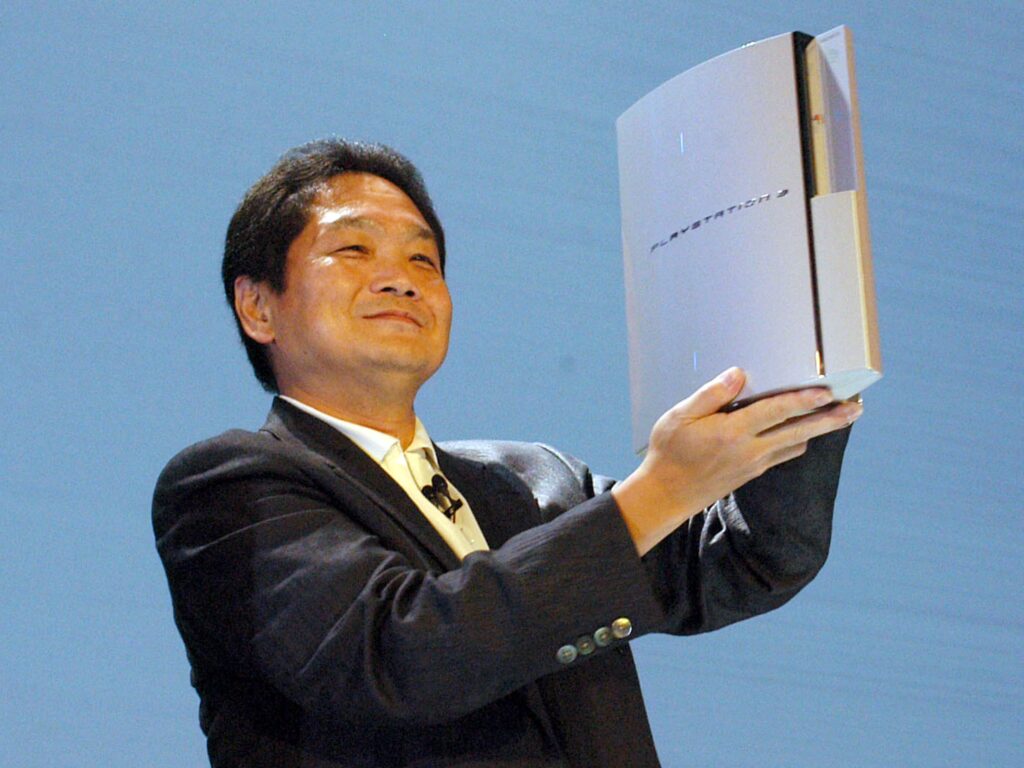
Kutaragi’s history helps explain why his forecast attracts attention. The Computer Entertainment Supplier’s Association records that he was born in Tokyo in 1950, joined Sony in 1975 and participated in establishing Sony Computer Entertainment in 1993. He played a leading role in creating the original PlayStation, PlayStation 2, PlayStation Portable and PlayStation 3, earning the organisation’s identification as the “father of PlayStation.” He became Sony Computer Entertainment president in 1999, later served as chairman and group chief executive, retired from active Sony management in 2007 and founded Cyber AI Entertainment in 2009. The original PlayStation strategy helped move console gaming towards real-time polygonal 3D graphics, optical media and more sophisticated consumer computing.
In the interview, Kutaragi presented that era as an example of the console business aggressively adopting technology to improve responsiveness, contrasting it with today’s lengthy and resource-intensive production schedules. He also noted the involvement of graphics and hardware companies such as Nvidia and AMD in the AI boom. His current argument follows the same emphasis on real-time performance: the disruptive moment is not simply when a model produces an impressive clip, but when it can react quickly enough to support interaction and potentially weaken the connection between greater content complexity and greater production effort.

AI Tools Already Advancing Game Worlds, Assets, Dialogue and Testing
Near-real-time game creation would require several technologies that currently perform separate tasks to work together reliably. A developer might describe a world in natural language, use a world model to produce a navigable approximation and generate reusable objects through a 3D asset system. Coding tools could help construct rules, while other systems assist with animation, dialogue, sound effects and music. AI agents could then explore the prototype, identify failures and return information to its creators. Parts of this proposed workflow already exist experimentally, although no single system provides the complete production pipeline. Their immediate value lies in shortening the distance between an idea and something a developer can evaluate. The following examples illustrate different parts of that emerging process:
- Google DeepMind’s Genie 3: DeepMind reports that Genie 3 generates navigable environments from text at 24 frames per second and 720p resolution, maintaining coherence for several minutes. It produces the visual world frame by frame in response to user actions rather than simply supplying a collection of conventional assets. Promptable world events can alter conditions, including weather, or introduce objects and characters. This demonstrates interactive generation in a constrained form, not the persistent systems required for a complete commercial game.
- Microsoft’s Muse: Developed with Ninja Theory and trained on Bleeding Edge, Muse learns aspects of an existing game’s dynamics and can generate gameplay visuals, controller actions or both. Microsoft demonstrated sequences that remained consistent for several minutes after receiving an initial second of gameplay. The research focuses on ideation, iterative adjustments and exploring different possibilities, including retaining generated changes long enough for creators to evaluate them. Microsoft positions it as support for experimentation rather than an autonomous replacement for a game studio.
- Roblox’s Cube 3D: Cube generates game-compatible 3D meshes from text, allowing creators to request objects such as vehicles or props inside Roblox Studio and receive results within seconds. Roblox explains that the system represents geometry as tokens and predicts shapes in a process conceptually similar to an autoregressive language model predicting text. Developers can use generated meshes as starting points while concentrating on materials, gameplay and artistic direction. Roblox’s broader plans extend towards functional objects, more complex scenes and multimodal creation, rather than stopping at decorative assets.
- Ubisoft Ghostwriter and Unity Spark: Ubisoft describes Ghostwriter as an internal tool that produces first drafts of NPC “barks,” leaving writers in control of the final dialogue and freeing time for broader narrative work. Its narrow purpose illustrates how AI can assist a particular production task without independently writing an entire game. Unity, meanwhile, describes its developing Spark project as a simplified browser-based creation environment incorporating AI assistance. Together, these approaches show how generative tools can enter both established studio workflows and more accessible development environments.
Programming and testing could also become faster, but neither task is solved by generating plausible scripts or demonstrating that an agent can play. Game code connects physics, animation, networking, interfaces, save systems, combat, economies and platform-specific behaviour, requiring architectural consistency across many interactions. Coding assistance can support individual functions, while Roblox’s wider creation plans point towards assets with programmatic behaviour rather than meshes alone. Autonomous agents offer another possibility by repeatedly exploring levels, testing scenarios, stressing economies and searching for unusual states.
Sony AI’s Gran Turismo Sophy demonstrates reinforcement learning in a complex real-time racing environment, while DeepMind has used generated worlds with SIMA agents that pursue navigation goals. Applying such capabilities to large-scale quality assurance is a logical future direction, but these examples do not establish that AI can replace complete human testing teams. People would still need to assess whether discovered behaviour is enjoyable, accessible and consistent with the intended design, not merely whether an agent can complete a task.
Why Real-Time AI Games Still Need Persistent Rules and Reliable Engines
AI cannot yet create a complete commercial video game in real time in the broad sense often attached to Kutaragi’s prediction. A convincing sequence of interactive images is only one part of a game, which also requires rules, controls, collision systems, persistent state, progression, narrative logic, animation, audio and interfaces. Accessibility, networking, security and testing must work consistently alongside those systems across many hours of play. Consider an AI-generated role-playing game in which a player drops a sword inside a house, leaves for twenty hours, completes several quests and returns.
The game must preserve the sword and its properties, changes to the house, relevant character relationships and quest states, potentially alongside thousands of other variables. Visual plausibility does not guarantee that kind of continuity. Current world models demonstrate important pieces of interactive generation, but their ability to maintain believable short experiences should not be confused with reliable long-term simulation.
DeepMind explicitly identifies several limitations in Genie 3, including a constrained direct action space, difficulty representing complex interactions among multiple independent agents, imperfect text generation and a continuous-interaction horizon measured in minutes. These issues matter for games containing many characters with separate objectives or adventures that require dozens or hundreds of hours of persistent state. Designers also need precise control over rules, such as a door opening only after a particular quest condition or a competitive weapon consistently producing the intended damage.
A probabilistic model cannot be allowed to improvise around requirements that must remain exact, and developers need reproducible behaviour to diagnose bugs. Latency and computational cost introduce further constraints because frame-by-frame generation demands substantial inference capacity, while consumer experiences must remain responsive and affordable. Network synchronisation, player safety, moderation, accessibility, intellectual-property controls and debugging add further production requirements. Kutaragi’s proposed performance threshold addresses an important part of the challenge, but fast generation alone does not make a system persistent, controllable, economical or production-ready.
A hybrid architecture offers a more practical route between traditional procedural generation and fully generated worlds. Developers have long used explicitly authored rules to assemble terrain, rooms, items and encounters, while generative AI learns patterns from data to produce new representations. A conventional dungeon generator might place rooms according to defined constraints, whereas a world model could infer how an environment should look and respond as a player moves through it. These approaches need not compete for exclusive control of the game. Conventional code could preserve inventories, quests, collision behaviour and other critical state, while generative layers supply scenery, dialogue and peripheral events.
Traditional geometry would retain its advantages in precision and persistence, while generated simulation could create variations that would be expensive to author manually. Characters might respond with context-sensitive dialogue, environments could reflect player preferences and secondary events could adapt to behaviour without abandoning dependable underlying rules. By 2029, increasingly sophisticated prototypes and hybrid experiences therefore appear more plausible than the universal replacement of game engines by a single generative model.

What AI Could Mean for Game Design, Independent Studios and PlayStation
One of generative AI’s most significant effects could be reducing the cost of experimentation rather than automatically producing finished games. Traditional development can require concept art, models, animation, scripts, level geometry and programming before a team can determine whether an idea is enjoyable. Generative tools could provide temporary versions of those elements earlier, changing what a prototype can communicate. Instead of relying only on crude grey-box geometry, a designer might describe an atmosphere, movement style, enemies and objectives, then interact with a generated approximation.
Traditional production would still offer deliberate authorship and reproducibility, while AI would provide speed and a wider range of alternatives. Some assets could remain handcrafted, others could be generated and extensively edited, and suitable background content could be created dynamically during play. That abundance also increases the importance of selection: producing ten environments cheaply does not determine which one is coherent, distinctive or worth developing. Creative direction may consequently become more valuable as teams spend less time producing initial options and more time deciding which ones belong in the game.
Independent studios could benefit particularly strongly because small teams are constrained by time and access to specialist labour. Generating preliminary meshes, dialogue drafts, concept variations and playable prototypes could give them capabilities that previously required additional artists, writers or programmers. Roblox presents its tools as a way to reduce repetitive asset work, while Microsoft frames Muse around helping creators explore and test ideas. However, lower production barriers also make it easier for competitors to enter the same market, potentially increasing the number of games competing for attention.
Studios would still need distinctive mechanics, storytelling, visual direction and community relationships to make their work matter to players. Intellectual-property provenance, training data, platform disclosure requirements and audience attitudes also remain considerations, particularly for teams with limited legal resources. AI can expand a studio’s productive capacity, but it does not guarantee originality, commercial success or a positive audience response.
Sony provides an example of how advanced AI can operate inside a conventionally developed game, but Kutaragi’s comments should not be mistaken for an official PlayStation roadmap. His interview represents his own analysis rather than a commitment from Sony Interactive Entertainment to deliver real-time generated games in 2028 or 2029. Sony AI’s Gran Turismo Sophy, developed with Polyphony Digital and Sony Interactive Entertainment, uses deep reinforcement learning to handle complex racing strategies and interactions. By 2026, Sony AI described the project as having progressed from research aimed at defeating elite drivers into a permanent feature used by millions of players.
That demonstrates a pathway focused on more capable agents within established game systems rather than replacing those systems entirely. Generative technology could eventually extend Sony’s options in prototyping, animation, NPC conversation, world building, testing and personalised experiences. Its combination of console hardware, game engines, first-party studios and AI research creates opportunities at both production and runtime, provided the resulting tools prove reliable.
The available examples support a transformation in developers’ work more strongly than wholesale replacement. Ubisoft emphasises writers’ control over Ghostwriter output, Microsoft describes generative research as support for creators, and Roblox presents Cube as a way to accelerate experimentation and reduce repetitive work. Routine modelling, scripting, placeholder dialogue and some repeated testing activities may require fewer manual hours as these systems improve.
At the same time, directing models, defining constraints, evaluating results and maintaining consistent systems and artistic identity remain substantial responsibilities. Kutaragi’s own interview ended by stressing the importance of individuals thinking for themselves and assembling strong teams capable of realising ideas. That emphasis complements rather than contradicts his technological optimism: making content easier to generate does not decide what deserves to be created. AI could substantially reduce the distance between imagination and implementation, but taste, judgement and intentional creative direction would still determine the quality of the final experience.
Frequently Asked Questions (FAQs)
- Did Ken Kutaragi say AI will generate complete games in real time by 2029?
Not exactly: Kutaragi discussed real-time AI generation of video and music rather than promising complete games from a prompt. He referred to predictions that this generation could reach speeds comparable with contemporary consoles around 2028 or 2029. Such responsiveness could make generated media more interactive and change how creators produce experiences. A finished AAA game would still require dependable controls, rules, persistent state, interfaces and testing. His forecast therefore describes a possible performance milestone, not a guarantee that AI will independently deliver production-ready games by 2029. - When did Ken Kutaragi make the AI prediction?
The relevant 4Gamer interview was published on October 9, 2026. It followed his participation in a September 29 event at the University of Electro-Communications in Tokyo. That event marked the opening activities for its Entertainment Creation Research and Education Center. In the interview, Kutaragi contrasted lengthy modern game-production schedules with advances in real-time AI generation. October 9 is the interview’s publication date, while 2028 and 2029 refer to the future performance window he discussed, not an announced product launch. - Why is Ken Kutaragi called the father of PlayStation?
Kutaragi earned the title through his central role in establishing Sony Computer Entertainment and developing the PlayStation hardware family. He participated in the company’s formation in 1993. His work encompassed the original PlayStation, PlayStation 2, PlayStation Portable and PlayStation 3. The original PlayStation helped advance console gaming towards real-time polygonal 3D graphics and optical media, making his contribution significant beyond individual hardware releases. Japan’s Computer Entertainment Supplier’s Association explicitly recognises him as the “father of PlayStation.” - Can AI already generate interactive game worlds?
Yes, experimental systems can already create environments that respond to player input. Google DeepMind’s Genie 3 generates text-prompted worlds that users can navigate at 24 frames per second and 720p resolution. It also supports prompt-driven events that change conditions or introduce objects and characters. However, its continuous interactive experiences remain limited to several minutes, with additional constraints on control and complex interactions. These demonstrations establish that interactive generation is possible, but they do not provide the persistence and reliability of a complete commercial game engine. - What is Microsoft Muse?
Muse is a World and Human Action Model developed by Microsoft Research with Ninja Theory. Trained on Bleeding Edge, it learns aspects of gameplay and can generate visuals, controller actions or both. Microsoft has demonstrated sequences continuing consistently for several minutes after receiving an initial second of gameplay. The research focuses on helping creators explore ideas, adjust generated experiences and evaluate different possibilities. It is therefore a tool for gameplay ideation and experimentation, not a system presented as independently designing, programming and delivering finished games. - Can generative AI already make 3D game assets?
Yes, Roblox Cube 3D can generate game-compatible meshes from text prompts. Creators can request objects such as vehicles or props and receive results within seconds. These meshes provide a starting point that developers can refine through materials, artistic adjustments and gameplay integration. Roblox intends to expand the technology towards more complex scenes, functional objects and multimodal creation, but those ambitions should remain distinct from its initial capabilities. Producing an object’s geometry is useful, although it does not automatically supply every behaviour or system needed to make that object playable. - What prevents AI-generated games from replacing normal games today?
The main obstacles include long-term consistency, precise control, computational cost and reliable simulation. A commercial game must preserve inventories, quest progress and changes to its world across many hours, not merely produce convincing images for a few minutes. It must also enforce exact rules and manage interactions between characters with independent goals. DeepMind identifies limited interaction duration, constrained controls and complex multi-agent behaviour among Genie 3’s challenges. Reproducible debugging creates another difficulty because developers must be able to identify failures and verify that fixes work consistently. - Is Sony already using AI in PlayStation games?
Yes, Gran Turismo Sophy is an example of advanced AI integrated into the Gran Turismo ecosystem. Sony AI developed it in collaboration with Polyphony Digital and Sony Interactive Entertainment. It uses reinforcement learning to handle racing strategy and complex interactions within a conventionally built game. That differs from generating the entire game’s world, rules and content in real time. Sophy demonstrates Sony’s work on capable gameplay agents, but it does not establish that Kutaragi’s personal forecast is an official PlayStation development roadmap. - Will AI make game development cheaper?
It can reduce costs for particular tasks by shortening the manual work needed for prototype assets and first-draft content. Roblox says its generation tools can save creators substantial modelling time. However, generated material still needs evaluation, editing and integration into the wider project. Computing, licensing, staffing and quality-control expenses can offset some of those savings. Whether an entire production becomes cheaper therefore depends on the complete workflow, not simply how quickly a model can produce an initial asset or draft. - Will AI replace video game developers by 2029?
There is no reliable evidence that AI will replace all video game developers by 2029. The research discussed here primarily supports augmentation, including faster ideation, asset generation, writing assistance and experimentation. Some routine tasks may require fewer manual hours, changing how teams allocate their work. Developers would still need to define rules, evaluate results, maintain coherent systems and exercise creative judgement. A transformation in production workflows is therefore better supported than a prediction that human development teams will become unnecessary.

Conclusion
Ken Kutaragi’s 2028 to 2029 prediction concerns AI-generated video and music reaching speeds comparable with current game consoles, not a guarantee that complete commercial games will be created instantly. In his October 2026 4Gamer interview, he envisioned real-time, interactive generation making imagination a more direct input into entertainment. Systems such as Genie 3, Microsoft Muse and Roblox Cube already demonstrate parts of that future through generated environments, gameplay sequences and 3D assets, while Ubisoft and Sony apply AI to dialogue assistance and sophisticated gameplay agents.
However, these capabilities have not been combined into a system offering the persistent worlds, precise rules and reliability required for a complete commercial game. The more likely near-term outcome is hybrid development, with conventional engines maintaining core mechanics and saved state while AI accelerates asset creation, prototyping, dialogue, testing and selected interactive content. This could help small teams explore ideas that previously demanded greater resources, enable larger studios to iterate faster and create more responsive environments and characters.
Developers would remain essential for designing systems, establishing constraints, directing models and deciding which generated material belongs in the final experience. Whether the decisive breakthrough arrives in 2028, 2029 or later remains uncertain, but the central challenge is increasingly how to make existing capabilities persistent, controllable, affordable and creatively useful enough for everyday game production.
Sources and Citations
- 4Gamer’s original interview with Ken Kutaragi, October 9, 2026This Japanese-language interview is the primary source for the 2028–2029 forecast. It was conducted after the September 29, 2026 opening ceremony for the University of Electro-Communications’ Entertainment Creation Research and Education Center. Kutaragi discusses PlayStation’s technological history, lengthy modern production schedules, and research into real-time AI generation of video and music. He refers to predictions that such generation could reach speeds comparable with contemporary game consoles around 2028–2029, enabling new forms of interactive entertainment. He does not promise that AI will independently produce complete, finished AAA games by that date, nor does the interview announce a Sony product roadmap. 4Gamer.net
Citation: 4Gamer: Ken Kutaragi Discusses Entertainment in the AI Era - The Computer Entertainment Supplier’s Association’s Ken Kutaragi biographyCESA’s official “Genealogy of the Game Industry” profile confirms that Kutaragi joined Sony in 1975, participated in establishing Sony Computer Entertainment in 1993, and helped create the PlayStation, PlayStation 2, PlayStation Portable and PlayStation 3 hardware family. It explicitly identifies him as the “father of PlayStation.” The biography also records his subsequent leadership positions, retirement from active management in 2007, and establishment of Cyber AI Entertainment in 2009. This supports the historical career information without treating every position listed on the profile as a newly verified current appointment. CESA
Citation: CESA: Ken Kutaragi, Genealogy of the Game Industry - Google DeepMind’s official Genie 3 announcement, August 5, 2025“Genie 3: A New Frontier for World Models,” by Jack Parker-Holder and Shlomi Fruchter, states that the model generates navigable environments from text prompts at 24 frames per second and 720p resolution, maintaining consistency for several minutes. It also documents prompt-driven changes to weather, objects and characters. The announcement’s limitations section identifies restricted direct actions, difficulties with multiple independent agents, imperfect text rendering and an interaction duration measured in minutes rather than hours. This is the exact primary source for the capabilities and limitations in your note, with those specifications attributed to the research announcement rather than assumed to describe every subsequent implementation. Google DeepMind
Citation: Google DeepMind: Genie 3, A New Frontier for World Models - Microsoft Research’s official Muse introduction, February 19, 2025Katja Hofmann’s “Introducing Muse: Our First Generative AI Model Designed for Gameplay Ideation” explains the World and Human Action Model, or WHAM, and its ability to generate game visuals, controller actions or both. It confirms collaboration with Ninja Theory and training on human gameplay from Bleeding Edge. The demonstrated world-model sequences use one second of initial gameplay together with controller actions for the subsequent sequence. Microsoft frames the research around helping creators experiment, evaluate alternatives and refine ideas, not autonomously delivering a complete game. The article also links the released model weights, sample data and WHAM Demonstrator. Microsoft
Citation: Microsoft Research: Introducing Muse for Gameplay Ideation - The original Muse research paper in Nature, February 19, 2025“World and Human Action Models Towards Gameplay Ideation,” by Anssi Kanervisto and colleagues, provides the research underlying Microsoft’s announcement. It examines three capabilities relevant to creative experimentation: consistency, diversity and the persistence of user modifications. The paper explains how understanding game creators’ needs informed the model’s development and evaluation. It is the appropriate technical citation for the research methods and demonstrated capabilities, rather than evidence that every requirement of commercial game production has been solved. Nature
Citation: Nature: World and Human Action Models Towards Gameplay Ideation - Roblox’s official Cube 3D announcement, March 17, 2025Anupam Singh and Nick Tornow’s announcement introduces Cube 3D’s foundation model, open-source release and initial text-to-mesh generation. Roblox states that generated objects are compatible with existing game engines and explains how 3D tokenization enables the model to predict shapes. It gives examples of generating props within seconds while leaving developers to refine appearance and gameplay integration. The announcement separately presents functional objects, complex scenes and multimodal creation as development ambitions. Its distinction between initial functionality and future plans supports your discussion, but the March 2025 roadmap should not be treated as a current feature ceiling. Roblox
Citation: Roblox: Introducing Roblox Cube, Our Core Generative AI System for 3D and 4D - Ubisoft’s official Ghostwriter announcement, March 21, 2023Roxane Barth’s “The Convergence of AI and Creativity: Introducing Ghostwriter” describes the internal tool developed by Ubisoft La Forge researcher Ben Swanson. Its purpose is to generate first drafts of NPC barks, meaning short reactions or utterances triggered by events. Writers define the character and interaction, review generated alternatives, and select and edit the results. Ubisoft explicitly presents Ghostwriter as assistance for a repetitive writing task while preserving human creative control. This supports the article’s narrow dialogue-assistance example, not a claim that Ghostwriter writes entire game narratives or replaces narrative teams. Ubisoft News
Citation: Ubisoft: The Convergence of AI and Creativity, Introducing Ghostwriter - Sony’s official Gran Turismo Sophy technical overviewThe official technology page explains the collaboration between Sony AI, Polyphony Digital and Sony Interactive Entertainment. It documents the racing simulator, deep reinforcement learning, reward design, training scenarios and distributed PlayStation infrastructure used to develop Sophy’s vehicle control, racing tactics and etiquette. This is the primary technical reference for Sophy as an agent learning to operate inside an existing game. That is different from a generative model creating the game’s complete world, rules and content. gran-turismo.com
Citation: Gran Turismo: The Technology Behind Gran Turismo Sophy - Sony AI’s Gran Turismo Sophy retrospective, July 1, 2026“Gran Turismo Sophy, Five Years On: From Nature Cover to Open Frontier” documents the transition from research to a continuing player-facing feature. Sony records Sophy 2.0 becoming a permanent part of Gran Turismo 7 through Spec II in November 2023, followed by Sophy 2.1’s Custom Race integration in March 2025. The retrospective also describes testing infrastructure, expanded vehicle coverage and work to make the agent challenging and enjoyable for different players. This directly supports the article’s account of research being integrated into a commercially available game. Sony AI
Citation: Sony AI: Gran Turismo Sophy, From Research to a Permanent Game Feature - Xbox Wire’s official generative-AI strategy statement, February 19, 2025Fatima Kardar’s “Empowering Creators and Players With Muse, a Generative AI Model for Gameplay” states that game creators remain central to Xbox’s AI work. It explicitly describes room for both traditional development and generative technologies that extend creative work, with creative leaders deciding how to use AI according to each project’s goals. This is the direct source for the platform-holder perspective in your note. It documents Xbox’s stated approach at publication, rather than establishing that every studio uses the same tools or that AI will replace conventional production. XBOX Wire
Citation: Xbox Wire: Empowering Creators and Players With Muse
Recommendations
- Vivian Kubrick Debunks Eyes Wide Shut Deleted Scenes Theory
- Battlefield 6 2026 Roadmap: More Maps, “Legendary” Battlefield 4 & Battlefield 3 Remakes, and Wake Island’s Return
- Apple TV’s Widow’s Bay is the First Breakout TV Hit of 2026: Why Everyone is Talking About the Horror Comedy
- Pitchify Launches New Service to Connect Developers and Publishers: How Pitch Direct Works
- Pokémon Pokopia Bubbly Basin DLC Release: Date, New Pokémon, and Everything You Need to Know
- Nordic Game 2026 (NG26 Spring): Dates, Venue, Passes, Speakers, Expo & Awards in Malmö
- Subnautica 2 Early Access Roadmap: Co-Op Updates, Sprinting, and More
- Virtua Fighter 6 Leak Explained
- The Future of 3D Modeling: Insights on AI Advancements
- GTA 6 is Already Outselling Everything Else: Why Pre-Orders Are Dominating Gaming



































































































