










In This Article (9 sections)
How Meccha Chameleon Turned Painted Hide-and-Seek into a Viral Steam Hit
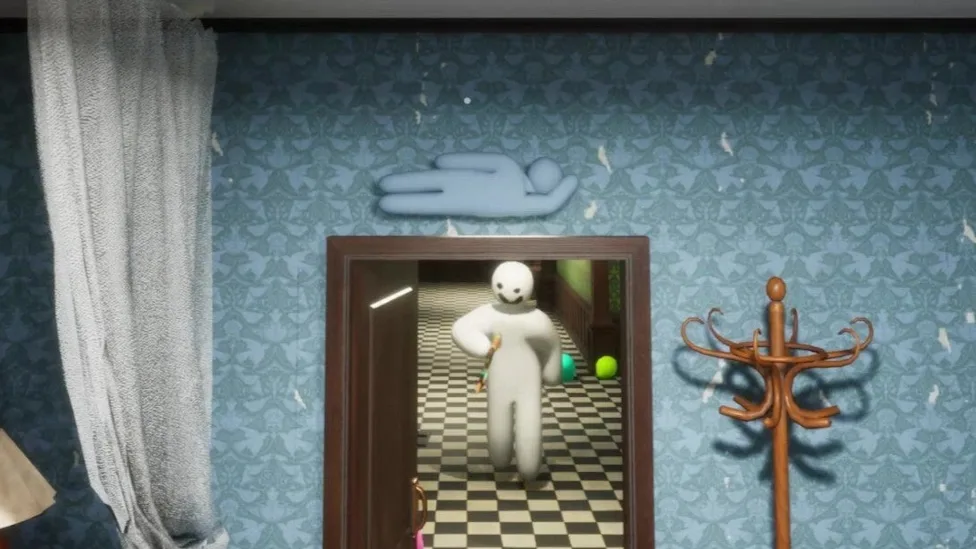
Meccha Chameleon has become one of 2026’s biggest multiplayer stories by turning hide-and-seek into a live painting challenge. Developed and published by lemorion_1224, the casual multiplayer game gives hiders pure white character bodies that they must paint to match walls, floors, framed pictures, props, shadows, and other environmental details. Seekers then search the stage and attempt to expose every disguised player before the time limit expires.
The concept is easy to understand, but the camouflage system gives it more depth than a single visual joke. Hiders must choose a convincing location, reproduce the surrounding colors, adopt a believable pose, and control their silhouette well enough to become part of the scenery. A player might imitate a patterned wall, hide inside a framed image, copy floor tiles, resemble a stain, or turn into a suspicious patch of shadow. Artistic skill helps, but survival also depends on understanding how quickly a seeker scans a room and which details are most likely to attract attention.
This structure makes Meccha Chameleon immediately entertaining for both players and viewers. Someone watching a short clip does not need a lengthy explanation of the rules. The room appears, the seeker begins searching, and the audience tries to identify the hidden player before the reveal. A well-painted disguise can look genuinely impressive, while a terrible painting may become even funnier when it somehow survives. The game therefore rewards creative skill without requiring every player to be a talented artist.
Its viral success also comes from the combination of accessibility, expressive freedom, streamer-friendly chaos, and a relatively low barrier to entry. Hide-and-seek is familiar, and players with experience in Prop Hunt-style games already understand the basic relationship between hiders and seekers. Painting the disguise manually gives that familiar structure a new identity and ensures that two players rarely approach the same location in exactly the same way.
Every successful hiding attempt can become a miniature visual story. A seeker may walk past someone who is obvious to the audience but invisible during the match. A player may create an elaborate mural, only to be discovered immediately because the pose is wrong. Another may make almost no artistic effort and survive because the seeker assumes the strange shape belongs to the map. That unpredictable balance between skill, confidence, deception, and absurdity explains why Meccha Chameleon has grown beyond a short-lived novelty and become a major Steam party game.

How Players Recreate High Art and Find the Best Hiding Spots
Players recreate high art in Meccha Chameleon by treating the body-painting system as a camouflage canvas. The objective is not to produce an attractive painting in isolation, but to create something that looks as though it belongs in the selected part of the map. In an art gallery-style area, a hider might copy the colors and shapes of a framed picture. Near a wall, the player may reproduce stripes, panels, stains, or shadows. On a patterned floor, the entire body can become one more tile or decorative section.
The strongest artistic disguises combine three elements:
- Color matching: The dominant shade must be close enough to the surrounding surface that the body does not immediately stand out.
- Silhouette control: The chosen pose should reduce the recognizable outline of a human-shaped character.
- Believable placement: Even a carefully painted body will look suspicious when it appears in a location where the copied pattern does not naturally belong.
This is why the game’s high-art clips have become so popular. Players are not simply hiding beside paintings. They are attempting to become part of the artwork. A character can resemble a brushstroke, a missing section of a background, an extra figure inside a portrait, or a block of color that appears intentionally placed. The humor comes from turning museum logic into survival strategy. If the disguise looks artistic or strange enough, the seeker may assume it is part of the exhibition.
Famous painting styles offer useful inspiration, but perfect accuracy is unnecessary. A Mona Lisa-inspired disguise works through muted colors, centered positioning, and a portrait-like pose. A Starry Night-inspired attempt benefits from swirling color patches and a visually busy background that can hide imperfect painting. A Mondrian-style disguise works best around hard lines, simple geometry, and bold blocks of color. Renaissance-inspired poses can be effective around portraits or classical artwork because the player’s body may resemble another figure inside the composition.
The most dependable locations are usually those containing visual noise. Busy paintings, patterned carpets, shelves, posters, decorative corners, and surfaces with several colors give hiders more room to make mistakes. Plain walls and simple floors are much less forgiving because the body outline and every incorrect shade remain easy to see. Skilled players therefore study the entire environment before deciding where to paint.
The best location may not be the center of a painting. Frames, shadows beneath artwork, carpet borders, signs, repeated wall decorations, and gaps between objects can be equally effective. Meccha Chameleon rewards players for identifying the visual language of a space and adding something that looks plausible within it. A successful disguise does not need to satisfy an art critic. It only needs to make the seeker believe the lie for a few more seconds.
This visual deception also explains why the game became such a strong party experience. Steam highlights public matches, simple team rules, streaming support, and recommended groups of 2 to 10 players depending on the host’s conditions. The result is a game that works for organized friend groups, public lobbies, livestream collaborations, and short sessions in which every round can create a different visual punchline.
Meccha Chameleon Gameplay, Camouflage Techniques, and Creator Appeal
New players should approach Meccha Chameleon as a game about believable visual deception rather than simply finding the darkest or most distant corner. Large flat surfaces may appear attractive because they are easy to copy, but they expose every color error and make the character’s outline more noticeable. Patterned areas, decorated walls, cluttered props, colorful artwork, and visually complex scenery are usually safer because they conceal imperfections.
After selecting a location, the player should begin with the dominant color rather than attempting fine details immediately. Covering the body with the main shade creates the foundation of the disguise. Secondary colors can then reproduce borders, shadows, stripes, stains, or other details that help the character merge with the surrounding image. The final step is choosing a pose that minimizes obvious limbs and prevents the body from reading as a person at first glance.
Beginners often make the mistake of overpainting. They choose an ambitious picture, add too many details, or spend so long perfecting the disguise that the final result becomes visually complicated. Experienced players are more likely to simplify the image into its largest and most recognizable color blocks. Perfect art is less important than believable art, particularly when the selected location already contains enough visual noise to disguise minor inaccuracies.
Seekers need to inspect the environment in a different way. Movement is an obvious clue, but skilled hiders may remain completely still and depend on confidence as camouflage. Seekers should instead look for broken patterns, incorrect edges, colors that are slightly too bright or dark, repeated shapes that suddenly change, and details that appear unusually symmetrical or human. A disguise can survive a quick glance even when it becomes obvious under closer inspection, so methodical observation is often more useful than rushing around the room.
Meccha Chameleon shares Prop Hunt’s social foundation. Both games divide players into hiders and seekers, reward deception and observation, and create laughter when someone survives in plain sight. The major difference is the level of creative control. Prop Hunt usually asks players to become an existing object and position it convincingly. Meccha Chameleon asks them to build the disguise themselves.
That difference changes the source of the comedy. A poor Prop Hunt choice might be a chair placed in an illogical location. A poor Meccha Chameleon disguise can resemble a cursed mural, a failed self-portrait, or a shapeless stain pretending to be modern art. A clever Prop Hunt disguise is satisfying because of object selection and placement. A clever Meccha Chameleon disguise can also display artistic skill, environmental awareness, and an understanding of how seekers process visual information.
Streamers and content creators have played a central role in turning those mechanics into a wider success. The Steam page explicitly welcomes gameplay videos and livestreams, asks creators to include the game’s name in the title, and suggests including the Steam store page in the description. This creator-friendly policy gives videos consistent naming, improves discoverability, and makes it easier for viewers to identify and search for the game.
The format is naturally suited to streaming because each round has a simple narrative. A player chooses a location, attempts a disguise, waits while the seeker approaches, and either survives or is exposed. Different personalities create different kinds of entertainment. One participant may carefully reproduce a painting, another may panic and become an obvious wall stain, and another may stand openly in the room with such confidence that the seeker ignores them. These moments are easy to clip, share, and understand outside the original livestream, allowing the game’s reach to expand far beyond the people actively playing it.

Sales Growth, Player Records, Funniest Disguises, and Upcoming Maps
Meccha Chameleon’s explosive Steam growth is built on low friction and high shareability. Players can understand the rules almost immediately, purchase the game without the financial commitment associated with a major release, invite friends, and produce funny moments during their first session. The game does not require advanced mechanical knowledge before it becomes entertaining, but its painting, positioning, and observation systems provide enough skill development to keep experienced players engaged.
Social proof strengthened that growth. The game reportedly sold 1 million copies in four days, reached 2 million after five days, and passed 7 million in under two weeks. Each milestone created another wave of attention. The progression made Meccha Chameleon look less like a passing joke and more like a genuine multiplayer phenomenon, encouraging curious Steam users to find out why so many people were playing it.
Steam visibility likely reinforced the cycle. High player activity, frequent creator coverage, public reviews, and social media clips increased discoverability, while the expanding audience generated even more videos and discussions. SteamDB recorded an all-time peak of 340,534 concurrent players on June 21, 2026, alongside substantial live-player activity around the same period. The Steam store also displayed a Very Positive English review rating and thousands of reviews shortly after launch, while SteamDB tracked tens of thousands of reviews across languages.
Those figures demonstrate more than raw sales. Sales show that the concept persuaded people to purchase the game, the concurrent-player peak shows that a large portion of the audience played at the same time, and the review volume indicates that enough users remained engaged to form a visible public response. Together, these measurements help explain how Meccha Chameleon moved from a viral curiosity to one of Steam’s most prominent party games of the year.
The disguises themselves continue to supply the game’s best marketing. The funniest creations often sit between impressive and ridiculous. A fake portrait can clearly resemble a painted human body yet still pass as gallery artwork. A landscape attempt can transform the player into a lumpy mountain. An abstract disguise may survive because it looks so strange that the seeker assumes the design is intentional.
Gallery-style clips are particularly effective because the seeker must decide whether a crooked face, distorted body, or strangely painted frame is a player or simply part of the map. A technically excellent disguise earns admiration, while a terrible disguise that survives produces an even stronger comic reaction. Meccha Chameleon does not depend on everyone being good at painting because both artistic success and artistic failure can generate memorable rounds.
The teased Japan-themed map is therefore important to the game’s future. Reports surrounding the 7 million sales announcement said the developers were preparing a new environment inspired by Japan, with the update expected within a relatively short period after the milestone. A setting of that kind could introduce paper screens, lanterns, patterned floors, signs, garden textures, traditional architectural details, and other surfaces suited to creative camouflage.
New maps are not merely cosmetic additions in Meccha Chameleon. Each environment changes the available strategies, provides new visual references, and gives creators additional material for clips and livestreams. The challenge is to maintain readable chaos. A successful map must contain enough detail for hiders to create clever disguises without becoming so visually crowded that seekers feel discovery is arbitrary. Preserving that balance will be essential as the game expands beyond its launch locations.

Why Social Media Loves Meccha Chameleon and Whether Its Momentum Can Last
Meccha Chameleon clips are ideally structured for short-form social media. A video begins with a room or gallery, the seeker starts searching, and the hidden player is eventually revealed. The payoff is quick, visual, and easy to understand without dialogue or extensive context. This makes the game suitable for platforms where viewers decide within seconds whether to keep watching.
The clips also invite participation. Viewers can pause the video, examine the background, and attempt to find the hider before the seeker does. That creates the satisfying “I would have missed that too” reaction when the camouflage is effective. Even people who do not own the game can interact with its central challenge by treating each video as a visual puzzle.
Different kinds of clips can succeed for different reasons. An intricate disguise can spread because the painting is impressive. A terrible disguise can spread because it looks absurd. A seeker overlooking an obvious character can spread because the mistake is painful and funny to watch. The same mechanic therefore produces skill demonstrations, comedic failures, surprising escapes, and audience challenges without requiring separate game modes.
Maintaining that momentum after 7 million sales will depend on whether the developers continue feeding the social ecosystem with fresh visual material. The launch proved that the central idea works, but viral party games often face a retention challenge once the audience fully understands the joke. Players need new reasons to create stories rather than repeat the same hiding locations and reveals.
Map variety is the most direct solution because every new environment changes the available surfaces, patterns, poses, and strategies. The Japan-themed map is a strong step in that direction. Better painting tools, useful quality-of-life improvements, expanded match options, workshop support, or custom-map features could also help players produce new situations, although those possibilities have not been confirmed.
The game must continue supporting both casual and skilled audiences. Casual players need easy laughs and disguises that can work even when the painting is imperfect. Skilled players need enough depth to improve color matching, posing, map knowledge, seeker psychology, and camouflage efficiency. If future updates preserve both sides of the experience, Meccha Chameleon may develop into a long-term party-game favorite rather than peaking as a brief viral sensation.

Frequently Asked Questions (FAQs)
- What is Meccha Chameleon?
Meccha Chameleon is a multiplayer hide-and-seek party game developed and published by lemorion_1224. Hiders paint their white character bodies to resemble parts of the environment, while seekers search the stage and try to identify every disguised player before the time limit expires. - Why is Meccha Chameleon going viral?
Meccha Chameleon is going viral because its painting-based camouflage system creates surprising and highly shareable moments. The rules are easy to understand, the reveals work well in short videos, and both impressive disguises and ridiculous failures can become entertaining clips. - How many copies has Meccha Chameleon sold?
Meccha Chameleon reportedly passed 7 million sales in under two weeks after launch. Its growth was extremely fast, reaching 1 million sales in four days and 2 million after five days before crossing the larger milestone. - What is the Meccha Chameleon concurrent player peak?
SteamDB recorded an all-time peak of 340,534 concurrent players on June 21, 2026. This shows that the game’s success was not limited to purchases, as hundreds of thousands of people were actively playing at the same time. - Is Meccha Chameleon like Prop Hunt?
Yes. Both games are based on social hide-and-seek, with one team disguising itself while another searches. The main difference is that Prop Hunt usually turns players into existing objects, while Meccha Chameleon lets players create their own disguises by painting their bodies to match the environment. - Why are players recreating high art in Meccha Chameleon?
Paintings and gallery-style environments provide complex colors, shapes, and patterns that make strong camouflage opportunities. Players can imitate portraits, brushstrokes, abstract blocks, or background sections, turning their character into a fake artwork that may convince the seeker it belongs in the room. - Is Meccha Chameleon good for beginners?
Yes. The basic rules are simple enough for beginners to understand during their first match, and an imperfect disguise can still succeed in the right location. The game also has a meaningful skill curve involving color matching, silhouette control, posing, map knowledge, and observation. - Does Meccha Chameleon support streaming?
Yes. The Steam page welcomes gameplay videos and livestreams. Creators are required to include the game’s name in the title and may also include the Steam store page in the description to help viewers identify and find it. - What new Meccha Chameleon map is coming?
The developers have teased a Japan-themed map following the game’s 7 million sales milestone. Reports indicated that it was expected relatively soon after the announcement, although the supplied material does not provide a specific release date. - Can Meccha Chameleon stay popular?
Meccha Chameleon can remain popular if future updates continue providing new maps, strategies, creative tools, and reasons for players and streamers to produce fresh moments. Its long-term strength will depend on preserving easy casual comedy while giving experienced players enough depth to improve their painting, positioning, and seeker-reading skills.
Conclusion
Meccha Chameleon Rockets Past 7 Million Sales as Players Hide By Recreating High Art is more than a viral headline. It captures the reason the game has exploded: Meccha Chameleon turns hiding into performance, painting into strategy, and mistakes into comedy. Its rise shows how powerful a simple multiplayer idea can become when it is easy to understand, funny to watch, and deep enough for players to improve.
The 7 million sales milestone, the 340,534 concurrent player peak, the flood of social clips, and the incoming Japan-themed map all point to the same conclusion. Meccha Chameleon is not just another short-lived Steam novelty. It is a rare party game that gives players the tools to create their own jokes, tricks, and miniature masterpieces. Whether players are copying famous paintings, hiding as terrible modern art, or simply becoming one suspicious patch of wall, the game has found a formula that feels fresh, funny, and built for the internet.
Sources and Citations
- Steam Store page for Meccha Chameleon
Steam Store – MECCHA CHAMELEON - SteamDB charts for Meccha Chameleon
SteamDB – MECCHA CHAMELEON Charts - GamesRadar report on Meccha Chameleon passing 7 million sales in under two weeks and developers teasing a Japan-themed map
GamesRadar – Meccha Chameleon flies by 7 million sales in under 2 weeks as Steam’s latest viral hit continues to go to the moon - PC Gamer report on Meccha Chameleon selling 1 million copies in four days and explaining the hide-and-seek body-painting premise
PC Gamer – Hide-and-seek game where you paint your body to blend in sells a million copies in four days - GamesRadar report on Meccha Chameleon reaching 2 million Steam sales after five days and being compared to Prop Hunt and other viral social multiplayer games
GamesRadar – Like Prop Hunt, but chameleons: Viral new hide-and-seek game celebrates 2 million Steam sales after just 5 days - Automaton Media report on Meccha Chameleon passing 7 million sales, reaching a major concurrent player high, and preparing a Japan-themed map
AUTOMATON WEST – Meccha Chameleon to get Japan-themed map as sales top 7 million
Recommendations
- Why Hair Grooming Takes So Long and How to Speed It Up
- 007 First Light: Murto Boss Fight Guide, How to Beat Murto Easily
- Manga Artist’s Struggles Go Viral as Fans Donate Over $5,600 – Shiten Akiyama’s Horizon Story Explained
- HBO Calls Harry Potter TV Series a Rare Financial Investment: Why the Reboot Is So Expensive
- Zibra AI Launches New Real-Time VFX Technology ZibraGDS: Everything You Need to Know
- Every Marvel & DC Voice Actor in INVINCIBLE: Full Cast Crossover Guide
- $270 Stranger Things: the Complete Series Blu-Ray Collection Announced 25 Discs, 148-Page Artbook, and Exclusive Hellfire Club D20 Dice
- Aaron Pierre’s Green Lantern John Stewart Will Return in James Gunn’s Man of Tomorrow: What It Means for the DCU
- MoCap Online: Top Motion Capture Resources, Tools, and Animation Packs for Game Developers and Animators
- PlayStation Might Offer Discount to Players Who Try to Cancel PS Plus: How the Reported Retention Deal Works



































































































