




In This Article (7 sections)
Medieval Horse Dealer Simulator Release, Price, Platforms and PC Requirements
Medieval Horse Dealer Simulator released on August 17, 2026, as a complete commercial game for Windows PC through Steam. The launch was not an Early Access release, and the official store does not classify the game as unfinished. One Slice of Pizza Games serves as both developer and publisher, giving the studio direct control over pricing, updates, community announcements and post-launch support. Patches began arriving shortly after release, addressing reported bugs and adding improvements such as a horse pedigree page, although that early support does not guarantee a specific long-term update schedule.
The game is currently a Windows-only, single-player release. No PlayStation, Xbox, Nintendo Switch, macOS or Linux editions have been announced. Steam lists 84 achievements and Family Sharing support, while controller support is not identified in the official feature panel. The interface and subtitles support 19 languages: English, French, Italian, German, Spanish, Czech, Hungarian, Japanese, Korean, Polish, Brazilian Portuguese, Romanian, Russian, Simplified Chinese, Thai, Traditional Chinese, Turkish, Ukrainian and Vietnamese. Full voice acting is not listed. A free demo was released on February 19, 2026, although its continued availability after launch can change.
The standard US Steam price is $17.99. A 10 percent introductory discount reduced it to $16.19 through August 31, 2026. Steam uses regional currencies and pricing, so other countries may see different amounts and applicable taxes. The game is also offered in a bundle with Arctic Motel Simulator, with the effective bundle price depending on current promotions and whether the customer already owns one of the included products. As of September 1, 2026, Steam displayed a Very Positive overall rating, with 89 percent of 160 user reviews marked positive, although those figures will naturally change as more reviews are submitted.
The official PC requirements are:
- Minimum: Windows 10, Intel Core i3, 8 GB RAM, Nvidia GeForce GTX 960 with 4 GB VRAM, DirectX 11 and 16 GB of available storage.
- Recommended: Windows 10, Intel Core i5, 16 GB RAM, Nvidia GeForce GTX 1070 with 6 GB VRAM, DirectX 12 and 16 GB of storage.
The processor requirements are broad because no exact Core i3 or Core i5 generations are specified. Players with older CPUs should therefore consider generation, clock speed and core count instead of relying solely on the family name. Official AMD graphics equivalents are not provided, and matching VRAM alone does not guarantee comparable performance. SteamOS, Linux and Steam Deck are not listed as officially supported platforms. Minimum requirements should also be treated as a baseline for playability rather than a promise of the highest settings or smoothest possible performance.

Medieval Horse Dealer Simulator Horse Trading, Breeding, Training and Auctions
Medieval Horse Dealer Simulator is a first-person business and life simulation centered on rebuilding a medieval horse enterprise. The player controls a formerly respected baron whose trusted vassal betrayed the family, seized its title and forced the protagonist to escape across the sea. With little money remaining, the displaced noble purchases a rundown stable and begins rebuilding from almost nothing. The long-term objective connects the economic simulation to the story: every successful horse sale, crop harvest, crafted weapon, caravan route and trained soldier contributes toward accumulating enough wealth, influence and military strength to return home and confront the usurper.
Horse dealing remains the core of that progression. Players acquire animals, care for them, evaluate their potential, train them for different purposes, develop bloodlines and decide whether each horse is more valuable as a sale, breeding animal, racer, transport mount or war horse. Trading is therefore more involved than purchasing cheaply and immediately reselling. Feed, condition, abilities, training, inherited traits and breeding potential can all affect the usefulness and commercial value of a horse. A modest animal may provide a quick profit after limited development, while another may be worth retaining because its lineage could generate more valuable offspring.
Breeding is designed as a multigenerational investment. Foals can inherit positive qualities, allowing players to preserve successful bloodlines and combine desirable traits over successive generations. A racehorse breeding program may prioritize different qualities from one intended to produce draft or military animals, so there is no single ideal horse for every purpose. The pedigree page added after launch supports this system by displaying known parents and offspring. Market horses may not have complete parental records, while animals bred within the player’s stable can form a more traceable family history. Strong breeding stock creates an ongoing economic dilemma because selling elite offspring generates immediate money, while keeping the best animals can improve future generations.
Training provides another way to increase value and specialization. Different approaches can develop qualities suited to racing, transport, draft work, warfare or resale, while achievement references to courage and strength training grounds indicate that training facilities themselves can be upgraded. Racing provides a practical use for developed horses and allows players to test the results of breeding, nutrition and training. Because development consumes both time and resources, players must determine which horses deserve substantial investment and which should be sold earlier.
Auctions serve as a formal route for converting developed horses into capital. Before selling, players can improve an animal through care, feed, training and selective breeding, but the highest-value horse is not automatically the best auction candidate. A superior breeding animal may generate greater long-term value by remaining in the stable, while a well-trained horse that does not fit the future bloodline may be better sold. Profit must also be judged against acquisition, feeding, care and development expenses rather than the final sale price alone.
The game explicitly refers to elite stallions, racehorses, draft mounts and war horses, but its official material places greater emphasis on functional roles, lineage and inherited traits than on collecting a fixed list of historical breeds. The major horse-management loop therefore combines:
- Buying and evaluating horses
- Daily feeding and care
- Specialized training
- Racing and practical use
- Selective breeding and pedigree development
- Auctions and direct commercial decisions
- Choosing between immediate sale value and long-term breeding, transport or military usefulness
This structure makes the stable a production business rather than a simple collection system. Horses become assets whose value can be developed over time, and the strongest decision often depends on how that animal fits the wider estate rather than its current selling price alone.

Farming, Crafting, Caravans and Mercenary Progression in Medieval Horse Dealer Simulator
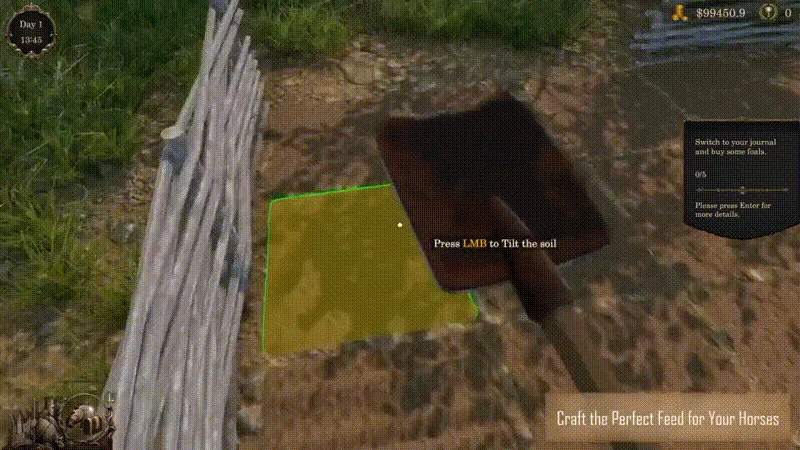
The stable is only one part of a much broader medieval enterprise. Official descriptions identify nine major feature areas covering feed formulation, horse care, training, breeding, merchant caravans, blacksmithing, mercenary development, livestock raising and valuable-goods production, with horse trading and auctions connecting those activities to the larger economy. Farming provides grass and other crops used for horse feed, while more advanced formulations encourage experimentation with different ingredients. Animal care remains a regular responsibility, and the estate can also raise livestock, construct shelters, care for newborn animals and collect products such as milk and eggs. Those resources can then support further production, including cheese, beer and other valuable goods.
Mining and blacksmithing create a second major production chain. Players extract ore, improve the forge, discover better blueprints and manufacture equipment. Crafted products can be sold for income, used on horses or issued to mercenaries, forcing the player to choose between short-term profit and internal development. Forge upgrades and additional blueprints gradually increase what can be produced, while mining reduces dependence on externally purchased materials. This makes the blacksmith especially important because it supports both the commercial and military sides of the estate.
Merchant caravans expand the business beyond the immediate property. Players need wagons, merchants and appropriate horses before opening trade routes between towns. Caravans give trained horses another way to generate repeated economic value and provide a market for agricultural products, livestock goods and forged equipment. Infrastructure associated with merchant wagons can also be improved as the organization expands. A successful caravan system therefore depends on the farm, stable and workshops producing enough goods to support it. Expanding too aggressively before those systems are stable can place unnecessary pressure on cash flow.
The mercenary system turns local villagers into an organized military force. Recruits can be trained into different troop types, equipped with weapons and armor from the forge and supplied with trained war horses from the stable. As they gain experience, they can progress from rookies toward elite veterans and accept contracts from rulers and other clients. Those contracts transform military investment into income and influence while moving the protagonist closer to the eventual objective of reclaiming the stolen title. Building the army too quickly can still become expensive because troops need equipment, preparation and supporting infrastructure, so military growth works best when the estate already has dependable commercial production.
All of these activities create recurring opportunity-cost decisions. Money used on a stable upgrade cannot simultaneously finance a caravan. Selling a powerful horse may provide the capital needed for new facilities but remove valuable breeding stock. A high-quality sword can be sold to a customer or given to a soldier. Expanding farmland increases production but also creates more labor, making employee housing and worker capacity increasingly important. The game therefore functions more like an interconnected medieval enterprise simulator than a narrowly focused horse game.
That breadth largely determines whether Medieval Horse Dealer Simulator will appeal to a particular player. Horse-game fans receive feeding, care, pedigrees, breeding, racing, training and auctions, while management players receive workers, production chains, facility upgrades, manufacturing, trading and resource allocation. Medieval life-simulation fans also gain farming, livestock, mining, forging and military development. Players seeking a highly specialized equestrian simulation may find those additional systems distracting, while anyone expecting a combat-focused medieval action game should recognize that management remains the central experience. For players who enjoy turning a modest starting property into a diversified organization through gradual investment and long-term planning, the combination of horses, agriculture, manufacturing, commerce and mercenary development gives the game a substantial progression loop.

Frequently Asked Questions (FAQs)
- When did Medieval Horse Dealer Simulator release?
Medieval Horse Dealer Simulator released on August 17, 2026, for Windows PC through Steam. This was the full commercial launch rather than a provisional date, and both the Steam store listing and the developer’s launch announcement confirm that the game became available on that day. - Is Medieval Horse Dealer Simulator in Early Access?
No. Medieval Horse Dealer Simulator launched as a complete commercial release on August 17, 2026. Steam does not place it under the Early Access program, although the developer can still release patches, bug fixes and other improvements after launch. - What platforms support Medieval Horse Dealer Simulator?
The officially supported version is currently available for Windows PC through Steam. No PlayStation, Xbox, Nintendo Switch, macOS or Linux editions have been announced, so players on those platforms should not assume ports are planned unless One Slice of Pizza Games confirms them. - How much does Medieval Horse Dealer Simulator cost?
The standard US Steam price is $17.99. A 10 percent introductory promotion lowered the launch price to $16.19 through August 31, 2026. Steam uses regional pricing, so the amount shown in other countries can differ, and future sales may temporarily reduce the standard price again. - Can players breed horses?
Yes. Breeding is one of the game’s major long-term systems. Players can pair suitable horses, raise foals across multiple generations, preserve desirable inherited traits and develop bloodlines suited to purposes such as racing, transport, warfare or future sales. - Does Medieval Horse Dealer Simulator include racing and auctions?
Yes. Horses can be trained for different roles, including competitive racing, and developed animals can also be sold through auctions. This creates a choice between selling a valuable horse for immediate income or keeping it for breeding, transport, military use or further training. - Can players farm and raise animals other than horses?
Yes. The estate includes broader agricultural systems alongside horse management. Players can plant crops, cut grass, create feed recipes, raise livestock, care for newborn animals and collect resources such as milk and eggs. Those materials can also support production activities such as making cheese and brewing beer. - Does Medieval Horse Dealer Simulator have combat?
The game includes military progression, but it is not primarily presented as a direct combat-focused action game. Players recruit villagers, train them into different troop types, equip them with horses, weapons and armor, develop experienced veterans and send the force on contracts connected to the wider progression of the estate and story. - Is Medieval Horse Dealer Simulator multiplayer?
No. The official Steam feature panel lists Medieval Horse Dealer Simulator as a single-player game, and no cooperative or competitive multiplayer mode is announced. The management, trading, breeding, farming and mercenary systems are all designed around a solo campaign. - What are the minimum PC requirements?
The minimum configuration requires Windows 10, an Intel Core i3 processor, 8 GB of RAM, an Nvidia GeForce GTX 960 with 4 GB of VRAM, DirectX 11 and 16 GB of available storage. Because the developer does not specify the exact Core i3 generation, players with older processors should also consider the age and performance of their CPU rather than relying only on the model family name.

Conclusion
Medieval Horse Dealer Simulator releases August 17, 2026 as a Windows PC simulation built around far more than purchasing and reselling animals. Its horse care, training, breeding, racing, and auction mechanics form the foundation of an economy that expands into agriculture, livestock, mining, forging, manufacturing, caravan commerce, and mercenary management.
The fallen baron storyline gives those systems a shared objective. Players begin with a neglected stable and limited money, then use careful investment and long term planning to rebuild their fortune. Elite bloodlines can strengthen the horse business, farms can supply feed and commercial products, mines can support blacksmithing, caravans can open new markets, and mercenaries can help the protagonist regain lost power.
With a standard US price of $17.99 and moderate official PC requirements, the game is positioned as an accessible management simulation for players interested in horses, medieval commerce, and gradual estate development. Its greatest strength is the way its many activities contribute to one expanding enterprise rather than existing as entirely separate minigames.
Sources and Citations
- Steam / One Slice of Pizza Games: Medieval Horse Dealer Simulator Official Store Page confirms the August 17, 2026 release date and identifies One Slice of Pizza Games as both developer and publisher. It documents the single-player format, 19 supported languages, 84 achievements and gameplay systems involving horse trading, breeding, training, auctions, farming, mining, blacksmithing, merchant caravans, livestock and mercenary management. The minimum requirements include Windows 10, 8 GB RAM, a GTX 960 and 16 GB of storage, while the recommended specification calls for 16 GB RAM and a GTX 1070. (Steam Store)
- One Slice of Pizza Games: Medieval Horse Dealer Simulator Is Out Now is the official launch announcement. The developer confirmed that the game became available on August 17 after several years of development and directed players to the Steam store for purchase and support information. (SteamDB)
- Notebookcheck: New Immersive Medieval Sim Launches on Steam With Launch Discount in Tow, published on August 18, 2026, independently confirms the launch. It records a regular US price of $17.99 and a temporary 10% discount that reduced the price to $16.19 until August 31. The report also confirms the Windows-only release, 19 languages, 84 achievements and the official PC specifications. (Notebookcheck)
- One Slice of Pizza Games: Patch 1.7: Horse Pedigree and Bug Fixes added a pedigree page showing each horse’s parents and children. Players can inspect another horse’s pedigree, view its statistics and access the feature through horse management or direct interaction. The update also fixed the horse photo camera and a save-file issue involving temporary stables, although older saves may contain incomplete pedigree information. (SteamDB)
- One Slice of Pizza Games: Patch 1.8, released on August 29, 2026, corrected a problem introduced alongside the pedigree feature. The bug caused previously sold horses to spawn when players selected horses from the pedigree page. (SteamDB)
- Steam: Medieval Horse Dealer Simulator News and Updates is the official archive for the launch announcement, patches, feature additions and continuing bug fixes. The individual Patch 1.7 and Patch 1.8 pages remain the more precise citations for the pedigree system and its subsequent correction. (Steam Store)
Recommendations
- Uncharted 5? Fans Believe Cryptic Naughty Dog Dev Post Is Teasing The Game
- Rhythm Heaven Groove got a surprise free demo on the Nintendo eShop ahead of its July 2 launch
- Obsidian Was Originally Planning To Make Fallout: New Vegas 2 – What Happened and Why It Never Released
- Pokemon Pokopia: Bubbly Basin – How To Get The Starmie Doll
- 80 Level gamescom dev 2026 Contest Winners: Ana Vien and Vovk Robert Win 5-Day Passes
- How to Use Clothes for MetaHuman in Animation: Best Tools, Techniques, and Workflows in Unreal Engine 5
- Best Render Farm for Blender and Costs: Complete Comparison
- Sony Shuts Down Bluepoint Games: Demon’s Souls Remake Studio Closing in March 2026
- 007 First Light Release is “Just the Beginning” as IO Interactive Confirms Massive Post-Launch Content Roadmap and TacSim Updates
- Managing Blender Scenes with Multiple Cameras Using The View Keeper



































































































