









In This Article (9 sections)
Mewgenics Blends Cat Breeding, Tactical Combat, and Generational Strategy
Mewgenics turns the fantasy of owning an enormous household of cats into a tactical role-playing game about breeding, inheritance, survival, and turn-based warfare, without the real-world costs of food, veterinary care, damaged furniture, or kitty litter. Developed by Edmund McMillen and Tyler Glaiel, it combines grid-based battles with roguelite progression, house management, equipment synergies, environmental interactions, and long-term genetic planning.
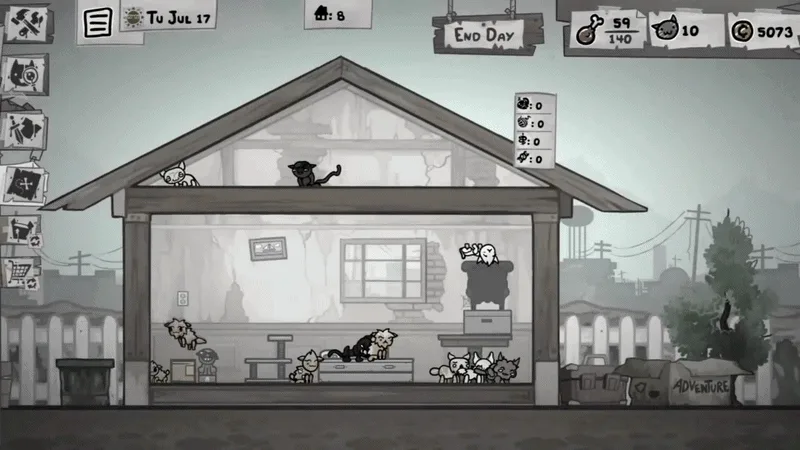
Players begin with a growing population of cats in Boon County, where animals form relationships, age, breed, and develop persistent strengths or weaknesses. Before each expedition, up to four cats can be selected and assigned classes through collars. The party then enters a sequence of battles and events, collecting equipment and abilities while facing increasingly dangerous enemies. Survivors return with valuable experience and traits that can influence future generations, while losing a veteran may permanently remove an important fighter or bloodline from the household.
This generational structure separates Mewgenics from tactical games built around one permanent group of heroes. A randomly generated kitten may eventually become a legendary adventurer whose descendants inherit parts of its build. Even a flawed cat can remain valuable because of a rare mutation, useful ability, unusual passive effect, or compatibility with another bloodline.
The game also stands out because of its scale. Its official description advertises:
- More than 1,000 abilities
- More than 900 items
- Over 200 enemies and bosses
- Numerous class paths and equipment combinations
- A main campaign lasting more than 200 hours
These systems allow Mewgenics to function as a tactical RPG, breeding simulator, collection game, house-management experience, and highly replayable roguelite at the same time. Discovering an unexpected interaction between a class, inherited ability, mutation, item set, and environmental effect can be as important as executing a carefully prepared battle plan.

Release Details, Genetics, and Building a Strong Cat Army
Mewgenics was released for Windows PC through Steam on February 10, 2026, with a standard United States price of $29.99. It is a single-player game with achievements, cloud saving, controller support, and Family Sharing. There is no native macOS or Linux edition, although the Windows version is Steam Deck Verified and runs through Valve’s Proton compatibility system.
Breeding is the foundation connecting individual adventures to the wider campaign. Cats living together can form relationships and produce kittens, which need time to mature before joining expeditions or becoming part of another breeding project. Early living-space restrictions can make accidental inbreeding difficult to avoid, but later house upgrades provide more rooms for separating relatives and maintaining several controlled bloodlines.
Two household characters are particularly useful. Tink reveals information about genetic statistics and inbreeding, while Frank provides house improvements that give players more control over living arrangements. Furniture also affects the household through several statistics:
- Appeal influences the quality of stray cats that may arrive.
- Comfort supports household activity and general effectiveness.
- Health contributes to longevity and recovery from certain conditions.
- Stimulation improves kitten outcomes and inheritance prospects.
- Mutation increases the possibility of new mutations.
A cat’s visible combat strength should not be confused with genetic value. Equipment and collars can make an adventurer look powerful without improving the traits passed to its offspring. Base statistics, inherited abilities, beneficial mutations, useful passives, lifespan, and genetic compatibility are more important when choosing parents.
Mutations can provide statistical exchanges or more unusual effects, but they are not guaranteed improvements. Version 1.1 restricted lower household Mutation values to simpler stat changes, while more advanced effects become possible after reaching the necessary threshold. Disorders and birth defects are separate concerns, and excessive inbreeding can increase the chance of harmful inherited conditions.
The strongest cat army is therefore a diverse population rather than several copies of one powerful animal. Maintaining separate physical, ranged, magical, healing, and control-focused bloodlines gives the household more ways to build balanced parties. Unrelated strays can introduce valuable genetic material, while reserve breeders protect long-term progress if an expedition ends badly. The goal is to avoid making the entire campaign dependent on one irreplaceable champion.

Best Classes, Beginner Combat Tips, and Equipment Synergies
Mewgenics contains 13 standard class paths associated with collars, alongside the special Collarless identity. Fighter, Hunter, Mage, and Tank are available early, while campaign progression unlocks Cleric, Thief, Necromancer, Tinkerer, Druid, Butcher, Psychic, Monk, and Jester. Collarless cats do not receive the usual class modifiers, but they can use broader universal possibilities that support unconventional builds.
There is no permanent best class because maps, enemies, inherited abilities, equipment, and balance updates continually change what a party needs. One of the most reliable early combinations is Tank, Fighter, Hunter, and Cleric. The Tank controls space, the Fighter provides direct melee damage, the Hunter attacks from safer positions, and the Cleric supplies healing, cleansing, and support. Later parties can replace the Tank with a Monk or Necromancer when equipment and inherited durability provide enough protection.
Combat takes place on an isometric grid with turn order influenced by Speed. Each cat can move and perform a basic attack during a normal turn, while additional abilities depend on mana, range, line of sight, positioning, and other conditions. Movement is a tactical resource rather than a way to approach the nearest enemy. Holding a choke point, moving a threat into a hazard, or protecting a healer can matter more than dealing immediate damage.
The environment is also interactive. Grass can burn, water can freeze, and objects can be moved into enemies or used as barriers. Food and grass may restore resources, while scrap can provide protection. Players should inspect enemy descriptions before acting because important targeting rules, immunities, special attacks, and conditional effects are often explained there.
Action economy is one of the most valuable concepts to understand. Extra attacks, summons, counters, free movement, and effects that deny enemy turns can outperform a simple statistical increase. This is why healing, cleansing, forced movement, immobilization, charm, initiative manipulation, and terrain control are often more useful than another direct-damage ability.
Equipment should be chosen according to synergy rather than rarity alone. Tanks benefit from armor, shields, retaliation, and protection-based effects, while ranged attackers value accuracy, Speed, range, and bonuses against distant or marked targets. Healers benefit from mana efficiency and effects triggered by supporting several allies. Completing sets such as Nurse, Rocks, or Obelisk can make an ordinary item more valuable than an isolated high-rarity reward.
Beginners should also recognize when to retreat. Returning home with surviving cats, useful equipment, and new knowledge is often better than risking an important bloodline for one more reward. Mewgenics rewards long-term survival as much as individual victories.

Inherited Abilities, PC Performance, and Future Content Plans
Kittens can inherit statistics, active abilities, passive abilities, mutations, and some undesirable conditions from their parents. Current community documentation describes active-ability inheritance as a series of separate checks, with a kitten able to receive as many as two active abilities. The process remains probabilistic, even when both parents carry the desired skills.
This uncertainty makes it safer to preserve an important ability across several genetically distinct cats rather than depending on one perfect parent. Inherited abilities can also create powerful hybrids. A durable frontline cat may begin with a support skill, while a ranged class can inherit mobility that helps it escape dangerous positions. The strongest results align the inherited ability with the cat’s natural statistics and intended class.
Stimulation improves inheritance conditions and can reduce some risks involving inherited defects, but it does not remove randomness or the dangers of inbreeding. A kitten that misses the desired ability may still inherit stronger base statistics, a useful passive, a beneficial mutation, or enough genetic diversity to support a later pairing.
On Steam Deck, Mewgenics has received Valve’s Verified status, confirming functional controls, readable interface elements, and suitable default performance. Independent testing reported targets of 60 frames per second on the LCD model and 90 frames per second on the OLED model at the handheld’s native resolution. Inventory management and precise targeting may still feel more natural with the trackpads, touchscreen, or a mouse.
The official minimum PC requirements include:
- 64-bit Windows 10
- A four-core processor from approximately 2014 or later
- 8 GB of RAM
- A graphics solution with 2 GB of video memory
- OpenGL 4.4 support
- 6 GB of available storage
No detailed recommended specification has been published. A newer four-core processor, more than 8 GB of memory, an SSD, and a graphics solution comfortably above the minimum should provide additional headroom.
As of July 15, 2026, no PlayStation, Xbox, Nintendo Switch, or Switch 2 edition had been released. Console ports have been discussed, with Switch 2 described as a possible priority, but there is no confirmed platform list or date. Possible downloadable content has also been discussed, including an early concept involving four new classes and more than 300 abilities. Free balance and quality-of-life updates are expected to continue, while larger classes and regions could become paid expansions. Steam Workshop support has also been considered, but none of these future plans should be treated as available features until formally released.

How Mewgenics Compares with the Binding of Isaac and Whether it is Worth Buying
Mewgenics and The Binding of Isaac share Edmund McMillen’s grotesque humor, unpredictable combinations, secrets, and roguelite progression, but their gameplay is fundamentally different. The Binding of Isaac is a real-time action game built around controlling one character, avoiding projectiles, reacting quickly, and collecting items during the current run.
Mewgenics replaces reflex-based action with turn-based grid combat. Players manage up to four cats, study initiative order, manipulate terrain, coordinate classes, and plan around enemy behavior before committing to an action. Its permanent progression is also more personal. Individual cats, relationships, mutations, disorders, inherited abilities, house upgrades, and entire bloodlines remain important across expeditions.
The house-management layer has no direct equivalent in The Binding of Isaac. Rooms, furniture, breeding conditions, genetic diversity, and population planning influence the campaign outside combat. Mewgenics may share its creator’s taste for strange imagery and unexpected synergies, but it is not an Isaac sequel with cats.
At $29.99, Mewgenics offers substantial value for players who enjoy tactical RPGs, breeding systems, complex builds, and long campaigns. Its official description estimates more than 200 hours for the main campaign, while completion-focused play may take considerably longer. Replayability comes from changing cats, inherited qualities, item combinations, routes, mutations, classes, and battlefield situations.
The game also creates memorable unscripted stories. A weak kitten may become an essential healer, a celebrated fighter can return with a permanent injury, and a carefully managed bloodline may disappear during a failed expedition. These events matter strategically while giving the household a history that feels different in every campaign.
Critical reception has generally praised the game’s depth, variety, tactical experimentation, and ability to produce unusual combinations. The official Steam page displayed a Metacritic score of 88, while English-language Steam reviews were approximately 91 percent positive at the time covered by the source. Criticism has focused on harsh randomness, occasional difficulty spikes, dense interfaces, control friction, and humor that may not suit every audience.
Mewgenics is best suited to players who enjoy learning complicated systems and accepting permanent consequences. Anyone seeking a short campaign, simple character progression, or fast action may find it overwhelming. For its intended audience, however, the interaction between tactical combat, genetics, classes, equipment, and household management offers an experience with few direct alternatives.

Frequently Asked Questions (FAQs)
- What is Mewgenics?
Mewgenics is a single-player, turn-based tactical roguelite about breeding cats and developing stronger bloodlines across a long campaign. Players manage a household, create four-cat adventuring parties, assign classes, collect equipment, inherit abilities, and fight through grid-based battles. The cats that survive can contribute valuable traits to future generations. - When was Mewgenics released?
Mewgenics was released on February 10, 2026. It launched for Windows PC through Steam as a complete single-player game rather than an Early Access release. Post-launch updates have continued adjusting breeding, classes, balance, and interface behavior. - How much does Mewgenics cost?
The standard United States list price is $29.99. Regional pricing differs, so players in other countries may see a different amount in their local currency. Steam sales can temporarily reduce the purchase price without changing the standard listing. - Is Mewgenics available on PlayStation, Xbox, or Nintendo Switch?
No console version was publicly available as of July 15, 2026. The developers have discussed possible ports, with Switch 2 mentioned as a likely candidate, but no PlayStation, Xbox, Nintendo Switch, or Switch 2 release date has been formally confirmed. - Does Mewgenics work on Steam Deck?
Yes. Mewgenics is Steam Deck Verified and supports controller input, readable interface text, and suitable default performance. Independent testing reported smooth results at the handheld’s native resolution, although menus and precise targeting may feel easier with the trackpads or touchscreen. - How many cats can be used in a Mewgenics party?
An adventuring party can contain up to four cats. Each member can perform a different tactical role, allowing combinations of frontline defense, melee damage, ranged attacks, healing, summons, support, and battlefield control. Balanced parties are generally safer than teams built entirely around one damage type. - How many classes are in Mewgenics?
The base game contains 13 standard collar-based classes, plus the special Collarless identity. Fighter, Hunter, Mage, and Tank are available early, while Cleric, Thief, Necromancer, Tinkerer, Druid, Butcher, Psychic, Monk, and Jester are unlocked through progression. - Can kittens inherit abilities and mutations?
Yes. Kittens can inherit base statistics, active abilities, passive abilities, mutations, and certain undesirable conditions from their parents. Current documentation indicates that a kitten can inherit up to two active abilities, but no individual trait is guaranteed. Stimulation improves the conditions without removing randomness. - How long does Mewgenics take to complete?
The official description advertises a main campaign lasting more than 200 hours. Edmund McMillen has suggested that a completion-focused player could spend 500 hours or longer pursuing every class, achievement, item, ability, breeding project, and optional discovery. Actual playtime depends heavily on experimentation and tactical success. - Is Mewgenics basically The Binding of Isaac with cats?
No. The games share a creator, dark humor, randomized combinations, secrets, and roguelite progression, but their combat and campaign structures are different. The Binding of Isaac is a real-time action game, while Mewgenics uses turn-based grid battles, four-cat parties, classes, inherited abilities, persistent bloodlines, and household management.
Conclusion
Mewgenics succeeds because its cat-breeding premise is connected directly to its tactical systems. Kittens are not cosmetic collectibles, and breeding is not a detached minigame. Every parent, mutation, inherited ability, household upgrade, and genetic risk can influence the player’s ability to survive future expeditions.
Its strongest feature is the way short-term and long-term decisions compete. The best cat for the next battle may also be the household’s most valuable breeder. A powerful mutation may carry an unwanted statistical cost. A familiar class combination may be safe, but an unusual inherited ability may support a stronger experimental party. Losing a run can mean more than losing equipment because the failed adventurers may represent several generations of selective breeding.
The result is an unusually deep strategy game with substantial replayability. It offers the pleasure of raising a huge population of distinctive cats without the real-world expense of feeding them, cleaning up after them, or finding space for them. The fictional household still creates responsibilities, but those responsibilities involve tactical positioning, genetics, equipment sets, class synergy, and the survival of an increasingly strange cat civilization.
For players interested in long campaigns, emergent storytelling, roguelite discovery, and turn-based experimentation, Mewgenics offers exceptional value. Its complexity, mature humor, randomness, and potential for permanent loss will make it unsuitable for some audiences. For the players it targets, however, few games provide a comparable combination of breeding simulation and tactical depth.
Sources and Citations
- Steam. Mewgenics Store Page.
https://store.steampowered.com/app/686060/Mewgenics/ - Steam Community. Mewgenics 1.1 Patch Notes.
https://steamcommunity.com/app/686060/announcements/ - PC Gamer. Mewgenics News and Guides.
https://www.pcgamer.com/mewgenics/ - GameSpot. Mewgenics Guides and Coverage.
https://www.gamespot.com/games/mewgenics/ - Steam Deck. Mewgenics Compatibility Information.
https://store.steampowered.com/app/686060/Mewgenics/ - RPG Site. Mewgenics Review and Steam Deck Performance.
https://www.rpgsite.net/search?search=Mewgenics - Metacritic. Mewgenics.
https://www.metacritic.com/game/mewgenics/ - PC Gamer. Mewgenics Review.
https://www.pcgamer.com/games/roguelike/mewgenics-review/ - GameSpot. Mewgenics Review.
https://www.gamespot.com/games/mewgenics/ - GamesRadar. Mewgenics Coverage and Review.
https://www.gamesradar.com/search/?searchTerm=Mewgenics
Recommendations
- Retro Rewind: Video Store Simulator: Gameplay, Features, Release Date & How to Build the Ultimate 90s Video Rental Store
- Hellblade 2 and Unreal Engine 5: What Makes the Sequel a Visual Breakthrough
- The Creators of Will Publish Third-Party Games: Explained
- Quantic Dream Statement on Star Wars Eclipse Amid Studio Layoffs and Strike over Development Crisis
- Until Dawn 2 First Look: Two-Minute Trailer Breakdown for a Game Where Everyone Can Die
- Blender Set Hair Curve Profile Geometry Nodes Preset
- Krafton Announces Its Lineup for Gamescom 2026: Games, Reveals, and Expectations
- Stranger Things Creators Call Season 2 Episode Spin-Off Rumors “Bullshit”: Full Explanation of the Lost Sister Controversy
- How To Complete Sparkling Skylands In Pokemon Pokopia (Full Walkthrough, Quests, Materials, and Rewards)
- Silent Hill: Townfall Explained, 1996 Setting, Simon Ordell Story, St. Amelia Island & Fog Mystery Breakdown



































































































