










In This Article (9 sections)
Complete Nintendo Console Release Timeline and Major Hardware Milestones
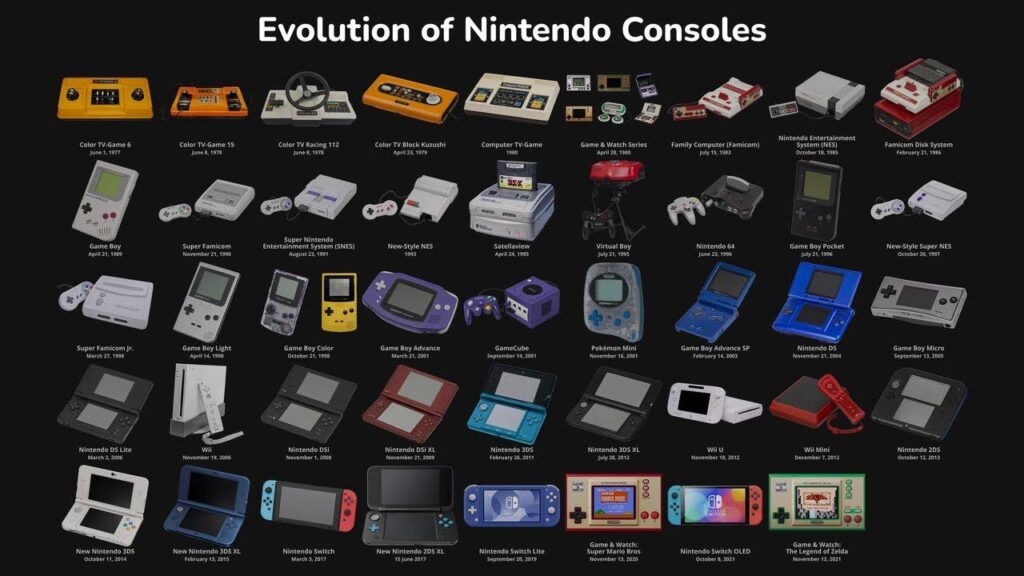
The full timeline of Nintendo consoles spans nearly five decades of gaming innovation, beginning in the late 1970s with simple dedicated home systems and evolving into hybrid, portable, and ultra-powerful modern platforms. Each generation reflects major shifts in gaming technology, consumer behavior, and interactive entertainment design.
Nintendo’s hardware journey includes early experiments like the Color TV-Game series, the global breakthrough of the NES, the 3D revolution of the Nintendo 64, motion gaming with the Wii, and the hybrid success of the Nintendo Switch. From 1977 to today, Nintendo consoles have defined multiple eras of gaming, influencing both competitors and developers worldwide and demonstrating how Nintendo consistently reshaped the gaming industry rather than simply competing within it.
Below is the chronological order of major Nintendo home and hybrid consoles:
- Color TV-Game (1977)
- Nintendo Entertainment System (NES) (1983 Japan / 1985 global)
- Super Nintendo Entertainment System (SNES) (1990)
- Nintendo 64 (1996)
- Nintendo GameCube (2001)
- Nintendo Wii (2006)
- Nintendo Wii U (2012)
- Nintendo Switch (2017)
- Nintendo Switch Lite (2019)
- Nintendo Switch OLED Model (2021)
- Nintendo Switch 2 (expected / next-generation successor)
This list includes both standalone consoles and major hardware revisions that significantly changed gameplay experience and market positioning.
Nintendo’s Classic Console Era: NES, SNES, and Nintendo 64
The Nintendo Entertainment System launched in Japan in 1983 as the Family Computer, or Famicom, and later entered North America in 1985 as the NES. It played a critical role in reviving the video game industry after the crash of 1983, introducing iconic franchises such as Super Mario Bros., The Legend of Zelda, and Metroid. With interchangeable cartridges and a strong software library, the NES standardized home gaming, sold over 60 million units worldwide, established Nintendo as a dominant global force, and laid the foundation for modern console gaming.
The Super Nintendo Entertainment System launched in 1990 in Japan and 1991 in North America, marking Nintendo’s transition into the 16-bit era with improved graphics, sound, and gameplay depth. The SNES delivered landmark titles such as Super Mario World, The Legend of Zelda: A Link to the Past, and Donkey Kong Country, while its Mode 7 graphics technology enabled pseudo-3D effects that revolutionized racing and action games. This generation cemented Nintendo’s dominance in the console wars against Sega.
The Nintendo 64 released in 1996 and introduced true 3D gaming to mainstream audiences. Its groundbreaking analog stick controller allowed precise movement in three-dimensional environments, while key titles like Super Mario 64, The Legend of Zelda: Ocarina of Time, and GoldenEye 007 set new standards for game design and storytelling. Despite its innovation, the N64 struggled commercially because of its cartridge format and limited third-party support compared to CD-based competitors.
Nintendo’s Disc, Motion, and HD Console Era: GameCube, Wii, and Wii U
The Nintendo GameCube launched in 2001 and represented a compact, cube-shaped redesign of Nintendo’s home console philosophy. It used miniDVD-based discs and focused on high-performance gameplay rather than multimedia features, with titles like Super Smash Bros. Melee, Metroid Prime, and The Legend of Zelda: The Wind Waker becoming defining entries in Nintendo history. Although innovative, the GameCube faced stiff competition from PlayStation 2 and Xbox, limiting its global market share.
The Nintendo Wii launched in 2006 and revolutionized gaming through motion-based controls using the Wii Remote. Unlike its competitors, the Wii targeted casual and family audiences, expanding gaming demographics significantly. Games like Wii Sports, Mario Kart Wii, and Wii Fit became cultural phenomena, helping the Wii sell over 100 million units globally and making it one of Nintendo’s most successful consoles ever.
The Nintendo Wii U released in 2012 as the first Nintendo HD console. It introduced the GamePad, a controller with a built-in touchscreen for asymmetric gameplay, but confusion over branding and limited third-party support led to poor sales performance. Many consumers misunderstood the Wii U as an accessory rather than a new console. Despite its commercial struggles, it introduced ideas later refined in the Nintendo Switch.
Nintendo Switch, Switch OLED, and Switch Lite Release Dates
The Nintendo Switch launched globally in March 2017 and became one of Nintendo’s most successful systems. Its hybrid design allowed seamless switching between handheld and docked TV play, redefining console portability and convenience. Blockbuster titles like The Legend of Zelda: Breath of the Wild, Animal Crossing: New Horizons, and Mario Kart 8 Deluxe helped drive record-breaking sales exceeding 140 million units.
The Nintendo Switch Lite launched in September 2019 as a handheld-only version of the Switch. It removed detachable Joy-Con controllers and TV docking functionality, focusing instead on portability and affordability for younger audiences and dedicated handheld gamers. Despite reduced features, it maintained compatibility with most Switch titles.
The Nintendo Switch OLED Model launched in October 2021 as an enhanced version of the original Switch. It features a 7-inch OLED display, improved audio, and a wider adjustable stand. While not a new-generation console, it significantly improved handheld visual quality and user experience, targeting users seeking premium display performance without changing the core hardware architecture.
Nintendo Switch 2, Handheld Console Timeline, and Console Generation Evolution
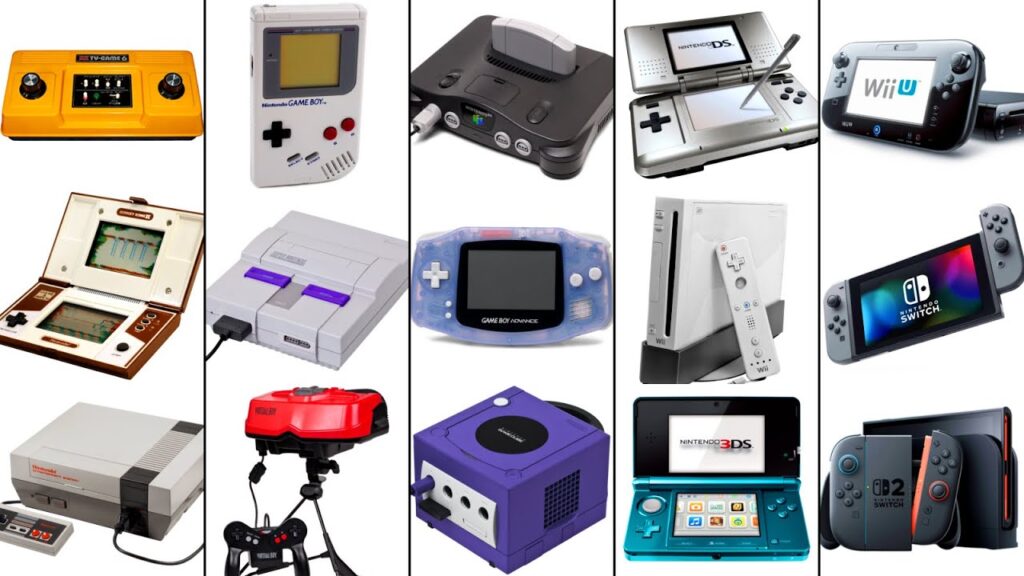
The Nintendo Switch 2 is widely expected to represent the next evolution of Nintendo’s hybrid console strategy. While official release timing has not been universally confirmed, industry expectations place its launch in the 2025–2026 window. Anticipated features include significantly improved processing power, enhanced graphical fidelity with potential 4K output when docked, backward compatibility with Nintendo Switch software, faster loading and upgraded storage architecture, and improved Joy-Con or next-generation controllers. The Switch 2 is expected to continue Nintendo’s hybrid philosophy while addressing hardware limitations of the original Switch.
Nintendo has also dominated handheld gaming with a parallel timeline:
- Game & Watch series (1980)
- Game Boy (1989)
- Game Boy Pocket (1996)
- Game Boy Color (1998)
- Game Boy Advance (2001)
- Game Boy Advance SP (2003)
- Nintendo DS (2004)
- Nintendo DS Lite (2006)
- Nintendo DSi (2008)
- Nintendo 3DS (2011)
- New Nintendo 3DS (2014)
- Nintendo Switch Lite (2019)
These handheld systems were critical in shaping mobile gaming long before smartphones dominated the space.
Nintendo console evolution can be divided into distinct technological eras:
- First Era (1977–1983): Dedicated home systems like Color TV-Game
- 8-bit Era (1983–1990): NES establishes modern gaming structure
- 16-bit Era (1990–1996): SNES brings graphical and audio improvements
- 3D Revolution (1996–2001): Nintendo 64 introduces analog control
- Multimedia Era (2001–2006): GameCube focuses on performance and exclusives
- Motion Era (2006–2012): Wii expands gaming audience globally
- HD Transition (2012–2017): Wii U experiments with dual-screen gaming
- Hybrid Era (2017: present): Nintendo Switch unifies handheld and console gaming
Each era reflects shifts in hardware innovation and consumer demand.

Frequently Asked Questions (FAQs)
- When is the Switch 2 coming out?
The Switch 2 is expected in the 2025–2026 timeframe, but its exact release timing has not been fully confirmed. It is widely expected to continue Nintendo’s hybrid console approach while improving performance, graphics, storage, and controller features. - What was Nintendo’s first console?
The Color TV-Game series, released in 1977, was Nintendo’s first console line. These were dedicated home systems built for simple TV-based games and marked Nintendo’s earliest move into the home video game hardware market. - When did the NES release?
The NES first launched in Japan in 1983 as the Family Computer, also known as the Famicom. It later released in North America in 1985 as the Nintendo Entertainment System, where it helped revive interest in home console gaming after the 1983 video game crash. - Why was the SNES important?
The SNES was important because it moved Nintendo into the 16-bit era, bringing stronger graphics, better sound, and deeper gameplay experiences. It also delivered major titles such as Super Mario World, The Legend of Zelda: A Link to the Past, and Donkey Kong Country. - What made the Nintendo 64 special?
The Nintendo 64 was special because it was Nintendo’s first major console built around true 3D gaming. Its analog stick controller allowed smoother movement in 3D environments, and games like Super Mario 64 and The Legend of Zelda: Ocarina of Time set new standards for game design. - Was the GameCube successful?
The GameCube had a strong library of games and introduced several defining Nintendo titles, including Super Smash Bros. Melee, Metroid Prime, and The Legend of Zelda: The Wind Waker. However, its sales were weaker than competitors like the PlayStation 2 and Xbox, which limited its overall market impact. - Why did the Wii become so popular?
The Wii became popular because its motion controls made gaming feel more accessible to families, casual players, and people who did not usually play video games. Titles like Wii Sports, Mario Kart Wii, and Wii Fit helped turn it into a cultural phenomenon. - What went wrong with the Wii U?
The Wii U struggled because its branding confused many consumers, with some thinking it was an accessory for the Wii rather than a new console. It also had limited third-party support, which reduced its software appeal compared to competing systems. - What is the Nintendo Switch?
The Nintendo Switch is a hybrid console that can be used as both a handheld system and a home console connected to a TV. Its flexible design allows players to switch between portable and docked play, which became one of its biggest selling points. - What is the Switch Lite?
The Switch Lite is a handheld-only version of the Nintendo Switch. It does not support TV docking or detachable Joy-Con controllers, but it is designed to be more portable and affordable while still playing most Switch games.

Conclusion
The history of Nintendo consoles demonstrates continuous innovation across multiple gaming generations. From simple home entertainment systems to advanced hybrid platforms, Nintendo has consistently reshaped the gaming industry. Each console reflects a unique technological leap, whether in graphics, gameplay mechanics, motion control, or portability. The evolution toward hybrid systems like the Nintendo Switch shows a long-term strategy focused on accessibility and flexibility, setting the stage for the next generation of gaming hardware.
Sources and Citations
- Nintendo Official Website
https://www.nintendo.com - Nintendo History Overview (Company Information)
https://www.nintendo.com/whatsnew/ - Nintendo Console Generations Reference (General Gaming History)
https://en.wikipedia.org/wiki/Nintendo_video_game_consoles - Nintendo Switch System Information
https://www.nintendo.com/switch/
Recommended
- How to Craft Improved Fins in Subnautica 2 (Blueprint, Materials, and Fastest Route)
- Deep Rock Galactic: Rogue Core Early Access Guide, Expenite, Void Gates, and How the Roguelite Works
- How to Build an RPG Character Creator Using MetaHuman in Unreal Engine 5
- The Sims 4 x Lofi Girl Album: Lo-Fi Remixes of Classic Sims Soundtrack Songs Explained
- Managing Blender Scenes with Multiple Cameras Using The View Keeper
- FBC: Firebreak just got its last ever major update (Open House), plus a permanent price drop and free Friend’s Pass
- Epstein Files Reveal Gaming Connections, Plans to Buy Activision Stock: Bobby Kotick Emails, Call of Duty, and More
- Mastering Lighting in Unreal Engine 5: Complete Guide to Realistic Game Illumination
- Exploring MOVA’s Contour Facial Capture Technology: Photorealistic Tracking in Film and Gaming



































































































