









In This Article (8 sections)
Purdue Google TPU Deployment, January 2027 Access, and the First U.S. University Claim
Purdue University announced on October 29, 2026, that it plans to become the first U.S. academic institution to provide Google Tensor Processing Unit hardware to researchers through an on-campus university computing program. The collaboration involves Google Public Sector, Cirrascale, and DDN, with Purdue’s Rosen Center for Advanced Computing integrating the accelerators into the Community Cluster Program. Initial researcher access is expected to begin in January 2027, although Purdue has not announced a specific opening day, wider availability schedule, chip generation, system size, or final access procedures. The university estimates that the installation will increase its AI computing capacity by 30%, but that figure describes overall campus capacity rather than a guaranteed speedup for every individual workload.
Purdue’s first claim applies to a specific deployment model. Google TPUs are already available through cloud services, but Purdue says it will be the first U.S. university to offer physical TPU hardware through its own campus research computing infrastructure. That distinction changes how researchers may interact with the hardware because allocation, identity, data handling, support, and scheduling can be managed through university systems rather than through an external cloud project.
The eventual experience will depend on the policies RCAC publishes for the TPU service. For research groups planning long experiments, those policies will matter as much as raw accelerator performance because teams need to know how jobs are queued, how compute time is allocated, and where datasets and checkpoints can be stored.
January 2027 is therefore best understood as Purdue’s expected window for the first researchers rather than a guarantee of immediate universal access. Early users can help expose practical issues in the local software environment, storage pipeline, scheduling system, and model compilation workflow before the service expands more broadly. A large training job may reveal device-to-device communication bottlenecks, while a vision workload could show that data decoding leaves accelerators waiting for input. An inference workload might discover that writing predictions or loading model weights consumes more time than expected. Those examples illustrate why a staged rollout can be useful even when the accelerator hardware itself is already mature.
Research teams can prepare before access begins by establishing baselines on their current hardware, identifying representative datasets, and documenting model code and software environments. That makes it easier to determine what actually improves once TPU resources become available. A university-wide capacity increase and a lab’s own time to result are different metrics because queue delay, compilation, input pipelines, checkpoints, and evaluation can dominate different parts of the workflow. For a project with a fixed deadline, Purdue’s January milestone and the research group’s confirmed allocation date should therefore be treated as separate planning points.
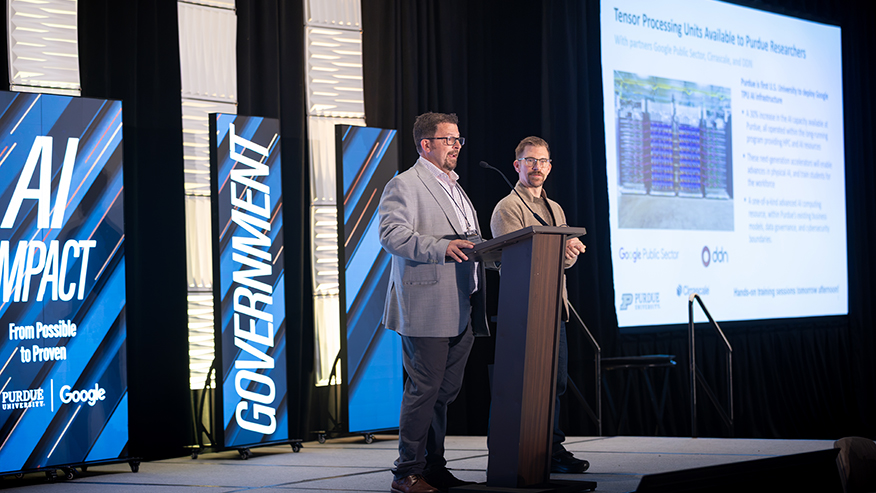
The project was announced during Purdue’s AI Impact: From Possible to Proven summit, held October 29 to 30, 2026. The event focused on moving artificial intelligence from experimentation into practical use across research, government, and industry, particularly in the physical world. Preston Smith of RCAC and Adam Deer of Google Public Sector presented the collaboration during the summit. The infrastructure project fits that theme by giving Purdue researchers a new accelerator architecture for model training, inference, benchmarking, and repeated evaluation before systems are deployed into physical environments. The announcement date and the January 2027 access target therefore mark different stages: one establishes the commitment, while the other is when the first research workloads are expected to begin.

Mathematical Sciences Data Center, Cirrascale, DDN, and Purdue’s Community Cluster Infrastructure
Purdue plans to install the TPU system in the Mathematical Sciences Building Data Center in West Lafayette, Indiana. The facility has hosted generations of university research computing systems, beginning with the CDC 6500 in 1968. In August 2024, RCAC reported that Purdue trustees approved a $16 million renovation expected to increase floor space by 32%, usable power by 60%, and cooling capacity twofold. RCAC also scheduled a phased outage from November 6 to 9, 2026, for remaining power and facility work. Those renovation figures apply to the wider data center and should not be interpreted as the price of the TPU system itself.
That distinction matters because accelerator deployments depend on more than rack space. High-density systems need adequate electrical distribution, continuous cooling, network connectivity, management systems, and fast access to storage. RCAC’s renovation description includes infrastructure such as a new chilled-water feed and overhead electrical distribution, both of which support denser computing equipment. The TPU announcement does not disclose the accelerator system’s purchase price or the total financial value of the collaboration. The data center investment serves Purdue’s broader research computing estate, so the available evidence does not support assigning the full $16 million renovation cost to the TPU deployment.
Cirrascale is one of the named collaborators in the project. In a separate March 2026 announcement, the company described itself as an implementation and services partner for the Google Public Sector Program for Accelerated Research. That relationship helps explain why it is involved in Purdue’s research infrastructure project, where hardware, firmware, accelerator runtime, compiler support, networking, storage, and host systems all need to work together. Purdue has not publicly detailed Cirrascale’s exact responsibilities for the campus deployment, the procurement structure, or who will handle specific maintenance and support functions. Researchers will ultimately need local documentation showing where to request access and where to report technical problems.
DDN is the other industry collaborator identified by Purdue. The company specializes in high-performance storage and data systems used in AI and high-performance computing, making its participation relevant to workloads that can move large datasets and checkpoints. Purdue’s announcement does not identify a specific DDN appliance, filesystem, storage capacity, or throughput figure for the TPU installation. Training jobs can become storage-limited when multiple workers read large datasets at once or write large checkpoints, while inference workloads can face different patterns involving model loading, video ingestion, and result storage. DDN’s inclusion is therefore technically meaningful, but Purdue has not assigned specific storage functions to the company in the public announcement.
The Community Cluster Program provides the institutional framework around the hardware. RCAC pools research computing infrastructure acquired through sources including faculty grants, startup funds, and university investment, while providing centralized facilities, administration, maintenance, and security updates. Integrating TPUs into that program extends Purdue’s shared research computing model to a new accelerator architecture rather than creating a standalone system disconnected from existing campus services. This could make it easier for different research groups to share expensive infrastructure even when their usage patterns differ substantially across semesters or projects.
The software environment will be just as important as the physical installation. Research teams need reproducible records of model code, datasets, framework versions, runtime libraries, and compiler settings if they want to rerun an experiment months later. Centralized documentation can make that easier, particularly as graduate students leave projects or collaborators change. Purdue’s existing Community Cluster documentation provides a model for how the university manages shared systems, but TPU-specific instructions for job submission, supported frameworks, software modules, storage paths, and allocation rules will need to be published before researchers can treat the platform as a routine part of their workflow.
How Google TPUs Work and How Purdue Researchers Can Use Them for Training, Inference, Robotics, and Physical AI
Google Tensor Processing Units are application-specific integrated circuits designed to accelerate machine learning workloads, particularly operations dominated by large matrix calculations. Neural networks spend significant time performing multiply-and-accumulate operations, and TPU hardware is built to execute large numbers of those calculations in parallel. In a systolic array, values and intermediate results move through a grid of processing elements so data can be reused efficiently as computation proceeds. The accelerator does not operate alone because host systems still prepare inputs, coordinate execution, manage software, and move data between storage and accelerator memory.
Google’s TPU ecosystem also depends on software such as the XLA compiler, which translates operations from machine learning frameworks into executable instructions for the hardware. Google documents TPU workflows for systems including JAX and PyTorch, but Purdue has not yet published the exact local software stack, supported framework versions, or scheduler integration for its deployment. Researchers familiar with the broader Google ecosystem may therefore have transferable knowledge about model compilation and accelerator memory, while still needing Purdue-specific instructions for accounts, data movement, job submission, and troubleshooting.
Training and inference place different demands on the system. Training repeatedly processes data, calculates loss, computes gradients, and updates model weights, which can make accelerator memory and communication between devices major bottlenecks. Inference applies already trained weights to new inputs and may instead be limited by model loading, batch size, input preparation, latency requirements, or how quickly results can be written. Both workloads can benefit from fast matrix arithmetic, but the rest of the pipeline determines how much of that advantage translates into shorter experiment times.
For a computer vision project in manufacturing, a Purdue research team might train multiple models on labeled images of defective components and then run inference against footage from a different production line. Training time and validation accuracy would help compare the models, while large-scale inference could reveal where changing lighting, camera angles, or factory conditions cause failures. The TPU would accelerate only the portions of the workflow that map efficiently to the hardware. Data labeling, dataset cleaning, video decoding, and human review of ambiguous predictions would remain separate tasks.
Language-model research raises another set of trade-offs. Fine-tuning a large pretrained model may require distributing weights or optimizer state across multiple devices, while inference may care more about throughput, request latency, sequence length, and memory use. Comparing TPU results with another accelerator requires keeping evaluation datasets and quality targets consistent and documenting changes to precision, batch size, model configuration, and software versions. A single speed number does not explain whether one system produces a better research workflow if the comparison also changes model quality or experimental conditions.
Purdue specifically connects the deployment to physical AI, robotics, autonomous vehicles, computer vision, and advanced manufacturing. A robotics lab could collect camera images, sensor readings, and robot actions, train a model on campus infrastructure, then replay the trained model against recorded scenarios before moving to controlled physical testing. Simulation can create additional data by varying lighting, friction, camera position, or object placement, although a faster learner can expose the simulator itself as the new bottleneck if simulated observations cannot be generated quickly enough. Campus TPUs can therefore help accelerate model development and evaluation without eliminating the need for physical experiments.
Manufacturing research presents a similar division between centralized training and edge deployment. A model might be trained and evaluated on Purdue’s campus system, then eventually run on a workstation or local device next to a production line. The requirements in those two environments can differ substantially because the factory system must account for response time, network availability, integration with equipment, and local operational constraints. On-campus compute can help researchers determine whether the model is accurate and robust enough before they decide what hardware should run it in the field.

AI Capacity, Researcher Access, Data Governance, and What Purdue Has yet to Disclose
Purdue estimates that the TPU installation will increase its overall AI computing capacity by 30%, but the university has not published the underlying baseline, accelerator count, benchmark methodology, or arithmetic behind that estimate. The figure should therefore be understood as a campus capacity statement rather than a claim that every model will train 30% faster. Added capacity may allow more experiments to run simultaneously, reduce contention, or make larger workloads feasible. A specific project’s time to result still depends on queue wait, compilation, data loading, checkpoint writing, evaluation, and how much of the workload is actually accelerated by the TPU.
Different metrics will matter for different research questions. Training projects may care about the time required to reach a fixed validation target rather than raw examples processed per second. Inference projects may evaluate throughput and latency separately because a larger batch can increase total predictions per second while making an individual request wait longer. Campus administrators may care about how many projects the system can support concurrently, while a graduate researcher may care primarily about turnaround time for a single experiment. The 30% figure cannot answer all of those questions on its own.
Purdue identifies faculty and student researchers as the intended users, with initial access expected in January 2027. The announcement does not identify the first research groups, describe whether students can request resources independently of faculty, explain classroom eligibility, or specify whether outside collaborators can receive access. It also does not disclose allocation charges or quota rules. For a research group, eligibility is only the first step because the team also needs enough accelerator time to run the full experiment plan, which may include multiple models, repeated random seeds, validation runs, and final evaluations.
Purdue says it will maintain institutional control over data, security, and governance for the deployment. That statement establishes that the university intends to manage these issues locally, but it does not identify which data classifications the TPU environment will support. Purdue’s existing REED+ documentation shows that university computing and storage systems can have different requirements for regulated or sensitive data. Approval to use one RCAC environment therefore does not automatically mean the TPU service will support the same categories of information. Researchers working with regulated, confidential, or restricted datasets will need system-specific guidance before moving data onto the new hardware.
Data governance also extends beyond the original training dataset. Temporary staging copies, model checkpoints, log files, evaluation results, backups, filenames, and intermediate outputs can all contain information subject to project rules. A physically on-campus accelerator answers where the hardware is located, but it does not by itself determine who can see each artifact, where data may be retained, or how long copies can remain. Institutional control is therefore meaningful only when the service publishes the storage, access, retention, and networking policies that researchers must follow.
Google Public Sector provides the TPU technology partnership and broader technical ecosystem, but Purdue has not detailed the campus support arrangement or any entitlement to other Google products. Cirrascale’s precise implementation responsibilities and DDN’s exact storage configuration are also undisclosed. The same is true of the TPU generation, accelerator count, local software stack, scheduling rules, pricing or allocation model, and supported frameworks. Those omissions do not diminish the significance of the announcement, but they define what researchers still need to know before they can evaluate how the system fits a specific project.
The deployment’s importance is therefore less about one headline benchmark than about bringing another accelerator architecture into Purdue’s existing research environment. Faculty and students will be able to compare TPU-based workflows with systems they already use while keeping the work inside an institutional computing program. The first major test will come when researchers begin running real workloads in January 2027 and can measure compilation behavior, data throughput, queueing, training performance, inference performance, reproducibility, and usability under the actual campus configuration. Those results will determine how much Purdue’s 30% capacity expansion changes day-to-day AI research in practice.
Frequently Asked Questions (FAQs)
- What did Purdue University announce about Google TPUs?
Purdue announced a collaboration with Google Public Sector, Cirrascale, and DDN to bring Google Tensor Processing Unit hardware into its campus research computing environment. The accelerators are expected to be integrated through Purdue’s Rosen Center for Advanced Computing and its Community Cluster Program. The goal is to give faculty and student researchers local access to Google’s custom AI hardware for machine learning workloads. Purdue also said it would retain institutional control over data, security, and governance for the deployment. The announcement did not yet provide the full technical configuration or detailed access procedures. - What exactly is the U.S. university first?
Purdue says it will be the first U.S. academic institution to provide Google TPUs to researchers through its own campus computing program. The claim is not that Purdue is the first university whose researchers have ever used Google TPUs, since TPUs have already been available through Google’s cloud services. The distinction is that the hardware will be physically installed on campus and delivered through Purdue’s institutional research computing infrastructure. That gives the university direct control over how resources are allocated, supported, and governed. The “first” therefore refers to this specific combination of on-campus hardware and university-managed research access. - When can Purdue researchers start using the TPUs?
Purdue expects the first group of researchers to begin using the TPU system in January 2027. The October 29, 2026 announcement gives a month rather than a specific opening date. It also refers to initial researcher access, which means the timetable for broader availability may be different. Individual research groups will still need to know when their own allocations become available before scheduling experiments around the new hardware. January 2027 should therefore be treated as the planned start of the rollout rather than a guaranteed universal access date for every Purdue researcher. - Where will Purdue install the Google TPUs?
Purdue plans to install the TPU infrastructure in the Mathematical Sciences Building Data Center on its West Lafayette campus in Indiana. The facility already supports university research computing and has undergone a major renovation intended to increase floor space, usable electrical power, and cooling capacity. Those upgrades are relevant because dense accelerator systems require substantial power, cooling, networking, and storage support. The location allows the TPU system to become part of Purdue’s existing research computing environment rather than operate as a separate external service. The announced data center renovation cost should not be confused with the undisclosed cost of the TPU installation itself. - What does Purdue’s 30% AI computing capacity increase mean?
Purdue estimates that adding the TPU system will increase its overall institutional AI computing capacity by 30%. That figure describes the university’s aggregate capacity rather than promising that every research job will run 30% faster. A project’s actual performance depends on factors such as model architecture, data loading, compilation, memory requirements, queue time, checkpoint writes, and how effectively the workload maps to TPU hardware. Additional capacity can also mean more experiments running at the same time rather than simply shorter runtime for one job. Researchers will therefore need workload-specific benchmarks to determine what the new system changes for their own projects. - Which Google TPU generation is Purdue installing?
Purdue’s October 29 announcement does not identify the TPU generation, chip count, device topology, or total accelerator configuration. Google publishes specifications for several TPU generations, but those general specifications cannot be assigned to Purdue’s installation without confirmation from the university or its partners. This matters because different generations can have different memory capacities, performance characteristics, interconnect designs, and software requirements. Until Purdue publishes the exact hardware configuration, comparisons based on a particular TPU generation would be speculative. Researchers should therefore wait for the campus system documentation before estimating performance from Google’s broader TPU specifications. - Are Purdue’s Google TPUs intended for training or inference?
Both. Purdue says the system is intended to support model training as well as inference. Training involves using data to fit a new model or adapt an existing one, which can require repeated forward and backward calculations and substantial accelerator memory. Inference uses a trained model to process new inputs, such as evaluating a large test dataset or generating individual predictions. The two workloads can have different bottlenecks, so researchers may measure training time, inference throughput, latency, and memory use separately. The TPU system is therefore intended to support more than one stage of the AI research workflow. - What are Cirrascale and DDN contributing?
Purdue identifies Cirrascale and DDN as collaborators in the deployment, but the university has not yet published a detailed division of responsibilities. Cirrascale separately describes itself as an implementation and services partner for Google Public Sector’s broader accelerated research program, which provides context for its involvement in the Purdue project. DDN develops high-performance storage and data infrastructure used in AI and high-performance computing environments. Both areas are relevant because accelerator systems depend on reliable integration and fast movement of datasets and checkpoints. Purdue has not yet disclosed which specific hardware, storage systems, installation tasks, or ongoing support duties each company will provide. - Can Purdue students use the TPU system?
Yes, student researchers are included among the intended users Purdue identifies for the new infrastructure. However, the announcement does not explain whether students will request resources directly, access them through faculty-led research groups, or use them through another allocation process. It also does not provide details about classroom use, external collaborators, quotas, or possible charges. In practice, student access will likely depend on the policies Purdue publishes as the service is rolled out. The confirmed point is that students are part of the target research community, while the exact access pathway remains to be announced. - Does on-campus deployment allow researchers to use regulated data?
Not automatically. Purdue has said it will maintain institutional control over data, security, and governance for the TPU deployment, but that does not mean every type of regulated or sensitive dataset is approved for use on the system. Universities typically classify computing environments according to the security and compliance requirements they can support. A project using regulated information would therefore need to confirm that the TPU environment is approved for its specific data category and research obligations. The physical location of the hardware on campus is only one part of the decision because storage, logs, checkpoints, access controls, networking, and retention policies also matter. Purdue has not yet published the regulated-data categories approved for this particular TPU system.

Conclusion
Purdue’s Google TPU deployment adds a new accelerator architecture to a research computing program that already serves faculty and students across the university. The October 29, 2026 announcement establishes the core plan: installation in the Mathematical Sciences Building Data Center in West Lafayette, an estimated 30% increase in Purdue’s AI computing capacity, and a January 2027 target for initial researcher access.
Purdue’s claim of being the first U.S. university in this category is tied specifically to providing Google TPU hardware through its own campus computing program rather than through a cloud-only model. Just as important, the university says it will retain institutional control over research data, security, and governance, giving the deployment a different operational structure from externally provisioned accelerator access.
The real value of the system will become clearer once Purdue publishes the details researchers need to plan around it. Allocation policies, supported frameworks, the exact TPU generation and system size, storage configuration, scheduling rules, and approved data environments will determine which projects can use the platform effectively. Those details will also make it possible to judge the 30% capacity increase in practical terms rather than as a campus-wide headline figure.
A robotics lab may care about how many training and evaluation cycles it can complete before a physical test, while a language-model group may focus on throughput, memory limits, and experiment turnaround time. Once researchers begin running real workloads in 2027, the strongest measure of Purdue’s TPU investment will be how much it improves the pace, scale, and reproducibility of research rather than how impressive the hardware sounds on paper.
Sources and Citations
- Purdue University, October 29, 2026 – Purdue Is First U.S. University to Deploy Google TPU AI Infrastructure: Announces Purdue’s Google TPU deployment, identifies Google Public Sector, Cirrascale and DDN as collaborators, and explains the expected 30% increase in AI computing capacity and expanded research access.
- Purdue University, AI Impact Summit, October 29–30, 2026: Documents the summit agenda, physical AI and robotics sessions, Google AI demonstrations, and participation by Google Public Sector and other industry partners.
- Source: Purdue University – AI Impact Summit
- Citation: Purdue University – 3rd Annual Purdue + Google AI Summit. Purdue University+1
- Rosen Center for Advanced Computing, August 9, 2024 – Mathematical Sciences Building Data Center Renovation: Records the Purdue Board of Trustees’ approval of a $16 million renovation, including a projected 32% increase in floor space, 60% increase in usable power, and doubling of cooling capacity.
- Source: RCAC – Mathematical Sciences Building Data Center Renovation
- Citation: Rosen Center for Advanced Computing, August 9, 2024. December 31, 2024 11:59pm EST)
- Rosen Center for Advanced Computing, November 6–9 Maintenance Notice: Provides the scheduled maintenance information for the remaining data center power and facility work.
- Rosen Center for Advanced Computing – Community Clusters: Explains Purdue’s shared research-computing model, including pooled investments from faculty, grants, and institutional funding, with centralized management of computing, networking, power, cooling, and storage infrastructure.
- Source: RCAC – Community Clusters
- Citation: Rosen Center for Advanced Computing – Community Clusters. Community Clusters
- Google Cloud – Introduction to Cloud TPU: Explains Google’s Tensor Processing Units, their application-specific hardware, high-bandwidth memory, TPU slices, and the XLA compiler used to translate machine-learning workloads into TPU machine code.
- Source: Google Cloud – Introduction to Cloud TPU
- Citation: Google Cloud Documentation – Introduction to Cloud TPU. Google Cloud Documentation
- Google Cloud – TPU System Architecture: Describes TPU hardware architecture, including the host system, matrix multiplication units, and systolic arrays used to accelerate machine-learning computations.
- Cirrascale, March 10, 2026 – Partnering with Google Public Sector: Announces Cirrascale’s strategic partnership and its role as an implementation and services partner for Google’s Program for Accelerated Research (GPAR), supporting secure AI infrastructure for research and government.
- Source: Cirrascale – Partnering with Google Public Sector
- Citation: Mike LaPan, Cirrascale, March 10, 2026. cirrascale.com
- DDN, June 23, 2026 – Next-Generation AI and HPC Data Intelligence Innovations: Describes DDN’s AI and high-performance computing infrastructure, including its AI400X3M storage appliance, distributed KV cache acceleration, high-throughput data systems, and storage capabilities for large-scale AI training and inference.
- Source: DDN – Next-Generation AI and HPC Data Intelligence Innovations
- Citation: DDN, June 23, 2026. DDN
- Purdue Institute for Physical Artificial Intelligence – Research Initiative: Describes Purdue’s interdisciplinary research initiative focused on physical AI, including intelligent systems that interact with the real world through robotics, autonomous systems, sensing, and advanced manufacturing.
- Source: Purdue Institute for Physical Artificial Intelligence
- Citation: Purdue Institute for Physical Artificial Intelligence. See also its 3rd Annual Purdue + Google AI Summit. Institute for Physical Artificial Intelligence+1
- Rosen Center for Advanced Computing – REED+ Ecosystem: Explains Purdue’s secured research-computing environment for sensitive and controlled workloads, including compliance support for HIPAA, FERPA, ITAR, and EAR data and distinctions between approved computing and storage environments.
- Source: RCAC – REED+ Secured Research Services
- Citation: Rosen Center for Advanced Computing – REED+ Ecosystem. REED+ Ecosystem
- Rosen Center for Advanced Computing – Research Data Depot: Documents Purdue’s centralized research storage service, including purchasing arrangements, access controls, data retention, redundancy, and restrictions on regulated information. Specifically, it states that Data Depot is not approved for HIPAA, ePHI, FISMA, or ITAR data.
- Source: RCAC – Research Data Depot
- Citation: Rosen Center for Advanced Computing – Data Depot. Storage: Data Dep
Recommedations
- Ubisoft Keeps Guidance Despite Black Flag Remake Success
- All Radio Stations and Songs in Forza Horizon 6 – Full Soundtrack List and Music Guide
- Supergirl Trailer Reveals Kara’s 3-Day Race to Save Krypto
- Eiji Aonuma says younger Ocarina of Time remake developers who never played the original helped shape the Switch 2 remake (AFP)
- Modder releases loader to turn the PS5 into a Linux system: PS5 Linux loader (ps5-linux) install, supported firmware, and what to expect
- History of Grand Theft Auto: From GTA 1 to GTA 6: The Complete GTA Timeline
- Lottomatica and CIRSA Merger: Deal Creates a Global Gambling Giant
- The SEC Plans to Relieve Companies from Mandatory Quarterly Reports: What It Means for Investors and Businesses
- Low-Budget Repairs: Release Date, Renovation Gameplay, and Everything You Need to Know
- EverQuest Legends Returns Players to Norrath With Solo-Friendly Progression



































































































