








In This Article (9 sections)
What Rixels Are and How 4J Studios Created Them for Reforj
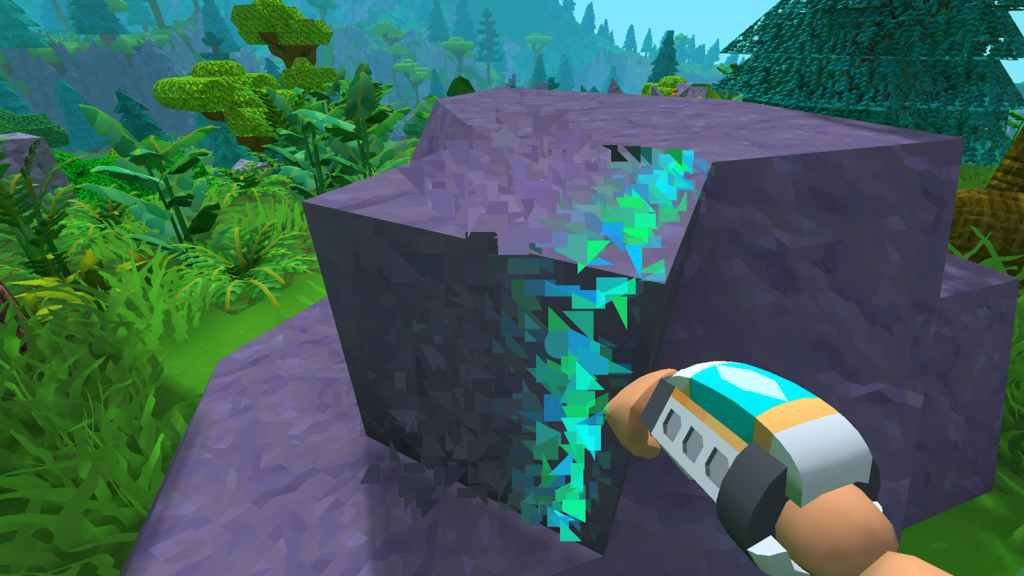
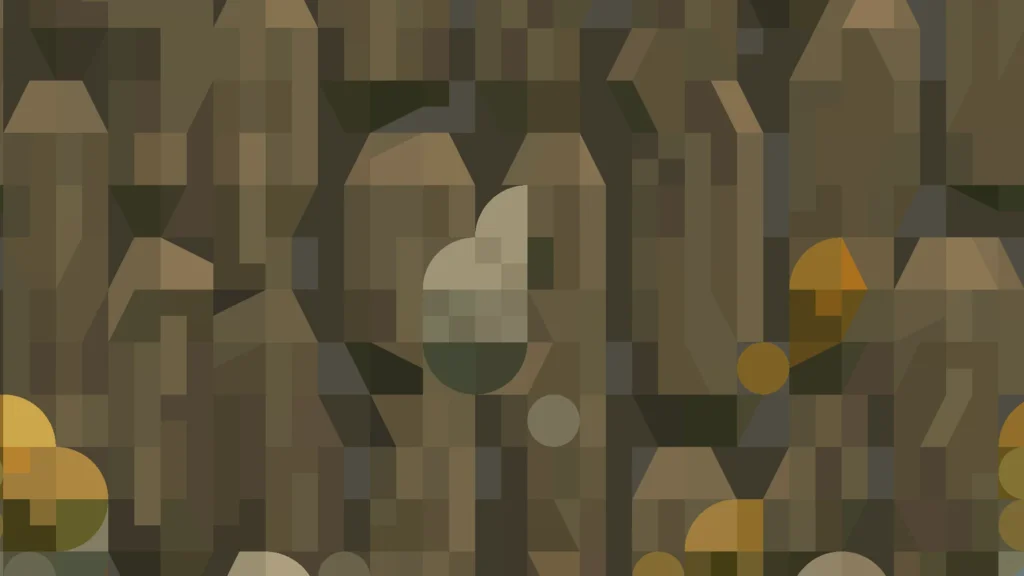
Rixels, short for Reforj Pixels, are the fundamental units of Reforj’s redesigned texture system. Like pixels in a conventional bitmap, they are organized within a grid, but each Rixel can represent richer geometric information instead of functioning only as a uniform square color sample. The current implementation supports up to 23 shapes, with each shape also able to carry material properties such as roughness and metallic characteristics. This creates a hybrid representation that retains the organizational simplicity of a texture grid while allowing individual locations to describe geometric forms that better match Reforj’s visual style.
The technology emerged from a practical production problem. 4J Studios liked Reforj’s earlier faceted graphics but found that consistently producing sharp geometric textures was difficult, particularly when working with diagonals and small details that could appear fuzzy or inconsistent. The art and engineering teams experimented with alternatives before combining vector inspired techniques with two dimensional versions of shapes already used by Reforj’s Elements system. Those forms could then be arranged within a grid and used as the actual building blocks of a texture rather than merely being painted onto underlying geometry.
Traditional pixels are discrete samples arranged in a regular raster and typically store color and related channel information at fixed positions. When a low resolution raster texture is viewed closely or enlarged substantially, those finite samples become visible. Rixels retain the idea of fixed locations while increasing what each location can describe. Their 23 available geometric shapes provide artists with a reusable vocabulary for constructing contours, diagonals, edges and patterns within a comparatively small grid. Because a Rixel can describe the relevant form directly, a diagonal or contour can be reconstructed more cleanly than one approximated entirely with enlarged square samples.
Reforj-Specific Fit and Rixel Limitations
This approach is particularly appropriate for Reforj because players can sculpt Elements into shapes, angles, curves and other forms instead of being restricted to uniform cubes. Using two dimensional counterparts of the same Element shapes allows the surface language to reinforce the geometry beneath it. The system is therefore both an asset format innovation and an art direction tool, helping establish a more recognizable visual identity across Element materials, characters and mobs.
Rixels should not be considered a universal replacement for conventional raster textures. Traditional textures remain highly effective for photographs, scanned materials, irregular surfaces, skin, cloth, vegetation and realistic detail. Reforj is deliberately stylized and geometry driven, making it unusually well suited to a compact vocabulary of reusable shapes. The work was also far more substantial than a simple cosmetic adjustment. Title Update 8 was described as one of Reforj’s most ambitious development changes, with the art and engineering teams spending roughly six months creating the transformation before its July 2026 rollout.

How Rixels Reduce Reforj Texture Sizes From 4MB to 72KB
The most striking efficiency claim for Rixels comes from 4J’s comparison between its previous material textures and the new representation. Under the earlier system, one material could use a 512 × 512 texture requiring approximately 4MB. An equivalent Rixel material can occupy around 72KB, representing a 98.2 percent reduction in storage requirements. A typical Rixel texture can be approximately 20 × 20 because every location contains richer geometric information than a conventional square sample, allowing far fewer grid positions to reproduce the intended design.
This is not standard compression applied to the original 512 × 512 bitmap. The representation itself has changed. Instead of storing hundreds of conventional raster samples along each axis, Rixels describe the material through a much smaller grid of geometric primitives suited specifically to Reforj’s stylized surfaces. The technique therefore trades extremely dense raster sampling for a compact shape based description. It shares some conceptual similarities with vector graphics, where certain geometric artwork can be represented efficiently through mathematical shapes, although Rixels remain a proprietary technology built specifically around Reforj.
The 98.2 percent figure applies to the material comparison disclosed by 4J and should not automatically be extended to every asset or the complete game installation. Likewise, reducing texture storage by that percentage does not mean frame rate will increase by the same amount or that overall video memory consumption will fall identically. Performance still depends on geometry, lighting, shaders, draw calls, physics, world simulation, CPU workloads, memory bandwidth and numerous other systems.
What the comparison does demonstrate is that Rixels can dramatically reduce the footprint of materials designed around Reforj’s geometric art direction. Smaller texture assets reduce storage and memory pressure while creating additional room for future content. 4J specifically says these savings provide greater capacity for new features, biomes, worlds and materials, giving the Elements Engine more flexibility as Reforj continues expanding.
How Rixels Work With the Elements Engine and Reforj’s New Art Style
Rixels are closely integrated with 4J Studios’ Elements Engine rather than functioning as a separate texture compression system. The studio introduced Elements Engine publicly in May 2024 as proprietary voxel sandbox technology designed around current generation hardware. Reforj was later announced as an original game powered by that engine, with exploration, creation and survival built around Elements that players can sculpt into numerous forms beyond standard full cubes.
Rixels extend the same geometric vocabulary into surface presentation. Two dimensional versions of Element shapes form the basis of Rixel textures, allowing the game’s three dimensional geometry and two dimensional material language to reinforce one another. This close relationship is one reason the technology cannot be evaluated simply as another image format. Its efficiency depends heavily on the type of artwork, geometry and gameplay the Elements Engine was created to support.
Building a proprietary engine gives 4J direct control over these fundamental systems. The studio has extensive experience with block based sandbox technology through its history bringing Minecraft to numerous Xbox, PlayStation, Nintendo and handheld platforms. With Elements Engine, it can shape rendering systems, data structures and content tools specifically around Reforj instead of adapting a general purpose engine. Rixels demonstrate that flexibility because 4J can change the underlying representation of materials and integrate geometric primitives directly into its rendering technology.
The visual overhaul also goes beyond terrain surfaces. Title Update 8 applies the Rixel inspired direction to characters and mobs, while redesigned characters receive new animations and expressions intended to give them more personality. Using a surface language derived from the same Elements that define terrain and constructed objects helps environments, creatures and characters feel like parts of one coherent visual system instead of products of unrelated art pipelines.
Lighting and presentation are also being expanded alongside the new materials. Bloom is introduced as the first of several planned post processing effects and can apply to emissive Elements, items, mobs, celestial bodies and environmental features such as glowing plants. Together, these changes make the Rixels Update less like a small optimization patch and more like a broader reset of Reforj’s visual identity, with sharper surfaces, cleaner geometric forms and more expressive presentation.
Reforj Title Update 8 and What Rixels Could Mean for Future Games
Title Update 8, also known as the Rixels Update, represents Reforj’s largest visual transformation so far, but it also introduces gameplay content beyond the texture overhaul. New ruins are connected to the game’s lost civilization, while an early version of the Gateway system allows players to discover structures containing loot and experiment with a Gateway Terminal powered by Aura. Existing worlds can access the system through a craftable terminal, meaning players do not necessarily need to abandon previous creations to test the new mechanics.
The update is available through the Reforj pre alpha preview on Xbox Series X|S, while the Steam page promotes the Rixels Update but continues to list the commercial release date as to be announced. Rixels are therefore still being developed and tested within an unfinished game rather than being presented as a completed commercial technology with a fixed final specification.
Their broader significance lies in the way 4J approached optimization. Developers do not always have to keep compressing conventional assets more aggressively if they can redesign how those assets are represented in the first place. Reforj replaced relatively high resolution raster style materials with compact compositions built from reusable shapes, producing far larger storage reductions than would normally be expected from simply optimizing the original bitmap representation.
Stylized, geometric and voxel based games may be particularly compatible with similar approaches because their surfaces can often be expressed through a controlled vocabulary of repeatable forms. The concept is less obviously suitable for highly realistic games, where dirt, skin, fabric, rocks, foliage and scanned materials contain irregular detail that may not translate naturally into a small collection of reusable shapes without substantially changing their appearance.
Rixels therefore do not suggest that geometric texture systems will replace raster pipelines across the industry. Their more useful lesson is that visual design and rendering technology can be developed together. When an art style is compatible with a different asset representation, changing the underlying format can produce dramatic efficiency improvements while simultaneously strengthening the game’s visual identity.
Frequently Asked Questions (FAQs)
- What are Rixels in Reforj?
Rixels, short for Reforj Pixels, are 4J Studios’ new texture building units created specifically for Reforj’s geometric art style. Unlike ordinary pixels, which are typically treated as square samples in a raster image, Rixels can represent different predefined geometric shapes. The current implementation supports up to 23 shapes, and those shapes can also carry material information such as roughness and metallic properties. - Do Rixels really reduce texture size by 98%?
Yes, in the specific material example published by 4J Studios and Xbox. A material that previously required about 4MB of texture data can be represented using roughly 72KB with the Rixel system, which Xbox calculates as a 98.2 percent reduction. That figure applies to the demonstrated material comparison and should not automatically be treated as the reduction for every texture or asset in Reforj. - Does that mean Reforj uses 98% less RAM or VRAM overall?
No. The 98.2 percent figure refers only to the cited reduction in texture storage for a particular material representation. Total RAM and VRAM usage also depends on geometry, lighting, shaders, world simulation, physics, character data, and many other systems, so the entire game will not use 98 percent less memory simply because some texture assets are much smaller. - How can a 4MB Reforj texture become 72KB?
4J Studios is not simply applying stronger compression to the same 512×512 image. Instead, it changes how the material is represented. A typical Rixel texture can be around 20×20, with each location capable of describing a meaningful geometric shape rather than only storing a conventional square sample. Because each unit carries more useful structural information, far fewer grid locations are needed to create the intended visual pattern. - How many Rixel shapes are there?
The Title Update 8 version of the system supports up to 23 different geometric shapes. These shapes give artists a vocabulary for creating edges, diagonals, contours, and repeating patterns within a small grid. Xbox also says individual shapes can support material properties such as metallic levels and roughness, allowing them to influence both appearance and surface response. - Why do Rixels remain sharp when viewed close up?
Rixels use vector inspired geometric forms instead of depending entirely on a fixed resolution raster image. This allows the renderer to preserve cleaner edges and diagonals when a surface is viewed from very close range. That is particularly useful in Reforj because players can freely explore, sculpt, build, and inspect surfaces from distances that artists cannot always predict. - What engine does Reforj use?
Reforj runs on 4J Studios’ proprietary Elements Engine. The studio describes it as a voxel sandbox engine built to take advantage of modern consoles and graphics hardware, with support for procedurally generated worlds and extensive sculpting. Rixels are integrated closely with that engine because their two dimensional shapes are based on forms already used by Reforj’s Elements system. - Did Rixels change only Reforj’s terrain?
No. 4J Studios says the visual overhaul extends across Element materials, environmental surfaces, characters, and mobs. The update also reworked character designs, animations, and expressions, helping the terrain, creatures, and player characters share a more consistent visual identity based on the same geometric art language. - What else was added in Reforj Title Update 8?
Title Update 8 added more than the Rixel texture system. It also introduced bloom and glowing lighting effects, revised world presentation, mysterious ruins connected to Reforj’s lost civilization, Gateway related content, and an early implementation of the Gateway Terminal. Existing worlds can also access the Gateway system through a craftable terminal rather than requiring players to start completely over. - When will Reforj be released?
Reforj is still under development and does not yet have a confirmed commercial release date. Its Steam page currently lists the release timing as to be announced. However, players can experience Title Update 8 and the Rixel system through the ongoing Xbox pre alpha preview while 4J Studios continues developing the game.

Conclusion
4J Studios’ Rixels technology is significant because it approaches texture optimisation at the representation level. Instead of pushing Reforj’s previous 512×512 material textures through heavier conventional compression, the developer created a new texture language built around compact grids of geometric, vector inspired forms derived from the same Elements vocabulary used by the game’s voxel world.
The result is a dramatic reduction in the specific texture storage example disclosed by 4J: from approximately 4MB to 72KB per material, or 98.2%. Just as importantly, the approach gives Reforj a sharper, more coherent style that can remain visually clean when players examine surfaces at close range.
The technology should not be overstated. The 98.2% figure does not mean the entire game consumes 98.2% less memory, nor does it prove that Rixels would benefit every genre. Their strength appears closely tied to Reforj’s stylised geometry and the architecture of 4J’s proprietary Elements Engine.
That specialisation may ultimately be the most important lesson. By developing its engine and visual language together, 4J Studios has created an optimisation that simultaneously addresses art direction, texture footprint and close range clarity. As Reforj develops, Rixels will provide a practical test of whether shape based hybrid texture systems can become a broader tool for building visually distinctive games without relying on ever larger conventional texture assets.
Sources and Citations
- 4J Studios, “4J Studios Debuts Pioneering New Graphics Technology for Upcoming Title: Reforj.” This primary developer announcement establishes the Rixels Update, the 98.2% texture storage reduction, the use of vectors and 2D Element shapes, character redesigns, bloom lighting, ruins and Gateways.
https://4jstudios.com/4j-studios-debuts-pioneering-new-graphics-technology-for-upcoming-title-reforj/ - Xbox Wire, “A New Look for Reforj: Explore the World’s Stunning Rixel Transformation.” This official platform publication provides the 23-shape specification, material property information, 4MB to 72KB comparison, 98.2% reduction and description of the six month art and engineering overhaul.
https://news.xbox.com/en-us/2026/07/31/a-new-look-for-reforj-explore-the-worlds-stunning-rixel-transformation/ - 4J Studios, “Introducing the Elements Engine.” This primary source identifies Elements Engine as 4J’s proprietary voxel-sandbox technology developed around modern console and graphics hardware.
https://4jstudios.com/introducing-the-elements-engine/ - 4J Studios Reforj announcement and company development updates. These sources establish that Reforj is powered by Elements Engine, was developed with community playtesting and uses an engine created specifically to support the title.
https://4jstudios.com/4j-studios-lands-in-edinburgh-as-work-on-reforj-gathers-pace/ - Official Reforj website. This provides the game’s core design pillars of exploration, sculpting and building across procedurally generated voxel environments.
https://reforj.game/ - Reforj Steam listing. This provides current commercial status information, including the fact that Reforj remains unreleased on Steam and its release date is presently listed as to be announced.
https://store.steampowered.com/app/3202730/Reforj/ - 4J Studios company and Minecraft portfolio pages. These sources document the studio’s history developing Minecraft Console Editions and its broader background in sandbox and console game development.
https://4jstudios.com/portfolio/
Recommendations
- Invokyr Early Access Release: Everything to Know Before October 8, 2026
- Paralives: How To Get Rich Quick – Best Money Making Tips, Cheats, and Fast Cash Strategies Guide
- The Internet Reacts To The First Photo Of Amazon’s God Of War: Ryan Hurst’s Kratos First Look Sparks Memes, Backlash, and Debate
- US Manufacturers Pivot to the AI Data Center Power Boom
- Cyberpunk TCG Launches Kickstarter Campaign, Raises Over $3 Million in Less Than an Hour – Everything You Need to Know
- Culdcept Begins: Best Cards for Earth Decks Ranked
- Virtua Fighter 6 Leak Explained
- Disney Dreamlight Valley: The Shadowy Surprise Walkthrough and Puzzle Solutions
- Xbox Layoffs Hit Obsidian, id Software, and More: Every Studio Reportedly Affected
- Kingdom Come: Deliverance Developers Donate Over $65,000 to Restore Historic Czech Castle Featured in the Game



































































































