





In This Article (8 sections)
Satisfactory: Board Game Reaches Its Crowdfunding Goal in Two Minutes
Satisfactory: The Board Game reached its €25,000 crowdfunding target in approximately two minutes after its Gamefound campaign launched on October 13, 2026. The tabletop adaptation brings Coffee Stain’s factory building universe to the table, where players explore, develop production networks and compete for recognition from the FICSIT Corporation. By October 15, reporting placed pledges above €1.3 million, demonstrating how quickly the video game’s community responded. That funding milestone establishes substantial early interest, but translating an open world automation game into a physical experience still requires changes to pacing, resource management and player interaction.
Coffee Stain Publishing, Coffee Stain Studios and MOOD Publishing announced the campaign’s opening together, following a September announcement that had already identified Gamefound and the launch date. Existing fans therefore had time to follow the project and decide whether to support it before crowdfunding began. The familiar licence also provides an immediate point of entry: arrive on an alien planet, identify useful resources and transform an inefficient operation into an organised industrial network. Fans can understand the importance of miners, production chains and the Space Elevator without having the setting explained from the beginning, although recognition alone cannot establish whether the physical systems remain satisfying across repeated sessions.
MOOD Publishing is developing the adaptation in collaboration with Coffee Stain. The Copenhagen studio’s portfolio includes board game adaptations associated with Deep Rock Galactic, Valheim and Hitman, while Coffee Stain provides the connection to the original Satisfactory property. Previous licensed projects offer relevant experience, but they cannot establish the quality of an unreleased game. Adapting the source material requires deciding which activities deserve detailed rules and which should be represented more abstractly. The finished rules, component usability and interaction between systems will ultimately provide stronger evidence than the studio’s previous work alone.
The scale of the campaign’s response also needs context. Instant Gaming reported €1,341,200 in pledges on October 15, equivalent to approximately 53.65 times the original target, with its report presenting a funding figure of 5,364%. These are dated measurements rather than a live total. Earlier reports recorded lower amounts because they captured different stages of the campaign, so a launch day figure and an October 15 figure can both accurately describe their respective moments. Funding percentages show the relationship between pledges and the stated threshold, but reveal much less about manufacturing costs, profit or the resources required to deliver every reward.
Premium editions can also generate a substantial total from fewer supporters than a project built around less expensive rewards. Money pledged, backer count and average pledge therefore describe different aspects of demand. Reaching the target in two minutes does not mean the game was designed, manufactured or ready for delivery within that period, and the total cannot establish eventual commercial performance, final production scale or successful fulfilment. October 13 marked the beginning of public backing rather than the arrival of finished copies in shops. Unlike a retail purchase involving an existing product and relatively short delivery process, crowdfunding supports a project with development, production or distribution work still ahead.
Gamefound serves as the central destination for choosing rewards, reviewing terms and following project updates. That matters because some purchasing details changed between advance announcements and launch reporting, including edition pricing and descriptions. Current campaign information takes precedence over older summaries when reward contents, shipping estimates or language options change. The funding threshold has already been crossed, but prospective players still need to assess the tabletop design and the terms attached to the particular reward they select.

Satisfactory Board Game Player Count, Factory Building and Competitive Play
Satisfactory: The Board Game supports one to four players, placing solo play alongside multiplayer factory building within its advertised range. Playing alone emphasises understanding the production system and improving decisions without waiting for opponents, while multiplayer adds the need to observe other players’ progress and consider how individual plans fit into a shared session. However, the player range does not explain the solo rules. It would be premature to assume a particular automated opponent, scoring target or campaign structure without consulting the current rulebook.
A four player maximum also does not establish the ideal group size. Some players prefer a busy table and visible competition, while others value shorter intervals between decisions. The practical consideration is how much planning and administration each participant contributes, particularly while learning production, upgrades and scoring. A group becoming familiar with those systems may need more time than experienced players, so the advertised player count should remain separate from assumptions about the pace of every session.
The central multiplayer objective is competitive, with players seeking the highest score and the FICSIT Employee of the Month title. Nevertheless, the official launch announcement also describes cooperation through sharing factory output, exchanging resources and using blueprints that help other pioneers. Cooperative actions do not necessarily create a fully cooperative victory condition: participants can assist one another during play while still being ranked individually at the end. It would therefore be misleading either to claim that cooperation has disappeared or to assume that resource sharing means everyone wins or loses together.
That combination creates useful strategic possibilities. Helping another player can make sense when an exchange improves both positions or provides something needed immediately, even though both participants are pursuing individual success. The exact limits and procedures for sharing belong to the current rules, so the announcement establishes opportunities to cooperate rather than unrestricted access to another player’s resources. Groups expecting a shared victory should examine that distinction before treating the game as a conventional cooperative adaptation.
The announced factory loop begins with finding resources, including iron, limestone and copper, then establishing extraction and processing while managing the power needed to operate machinery. The official overview describes a production stage after players complete their initial actions. These activities depend on one another: extraction has limited value when materials cannot be processed usefully, while processing capacity is ineffective without sufficient inputs or power. A larger operation is not automatically a better one when its production stages cannot support each other.
For a general factory planning example, increasing resource supply may appear productive but do little for progress when the next stage cannot consume the additional material. This illustrates bottleneck management rather than replacing the game’s specific production rules. Expansion also creates opportunity costs because resources invested in improving a factory cannot necessarily support an immediate objective at the same time. The important decisions involve identifying the weakest part of the operation, understanding why production is inefficient and judging whether another investment can repay its cost before the session ends.
Keeping those decisions manageable is central to the adaptation. A computer can track large quantities of production automatically, but equivalent bookkeeping around a table could overwhelm the planning that makes factory building enjoyable. The tabletop game needs an understandable endpoint, production that players can administer themselves and enough interaction to keep a shared session engaging. Its design priorities therefore involve preserving the relationship between inputs, outputs and expansion without trying to reproduce every calculation performed by the video game.

Satisfactory Board Game Space Elevator, Scoring, Biomes and Video Game Differences
The official launch explanation states that players contribute to completing the Space Elevator, after which their scores are compared and the highest scoring player wins. This is more precise than saying that whoever builds an elevator first automatically wins. Elevator completion provides the endpoint, while scoring determines the result and the recipient of the FICSIT Employee of the Month title. As a physical centrepiece, the elevator also makes progress visible, giving the industrial competition a clear direction even for players still learning the production systems.
The relationship between the ending condition and scoring can create different pressures. A player who believes their position is strong may welcome progress toward the conclusion, while someone needing more development time may prefer to improve production or pursue further scoring opportunities. This is a strategic interpretation, not a claim about an undocumented timing rule. Exact contribution requirements, final turn procedures and tie breakers must come from the rulebook rather than assumptions based on the elevator’s role in the announcement.
Employee of the Month gives the competition a distinctly corporate flavour, but its practical significance is that an impressive factory and a winning factory are not necessarily identical. Production needs to support the victory conditions rather than become an objective detached from scoring. Continually expanding after the remaining game length no longer justifies the investment can waste resources, while pursuing immediate points too early may leave a player unable to meet more demanding requirements later. More output matters when it enables meaningful progress, flexibility or scoring, and the final rules will determine the strongest combinations. Claims about guaranteed winning strategies would be speculative while the game remains in development.
Biomes, milestones, abilities and tool upgrades provide additional structure around production, while exploration includes opportunity spaces that can lead to useful discoveries. Each element serves a different purpose: biomes give exploration a sense of place, milestones provide reasons to develop industry, and upgrades change what players can accomplish with available resources. Decisions become more interesting where these purposes intersect, such as choosing between improving an existing operation and preparing for a future requirement. The value of either approach depends on timing and the current position rather than a universally correct order of expansion.
The existence of biomes does not establish a complete list of terrain effects, and technology from the video game should not be assumed to have an identical tabletop equivalent. Familiar terminology helps preserve the setting, but component text and rules determine how it works in this adaptation. The game is an official interpretation with its own priorities, not simply a physical copy of every digital activity.
The most obvious difference from the video game is the medium. Digital Satisfactory places players inside a three dimensional environment, while the board game represents exploration and industrial development through physical components and formal procedures. Continuous automated activity becomes a sequence of decisions and resolution that players must understand and administer. Progress that a screen communicates through movement, sound and scale instead needs to remain visible through boards, resources and objectives.
Neither format is automatically superior. Tabletop planning can be easier to discuss because everyone can inspect the same position, while the video game supports environmental scale and automation that would be impractical to reproduce physically. Recognisable machines and artwork establish the adaptation’s identity, but lasting appeal depends on whether production planning continues to generate engaging choices after the novelty of the licence fades.

Satisfactory Board Game Pledges, Stretch Goals, Shipping and Campaign Deadline
The campaign offers several pledge levels, but advance pricing and launch reporting should be kept separate rather than combined into one supposedly fixed price list. The publisher’s advance announcement described Standard, Deluxe and Collector options, with different combinations of the game, upgraded components and additional material. The reported packages are:
- Standard Pledge: The advance publisher announcement lists €70 for the base game and FICSIT Gift Box.
- Deluxe Pledge: The same announcement lists €135, including miniatures, upgraded components and the gift box.
- Collector Pledge: The advance update advertised €295, while launch coverage reported €280. Launch reporting describes a package combining the deluxe game with additions such as the Biome Pack, Explorer Pack, Space Elevator model and neoprene mats. The current reward selection determines the payable price and contents rather than either historical figure alone.
The distinction between component upgrades and additional gameplay matters more than the edition name. Premium miniatures can improve presentation without changing the underlying decisions, an expansion may alter available content, and a mat primarily changes the physical playing surface. A large bundle may appeal to collectors without providing the most useful combination for every group. Comparing editions therefore means considering what each item contributes rather than assuming that the most expensive package is automatically the best fit.
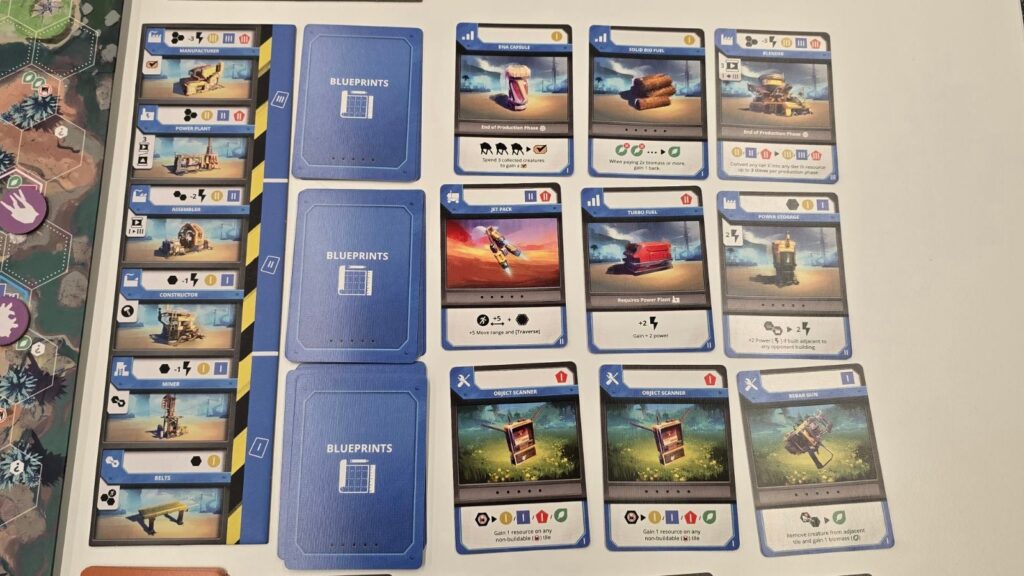
Campaign reporting also identifies stretch goals involving upgraded HUB boards, artwork and additional component designs, alongside optional purchases rather than one compulsory premium bundle. These reports capture a campaign that can continue changing. An upgrade that keeps components organised may improve usability, new artwork changes presentation, and additional abilities can affect variety and balance. Optional additions likewise serve different purposes, from more gameplay material to alternative components or a display piece.
The indexed Gamefound rewards list and publisher update identify the following optional prices:
- Biome Pack: €30.
- Explorer Pack: €15.
- Base game neoprene mats: €27.
- Wooden Meeple Upgrade Pack: €30, described separately by the publisher as not included in the listed pledges.
Campaign totals do not establish which extras accompany every reward. The wording attached to the selected pledge remains important, especially where an edition replaces components rather than supplying both versions. A backer comparing bundles should therefore distinguish included items, optional purchases and upgraded replacements before calculating the complete package.
MOOD’s launch update estimates English fulfilment in the fourth quarter of 2027 and other language fulfilment in the first quarter of 2028. These are campaign estimates, not guaranteed arrival dates. A fulfilment window may describe when distribution is expected to begin, while individual parcels arrive at different times. The crowdfunding launch date, estimated dispatch period and eventual delivery to a particular address are separate milestones.
Shipping is additional to the pledge price. As a regional example, 4Gamer reports estimated shipping to Japan of €31 to €35 for Standard, €38 to €43 for Deluxe and €61 to €70 for Collector. Those figures apply to the reported destination category and should not be reused as worldwide rates. Destination, selected additions and applicable taxes can materially change the final cost, while larger packages may cost more to transport because of their weight and dimensions.
For an international backer, the relevant comparison is the complete delivered cost of the desired edition. A lower base pledge may become less attractive once additions and shipping are included, while a larger bundle can carry a higher freight charge. The headline reward price therefore provides only part of the purchasing picture, particularly when comparing packages with different physical contents.
Launch reporting places the campaign’s end on November 10, 2026. Japanese coverage gives midnight on November 11 in Japan, corresponding to November 10 in UTC. Because summaries have not presented the deadline consistently, the live Gamefound countdown should be treated as authoritative. Backing involves opening the official project, selecting a reward and reviewing its contents, language, delivery estimate and additional charges before submitting a pledge.
Understanding the game itself remains as important as comparing rewards. MOOD has published an update directing prospective players to a teaching video, Tabletop Simulator preview and developing rulebook. These materials can clarify whether the production system suits a group, although they should not be mistaken for an immutable final specification. With the initial funding threshold already crossed, the decision is now whether the current rules, reward contents, total cost and expected wait make sense for the prospective player.

Frequently Asked Questions(FAQs)
- What is Satisfactory: The Board Game?
It is an official tabletop adaptation of Coffee Stain’s factory building video game. Players explore an alien setting and develop industrial production while pursuing objectives and recognition from FICSIT. - Did the campaign reach its goal in two minutes?
Yes. Campaign coverage reports that the €25,000 threshold was reached in approximately two minutes. This refers to crowdfunding performance, not manufacturing or delivery. - Where is the crowdfunding campaign hosted?
The project is hosted on Gamefound, where its rewards, updates and campaign terms can be reviewed. The public crowdfunding launch took place on October 13, 2026. - How many people can play?
The advertised range is one to four players. The inclusion of solo play does not, by itself, explain the solo scoring or opponent system; those details belong to the rules. - Is it a cooperative game?
Its central scoring contest is competitive, but the official overview also describes resource exchanges and other cooperative actions. Cooperation during play should be distinguished from a shared victory condition. - Does finishing the Space Elevator automatically mean winning?
The official overview says elevator completion leads to score comparison. The winner is the player with the highest score, so construction progress and final victory should not be treated as interchangeable. - What does the cheapest announced pledge include?
The publisher’s advance announcement lists the €70 Standard Pledge with the base game and FICSIT Gift Box. Additional purchases and shipping can increase the total. - Are premium components necessary to play?
The Standard Pledge is presented as a playable base game. Deluxe components and optional additions should be evaluated according to their specific contents rather than assumed to be mandatory. - When is delivery expected?
The campaign’s published estimate is the fourth quarter of 2027 for English and first quarter of 2028 for other languages. Estimated windows remain subject to development and fulfillment changes. - Is the crowdfunding price the final delivered cost?
Not necessarily. Shipping is additional, and destination specific charges or optional additions may apply. The relevant amount is the full cost associated with the selected reward and delivery address.
Conclusion
Satisfactory: The Board Game has attracted substantial early support, crossing its initial crowdfunding target within minutes and passing €1.3 million in reported pledges by October 15. That response demonstrates interest in bringing its industrial setting to a new format.
The more significant question is how effectively the adaptation turns factory planning into a manageable tabletop experience. Its appeal rests on production decisions, meaningful objectives and the tension between improving an engine and converting that efficiency into a winning position.
The available material supports a promising premise, but campaign success should remain separate from a verdict on the finished game. Current rules, edition contents, delivered cost and fulfillment estimates provide a firmer basis for evaluating a pledge than the funding percentage alone.
Sources and Citations
- Gamefound, Satisfactory: The Board Game Official Campaign: The official crowdfunding page for MOOD Publishing’s tabletop adaptation. It provides the live campaign status, pledge options, reward contents, add-ons, stretch goals, campaign updates, and current project terms. Gamefound
Satisfactory: The Board Game Official Campaign - Coffee Stain Publishing, Coffee Stain Studios and MOOD Publishing, October 13, 2026: The official launch announcement confirms the Gamefound crowdfunding launch, one-to-four-player format, competitive Victory Point structure, FICSIT Employee of the Month objective, Space Elevator progression, biomes, milestones, abilities and tool upgrades. Mynewsdesk
Crowdfunding for Satisfactory: The Board Game Launches Today and Gameplay Loop Revealed - MOOD Publishing, Pledge Tiers Revealed, October 9, 2026: Official Gamefound update detailing the campaign’s pledge structure and advance pricing, including the Collector’s Pledge at €295 and its stated retail value. This is the appropriate source for comparing the originally announced pledge tiers with later launch information. Gamefound
Pledge Tiers Revealed | Gamefound - MOOD Publishing, How to Play, Tabletop Simulator, and Rulebook, October 8, 2026: Official pre-launch update providing the Meeple University teaching video, playable Tabletop Simulator preview and work-in-progress rulebook. MOOD explicitly notes that the rulebook remained subject to changes and clarification. Gamefound
How to Play, Tabletop Simulator, and Rulebook | Gamefound - Instant Gaming, October 15, 2026: Reports that the campaign’s €25,000 funding target was reached in less than two minutes. At the time of publication, it recorded €1,341,200 pledged, equivalent to approximately 5,364% of the initial goal. Instant Gaming News
Satisfactory Board Game Crowdfunding Campaign Hit Its Goal in 2 Minutes - 4Gamer, October 14, 2026: Japanese launch coverage confirms that MOOD Publishing opened the campaign on October 13 with a €25,000 goal, which had already been achieved when the report was published. It also records the campaign deadline as midnight on November 11 in Japan and confirms the one-to-four-player format. 4Gamer.net
Satisfactory: The Board Game Crowdfunding Launch Coverage | 4Gamer
Recommendations
- Vivian Kubrick Debunks Eyes Wide Shut Deleted Scenes Theory
- Battlefield 6 2026 Roadmap: More Maps, “Legendary” Battlefield 4 & Battlefield 3 Remakes, and Wake Island’s Return
- Apple TV’s Widow’s Bay is the First Breakout TV Hit of 2026: Why Everyone is Talking About the Horror Comedy
- Pitchify Launches New Service to Connect Developers and Publishers: How Pitch Direct Works
- Pokémon Pokopia Bubbly Basin DLC Release: Date, New Pokémon, and Everything You Need to Know
- Nordic Game 2026 (NG26 Spring): Dates, Venue, Passes, Speakers, Expo & Awards in Malmö
- Subnautica 2 Early Access Roadmap: Co-Op Updates, Sprinting, and More
- Virtua Fighter 6 Leak Explained
- The Future of 3D Modeling: Insights on AI Advancements
- GTA 6 is Already Outselling Everything Else: Why Pre-Orders Are Dominating Gaming



































































































