







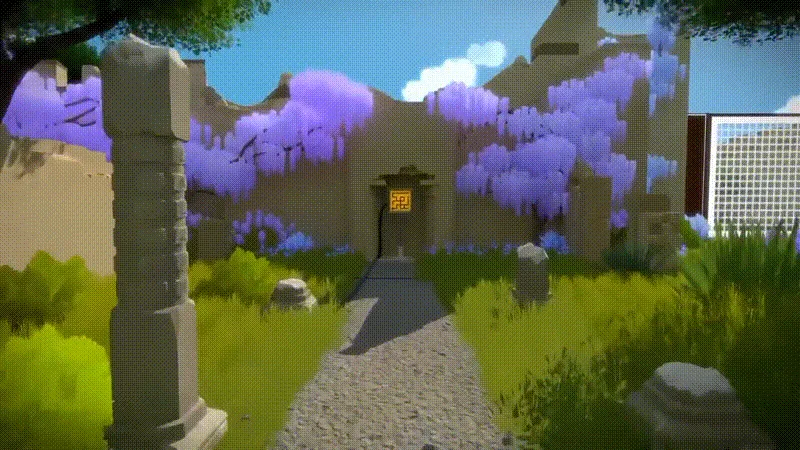
Jonathan Blow’s The Witness remains one of the most influential puzzle games ever released, even years after its initial launch. Built around a mysterious island filled with interconnected puzzles, the game challenges players through observation, deduction, and pattern recognition rather than combat, dialogue, or traditional quest design.
At first glance, The Witness appears simple. Most of its puzzles involve drawing lines across panels. However, that simplicity is deceptive. As players move through the island, they gradually learn that every shape, color, sound, shadow, reflection, and environmental detail may contain meaning. The game constantly asks players to slow down, observe carefully, and rethink what they assume they understand.
Rather than guiding the player with tutorials or direct explanations, The Witness teaches through design language. Every puzzle is both a challenge and a lesson, gradually building toward a deeper understanding of its hidden logic systems. This makes the game demanding, but it also makes each solution feel genuinely earned.
This review looks at whether The Witness still holds up in 2026, how its puzzles work, why its design remains so respected, and whether it is still worth buying today.
In This Article (11 sections)
The Witness Review and Final Verdict: Is It Still Worth Playing in 2026?
The Witness is still highly worth playing in 2026, especially for players who enjoy puzzle design, open-ended exploration, and games that trust the player to think independently. Even more than a decade after release, it remains one of the clearest examples of how a game can teach complex ideas without relying on text-heavy tutorials or constant hints.
The game is widely regarded as a landmark puzzle experience because it prioritizes player discovery over hand-holding. It does not tell players what every symbol means. It does not mark the correct path with obvious indicators. Instead, it creates a world where learning comes from paying attention.
The game excels in:
- Elegant puzzle progression
- Seamless environmental integration
- Deeply rewarding “aha” moments
- Minimalist but meaningful narrative design
One of the main reasons The Witness has aged so well is that its strengths are not tied to technology that quickly becomes outdated. Its visual design is clean, its mechanics are precise, and its interface remains simple. There are no bloated systems, unnecessary menus, or trend-based mechanics that make it feel stuck in the year it was released.
Its core appeal lies in timeless design principles rather than technical novelty. The Witness is about learning, testing ideas, recognizing patterns, and slowly developing mastery. Those qualities remain just as effective today as they were at launch.
However, it is not designed for everyone. The pacing is deliberate, and the difficulty curve can be unforgiving for players who prefer guided experiences. The game rarely explains itself directly, which can feel refreshing to some players and frustrating to others.
Overall, The Witness still stands as one of the most thoughtfully constructed puzzle games ever made. Its final verdict remains strongly positive for players who enjoy slow, intelligent, logic-driven gameplay.
The Witness Puzzle Design Explained: Why Its Logic Systems Work So Well
The puzzle design in The Witness is based on one foundational mechanic: drawing paths on panels according to learned rules. On paper, that sounds simple. In practice, the game uses this single interaction to create an enormous range of puzzle types.
What makes the design exceptional is that rules are never explicitly explained. Instead, players learn through observation, failure, correction, and experimentation. A basic puzzle introduces an idea. The next puzzle slightly changes the context. Later puzzles combine that idea with other systems, forcing the player to prove they understand the logic rather than simply repeat a pattern.
Each area introduces a new visual language or rule set, such as:
- Color-based logic
- Directional constraints
- Environmental reflection puzzles
- Sound-based cues
These mechanics are gradually combined into complex multi-layered puzzles, creating a steady escalation of cognitive challenge. The game rarely relies on cheap tricks. When a puzzle is difficult, it is usually because the player has not yet understood the rule deeply enough.
This structure is one of the reasons The Witness is considered one of the best puzzle games ever made. It succeeds because:
- Every puzzle teaches something new
- There is no filler content
- The world itself is the tutorial
- Solutions feel earned, not given
Few games achieve this level of systemic clarity without relying on explicit instruction. The Witness trusts players to learn through interaction, and that trust is central to its identity.
The game’s best puzzles often create a moment where confusion suddenly turns into understanding. These “aha” moments are not just satisfying because the player solved something difficult. They are satisfying because the player realizes the answer was always available, hidden in plain sight.
The Witness Difficulty Curve and Common Beginner Mistakes
The difficulty curve in The Witness is unconventional. Instead of traditional levels, difficulty increases through understanding. The game does not simply make puzzles bigger or more mechanically complex. It asks players to think in more abstract ways as they progress.
Instead of traditional levels, difficulty increases through:
- Rule stacking
- Conceptual abstraction
- Multi-system integration
- Player interpretation ability
This means progression can feel very different from player to player. One person may understand a rule almost immediately, while another may struggle for a long time because they missed a small visual clue or misunderstood a basic concept.
The open-world structure also affects the difficulty curve. Players can enter areas before they fully understand the rules needed to solve them. This can make the game feel harsher than it actually is. In many cases, the best solution is not to force a puzzle, but to leave, explore elsewhere, and return later with new knowledge.
New players often struggle due to misunderstanding the game’s learning structure.
Common mistakes include:
- Assuming puzzles are solved through guessing rather than deduction
- Ignoring environmental hints
- Overlooking subtle visual language patterns
- Rushing through areas without mastering fundamentals
Success requires patience and careful observation. The Witness is not designed around brute force. Guessing may occasionally work, but it usually prevents the player from learning the rule properly, which causes bigger problems later.
The best approach is to treat each puzzle as part of a lesson. When a solution seems impossible, it usually means the player is missing a concept, misreading a symbol, or looking at the problem from the wrong perspective.
The Witness Island Secrets, Hidden Areas, and Environmental Puzzles
The island in The Witness is not just a setting. It is part of the puzzle system itself. Nearly every area has been arranged with intention, and the player gradually learns to treat the landscape as more than decoration.
The island is filled with hidden paths, secret puzzles, and optional challenges that reward exploration.
These include:
- Hidden environmental puzzles embedded in scenery
- Optional challenge areas with advanced logic systems
- Audio-based secrets tied to environmental cues
- Endgame puzzles requiring deep understanding of multiple mechanics
Many secrets are designed to go unnoticed until players fully internalize the game’s language systems. Early in the game, a player may walk past something without recognizing its importance. Later, after learning how the game communicates, that same object or landscape detail may suddenly become meaningful.
Environmental puzzles are especially important to The Witness because they expand the player’s understanding of what a puzzle can be. Unlike panel-based puzzles, these require players to interpret:
- Shadows and lighting angles
- Tree and branch alignments
- Reflections in water or glass
- Perspective shifts based on positioning
These puzzles reinforce the idea that the entire environment is part of the puzzle system, not just isolated panels. The player is encouraged to look at paths, buildings, trees, clouds, water, and architecture as possible sources of information.
This is one of the game’s most memorable design achievements. It changes how the player sees the world. Once the environmental puzzle language becomes clear, the island feels transformed, even though nothing about it has physically changed.
The Witness Story and Ending Explained
The Witness does not present a traditional narrative. There are no conventional characters, no clear protagonist arc, and no straightforward plot progression. Instead, the story is fragmented, abstract, and tied closely to the game’s themes of perception and understanding.
Players uncover environmental recordings and visual metaphors suggesting themes such as:
- Consciousness and perception
- Learning and enlightenment
- The nature of understanding itself
However, the game deliberately avoids confirming a single interpretation, allowing meaning to remain subjective. This can make the story feel distant or even confusing for players expecting a more direct narrative. But for players who enjoy ambiguity, the structure gives the game a philosophical quality.
The ending is intentionally open to interpretation. It does not provide a conventional narrative conclusion or answer every question about the island. Instead, it reinforces the idea that the game has always been about perception, awareness, and learning how to see differently.
Many players interpret the ending as a commentary on enlightenment or self-realization through learning systems. Others see it as a reflection on obsession, interpretation, or the limits of understanding. The game leaves room for all of these readings without forcing one final explanation.
This ambiguity fits the broader design philosophy of The Witness. The game rarely tells players what something means. It gives them systems, spaces, clues, and patterns, then asks them to make sense of those elements themselves.
The Witness Graphics, Art Style, Sound Design, and Atmosphere
The Witness features a minimalist yet highly stylized visual design. It does not aim for photorealism, but its art direction remains striking because of how deliberate and readable everything feels.
Its art direction emphasizes:
- Clean geometry and sharp color contrast
- Natural landscapes paired with artificial structures
- Strong visual readability for puzzle clarity
- A calm, isolated atmosphere
The island is colorful and visually inviting, but it also feels strangely empty and controlled. This contrast creates a quiet sense of mystery. The world appears peaceful, yet its precision suggests that everything has been placed for a reason.
The graphics also serve a practical purpose. Because so many puzzles depend on visual recognition, the clean art style helps prevent unnecessary confusion. Colors, shapes, shadows, and lines need to be readable, and The Witness handles that with unusual discipline.
Sound design in The Witness is subtle but highly effective.
The island is filled with:
- Ambient natural sounds
- Minimalist environmental audio cues
- Occasional voice recordings that enhance mystery
This restrained audio design reinforces the game’s focus on concentration and observation. There is no constant musical score pushing emotion onto the player. Instead, the quiet atmosphere allows small sounds to stand out.
In certain areas, sound is not just background detail. It becomes part of the puzzle language itself. This reinforces the game’s central idea: everything the player sees and hears may matter.
Best Moments in The Witness and How It Compares to Modern Puzzle Games
Some of the most memorable moments in The Witness come from realization rather than scripted events. The game does not rely on dramatic cutscenes, boss fights, or major narrative twists. Its strongest emotional moments come from understanding something that previously seemed impossible.
Key highlights include:
- Discovering a new rule without explanation
- Solving a puzzle using environmental logic for the first time
- Unlocking new island regions through understanding alone
- Experiencing sudden clarity after repeated failure
These “aha” moments are the emotional core of the game. They are powerful because they come from the player’s own reasoning. The game provides the structure, but the breakthrough belongs to the player.
Compared to modern puzzle games, The Witness remains unusual in its strict commitment to pure logic-based design. Many newer puzzle games blend puzzles with story sequences, character dialogue, platforming, physics systems, or cinematic guidance. The Witness is more austere. It strips the experience down to observation, logic, space, and interpretation.
This makes it more challenging, but also more intellectually rewarding than many modern alternatives. It does not try to comfort the player at every moment. Instead, it expects focus and persistence.
That design choice can make the game feel cold or demanding, but it is also what gives The Witness its lasting identity. Few puzzle games are this confident in silence, ambiguity, and player-led discovery.
Should You Buy The Witness Today?
Yes, The Witness is still worth buying today for players who enjoy intellectual challenge and exploration-based puzzle design. It remains one of the strongest examples of how a game can create depth from simple mechanics and careful rule progression.
It is especially recommended for:
- Puzzle enthusiasts
- Players who enjoy non-linear exploration
- Fans of minimalist storytelling
However, it may not appeal to those seeking fast-paced gameplay or explicit narrative direction. The Witness requires patience, attention, and a willingness to be confused before reaching clarity.
For the right player, it remains one of the most rewarding puzzle games available. Its design has aged well because it is built on strong ideas rather than temporary trends. Even in 2026, The Witness still feels precise, intelligent, and unusually confident in the player’s ability to learn.
FAQs
- What is The Witness about?
The Witness is a first-person puzzle game set on a mysterious island where players solve line-drawing puzzles while gradually learning new logic rules through observation and exploration. - Is The Witness still worth playing in 2026?
Yes, it still holds up extremely well due to its timeless puzzle design, clean visuals, and focus on logic-based discovery rather than outdated mechanics. - How does puzzle progression work in The Witness?
Puzzle progression is based on learning new rules organically. Each area teaches a mechanic visually, and later puzzles combine multiple learned rules into more complex challenges. - Is The Witness a difficult game?
Yes, it can be very challenging because it does not explain rules directly. Difficulty comes from interpretation, pattern recognition, and careful observation. - Does The Witness have a story?
It does not have a traditional story. Instead, it uses environmental storytelling, audio logs, and symbolism to explore themes of perception and understanding. - What makes The Witness so highly rated?
Its reputation comes from its elegant puzzle design, lack of hand-holding, strong “aha” moments, and the way the entire world functions as a learning system. - How long does it take to finish The Witness?
Most players take around 15 to 30 hours depending on how quickly they understand puzzle mechanics and how much optional content they explore. - Are there secrets in The Witness?
Yes, the island contains hidden puzzles, optional areas, environmental secrets, and advanced challenges that are not required to finish the main game. - What is the hardest part of The Witness?
The hardest part is usually later-stage puzzles where multiple rules are combined, requiring deep understanding of earlier mechanics. - Should beginners play The Witness?
Yes, but only if they enjoy slow, thoughtful puzzle-solving. It is not ideal for players who prefer guided tutorials or fast-paced gameplay.
conclusion
The Witness remains a masterclass in puzzle game design, even years after its release. Its commitment to environmental learning, elegant mechanics, and player-driven discovery sets it apart from most modern puzzle experiences. While its difficulty and minimal guidance can be challenging, those who engage with its systems fully are rewarded with one of the most satisfying intellectual journeys in gaming.
sources and citation
Official game documentation and developer commentary from Jonathan Blow and Thekla, Inc.
Critical reviews and retrospective analyses of The Witness puzzle design and player experience.
Community breakdowns of puzzle mechanics and environmental logic systems.
Comparative studies of modern puzzle game design trends and legacy influence of The Witness.



































































































