









In This Article (9 sections)
What Inkling Is, When it Was Released, and Why Its Open-Weight Model Matters
Inkling is the first publicly released production model from Thinking Machines Lab, the artificial intelligence company led by former OpenAI technology chief Mira Murati. Released on July 15, 2026, it is designed as a general-purpose multimodal model for reasoning, coding, tool use, document analysis, long-context processing, audio understanding, visual tasks, and specialized enterprise applications.
The flagship model contains 975 billion total parameters, but it does not activate all of them for every token. Inkling uses a sparse Mixture-of-Experts architecture that activates approximately 41 billion parameters per token, allowing it to draw from a much larger collection of learned capabilities without performing calculations across the complete model during every processing step.
Inkling also supports a maximum configured context window of 1,048,576 tokens. That capacity could accommodate large software repositories, extensive document collections, lengthy transcripts, research archives, long tool histories, or combinations of text, images, and audio inside one working context. The practical limit can still be lower when Inkling is accessed through a hosted provider or deployed on hardware that cannot economically serve the complete window.
Thinking Machines released two official downloadable versions. The original BF16 checkpoint is approximately 1.9 terabytes, while the compressed NVFP4 version occupies about 592 gigabytes. Inkling is also available through the company’s Playground, its Tinker post-training platform, and several third-party inference services. Thinking Machines named Together AI, Fireworks, Modal, Databricks, and Baseten among the initial providers or deployment partners.
The model is best described as open weight, not fully open source. Thinking Machines released its trained parameters under the Apache License 2.0, allowing substantial use, modification, private deployment, fine-tuning, and redistribution under the license’s conditions. However, the company has not released the complete training corpus, every data-processing tool, all filtering code, or a fully reproducible pretraining pipeline.
That distinction does not remove the practical benefits. An organization can download Inkling, operate it within private infrastructure, create customized adapters, apply its own safety controls, quantize the model, and avoid complete dependence on one hosted API. What it cannot do from the available materials is independently reconstruct every stage of the original training process.

Inkling’s 975B MoE Architecture, One-Million-Token Context, and 45-Trillion-Token Training
Inkling is a 66-layer decoder-only transformer with a hidden dimension of 6,144, 64 attention heads, a vocabulary containing 201,024 entries, and 256 routed experts. A learned router selects six routed experts for each token, while two shared experts remain active across all tokens. This produces the model’s approximately 41-billion-active-parameter workload.
The active-parameter count should not be confused with storage requirements. A deployment still needs access to all 975 billion parameters because different tokens may be sent to different experts. The complete expert collection must therefore be distributed across several accelerators, even though only a fraction of those experts participates in each token’s calculation.
Inkling alternates local and global attention layers at a five-to-one ratio. Its sliding-window attention covers 512 tokens at a time, reducing the cost of local processing, while periodic global layers allow information to travel between distant parts of the context. Thinking Machines also uses relative positional embeddings instead of the more common rotary approach, reporting that relative embeddings performed better in its long-context experiments.
The architecture includes short convolutions after key and value projections and within attention and multilayer-perceptron residual paths. These design choices are intended to improve stability, efficiency, and the ability to extrapolate across long sequences. They also make Inkling more complicated to serve than a standard dense transformer because expert routing, inter-GPU communication, memory distribution, and load balancing all affect real performance.
Thinking Machines says Inkling was pretrained on 45 trillion tokens drawn from text, images, audio, and video. The training material included publicly accessible information, third-party data, and synthetic or synthetically augmented content. The company says the data went through cleaning, processing, deduplication, quality filtering, and filtering related to safety and other training goals.
The exact mixture remains undisclosed. Thinking Machines has not provided a complete inventory of public sources, a full list of third-party datasets, the number of tokens assigned to each modality, or detailed percentages for different languages and domains. The 45-trillion-token figure demonstrates the scale of the training run without making the complete corpus independently auditable.
For optimization, Thinking Machines combined Muon for large matrix parameters with Adam for other parameters. Its training schedule also used research involving modular manifolds and weight decay connected to the square of the learning rate. These details provide insight into the model’s development, but the published information is still insufficient to reproduce the full pretraining run from beginning to end.

How Inkling Handles Text, Images, Audio, Video, Tools, and Adjustable Reasoning
Inkling’s documented public input modalities are text, images, and audio, while its documented output is text. Inputs from each supported medium are converted into model-compatible representations and projected into the same hidden space, allowing one conversation to combine written instructions, documents, pictures, charts, diagrams, and spoken content.
Images are processed through a four-layer hierarchical multilayer-perceptron patch encoder. The released configuration uses 40-pixel visual patches and supports image dimensions between 40 and 4,096 pixels for optimal operation. Current Tinker documentation accepts PNG and JPEG files supplied locally, through file references, as encoded data, or as image objects.
Possible visual applications include image captioning, document interpretation, chart and diagram analysis, visual classification, and answering questions about photographed or scanned material. During agentic tasks, Inkling can also use tools such as Python to crop, enlarge, or inspect a specific region when important text or visual evidence is difficult to interpret from the complete image.
Audio is converted into quantized mel-spectrogram features called DMels. Thinking Machines recommends 16-kilohertz WAV input and audio segments lasting no more than approximately 20 minutes for the most dependable operation. Tinker can accept WAV, MP3, and FLAC files, decode and resample them, and convert the result into the representation Inkling expects.
The model can transcribe speech, follow spoken instructions, extract information such as names or dates, answer questions about recordings, and identify characteristics including whispering or laughter. Inkling does not generate native audio output, so a spoken assistant would need a separate text-to-speech system to read its answers aloud.
Video support requires more caution. Inkling was pretrained on video, its visual architecture includes temporal patches, and its model description refers to video processing. However, the formal public input list and current Tinker guides do not describe one universal interface for submitting arbitrary video files. Some applications may need to extract ordered frames and audio before sending them to the model.
One of Inkling’s most distinctive features is continuous reasoning-effort control. Applications can request lower effort for straightforward tasks or increase the setting for difficult mathematics, software engineering, tool use, and multi-step reasoning. This creates a direct trade-off between response quality, latency, token generation, and operating cost.
A routine classification request may not justify the same reasoning budget as debugging a large codebase. Inkling’s effort-conditioned training allows developers to treat reasoning depth as an application parameter rather than accepting one fixed behavior for every prompt.

Inkling Benchmarks, Coding Performance, Factuality, and Comparisons with Frontier Models
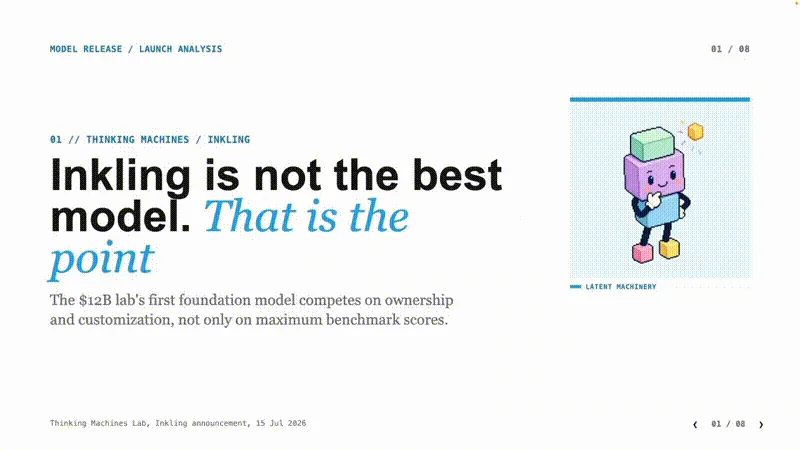
Thinking Machines does not claim that Inkling is the strongest artificial intelligence model overall. Its launch results show a capable open-weight system, but closed models from the GPT, Claude, and Gemini families generally remained ahead on maximum reasoning and coding evaluations included in the company’s comparison.
Inkling scored 29.7 percent on the text-only Humanity’s Last Exam and 87.2 percent on GPQA Diamond. Its mathematical result on AIME 2026 reached 97.1 percent. Tool-enabled Humanity’s Last Exam performance rose to 46.0 percent, demonstrating that access to external tools can materially improve difficult reasoning tasks.
For coding, Inkling recorded 77.6 percent on SWE-bench Verified, 54.3 percent on SWE-bench Pro, and 63.8 percent on Terminal Bench. These are substantial results for a downloadable model, but the source’s comparison placed the strongest Claude and GPT systems considerably higher on several of those tests.
Instruction following was one of Inkling’s stronger areas. It scored 79.8 percent on IFBench and 88.7 percent on Global-MMLU-Lite. Its visual results included 73.5 percent on MMMU Pro and 78.1 percent on CharXiv reasoning, rising to 82.0 percent when Python tools were available. Audio scores included 56.6 percent on Audio MC, 77.2 percent on MMAU, and 91.4 percent on VoiceBench.
Results against Kimi and DeepSeek were mixed. Inkling trailed some of the compared releases on Humanity’s Last Exam, Terminal Bench, visual understanding, and factuality, while leading selected instruction-following and agent evaluations. It scored 74.1 percent on MCP Atlas, exceeding the cited Kimi result and narrowly surpassing the cited DeepSeek score. These differences reinforce the point that no model leads every category.
Factual accuracy remains an important weakness. Inkling scored 43.9 percent on SimpleQA Verified. An independent evaluation described in the provided article reported 40 percent accuracy and a 63 percent hallucination rate on its particular factuality test. That does not mean 63 percent of all Inkling responses will contain false information, but it demonstrates why the model should not be trusted without validation when factual correctness matters.
Thinking Machines also acknowledges hallucinations, occasional instruction failures, performance degradation across extended multi-turn conversations, possible demographic and linguistic bias, and uneven results across languages and subject areas. Retrieval systems, citations, constrained tools, human review, and use-case-specific testing remain necessary for legal, medical, financial, safety-critical, and other high-stakes work.
Inkling’s competitive advantage is therefore not unconditional benchmark leadership. Its strongest differentiators are downloadable weights, multimodal operation, a one-million-token configuration, adjustable reasoning effort, private deployment, and first-party customization through Tinker.

Inkling Hardware Requirements, Download Size, Tinker Fine-Tuning, and Deployment Costs
Inkling is not a model that can realistically be downloaded and operated on a normal laptop or one consumer graphics card. Thinking Machines says the BF16 checkpoint requires at least two terabytes of aggregate GPU memory. Its example configurations use eight NVIDIA B300 GPUs or 16 NVIDIA H200 GPUs.
The NVFP4 checkpoint reduces the minimum requirement to approximately 600 gigabytes of aggregate GPU memory. It can operate in W4A4 mode on four B300 GPUs with the required architecture or in W4A16 mode on eight H200 GPUs. Those figures describe minimum model-serving setups rather than complete production capacity.
A real deployment also needs memory for key-value caches, request batching, runtime workspaces, multimodal encoders, communication buffers, and operating overhead. Very long contexts create particularly demanding prefill and cache requirements. A checkpoint may technically fit into a cluster while still delivering poor latency or low concurrency.
Mixture-of-Experts serving adds another challenge because tokens may need to reach experts stored on different GPUs. Interconnect bandwidth, expert parallelism, load distribution, batching, and inference software can become as important as raw accelerator performance. Organizations should benchmark prompt ingestion, time to first token, generation speed, concurrency, and cost per completed task on the exact hardware they intend to use.
Supported inference paths include SGLang, vLLM, TokenSpeed, Unsloth, Hugging Face tooling, and related community implementations. The most suitable option depends on the accelerator generation, quantization, multimodal requirements, workload shape, monitoring systems, and surrounding application.
Teams without a large GPU cluster can use Tinker or an outside inference provider. Tinker is Thinking Machines Lab’s managed post-training service and supports supervised fine-tuning, reinforcement learning, preference optimization, distillation, tool-use training, visual-language adaptation, and audio workflows. The service manages the distributed infrastructure, allowing developers to customize Inkling without owning the full training cluster.
A responsible fine-tuning project should begin with an unmodified-model baseline and a held-out evaluation set. Training data should include difficult, ambiguous, multilingual, adversarial, and incomplete cases rather than only ideal examples. Teams should then evaluate whether the customized checkpoint improves the intended task without weakening factuality, general instruction following, privacy behavior, tool restrictions, or safety.
As of July 21, 2026, Tinker’s temporary discounted pricing for the 64,000-token configuration was $1.87 per million prefill tokens, $0.374 per million cached prefill tokens, $4.68 per million sampled tokens, and $5.61 per million training tokens. The 256,000-token configuration cost twice those listed token rates, while checkpoint storage was $0.10 per gigabyte each month. The source explicitly identifies these as limited promotional prices rather than permanent rates.
Self-hosting may suit organizations with consistently high utilization, private-data requirements, offline environments, or unusual weight-level modifications. Hosted access may be more economical for experimentation and irregular demand. A hybrid workflow can use Tinker for training, hosted endpoints for evaluation, and private hardware for the final production deployment.

Frequently Asked Questions (FAQs)
- What is Inkling AI?
Inkling is a general-purpose multimodal artificial intelligence model developed by Mira Murati’s Thinking Machines Lab. It uses a 975-billion-parameter Mixture-of-Experts architecture with approximately 41 billion parameters active for each token. Its documented capabilities include reasoning, coding, image understanding, audio processing, tool use, agent workflows, and long-context analysis. - When was Mira Murati’s Inkling released?
Thinking Machines Lab released Inkling on July 15, 2026. The launch included the original BF16 checkpoint, the smaller NVFP4 checkpoint, Tinker support, Playground access, model documentation, and integrations with several inference frameworks and hosted providers. - Is Inkling fully open source?
No. Inkling is more accurately described as open weight. Its trained checkpoints are downloadable under the Apache License 2.0, allowing substantial use, modification, and redistribution. However, Thinking Machines has not published the complete training dataset, all processing code, or the full reproducible training pipeline needed for the strictest definition of an open-source AI system. - Can Inkling run on a consumer GPU or ordinary laptop?
The official flagship checkpoints cannot practically run on an ordinary laptop or a single consumer GPU. The BF16 model requires at least two terabytes of aggregate GPU memory, while the NVFP4 version requires approximately 600 gigabytes. Supported examples use between four and 16 data-center accelerators depending on the checkpoint and GPU generation. - How large is the Inkling download?
The original BF16 repository is approximately 1.9 terabytes, while the official NVFP4 checkpoint is about 592 gigabytes. A deployment also needs extra storage for downloads, caching, containers, logs, temporary files, conversions, and any customized checkpoints created through fine-tuning. - Does Inkling support video input?
Inkling was pretrained on video, and its architecture includes temporal visual processing. However, its currently documented public interfaces focus on text, images, and audio rather than guaranteeing direct support for arbitrary video files in every runtime. Developers may need to extract frames and audio unless their chosen provider or inference framework offers a dedicated video interface. - Does Inkling really have a one-million-token context window?
Yes. The downloadable configuration supports a maximum sequence length of 1,048,576 tokens. That is an architectural maximum rather than a guarantee that every provider will expose the complete window. Tinker currently offers smaller 64,000-token and 256,000-token configurations, while third-party limits can vary. - Can Inkling be fine-tuned without owning a large GPU cluster?
Yes. Thinking Machines’ Tinker platform manages distributed post-training through an API. Developers can use it for supervised fine-tuning, reinforcement learning, preference optimization, multimodal adaptation, tool-use training, and other workflows without purchasing and operating the complete hardware cluster themselves. - Is Inkling better than GPT, Claude, Gemini, DeepSeek, or Kimi?
Not across every task. Thinking Machines explicitly states that Inkling is not the strongest model overall. Closed GPT, Claude, and Gemini systems generally led several maximum-capability reasoning and coding tests in the launch comparison. Results against DeepSeek and Kimi were mixed. Inkling’s main advantages are weight access, private deployment, customization, multimodality, long context, and adjustable reasoning effort. - Is Inkling-Small available to download?
No, not as of July 21, 2026. Thinking Machines previewed Inkling-Small with 276 billion total parameters and 12 billion active parameters, but said testing was still being completed. Preliminary benchmarks were published, while the downloadable checkpoint, final hardware requirements, standardized latency figures, and full deployment documentation remained unavailable.
Conclusion
Mira Murati’s TML drops open-weight 975B MoE ‘Inkling’ at a moment when model ownership, customization, and inference efficiency are becoming as strategically important as raw benchmark leadership. Inkling’s 975 billion total parameters, 41 billion active parameters, one-million-token maximum context, multimodal training, 45-trillion-token corpus, and adjustable thinking effort make it one of the most technically ambitious open-weight releases from a United States laboratory.
The model is not a universal performance leader. Closed systems from the GPT, Claude, and Gemini families led Inkling on many launch benchmarks, while Kimi, DeepSeek, and other open-weight competitors remained stronger in selected areas. Inkling also requires data-center-scale hardware, has measurable factuality limitations, and does not disclose enough training information for full reproduction.
Its significance lies in what developers are permitted and equipped to do with it. The Apache-licensed weights can be downloaded, privately deployed, quantized, inspected, and adapted. Tinker lowers the infrastructure barrier to fine-tuning, while the Cookbook and multimodal renderer support specialized training workflows. Inkling-Small may eventually extend that strategy to a less expensive deployment tier.
Inkling should therefore be judged as a customizable AI foundation rather than merely a chatbot or benchmark entry. For organizations that value weight access, multimodal specialization, private infrastructure, controllable reasoning costs, and reduced dependence on a single closed provider, it represents a meaningful new option in the open-weight AI landscape.
Sources and Citations
- Thinking Machines Lab Inkling Announcement
https://thinkingmachines.ai/news/introducing-inkling/ - Official Inkling Model Card
https://thinkingmachines.ai/model-card/inkling/ - Official Inkling Product Page
https://thinkingmachines.ai/inkling/ - Thinking Machines Inkling BF16 Repository
https://huggingface.co/thinkingmachines/Inkling - Inkling BF16 Configuration File
https://huggingface.co/thinkingmachines/Inkling/blob/main/config.json - Inkling BF16 Repository Files and Checkpoint Sizes
https://huggingface.co/thinkingmachines/Inkling/tree/main - Thinking Machines Inkling NVFP4 Repository
https://huggingface.co/thinkingmachines/Inkling-NVFP4 - Inkling NVFP4 Repository Files and Checkpoint Sizes
https://huggingface.co/thinkingmachines/Inkling-NVFP4/tree/main - Hugging Face Inkling Release Overview
https://huggingface.co/blog/thinkingmachines-inkling - Tinker Documentation
https://tinker-docs.thinkingmachines.ai/ - Tinker Models and Hosted Pricing
https://tinker-docs.thinkingmachines.ai/tinker/models/ - Tinker Cookbook
https://tinker-docs.thinkingmachines.ai/cookbook/ - Using Inkling with Tinker
https://tinker-docs.thinkingmachines.ai/cookbook/inkling/ - Inkling tml-renderers Documentation
https://tinker-docs.thinkingmachines.ai/cookbook/inkling/tml-renderers/ - Inkling Thinking-Effort Controls
https://tinker-docs.thinkingmachines.ai/cookbook/inkling/thinking-effort/ - Inkling Audio-Input Documentation
https://tinker-docs.thinkingmachines.ai/cookbook/inkling/audio/ - Inkling Image-Input Documentation
https://tinker-docs.thinkingmachines.ai/cookbook/inkling/images/ - Official Tinker Cookbook GitHub Repository
https://github.com/thinking-machines-lab/tinker-cookbook - Tinker Cookbook Inkling Examples
https://github.com/thinking-machines-lab/tinker-cookbook/tree/main/tinker_cookbook/recipes/inkling - Artificial Analysis Inkling Benchmark Report
https://artificialanalysis.ai/articles/thinking-machines-has-released-inkling-the-new-leading-u-s-open-weights-model - Artificial Analysis Inkling Model Page
https://artificialanalysis.ai/models/inkling - Artificial Analysis Thinking Machines Model Comparison
https://artificialanalysis.ai/providers/thinking-machines - Open Source Initiative Open Source AI Definition 1.0
https://opensource.org/ai/open-source-ai-definition - Open Source Initiative Definition Announcement
https://opensource.org/blog/the-open-source-initiative-announces-the-release-of-the-industrys-first-open-source-ai-definition - The Wall Street Journal Inkling Report
https://www.wsj.com/tech/ai/mira-muratis-ai-startup-releases-first-model-in-bid-to-loosen-ai-giants-grip-e042bb2b - WIRED Thinking Machines Lab Inkling Report
https://www.wired.com/story/thinking-machines-lab-releases-its-first-model-inkling/ - WIRED Mira Murati and Thinking Machines Lab Profile
https://www.wired.com/story/mira-murati-thinking-machines-lab/
Recommendations
- AMD Radeon RX 9060 XT: Everything We Know Features, Specs, Pricing, and How It Compares to RX 9070 XT and NVIDIA Rivals
- Roblox Grow A Garden 2 Complete Crops Guide: Best Seeds, Crop Values, and Farming Tips
- Redefining Representation: Authentic Black Hairstyles in Video Games
- PS5 and Xbox Sales Plunge in the United States as Console Prices Surge and Demand Weakens in 2026
- How to Create a Metahuman from a Photo: The Ultimate Guide to Digital Character Creation
- Can They Win the Match While Breaking the Laws of Physics? Shaolin Soccer Spinoff Kung Fu Soccer Heads to North American Theaters
- Ubisoft Reveals Plans for Workforce Reductions and Will Be Halting Game Development Operations at Red Storm Entertainment: What It Means for the Gaming Industry
- New Lanterns Trailer Has a Lot More Green and First Look at Nathan Fillion’s Guy Gardner Explained
- Saudi Arabia Just Spent Over $6 Billion Buying Up More of the Video Game Industry: What the Moonton Deal Means
- The Winter Olympics Featured a Mortal Kombat Figure Skating Routine: What Happened and Why it Went Viral



































































































