






In This Article (16 sections)
Walmart Agent Gateway: How AI Shopping Agents Connect With Walmart and Sam’s Club
Walmart Agent Gateway is designed to let approved AI shopping agents connect with Walmart’s commerce systems and help customers complete purchases. Alongside it, Walmart is introducing Agent Profiles, which allow shoppers to authorize individual assistants, review their purchases, and control their spending. Announced on October 21, 2026, the initiative also includes Sam’s Club and represents Walmart’s approach to making AI assisted shopping more accessible while maintaining customer oversight.
The development addresses an important question in AI commerce: how can an assistant purchase products for a customer without receiving unrestricted access to their account? Finding a suitable item is only part of the process. An agent also needs accurate product information, appropriate purchasing permissions, reliable fulfillment details, and opportunities for the shopper to intervene. Walmart’s approach combines a technical connection for developers with separate account controls for customers, although the developer beta and planned consumer rollout remain at different stages.
Walmart Agent Gateway provides a dedicated connection between AI assistants and the retailer’s shopping systems. Its product page describes access to current product and fulfillment information, integration through Walmart’s Sparky assistant, and safeguards including verified identities, controlled permissions, category restrictions, and rate limits. These features are intended to help approved agents carry out shopping tasks while operating within defined boundaries.
Gateway Mechanics and Access Boundaries
The gateway addresses the practical work involved in translating ordinary shopping requests into transactions. A customer might ask an assistant to restock cleaning supplies before the weekend, but completing that instruction requires more than identifying products with matching names. The assistant must distinguish suitable items from alternatives, understand package sizes and quantities, check availability, and determine whether the requested delivery timing is feasible. Producing a plausible shopping list does not necessarily mean the customer’s actual requirements have been satisfied.
A dedicated connection can make these exchanges more consistent by providing information through an interface designed for software rather than relying entirely on website navigation. However, access to accurate information does not guarantee accurate purchasing decisions. An agent might retrieve the correct product details while misunderstanding the desired quantity, variation, or delivery arrangement. The gateway supports the transaction process, but the quality of each shopping decision still depends on the connected assistant.
Walmart Agent Gateway uses the Model Context Protocol (MCP), an open standard that allows AI applications to connect with external systems, including data sources and tools. MCP provides a common way for assistants to request information or invoke supported capabilities. In this arrangement, a server can expose tools with defined names, descriptions, and accepted inputs, allowing an AI application to interact with a connected service through structured requests.
For shopping, structured communication is particularly valuable because ordinary retail websites contain navigation menus, advertisements, product variations, promotional information, and checkout controls. Human shoppers can usually distinguish these elements visually, but an automated assistant must interpret them correctly. Direct integration can reduce dependence on changing website layouts by allowing the agent to request relevant information through a dedicated software interface.
However, MCP support should not be confused with unrestricted shopping access. Technical connectivity, retailer permission, and customer authorization are separate requirements. An application may support the protocol without being approved to purchase products through Walmart. Similarly, access to product information does not automatically grant authority to place orders.
The gateway’s capabilities can be understood through several connected functions:
- Product information: Providing approved assistants with current details needed to identify suitable products.
- Fulfillment information: Supporting decisions about availability and delivery or collection arrangements.
- Verified identities: Helping establish which approved application or agent is accessing Walmart’s systems.
- Controlled permissions: Restricting what connected assistants are authorized to do.
- Category restrictions: Limiting access or purchasing activity according to applicable product rules.
- Rate limits: Controlling how frequently connected applications can make requests.
- MCP integration: Providing a standardized method for communication between AI applications and supported commerce tools.
These functions establish the technical foundation for delegated shopping, but the customer experience depends on how developers implement them. An assistant must still interpret instructions correctly, distinguish product alternatives, and present decisions that require human approval.
Sam’s Club Integration and Practical Considerations
Sam’s Club is also included in the announced initiative. Reuters describes the gateway as connecting approved assistants with Walmart and Sam’s Club systems for product discovery and purchasing. This broadens the potential shopping experience beyond Walmart’s main retail platform, although the announcement does not establish that every account control, product category, or fulfillment option will operate identically across both services.
Sam’s Club shopping introduces additional practical considerations. Its existing availability guidance directs customers to select a particular club before checking whether an item is available. An AI agent therefore needs to understand the relevant location and fulfillment context rather than assuming that a product appearing in a catalog is available through the customer’s preferred club.
Package quantities also matter. A bulk purchase may be appropriate for household replenishment but excessive for a smaller request. The assistant must distinguish the overall price from the suitability of the quantity being ordered. The inclusion of Sam’s Club does not establish that membership requirements disappear or that all Walmart and Sam’s Club account relationships become interchangeable.
The gateway begins with beta access for companies and developers, meaning its technical availability should be distinguished from the availability of customer facing Agent Profiles. Developers must obtain appropriate access, implement the integration, and provide the required shopping controls before customers can use a supported assistant to complete purchases.
Beta testing also provides an opportunity to identify problems involving unavailable products, changing delivery options, substitutions, interrupted orders, and product variations. These situations can make routine shopping considerably more complicated than a simple demonstration suggests.
The initiative consequently represents more than an attempt to make AI assistants capable of clicking through checkout pages. Walmart is establishing a defined connection through which approved applications can participate in commerce while remaining subject to retailer requirements and customer permissions. Whether that approach delivers a reliable experience will depend on how effectively the technical connection supports accurate product selection and controlled purchasing.
Walmart Agent Profiles: Customer Authorization, Spending Limits, Privacy, and Purchase Controls
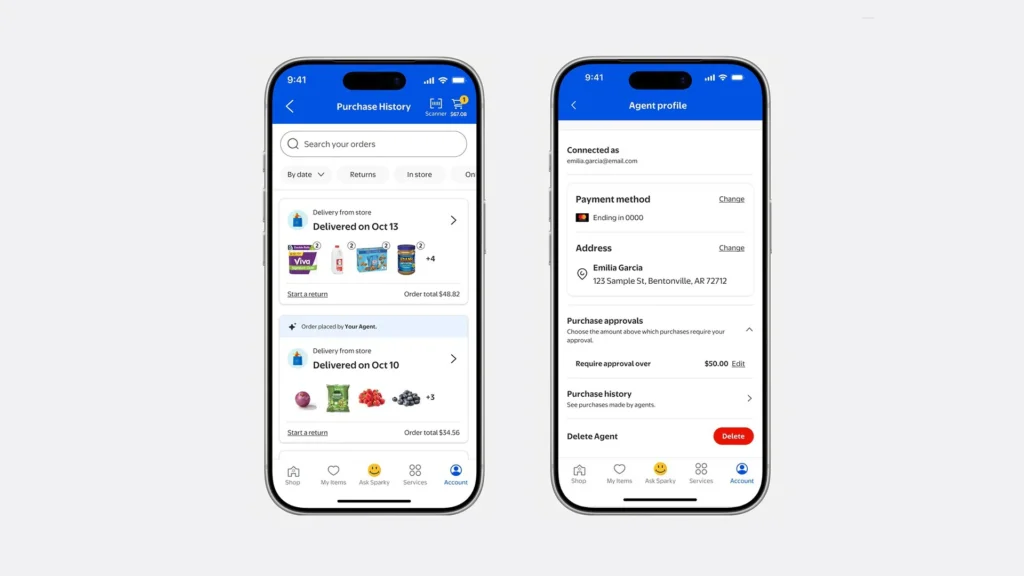
Walmart Agent Profiles are dedicated profiles for individual AI assistants within a customer’s Walmart account. They are intended to distinguish purchases made by an agent from those completed directly by the shopper. Reuters reports that customers will be able to authorize assistants individually and manage their purchasing activity separately, creating a clearer relationship between an instruction, the agent carrying it out, and the resulting transaction.
This separation becomes useful when a customer relies on several assistants. For example, one application might help with meal planning while another handles household supplies or occasional product research. If both can place orders, a combined purchase history may make it difficult to determine which application initiated a transaction. Individual profiles provide a clearer way to identify the responsible assistant and review its activity.
Agent Profiles also make purchasing permission an ongoing relationship rather than a single unrestricted authorization. Trusting an assistant to complete one task does not necessarily mean allowing it to make every future purchase. The practical value of the profile depends on whether customers can understand which agent has access, what that access permits, and how its purchasing activity corresponds to their instructions.
Walmart has announced November 2026 as the rollout window for Agent Profiles, following the October 21 announcement. As of October 22, the available information does not establish a specific November launch day or a complete schedule covering every participating application, platform, product category, or geographical market. The consumer rollout should therefore remain separate from the gateway’s initial developer beta.
Authorization Flow and Spending Limit Configuration
The authorization process begins in the AI agent’s application. According to Walmart, an Agent Profile is created when the customer first uses the gateway through that assistant. The shopper then signs in through Walmart to authorize and link the profile before establishing purchasing controls. Walmart states that the sign in is visible only to Walmart.
This arrangement distinguishes requesting shopping assistance from granting permission to spend money. A customer asking an assistant to find suitable cookware may only want product recommendations, while another shopper may already know the exact item and prefer to delegate checkout. Product research, cart preparation, and purchasing represent different levels of authority even when they occur within the same conversation.
A clear authorization process should make those distinctions understandable. The customer needs to recognize the assistant being connected and understand what actions it may perform. For example, someone requesting dinner suggestions may welcome a proposed ingredient list but still want to inspect it before purchasing. The authorization process is where such preferences become concrete rather than being inferred entirely from conversational instructions.
Walmart says shoppers can authorize spending within limits they choose, giving $50, $100, and $200 as examples. These amounts illustrate possible budgets rather than establishing that they are the only available options. Spending limits create financial boundaries, but they do not replace the need for accurate instructions about products, quantities, and acceptable substitutions.
An assistant authorized to spend up to $100 on laundry supplies could select one large detergent container or several smaller alternatives. Both choices might satisfy the financial limit while only one matches the customer’s intention. Budget compliance therefore does not guarantee that a shopping task has been completed correctly.
The announcement also leaves several accounting details unspecified. It does not fully explain whether a limit applies to one transaction, an accumulated allowance, or a recurring period. The treatment of taxes, delivery charges, tips, temporary authorizations, and later order adjustments is also not completely defined. These details matter because a $100 limit per transaction is different from a $100 allowance covering an entire week.
Approval Requirements, Oversight, and Purchase Tracking
Customer approval is required by default, although Walmart allows shoppers to authorize purchasing within chosen limits. The company also says it may request additional approval even when an order falls within the agent’s permitted budget. A spending limit therefore does not guarantee that every transaction will proceed automatically.
Approval serves a different purpose from financial restrictions. A spending limit establishes how much may be spent, while confirmation allows the customer to decide whether a particular purchase is acceptable. An assistant may identify a cheaper replacement for an unavailable item, but the alternative could differ in scent, material, compatibility, package size, or another important characteristic.
A useful approval experience should provide enough information for the shopper to recognize the selected items and understand the purchasing terms. The MCP tools specification also recommends keeping users able to deny tool actions and presenting confirmation prompts where appropriate. This broader principle supports meaningful customer intervention without defining Walmart’s exact approval interface.
Agent Profiles are also intended to make AI purchases easier to review. Identifying the assistant responsible for an order provides a clearer record of delegated activity, while shipment tracking addresses what happens after the transaction is placed. Walmart’s existing order tracking guidance directs customers to Purchase History and the relevant shipment tracking option, with tracking links also available through shipping confirmation emails.
Purchase attribution and fulfillment tracking answer different questions. An order may be correctly attributed to an assistant but experience a delivery delay. Conversely, a package may arrive on time even if the agent selected an unsuitable product. Reviewing an AI purchase therefore involves recognizing the products ordered, their quantities, the amount charged, and the expected delivery or collection arrangements.
Transaction Evidence, Access Revocation, and Privacy Boundaries
The transaction record is also more dependable evidence of a completed purchase than the assistant’s conversational statement alone. An agent saying that it has handled a shopping request should correspond to a recognizable transaction rather than leaving the customer uncertain whether it completed checkout or merely prepared a cart.
Walmart allows customers to revoke an agent’s shopping access through account settings. Its terms state that revocation immediately invalidates the active tokens or credentials associated with that agent. This provides an important way for shoppers to stop future activity when an application becomes unnecessary, unreliable, or unsuitable for a particular task.
However, revoking access and cancelling an existing order are separate actions. A shopper who discovers an unwanted purchase may need to disable further access and inspect the transaction already placed. Walmart’s standard order management process allows cancellation requests for eligible orders before processing advances too far, although some orders cannot be cancelled through Purchase History.
Removing an assistant should therefore not be assumed to stop a shipment already underway. The order’s status determines which cancellation or return options remain available. Similarly, ending a shopping connection does not necessarily delete conversations or other information retained by an external application, which may be governed by that provider’s own policies.
Privacy protections are another important component of Walmart’s approach. The company’s terms permit sharing account, order, and transaction information reasonably necessary for functions the customer authorizes. The announcement also describes helping assistants identify familiar products without exposing the customer’s broader shopping history.
The distinction is between providing relevant information and sharing an entire customer record. An assistant helping with a household reorder may need to identify a previously purchased product, but that does not necessarily require access to unrelated shopping activity. The intended approach is to limit information exchanged through the connection while still supporting the authorized transaction.
Voluntary Data, Payment Boundaries, Pricing, and Returns
However, information Walmart shares through the gateway should be distinguished from information customers voluntarily enter into an assistant’s conversation. A shopper could disclose personal details directly to an external application that Walmart itself does not need to provide. Walmart’s Privacy Notice also explains that independently operated third party services may follow their own privacy practices.
Walmart says connected AI agents do not receive customers’ payment card information and cannot add or change payment methods. This establishes a boundary between permission to initiate an authorized purchase and access to sensitive payment details. An assistant can be allowed to complete a defined transaction without receiving unrestricted control over the customer’s payment arrangements.
These restrictions do not establish the complete technical payment architecture, nor do they eliminate the possibility of purchasing mistakes. An agent could protect payment information while still ordering an unsuitable product within its authorized budget. Payment security and shopping accuracy are separate requirements, making customer oversight important even when sensitive account information remains protected.
Walmart also says AI agents will see the same Walmart.com product prices as human shoppers, with applicable offers and fees disclosed before purchase. However, equivalent product prices do not necessarily mean every final order total will be identical. Fulfillment choices, basket contents, applicable benefits, and other transaction conditions can affect the total amount.
The company further states that its standard returns process applies when an agent does not act as intended. Walmart’s usual guidance generally provides a 90 day return window for most items, subject to exceptions, while products sold and shipped by Marketplace sellers may have a 30 day window. Purchase History displays the applicable return or replacement deadline.
An AI purchasing mistake should therefore not be interpreted as creating an unlimited refund guarantee. The applicable seller, product category, order status, and return rules still determine which remedies are available. Customers retain the responsibility to review transactions and understand the conditions attached to purchases completed on their behalf.

Walmart AI Shopping Availability, Sam’s Club Integration, Amazon Comparison, and Future Implications
Walmart Agent Gateway and Agent Profiles introduce separate requirements for developers and customers. Reuters reports that the customer tools are intended for Walmart account holders and do not require Walmart+ membership. However, customers still need an eligible account and a supported AI agent experience. The absence of a Walmart+ requirement does not establish that external AI applications are free or that ordinary fulfillment charges are waived.
Developers must also satisfy Walmart’s registration, technical, and access requirements. The company retains the ability to restrict participation, meaning an application cannot assume that supporting MCP automatically grants permission to purchase products through Walmart. Customer authorization is necessary, but it does not replace the retailer’s approval of the connected application.
Availability therefore depends on several conditions:
- Customer eligibility: The shopper must have an eligible Walmart account.
- Supported applications: The chosen AI assistant must have an approved gateway integration.
- Customer authorization: The shopper must link and authorize the assistant.
- Purchasing permissions: The agent must operate within the applicable spending and approval controls.
- Rollout status: Agent Profiles must be available to the relevant customer and application.
- Product and fulfillment support: The requested purchase must fall within the services supported through the integration.
Geographical availability also requires care. The announcement does not establish a comprehensive worldwide rollout or confirm that every international Walmart operation is included. Similarly, the announced inclusion of Sam’s Club does not establish that all membership arrangements, product categories, or fulfillment options will operate identically to Walmart’s main shopping platform.
The distinction between technical availability and practical usability is particularly important during the initial rollout. An approved developer may have access to the gateway before customers can use its shopping application. Likewise, a customer may have an eligible Walmart account but lack access to a particular assistant or supported purchasing feature.
The announcement therefore represents the beginning of an organized approach to delegated shopping rather than proof that every possible AI commerce experience is immediately available.
Walmart and Amazon External Agent Strategies
Walmart’s strategy also differs from Amazon’s approach to external shopping agents. Walmart is establishing a defined connection through which approved outside assistants can participate in commerce. Amazon has challenged some external agents, including Perplexity’s Comet, arguing that third party purchasing applications should operate transparently and respect a service provider’s decisions about participation.
Amazon’s position should not be confused with opposition to AI shopping itself. The company has developed its own agentic shopping capabilities, including Buy for Me, which can purchase selected products from external brand websites. Amazon’s materials also describe shopping assistance through Rufus and Alexa, including Alexa for Shopping.
The strategic difference concerns how outside assistants gain access and who controls that relationship. Walmart’s gateway creates a dedicated route for approved applications, supported by retailer permissions and customer authorization. Amazon’s published position places greater emphasis on whether external agents have permission to participate and whether their activity provides an acceptable customer experience.
These approaches address an emerging change in online commerce: customers may begin shopping through an AI assistant rather than directly visiting a retailer’s website or application. A retailer must then decide how that assistant can access product information, interpret purchasing requirements, and complete transactions without undermining account security or customer control.
One interpretation of Walmart’s approach is that it seeks to remain accessible when shoppers begin their purchasing journey through another company’s assistant. The retailer can support that interaction while retaining rules governing identity, permissions, payments, and fulfillment.
Delegated Shopping Challenges and Customer Trust
However, providing access does not guarantee that AI agents will make consistently good decisions. The challenges surrounding product selection, package quantities, substitutions, changing availability, and delivery expectations remain regardless of whether the assistant communicates through a dedicated gateway or another supported shopping system.
Customer trust will depend heavily on how those situations are handled. An assistant that selects the wrong variation of a product may remain technically compliant with its permissions, but the resulting transaction can still disappoint the shopper. Similarly, a system that frequently requests confirmation without presenting useful details may reduce convenience rather than improve it.
The effectiveness of Walmart Agent Profiles will therefore depend on whether customers can easily understand their assistants’ permissions, recognize completed purchases, intervene when necessary, and revoke access without confusion. Clear account controls become especially important as shoppers begin delegating recurring tasks rather than making isolated purchases.
Recurring shopping also introduces practical questions beyond the initial announcement. A customer may want an assistant to reorder familiar household products while avoiding substitutions, respecting a spending budget, and considering changing availability. These requirements are more demanding than completing a single transaction because the customer’s preferences must remain relevant across repeated interactions.
The gateway may provide the information and transaction connection needed for such experiences, but accurate interpretation remains the responsibility of the connected application. The quality of delegated shopping therefore depends on both retailer infrastructure and the assistant’s ability to understand the customer’s intentions.
Spending Controls and Future Rollout Implications
Walmart’s inclusion of spending limits, individual profiles, approval requirements, and revocation controls reflects the importance of maintaining human authority over purchasing. These features are intended to distinguish assistance from unrestricted account access, allowing customers to delegate specific actions without abandoning oversight.
The November 2026 Agent Profiles rollout will be an important stage in determining how these controls work in practice. The developer beta may establish technical connections, but customer adoption will depend on whether supported assistants can complete ordinary shopping tasks reliably while presenting understandable decisions and accurate transaction records.
Ultimately, Walmart Agent Gateway represents a structured approach to integrating AI shopping assistants into established retail systems. Its potential value lies in combining current commerce information with clearly defined purchasing authority, while Agent Profiles give customers a way to manage individual assistants and their activity.
The broader significance is not simply that an AI agent can place an order. It is whether delegated shopping can become reliable, transparent, and controllable enough for customers to trust assistants with routine purchases. Walmart’s announced features establish a framework for that possibility, although the practical results will depend on the supported integrations and consumer experience following rollout.

Frequently Asked Questions (FAQs)
- What does Walmart Agent Gateway do?
Walmart Agent Gateway provides a dedicated connection that allows approved AI shopping assistants to interact with Walmart’s commerce systems. It uses the Model Context Protocol to support access to current product and fulfillment information while maintaining restrictions on identity, permissions, and purchasing activity. The goal is to help connected assistants find suitable products and complete authorized shopping tasks without relying entirely on ordinary website navigation. - When are Walmart Agent Profiles launching?
Walmart announced that Agent Profiles will begin rolling out in November 2026, following the October 21 announcement. As of October 22, the company had not established a specific November launch date or a complete rollout schedule for every participating application. The consumer release is also separate from the gateway’s initial developer beta, meaning access to the technical integration does not automatically indicate that all customer features are available. - Is Walmart+ required for AI agent shopping?
No. According to Reuters’ reporting on Walmart’s announcement, Walmart+ membership is not required to use the planned AI agent shopping features. Customers will still need an eligible Walmart account and an assistant with an approved integration. However, this does not mean that every third party AI application will be free or that ordinary delivery, fulfillment, or other applicable charges will disappear. Access will also depend on the rollout and supported services. - Will an agent always ask before making a purchase?
Customer approval is required by default, but Walmart allows shoppers to authorize purchases within spending limits they choose. This means some transactions may proceed under delegated permission rather than requiring separate confirmation every time. However, Walmart can still request additional approval even when an order falls within the permitted budget. The system is intended to balance shopping convenience with customer oversight, although the exact approval experience may depend on the supported integration. - Does a spending limit guarantee the agent will buy the right item?
No. A spending limit controls how much an assistant is authorized to spend, but it does not guarantee that the selected product matches the shopper’s intentions. An agent could remain within budget while choosing the wrong size, quantity, brand, or variation. For example, a replacement product might cost less than the requested item but contain unsuitable ingredients or materials. Accurate purchasing still depends on clear instructions, reliable product information, and appropriate customer review. - Can customers inspect purchases made by an assistant?
Yes. Walmart Agent Profiles are designed to identify purchases made by individual AI assistants separately from orders placed directly by customers. This allows shoppers to review which assistant initiated a transaction and examine its purchasing activity. Standard Walmart order tracking is available through Purchase History and shipment confirmation information. Purchase attribution helps identify who initiated an order, while delivery tracking shows what happens after the transaction has been completed. - Does revoking an agent cancel orders it already placed?
No automatic cancellation should be assumed. Revoking an assistant’s access prevents further authorized activity by invalidating the associated credentials, but an order already placed may continue through processing and fulfillment. Customers who want to stop an existing purchase must check the order separately through Walmart’s order management process. Cancellation is available only when the order remains eligible, and some purchases may already be too far along to stop. - Can an agent see a customer’s payment card details?
Walmart says connected AI agents do not receive customers’ payment card information and cannot add or change their payment methods. These restrictions help separate permission to complete an authorized purchase from access to sensitive payment credentials. However, they do not eliminate the possibility of an assistant selecting an unsuitable item or misunderstanding a shopping instruction. Customers still need to review purchasing permissions and monitor transactions completed on their behalf. - Can products ordered by an AI agent be returned?
Yes. Walmart says its existing returns process applies to purchases made by AI agents, including situations where an assistant does not act as intended. However, returns remain subject to the applicable product, seller, and eligibility requirements. Walmart generally allows 90 days for most returns, with exceptions, while certain Marketplace purchases may have shorter windows. Customers should review the specific order’s return deadline rather than assume every AI purchasing mistake qualifies for an unconditional refund. - Does Amazon offer AI shopping too?
Yes. Amazon has developed AI shopping capabilities, including Buy for Me, which can purchase selected products from external brand websites, as well as shopping assistance through Rufus and Alexa. However, Amazon has also challenged certain external shopping agents, including Perplexity’s Comet, over access and participation. The distinction is that Amazon supports its own agentic shopping services while taking a different approach to outside applications accessing its commerce systems.

Conclusion
Walmart Agent Gateway and Agent Profiles aim to make AI shopping more reliable by providing secure connections, identifiable assistants, spending controls, and customer oversight. These features could reduce the effort involved in routine purchases while allowing shoppers to review transactions and manage their assistants’ permissions.
However, their effectiveness will depend on how well AI agents handle product variations, unavailable items, delivery changes, and unclear instructions. The announced controls provide a foundation for delegated shopping, but the real test will be whether customers can easily authorize purchases, track agent activity, and intervene when necessary.
Sources and Citations
- Walmart Corporate, October 21, 2026 : Official announcement detailing Agent Gateway, Agent Profiles, purchase approvals, spending limits, and customer controls when shopping through AI agents. corporate.walmart.com
Citation: Making It Possible for Agents to Shop on Behalf of Customers. (Walmart Corporate) - Walmart Agent Gateway Product Page : Introduces the shopping gateway, explains spending and approval controls, and confirms that the early beta has limited access by invitation. walmart.com
Citation: Walmart Agent Gateway. (Walmart) - Walmart.com Terms of Use, Section 16.L : Defines authorized agents, customer responsibilities, access restrictions and revocation, and the account and transaction information Walmart may share with an approved agent. Walmart.com
Citation: Walmart.com Terms of Use, Authorized Agents. (Walmart) - Reuters, published by The Indian Express, October 22, 2026 : Reports on the planned Agent Profiles rollout, Sam’s Club integration, and eligibility for Walmart account holders without requiring Walmart+ membership. Technology News – The Indian Express
Citation: Walmart launches tools for AI agents to shop for customers. (The Indian Express) - Model Context Protocol Documentation : Explains how AI models connect with external tools and systems, including recommendations for visible tool activity, confirmation prompts, and human oversight. Model Context Protocol
Citation: Tools, Model Context Protocol Specification. (Model Context Protocol) - Walmart Help Center : Provides instructions for tracking shipments, requesting order cancellations, and starting product returns through Walmart’s website or app. Walmart.com
Citation: Track Your Order, Edit or Cancel an Order, and Start an Online Return. (Walmart Help Center) - Walmart Privacy Notice : Explains Walmart’s handling of personal information and clarifies that independently operated third party services may follow separate privacy practices outside this notice. corporate.walmart.com
Citation: Walmart Customer Privacy Notice. (Walmart Corporate) - Amazon’s Perplexity Statement and AI Shopping Documentation : Sets out Amazon’s objections to Perplexity’s Comet shopping agent and describes Amazon’s own AI shopping capabilities, including Rufus and Buy for Me. aboutamazon.com
Citation: Statement about Perplexity and How Amazon is making it easier to shop by leveraging GenAI and AgenticAI. (About Amazon)
Recommended
- Ireland’s Data Centers Used 23% of National Electricity in 2025
- Why Spyro: a Realm Beyond is Not the True Fourth Entry in the Series
- Marathon Surpasses Crimson Desert in U.S. Revenue for March, According to New Analytics Data
- Games Workshop Just Brought Back an Iconic Warhammer 40,000 Character With a Flashy New Trailer — Commissar Yarrick Returns to Armageddon
- Subnautica 2: Top 15 Things The Game Doesn’t Tell You
- The NEW IRON FIST SKIN Is AMAZING | Marvel Rivals — Lin Shao: The Knockout (Release Date, Price, How to Get It)
- Blender 3D: How to Make a Character from Scratch – The Ultimate Step-by-Step Guide
- Canceled Star Wars FPS Is Playable Again – Why “First Assault” Feels Amazing and Sad at the Same Time
- Control Has Sold More Than 6 Million Copies: Massive Success Explained



































































































