




In This Article (9 sections)
Why ZA/UM Issued Layoff Notices After Zero Parades: for Dead Spies
ZA/UM layoffs have become one of the biggest gaming industry stories of 2026 after the studio confirmed that up to 32 employees received redundancy or at-risk notices following the commercial underperformance of Zero Parades: For Dead Spies.
ZA/UM has announced another major restructuring following the release of its espionage role-playing game Zero Parades: For Dead Spies. The studio said that up to 32 employees had received redundancy or at-risk notices because the game did not generate enough business to sustain a company of its existing size. The proposed reductions affect employees across every department rather than one isolated production team, making the announcement a company-wide response to financial pressure rather than a routine reduction limited to workers whose responsibilities ended when development was completed.
The announcement arrived on July 17, 2026, less than two months after Zero Parades: For Dead Spies launched for PC and PlayStation 5 on May 21. ZA/UM described the game as critically acclaimed, but acknowledged that its commercial performance was insufficient to maintain the existing workforce. That distinction is central to understanding the restructuring. A game can attract praise for its writing, visual direction, atmosphere, and creative ambition while still failing to produce the revenue required to cover salaries, benefits, contractors, marketing, localization, technology, office expenses, and development of the studio’s next project.
Narrative role-playing games can be particularly demanding to produce because they require extensive writing, branching scenes, artwork, animation, localization, quality assurance, and systems capable of responding to numerous player decisions. Their potential audience may also be smaller than the market available to established shooters, action games, or globally recognized franchises. Zero Parades did not need to become an absolute commercial failure for ZA/UM to face financial difficulties. It only needed to perform below the level required by the company’s production costs and longer-term business plans.
ZA/UM has not released the game’s unit sales, total revenue, development budget, break-even point, or internal commercial target. It is therefore impossible to calculate exactly how far Zero Parades fell below expectations. Public review counts and visible Steam activity cannot provide a complete answer because they do not account for every purchase, refund, regional price, direct sale, or PlayStation 5 transaction. The only firm conclusion supported by the studio’s statement is that management did not believe the game’s current and projected income could support the organization at its previous size.
The timing indicates that Zero Parades’ opening sales period was weaker than ZA/UM needed. Premium games commonly generate a significant proportion of their early revenue during launch and the first several weeks afterward. By beginning a major restructuring before the game had been available for two full months, ZA/UM signaled that its initial commercial information had already changed its financial expectations. The company was consulting with the ZA/UM Workers’ Alliance during the process, but the phrase “up to 32” means the final number of completed job losses may still depend on consultation, redeployment possibilities, and individual employment decisions.

Zero Parades’ Critical Reception Could Not Solve Its Commercial Problem
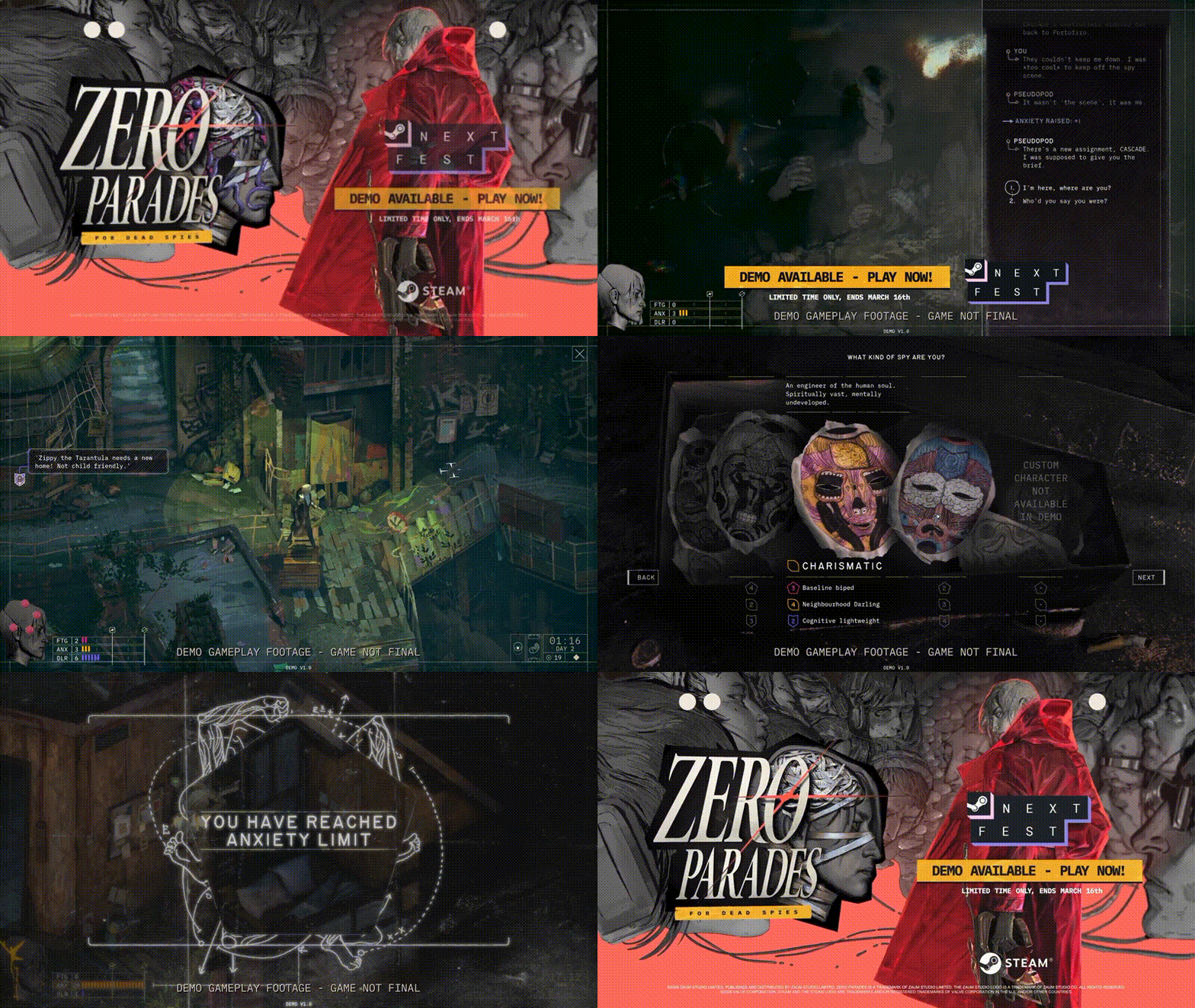
Zero Parades: For Dead Spies follows Hershel Wilk, also known as Cascade, an intelligence operative attempting to recover from a disastrous earlier mission while becoming involved in a new political and espionage crisis. Its setting, Portofiro, is shaped by political tensions, competing interests, and a stylized interpretation of Cold War espionage. Rather than relying on conventional combat, the game emphasizes investigation, extensive dialogue, skill checks, psychological characterization, failure, and decisions that influence how Cascade understands and responds to the people surrounding her.
These systems invited immediate comparisons with Disco Elysium. Both games rely heavily on internal skill conversations, dialogue-driven role-playing, political themes, and dramatic situations that allow failure to produce further narrative possibilities. Supportive critics viewed that continuity as evidence that ZA/UM remained committed to unusual role-playing design. They praised Zero Parades for its political intrigue, character writing, setting, atmosphere, visual presentation, and willingness to build an espionage story around uncertainty rather than straightforward power progression.
Other reviewers believed that the familiar structure transferred less naturally to a spy narrative than it had to Disco Elysium’s detective story. Some found the protagonist and broader plot less cohesive, while others believed the inherited systems highlighted the absence of the emotional chemistry, discovery, and thematic unity associated with ZA/UM’s earlier game. PC Gamer awarded Zero Parades a score of 66 percent and criticized the way the older structure had been adapted to a different narrative context. More favorable assessments still described it as an ambitious and compelling espionage RPG, producing a critical response that was respectable but considerably less consistent than the reception given to Disco Elysium.
The commercial result was more decisive than the critical disagreement. Whatever its positive reviews or artistic strengths, Zero Parades did not produce enough income for ZA/UM to preserve its existing staffing level. This could mean that favorable coverage did not convert into sufficient purchases, that the studio’s costs were too high for the audience it reached, or that both factors contributed. Without internal financial information, no single explanation can be proven more precisely.
The phrase “sold below expectations” must also be interpreted carefully. ZA/UM did not say that nobody bought the game or that it produced no meaningful revenue. A release may earn millions and still fail to meet the costs of its development and the financial requirements of the studio responsible for it. For ZA/UM, the relevant question was not simply whether Zero Parades had customers. It was whether the game could support the current company while also providing the resources required for post-launch work and future development.
ZA/UM framed the reductions as a structural change rather than an abandonment of its creative purpose. The studio said its artistic standards and ambitions remained intact and thanked the affected employees for their contributions to both the game and the company. That reassurance establishes an intention to continue operating, but it does not remove the practical consequences of losing workers across writing, programming, art, production, quality assurance, marketing, and administration. A smaller team may retain the same goals while having less capacity to achieve them at the same scale or within the same schedule.
How the Disco Elysium Disputes Complicated Zero Parades’ Launch
Zero Parades did not enter the market as an ordinary new intellectual property from a stable and broadly trusted studio. It arrived after years of disputes concerning ZA/UM’s leadership, ownership, canceled projects, and the departure of several people closely associated with Disco Elysium. These issues remained active in public discussion and influenced how many players evaluated the studio’s new work before they had considered the game on its own terms.
Disco Elysium was released in 2019 and became one of the most acclaimed narrative role-playing games of its generation. It won major awards and established ZA/UM as a studio capable of combining political fiction, psychological characterization, literary writing, and unconventional role-playing mechanics. However, several important creative figures, including Robert Kurvitz, Aleksander Rostov, and Helen Hindpere, were no longer working at the studio by late 2021. Their departures became widely known in 2022 and led to conflicting allegations, denials, legal proceedings, and competing accounts of what had happened inside the company.
ZA/UM retained control of the Disco Elysium intellectual property, but its public reputation became separated from several creators whose work had established the value of that name. This meant later projects were judged not only according to their own quality but also through arguments about creative legitimacy, authorship, ownership, and the treatment of former employees. Several former ZA/UM developers subsequently established or joined other studios pursuing narrative games commonly described as spiritual successors to Disco Elysium, further complicating the company’s position.
That history affected consumer sentiment toward Zero Parades. Some players refused to support ZA/UM because of the previous departures and allegations, while others wanted to separate the efforts of the current development team from management and evaluate the game independently. Discussions about whether to purchase Zero Parades regularly became arguments about the studio itself. It is not possible to calculate how many sales were lost because of this distrust, but the reaction shows that reputational damage remained a potential commercial obstacle when the new game launched.
Fan responses to the layoffs reflected the same divide. Many players criticized ZA/UM’s leadership while emphasizing that employees losing their jobs should not be blamed for management decisions, ownership disputes, canceled projects, or the game’s sales. Some interpreted the restructuring as another consequence of the instability that had followed Disco Elysium. Others praised Zero Parades and worried that reducing the workforce would prevent it from receiving technical fixes, performance improvements, or future expansions.
The reaction was therefore not a celebration of the company’s difficulties. Even players who had called for boycotts or encouraged support for projects involving former ZA/UM developers frequently expressed solidarity with the workers affected by the restructuring. The employees facing redundancy had contributed to a game that some critics and players considered imaginative and worthwhile, regardless of the unresolved arguments surrounding the company that employed them.

What the Layoffs Mean for ZA/UM’s Next Game and Long-Term Future
Reducing the workforce by up to 32 employees is likely to influence the scale, schedule, and production strategy of ZA/UM’s next project. Because the notices affect every department, fewer internal resources will be available for simultaneous development, post-launch support, prototyping, and future planning. The studio may need to concentrate on one central project rather than maintain several efforts at once, particularly if its remaining revenue cannot support another period of aggressive expansion.
One possible response would be to develop a smaller and less expensive game. This could reduce financial exposure, but it could also create tension with the expectations attached to the ZA/UM name. Players familiar with Disco Elysium may expect dense writing, extensive choices, intricate systems, and a substantial campaign, all of which require time and specialist labor. Reducing scope can protect a studio financially, but it may also make the finished release appear less ambitious than the work that built its reputation.
ZA/UM could instead extend its next development schedule, increase its reliance on contractors, seek a publishing partner, or attract new investment. A longer production period may improve quality but also delays the arrival of new revenue. Outsourcing can restore missing capacity, although contractors may lack the same long-term knowledge of the studio’s systems and creative direction. External funding could provide stability, but it might require ZA/UM to surrender part of its ownership, control, or future earnings.
Before Zero Parades launched, ZA/UM was also associated with a mobile adaptation of Disco Elysium. The supplied article does not establish whether that project will continue, be reduced, or receive greater priority after the restructuring. Its status illustrates the wider uncertainty surrounding the company’s plans. ZA/UM has stated that its creative purpose remains unchanged, but it has not published a complete post-layoff roadmap identifying which projects remain active or how resources will be distributed.
The present restructuring follows an extended period of internal disruption. Disco Elysium arrived in 2019, major creative departures occurred by late 2021, and those departures became public in 2022. In February 2024, ZA/UM laid off approximately 24 employees after canceling X7, a project described as a Disco Elysium expansion or related game. In 2025, UK-based employees formed the ZA/UM Workers’ Alliance under the Independent Workers Union of Great Britain, and management voluntarily recognized the organization. Zero Parades then launched on May 21, 2026, before the new redundancy and at-risk notices were announced on July 17.
This timeline demonstrates that the latest layoffs are not an isolated adjustment after one disappointing release. They are part of several years marked by leadership disputes, legal conflicts, abandoned projects, workforce reductions, and uncertainty about the company’s creative direction. ZA/UM must now restore financial stability while retaining enough experienced staff to complete another game. It must also persuade players that its next project deserves attention on its own merits rather than being judged only through the legacy and controversies of Disco Elysium.
Staff retention may become as important as the announced redundancies. Employees who remain after a large restructuring can begin looking for more stable opportunities, particularly when they expect heavier workloads or further cuts. If senior writers, artists, engineers, or producers leave voluntarily, the studio’s practical loss of knowledge could become greater than the official number of positions removed. ZA/UM’s future will therefore depend not only on reducing costs but on maintaining a team capable of producing the kind of distinctive work still associated with its name.
Whether Zero Parades is Still Worth Playing and What the Layoffs Say About the Industry
The commercial underperformance of Zero Parades does not automatically mean the game lacks artistic value. Players who enjoy dialogue-heavy role-playing games, political fiction, psychological characterization, and unconventional espionage stories may still find a compelling experience. Positive reviews highlighted its setting, writing, visual identity, character-building systems, and commitment to allowing choices and failure to shape the narrative. Players attracted to the internal debates and skill interactions of Disco Elysium may recognize related ideas presented through a different protagonist and genre.
Potential buyers should also consider the criticisms contained in the supplied article. Reviews identified uneven pacing, technical issues, and mechanics that sometimes seemed too closely inherited from Disco Elysium. Testing focused on Steam Deck performance described the game as captivating but affected by bugs and technical concerns. Players who prioritize a highly polished experience may therefore want to consider the game’s current condition before purchasing, particularly because ZA/UM has not explained how the restructuring will affect its patch schedule.
The studio has not announced that support for Zero Parades is ending. A smaller development team may continue correcting serious bugs and maintaining the released versions, but no detailed roadmap explains whether the game will receive major updates, performance work, new features, or an expansion. The layoffs do not prove that every post-launch plan has been canceled, but they create reasonable uncertainty about how much work the reduced studio can support while also preparing its next project.
The decision to purchase the game may also depend on how an individual separates the work of developers from the actions of company leadership. Some players believe the current team’s creative work should be judged independently and that refusing to buy the game primarily harms employees who made it. Others do not want to provide financial support to ZA/UM because of its history. The supplied article does not attempt to settle that disagreement, and review scores cannot determine the personal or ethical conclusion each buyer reaches.
ZA/UM’s restructuring also belongs to a much larger employment crisis affecting game development. The supplied article states that the 2026 State of the Game Industry report found that 28 percent of surveyed professionals had experienced layoffs during the previous two years. The figure rose to 33 percent among respondents in the United States. Half said their current or most recent employer had conducted layoffs within the previous 12 months, while two-thirds of AAA developers reported reductions at their companies.
Layoffs create consequences extending far beyond the people who immediately lose their positions. Projects may be delayed or canceled, remaining employees inherit greater workloads, and experienced developers can leave the industry entirely. Competition for available jobs increases, making recovery difficult for displaced workers and for new graduates attempting to begin their careers. Smaller studios face a particularly severe balance because they lack the financial reserves of the largest publishers while still needing multidisciplinary teams capable of building complicated games.
The central lesson from the ZA/UM announcement is that critical recognition does not guarantee commercial sustainability or employment security. Developers can create ambitious work that earns praise and still lose their jobs when revenue does not meet the requirements of a studio or its owners. Zero Parades may continue to find an audience through later sales, discounts, and updates, but its initial performance has already produced a major structural consequence for the people who created it.

Frequently Asked Questions (FAQs)
- How many ZA/UM employees were affected by the layoffs?
ZA/UM said that up to 32 employees received redundancy or at-risk notices. The wording does not confirm that all 32 positions will result in completed job losses, since the final total may depend on consultation, possible redeployment, and individual employment decisions. - When did ZA/UM announce the proposed layoffs?
The studio announced the restructuring on July 17, 2026. This was less than two months after Zero Parades: For Dead Spies launched for PC and PlayStation 5 on May 21, 2026. - Why is ZA/UM reducing its workforce?
ZA/UM said Zero Parades did not generate enough business to support a studio of its existing size. Although the company described the game as critically acclaimed, its commercial results were insufficient to maintain the previous workforce and production structure. - Did Zero Parades: For Dead Spies receive bad reviews?
Its reception was mixed to positive rather than universally negative. Some critics praised the writing, political intrigue, visual presentation, atmosphere, and ambitious dialogue-driven design. Others criticized the pacing, technical condition, protagonist, and the way systems associated with Disco Elysium were transferred into an espionage story. - How many copies did Zero Parades sell?
ZA/UM has not disclosed an official unit-sales figure. It has also not released the game’s total revenue, production budget, break-even point, or internal sales forecast, so any precise unit estimate would be unsupported by the supplied article. - Which ZA/UM departments were affected?
The proposed reductions affect employees across all departments. ZA/UM did not publish a detailed breakdown showing how many writers, programmers, artists, producers, quality assurance workers, marketers, or administrative employees received notices. - Will Zero Parades continue receiving updates?
ZA/UM has not announced that support is ending. However, the company has not provided a detailed roadmap or explained how the smaller workforce will affect bug fixes, performance improvements, new features, or possible expansions. - Is ZA/UM shutting down?
No shutdown has been announced. ZA/UM described the layoffs as a structural change and stated that its creative purpose and artistic standards remain unchanged, indicating that the company intends to continue operating and developing games. - Has ZA/UM conducted layoffs before?
Yes. In February 2024, approximately 24 employees were laid off after the cancellation of a project known as X7. The latest restructuring follows earlier creative departures, canceled projects, ownership disputes, and uncertainty surrounding the studio’s future. - Is Zero Parades directly connected to Disco Elysium?
Zero Parades: For Dead Spies is not a direct sequel to Disco Elysium. It is a separate espionage role-playing game with a different protagonist and setting, although it uses related ideas involving internal skill dialogue, political themes, investigation, failure, and choice-driven storytelling.

Conclusion
ZA/UM’s decision to issue redundancy or at-risk notices to up to 32 employees demonstrates the gap that can exist between creative achievement and commercial sustainability. Zero Parades: For Dead Spies earned praise from some critics and players, but its launch did not produce enough business to support the studio’s workforce.
The layoffs are more consequential because they follow years of disputes, departures, canceled projects and earlier job losses. ZA/UM must now operate with fewer employees while trying to preserve the artistic identity that made its name valuable.
The future of the studio is not yet settled. ZA/UM still owns a recognized brand, an acclaimed back catalog and a distinctive approach to role-playing games. However, it must rebuild trust, maintain its remaining talent and develop projects that can succeed both critically and commercially.
For the affected employees, the announcement is another example of the instability facing game workers in 2026. Their contributions helped create Zero Parades: For Dead Spies, but the game’s financial performance was ultimately used to justify a major reduction across the company.
Sources and Citations
- PC Gamer – ZA/UM statement (July 17, 2026): “2 months after releasing Zero Parades, Studio ZA/UM is laying off employees”
- GamesRadar – Commercial performance of Zero Parades: For Dead Spies and proposed layoffs
- Game Developer – ZA/UM layoffs affecting up to 32 employees
- https://www.gamedeveloper.com/
- (Search for “ZA/UM layoffs July 2026”)
- GameDev.net – Company-wide restructuring and Workers’ Alliance consultation
- https://www.gamedev.net/
- (Search for “ZA/UM restructuring Workers’ Alliance July 2026”)
- Steam – Zero Parades: For Dead Spies (May 21, 2026 release)
- https://store.steampowered.com/app/
- (Search “Zero Parades: For Dead Spies”)
- Metacritic – Zero Parades: For Dead Spies
- PC Gamer – ZA/UM Workers’ Alliance recognition
- https://www.pcgamer.com/
- (Search “ZA/UM Workers’ Alliance PC Gamer”)
- Game Developer – ZA/UM’s 2024 layoffs and cancellation of Project X7
- https://www.gamedeveloper.com/
- (Search “ZA/UM 2024 layoffs Project X7”)
- GDC – 2026 State of the Game Industry Report
- Game Developer – Coverage of the 2026 industry survey (28% experienced layoffs within two years)
- https://www.gamedeveloper.com/
- Search “2026 State of the Game Industry 28 percent layoffs”)
Recommendations
- New Lanterns Trailer Has a Lot More Green and First Look at Nathan Fillion’s Guy Gardner Explained
- Call of Duty: Modern Warfare 4 Puts Players in Grunt Roles as Infinity Ward Returns to Boots-on-the-Ground Storytelling Inspired by Call of Duty 2
- Razer Updates Its QA Companion-AI and Other Developer Tools for GDC 2026: What’s New for Game Testing and Dev Pipelines
- Mario Tennis Fever review: Is it worth buying on Nintendo Switch 2?
- All Pokemon Pokopia Mosslax Flavors And Effects: Full Food List, Buffs, And Best Offerings
- The Last of Us Part 2’s Major Death Was “Controversial Internally Too,” Former Naughty Dog Dev Says
- Idris Elba Says He Was Never in the Race to Play James Bond
- Krafton Announces Its Lineup for Gamescom 2026: Games, Reveals, and Expectations
- Beast of Reincarnation Release Date Announced: Community Reaction & Everything We Know from Sony’s State of Play
- Midgar Studio Closure: What Nacon’s Decision Means for Edge of Memories



































































































