







In This Article (8 sections)
MTG Secret Lair Chaos Vault Zeta Set Launch Disaster, Queue Problems, and Sellout Timeline
The launch of Secret Lair x MSCHF: The Zeta Set became one of the most troubled Magic: The Gathering Secret Lair sales in recent memory. Wizards of the Coast itself used unusually direct language after the September 2, 2026 sale, describing the experience as a “disaster” and apologising to customers while opening an investigation into what went wrong. The company said the root cause had not yet been established and specifically left open two possibilities: a failure within its own systems or some form of external tampering.
The situation was particularly damaging because The Zeta Set was designed as a scarce, experimental Chaos Vault product. Wizards announced that it would sell for $19.92 per Zeta Booster, a reference to the early Magic playtesting era, and that it would remain available only while supplies lasted. Each booster contained seven randomly selected cards drawn from a 121-card set, making the release substantially different from the fixed-card Secret Lair drops players were accustomed to buying.
Wizards scheduled The Zeta Set sale for September 2, 2026. Its official launch instructions stated that a pre-queue would open at 8 a.m. Pacific Time, one hour before the actual sale began at 9 a.m. Pacific Time. Customers who entered the pre-queue before the sale were not given positions according to arrival time. Instead, the people already waiting were randomly assigned places when the sale opened, while customers joining after 9 a.m. were placed behind them in the order they proceeded to checkout.
There was another important limitation: putting Zeta Boosters into a shopping cart did not reserve them. Wizards explicitly warned customers that inventory was secured only when checkout was completed. This distinction became crucial once the queue malfunctioned because somebody could have Zeta products sitting in a cart, remain legitimately queued for a long period, and still lose access to the product if stock was exhausted before payment finished.
Technical problems appeared during the sale, and Secret Lair announced that the Chaos Vault queue had been temporarily paused. Customers already waiting were told that their queue positions would remain the same and that they should stay in line. Contemporary reporting describes buyers facing frozen or extremely long estimated wait times, error messages, and prolonged uncertainty over whether the sale was actually progressing.
There is some disagreement among contemporary reports about exactly how quickly the first pause occurred. TheGamer reported that the launch encountered a major technical hitch within roughly eight minutes, while other accounts describe the broader sale being paused later in the launch window. Because Wizards’ subsequent apology did not publish a minute-by-minute technical timeline, the safest conclusion is that serious problems developed early and persisted long enough to disrupt normal ordering rather than assigning an unsupported single timestamp to every region and customer.
Once ordering resumed, whatever inventory remained disappeared extremely quickly. The safest description is that The Zeta Set sold out within minutes of the disrupted queue resuming, rather than claiming a single universally documented sellout time. ICv2 reported that after the sale resumed, customers were informed only minutes later that Zeta packs had sold out. Other contemporary coverage likewise described the remaining stock disappearing extremely rapidly.
Some reporting put the post-resumption window at around eight to ten minutes. MTG Rocks reported that supply lasted only around another ten minutes after the sale returned, while Kotaku’s coverage similarly described the remaining stock disappearing within minutes. Because Wizards has not publicly released a transaction-by-transaction inventory timeline, these figures should be understood as contemporary reporting rather than an official audited sellout duration.
The important point is that the effective buying window after the queue recovered was exceptionally short compared with the amount of time many players had already spent waiting. Some customers reported joining before the sale began, remaining through the queue pause, and eventually discovering that the product was unavailable by the time they were permitted to proceed.
The result was not merely a normal limited-edition sellout. Players had entered a system that Wizards had specifically told them would preserve their queue positions during the disruption, only to discover that stock could still disappear before they reached checkout. That combination of scarcity, uncertainty, and technical failure is why the MTG Secret Lair Chaos Vault Zeta Set launch disaster attracted significantly more criticism than a product simply selling out because of high demand.

Wizards’ Apology, Investigation, Possible Tampering, and Order Confirmation Issues
Wizards did not characterise the launch as a minor inconvenience. In its official statement, the Secret Lair team acknowledged that the experience had fundamentally failed customers and apologised to everyone who participated. It announced an investigation intended to determine what had caused the problems and said it would provide additional information once it understood the root cause.
The apology was necessary because several different problems occurred simultaneously. Wizards acknowledged successful orders, customers who believed they had purchased but were uncertain about their order status, duplicate confirmation emails, and people who believed payment had completed but received no confirmation. This meant the company had to determine not simply why a queue had stalled, but which orders actually existed and which transactions had failed somewhere in the process.
That ambiguity matters in a limited-stock sale. In an ordinary online transaction, a temporary payment or email problem may be annoying but recoverable because the customer can try again. With The Zeta Set, a failed attempt could mean losing the opportunity completely because inventory was disappearing while customers were attempting to establish whether their original purchase had worked.
Wizards consequently said it intended to review successful orders, failed orders it could track, and cases that fell between those categories before deciding how to make things right. As of September 15, 2026, the company’s public product-status information lists The Zeta Set’s September 2 sale as a while-supplies-last release and shows the product proceeding through fulfilment preparation; the initial apology remains the key public explanation of the sales failure.
The queue was paused because Secret Lair said it needed to manage technical issues affecting the Chaos Vault sale. Its public message specifically instructed customers already in line to remain there because their positions would be maintained while the problem was addressed. What Wizards did not immediately provide was a final technical diagnosis. Its formal statement said the company was still attempting to identify the root cause and was considering both an internal systems problem and potential external tampering. Therefore, claims that the pause was definitively caused by bots, a cyberattack, payment processing, scalpers, or a specific queue software defect go beyond what Wizards publicly established in the immediate aftermath.
Pausing the queue was logically intended to prevent a malfunctioning checkout process from continuing to produce additional failures. The problem for buyers was that the pause did not transform products in their shopping carts into reserved inventory. Wizards had already stated before launch that a customer’s products were secured only after checkout was completed. That gap between queue position and inventory reservation is central to understanding the controversy. Preserving a customer’s place in line protected their relative position in the queue, but it did not necessarily guarantee that enough Zeta Boosters would remain once that person reached checkout.
Wizards’ investigation is one of the most important parts of the story because the company did not immediately blame a particular technical vendor or external actor. Instead, its official statement described the unresolved possibilities broadly: an internal systems issue or external tampering. That wording means the company was examining whether something within the Secret Lair infrastructure failed unexpectedly while also determining whether outside activity contributed to abnormal behaviour. It does not mean that Wizards confirmed an attack took place.
Wizards mentioned external tampering as a possibility, not a conclusion. That distinction is essential. Its statement said investigators were working to establish the root cause, whether that turned out to be an internal systems problem or external tampering. No evidence was presented in that announcement identifying an attacker, automated purchasing operation, or other malicious party as responsible.
Consequently, allegations that bots or hackers definitively caused the Zeta Set launch disaster should not be presented as established fact. High-demand online collectibles frequently generate suspicions about automated purchasing, but Wizards’ September 3 statement remained explicitly investigative rather than accusatory. The responsible interpretation is therefore that external interference was one hypothesis Wizards was investigating. Until Wizards provides a completed technical assessment, the precise cause remains unresolved in its public account.
The investigation also had to reconcile the ordering data. Wizards said it needed a clearer understanding of orders that successfully went through, failed transactions it could identify, and ambiguous cases before it could fully explain what happened or determine a remedy. This is particularly relevant to complaints about inventory. Without a complete order ledger, outsiders cannot reliably determine how many packs were successfully sold before the pause, during various stages of the disruption, or immediately after service resumed.
Duplicate confirmation emails were another symptom of the unusual ordering problems. Wizards specifically told customers who received duplicate confirmations not to be alarmed. A duplicate email did not automatically mean a customer had accidentally purchased multiple additional orders, nor did Wizards say that duplicates represented extra inventory. The company’s guidance was intentionally reassuring because it was still reconciling transaction and confirmation records. Customers should therefore rely on their actual Secret Lair order information, payment records, and subsequent communication from Wizards rather than assuming that every duplicated message represents a separate completed purchase.
Wizards also provided a specific procedure for buyers who believed they had purchased The Zeta Set but did not receive a confirmation email. The company asked customers to allow 24 hours for confirmation to arrive. If no email appeared after that period and the customer still believed the purchase had completed, Wizards instructed them to contact Customer Support.
The company also warned that its support team was receiving a large number of contacts because of the sale. Customers dealing with uncertain orders should preserve transaction evidence such as payment notifications and their Secret Lair account information so that the relevant order can be identified. The official support route is more reliable than attempting to infer order status from queue behaviour or duplicated emails, because Wizards acknowledged that confirmation messaging itself was affected by the incident.

MSCHF Collaboration, Zeta Booster Contents, Scarcity, Demand, and Player Backlash
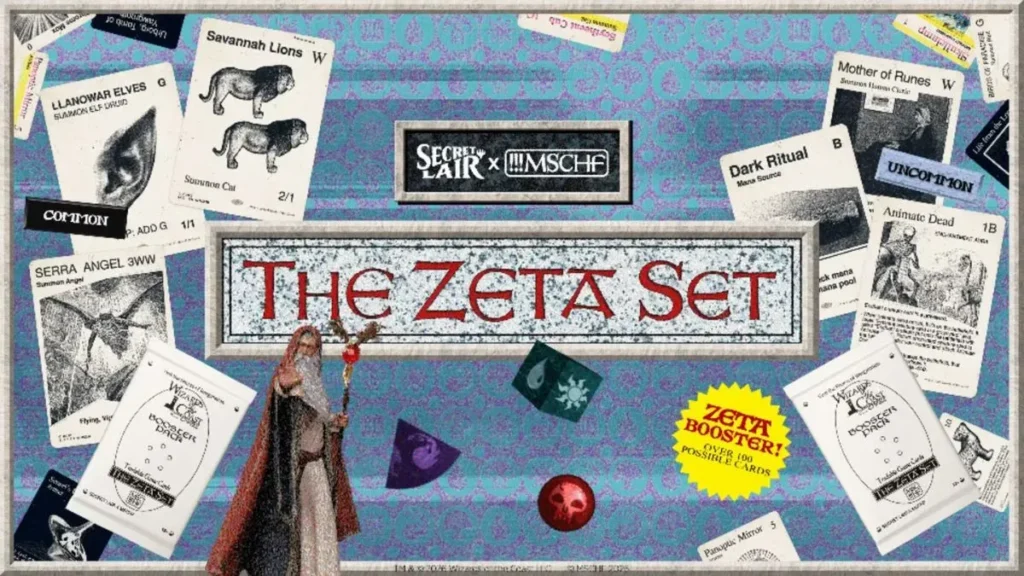
The Zeta Set was produced through a collaboration between Secret Lair and MSCHF, the Brooklyn-based multidisciplinary art collective known for projects designed around cultural experimentation and appropriation. Wizards described MSCHF’s approach as using existing cultural objects, images, and businesses as creative material.
For The Zeta Set, that approach was applied directly to the earliest visual history of Magic. The cards were inspired by prototype Magic playtest cards created before the commercial game took its familiar form. Those prototypes were inexpensive, functional test pieces assembled using photocopies, text, and appropriated imagery rather than polished fantasy card illustrations.
The finished Secret Lair release contained 121 different cards, ranging from early Magic classics to modern Commander staples. Most used black-and-white photocopy styling. Wizards said approximately 10% of cards would use a negative photocopy treatment, while approximately 5% would receive a jittery CMYK-inspired colour-banding treatment.
Every Zeta Booster contained seven cards:
- Three commons from a pool of 52
- Two uncommons from a pool of 39
- One wildcard with rarity determined by stated probabilities
- One rare or mythic from a pool of 20 rares and ten mythics
The release also unexpectedly affected competitive Magic. Twelve cards appeared at common rarity for the first time. Wizards and the Pauper Format Panel eventually decided those printings would become legal in tabletop Pauper beginning September 7, 2026, while warning that their impact would be monitored for potential future bans.
The Zeta Set combined several characteristics capable of generating intense demand. It was a limited Chaos Vault release, used a previously unusual random-booster format for Secret Lair, contained 121 possible Magic cards, and was created with MSCHF using an aesthetic modelled on Magic’s earliest photocopied playtest cards. Each pack cost only $19.92, and purchases were made directly through the Secret Lair storefront rather than through a normal widely distributed booster product.
That structure created an unusually strong collector incentive. A single pack did not contain the entire set; it contained seven random cards, including three commons, two uncommons, one wildcard, and one rare-or-mythic slot. The cards could also appear in standard photocopy styling, the rarer negative treatment, or the rarer still colour-banding treatment. Collectors seeking particular cards or treatments therefore had reasons to purchase multiple packs. High demand does not explain the technical failure, but it helps explain why whatever stock remained after the disruption could disappear almost immediately once transactions resumed.
Much of the anger came from the perception that players had done exactly what the system asked of them and still had no meaningful opportunity to buy the product. Wizards encouraged customers to enter a pre-queue, told people already waiting that their places would remain intact during the technical pause, and asked them to stay on the page. Some customers subsequently waited through the interruption only to discover that The Zeta Set had sold out before they could complete checkout.
Scarcity amplified that frustration. The product was advertised as available only while supplies lasted, meaning there was no guarantee that a customer who missed the original sale could simply buy the same product later from Wizards. Players were also dealing with uncertainty rather than a clean rejection. A conventional sold-out message immediately tells a customer what happened. The Zeta incident produced failed transactions, duplicate confirmations, missing confirmations, and lengthy queue delays before some users ultimately learned there was no stock left. Wizards’ own apology acknowledges those different failure states.
That is why describing the backlash solely as anger that a popular collectible “sold out” misses the core issue. The controversy concerned the fairness and reliability of the purchasing process, not merely scarcity.

Secret Lair Queue Changes, Possible Restock, and What the Zeta Set Disaster Means for Future Drops
Wizards certainly could modify the Secret Lair purchasing system, but there is an important distinction between what is technically possible and what the company has actually announced. The Zeta launch already used a specific queue model: a pre-queue opened one hour before release, customers already present at launch were randomly assigned positions, later arrivals joined sequentially, and cart contents were not reserved until checkout.
Possible future changes could theoretically involve inventory reservation once a shopper reaches a defined stage, stronger bot mitigation, clearer real-time inventory information, revised purchase limits, or different handling of queues during outages. Those are reasonable design possibilities, not confirmed Wizards plans. The launch gives Wizards an obvious reason to review the current architecture. Its own statement promised an investigation and said the company would attempt to make things right once it understood the order data and root cause. For future buyers, however, any claim that Wizards has already replaced the system should be based on a subsequent official announcement rather than assumptions arising from the Zeta controversy.
As of September 15, 2026, Wizards has not publicly announced a general second Zeta Set sale in the official materials reviewed for this article. The official Secret Lair production-status page lists Chaos Vault: Secret Lair x MSCHF: The Zeta Set with a September 2, 2026 sale window described as “while supplies last.” It currently lists the US and EU/UK versions as preparing for fulfilment rather than advertising another sales window.
That does not make a restock physically impossible. Wizards could choose to create additional inventory or establish some form of remedy for affected customers. Its apology specifically said the company wanted to make the situation right after determining which orders succeeded and failed. However, that statement did not promise a reprint or public restock. Therefore, the accurate answer is that no Zeta Set restock should be treated as confirmed until Wizards announces one.
The broader importance of the Zeta launch is that it tested several systems simultaneously: limited inventory, a randomised Secret Lair booster product, pre-queue randomisation, and extremely high collector demand. Those systems depend heavily on customer confidence. A buyer needs to trust that a queue accurately controls access, that an attempted checkout produces an unambiguous result, and that stock is allocated according to the rules announced before the sale. The Zeta incident undermined each of those expectations for at least some participants, which explains Wizards’ unusually direct apology.
It may also influence how Wizards evaluates experimental Chaos Vault products. The Zeta Set demonstrated that an unconventional Secret Lair concept can generate enormous interest: stock still disappeared rapidly despite the malfunction. At the same time, strong demand makes infrastructure failures more costly because thousands of highly motivated customers are competing for finite inventory.
The most important unresolved question is therefore not whether Zeta was popular. It clearly attracted enough demand to exhaust the available product. The real question is whether Wizards’ investigation results in changes capable of making future high-demand Secret Lair drops predictable and trustworthy.
Frequently Asked Questions (FAQs)
- What happened to the MTG Secret Lair Zeta Set launch?
The September 2, 2026 sale for the MTG Secret Lair x MSCHF: The Zeta Set ran into serious technical and queue-related problems. Wizards temporarily paused the Chaos Vault queue while trying to address the issue, and many customers reported long waits, frozen or unclear queue times, checkout uncertainty, missing confirmations, or duplicate emails. After the sale resumed, the remaining inventory sold out very quickly, leaving many people who had waited in line unable to buy the product. Wizards later apologised, described the launch experience as a disaster, and said it was investigating what caused the failure. - When did the Zeta Set go on sale?
The Zeta Set officially went on sale on September 2, 2026, at 9 a.m. Pacific Time. A pre-queue opened one hour earlier, at 8 a.m. Pacific Time. Customers who entered the pre-queue before the sale began were not simply served in the exact order they arrived; they were randomly assigned queue positions when the sale opened. Anyone joining after 9 a.m. was placed behind the pre-queue group as the sale moved toward checkout. - How much did a Zeta Booster cost?
Each Zeta Booster cost $19.92. That price was intentional, as it referenced the early 1992 era connected to Magic: The Gathering’s original prototype-card history. The product’s visual identity also leaned into that idea, using a rough early-playtest style rather than the polished fantasy art usually associated with modern Magic cards. - How many cards were in each Zeta Booster?
Each Zeta Booster contained seven cards. The pack structure was three commons, two uncommons, one wildcard, and one rare-or-mythic card. This made The Zeta Set different from many Secret Lair releases because buyers were not purchasing a fixed list of cards. Instead, each booster contained a random selection from the 121-card set, which increased the collector appeal but also meant players could not guarantee they would receive a specific card from a single pack. - Did Wizards confirm that bots or hackers caused the problems?
No. Wizards did not confirm that bots, hackers, or any specific outside actor caused the Zeta Set launch problems. The company said it was investigating whether the root cause was an internal systems issue or external tampering. That means outside interference was one possibility Wizards was considering, but it was not presented as a confirmed explanation. Until Wizards publishes a final technical finding, the cause should be described as unresolved. - Why did customers lose out even though they were already in the queue?
Customers lost out because being in the queue did not reserve inventory. Wizards had warned before launch that putting Zeta Boosters into a cart did not secure them; the product was only secured once checkout was completed. That became a major issue when the queue malfunctioned. Even customers who entered early, waited through the pause, and kept their place in line could still miss out if the remaining stock sold out before they reached and completed checkout. - What should buyers do if they never received an order confirmation?
Wizards told buyers who believed they had completed a purchase to wait up to 24 hours for a confirmation email. If no confirmation arrived after that period, they were instructed to contact Customer Support. Because the launch involved failed orders, uncertain transactions, and confirmation-email problems, customers should rely on official order records, payment information, and Wizards support rather than assuming their purchase succeeded or failed based only on the queue page. - Should customers worry about receiving two confirmation emails?
Wizards explicitly told customers not to panic if they received duplicate confirmation emails. The duplicate messages were part of the broader order-confirmation problems that followed the troubled launch. A second email did not automatically mean the customer had placed an unintended extra order or that something had gone wrong with their purchase. The safer approach was to wait for Wizards to reconcile affected orders and check official account or payment records if there was still uncertainty. - Is The Zeta Set being restocked?
No public restock has been confirmed as of September 15, 2026. Wizards’ production-status information lists the original September 2 sale as a while-supplies-last release and shows the product moving through fulfilment preparation rather than advertising a second sale. Wizards has said it wants to understand what happened and make things right, but that statement should not be treated as a confirmed reprint or general restock unless the company announces one directly. - Why was The Zeta Set so desirable?
The Zeta Set was desirable because it combined several collector-friendly elements at once. It was a limited Chaos Vault release, it featured an unusual MSCHF-designed aesthetic inspired by early Magic prototype cards, and it contained 121 possible cards in random seven-card boosters. The set also included multiple visual treatments, including rarer negative photocopy and colour-banding styles. At $19.92 per pack, it was relatively inexpensive for a highly limited Secret Lair product, which made demand even stronger once the sale opened.

Conclusion
The MTG Secret Lair Chaos Vault Zeta Set launch disaster was not simply a story about an exclusive product selling out. The defining problem was that a high-demand limited release encountered technical failures at the exact moment customers depended on the queue and checkout infrastructure to distribute scarce inventory fairly.
Wizards acknowledged that the September 2, 2026 sale went badly, apologised, began investigating potential internal failures and possible external interference, and established support procedures for customers with uncertain orders or missing confirmations.
At the same time, the underlying product was extraordinarily well positioned to attract collector demand. MSCHF’s homage to Magic’s prototype era, the random seven-card format, rare visual treatments and $19.92 price made The Zeta Set unlike a conventional Secret Lair. The limited while-supplies-last structure then turned technical instability into a much bigger consumer problem.
The definitive cause of the launch problems should not be guessed at until Wizards completes or expands upon its investigation. Likewise, a Zeta Set restock remains unconfirmed. What is established is that the sale exposed serious weaknesses in the purchasing experience for an intensely sought-after Secret Lair product, and Wizards itself acknowledged that the experience fell dramatically short of expectations.
Sources and Citations
- Wizards of the Coast, “Statement on Today’s The Zeta Set Sale”, September 3, 2026. Covers Wizards’ apology, investigation, possible internal issues or external tampering, duplicate confirmation emails and support guidance. (magic.wizards.com)
- Wizards of the Coast, “Chaos Vault: The Zeta Set Puts the Playtest in Your Hands”, September 1, 2026. Provides the product announcement, $19.92 price and MSCHF collaboration details. (magic.wizards.com)
- Secret Lair Support, “Secret Lair Production and Shipping Status”. The official page for production updates, release dates and fulfilment status. (secretlair-support.wizards.com)
- Wizards of the Coast and the Pauper Format Panel, “On The Zeta Set in Pauper”, September 4, 2026. Explains the twelve cards printed at common for the first time and the decisions concerning their Pauper legality. (magic.wizards.com)
- ICv2, “‘Magic: The Gathering’ ‘Zeta Set’ Sale Experiences Technical Difficulties”, September 2, 2026. Documents the queue disruption and rapid sellout after ordering resumed. (icv2.com)
- GosuGamers, “MTG players left frustrated after The Zeta Set sells out, Wizards calls launch ‘a disaster’”. Includes firsthand observations of the paused queue, lengthy waits and frustrated buyers. (GosuGamers)
- TheGamer, “Tech Hitch Pauses MTG Zeta Set Sales After Eight Minutes”, September 2, 2026. Reports how quickly technical problems interrupted the sale. (thegamer.com)
Recommended
- Monster Hunter Wilds DLC Overhaul and Permanent Price Cut Explained
- 007 First Light Becomes May’s Highest-Grossing Game in the US: Sales Success, Rankings, and Market Impact Explained
- Servant Of The Lake: Day 1 Complete Walkthrough Guide
- How to Add Colored Shadow Penumbra in Unreal Engine 5 (UE5 Guide)
- After Nine Years, The Live-Action Hitman TV Show Is Dead What Happened to the Hulu Series?
- Final Fantasy 7 Modder Brings OG Polygon Character Designs to Final Fantasy VII Rebirth: “Them Polygons Got That Aura”
- Blender Smooth Hair Curves Geometry Nodes Preset
- ONTOS Gameplay Reveals Frictional Games’ New Sci-Fi Horror
- Aerial Knight’s MrFreezy Turns Chopping Off Heads into a Brain-Teaser



































































































