


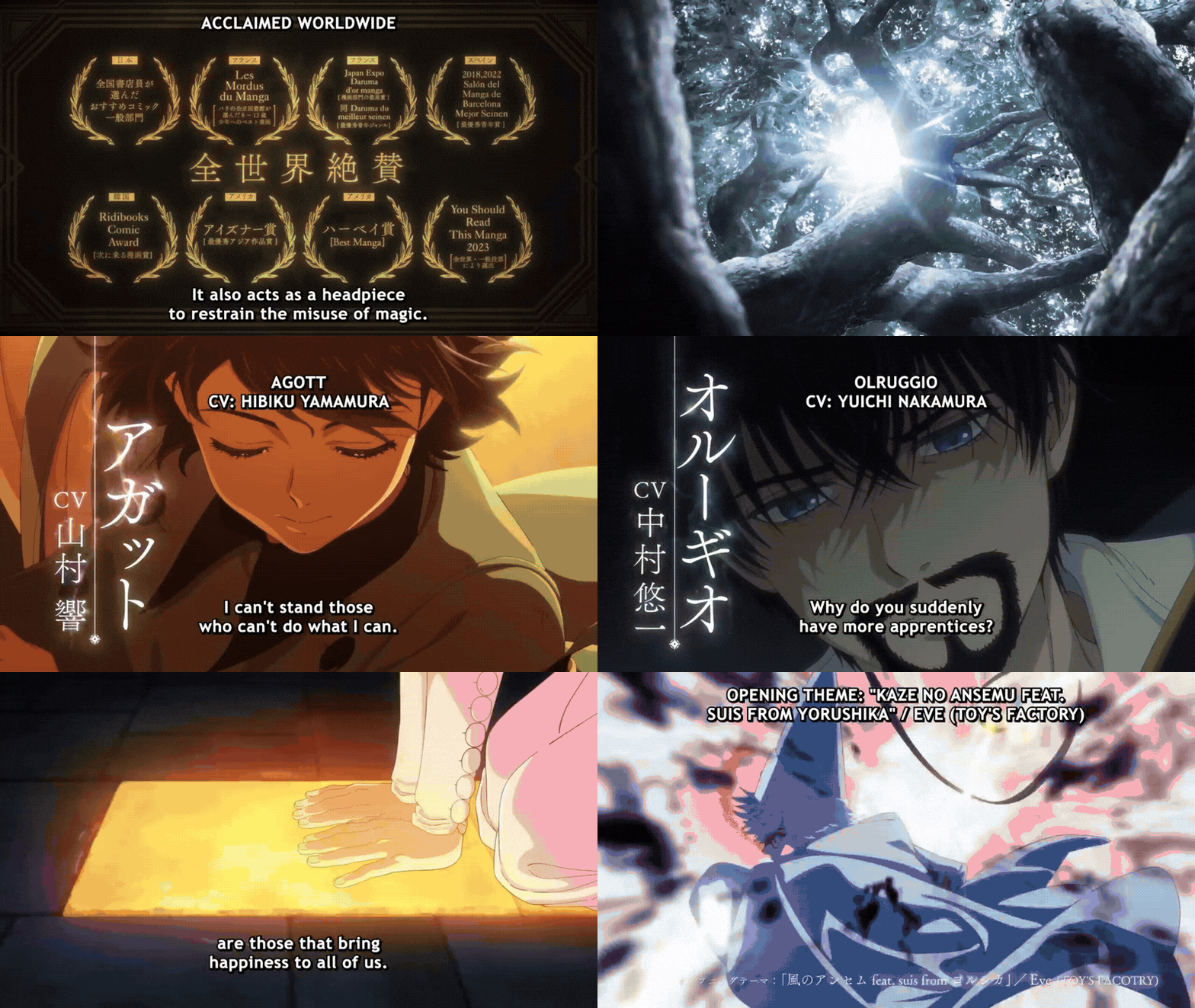
The TV anime adaptation of the award-winning manga by Kamome Shirahama arrives with a two-episode premiere that introduces its “drawn magic” conceit, delivers a sharp emotional turning point, and then pivots into apprentice life and rules-based worldbuilding.
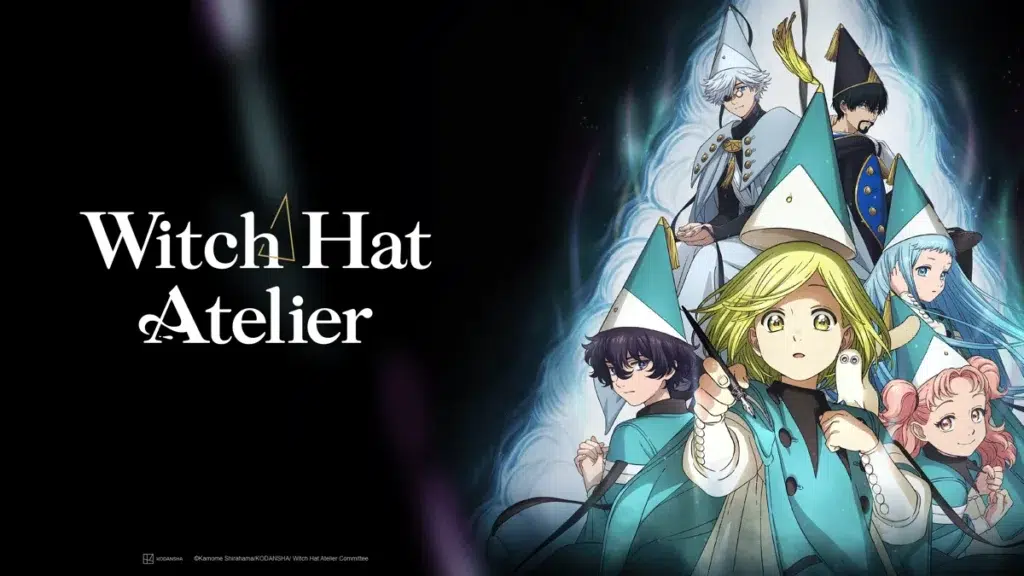
Witch Hat Atelier premiere review (Episode 1–2)
Across Episodes 1–2, the premiere’s standout achievement is how quickly it makes the world feel tactile and “lived-in,” while still preserving mystery around how magic is policed and why certain knowledge is forbidden. The first episode builds wonder through craft (sewing, tools, quiet labour), then weaponises that same “precision” as the engine of tragedy; the second episode widens the lens, introducing the atelier’s social dynamics and a structured learning path.
In critical reception immediately surrounding launch, reviewers repeatedly emphasised two points: (1) the adaptation is unusually confident in its art direction, and (2) the premiere is paced to get to the inciting disaster and its consequences without stalling in exposition.
Witch Hat Atelier Episode 1 review and recap
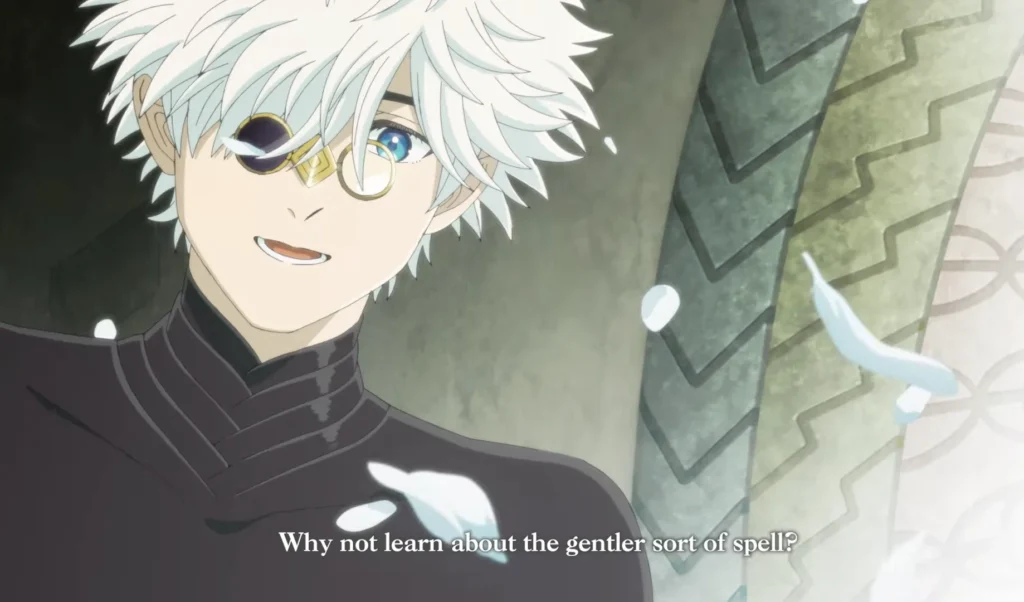
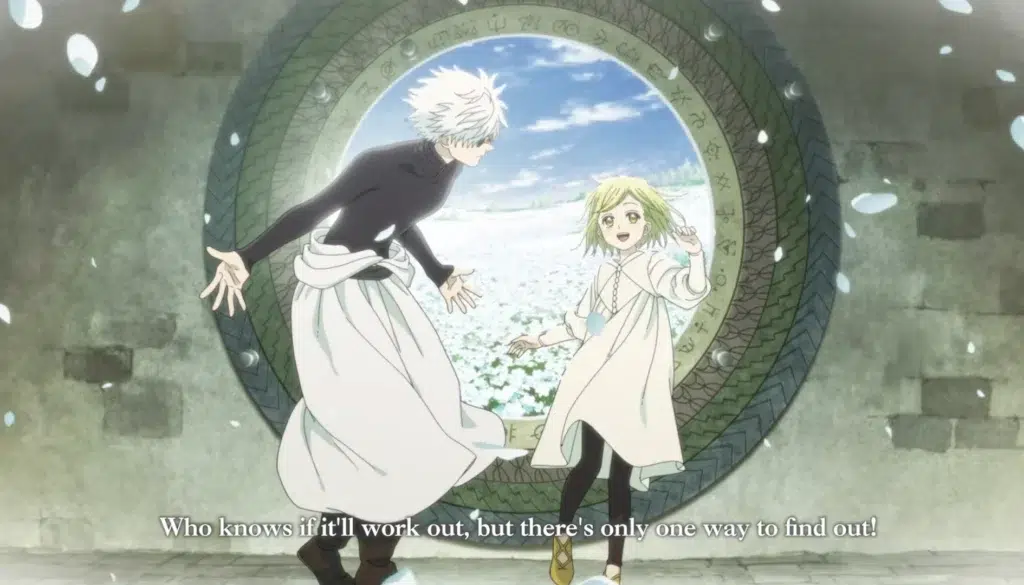
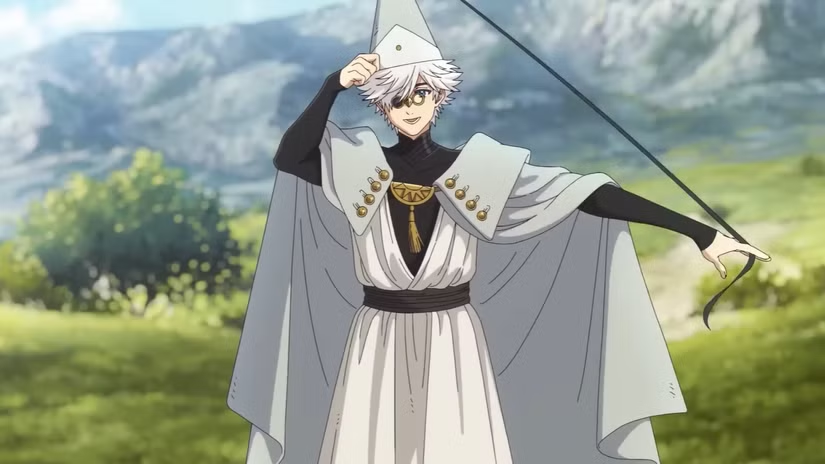
Episode 1 centres on Coco, a dressmaker’s daughter who adores magic but believes she can never become a witch. When the travelling witch Qifrey appears in her village, Coco witnesses something foundational: spells are drawn—not waved into existence with a wand—and the “wand” she owns is, in truth, a pen-like tool connected to ink and diagrams.
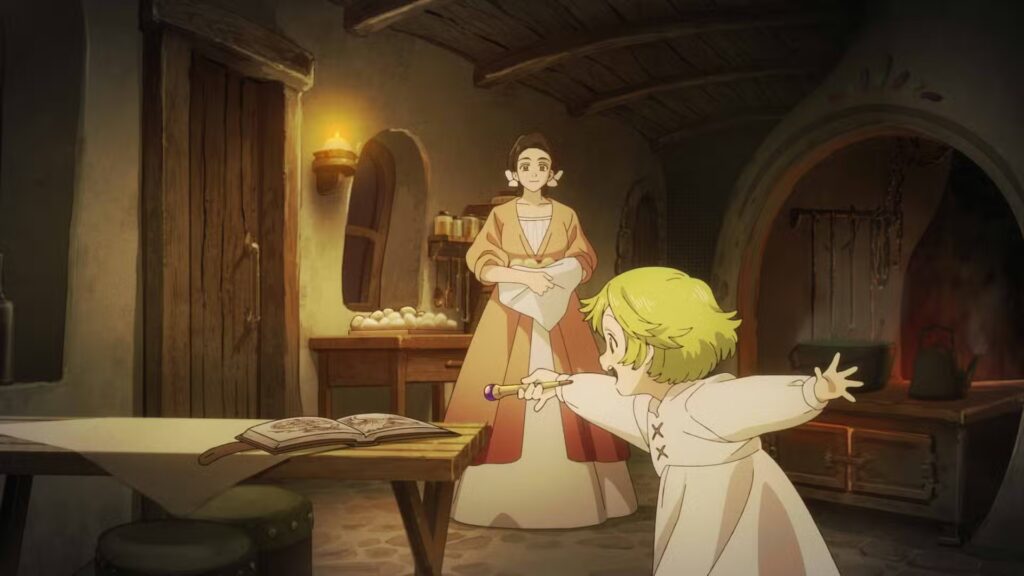
After Coco experiments by copying patterns from her book, the tone snaps from fairytale awe to immediate dread: a complex diagram triggers a dangerous, forbidden effect that spreads through her home and petrifies (or freezes solid) her mother. Qifrey moves to erase her memories—because the secret of how magic works cannot be exposed—yet chooses to keep Coco close as his apprentice, partly because she may be the only lead connected to whoever supplied the spellbook and tools.
From a craft perspective, Episode 1’s review coverage often points to how the anime uses “book” motifs and carefully animated everyday motion (cloth handling, running, paper and fabric movement) to foreshadow the series’ obsession with line, measurement, and consequence.
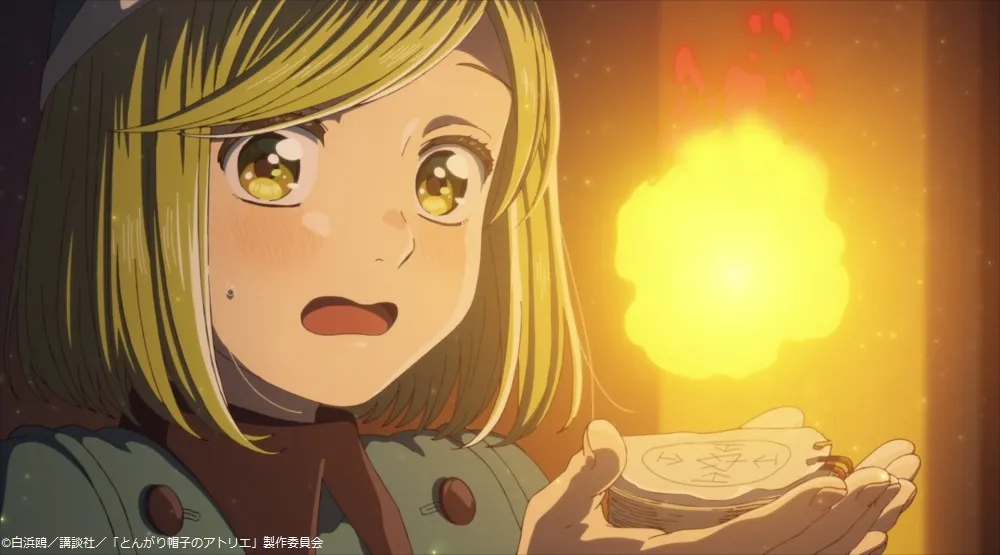
Witch Hat Atelier Episode 2 review and recap
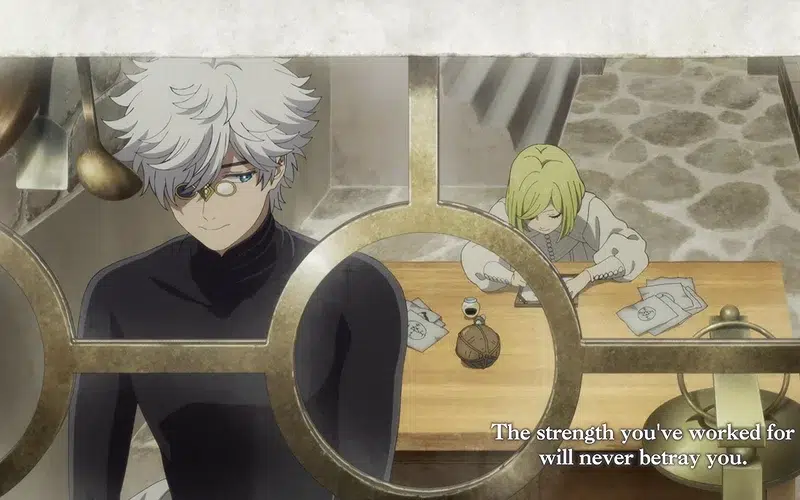
Episode 2 begins the “apprenticeship” arc in earnest: Coco arrives at Qifrey’s home/atelier and meets other students, including Tetia, Richeh, and Agott. The episode leans into social tension—Coco’s status as an “outsider” is controversial precisely because she performed a forbidden spell almost immediately, without formal training.
The episode also delivers the premiere’s clearest worldbuilding dump: Qifrey explains that magic once wasn’t secret, but misuse led to a system where witches erased others’ knowledge, restricted spells, and codified categories of “forbidden” magic. The rules arrive with hands-on demonstrations: Coco learns the basics of sigils and symbols, and the episode shows how even a slight imbalance in drawn components can alter a spell’s output and direction—turning a “safe” exercise into an accident that tests relationships within the atelier.
In evaluation, Episode 2 is frequently described as less “shock-driven” than Episode 1 but essential for establishing stakes beyond the initial tragedy—especially through the introduction of tests, institutions, and a longer-term objective tied to magical knowledge.
Witch Hat Atelier anime premiere story summary (Coco and Qifrey)
The premiere’s story premise, as outlined by the official anime site, is deceptively simple: in a world where witches alone can cast magic (and must not be seen doing so), Coco dreams of becoming a witch until she discovers the “absolute secret” that anyone can use magic if they draw a “Casting Seal” with special tools.
Episodes 1–2 then dramatise the cost of that revelation. Coco’s curiosity triggers disaster, and Qifrey becomes both mentor and gatekeeper—someone who can teach her while also representing the system that prevents knowledge from spreading freely.
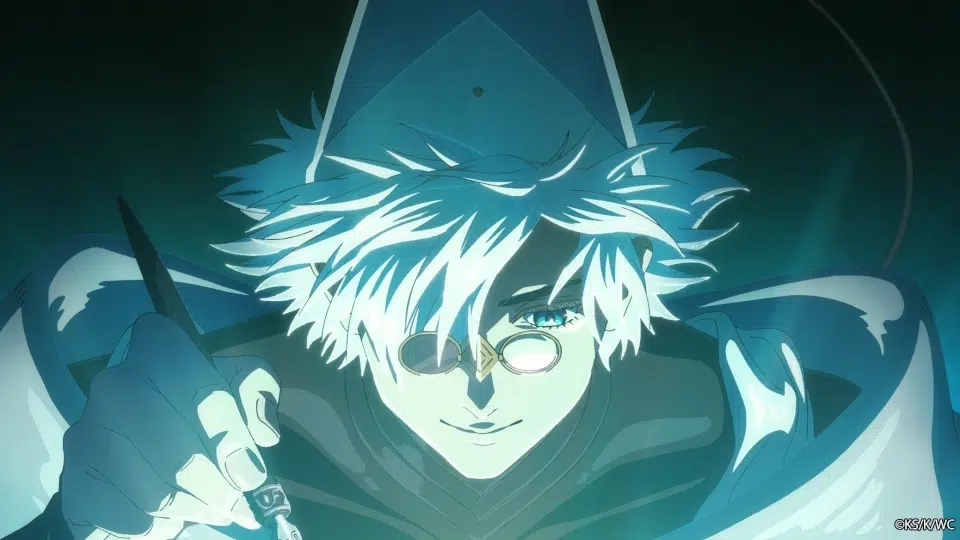
Witch Hat Atelier anime animation quality and art style review
Across both professional reviews and early fan discussion, the premiere’s animation and art direction are the dominant talking point. The adaptation leans into ink-and-book imagery (including sequences that explicitly frame the world as pages and illustrations) as a visual “translation” of the manga’s identity, not merely a garnish.
Review coverage also points to targeted areas of detail rather than an impossible attempt to replicate every line of the original manga: lighting/shadow on clothing, expressive eyes, and backgrounds filled with texture, plus movement that sells weight—paper billowing, fabric folding, and magic that feels like luminous matter rather than generic particle effects.
This emphasis on “handmade” texture aligns with statements from key staff about portraying magic as something close to daily life—fantastical, but grounded in believable routine and reality.
Witch Hat Atelier magic system explained (pens, ink, and spell circles)
The premiere establishes a hard-rule magic system built on drawing: spells are created by drafting a “Casting Seal” using specialised tools, rather than relying on innate “sparkle magic.” In Episode 1, Coco learns (by spying and then experimenting) that witches write or draw spellwork directly onto objects—revealing why secrecy matters if ordinary people could replicate the technique.
Episode 2 develops the “engineering” logic of the system. Qifrey’s instruction frames symbols and sigils as components whose proportions and balance affect output; the narrative then demonstrates that a minor difference in stroke length can change a spell’s force and direction, producing unintended consequences even in a controlled setting.
Just as important, the system is linked to law and ethics: the premiere introduces “forbidden” spells and the idea that magic applied to people (rather than tools) crosses a line—an early statement that this world treats magic as power with regulation, not pure wish fulfilment.
Witch Hat Atelier premiere best scenes and standout moments
Several sequences recur in early highlights because they encapsulate the series’ thesis that “beauty” and “danger” are inseparable when power depends on craft and knowledge.
One of the most frequently singled-out moments is the fabric-cutting sequence: it functions as characterisation (Coco’s skill), tone-setting (the series’ devotion to hands and tools), and foreshadowing (precision as destiny). Another standout is the revelation that the “wand” is a pen and that spellwork is reproducible—an elegant plot pivot that turns a childhood fantasy into a structural threat to the world’s order.
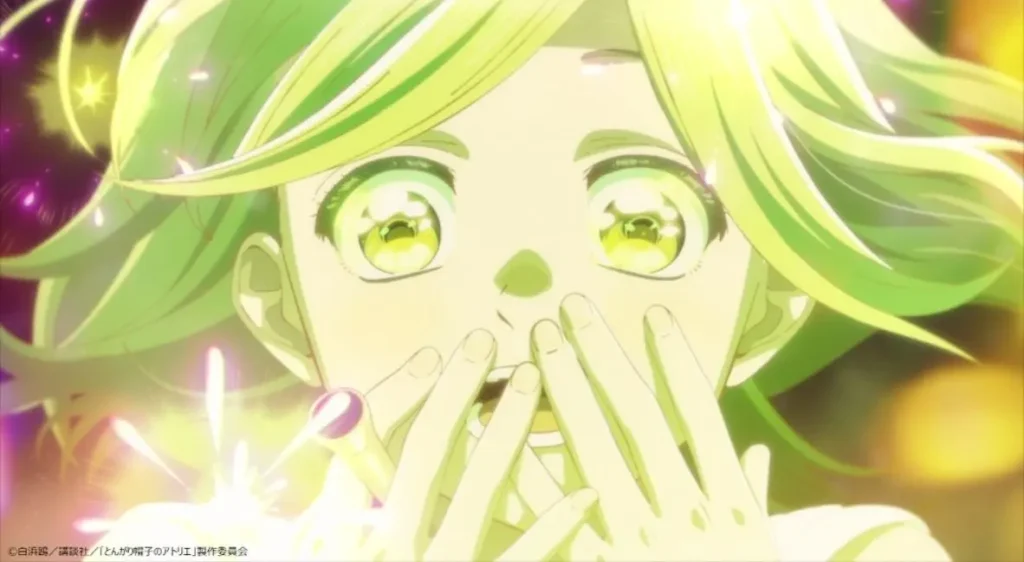
Finally, the premiere’s emotional apex—Coco’s spell spiralling into catastrophe—lands precisely because the visual language has already trained the audience to read lines and shapes as meaningful. Reviews repeatedly describe the final turn of Episode 1 as impactful without needing gore; the shock is in the character’s realisation and the sudden permanence of consequences.
Witch Hat Atelier opening episode pacing and adaptation choices
The pacing of the premiere reflects a deliberate “two-step” structure: Episode 1 is discovery → catastrophe → recruitment, while Episode 2 is orientation → rules → relationships → tests. That split matters because it allows the anime to deliver both a complete emotional hook and a coherent framework for what the series actually is (an apprenticeship story with institutions and exams, not just a single tragic inciting incident).
Production commentary also suggests the anime’s pacing choices were shaped by TV-format constraints: producer Hiroaki Kojima and director Ayumu Watanabe were quoted describing how scenes sometimes must be cut for runtime, and how the adaptation may also “amplify” certain parts—spending time on character description and subtext rather than simply transferring panels one-for-one.
Witch Hat Atelier anime vs manga differences in the premiere
Two categories of differences are most clearly evidenced in premiere reporting: cuts made for time and additions/expansions made for animation.
On the cutting side, producer commentary indicates that Episode 1 in particular had animated scenes removed during editing due to time constraints, with the producer even musing publicly about the appeal of releasing a longer “director’s cut” version in the future. On the expansion side, manga-reader commentary around the premiere notes anime-original material and extended beats—such as adding scenes that deepen domestic context around Coco and her mother, and stretching specific physical actions to emphasise the series’ theme of careful workmanship.
More subtly, review analysis suggests some early moments were adjusted for tone and relationship framing, using performance, timing, and movement to communicate interpersonal texture that reads differently on the page.
Witch Hat Atelier release date and time on Crunchyroll
The official anime site lists an April 6 launch with “simultaneous global streaming,” and specifically states that Episodes 1 and 2 premiere on major streaming platforms (with times varying by service and region).
For Crunchyroll viewers, multiple outlets reporting on the rollout list a Monday release cadence, with the premiere becoming available at 7:00 AM Pacific / 10:00 AM Eastern—3:00 PM BST in the UK. Because platform start times can differ and regional availability can vary, the official guidance is to confirm the local listing within the service itself.
Witch Hat Atelier two-episode premiere explained (why Episodes 1 and 2 dropped together)
The two-episode premiere is explicitly confirmed by the official anime site, which states that Episodes 1 and 2 “premiere simultaneously” on streaming services at launch.
Narratively, this approach makes structural sense: Episode 1 ends on the series’ defining pivot (Coco’s irreversible mistake and Qifrey’s decision), while Episode 2 immediately answers the practical question of “what happens next?” by relocating Coco to the atelier, introducing the other apprentices, and laying out the rules and tests that will drive weekly storytelling. In early community discussion, some viewers explicitly describe the double drop as a stronger “hook,” pairing spectacle/emotion (Episode 1) with worldbuilding/exposition (Episode 2) before the series settles into weekly episodes.
Witch Hat Atelier English dub release details
Same-day English dub availability has been widely reported alongside the premiere, with reporting indicating the dub simulcasts with subtitled episodes and launches as a double-feature for Episodes 1 and 2.
Dub casting announced in coverage includes: Anjali Kunapaneni as Coco, Joshua A. Waters as Qifrey, Madeleine Morris as Agott, Sarah Wiedenheft as Tetia, plus additional roles including Richeh, Olruggio, Brushbuddy, and Iguin.
Reported key dub staff includes Emily Fajardo as ADR voice director, along with ADR production and script roles credited in dub-crew reporting.
Witch Hat Atelier weekly episode schedule (Spring 2026)
The official site frames the series as a Monday title (with Japanese broadcast listed for Mondays at 11:00 PM JST on TOKYO MX and partner networks). Weekly Netflix streaming is also referenced in official streaming materials, with service timing and availability varying by region.
For UK-facing scheduling, multiple outlets list a Monday drop time of 3:00 PM BST on Crunchyroll and provide a projected week-by-week date list through late June (noting schedules can change).
A widely circulated projected release run (subject to change) lists: April 6 (Episodes 1–2), then April 13 (Episode 3), continuing weekly on Mondays through June.
Where to watch Witch Hat Atelier (Crunchyroll and other regions)
The official anime site lists a launch on April 6 with a “simultaneous global streaming release,” and states that Episodes 1 and 2 premiere simultaneously on Netflix, ABEMA, and Crunchyroll—while also warning that start times differ by platform and some services may not be available in certain regions.
Coverage of the rollout commonly clarifies that Netflix availability is region-dependent (frequently described as select Asian territories), while Crunchyroll is positioned as the primary platform in many regions outside Asia.
Witch Hat Atelier premiere reactions and early fan reception
Early viewer discussion is strongly aligned with critical review themes: the premiere’s art direction is repeatedly praised as “beautiful,” “vibrant,” and notably “storybook-like,” with multiple comments dwelling on the pop-up-book/illustration framing as a rare stylistic identity for a TV fantasy anime.
This matches reviews that highlight the anime’s commitment to the manga’s ethos without attempting an impossible one-to-one reproduction of line density—prioritising lighting, texture, and motion that communicates the “handmade” logic of drawn magic.
Pre-release and production-context reporting also shaped reception expectations: the adaptation was publicly positioned as a high-effort project, delayed to prioritise “highest possible quality,” and discussed by producers in terms of the challenge of translating intricate artwork to animation.
Frequently Asked Questions (FAQs)
- When did the two-episode premiere release?
The official anime site lists an April 6 launch and confirms Episodes 1 and 2 premiere simultaneously on streaming platforms. - What time do new episodes release on Crunchyroll in the UK?
Reporting on the release schedule commonly lists 3:00 PM BST for weekly Monday drops, corresponding to 7:00 AM PT. - Is there a same-day English dub for the premiere?
Yes—dub simulcast alongside the subtitled release has been reported, including a double-feature premiere for Episodes 1 and 2. - Who are the main Japanese cast members for Coco and Qifrey?
The official staff/cast page lists Rena Motomura as Coco and Natsuki Hanae as Qifrey. - Who are the main English dub cast members for Coco and Qifrey?
Dub-cast reporting lists Anjali Kunapaneni as Coco and Joshua A. Waters as Qifrey. - Is Witch Hat Atelier on Netflix?
The official site lists Netflix among streaming platforms, but explicitly notes that availability can differ by region and service. Coverage commonly describes Netflix availability as limited to select regions (often in Asia). - Is ABEMA required to watch the series?
No. ABEMA is listed as a streaming option, but the official site also lists Crunchyroll (and Netflix in certain regions), with regional availability varying. - Why is the magic system such a big deal in the premiere?
Because the series’ core secret is that anyone can cast magic by drawing a casting seal with special tools—making the knowledge itself dangerous, politically controlled, and narratively consequential. - How does Episode 2 change the direction after Episode 1’s tragedy?
Episode 2 shifts the focus from discovery and catastrophe to structured learning, rules (including forbidden magic), and interpersonal tension among apprentices—setting up the ongoing weekly format. - Was the anime delayed, and if so—why?
Yes. Reporting around official announcements cites a delay from the originally planned 2025 window into 2026 to deliver the “highest possible quality” and fully showcase the series’ charm.
Conclusion
The Witch Hat Atelier premiere succeeds by making its central promise tangible: magic is not an abstract power-up, but a craft built from tools, lines, and choices—beautiful enough to inspire obsession, precise enough to destroy a life in seconds. Episodes 1–2 work especially well as a pair: the first delivers the emotional rupture that justifies the journey; the second lays down the rules, relationships, and institutions that can sustain weekly storytelling.
On the production side, the premiere aligns with the “high quality” positioning that accompanied the show’s delay, and early reception—both critical and fan-led—suggests the adaptation’s art direction and animation language are already differentiators in Spring 2026’s lineup.
Sources and citation
- https://witchhatatelier-anime.com/introduction/
Official Witch Hat Atelier anime introduction page outlining premise, world, and core story setup. - https://witchhatatelier-anime.com/onair/
Official broadcast page confirming premiere format, release timing, and airing schedule. - https://witchhatatelier-anime.com/staff-cast/
Official staff and cast page listing key production roles and voice actors. - https://www.radiotimes.com/tv/fantasy/witch-hat-atelier-anime-release-schedule/
Radio Times reporting on Crunchyroll release timing and weekly episode cadence. - https://www.gamesradar.com/witch-hat-atelier-anime-release-schedule-crunchyroll/
GamesRadar coverage detailing episode release schedule and streaming availability. - https://ew.com/tv/witch-hat-atelier-anime-production-update/
Entertainment Weekly reporting on production context, including delays and staff involvement. - https://www.thereviewgeek.com/witchhatatelier-s1e1review/
The Review Geek Episode 1 recap and review covering plot beats and initial story setup. - https://www.thereviewgeek.com/witchhatatelier-s1e2review/
The Review Geek Episode 2 recap and review highlighting rules, character development, and early progression. - https://animecorner.me/witch-hat-atelier-episode-1-review/
Anime Corner review focusing on animation quality, visual execution, and adaptation strengths. - https://nerdsandbeyond.com/2026/01/witch-hat-atelier-english-dub-announced/
Nerds and Beyond reporting on English dub announcement and voice cast details. - https://www.crunchyroll.com/news/announcements/2026/01/witch-hat-atelier-anime-dub
Crunchyroll announcement confirming dub availability and streaming platform details. - https://www.reddit.com/r/anime/comments/witch_hat_atelier_episode_1_discussion/
r/anime Episode 1 discussion thread reflecting early audience reactions and impressions. - https://www.reddit.com/r/anime/comments/witch_hat_atelier_episode_2_discussion/
r/anime Episode 2 discussion thread showing continued audience reception and feedback.
Recommended
- Cyberpunk 2077 Mods: Essential Enhancements, Installation Guides, and Top Community Picks
- Animating 2D Illustrations in Blender: A Comprehensive Guide for Vocaloid and J-Pop Themed Characters
- How to Create Your Alter Ego with Metahuman for the Metaverse: A Guide to Building Digital Identity in Unreal Engine 5
- Best Black Mirror Season 7 Episodes: Ranked List, Reviews, and What to Watch First
- Psychedelic Games Secures $3.5M for Golden Tides, a Pirate-Themed “Adventure MOBA” With Open-Sea Combat and No Lanes
- What Is Stop Motion Animation? Why It Was Important to Animation: A Comprehensive History and Impact Guide
- Stylized Water Shader in UE5: Complete Guide to Creating Real-Time Cartoon Water Effects
- Best Blender Render Settings: Ultimate Guide to High-Quality Renders Without Wasting Time
- Konami Is Getting Its Own Picross Game Featuring Classic Pixel Art: Everything We Know About Picross S Konami Antiques Edition
- Emberville Pixel Fantasy Action RPG with Unique Combat Mechanics – Gameplay, Classes, and World Exploration Guide