








India’s mobile app economy entered early 2026 with a milestone that matters more for monetization strategy than for vanity metrics. India recorded 6.2 billion downloads in Q1 2026 and more than $300 million in in-app purchase revenue across the App Store and Google Play, according to Sensor Tower. Non-gaming apps generated over $200 million of that total, while gaming represented roughly the remaining third. Just as important, Sensor Tower states that the analysis excludes advertising revenue and third-party Android stores, so the headline reflects app-store IAP mix rather than the full value of India’s mobile games economy.
For publishers and developers, that distinction is the whole story. India is not becoming “less gaming-first” in the sense of player demand; it is becoming more diversified in how users pay. That pattern mirrors Sensor Tower’s broader global finding that non-game app spending overtook games in 2025, while gaming itself shifted from raw scale toward tighter monetization, retention, and live-service efficiency. In India, the implication is straightforward: teams that still optimize mainly for downloads are already behind the market.

Sensor Tower India mobile market early 2026 IAP revenue report explained
Sensor Tower’s India Q1 2026 readout describes a market moving from reach to monetization quality. The quarter delivered 6.2 billion downloads, with non-gaming apps taking a 72% share of installs, while total IAP exceeded $300 million and grew 33% year over year. Sensor Tower attributes the usage side of the market to strong demand for generative AI, short drama, e-commerce, and fintech, while the revenue side was powered increasingly by OTT, cloud services, and AI-powered utilities.
What makes the report especially useful for strategy is that it frames India as a “monetization efficiency” story rather than a pure scale story. That is a meaningful shift from the old India narrative, where gigantic install volumes were often disconnected from meaningful revenue. In Q1 2026, the two are still unequal, but they are no longer unrelated.
Games made up one-third of India in-app purchase revenue in 2026
Using Sensor Tower’s rounded public figures, gaming accounted for about one-third of India’s Q1 2026 app-store IAP revenue. That is the right way to read the headline: games still represented a major monetization pillar, but they no longer dominated the country’s wallet the way they once dominated the logic of mobile revenue models.
The more important nuance is that gaming did not weaken in absolute terms. Sensor Tower says India mobile game revenue rose 15% year over year in Q1 2026, even as non-gaming grew faster at 44%. So the market signal is not “games are falling”; it is “everything else is monetizing faster now.”
India mobile gaming in-app purchase spending Q1 2026 (Sensor Tower data)
India’s gaming segment stayed large in usage and healthier in spending than many observers might assume. Sensor Tower says game downloads were stable at more than 1.7 billion in Q1 2026, while revenue grew 15% year over year and outperformed the global mobile-game growth benchmark cited in the same note. That is a sign of stronger payer extraction from a mature audience base, not just a bigger player base.
The quarter also sits on top of an already massive gaming foundation. Sensor Tower’s India mobile gaming work published in 2025 says India remained the world’s largest mobile gaming market by downloads, with 8.45 billion installs in FY 2024–25 and just over $400 million in IAP revenue. In other words, Q1 2026 was not the start of India’s gaming monetization story; it was evidence that the monetization layer is getting thicker on top of a very large funnel.
India non-gaming apps vs games IAP share 2026 breakdown
The simplest breakdown is this: non-gaming apps contributed roughly two-thirds of app-store IAP in India in Q1 2026, while games supplied roughly one-third. Sensor Tower also reports that non-gaming revenue hit a record level for the market and grew much faster than gaming, which means share shifted not because gaming collapsed, but because adjacent categories found product-market fit for payment.
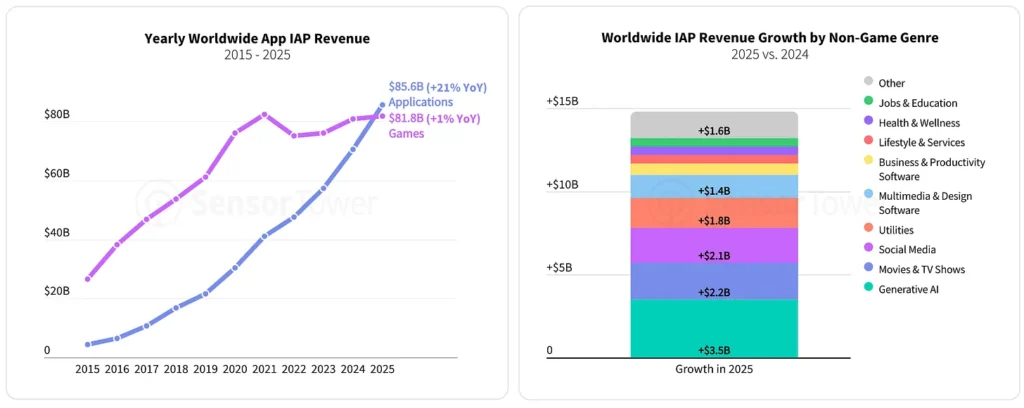
That pattern is consistent with the wider market. Sensor Tower’s 2025 global work shows non-game apps overtaking games in IAP for the first time, driven by subscriptions, utility monetization, AI, and broader consumer comfort with paying for mobile services. India is now following that structural direction, even if its market economics remain more price-sensitive than in the United States or Western Europe.
Top grossing mobile games in India early 2026 by in-app purchase revenue
Sensor Tower’s public Q1 2026 write-up confirms that Free Fire held the No. 1 revenue position in India. It also says Candy Crush Saga defended No. 4, while Gardenscapes and Royal Match climbed to No. 9 and No. 10. Sensor Tower adds that puzzle revenue in India jumped 78% year over year, making Puzzle the second-largest genre by revenue after Shooter.
The broader ranking picture also lines up with Sensor Tower’s earlier India gaming research. In FY 2024–25, Sensor Tower said India’s revenue chart was led by battle royales and core titles such as Battlegrounds Mobile India, Coin Master, and Clash of Clans alongside Free Fire. So the Q1 2026 story is not a genre replacement; it is a genre layering story in which shooters remain highly monetized while puzzle titles expand the paying audience.
Highest earning app categories in India mobile market Q1 2026
Outside games, revenue remained concentrated in categories that monetize habit and utility. Sensor Tower says India’s top-grossing non-game apps were mainly in productivity, social, and video entertainment, with video entertainment alone accounting for five of the top ten apps by revenue. It also says non-gaming growth was supported by OTT, cloud services, and AI-powered utilities.
That mix matters because it shows what Indian users are willing to pay for right now: recurring utility, premium content, and time-saving services. Sensor Tower highlights ChatGPT’s rise into India’s top three apps by revenue and notes that Crunchyroll entered the top ten by revenue with more than 4x year-over-year growth, reinforcing the idea that premium utility and premium entertainment are now the strongest non-game payment lanes in the market.

India mobile monetization trends 2026: IAP growth drivers and category shifts
India’s monetization trend is no longer a one-quarter anomaly. Secondary reporting that relays Sensor Tower’s annual market trajectory says India’s in-app purchase revenue rose from $520 million in 2021 to more than $1 billion in 2025 and is projected to reach about $1.25 billion in 2026. Using the $1 billion figure as a floor, that implies annualized growth of at least about 18% from 2021 to 2025.
The category shifts underneath that growth are highly specific. Sensor Tower says Q1 2026 app demand in India was lifted by a 69% year-over-year increase in generative AI downloads and a 403% increase in short-drama downloads, while gaming monetization was helped by puzzle and live-ops execution. That means India’s revenue mix is expanding because new categories are creating willingness to pay, not just because legacy categories are squeezing harder.
Why India’s mobile IAP revenue is growing faster than downloads in 2026
The global explanation is that app markets mature in stages. Sensor Tower’s 2026 State of Mobile says worldwide downloads grew just 0.8% in 2025, but IAP revenue rose 10.6%, as mature app ecosystems shifted from acquisition-led growth toward monetization-led growth. Non-game revenue globally climbed 21% year over year, while games posted a smaller but still positive 1.3% increase.
India is following that same logic with local characteristics. Downloads remain enormous, but the higher-value layers of the market are coming from AI features, premium video, cloud utilities, and live-service games that keep people engaged long enough to convert. In short, revenue is now compounding faster than installs because the marginal Indian mobile user is more payment-ready than the marginal Indian mobile user of just a few years ago.
India mobile market ARPU 2026: what one-third gaming IAP share indicates
The public Sensor Tower materials do not publish ARPU per active user or per payer for India, so the safest public proxy is revenue-and-download mix. Using the rounded Q1 figures, games represented about 27% of total downloads but roughly 33% of app-store IAP, which means gaming monetized above its share of traffic by about 1.2x. That indicates gaming still over-indexes on payer intent, even though non-gaming has become the larger revenue block overall.
The same proxy also shows why publishers should avoid overreading the one-third figure as a sign of weak game monetization. Sensor Tower’s India mobile gaming market page says Android still dominates downloads, while iOS users drive higher-value spending. So the current mix points to a market where scale sits on Android, value density sits disproportionately with iOS and premium cohorts, and games remain the clearest category for extracting that value efficiently.
How mobile game studios can increase IAP revenue in India in 2026
Mobile game studios looking to grow IAP in India in 2026 should treat retention depth, not install breadth, as the primary lever. Sensor Tower’s global 2026 gaming analysis says the market has shifted from new-user volume to lifetime value expansion, with winning teams prioritizing retention, reactivation, tighter payer management, and acquisition disciplined by payback rather than pure volume. India’s Q1 results support that exact framing.
Genre choice and audience design matter too. Sensor Tower’s India gaming research says India’s revenue is led by Shooter, Strategy, and Casino, while Puzzle is rising quickly, and that the market is youthful, with Android driving reach and iOS driving higher-value spending. For a studio, that translates into a clear operating model: build accessible onboarding for scale, but monetize through deeper loops, social competition, collection pressure, and payer segmentation once the player is inside the system.
Best live ops strategies for India mobile games in 2026 (events, battle passes, pricing)
India’s Q1 winners reveal what live ops should look like in practice. Sensor Tower credits Free Fire’s No. 1 revenue performance to Q1 activities including the Lost Treasure campaign, the Ramadan Cup 2026 esports event, and a Jujutsu Kaisen crossover. It also highlights Carrom Pool’s themed events, Turf Battles, and Token Shops, and says Kingshot scaled monetization with frequent themed live ops centered on rewards and progression.
The broader Sensor Tower gaming coverage shows the same monetization mechanics at work globally: seasonal progression systems, tightly timed cosmetic drops, holiday events, collectible reward ladders, and pass-driven content such as Royal Match’s Winter Pass. The strongest India playbook, then, is a hybrid one: tie events to local calendar moments and sports culture, add progression-based passes and collectible incentives, and use collaborations or thematic overlays to make spending feel time-bound and socially visible rather than purely transactional.
India mobile game pricing strategies 2026: microtransactions and low-ticket bundles
India mobile game pricing strategies in 2026 should start from one unavoidable premise: this is still a price-sensitive market. Sensor Tower explicitly frames India’s app economy as being shaped by scale, price sensitivity, and cultural context, while its India gaming market materials say Android dominates volume and iOS drives the higher-value spenders. That combination argues for a layered price stack rather than an aggressively premium-first price stack.
In practice, that means low-ticket starter packs, repeatable microtransactions, festival bundles, and optional premium tracks are more defensible than blunt list-price increases. On the platform side, Google’s India billing program allows developers to set different prices on alternative billing versus Google Play billing, while Apple lets developers create region-based prices and automatically updates non-subscription prices for tax and foreign-exchange changes. Meanwhile, UPI AutoPay supports recurring mandates for subscription-style use cases, which helps explain why low-friction, low-denomination repeat purchases are becoming more viable in India’s digital economy.
App store policy and payments in India 2026: how it affects in-app purchases
For Google, the current India setup is materially different from the old “Play billing only” default. Google’s Play Console Help states that developers serving users in India can offer an alternative billing system alongside Google Play’s billing system on mobile and tablet, that the service fee is reduced by 4% when users choose the alternative path, that transactions must be reported within 24 hours, and that prices may differ across billing systems. Google’s own policy-announcement archive says the India change was introduced in response to regulatory developments in the country.
That policy environment did not emerge in a vacuum. Reuters reported in March 2024 that India’s antitrust regulator, the Competition Commission of India, ordered a probe into Google’s in-app billing conduct after startup complaints about discriminatory implementation. For Apple, the environment remains more store-native: Apple’s developer documentation says it handles tax calculation, collection, and remittance in more than 80 regions and automatically adjusts prices for apps and non-subscription IAP when taxes or currencies move. The operational takeaway for publishers is that store policy now directly affects margin design, payment UX, and even final retail price architecture in India.
Forecast for India mobile gaming revenue 2026: what Sensor Tower trends suggest
Sensor Tower’s public Q1 2026 blog does not publish a formal full-year gaming forecast for India, so any 2026 number must be treated as an inference. Still, the public signals are useful. If the quarter’s roughly one-third gaming share is annualized against the Q1 market total, that implies around $400 million in 2026 game IAP on a simple run-rate basis.
That annualized figure matters because Sensor Tower’s India gaming work said FY 2024–25 game IAP was already just over $400 million. Put differently, Q1 2026 suggests that India’s gaming market is more likely to post another year of steady growth than an explosive re-rating. Upside exists if puzzle momentum, higher-value iOS cohorts, stronger billing design, and disciplined live ops keep pushing payer conversion higher, but the most defensible base case is moderate expansion from an already large download base, not a sudden jump to mature-market monetization levels.
Key takeaways from Sensor Tower India IAP report for publishers and UA teams
The first takeaway is that India is now a real monetization market, not just a scale market. The second is that gaming still monetizes efficiently enough to remain central, but the growth edge is no longer exclusive to games. The third is that winning increasingly depends on monetization craftsmanship: live ops cadence, pricing architecture, payment flexibility, and category selection now matter more than download bragging rights.
For UA teams, the message is especially sharp. Sensor Tower’s global gaming analysis says payback, retention, reactivation, and payer quality should outrank raw user volume, and India’s Q1 data validates that approach locally. Teams that still optimize against CPI alone will likely overfund cheap installs in low-value cohorts, while teams that optimize against payer conversion, revenue depth, and event responsiveness should outperform in both games and high-value non-game verticals.

Frequently Asked Questions (FAQs)
- Does the one-third figure mean gaming is weakening in India?
No. Sensor Tower says game IAP in India still grew 15% year over year in Q1 2026; non-gaming simply grew faster at 44%, which changed the mix. - Does this data include ad revenue from mobile games and apps?
No. Sensor Tower explicitly says the Q1 2026 India analysis covers estimated IAP from Google Play and the App Store and excludes advertising revenue and revenue from third-party Android stores. - Which game genres are driving the most money in India right now?
Shooter remains the largest revenue genre, while Puzzle has become the second-largest by revenue after a 78% year-over-year increase in Q1 2026. Sensor Tower’s India gaming materials also point to Strategy and Casino as important monetization genres. - Why are puzzle games becoming more important in India’s revenue mix?
Sensor Tower says Candy Crush Saga held its rank while Gardenscapes and Royal Match climbed the Q1 2026 revenue chart, indicating that accessible gameplay and better monetization loops are broadening the paying audience beyond core battle-royale spending. - What should a new studio optimize first if it wants to monetize well in India?
Retention and conversion design should come before pure scale. Sensor Tower’s 2026 gaming work emphasizes lifetime value, tighter payer management, and UA driven by payback rather than raw installs. - Are live events more effective than permanent price hikes in India?
The evidence points that way. Sensor Tower repeatedly attributes revenue strength to themed events, seasonal progression systems, token shops, premium cosmetics, and passes, not to blunt across-the-board price increases. - How important is alternative billing on Google Play in India?
It matters because it changes both margin and price flexibility. Google says India developers can offer alternative billing alongside Play billing, receive a 4% service-fee reduction on those transactions, and even set different prices across billing systems. - Does Apple’s commerce system still matter in a mostly Android market?
Yes. Even though Android dominates installs, Sensor Tower says iOS users drive higher-value spending, and Apple provides structured regional pricing plus automated tax handling. For premium products, that can materially affect realized revenue quality. - Is India already a high-ARPU mobile market?
Not yet. Publicly available Sensor Tower materials suggest monetization is improving quickly, but the market is still better described as “large and increasingly monetizable” than as “high ARPU” in the mature-market sense. - What is the clearest action item for UA teams in 2026?
Re-rank KPIs. In India, the smarter stack is retention, event responsiveness, payer conversion, and revenue per acquired user, not install volume on its own. That is the logic behind both Sensor Tower’s global gaming guidance and India’s Q1 mix shift.

Conclusion
Sensor Tower’s early-2026 India data shows a market that has crossed an important threshold. Games still matter enormously and still monetize above their traffic weight, but India’s revenue story is now broader, more utility-led, and more dependent on monetization precision than on download accumulation. For publishers and developers, the implication is clear: India in 2026 rewards better live ops, better pricing, better payment design, and better cohort economics far more than it rewards raw scale alone.
Sources and Citations
- Sensor Tower — “India Mobile App Market in Q1 2026: Revenue Surpasses $300M, Up 33%, as AI and Short Drama Drive Non-Gaming, While Puzzle and LiveOps Boost Gaming.”
https://sensortower.com/blog/india-mobile-market-q1-2026 - Sensor Tower — “2026 State of Mobile: AI Moves Mobile into Its Next Phase.”
https://sensortower.com/blog/state-of-mobile-2026 - Sensor Tower — “Q2 2025 Digital Market Index.”
https://sensortower.com/blog/q2-2025-digital-market-index - Sensor Tower — “India Mobile Game Insights 2025 — Homegrown Hits Drive 8.45B Downloads.”
https://sensortower.com/blog/india-mobile-game-insights-2025 - Sensor Tower — “State of Mobile India 2026 Report.”
https://sensortower.com/report/state-of-mobile-india-2026 - Google Play Console Help — “Changes to Google Play’s billing requirements for developers serving users in India.”
https://support.google.com/googleplay/android-developer/answer/13306652?hl=en - Google Play Console Help — “An update regarding Google Play’s policies for developers serving users in the United States.”
https://support.google.com/googleplay/android-developer/answer/15582165?hl=en - Reuters — “India antitrust body to probe Google’s in-app billing amid dispute with startups.”
https://www.reuters.com/technology/india-antitrust-body-orders-probe-into-googles-billing-dispute-2024-03-15/ - Apple Developer — “In-App Purchase.”
https://developer.apple.com/in-app-purchase/ - Apple Developer — “Understanding taxes.”
https://developer.apple.com/help/app-store-connect/making-payments-to-apple/understanding-taxes/ - Apple Developer — “Set a price for an In-App Purchase.”
https://developer.apple.com/help/app-store-connect/manage-in-app-purchases/set-a-price-for-an-in-app-purchase/ - National Payments Corporation of India — “UPI Autopay for Recurring Payments.”
https://www.npci.org.in/product/autopay - Press Information Bureau — “From Queues to QR Codes: India’s Payment Revolution.”
https://www.pib.gov.in/FeaturesDeatils.aspx?ModuleId=2&NoteId=158149&id=158149 - Business Standard — “India leads mobile app downloads, usage, but spending remains low.”
https://www.business-standard.com/technology/tech-news/india-app-downloads-revenue-gap-sensor-tower-report-126042400618_1.html - Sensor Tower — “Top 10 Worldwide Mobile Games by Revenue and Downloads in January 2025.”
https://sensortower.com/blog/top-10-worldwide-mobile-games-by-revenue-and-downloads-in-january-2025 - Sensor Tower — “Top 10 Worldwide Mobile Games by Revenue and Downloads in December 2025.”
https://sensortower.com/blog/top-10-worldwide-mobile-games-by-revenue-and-downloads-in-december-2025
Recommended
- KPop Demon Hunters Cast Reunites for Special Online Performances: What Fans Can Expect
- Slay The Spire 2 Is Absolutely Crushing It With 400,000 Concurrent Players And A 97 Percent Positive Rating On Steam
- Simplifying Camera Control in Blender with The View Keeper Plugin
- A 91 Year Old Woman Who Received a Wellness Check From Police Was Just Busy Gaming The Viral Story Explained
- No More Room In Hell 2 Is Leaving Early Access for Consoles This Summer: How to Play Free Before the 1.0 Launch
- How do I adjust the camera’s sensor size in Blender?
- Forza Horizon 6 Is Every Japanese Driving Fantasy Rolled into One: Why Japan Feels Like the Perfect Setting
- God of War TV Series Adds Lost Star Sonya Walger as Freya in Prime Video Adaptation
- Steven Spielberg Comments on Disclosure Day: What He Said, What It Means, and Why It Matters
- Avatar Aang Movie Footage Leak: What We Know About the Alleged Paramount+ Leak Before Release