




Executive Summary: American digital artist Mike “Beeple” Winkelmann has created a provocative new installation at Berlin’s Neue Nationalgalerie featuring autonomous robot dogs with hyper-realistic silicone heads of tech billionaires (Elon Musk, Mark Zuckerberg, Jeff Bezos) and artists (Picasso, Warhol).
Titled Regular Animals (first shown at Art Basel Miami Beach 2025), the work combines AI, robotics, and sculpture to satirize how modern algorithms (owned by those same tech moguls) control what we see. The installation (open free to the public 29 April–10 May 2026) invites visitors to walk among the dogs, watch them capture and reinterpret their surroundings, and even collect the AI-generated prints the robots “excrete”. This article examines the exhibition’s facts, concept, artworks, technology, visitor experience, and cultural significance, drawing on museum sources and art journalism to provide a comprehensive SEO-optimized analysis.
What Is Beeple’s Robot Dog Installation at Berlin’s Neue Nationalgalerie?
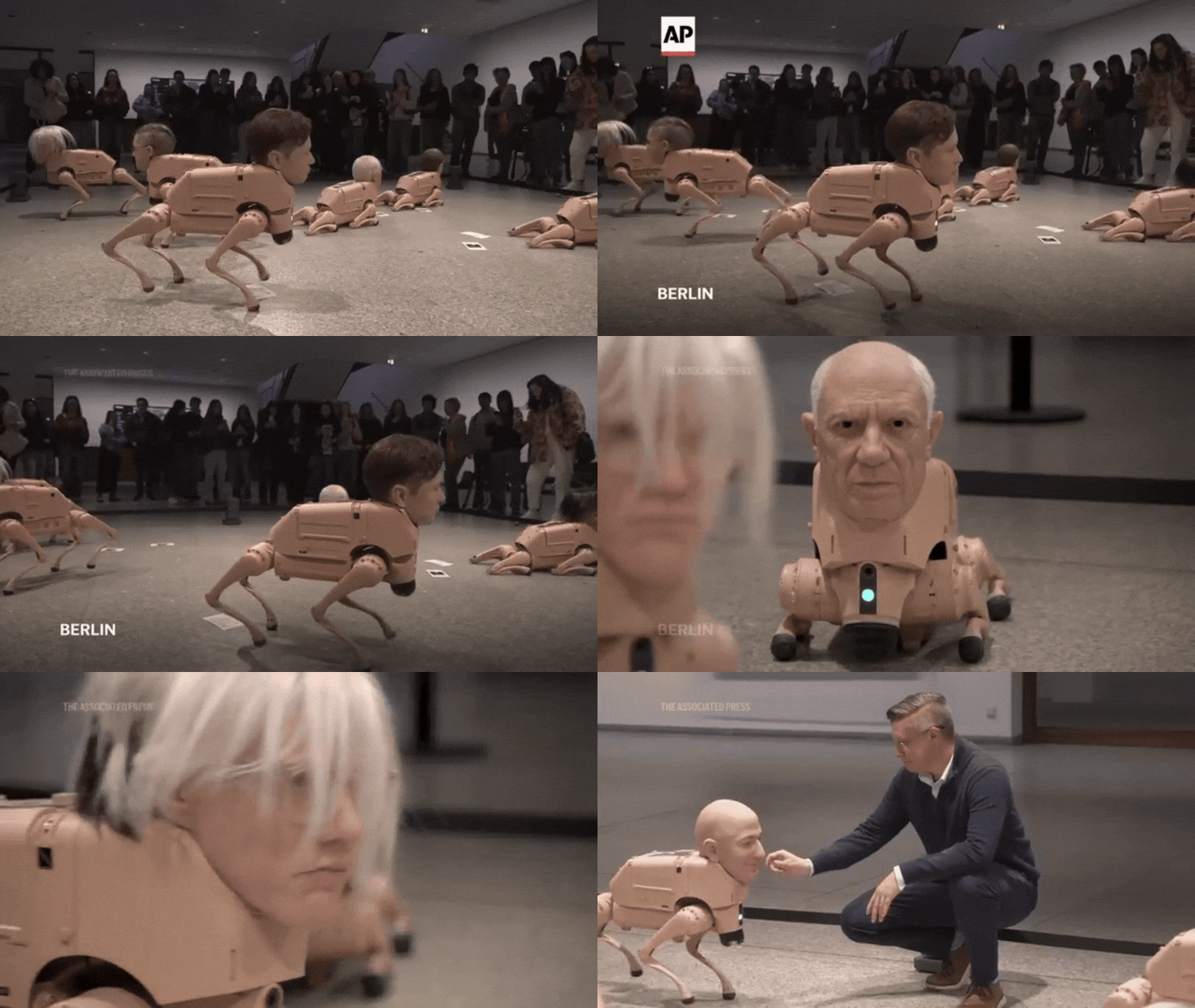
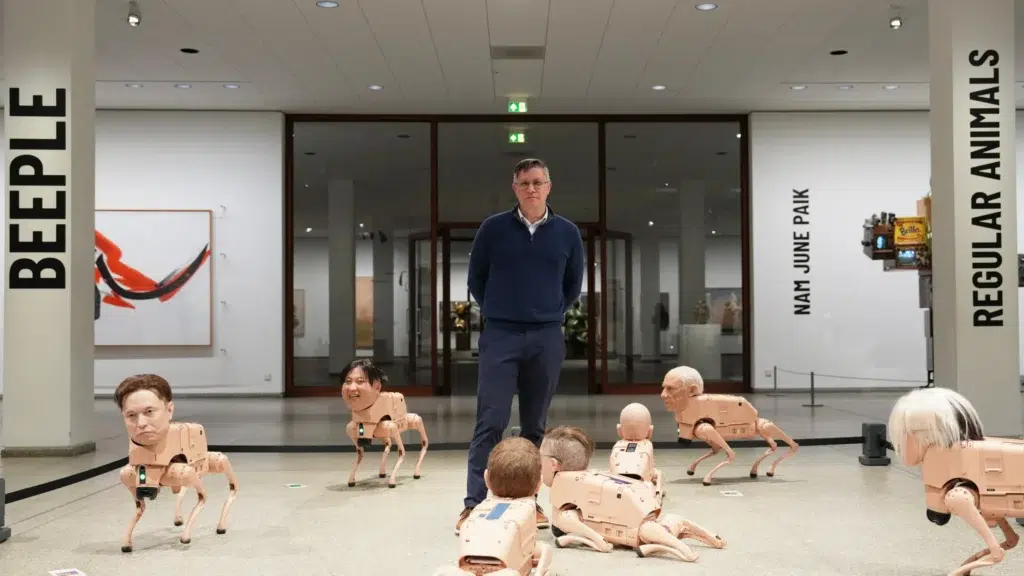
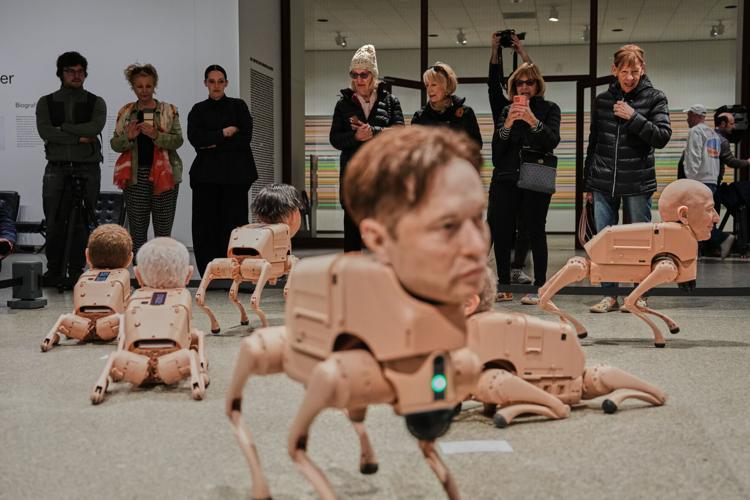
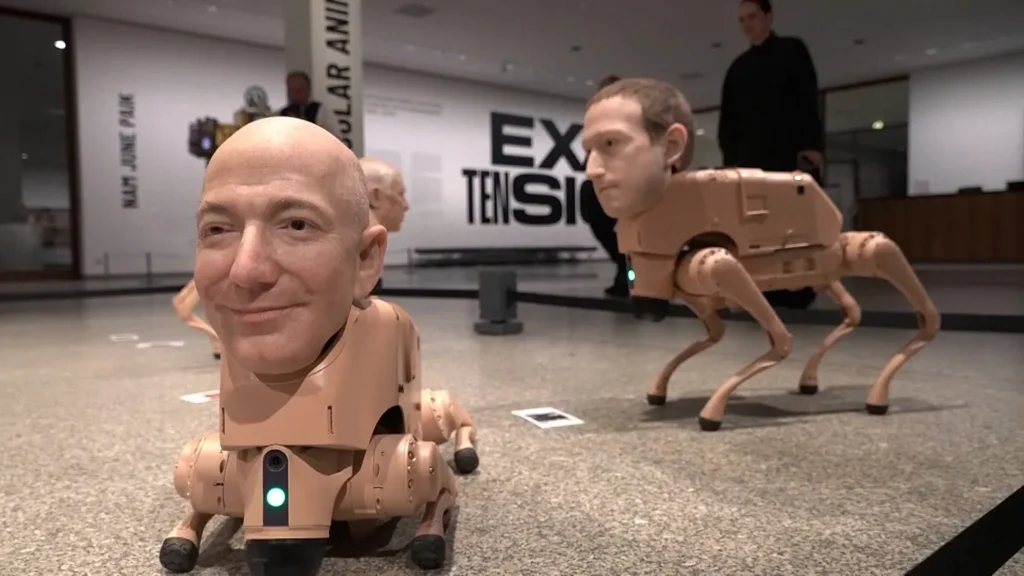
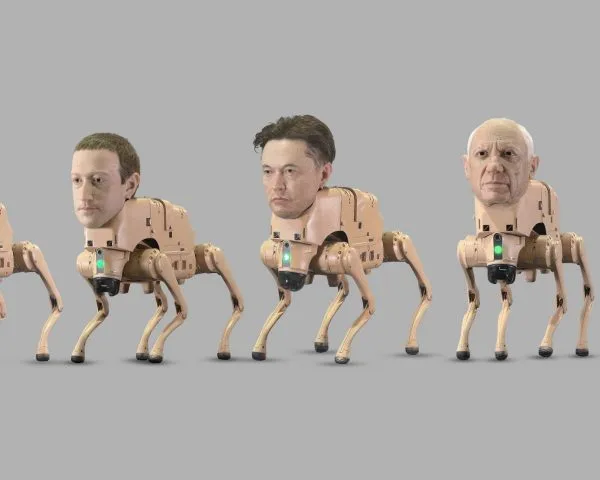
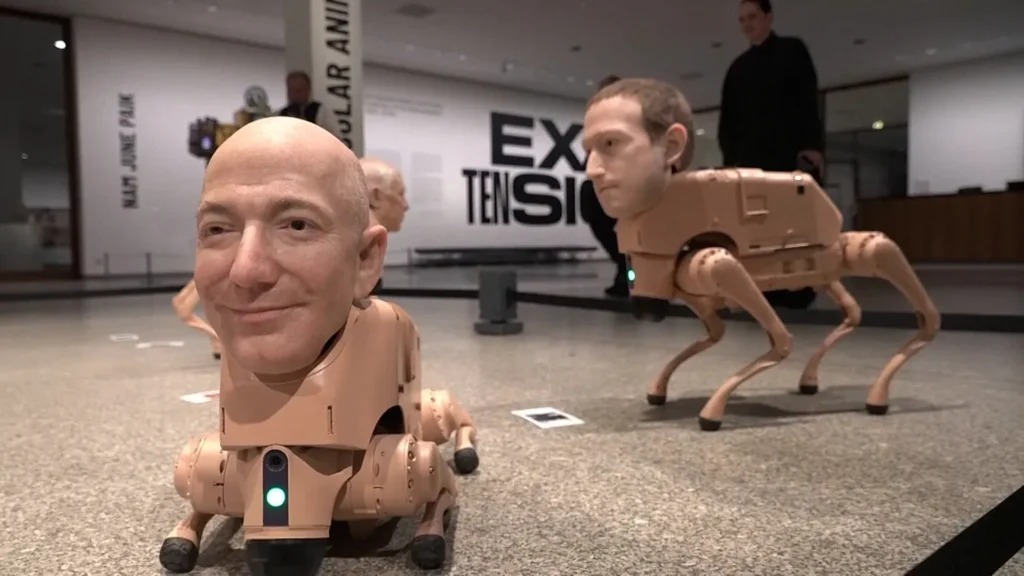
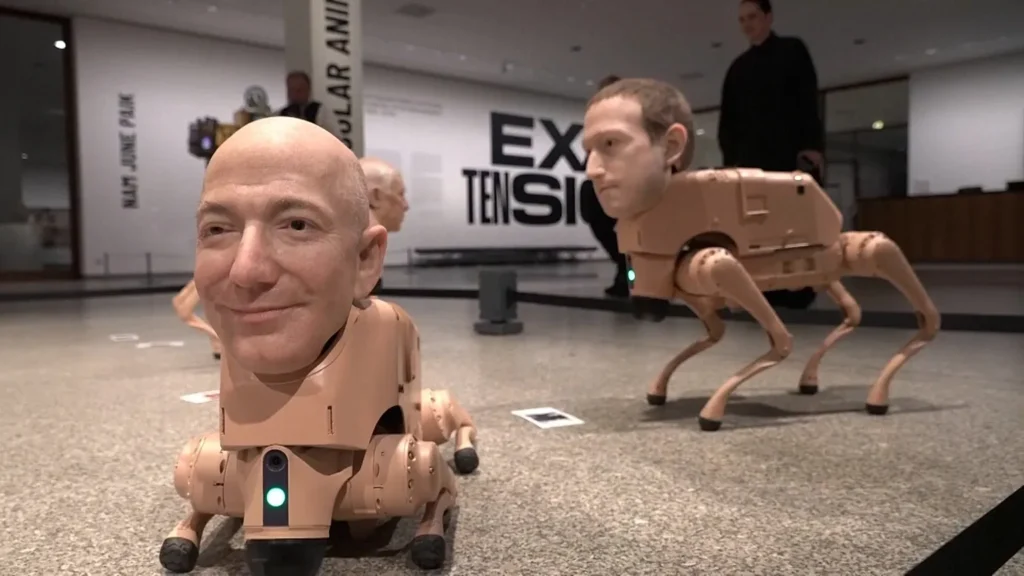
Beeple’s Regular Animals is an interactive installation of autonomous robot dogs on display in the lower foyer of Berlin’s Neue Nationalgalerie (Gallery Weekend Berlin 29 Apr–10 May 2026). Each dog is fitted with a hyper-realistic silicone head modeled after a famous personality among them Elon Musk, Mark Zuckerberg, Jeff Bezos, Pablo Picasso, Andy Warhol, and Beeple himself. As the robots roam freely, onboard cameras constantly capture the gallery environment.
Those images are immediately fed into an AI system that reinterprets the view in the style or “worldview” of the figure on each dog’s shoulders. The transformed images are then printed and physically ejected from the dog’s rear end, making the algorithmic vision tangible. All prints are given free to visitors. According to Beeple and the museum, the installation is a “sociopolitical allegory of contemporary power structures,” illustrating how “Mark Zuckerberg and Elon Musk own algorithms that control what we see and decide how we see the world”. The project marks the first German showing of Beeple’s work and is curated by Lisa Botti of the Neue Nationalgalerie.

Inside Mike “Beeple” Winkelmann’s Regular Animals Exhibition Explained
Regular Animals is a physical–digital hybrid installation that blurs sculpture, AI art, and performance. In creating the exhibition, Beeple aimed to reinterpret the legacy of pop portraiture and generative art through technology. The museum description explains that these anthropomorphic animal figures (dogs) bearing celebrity heads serve as a pointed commentary on how modern media and technology mediate perception. Each dog is a “fluid digital canvas” whose captured images become a “future data set that AI will be trained on”.
The show was first unveiled at Art Basel Miami Beach in December 2025, where the Regular Animals piece caused a sensation. In Berlin, the Neue Nationalgalerie mounted the work free-of-charge as part of Gallery Weekend, alongside Nam June Paik’s historic Andy Warhol Robot (1994) to highlight a lineage from Paik’s video-art to Beeple’s AI-art in the digital age.
Curator Lisa Botti emphasized that the museum wanted to engage with the profound impact of AI and technology, noting that tech currently shapes our politics, economies, and sense of reality and should not be ignored by cultural institutions. In short, the exhibition places visitors inside a gallery crossed by lively robot “view-makers,” embodying Beeple’s idea that the way we see the world is being rewritten by digital filters.
Table: Comparison of Major Sources Used in This Analysis.
| Source Type | Example & Scope | Key Information Provided |
|---|---|---|
| Official Museum (Neue Nationalgalerie website/press) | Staatliche Museen zu Berlin – Exhibition page and press release | Exhibition details (dates, venue, curator), core concept description, list of figures, free entry, first German showing. |
| ArtNews / Art World Journalism | Artnet (“Robot Dog Pack… Berlin,” Kate Brown, Mar 2026) | In-depth context on exhibition (curator and artist quotes), Beeple’s career and market context, technical highlights (AI filters), and audience expectations. |
| News Wire Agencies (AP/ABC) | AP News via ABC (“Robot dogs… Berlin,” Brodersen/Ciobanu, Apr 2026) | Summary of installation, live description (robots “pooping” prints), quotes from Beeple and curator, background on Beeple’s 3D/‘everyday’ practice, and NFT history. |
| Art Magazines (Feature stories) | Whitewall (“Beeple Unleashes Regular Animals at ABMB,” Dec 2025) | Technical deep dive: construction of the heads (silicone fabrication), robotics (sensors, motors, battery), printer specs, and conceptual lifecycle (memory on blockchain). |
| Art Magazines (Market focus) | The Art Newspaper (“Who let the dogs out? Beeple unleashes robot canines,” Dec 2025) | Art market context (pricing and editions of the robots), Beeple biography (NFT record), and commentary on how the robots produce and excrete prints (with certificates and NFTs). |
Robot Dogs With Elon Musk and Mark Zuckerberg Faces Shock Visitors in Berlin
The sight of lifelike robot dogs bearing celebrity heads immediately grabs attention. Journalists report that the installation quickly became a viral spectacle. For many visitors, seeing two golden retriever–like machines with Musk and Zuckerberg’s faces is both “uncanny” and humorous. Artnet describes the project as a “crowd-pleaser” that drew long lines in Miami, and it will likely attract similarly large audiences in Berlin. Social media has already dubbed one sculpture “Bark Zuckerberg,” reflecting how the piece plays on pop-culture memes (though no official source has commented).
By design, Regular Animals can startle or amuse onlookers, as the dogs move, shift, and literally “poop” out photographs. The press notes that the dogs will “occasionally ‘poo’ printed images of their surroundings” for visitors, a surreal sight that reinforces the installation’s satirical tone. Overall, audience reaction ranges from amazement at the technical craftsmanship to bemusement at the biting social commentary.
How Beeple Combines AI Art and Robotics in His Latest Museum Installation
Technologically, Regular Animals is a marriage of advanced robotics and generative AI. Each dog is a semi-autonomous robot: it uses a Unitree 4D LiDAR L1 sensor with a 360°×90° field of view to map and navigate the space in real time. Twelve servomotor-driven limbs (with IMU stabilization) allow the dogs to walk, pivot, and rebalance fluidly. Onboard cameras continuously capture live images of visitors and the environment.
These images are then fed into a neural network or AI algorithm that applies a style transformation corresponding to the figure on each dog’s head. In other words, each robot “sees” the gallery and reinterprets that vision through an artistic filter (e.g. a cubist filter for Picasso, a pop-art filter for Warhol). The transformed image data is ultimately sent to a thermal dye-sublimation printer built into the robot’s body, which prints 4×6 photographs of the AI-altered scene.
The whitewall coverage notes that the robots even store these “memories” on a blockchain ledger, so that even after a finite ‘lifespan’ the digital legacy persists. In short, every step of Regular Animals – sensing, computing, moving, printing – is driven by interwoven robotics and AI systems, making the installation a fully immersive techno-artwork.
Table: Key Technologies in Beeple’s Regular Animals.
| Technology | Function / Role | Source (Key Details) |
|---|---|---|
| Unitree 4D Lidar L1 sensor | 360°×90° 3D mapping and obstacle detection (real-time environment scanning). | Whitewall (2025): allows autonomous navigation and “side-follow tracking”. |
| Onboard cameras | Capture live images of surroundings from each dog’s perspective. | Neue Nationalgalerie (2026): photos feed into AI system. |
| AI Style-Transfer Algorithms | Generate new images by reinterpreting captures in each head’s “signature” style. | Artnet (2026): e.g. Picasso dog outputs cubist planes, Warhol dog pop art. |
| Silicone Casting (Platinum-cure, Shore 00–30) | Creates the hyper-realistic heads (mold-cast and hand-painted with subdermal layers). | Whitewall (2025): achieves skin-like translucency and realism. |
| Thermal dye-sublimation printer (Canon Selphy CP1500) | Onboard output device producing 4×6 printed photos of the AI-altered images. | Whitewall (2025): prints at 300 dpi, ejected from each robot’s rear. |
| Servomotors & IMU | Drive the dog’s twelve limbs and maintain balance/agility (up to ~5 m/s in lab). | Whitewall (2025): enables fluid, non-static movement (robots “behave” rather than pose). |
| 15,000 mAh Lithium Battery | Powers each robot’s electronics and motors (2–4 hour runtime with optional extender). | Whitewall (2025): built-in energy source for autonomous operation. |
Why the Neue Nationalgalerie Is Hosting Beeple’s Most Controversial Artwork Yet
The Neue Nationalgalerie’s decision to present Regular Animals reflects its interest in confronting today’s tech issues. Curator Lisa Botti explains that “technology is currently one of the most powerful forces shaping our lives… If museums are places where society reflects on itself, then they must engage with the technologies that are actively transforming it”. In that context, Beeple’s installation – with its bold use of real corporate faces – was seen as a necessary provocation.
Featuring Elon Musk, Mark Zuckerberg and others on living robots is certainly edgy: some media noted Beeple is “causing a stir” with the piece. At the same time, the museum frames it as a meaningful critique rather than mere spectacle. Through satire and interactivity, Regular Animals turns questions of algorithmic power and image control into public discourse.
By hosting it, the Nationalgalerie effectively endorses Beeple’s work as culturally significant, even if it pushes the boundaries of traditional sculpture (placing robotic dogs in a Mies van der Rohe building). In short, the piece’s controversial elements – giant faces of living CEOs on dog bodies – serve its critical purpose, and the gallery aims to use that controversy to spark conversation about media, art, and power.
Meaning Behind the Robot Dogs Featuring Jeff Bezos, Picasso, and Andy Warhol
Beyond Musk and Zuckerberg, each featured head carries symbolic weight. Jeff Bezos (who co-developed the robots) represents the logistical and digital infrastructure of the age (and Amazon’s retail/networking power). Iconic artists Pablo Picasso and Andy Warhol appear as well, linking the theme to art history. Beeple’s intention is to liken tech barons to cultural visionaries – all of whom shape how society sees.
He told the press that the mix of billionaires and artists “is that they each have shaped and are shaping the world with their unique view”. In practice, this is visualized by each robot filtering reality through the associated vision: for example, the Picasso-headed dog outputs cubist interpretations, while the Musk-headed dog’s prints look like stark patent drawings. Warhol’s visage hints at consumerist pop culture influence.
By anthropomorphizing these figures on animals, Beeple creates a sardonic allegory: the world’s perspective is literally carried by (and excreted from) these “regular animals,” whose heads are the lens of power and creativity. This combination of subjects underscores the exhibition’s message that artists and tech CEOs alike become the arbiters of our collective imagery and culture.
How Regular Animals Uses Artificial Intelligence to Generate Art in Real Time
In Regular Animals, AI is embedded into the very fabric of the exhibit. As each dog wanders, it continuously captures images and instantly transforms them. The processing happens in real time: onboard computers take the camera feed, apply neural style-transfer algorithms (potentially like image generators or custom-trained models), and send the result to the printer without human intervention. Whitewall describes the system as a shared “perceptual field” – visitors and robots are both observing and being observed. Technically, the robots’ sensors (LiDAR, cameras) feed a live 3D model and video to the AI module.
The AI then “reimagines” the scene with the chosen style, producing a final image that embodies the style of Picasso, Warhol, etc., as Beeple intended. Each produced image is not stored as art in a computer but is printed out as a 4×6 photograph on the spot. At Art Basel, Beeple even recorded that some prints were accompanied by NFT access codes; in Berlin, all prints (with humorous “100% organic dogshit” labels) are handed out to attendees. The result is a continuous cycle of AI creation: the robots see, compute, and output without interruption, effectively generating an ongoing gallery of machine-made art during each day of the show.
The Technology Behind Beeple’s Hyper-Realistic Silicone Robot Heads
A striking feature of the installation is the uncannily lifelike heads on each robot. These are not simple masks but advanced silicone sculptures. According to Whitewall, each head is made from platinum-cure silicone (Shore hardness 00–30), sculpted and cast from molds, then painted with multiple translucent layers to mimic human skin. This gives the heads realistic translucency and texture – complete with pores and subtle color gradients – that enhance the eeriness.
The hair and facial details are similarly sophisticated (Beeple likely used high-quality digital 3D modeling and hair assets to capture the celebrities’ likenesses). In short, the fabrication techniques come from film/animatronic make-up and high-end prop work. Combined with the robots’ lively movement, the heads appear vividly real until one notices the mechanical bodies.
This technological craftsmanship of the masks is what allows visitors to immediately recognize Musk, Zuckerberg or Warhol on a dog’s body, making the satire clear. (Note: while Beeple has not detailed his hair pipeline, similar projects often use specialized 3D hair libraries like PixelHair for realistic strand rendering.) By fusing cutting-edge silicone artistry with robotics, Beeple ensures the robots’ appearance carries the full emotional and cultural impact of the figures they portray.
What Visitors Experience Inside the Berlin Robot Dog Art Exhibit
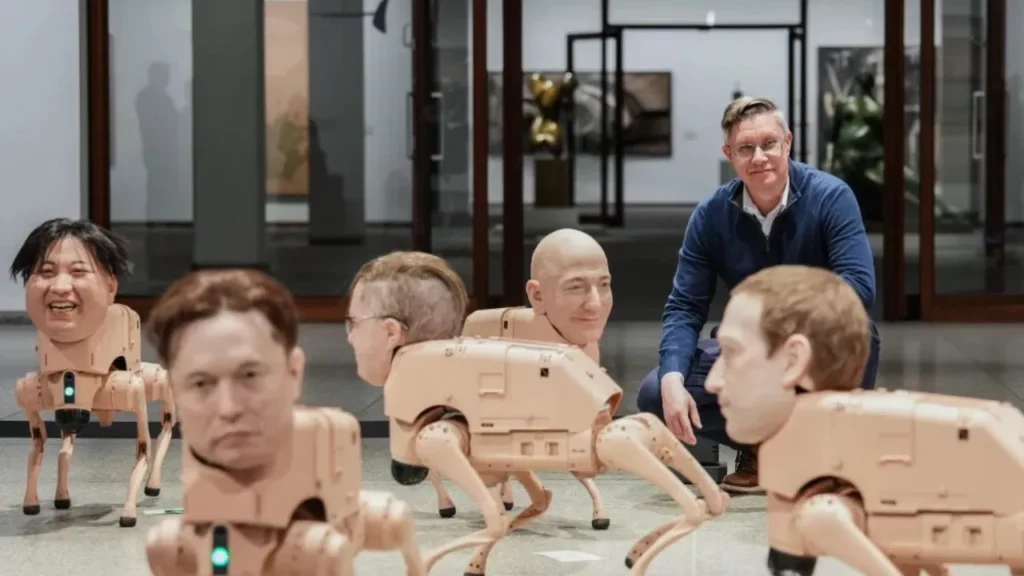
Visitors walk into a fenced-in pen at the Neue Nationalgalerie and encounter the Regular Animals herd up close. The dogs roam autonomously, sometimes pausing to adjust their cameras or printers. Many visitors are amused or startled to receive random 4×6 prints ejected from behind a robot – the gallery notes that “all of these prints are distributed free of charge to visitors”. These souvenir photos show the gallery scene filtered through a lens of cubism, pop art, or patent diagrams, so each guest gets a unique AI-generated artwork to take home. Admission is free, but the exhibition is short (just 11 days) and media outlets predicted “large crowds and long lines” (comparing it to the popular The Clock exhibit).
Inside, the atmosphere mixes high-tech wonder with dark comedy. The dogs are not static; they walk and twitch realistically, sounding subtle whirrs. Visitors find themselves literally under the gaze of robot cameras. Some guests quietly watch the printers churning out photos; others interact (the exhibit is open, so one could try to influence what a dog sees). Beeple even joins visitors inside at the press preview – as seen in photographs – underscoring the experiential, participatory nature of the work. In sum, the visitor’s experience is equal parts art observation, high-tech spectacle, and interactive game.
Beeple’s Critique of Tech Billionaires Through Interactive AI Installations
The underlying critique in Regular Animals is explicitly aimed at tech billionaires’ control over information. Beeple has said that whereas in the past “our view of the world was shaped in part by how artists saw the world”, today it is reshaped by “tech billionaires who own powerful algorithms”. In practice, this meaning is encoded in the installation’s mechanics. Each dog’s head signifies who “looks over” us: the human artists (Warhol, Picasso) once framed our cultural view through art, but now figures like Musk and Zuckerberg frame it through algorithms. By feeding live images through each dog’s filter, Beeple dramatizes this idea: the rich CEOs (and himself and the famous artists) get to reinterpret reality on a mass scale.
One robot even wears Beeple’s own head, suggesting the artist includes himself in this dynamic of media authorship. Through this participatory setup, Beeple critiques how a few individuals (and their companies’ AI) decide which content is seen, shared, or amplified. As he put it, tech CEOs can just “wake up and change [their] algorithms” whenever they please – a power ordinary people or governments lack. The exhibit makes this critique tangible: visitors experience firsthand what it’s like to see the world filtered by the whims of a handful of moguls. In this way, the piece is not just spectacle but a commentary on surveillance, censorship, and the concentration of digital power.

How Robot Dogs Capture and Transform Images Into AI-Generated Prints
Each robot dog effectively acts as a mobile art studio. It captures the world through an integrated high-resolution camera, then transforms the scene via an on-board AI image pipeline, and finally outputs the result on paper. Technically, a visitor might not see the transformation happening live (the AI processing is internal), but the result is obvious in the prints. The Art Newspaper reported that each robot “is continually taking pictures of its surroundings, which appear on the [paper] certificates,” and that the “images produced are interpreted according to the style of each dog”.
This matches the museum’s description: a dog with Picasso’s head will produce a cubist-looking image, while the Musk dog’s print appears in stark black-and-white (like a patent drawing). In short, the pipeline is: camera capture → AI style-filter → photo print. Behind the scenes, the robots run software that likely uses generative neural networks (though Beeple hasn’t named the exact model) to apply these artistic filters in milliseconds.
The physical result is what visitors see: a pile of freshly printed AI artworks on the gallery floor. In Berlin, all prints are given away (unlike some NFTs at Art Basel), so the robots are constantly generating gratis art for attendees to examine. This loop of capture-transform-print repeats non-stop for the duration of each dog’s operation, making the exhibit a live example of AI-generated art in action.
The Role of Elon Musk and Mark Zuckerberg in Beeple’s Artistic Commentary
Elon Musk and Mark Zuckerberg occupy central symbolic roles in Regular Animals. By placing their faces on two of the robotic dogs, Beeple explicitly targets them as archetypes of algorithmic power. Several sources note that using these specific tech figures was a deliberate choice: the artist’s stated theme is that these billionaires control “what we see” through their platforms. In other words, when the robots reframe reality, the show is saying: “this is how Musk’s and Zuckerberg’s algorithms shape your worldview.” The installation even toys with this idea on a basic level – the dogs are literally on all fours, suggesting subservience, as if these moguls’ power is being figuratively “dogged”.
Beeple’s own commentary reinforces this: he pointed out the absurdity and danger of such concentrated control, noting that unlike traditional powerbrokers they can alter reality on a global scale at the push of a button. Reviewers also catch the satire – one photo caption quips that people will have “nightmares of Bark Zuckerberg” (a playful nickname) after seeing the Musk and Zuckerberg dogs. In sum, Musk and Zuckerberg represent the current epoch’s “view-keepers”: tech CEOs whose AI determines our news feeds, search results, and digital experiences. Beeple’s use of their likenesses is a direct jab at that influence, and it ties together the exhibition’s motifs of surveillance, control, and technological spectacle.

Why Regular Animals Is Being Called a Landmark in Digital Art History
While no mainstream critic has literally labeled Regular Animals a “landmark” yet, many commentators imply its historical significance. Beeple’s career itself is unique: he was a meme-era digital artist who broke art-auction records and now has the explicit endorsement of a major museum. By bringing this work into the Neue Nationalgalerie, the exhibition bridges the gap between internet-born NFT art and the traditional fine-art world. Artnet notes that Beeple “rewrote the typical trajectory of an art career” by moving from viral digital projects to museum halls.
That transition is indeed unprecedented and suggests a new era where crypto-art techniques and high-culture institutions intersect. Technologically, the piece is also innovative: it’s one of the first times generative AI and autonomous robots have been combined in a major public art installation. All these factors – Beeple’s NFT pedigree, the cutting-edge tech, and the museum’s backing – contribute to viewing Regular Animals as a milestone. Though academic analyses are yet to come, it is already being referenced in media as a signature example of the “Algocene” (the age of algorithms) in art. In summary, Regular Animals is shaping up to be seen as a landmark work that formalizes and legitimizes digital art practices within a historic gallery context.
Pixelhair and the Visual Design Language of Beeple’s AI Robot Dogs
One of the subtler aspects of Beeple’s design is the visual aesthetic of the robots, which blends high-fidelity realism with a hint of surreal distortion. The heads’ realistic skin and hair are achieved through meticulous digital and sculptural techniques (some 3D hair artists mention using tools like PixelHair for similar projects, although Beeple has not publicly detailed his process). The overall look – glossy dog bodies with uncanny human faces – reflects Beeple’s signature style of combining lifelike and digital elements. The glossy chrome dog frames contrast with the textured silicone, creating a “cyborg” motif.
The color palette also references the subjects: for instance, the Zuckerberg dog has a flat brown paint reminiscent of classical portrait tones, while the Bezos dog is bright yellow (a nod to Amazon’s branding). In this sense, Regular Animals has its own visual “language”: it’s clean, polished, and digital-looking at first glance, but full of jarring anachronisms (dog limbs on human heads) that make viewers question what they’re seeing.
This pixel-by-pixel attention to design – from hair strands down to pupil reflections – exemplifies how Beeple’s background in 3D modelling and animation (often using layered assets and 3D brush libraries) influences the final piece. The result is a highly stylized yet cohesive look that unites all the robots under a single aesthetic umbrella, making the gang appear as parts of one grand idea.
The View Keeper Concept: How Beeple’s Installation Reframes Human Perception Through Machines
At its core, Regular Animals embodies what one writer has called the “View Keeper” concept: the notion that machines and algorithms now mediate our sight of the world. Beeple himself captures this idea by saying, “we’ll be viewing the world through the lens of robots and math”. Each robot dog literally collects visual data and controls the output, acting as a mechanical “keeper” of the view. The installation forces us to confront this shift in perspective. Instead of watching a static sculpture, visitors effectively watch themselves being processed by machines.
The very act of picking up a print (a view of the gallery) handed out by a robot makes you aware of the mediation. In the artist’s words, the exhibit hints “at a future where [the] roles may reverse” – where humans are observed by our creations. This reframing means the dog robots are stand-ins for modern media platforms: what we see on our screens comes filtered through algorithms (the dog heads), not directly from nature.
By experiencing this cycle firsthand, visitors gain a visceral understanding of how their perception is “shaped by algorithms,” as Beeple put it. Thus, the “View Keeper” idea is made concrete: each mechanical gaze in the exhibit reminds us that human sight is now often robotically curated. The installations’ data and visual pipeline (camera → AI → print) is itself a metaphor for how digital gatekeepers process reality.
Frequently Asked Questions (FAQs)
- What is Regular Animals and where is it exhibited?
Regular Animals is an interactive artwork by Mike “Beeple” Winkelmann. It consists of roaming robot dogs with the heads of Elon Musk, Mark Zuckerberg, Jeff Bezos, Pablo Picasso, Andy Warhol, and Beeple himself. It debuted at Art Basel Miami Beach in 2025 and is currently on display at Berlin’s Neue Nationalgalerie from 29 April to 10 May 2026. The show is open to the public free of charge. - Who is Beeple and why is this installation significant?
Beeple (Mike Winkelmann) is a US digital artist famous for his Everydays project (daily digital artworks since 2007) and for selling an NFT collage for $69 million. Regular Animals is significant as one of the first major museum presentations of a digital artist whose work is rooted in internet culture. It uses cutting-edge tech (AI, robotics) and features real tech CEOs as subjects, sparking conversation about the future of art and media. - How do the robot dogs work?
Each dog is an autonomous robot equipped with sensors (LiDAR, cameras) and motors. The robots map the space, capture photos of their surroundings in real time, and then run those images through an AI “style-transfer” algorithm corresponding to the human head they carry. The AI-processed image is immediately printed by a built-in dye-sublimation printer inside the robot. The result is an endless loop of observation → AI processing → output, generating new art on the spot. - What kind of images do the robots produce?
The output images are real photographs of the gallery or audience scene, but they’re filtered to reflect the style of the figure on each dog. For example, Warhol’s dog outputs pop-art style photos, Picasso’s dog outputs cubist-style images, and the Elon Musk dog produces stark black-and-white “patent drawing” style prints. Essentially, the robots apply an AI artistic filter to reality and then print the creative result. - Who are the figures represented on the heads?
The silicone heads are modeled after technology leaders and artists: Elon Musk (Tesla/SpaceX), Mark Zuckerberg (Meta), Jeff Bezos (Amazon), Pablo Picasso, Andy Warhol, and Beeple himself. These were chosen to symbolize the shift from artists (Warhol, Picasso) as culture-makers to tech CEOs (Musk, Zuckerberg, Bezos) as modern “view-makers,” each shaping our visual world. Beeple appears to include himself as commentary on the art world’s changing hierarchy. - Can visitors take the robot-generated prints?
Yes. All prints created by the dogs are given away free to visitors. The museum explicitly states “all of these prints are distributed free of charge to visitors”. Visitors often pick up a random photo that a robot has just printed, along with a tongue-in-cheek certificate (the Art Newspaper notes these come with humorous text like “100% pure organic dogshit”). - Is there an admission fee?
No. The installation is open to the public free of charge as part of the special exhibition program. It runs only for a limited time (29 April–10 May 2026), so attendees will likely face crowds, but they will not need to buy tickets. - Are there any legal or ethical issues with using real people’s faces?
The displayed figures are all well-known public figures, and the work is a clear satire/commentary. In most jurisdictions, using public figures in an artistic context like this is protected by fair use or freedom of expression. So far, no lawsuits have been reported. The museum and artist present the likenesses as part of a political and cultural critique. If anything, the decision to feature them has sparked playful controversy (one commenter dubbed Zuckerberg’s dog “Bark Zuckerberg”), but legally it is generally considered permissible since it is non-commercial, transformative art. - What happens to the robots when the exhibition ends?
Each Regular Animals robot has a programmed lifespan of three “real” years (about 21 dog years), after which it “dies” (stops moving). However, its legacy lives on in the printed photos and the blockchain record of images it created. For the Berlin show, all the robots on view are on loan from Beeple’s studio. After the exhibit, they will likely return to storage or future shows (Beeple may continue the series at other venues, as he did after the ABMB debut). - How does this installation connect to art history?
Regular Animals consciously references previous media art. The museum displays Nam June Paik’s Andy Warhol Robot alongside it, drawing a direct line from Paik’s 1990s vision of a TV-sculpture to Beeple’s 2026 AI sculpture. By invoking Picasso and Warhol, it also connects digital practice to traditional art icons. Critics suggest the work builds on a legacy of artists exploring mass media and technology (as Warhol did with pop art), updating it for the era of AI and social media.
Conclusion
Beeple’s Regular Animals installation at Berlin’s Neue Nationalgalerie is a groundbreaking fusion of technology, art, and social critique. It takes the artist’s signature digital style offline by putting AI-powered robots into a physical gallery space. Through robot dogs with the heads of billionaires and famous artists, Beeple makes a bold statement on how algorithms and media moguls shape public perception. Visitors experience first-hand how reality can be “chewed up” and reconstituted by machines, literally walking among the consequences of algorithmic curation.
The exhibition has drawn significant media attention and public interest, reflecting both its technical novelty and its cultural relevance. While some debate the work’s sensational elements, the museum frames Regular Animals as an essential conversation piece – a sign of the times, and indeed a landmark moment in the ongoing dialogue between digital culture and the art world. The installation’s blend of humor, satire, and technical wizardry ensures it will be remembered as a key example of 21st-century digital art.
Sources and Citations
- Staatliche Museen zu Berlin – Beeple. Regular Animals Exhibition
https://www.smb.museum/en/exhibitions/detail/beeple-regular-animals/ - Staatliche Museen zu Berlin – Beeple. Regular Animals Press Release
https://www.smb.museum/en/press/press-releases/detail/neue-nationalgalerie-beeple-regular-animals-294-1052026-1/ - Artnet News – Beeple’s Robot Dog Pack Heads to the Neue Nationalgalerie in Berlin
https://news.artnet.com/art-world/beeple-robot-dogs-nationalgalerie-berlin-2752213 - AP News – Robot dogs with Musk and Zuckerberg heads roam Berlin gallery in Beeple’s new exhibit
https://apnews.com/article/germany-berlin-robot-dogs-beeple-bezos-digital-art-4a2be2a4a4490553ad68c27beedfe83a - ABC News – Robot dogs with Musk and Zuckerberg heads roam Berlin gallery in Beeple’s new exhibit
https://abcnews.go.com/International/wireStory/robot-dogs-musk-zuckerberg-heads-roam-berlin-gallery-132447491 - Whitewall – Beeple Unleashes “Regular Animals” at Art Basel Miami Beach 2025
https://whitewall.art/art/beeple-unleashes-regular-animals-at-art-basel-miami-beach-2025/ - The Art Newspaper – Who let the dogs out? Beeple unleashes uncanny robot canines at Art Basel Miami Beach
https://www.theartnewspaper.com/2025/12/04/beeple-robot-dogs-elon-musk-art-basel-miami-beach
Recommended
- Switch 2 and PS5 Versions of Mewgenics Teased by Developers: Release Date, Gameplay, and Console Plans Explained
- The Ivors Academy Announces Ivors Composer Awards With New Video Game Music Category – Everything You Need to Know
- Can you animate multiple cameras in one Blender project?
- Blender Roll Hair Curves Geometry Nodes Preset: Comprehensive Guide
- Starfield For PlayStation 5 Is Now Available to Preorder Ahead of PS5 Release
- Plants vs Zombies 3 Soft Launch Returns Again as PvZ 3: Evolved Reappears After Years of Reworks
- Pokopia Metacritic Score Explained: Why It’s 2026’s Highest-Rated Pokémon Game and the Best Pokémon Title of All Time
- Blender Add-Ons for Customizable Procedural Clouds: Best Tools for Volumetric Sky, Cloudscapes, and Fast Art Direction
- When Is PS6 Coming Out, How Much Will the PS6 Cost, and Will PS6 Be Backwards Compatible? (2026 Update)