




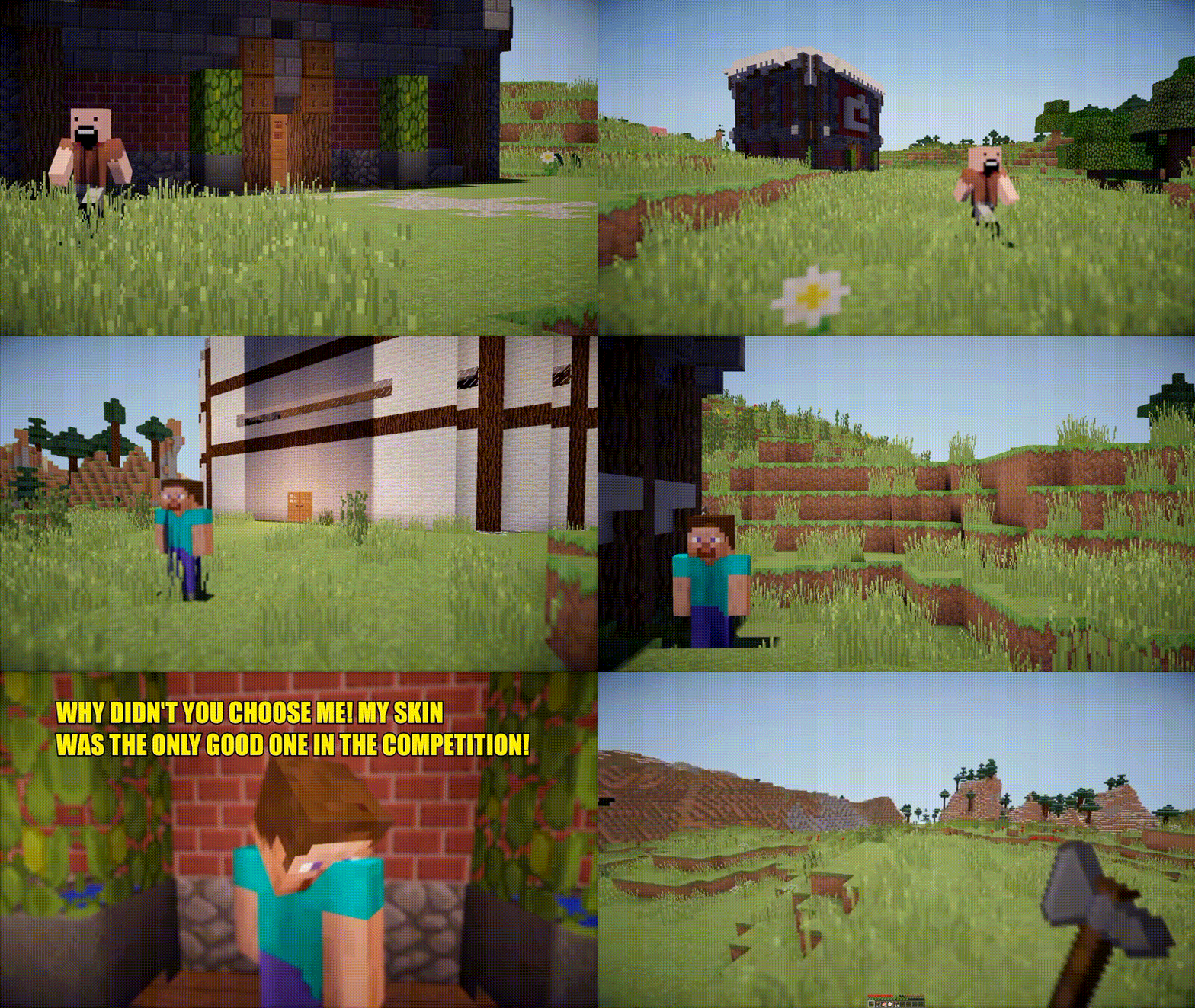
Steve is the best-known default player avatar in Minecraft. Official Minecraft guidance still treats him less like a fully scripted hero and more like a baseline character model that players can keep, replace, or customize; the game itself has no fixed story path, and Mojang Studios repeatedly describes Minecraft as a world where players shape their own stories. That combination of visibility and openness is the core reason Steve became the face of the franchise.
He also became culturally larger than a mere default skin. A 2024 poll by BAFTA ranked Steve among the most iconic video game characters, Nintendo made him a major DLC fighter in Smash, and Minecraft’s own movie and marketing kept returning to him as the easiest visual shorthand for the entire series. In other words, Steve represents Minecraft because he is simple, readable, reusable, and instantly recognizable across games, trailers, merch, and adaptations.
Who is Minecraft Steve
Steve is Minecraft’s classic default player skin: the familiar blocky avatar that stands in for “the player” whenever a custom skin is not being used. Official Minecraft articles describe default skins such as Steve and Alex as appearance options players can choose, while the broader game is defined as a sandbox with no set goal, which reinforces that Steve is primarily a player vessel rather than a locked-in protagonist with a preset story arc.
That is why Steve occupies an unusual place in game culture. He is not written like Mario, Link, or Master Chief, but he still functions like Minecraft’s mascot because he appears first, appears often, and visually communicates the game’s entire style in a single silhouette. Minecraft’s own default-skin history literally summarizes the progression as: Steve first, Alex next, then later the wider default lineup.
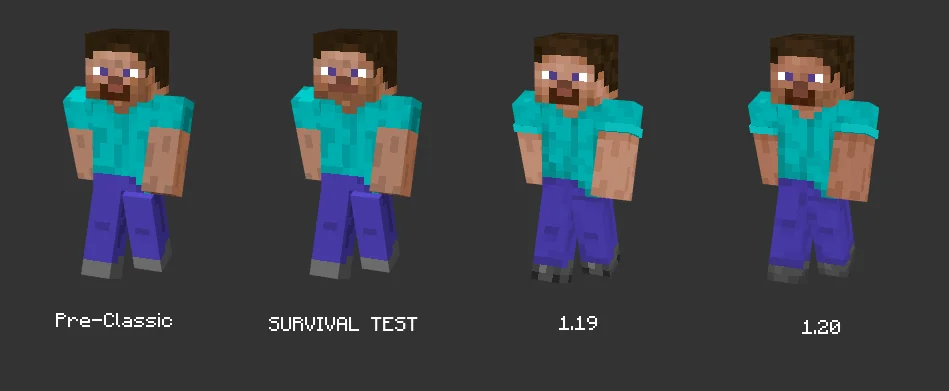
Minecraft Steve Default Skin History
The simplest official timeline comes from Minecraft itself: “In the beginning, there was Steve. Then Alex came along. Now, almost ten years later” Mojang added seven more default skins, Noor, Sunny, Ari, Zuri, Makena, Kai, and Efe, so players now have nine first-party defaults instead of just two. Minecraft also states that those defaults are available in both wide and narrow models.— ×2
Community-maintained technical documentation fills in the missing version detail: Alex was added with the newer slim-armed player model in the Java 1.8 prerelease cycle, and later updates expanded the default roster further. Minecraft’s official skin guide now reflects that expansion by noting that Java players can select from nine default skins in the launcher, while Bedrock players access the same baseline lineup in the Dressing Room.

Why is Minecraft Steve Called Steve
The exact origin of the name is one of the few Steve facts not fully preserved in a current first-party explainer, but long-running Minecraft community documentation consistently traces it back to a joke by creator Markus Persson. That same documentation notes that the name was later formalized in places such as Minecraft profile/change-skin interfaces, Bedrock defaults, and Smash naming.
The name stuck because it fits the role. “Steve” is ordinary, generic, and unassuming, which matches Minecraft’s design philosophy: the avatar is intentionally plain so the player’s actions, builds, and chosen skin can supply the actual identity. In that sense, the name’s banality is not a flaw; it is part of the character’s function.
Minecraft Steve Backstory and Lore
In the main game, Steve has almost no official backstory in the conventional character-writing sense. Minecraft’s own introductory material says the game has “no set goal” and can be played however the player likes, while an official Minecraft.net feature on fan storytelling states plainly that there is “no official storyline” and that players make of the world what they want.
That means “Steve lore” is mostly interpretive. The real canon is minimal: Steve is a default avatar in a sandbox world. Everything else, survivalist, builder, explorer, last human, hero of the End, or victim of Herobrine theories, is mostly community storytelling layered on top of an intentionally open framework. The one major exception is adaptation-specific material, such as the movie, which gives a version of Steve a concrete biography that does not automatically become the core game’s lore.— ×2
Minecraft Steve vs Alex Differences
Official Minecraft guidance makes the Steve-versus-Alex difference unusually clear: Steve uses the classic model, while Alex uses the slim model. The practical visual distinction is arm width, Steve’s arms are four pixels wide, while Alex’s are three pixels wide, and Minecraft also notes that Alex’s shoulders sit slightly lower.— ×2
Importantly, these are appearance-model differences, not gameplay-class differences. Minecraft defines skins as changes to how your in-game character looks, not to what that character can do. So Steve and Alex are functionally equivalent in ordinary play; the difference is silhouette, not stats, abilities, or survivability.
Minecraft Steve Skin Png and Dimensions
Minecraft’s official skin documentation explains that a custom skin is an “unwrapped” PNG image wrapped around the player model. Current Java technical notes also show the internal naming approach for defaults: a skin texture path like entity/player/wide/steve resolves to the default wide Steve skin, with the PNG suffix applied in the texture system.
For dimensions, Microsoft’s Minecraft creator documentation states that skin textures must be 64×64 or 128×128 pixels, and Minecraft’s own skin guide ties Steve specifically to the classic/wide model. In practical terms, if someone wants a Steve-style skin PNG, the safest modern assumption is a standard square skin sheet built for the wide/classic layout.
How to Change Minecraft Steve Skin (java and Bedrock)
On Java Edition, Minecraft’s official instructions are straightforward: open the launcher, choose Java Edition, click the Skins tab, and either select one of the default skins or create/import a new one. Minecraft’s skin guide adds that players should name the skin, choose Classic/Wide or Slim, browse to the PNG file, and then Save & Use.
On Bedrock Edition, the official route starts from the Dressing Room on the start screen. From there, players can choose Create Character and then either work from Character customization or use Classic Skin options; Minecraft’s own guide says the nine default skins are available there as base models. In SEO terms, the practical answer is simple: Java uses the launcher skin library, while Bedrock uses the in-game Dressing Room.
Minecraft Steve Character Model and Design
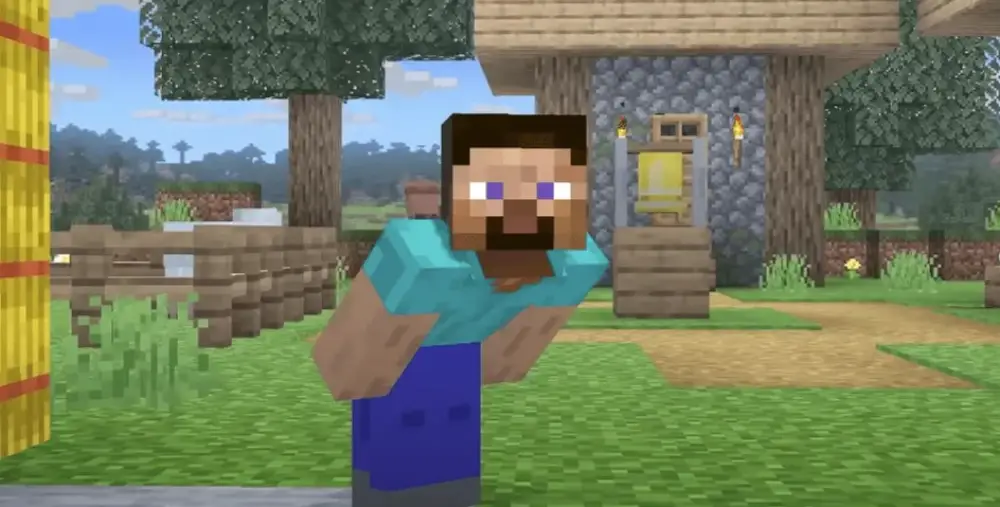
Steve’s design works because it is efficient. Minecraft describes his skin as mapped to the “classic” blocky character shape, and technically that shape is the wide model with four-pixel arms. The model is intentionally uncomplicated, which helps Steve remain readable at a distance, recognizable in tiny thumbnails, and easy to adapt into toys, promo art, crossover games, and film marketing.
That readability is not trivial. Steve’s block geometry is almost logo-like: square head, rectangular torso, symmetric limbs, and a very small amount of facial detail. Cultural rankings and industry commentary reflect how effective that design has become, with BAFTA’s poll and later games-media retrospectives treating Steve as one of gaming’s most immediately identifiable modern silhouettes.
Minecraft Steve Height and Real World Scale
Community technical documentation gives the player’s normal size as 1.8 blocks tall and 0.6 blocks wide. Separate Minecraft block documentation states that most solid blocks are one meter high and are proportioned as one cubic meter by default. Using that in-game scale, Steve comes out to roughly 1.8 meters tall, or about 5 feet 11 inches.
That estimate should be treated as gameplay scale, not anatomical realism. The 0.6-block width is a hitbox measure, not a literal shoulder measurement, and Minecraft regularly simplifies dimensions for collision and readability. So “Steve is about 1.8 meters tall” is a useful rule of thumb, not a statement that every visible body proportion maps perfectly to real human anatomy.
Minecraft Steve Abilities and Survival Skills
Steve’s “abilities” are really the default player toolkit. Minecraft’s official how-it-works pages describe the baseline loop as gathering resources, surviving the night, crafting tools, building shelter, exploring, and fighting hostile mobs. The same material frames Survival mode as the place where crafting, exploration, and combat come together, while Creative mode reveals that the avatar can also fly and build without resource limits when the game mode changes.
Seen through that lens, Steve is less a lore character and more a universal survival template. He can punch trees to begin progression, mine ores, build redstone contraptions, travel dimensions, farm, fight, and cooperate online, not because “Steve” has a bespoke power set, but because Minecraft’s player-avatar rules are built around broad freedom of action.— ×1
How Strong is Minecraft Steve (carrying Capacity)
Canonically, Minecraft does not simulate weight or encumbrance. Community inventory documentation notes that players move at normal speed regardless of how full their inventory is, and the inventory itself consists of 27 storage slots, 9 hotbar slots, and 1 off-hand slot, with most stackable items going up to 64 per slot. That already makes Steve absurdly strong by real-world standards, because the game simply does not impose a weight penalty.
If the question is carrying capacity rather than true physical mass, the most defensible answer is slot math. A shulker box has 27 inventory slots, and each of those can hold up to 64 stackable items; if all 37 carryable slots are filled with shulker boxes packed with full stacks, that yields a theoretical 63,936 stackable items on Steve’s person. That is a rules-based inventory calculation, not proof of canonical lifting strength in kilograms.
Minecraft Steve in Super Smash Bros. Ultimate
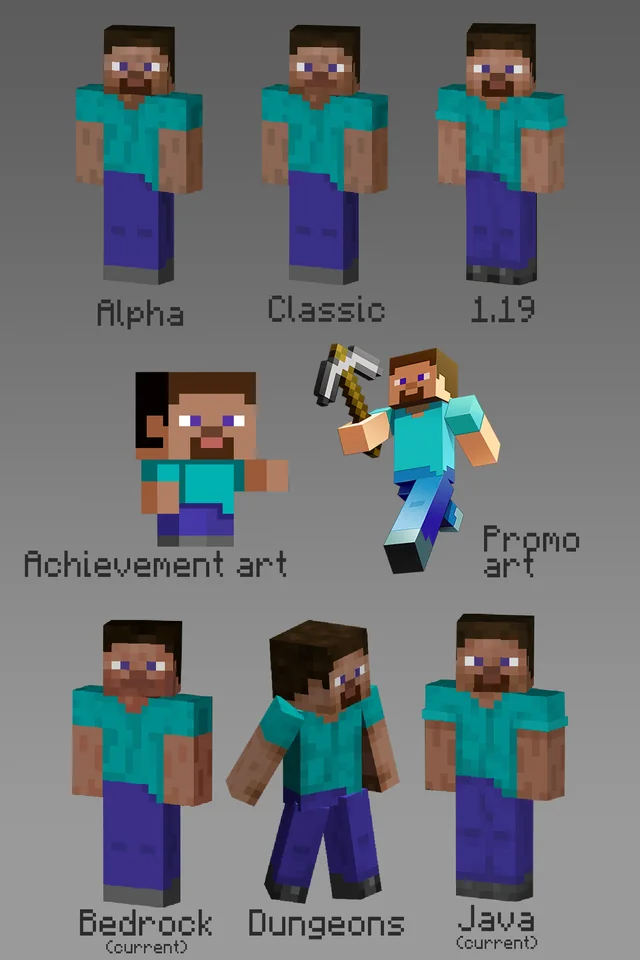
Steve became a playable Smash fighter through Challenger Pack 7. Nintendo’s official pages describe Steve and Alex as the second fighter in Fighters Pass Vol. 2, bundled with the Minecraft World stage, music, a Classic Mode route, and a Spirit Board, while the store listing gives the release date as October 13, 2020, with the wider rollout article marking availability on October 14 in Nintendo UK’s regional communication.
This crossover mattered because it changed Steve from “Minecraft mascot” into a formal Nintendo fighting-game character. Nintendo positioned him not as a joke cameo but as a mechanics-heavy DLC fighter whose mining, crafting, and block placement were central to his design. That elevated Steve’s status from franchise shorthand to one of the most ambitious crossover implementations in Smash history.
Steve Ssbu Moveset Mining Crafting and Materials
Steve’s Smash design deliberately mirrors Minecraft systems. SmashWiki’s move breakdown explains that his neutral special becomes Mine, Craft, or Create Block depending on context: he mines terrain-specific resources, uses a Crafting Table to upgrade and repair tools, and creates blocks in midair for recovery, pressure, and stage control. The available materials include dirt, wood, stone, iron, gold, diamonds, and redstone, and terrain affects what he gathers.
His other specials extend the same logic. Minecart consumes iron and lays rails using materials, Elytra references the gliding system from Minecraft, and TNT uses a points system tied to dirt, wood, stone, iron, and redstone. Nintendo’s own promotional text summarized the whole philosophy well: mine and craft your way to victory.
Why Steve is Banned or Controversial in Smash Tournaments
Steve’s Smash controversy did not come from one single issue. Competitive documentation describes him as widely viewed as one of the strongest characters in Ultimate because Mine / Craft / Create Block gives him recovery help, combo extension, camping power, ledge pressure, and unusual control over stage geometry; the same writeups also point to his strong kill power, versatile specials, and rising tournament representation after 2022.
The ban wave intensified after controversy around advanced techniques such as Phantom MLG/PMLG, which was documented as a way to negate or alter knockback in certain situations, leading many events in 2023 to ban either Steve himself or specific Steve tech. By 2025, some majors had moved toward narrower solutions such as banning Steve planking or other stalling interactions rather than enforcing a universal character ban. Nintendo also issued at least one official balance adjustment for Steve in version 13.0.1, but tournament legality remained a community rules question rather than something fixed centrally by the publisher.
What matters most for accuracy is this: Steve is not globally banned from Smash. The more precise description is that some regions, weeklies, or majors have banned Steve outright at different times, while others have preferred targeted restrictions on techniques they view as degenerate or exploit-like. That is why people still argue about whether “Steve is banned” when the truthful answer is usually “sometimes, depending on the event and the rule set.”

Minecraft Steve in a a Minecraft Movie (Jack Black)
The movie version of Steve is explicitly more defined than the game avatar. Minecraft’s first-look article says the film casts Jack Black as Steve, an “unexpected, expert crafter” who helps four real-world characters survive the Overworld, and Warner Bros. lists the film’s theatrical release as April 4, 2025. Minecraft later promoted a free Hero Pack featuring Steve and the other movie protagonists, then announced that the movie became available on Digital; as of current official Minecraft site listings, the movie is presented in the “Beyond the Game” section as “Now Streaming.”
This distinction is important for lore discussions. The film gives “Steve” a specific personality and plot function because movies require a defined lead, but that does not overwrite the mainline game’s blank-slate design. The cleanest interpretation is that the movie’s Steve is one adaptation of the Minecraft default-avatar idea, not a retroactive proof that the game’s Steve always had a detailed canon biography.
Frequently Asked Questions (FAQs)
- Is Steve the main character of Minecraft?
Not in the traditional story-driven sense. Steve is the most recognizable default player skin, but Minecraft officially describes the game as an open sandbox with no set goal, which means the player, not a scripted protagonist, drives the experience. - Are Steve and Alex mechanically different?
No. Official Minecraft skin documentation says skins change appearance, while the Steve-versus-Alex difference is the classic/wide model versus the slim model, especially the arm width. - How many default Minecraft skins are there now?
Nine. Mojang’s 2022 default-skins update added Noor, Sunny, Ari, Zuri, Makena, Kai, and Efe to Steve and Alex. - How tall is Steve in real-world terms?
Using the common in-game scale of 1 block = 1 meter and the documented player height of 1.8 blocks, Steve is about 1.8 meters tall, roughly 5 feet 11 inches. - Does Steve have an official backstory?
In the main game, not much of one. Minecraft’s own materials emphasize that there is no official fixed storyline and that players create their own stories in the world. - Can players still choose Steve even after the newer default skins were added?
Yes. Minecraft’s official skin guide says players can still pick default skins such as Steve and Alex, and Java and Bedrock both surface the broader default roster in their skin interfaces. - How do you switch from Steve to another skin on Java?
Open the Minecraft Launcher, choose Java Edition, go to the Skins tab, then select a default skin or import a new PNG and save it. - Why do Smash players complain about Steve so much?
Because his design combines extreme flexibility, stage control, strong kill power, and controversial advanced tech such as PMLG and certain stalling/planking interactions, which led to repeated legality debates and event-specific restrictions. - Is the movie version of Steve the same as the game’s canon Steve?
The movie clearly uses Steve as a named character, but the main game still leaves the player avatar largely open-ended. The safest reading is that the film gives one adaptation-specific version of Steve, not the final word on universal Minecraft canon. - What size should a Steve-style skin PNG be?
Modern Minecraft creator documentation says skin textures should be 64×64 or 128×128 pixels, and official Java guidance expects an unwrapped PNG skin image that matches either the classic/wide or slim model.
Conclusion
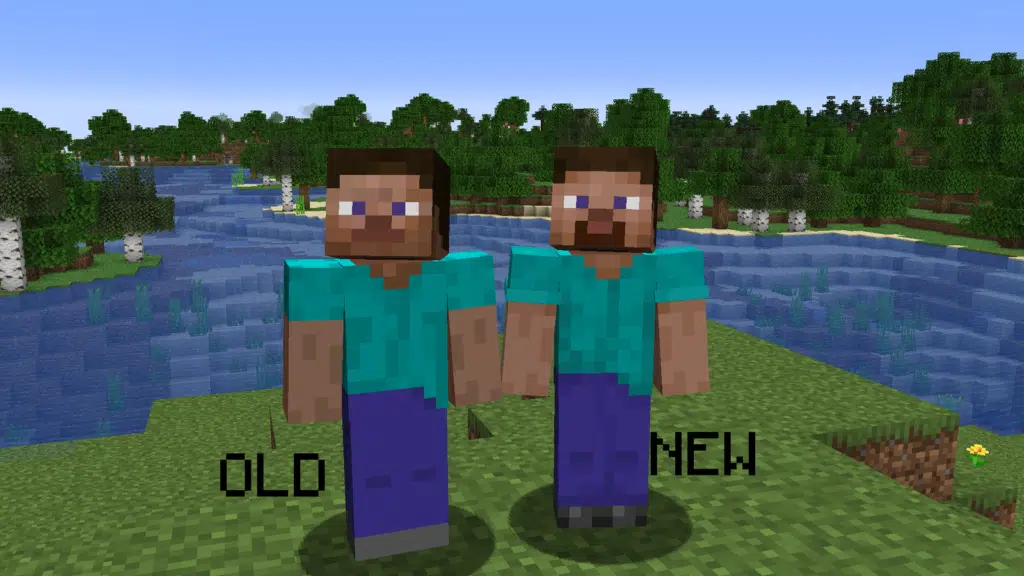
Steve became the face of Minecraft for a very practical reason: he was there first, he is simple enough to represent every player, and he scales perfectly across almost every kind of media. Mojang’s own default-skin history starts with him, Minecraft’s open-ended design lets him act as a universal blank slate, Nintendo turned him into a high-profile crossover fighter, and the movie adaptation proved that even a minimally defined avatar can anchor a mainstream feature film when the brand needs a recognizable human center.
That is why Steve endures. He is not the most verbally expressive or narratively detailed character in gaming; he is one of the most adaptable. In a sandbox built around player imagination, that adaptability is exactly what made him iconic.
Sources and Citations
The highest-confidence claims in this article rely primarily on first-party or official sources from Minecraft, Nintendo, Microsoft Learn, Warner Bros., and BAFTA, with community technical references used only where official documentation is sparse. The most important supporting sources are listed below.
- Minecraft official skin guide (Minecraft Support / Minecraft.net article)
https://www.minecraft.net/en-us/article/what-is-minecraft-skin - Minecraft official gameplay explainers (official “What is Minecraft?” / gameplay overview)
https://www.minecraft.net/en-us/article/what-is-minecraft - Microsoft Learn / Minecraft creator & technical documentation (skin format, textures, creator systems)
https://learn.microsoft.com/en-us/minecraft/creator/ (Microsoft/Minecraft creator docs hub; skin technical details are distributed across creator documentation pages) - Nintendo official Smash pages (Steve DLC, Challenger Pack, fighter details)
https://www.nintendo.com/us/store/products/super-smash-bros-ultimate-switch/ (official Smash Ultimate product page; DLC and fighter info is linked from Nintendo’s official Smash hub) - Warner Bros / Minecraft movie official pages (film info, release and synopsis)
https://www.warnerbros.com/movies/minecraft-movie (official film hub; may redirect depending on region/updates) - BAFTA poll / iconic game character coverage (BAFTA Games / public voting features)
https://www.bafta.org/games (BAFTA Games hub where polls and featured coverage appear; specific polls are time-limited pages) - Community technical references (Minecraft mechanics: scale, inventory math, capacity, etc. — used cautiously; typically wiki-based rather than official)
https://minecraft.wiki/w/Minecraft_Wiki
A narrow limitation remains around the precise first-party origin story of the name “Steve”: current official Minecraft pages clearly confirm Steve’s central role in default-skin history, but the exact joke-origin of the name survives most clearly in longstanding community documentation rather than in a currently prominent official Mojang article. That part of the article is therefore presented with deliberate caution.
Recommended
- The Expanse: Osiris Reborn — Everything We Know So Far
- Dreadmoor Preview: A Lovecraftian Horror Fishing Game Like Dredge – Gameplay, Features, Release Date & First Impressions
- Unigine 2.21 Is Out: What’s New in the Real-Time 3D Engine — Animation Graph, AI Workflow, Performance
- UModeler X is Now Free: What Changed, How to Download, and What You Get in the Free Version
- Free Game From The Epic Games Store On Mobile This Week: Wonder Boy: The Dragon’s Trap
- Exploring MOVA’s Contour Facial Capture Technology: Photorealistic Tracking in Film and Gaming
- How to Use Physics-Based Hair in BlenderScooby-Doo: Netflix Reveals Full Title
- Scooby-Doo: Origins and First Look at the Live-Action Cast
- Saros: The Kotaku Review — What Housemarque’s Returnal Successor Gets Right (And Where It Struggles)