








In This Article (7 sections)
Accenture’s $29 Claude Spending Limit: Funding Changes, Employee Access, and Company Response
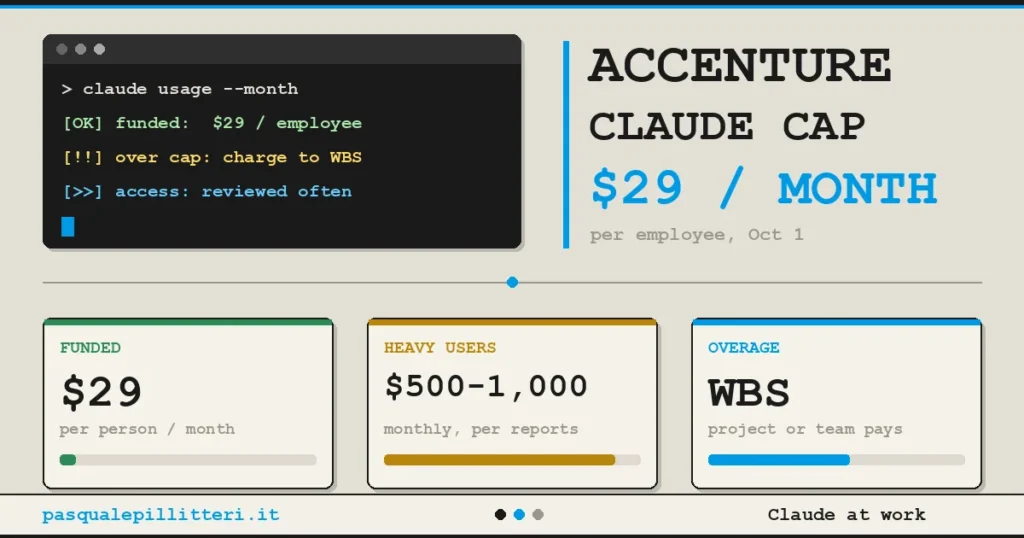
Accenture’s reported $29 monthly Claude spending limit has attracted attention after an internal announcement described changes to how employee AI usage is funded. According to reporting published by 404 Media on October 15, 2026, Accenture introduced a centrally funded monthly amount of $29 for certain employees using Claude, including its AI coding tool, Claude Code. The reported arrangement took effect on October 1, 2026, and requires additional usage costs to be assigned to an approved project or team budget. Some employees reportedly consumed hundreds of dollars in Claude services each month, raising questions about how businesses manage increasingly expensive AI tools.
However, the $29 figure should not be interpreted as a universal restriction that automatically prevents employees from using Claude after reaching that amount. It represents a reported central funding threshold rather than a confirmed technical access limit. Accenture disputed descriptions of the figure as a firm monthly cap on employees’ AI access. A spokesperson told Forbes that the amount illustrated part of the company’s funding approach and emphasized that Accenture continues investing in Claude where it can have the greatest impact.
Claude is Anthropic’s family of AI models and products, supporting activities such as writing, research, analysis, and software development. Claude Code provides an agentic coding workflow that can inspect software projects, generate changes, and assist with development tasks. The internal announcement reportedly concerned Claude Enterprise, which includes organizational administration and security features. However, the available reporting does not establish that identical funding rules apply to every Accenture employee, Anthropic product, or AI tool used by the company.
The distinction between funding and access is central to understanding the situation:
- Central funding threshold: The reported $29 monthly amount contributed through Accenture’s central funding arrangement.
- Additional project funding: Usage above the central amount may be assigned to an approved project or team budget.
- Access permissions: Employees must still have the appropriate license and authorization to use Claude.
- License reviews: Access may be reassessed according to business requirements, even when project funding is available.
- Enterprise pricing: The reported $29 amount is not established as Anthropic’s standard public price for Claude Enterprise.
Accenture’s public response reinforces these distinctions. The company described Claude as a specialized AI tool used for client delivery and internal work, explaining that it aims to provide appropriate tools for particular tasks. However, this statement does not guarantee unlimited Claude access for every employee, nor does it disclose the complete internal funding policy.
The internal announcement was reportedly effective from October 1, while 404 Media published its findings on October 15 and The Next Web covered the story on October 16. Accenture has not released the full document publicly, leaving some implementation details uncertain, including whether all affected teams received identical arrangements across locations and business units.
Under the reported policy, additional Claude usage is assigned through a Work Breakdown Structure, or WBS, an internal project accounting reference used to allocate expenses. This allows AI consumption to be associated with the project or team responsible for the work instead of placing every charge under one central budget.
For example, if an employee generated $500 in eligible Claude usage during a month and received the reported $29 central contribution, the remaining $471 would need another funding source. This illustrates the funding structure rather than confirming an actual Accenture invoice. The additional expense could be absorbed by the project, handled through an internal budget, or treated according to applicable client agreements. The publicly available reporting does not establish which arrangement applies to individual engagements.
A WBS does not automatically provide a Claude license or guarantee approval for additional spending. Employees still need permission to access the tool, and the responsible budget must be able to support the expense. Those working across several projects may also need guidance about which activities should be charged to particular accounts.
Accenture has not publicly identified one definitive reason for the funding change. Its statements emphasize allocating Claude where it can provide the greatest impact. Cost accountability is a plausible explanation because employees using AI coding agents extensively can generate much higher expenses than those using chat assistants occasionally. However, the evidence does not establish that the decision was made solely because spending had become excessive.
The reported arrangement illustrates how enterprises can separate centrally funded AI access from additional consumption associated with specific business activities. This approach may improve financial visibility, although it can introduce approval requirements for employees whose work depends on frequent Claude usage.

Accenture Claude General and Premium Plans: Claude Code Spending, Enterprise Pricing, and License Restrictions
The reported funding changes are particularly relevant to employees using Claude Code for intensive development work. Unlike occasional chatbot conversations, agentic coding tasks can involve repeatedly reading source files, generating modifications, examining command results, and continuing through complex workflows. These activities can produce substantial token consumption, especially when employees work with large codebases or conduct extended development sessions.
404 Media reported examples of employees whose monthly Claude usage greatly exceeded $29. According to The Next Web’s account, one employee using Claude Code to build and test an AI accelerator for multiple clients described monthly costs of approximately $500 to $1,000. Another employee reported spending more than $500 during previous months and sought information about upgrading to a Premium account. These examples demonstrate the potential scale of intensive usage but do not represent companywide averages.
High usage does not automatically indicate inefficient spending. An AI coding assistant that costs hundreds of dollars may still provide substantial value if it reduces development time or improves delivery. Conversely, lower usage does not necessarily represent greater efficiency if the resulting work requires extensive corrections. Evaluating costs properly requires considering the quality and usefulness of completed tasks.
The reporting distinguishes between Accenture’s General and Premium Claude arrangements. Many employees were reportedly using General accounts, while Premium users had access to higher token usage allowances. According to the reported internal information, Premium arrangements included approximately $250 worth of token usage per week.
These figures describe different funding periods and should not be directly equated. The $29 figure concerns reported monthly central funding, while the $250 amount refers to weekly token usage associated with Premium. Although four weeks at $250 produces $1,000, the reporting does not establish a guaranteed monthly allowance, rollover rules, or the complete relationship between the two arrangements.
The labels General and Premium also require care because Accenture’s internal categories should not automatically be equated with every public Anthropic subscription type. Anthropic separately offers Enterprise arrangements involving Standard and Premium seats, while private commercial agreements may contain additional terms.
Claude Enterprise billing can involve different structures. Anthropic’s documentation describes usage based Enterprise plans that charge for actual consumption separately from seat fees, as well as seat based arrangements with included usage limits. Charges may depend on the selected model, input tokens, output tokens, and caching activity. Public pricing documentation illustrates how consumption is calculated but does not disclose Accenture’s negotiated commercial terms.
The relevant factors influencing Claude costs include:
- Model selection: Different Claude models may have different usage rates.
- Input and output tokens: Longer instructions, codebases, and generated responses can increase consumption.
- Caching: Cache reads and writes may be charged differently from ordinary token processing.
- Task complexity: Extended coding workflows may require repeated requests and additional context.
- Seat arrangements: Enterprise plans may combine license fees with usage allowances or consumption charges.
- Budget controls: Organizations can monitor spending and allocate costs to approved teams or projects.
Anthropic provides enterprise administration features such as spending controls, role based permissions, and consumption analytics. However, the available sources do not identify every control enabled within Accenture’s environment.
The reported internal announcement also indicates that employees can lose Claude access even when they have a WBS and an existing license. One employee reportedly said their access had been revoked, while the internal notice described license reviews based on factors including business need. The reporting does not establish how many employees were affected or the precise circumstances surrounding individual access decisions.
This means project funding and continued authorization are separate considerations. An employee may have a project willing to fund additional consumption but still require an approved license. Likewise, having an existing license does not guarantee indefinite access.
Accenture’s response emphasized that the company continues making AI tools available to employees, but that should not be interpreted as a promise that every worker receives unlimited access to Claude specifically. Losing access to Claude also does not necessarily mean losing access to every AI tool supported by Accenture.
For development teams relying on Claude Code, the funding approach may introduce additional planning requirements. Project managers could need to estimate usage, identify an approved budget, and monitor consumption against expected expenses. Employees working across multiple engagements may need to assign costs correctly, while teams experiencing license changes may need to identify approved alternatives.
General methods for controlling AI coding expenses include writing clearer task instructions, supplying only relevant context, avoiding unnecessary repeated operations, and selecting models appropriate to the work. However, lowering token consumption should not come at the expense of accuracy or software quality. A cheaper process that creates substantial rework may ultimately cost more.
The available evidence does not establish that Accenture has banned Claude Code or that all employees face interruptions after reaching $29. Instead, it describes a funding structure in which additional consumption may need project authorization while licenses remain subject to internal review.

Accenture and Anthropic Partnership: Enterprise AI Investment, Cost Management, and Business Implications
Accenture and Anthropic announced a partnership in December 2025 to help organizations adopt Claude and develop enterprise AI applications. The collaboration included bringing Claude into Accenture’s Innovation Hubs, allowing clients to prototype and evaluate AI solutions before wider deployment. It connected Accenture’s consulting and implementation capabilities with Anthropic’s models and products.
In June 2026, Anthropic stated that Accenture was training 30,000 professionals on Claude. This figure describes the announced training initiative rather than the number of employees holding particular licenses or affected by the October funding changes. The companies also announced a separate collaboration in September 2026 focused on independent evaluation of frontier AI, including plans to develop evaluation capabilities over five years.
These collaborations provide important context for Accenture’s reported funding policy. The October announcement does not establish that the partnership has ended or that Accenture intends to abandon Claude. The company has explicitly stated that it continues investing in the technology while seeking to deploy it where it expects meaningful business value.
The broader issue is how enterprises manage the cost of AI tools when consumption differs substantially between employees. Someone using Claude occasionally for writing or research may generate relatively modest expenses, while a developer running coding agents throughout the working day may consume significantly more resources. Providing access to both employees does not necessarily mean their usage should be funded identically.
Project based cost allocation can help organizations identify which activities generate expenses and compare those costs with business outcomes. However, it may also create administrative difficulties when employees need approval before continuing work or when usage benefits several projects simultaneously.
For client engagements, additional AI spending may affect project budgets and financial margins. Whether those costs can be passed to clients depends on contractual terms and internal accounting arrangements, which have not been publicly disclosed for Accenture’s reported policy.
Businesses considering similar arrangements need to measure more than token consumption. Relevant indicators include:
- Task completion: Whether AI assistance contributes to finished, usable work.
- Productivity: Whether employees complete appropriate tasks more efficiently.
- Quality: Whether outputs meet technical and business requirements.
- Rework: Whether AI generated results require substantial corrections.
- Cost allocation: Which projects or teams benefit from the expenditure.
- Usage efficiency: Whether additional consumption produces meaningful results.
Spending analytics can identify where resources are consumed, but they do not automatically establish whether the work was valuable. A project with substantial Claude expenses may still achieve favorable results if the tool delivers sufficient productivity or quality improvements.
The Accenture case also demonstrates why terminology matters when discussing enterprise AI restrictions. A central funding threshold, subscription allowance, technical spending cap, and license authorization are different mechanisms. The reported $29 amount concerns centrally funded usage, while Accenture disputes the suggestion that it represents a universal hard limit on employee access.
The available information supports a distinction between how Claude usage is financed and whether employees remain authorized to use the service. Understanding both is necessary to evaluate how the reported policy affects development workflows, project budgets, and Accenture’s continued investment in enterprise AI.
Frequently Asked Questions (FAQs)
- What is Accenture’s reported $29 Claude limit?
The reported $29 amount is a monthly central funding threshold for Claude usage by certain Accenture employees. According to 404 Media, costs exceeding that amount must be allocated to an approved project or team budget. Accenture has disputed descriptions of the figure as a firm access restriction, emphasizing that it represents part of the company’s funding approach. - When did the reported funding change take effect?
The internal announcement reportedly established October 1, 2026, as the effective date. The information became public through 404 Media’s report on October 15, followed by additional coverage and Accenture’s response. The complete internal policy has not been released publicly, so implementation details may differ between affected teams. - Are Accenture employees blocked from Claude after spending $29?
Not necessarily. The available reporting does not establish an automatic restriction preventing every employee from using Claude after reaching $29. Additional usage may continue through an approved project or team budget. However, employees must still have the appropriate license and authorization, meaning funding approval and actual access remain separate requirements. - Do employees have to pay for extra Claude usage themselves?
The reported arrangement assigns additional usage costs to project or team budgets through an internal Work Breakdown Structure. It does not establish a general requirement for employees to pay personally. Whether a particular project can approve and absorb the expense depends on applicable internal funding arrangements and authorization procedures. - What does WBS mean in the reported policy?
WBS stands for Work Breakdown Structure. In this context, it refers to an internal project or team accounting reference used to allocate additional Claude expenses. It allows Accenture to associate AI consumption with the work generating those costs. A WBS does not automatically grant a Claude license or guarantee approval for unlimited usage. - How much were some Accenture employees spending on Claude Code?
One employee reportedly described monthly Claude Code expenses of approximately $500 to $1,000 while working on an AI accelerator for multiple clients. Another reported exceeding $500 in previous months. These figures illustrate the potential expense of intensive coding workflows but do not establish average spending across Accenture’s workforce. - How much usage did the reported Premium plans include?
The reporting described Premium arrangements containing approximately $250 worth of token usage per week. This is a monetary allowance rather than a fixed number of tokens, since consumption depends on models and usage patterns. The complete terms, approval requirements, and relationship with Accenture’s reported $29 monthly funding amount have not been publicly established. - Is the $29 figure Anthropic’s standard Claude Enterprise price?
No. The $29 amount comes from reporting about Accenture’s internal funding arrangements and should not be interpreted as Anthropic’s standard Enterprise subscription price. Anthropic offers different Enterprise billing structures, including arrangements involving seat fees, usage allowances, and consumption based charges. Accenture’s specific commercial terms have not been disclosed. - Can a funded Accenture employee still lose Claude access?
Yes. The reported internal announcement indicates that having an approved project funding reference and an existing license does not guarantee indefinite access. Accenture may review authorization according to business needs and other internal considerations. One employee reportedly experienced revoked access, although the available reporting does not establish how widespread such decisions were. - Are Accenture and Anthropic still partners?
The reported funding change does not establish that their partnership has ended. Accenture and Anthropic announced collaborations involving enterprise AI adoption, professional training, and independent AI evaluation. Accenture has also stated that it continues investing in Claude where the technology can provide meaningful business value. The funding arrangement concerns how usage costs and access are managed rather than confirming the end of their relationship.

Conclusion
Accenture’s reported $29 monthly Claude funding arrangement has raised questions about enterprise AI spending, particularly after reports revealed that some employees consumed hundreds of dollars in Claude services each month. Under the reported arrangement, usage exceeding the central contribution can be assigned to a project or team budget, while continued access depends on licensing and business requirements.
Accenture disputes claims that $29 represents a firm monthly access limit. However, the complete internal policy and commercial agreement with Anthropic remain private, making it difficult to determine how the arrangement applies across the workforce. The situation highlights the importance of balancing AI consumption costs with productivity, project budgets, and measurable business value.
Sources and Citations
- 404 Media, October 15, 2026: Original report on Accenture’s internal Claude funding change. It says many employees would receive $29 per month in centrally funded Claude usage, with costs above that amount charged to an approved project or team budget. The report also cites employees whose Claude usage had reached hundreds of dollars or more per month. 404 Media
404 Media — Accenture Tells Employees They Can Now Spend Only $29 on Claude Per Month - The Next Web, October 16, 2026: Follow-up coverage explaining that the reported policy took effect October 1, that spending above $29 had to be assigned to a Work Breakdown Structure (WBS), and that some employees had previously spent as much as $1,000 per month. TNW
The Next Web — Accenture caps staff Claude spending at $29 a month - Forbes, October 16, 2026: Includes Accenture’s clarification that the $29 figure should not be described as a firm universal limit on AI access. Accenture said it represented one part of its funding approach and that Claude remained important to client delivery and internal work. Forbes
Forbes — Accenture Clarifies Claude Spending Limits As AI Cost Questions Grow - Anthropic — What Is the Claude Enterprise Plan?: Official documentation describing Claude Enterprise, including enterprise security, role-based permissions, audit logs, increased usage, and Standard and Premium seat types. Premium seats include Claude Code and higher usage allowances. Claude Help Center
Anthropic — What is the Claude Enterprise plan? - Anthropic — Enterprise Billing: Anthropic’s Claude for Work documentation includes a dedicated Enterprise billing section and distinguishes Enterprise arrangements from ordinary Team-plan subscriptions. Its broader billing documentation also shows that usage and charges can vary by plan and consumption model. Claude Help Center
Anthropic — Claude for Work billing and Enterprise documentation - Anthropic — Cost and Usage Reporting: Official documentation explains how organizations can monitor AI consumption by model, date, API key, token usage, and total cost, with CSV export for usage and cost analysis. This supports the article’s discussion of enterprise spending visibility and consumption management. Claude Help Center
Anthropic — Cost and Usage Reporting in Console - Anthropic — Usage Limit Best Practices: Official guidance explains that Claude usage varies according to plan, message length, attachments, conversation length, tool usage, model choice, and caching. This supports the article’s point that Claude consumption can vary substantially according to workload. Claude Help Center
Anthropic — Usage Limit Best Practices - Anthropic, December 9, 2025: Official announcement of the expanded Accenture-Anthropic partnership. The companies formed the Accenture Anthropic Business Group, said approximately 30,000 Accenture professionals would receive Claude training, and positioned Accenture as a major Claude Code partner. Anthropic
Anthropic — Accenture and Anthropic launch multi-year partnership - Anthropic, September 18, 2026: Announces a separate collaboration with Accenture for independent frontier-AI evaluation, red teaming, alignment assessments, and safeguard testing. Anthropic and Accenture each said they expected to invest at least $1 billion over five years in building evaluation capacity. Anthropic
Anthropic — Partnering with Accenture on embedded evaluation
Recommendations
- Subnautica 2 Early Access Roadmap: Co-Op Updates, Sprinting, and More
- Virtua Fighter 6 Leak Explained
- Best Gaming Headsets for 2026: Top Wireless, Wired, PC, PS5, and Xbox Picks
- Take-Two CEO Comments on Roblox and GTA Explained
- All characters and color variations in Mario Tennis Fever: Full roster, unlocks, and alternate colors
- Assassin’s Creed Black Flag Remake
- How to Make a 3D VTuber Avatar: The Complete Guide for Beginners and Content Creators
- Farm to Table Grow Your Own Food & Make Fine Dishes in Cozy Restaurant Simulator: Complete Gameplay Guide
- Don’t Fret Hits All the Right Notes for a Frightening Survival-Horror Experience
- Assassin’s Creed Black Flag Resynced Post-Game Support Teased Ahead of GTA 6



































































































