







In This Article (9 sections)
Why Ace Combat Has Always Been Political and How Strangereal Shapes Its Wars
The long-running Ace Combat franchise is often viewed primarily as an arcade-style aerial combat series built around fast-paced dogfights and cinematic missions. Beneath that accessible gameplay, however, is a deeply political narrative framework shaped by state power, ideological division, military escalation, propaganda, and the consequences of global warfare. The series does not treat conflict as a collection of isolated battles. Instead, each major war develops from competition among governments, military alliances, political movements, and nations pursuing control over resources, territory, or international influence.
This structured focus on nation-to-nation conflict is what makes Ace Combat inherently political. Players may experience war from the cockpit, but the missions they undertake are determined by decisions made far beyond the battlefield. Political leaders authorize military campaigns, alliances reshape the balance of power, and propaganda influences how combatants and civilians understand the conflict. The resulting instability affects entire populations, showing how decisions made at the highest levels can lead to widespread destruction and civilian suffering.
Unlike arcade shooters that present enemies as faceless targets with little context, Ace Combat gives its wars distinct histories, motivations, and political consequences. Pilots are portrayed not only as individual warriors but also as instruments of national policy and military strategy. Even when the narrative celebrates extraordinary flying skill or heroic intervention, it continues to examine the systems that created the conflict and placed those pilots in combat.
The fictional Strangereal universe provides the foundation for this political storytelling. Its nations are not interchangeable backdrops but developed political entities with their own histories, alliances, rivalries, and strategic interests. Although the setting is fictional, it reflects recognizable geopolitical tensions through themes such as nationalism, militarization, resource competition, ideological extremism, and international security. These forces determine why wars begin, how coalitions form, and whether peace can be negotiated after the fighting ends.
Political instability remains one of Strangereal’s most consistent sources of conflict. Governments can be weakened or overthrown by coups, extremist movements can gain access to powerful military assets, and international organizations often struggle to preserve a workable balance between competing states. War is therefore presented not as an unusual disruption but as a recurring consequence of political failure. By combining accessible aerial combat with detailed geopolitical storytelling, Ace Combat has established itself as one of gaming’s most politically conscious action franchises.

How Ace Combat Uses Fictional Wars, Osea, and Erusea to Explore Geopolitics
One of Ace Combat’s most distinctive storytelling techniques is its use of fictional wars to reflect recognizable real-world political dynamics. Rather than directly recreating historical conflicts, the series constructs fictional parallels that allow it to examine similar ideas without being restricted by real-world events or the need for strict historical accuracy. Some conflicts resemble Cold War-era proxy wars in which major powers support opposing sides without confronting each other directly, while others reflect post-Cold War interventionism, military-industrial escalation, and government responses to global terrorism.
This indirect approach gives the series the freedom to explore sensitive political issues while encouraging players to view each conflict through a geopolitical lens rather than simply as a collection of action set pieces. Individual missions become part of a broader examination of how governments justify military intervention, how propaganda shapes public and military perception, and how continued escalation can create the conditions for further violence. Warfare is rarely presented as an isolated event because each battle exists within a larger political system involving national interests, competing ideologies, historical grievances, and struggles for influence.
Osea and Erusea are two of the most important political powers used to illustrate this complexity. Osea is commonly portrayed as a major global power with extensive military and economic influence. It often presents itself as a defender of stability, international cooperation, and interventionist foreign policy, but the series does not depict it as morally flawless. Osean decisions can contribute to escalation, political instability, or unintended consequences, complicating its position as an apparent stabilizing force.
Erusea is frequently associated with historical resentment, nationalism, technological militarization, and attempts to recover lost influence or prestige. Its conflicts often emerge from internal political movements and growing pressure within the state, showing how national frustration can be transformed into aggressive policy. However, the relationship between Osea and Erusea is not framed as a simple struggle between good and evil. Both nations use political narratives to define their identities and justify military action, and each side commonly presents its behavior as necessary for protecting sovereignty or national survival.
At its core, Ace Combat treats military conflict as an extension of political struggle. Wars are usually triggered by deeper tensions involving resource scarcity, territorial disputes, ideological extremism, or competition between powerful states. The player normally assumes the role of a fighter pilot operating within a much larger military system, reinforcing the idea that individual heroism exists inside structures of command and political authority that cannot be fully controlled from the cockpit.
Military leadership, shifting alliances, wartime diplomacy, and changing strategic priorities all influence the missions players receive and the enemies they are ordered to confront. Even successful operations rarely eliminate the underlying causes of a war, because defeating an opposing force does not automatically resolve the political grievances, power imbalances, or ideological divisions that created the conflict. This recurring pattern emphasizes the cyclical nature of warfare in the Strangereal universe, where unresolved political tensions repeatedly produce new alliances, new enemies, and new reasons for nations to return to battle.
Why Ace Combat is Political: Propaganda and Cold War Influence
Ace Combat is political in a structured narrative sense rather than a partisan one. The series does not promote a specific real-world ideology or political party, but it consistently explores what happens when governments, military institutions, and international alliances are placed under extreme pressure. Strategic decisions made by national leaders can lead either to peace or further escalation, often producing unintended consequences that spread far beyond the officials responsible for them. War is therefore presented not as isolated chaos, but as the result of political choices made at the highest levels of power.
This focus on governance, military authority, and international relations forms the core of the series’ political identity. Governments determine how conflicts are defined, military leaders translate national objectives into battlefield orders, and pilots carry out missions shaped by decisions they cannot fully control. By examining these systems without directly endorsing a real-world ideology, Ace Combat maintains political neutrality while still engaging deeply with questions about power, responsibility, and the causes of war.
Propaganda and media influence are also central to how conflict operates within the Strangereal universe. Wars are fought not only through aircraft, weapons, and military operations, but also through competing attempts to control public perception. Governments use broadcasts, speeches, and in-universe news reports to justify military action, strengthen national morale, and portray opposing forces as threats. Information becomes another weapon, allowing political leaders to influence how civilians and soldiers interpret the same conflict.
This treatment of propaganda reflects the idea that controlling the narrative surrounding a war can be as important as achieving victories on the battlefield. Media framing, psychological operations, and selective reporting can determine which side appears justified, heroic, or dangerous. By repeatedly showing how public understanding is shaped by official messaging, the series encourages players to question whether the version of events presented by a government or military command represents the complete truth.
Much of this political structure draws inspiration from Cold War-era geopolitics. Competing superpowers form political blocs, develop deterrence strategies, participate in arms races, and support indirect conflicts rather than immediately entering total global war. The emphasis is often placed on controlled escalation, strategic positioning, and the pursuit of military advantage without triggering complete destruction.
Cold War influence also shapes the series’ approach to technology. Advanced aircraft and experimental weapons function as more than gameplay tools; they become symbols of national strength, technological superiority, and deterrence. Through these recurring ideas, Ace Combat uses fictional politics to examine how governments justify military expansion, how information shapes public support, and how competition between powerful nations can turn political tension into recurring warfare.

How Ace Combat’s Strangereal Timeline Balances Arcade Action with the Ethics of War
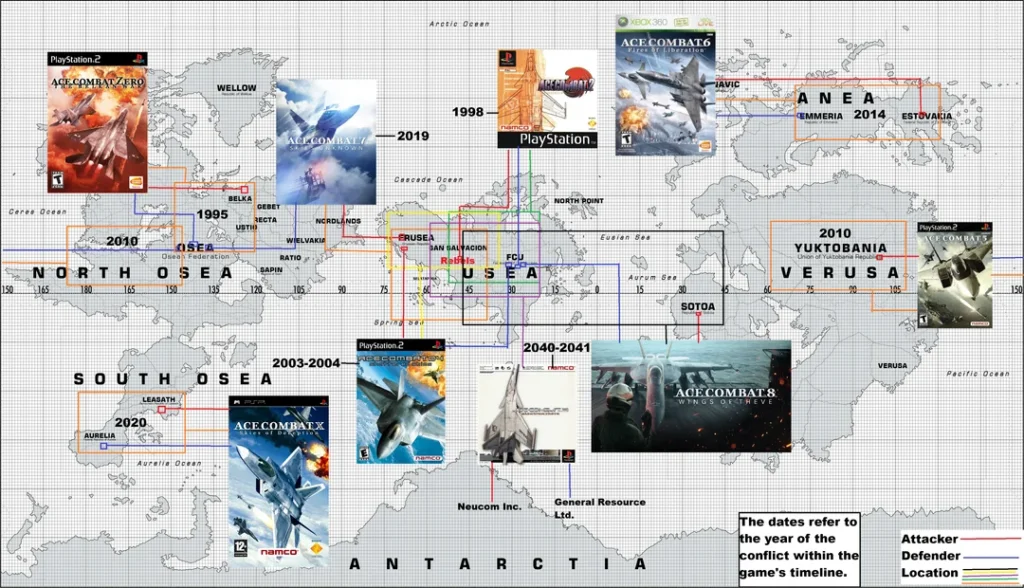
The Strangereal timeline is built around an interconnected sequence of wars, peace treaties, and political crises that gives the Ace Combat series a layered historical narrative. Each entry develops conflicts established in earlier games, allowing rivalries, alliances, and unresolved political tensions to influence later events. Early wars create the foundational divisions between major nations, while subsequent conflicts expand in scale through advanced military technology, satellite systems, and global defense networks.
Although periods of peace occur throughout the timeline, Strangereal repeatedly returns to war. This cyclical structure reinforces the idea that political instability does not disappear simply because a military campaign ends or a peace agreement is signed. Unresolved territorial disputes, strategic rivalries, and political grievances eventually reappear in new forms, allowing the series to examine how one conflict can shape the conditions that produce another.
One of the franchise’s greatest strengths is its ability to combine this serious political storytelling with fast-paced arcade gameplay. Players participate in high-speed aerial battles while the surrounding narrative addresses war ethics, military strategy, international relations, and the political decisions driving each operation. The accessible combat does not diminish the thematic depth, and the political narrative does not unnecessarily interrupt the action. Instead, both elements support one another, creating an experience in which cinematic missions remain connected to the wider consequences of war.
Ethical conflict is central to many Ace Combat campaigns, particularly when military necessity comes into conflict with moral responsibility. Collateral damage, civilian displacement, and escalating violence appear repeatedly, demonstrating that even operations presented as strategically necessary or justified can produce unintended humanitarian consequences. Successful missions may achieve an immediate military objective without resolving the suffering or instability created by the wider conflict.
By placing players in the role of pilots operating within larger command structures, the series also raises questions about responsibility and accountability during wartime. Pilots carry out orders and influence the course of battles, but they rarely control the political systems that determine why the war began or how military power is used. This tension between individual action and institutional authority allows Ace Combat to deliver accessible aerial combat while maintaining a serious examination of recurring conflict, political failure, and the human consequences of military decisions.
How Ace Combat Uses Fictional Politics, Diplomacy, and Military Conflict
Although Ace Combat avoids directly referencing real-world countries, its fictional conflicts frequently reflect recognizable global political patterns, including superpower rivalry, regional instability, technological arms races, and competition for military influence. The Strangereal setting gives the series enough distance from actual geopolitical events to explore these sensitive ideas without tying its stories to one specific nation or historical conflict. As a result, the political situations feel familiar while remaining flexible enough to support the franchise’s fictional history, alliances, and wars.
This approach gives Ace Combat a layered narrative that extends beyond aerial battles and mission objectives. Players are not simply destroying targets or completing military operations; they are participating in conflicts shaped by national interests, political mistrust, military expansion, and historical grievances. The wider geopolitical context adds emotional weight to each campaign, making victories feel consequential and losses more impactful because every mission affects a larger political struggle.
Diplomacy also plays an important role throughout the Ace Combat universe. Peace treaties, ceasefires, and international negotiations frequently become major narrative turning points, offering temporary opportunities to end wars or prevent further escalation. However, these agreements are often fragile. Political mistrust, unresolved historical grievances, and interference from outside forces can quickly undermine attempts at stability, allowing old conflicts to return in new forms.
This portrayal emphasizes how difficult peace can be to maintain in a world where military power frequently outweighs diplomatic solutions. It also helps explain why the series’ political storytelling continues to resonate with fans. Ace Combat combines the accessibility and spectacle of arcade-style aerial combat with a world that treats war, diplomacy, and political consequences seriously. That balance between immediate action and broader narrative substance has allowed the franchise to remain meaningful across different generations of players.

Frequently Asked Questions (FAQs)
- What makes Ace Combat a political series?
The series focuses on wars between nations that are shaped by government decisions, military authority, and competing geopolitical interests. Its battles are not presented as isolated conflicts, as each one develops from wider political tensions and decisions made by national leaders. - Is Ace Combat based on real-world politics?
The series draws inspiration from recognizable real-world political patterns, but it does not directly recreate actual countries or conflicts. Instead, it uses the fictional Strangereal universe to explore subjects such as international rivalry, military escalation, and political instability. - What is Strangereal in Ace Combat?
Strangereal is the fictional world in which the stories of Ace Combat take place. It has its own nations, political history, alliances, rivalries, and military conflicts, allowing the series to build interconnected wars without depending directly on real-world geography. - Are Osea and Erusea real countries?
No, Osea and Erusea are fictional nations created for the Strangereal universe. They are used to represent different political interests, military strategies, and national viewpoints within the series’ broader conflicts. - Does Ace Combat support any political ideology?
No, the series does not promote a particular real-world political ideology. It instead examines how governments, military institutions, and international systems behave during periods of tension, instability, and war. - Why does war keep happening in Ace Combat?
Conflict repeatedly returns because the series presents political instability as cyclical. Peace may temporarily end active fighting, but unresolved rivalries, mistrust, and global tensions can remain and eventually create the conditions for another war. - How important is propaganda in Ace Combat?
Propaganda is an important part of how wars are presented and understood within the series. Governments and media can shape public perception, influence national morale, and control how their own military actions or opposing forces are viewed. - What real-world era influences Ace Combat?
The Cold War is a major influence on the series’ political structure and conflict design. This can be seen in its focus on competing powers, international tension, military expansion, and conflicts shaped by strategic rivalry. - Is Ace Combat realistic?
Its gameplay is primarily arcade-focused, emphasizing accessible and fast-paced aerial combat rather than strict simulation. However, its political themes are more grounded, exploring recognizable ideas involving governments, warfare, propaganda, and international relations. - Why do fans consider Ace Combat storytelling unique?
The series combines exciting aerial combat with detailed geopolitical storytelling. Players can enjoy cinematic missions while also following a larger narrative involving fictional nations, political decisions, military conflict, and the consequences of war.

Conclusion
The franchise Ace Combat demonstrates that even arcade-style action games can carry deep political meaning when built within a carefully constructed world. Through its Strangereal universe, the series explores war not as isolated conflict but as the outcome of layered political systems, ideological struggles, and media influence.
By blending cinematic gameplay with geopolitical storytelling, the series has created a unique space in gaming where entertainment and political reflection coexist. Its enduring appeal lies in its ability to present complex global issues through the lens of aerial combat without losing accessibility or emotional impact.
Sources and Citations
- Ace Combat Series Overview (Wikipedia)
https://en.wikipedia.org/wiki/Ace_Combat - Strangereal Universe Lore (Ace Combat Wiki)
https://acecombat.fandom.com/wiki/Strangereal - Bandai Namco Entertainment Official Site
https://www.bandainamcoent.com/ - Ace Combat Franchise Information (Bandai Namco: Ace Combat Portal)
https://www.bandainamcoent.com/series/ace-combat - Video Game Narrative Analysis: Military Fiction in Games (General Studies Source)
https://www.gamasutra.com/ (Game Developer archives / articles on narrative design)
Recommendations
- Palworld 1.0 Refined Ingots Guide: How to Craft Them and Farm Ore and Coal Fast
- Planet of Lana II: Children of the Leaf Review, a Beautiful Sequel that Sticks to the Winning Formula
- Resident Evil Requiem Gets Free “Leon Must Die Forever” Mode Explained: Fast-Paced Bonus Update Now Available
- Tom Noonan, RoboCop 2 and Manhunter Actor, Dead at 74: Cause of Death, Movies, and Tributes
- Cheap Render Farm: Guide to Budget-Friendly Cloud Rendering for 3D Artists & Game Developers
- Xbox 25th Anniversary Controller: Release Date, Price, Design Rumors, and What to Expect
- Crimson Desert Reveals Console Specs, Some Compromises on PS5 Explained
- What Is Gaussian Splatting? A Complete Guide to This Revolutionary Rendering Technique
- Dune: Part Three is Shaping up to Be a Very Unpredictable Sequel, Here’s Why
- Freelance and Indie Commercial License



































































































