









In This Article (9 sections)
Agility Robotics AGLT SPAC Merger, Valuation, and Public Listing Plan
The Agility Robotics AGLT SPAC Merger has become one of the most closely watched stories in humanoid robotics, public-market automation investing, and the next phase of physical AI. Agility announced the planned transaction with Churchill Capital Corp XI on June 24, 2026, positioning the Oregon-based humanoid robotics company for a public listing under the ticker symbol AGLT after the deal closes. The transaction would value Agility Robotics at a $2.5 billion pre-money equity value and is expected to bring the company more than $620 million in gross proceeds, including cash held in Churchill XI’s trust account and a PIPE investment led by Foxconn.
The proposed business combination gives Agility Robotics a path to public markets through a SPAC merger rather than a traditional initial public offering. Churchill Capital Corp XI is a publicly traded special-purpose acquisition company listed under the ticker CCXI, and once the transaction is completed, the combined company is expected to operate as Agility. This structure gives Agility a public-market identity while providing investors with a more direct way to gain exposure to humanoid robotics, especially robots built for manufacturing, distribution, and logistics environments.
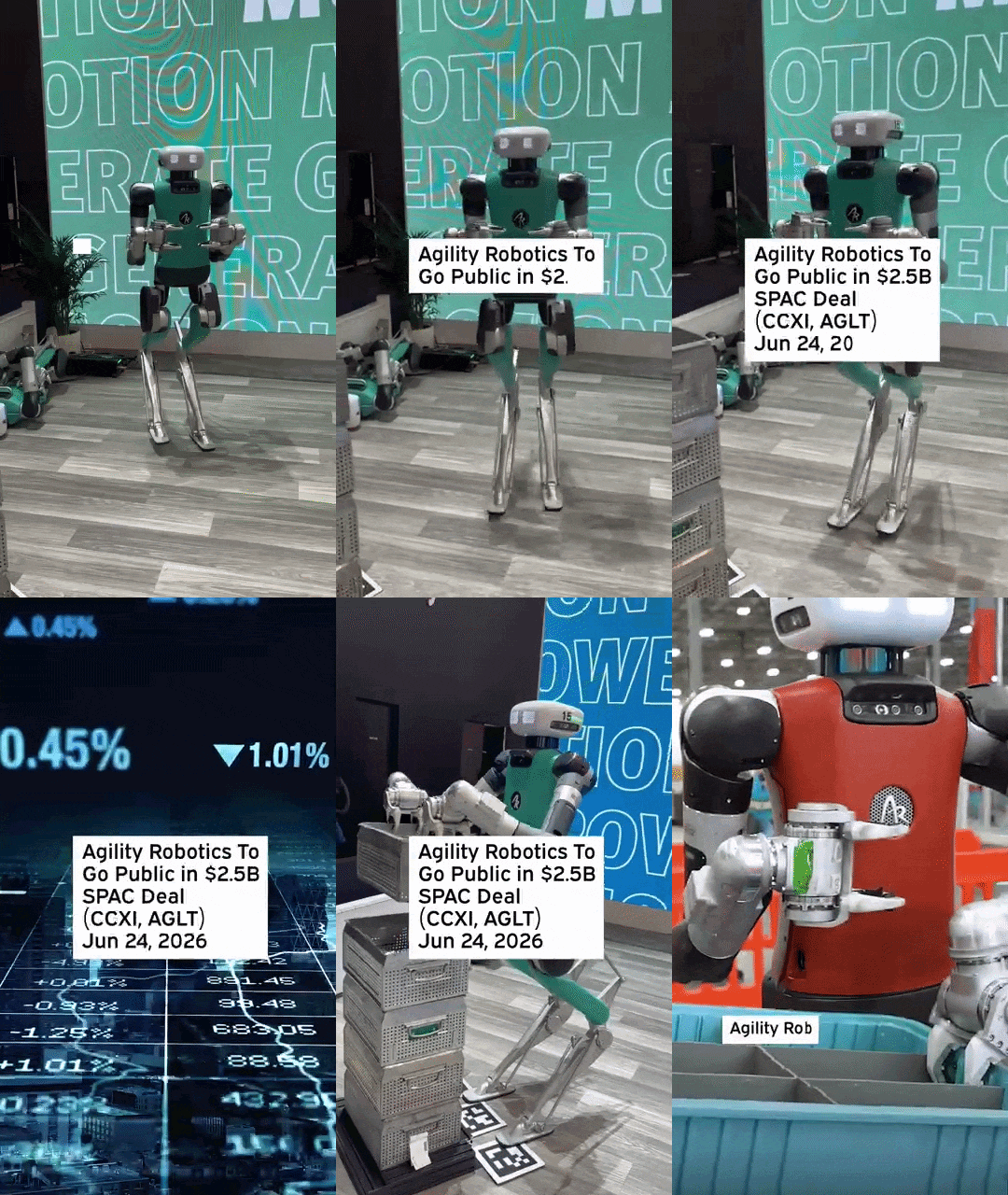
The deal matters because Agility is not presenting humanoid robotics only as a futuristic concept or a research-stage demonstration. Its flagship robot, Digit, is designed to perform physical work in spaces built for people, including repetitive tasks such as moving totes, handling containers, and supporting material flow inside warehouses and industrial facilities. The company says Digit has accumulated more than 65,000 hours of operation across customer facilities and that Agility has secured more than $300 million of multi-year contracted orders for Digit v5, subject to certain contractual milestones.
For Agility, the $2.5 billion Churchill Capital XI deal is not simply a financial event. It is also a scaling event. Humanoid robotics companies face expensive challenges in engineering, manufacturing, safety, software, deployment, and customer support before they can reach large-scale adoption. Agility plans to use the expected proceeds to fulfill existing customer orders, expand commercial deployments, scale Digit v5 production, and continue investing in its integrated platform across robotics, physical AI, software, safety systems, and manufacturing infrastructure.
The transaction also gives Agility a potential public-market distinction before several major humanoid robotics rivals. Tesla’s humanoid effort is part of a much larger electric vehicle, energy, and AI company. Boston Dynamics is owned by Hyundai Motor Group. Figure AI remains private. By contrast, Agility is expected to become a publicly traded pure-play humanoid robotics company, making AGLT a potentially unique ticker for investors seeking specific exposure to humanoid automation rather than a broader technology or automotive business.
AGLT as a Western Humanoid Pure Play and Foxconn-Backed Public Listing
Agility Robotics is becoming what the company describes as the only U.S. publicly listed pure-play humanoid company with proven, active commercial deployments. That distinction is central to the investment story because Agility’s business is centered on humanoid robots as its core product rather than treating humanoid robotics as a side project inside a larger corporation. A pure-play company gives shareholders more direct exposure to one specific theme, and in this case, that theme is humanoid robotics for industrial and logistics work.
The phrase “Western humanoid pure play” also reflects the broader geopolitical and industrial context around robotics. Humanoid robotics is not only a technology race. It is also tied to manufacturing capability, supply chain resilience, labor productivity, and national competitiveness. Agility’s CEO Peggy Johnson has framed humanoids as part of American technology leadership and global industry, while the company argues that robots such as Digit can help address labor shortages and improve supply chain resilience.
Foxconn’s role strengthens the transaction because the deal includes approximately $200 million of incremental financing through a common-stock PIPE committed at $10 per share. Foxconn is leading that PIPE, with participation from existing and new institutional investors. A PIPE, or private investment in public equity, is often used in SPAC transactions to provide committed capital from strategic or institutional investors, and Foxconn’s involvement is especially relevant because of its global manufacturing expertise.
Foxconn is one of the world’s most important contract manufacturers and a major player in global electronics production. Its participation signals confidence from a strategic investor that understands scale, production systems, component sourcing, and manufacturing complexity. Foxconn was already listed among Agility’s strategic investors and partners, alongside Nvidia, Amazon, SoftBank Vision Fund 2, Schaeffler, DCVC, Abico, and Playground Global. That investor base gives Agility a stronger narrative than a typical early-stage robotics startup because it suggests support from companies with deep knowledge of logistics, AI computing, manufacturing, and industrial operations.
The combined company is expected to operate as Agility after the transaction closes and list under the ticker symbol AGLT on a major North American exchange. The ticker is central to the public-market story because it would become the symbol associated with Agility Robotics’ humanoid robotics business. As the transaction moves through regulatory review and shareholder approval, terms such as Agility Robotics stock, AGLT stock, AGLT IPO, Agility Robotics IPO, and Agility Robotics SPAC are likely to become increasingly common among investors following the deal.
The listing is not immediate. The transaction must still close, and the company has stated that closing is expected in 2026. Completion remains subject to Churchill XI shareholder approval, SEC review of the registration statement on Form S-4, required regulatory approvals, stock exchange approval for listing the combined company’s securities, and other customary closing conditions.

Churchill Capital XI Proceeds, SPAC Structure, and Use of the $620M Funding
Churchill Capital Corp XI is taking Agility Robotics public through a SPAC merger. A SPAC is a blank-check company that raises money in an initial public offering and then seeks a private company to merge with. Once the business combination is completed, the private company effectively becomes public through the combined entity. Churchill Capital Corp XI is associated with Michael Klein, a well-known SPAC sponsor and dealmaker, and in this transaction it provides the public listing vehicle, trust-account capital, and merger structure needed to bring Agility to the public markets.
The transaction is expected to contribute $420 million of cash held in Churchill XI’s trust account, assuming no redemptions, along with the approximately $200 million PIPE financing led by Foxconn. Together, the deal is expected to provide more than $620 million of gross proceeds. The announced valuation is a $2.5 billion pre-money equity value, meaning it reflects Agility’s value before adding the expected cash proceeds from the transaction.
That valuation reflects investor appetite for humanoid robotics, but it also creates a high bar for future execution. A $2.5 billion valuation implies that public investors will expect Agility to convert customer interest, pilot deployments, operational experience, and contracted orders into meaningful revenue growth over time. The company’s credibility rests heavily on its claim that Digit is already commercially deployed and that Agility has accumulated multiple years of experience in real customer environments.
The expected proceeds are important because humanoid robotics is capital-intensive. Building and deploying robots requires hardware engineering, supply chain development, manufacturing capacity, quality control, safety validation, software integration, customer support, and field operations. A company attempting to scale humanoid deployments cannot rely only on impressive demonstrations. It needs enough capital to produce units, service customers, improve reliability, and support enterprise deployments.
Agility plans to use the expected $620 million-plus funding to fulfill existing customer orders, expand commercial deployments, scale Digit v5 production, and continue investing in its integrated platform. The company has specifically identified robotics, physical AI, software, safety systems, and manufacturing infrastructure as areas of continued investment. This use of proceeds reflects the practical challenge facing Agility: moving from limited deployments and contracted commitments to broader commercial adoption.
Digit v5 is described by the company as its next-generation humanoid robot and as the world’s first AI-enabled cooperatively safe humanoid robot. The emphasis on safety is critical because humanoid robots are expected to operate in environments where people are present, unlike many traditional industrial robots that work behind fences or inside tightly controlled automation cells. Funding also matters for customer confidence, since large industrial customers do not want to depend on a supplier that cannot scale production, maintain service quality, or support long-term deployments. By going public and raising a large pool of capital, Agility is trying to reassure potential customers that it can support multi-year automation programs rather than one-off pilots.
Digits, Enterprise Customers, and Investor Interest in Humanoid Robotics
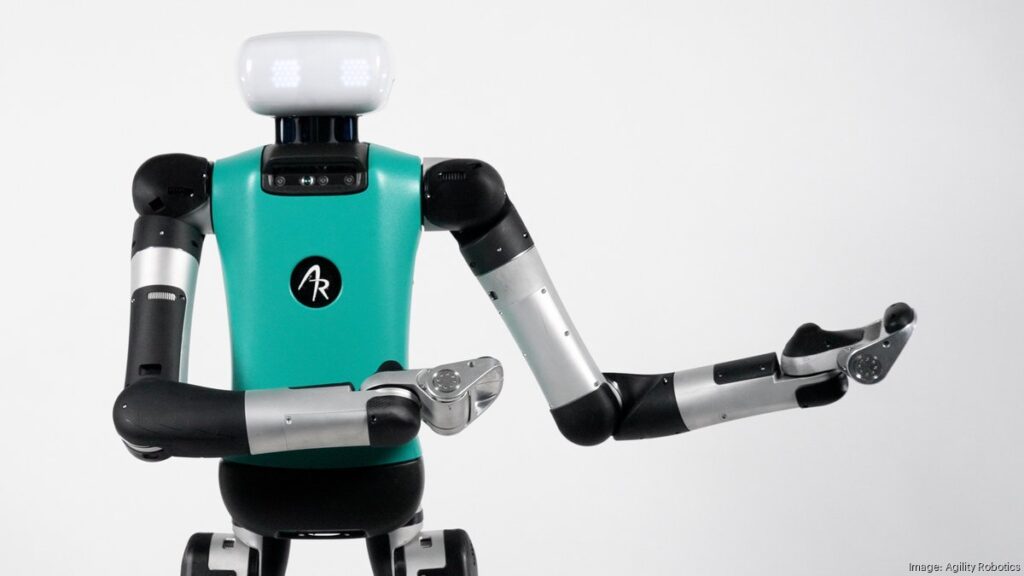
Digit is the core product behind the Agility Robotics AGLT SPAC Merger story. It is a bipedal humanoid robot designed for work in manufacturing, distribution, and logistics environments. Agility describes Digit as a general-purpose, human-centric robot made for work, and the company says it is currently operating in commercial environments that involve repetitive physical tasks.
Digit’s design differs from some popular ideas of what a humanoid robot should look like. Associated Press reporting notes that Digit has birdlike legs and gripper-style hands rather than a fully humanlike body. Agility co-founder Jonathan Hurst has said the company did not set out to build a machine that looks like a person. Instead, the company designed Digit around the work it needs to perform.
This design philosophy matters because the goal is not to build a robot that looks impressive on stage. The goal is to create a machine that can safely, reliably, and economically handle physical tasks in spaces where human workers already operate. Warehouses and factories contain aisles, bins, totes, stairs, pallets, carts, shelves, doors, and human coworkers. A humanoid or bipedal form can be useful if it lets the robot move through those environments without requiring an expensive rebuild of the entire facility.
Agility has drawn attention because its customer and investor list includes major enterprise names. The company’s own announcement says Digit is commercially deployed with Schaeffler, GXO, Toyota Motor Manufacturing Canada, and Mercado Libre. Other reporting identifies Amazon as a customer using Agility’s products in warehouses, while Agility also lists Amazon as one of its strategic investors and partners. These relationships are central to the AGLT investment thesis because robotics startups often struggle to prove that products working in demonstrations can create economic value in real operating environments.
Agility is trying to show that Digit is not simply a lab prototype. The company says it has deployment commitments across nine customer facilities and more than 65,000 hours of operation in live production environments. Amazon’s connection matters because Amazon is one of the world’s most advanced logistics and warehouse automation companies. Toyota matters because automotive manufacturing is one of the most demanding industrial environments. GXO matters because contract logistics companies manage large labor-intensive operations for many customers. Schaeffler adds a manufacturing and industrial supplier context. Together, these names help Agility make the case that Digit can serve real enterprise use cases rather than narrow demonstrations.
Investors are watching the Agility Robotics SPAC deal because it combines several powerful market themes: humanoid robotics, artificial intelligence, warehouse automation, reshoring, labor shortages, and public-market access to a category that has mostly remained private. The timing is important because humanoid robotics has become more visible as AI models, sensors, simulation tools, motion planning, and robotics hardware improve.
Private companies such as Figure AI have attracted major funding, while Tesla has promoted Optimus as part of its long-term AI strategy. Agility’s planned listing could test whether public investors are ready to value humanoid robotics companies based on future adoption rather than mature revenue and profit metrics. It also follows renewed interest in SPACs after the earlier boom-and-bust cycle, meaning public investors are likely to scrutinize Agility’s customer adoption, production progress, safety performance, and revenue conversion more carefully than they might have during the 2020 and 2021 SPAC surge.

Agility Robotics Competition, Foxconn Scaling Potential, and Public Listing Risks
Agility Robotics is entering a competitive field that includes Tesla, Figure AI, Boston Dynamics, Apptronik, Unitree, and other robotics companies. The comparison is complicated because each company has a different strategy, ownership structure, market focus, and level of commercialization. Tesla’s Optimus benefits from Tesla’s engineering resources, AI ambitions, manufacturing experience, and public-market visibility, but it is part of Tesla rather than a standalone humanoid robotics investment. Figure AI has become one of the most visible private humanoid robotics startups, with a strategy focused on general-purpose humanoid labor and AI integration. Boston Dynamics has decades of robotics experience and is known globally for advanced mobility, but it is owned by Hyundai and is not a pure public humanoid listing.
Agility’s argument is different. It emphasizes commercial deployments, enterprise customers, and a purpose-built robot for manufacturing, distribution, and logistics. Instead of trying to build a robot that imitates human appearance, Agility focuses on a “made for work” machine that can operate in industrial spaces. This may make Agility less flashy than some competitors, but it could also make the company more credible with customers that care about uptime, safety, workflow integration, and return on investment.
Foxconn’s investment could help Agility Robotics scale production because Foxconn brings strategic credibility in manufacturing and supply chain execution. Building a humanoid robot at scale is not only a robotics problem. It is also a manufacturing problem involving components, suppliers, assembly processes, electronics, quality assurance, cost reduction, and production repeatability. Agility has said the transaction proceeds will support scaling Digit v5 production and continued investment in manufacturing infrastructure. Although the announcement does not say Foxconn will manufacture Digit, its financial leadership in the PIPE suggests a strategic relationship that could help Agility as it moves from deployments and orders toward larger production volumes.
The challenge is that humanoid robots are more complex than many consumer electronics devices. They combine motors, actuators, batteries, sensors, compute, software, mobility systems, grippers, safety systems, and rugged physical design. Even if demand exists, production can become a bottleneck. Foxconn’s investment therefore matters less as a headline number and more as a signal that manufacturing-focused capital is backing Agility’s attempt to industrialize Digit.
The public listing is still not guaranteed until the transaction closes. The boards of both Agility and Churchill XI have unanimously approved the proposed business combination, but the deal remains subject to Churchill XI shareholder approval, SEC review of the Form S-4 registration statement, required regulatory approvals, approval by the relevant stock exchange to list the combined company’s securities, and other customary closing conditions. The transaction is expected to close in 2026.
There are also financial, operational, and valuation risks. The expected gross proceeds assume that Churchill XI shareholders do not redeem shares in a way that materially reduces the cash available from the trust account, and SPAC redemptions have been a major issue in many transactions. Agility must also prove that Digit can be manufactured at scale, deployed reliably, and supported economically.
The company must show that customer pilots and contracted orders can become durable revenue while managing technical challenges in safety, perception, manipulation, battery life, mobility, serviceability, and software updates. A $2.5 billion pre-money valuation may look attractive if Agility becomes a leader in a large humanoid robotics market, but it may look aggressive if deployments scale more slowly than expected. Investors will need to separate the long-term promise of humanoid robotics from the near-term realities of production, gross margins, and customer economics.

Frequently Asked Questions (FAQs)
- Is AGLT a risk-free robotics investment?
No. AGLT would carry significant risks, including SPAC redemption risk, regulatory review risk, valuation risk, production-scaling risk, customer adoption risk, and competition from companies such as Tesla, Figure AI, Boston Dynamics, Unitree, and others. The opportunity is large, but humanoid robotics remains an early commercial market, and Agility will need to prove that Digit can scale reliably, economically, and safely in real customer environments. - What is the Agility Robotics AGLT SPAC Merger?
The Agility Robotics AGLT SPAC Merger is the proposed business combination between Agility Robotics and Churchill Capital Corp XI. If completed, the deal will take Agility Robotics public through a SPAC structure rather than a traditional IPO, and the combined company is expected to operate under the Agility name and trade under the ticker symbol AGLT. - What is the valuation of the Agility Robotics SPAC deal?
The transaction values Agility Robotics at a $2.5 billion pre-money equity value. That means the valuation reflects Agility’s value before adding the expected cash from the transaction. The deal is also expected to provide more than $620 million in gross proceeds, assuming no redemptions from Churchill XI’s trust account. - What ticker will Agility Robotics use after going public?
Agility Robotics is expected to trade under the ticker symbol AGLT after the merger with Churchill Capital Corp XI closes. The ticker would become the public-market symbol tied directly to Agility’s humanoid robotics business, making it important for investors following Agility Robotics stock, AGLT stock, and related IPO or SPAC searches. - Who is leading the PIPE investment in Agility Robotics?
Foxconn is leading the approximately $200 million PIPE investment connected to the Agility Robotics SPAC merger. The PIPE is committed at $10 per share and includes participation from existing and new institutional investors. Foxconn’s role is notable because of its global manufacturing expertise and relevance to large-scale production. - What does Agility Robotics make?
Agility Robotics makes humanoid robots for physical work. Its flagship robot is Digit, a bipedal robot designed for manufacturing, distribution, and logistics environments. Digit is intended to operate in spaces built for people and perform repetitive physical tasks such as moving totes, handling containers, and supporting material flow. - Which companies use or work with Agility Robotics?
Agility has named commercial deployments or relationships involving companies such as Schaeffler, GXO, Toyota Motor Manufacturing Canada, Mercado Libre, and Amazon. Agility also lists strategic investors and partners, including Nvidia, Amazon, SoftBank Vision Fund 2, Foxconn, Schaeffler, DCVC, Abico, and Playground Global. These relationships support the company’s claim that Digit is being tested and deployed in real enterprise environments. - Why is the Agility Robotics IPO important?
The Agility Robotics IPO is important because it could create the first publicly listed pure-play humanoid robotics company in the United States with active commercial deployments. That would give investors more direct public-market exposure to humanoid robotics, rather than exposure through broader companies where humanoid robots are only one part of a larger business. - What will Agility Robotics do with the merger proceeds?
Agility plans to use the proceeds to fulfill existing customer orders, expand commercial deployments, scale production of Digit v5, and keep investing in robotics, physical AI, software, safety systems, and manufacturing infrastructure. This funding is intended to help the company move from limited deployments and contracted orders toward broader commercial adoption. - When will the Agility Robotics SPAC merger close?
The transaction is expected to close in 2026. It remains subject to Churchill XI shareholder approval, SEC review of the registration statement on Form S-4, required regulatory approvals, stock exchange approval, and other customary closing conditions. Until those steps are completed, the AGLT public listing is not final.
Conclusion
The Agility Robotics AGLT SPAC Merger: $2.5B Humanoid Robotics IPO Explained shows why Agility Robotics has become one of the most important companies to watch in humanoid robotics. The proposed merger with Churchill Capital Corp XI would give Agility a public listing under the ticker AGLT, value the company at $2.5 billion before new proceeds, and provide more than $620 million in expected gross funding to support customer orders, commercial deployments, Digit v5 production, and continued development of its robotics and physical AI platform.
The deal is important because it could create a rare public-market pure play on humanoid robotics. Agility is not pitching only a distant vision. It is pointing to real deployments, major enterprise customers, more than 65,000 operating hours, and more than $300 million of multi-year contracted Digit v5 orders subject to milestones. That gives the company a stronger commercial story than many robotics startups that remain mostly in prototype mode.
Still, the public listing will be a major test. Agility must prove that Digit can scale from early deployments to large production volumes, that customers will adopt humanoid robots beyond pilots, and that the company can build a sustainable business around hardware, software, service, and enterprise automation. Foxconn’s PIPE leadership, Amazon and Nvidia’s backing, and Agility’s customer list all strengthen the narrative, but public investors will eventually demand execution.
If AGLT succeeds, it could open a new chapter for humanoid robotics investing and become a reference point for the entire sector. If it struggles, it could remind investors that physical AI and humanoid robots are still difficult, expensive, and technically demanding. Either way, the Agility Robotics AGLT SPAC Merger is a landmark moment because it brings the humanoid robotics race directly into the public markets.
Sources and Citations
- Agility Robotics: Agility Robotics To Become Publicly Listed Through Merger With Churchill Capital Corp XI
https://www.agilityrobotics.com/news/agility-robotics-to-become-publicly-listed-through-merger-with-churchill-capital-corp-xi - Business Wire: Agility Robotics And Churchill Capital Corp XI Announce Definitive Business Combination Agreement
https://www.businesswire.com/news/home/20260623000000/en/Agility-Robotics-and-Churchill-Capital-Corp-XI-Announce-Definitive-Business-Combination-Agreement - Associated Press: Agility Robotics Plans Public Listing At $2.5 Billion Valuation
https://apnews.com/article/agility-robotics-spac-churchill-capital-digit-humanoid-robots - The Wall Street Journal: Agility Robotics To Go Public Through Churchill Capital Merger
https://www.wsj.com/business/deals/agility-robotics-spac-merger-churchill-capital-xi-2026 - Investor’s Business Daily: Agility Robotics Stock Debut And Market Reaction
https://www.investors.com/news/agility-robotics-spac-deal-churchill-capital-humanoid-robotics/ - Churchill Capital Corp XI Investor Relations
https://www.churchillcapitalcorp.com/xi - Agility Robotics: Digit Humanoid Robot
https://agilityrobotics.com/robots/digit - Agility Robotics: RoboFab Manufacturing Facility
https://agilityrobotics.com/manufacturing - Foxconn Official Website
https://www.foxconn.com/ - GXO Logistics Official Website
https://gxo.com/ - Schaeffler Official Website
https://www.schaeffler.com/ - Amazon Robotics
https://www.aboutamazon.com/news/operations/amazon-robotics - NVIDIA Robotics And AI
https://www.nvidia.com/en-us/industries/robotics/ - SoftBank Group Official Website
https://group.softbank/en/
Recommended
- Mobile Suit Gundam Hathaway: the Sorcery of Nymph Circe Review: a Bigger, Darker Sequel that Doubles Down on Politics, Memory, and Mecha Warfare
- Sony’s Enhanced PSSR Upscaling Arrives on PS5 Pro Today: What the Upgraded PSSR Update Does and How to Enable It
- Ambrosia Sky Final Act Lands on August 6, Release Date, Story Conclusion, Gameplay Details & What to Expect from Act Two
- Tyrant: The World’s Greatest Dinosaur Comic Returns in New Hardcover Collection as Stephen R. Bissette’s Classic Roars Back
- Samson: a Tyndalston Story New Game Might Scratch that GTA 6 Itch with Its Brutal Debt-Driven Open World Crime Gameplay
- AionGuard Was Supposed To Be The Crimson Desert Of 15 Years Ago, But Was Canceled In A Text
- Forza Horizon 6 Is Every Japanese Driving Fantasy Rolled into One: Why Japan Feels Like the Perfect Setting
- Indie Loop | Three New Indie Games to Check Out: Husk Protocol, the Wilds of Dacrima, Pawsome Resort
- The Game Awards 2026 Sets December Premiere Date: December 10, 2026 at Peacock Theater in Los Angeles
- 18 Games At Nintendo’s March Indie World Showcase (March 2026): Full Switch 2 & Switch List, Release Dates, and Demos



































































































