







In This Article (8 sections)
Avengers Doomsday’s Unfinished Script and the Shift from Kang to Doctor Doom
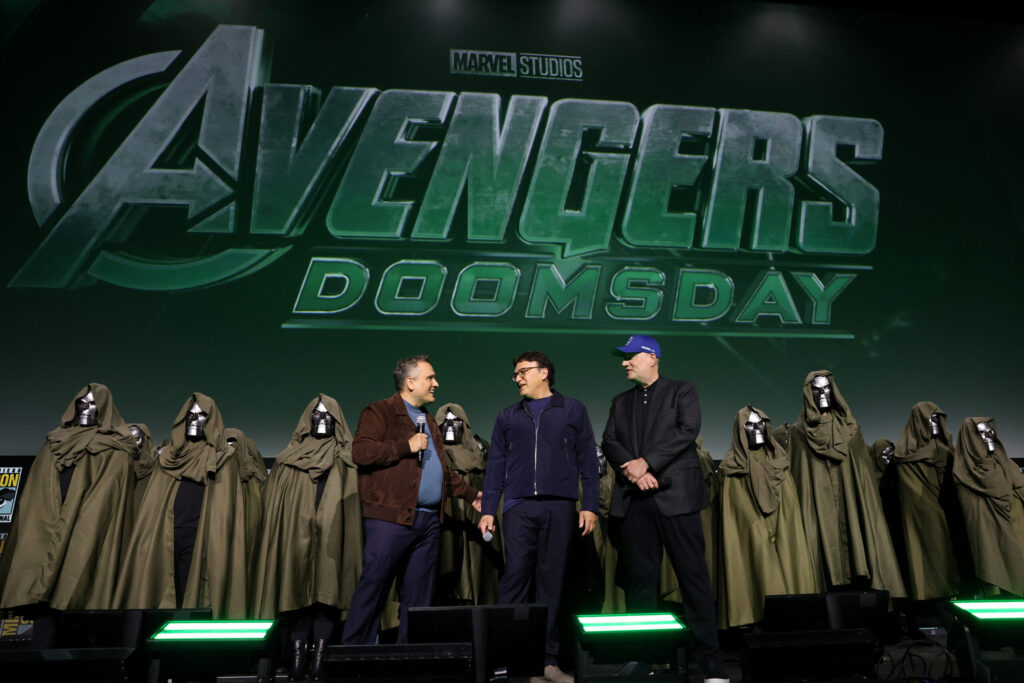
The revelation that Avengers: Doomsday filmed without a finished script has attracted attention because a production of this scale appears, from the outside, to demand an unusually rigid blueprint. Yet directors Joe and Anthony Russo argue that the situation is less chaotic than the headline suggests. In a September 2026 Associated Press interview, Joe Russo described the screenplay as a “living organism” and said the brothers deliberately work through rehearsal, improvisation and what performers discover when they inhabit their characters. AP reported that the reconfigured production entered filming with its screenplay unfinished following the transformation of the fifth Avengers movie from the originally planned Avengers: The Kang Dynasty into the Doctor Doom-centred Avengers: Doomsday.
That description also needs to be reconciled with earlier comments from Marvel Studios president Kevin Feige. During production in 2025, Feige said Marvel had never begun a movie without a full script, while simultaneously acknowledging that Avengers: Doomsday was being changed and improved every day. He described that continuous revision as “plus-ing”, with filmmakers and actors contributing ideas after shooting had already started. The most reasonable reading is therefore not that Marvel began shooting Avengers: Doomsday with no screenplay.
Rather, the project had a workable script or draft while significant portions remained fluid instead of being permanently locked. That distinction is crucial when assessing whether the Russos’ approach represents reckless blockbuster filmmaking or simply a more extreme version of an iterative process they and Marvel have used before.
The phrase “filmed without a finished script” can easily create the impression that actors arrived on elaborate Marvel sets without knowing what story they were making. The available evidence does not support that interpretation. AP specifically reported that the revamped production went into shooting with an unfinished screenplay, while Joe Russo explained that the directors regard screenplays as works that remain responsive to performers and rehearsals.
Earlier, Feige had said Marvel starts movies with full scripts but continues changing those scripts once production is under way. The distinction is between having a complete working draft and having a final, locked screenplay in which dialogue, character beats and scene construction are considered finished. On Doomsday, the latter apparently remained unusually fluid.
Feige confirmed that Michael Waldron was assisting longtime Russo collaborator Stephen McFeely with the screenplay during production, reinforcing the conclusion that writing continued after cameras started rolling. On-set rewriting consequently became one of the defining talking points around Avengers: Doomsday, with Feige describing script improvement as an everyday activity in 2025. That is why the apparently conflicting statements can coexist. Marvel could possess a full narrative document while the Russos could still accurately describe the script as unfinished in the sense that major creative decisions remained open to revision.
The movie itself had already experienced a much larger transformation before shooting. The fifth Avengers film was originally announced around Kang, but the project was substantially reworked after Jonathan Majors was dropped from Marvel following his assault conviction. Doctor Doom became the central antagonist, Robert Downey Jr. was cast in the role, and the Russo brothers returned to direct. AP characterises that restructuring as part of the reason the eventual production entered filming with an unfinished script. That history is important because the Doomsday rewrites did not begin as minor dialogue polishing. The entire Avengers project had undergone a major conceptual reset before production, after which refinement continued during shooting.
How Rehearsals, Improvisation and Actor Input Shaped Avengers Doomsday
The Russos’ explanation begins with their directing philosophy. Joe Russo told AP that they are rehearsal-based and improvisation-based filmmakers who want to see what actors bring to their roles. Some performers, he noted, may not become available until shortly before their scenes are shot, meaning discoveries made during those final rehearsals can influence the material. That consideration becomes particularly significant in Avengers: Doomsday. The film assembles performers associated with several different corners of Marvel history, including the Avengers, Wakandans, New Avengers, Fantastic Four and veteran X-Men characters. AP described the movie as an ensemble that pushes even the Russos beyond the scale they previously handled on Infinity War and Endgame.
With such a cast, treating every line as immutable months before individual performers arrive could prevent the directors from responding to chemistry, performance choices and character knowledge accumulated across previous films. The Russos’ position is that flexibility creates opportunities unavailable to a production that regards the screenplay as untouchable. Joe Russo’s description of the Avengers: Doomsday script as a “living organism” is the clearest summary of the brothers’ approach. His point was not that structure and preparation are unnecessary. It was that a screenplay continues to evolve as actors, rehearsals, staging and production realities reveal new possibilities.
Marvel president Kevin Feige used different language to describe essentially the same production behaviour. In 2025, he called the process “plus-ing”, saying that filmmakers should listen when actors who understand their characters have ideas that could strengthen a scene. Feige specifically praised the mix of performers playing roles for the first or second time and veterans who had lived with their Marvel characters across numerous films. Those two descriptions suggest that Doomsday was designed around controlled evolution rather than rigid adherence to a shooting draft. The screenplay provided the underlying story, while dialogue, beats and possibly larger scene elements could be revised when the filmmakers believed a stronger option had emerged.
Improvisation in a production like Avengers: Doomsday does not necessarily mean actors invent entire plotlines while cameras run. In professional filmmaking, improvisational work can include alternative dialogue, altered reactions, reordered exchanges, changes in blocking or discoveries during rehearsal that are then incorporated into revised pages. Joe Russo’s explanation emphasised the moment when performers actually inhabit scenes. The directors want to observe what each actor brings to the character before treating the written material as final.
Feige’s account adds another layer: he said Doomsday was being “plus-ed” daily because actors and filmmakers could suggest improvements and Marvel wanted to remain receptive to them. The practical implication is that improvisation and rewriting were interconnected. An actor might discover an emotional or comedic beat in rehearsal, and the filmmakers could incorporate that discovery into the next draft rather than leaving it as an isolated unscripted moment.
Marvel has not publicly released a scene-by-scene account showing exactly which Avengers: Doomsday sequences changed in rehearsal. Any claim naming specific rewritten scenes without reliable documentation should therefore be treated cautiously. What the filmmakers have confirmed is the mechanism through which change occurred. Joe Russo said rehearsals help the directors discover what performers contribute, sometimes shortly before filming. Feige similarly said the production adjusted material when actors offered ideas that could improve it.
That means rehearsal was functioning not merely as preparation but as part of the writing process. Dialogue could be refined after hearing an actor speak it, character interactions could change once two performers worked together, and emotional beats could become larger or smaller depending on what appeared natural in the room. The approach places considerable responsibility on the directors and writers because every improvement to an individual scene still has to fit the continuity and dramatic architecture of a gigantic interconnected film.
The Doomsday cast contains performers with radically different levels of familiarity with their characters. Some are relatively new to the MCU, while others have played Marvel roles for many years or are revisiting characters from earlier X-Men films. Feige explicitly argued that this experience matters. He said actors who have played characters repeatedly may understand details of those personalities exceptionally well, so filmmakers should listen when those performers suggest changes.
Rebecca Romijn, returning as Mystique, publicly indicated during production that writing was still continuing and that she did not necessarily know whether she had finished all of her scenes. Her comments illustrated how fluid the production remained even for major returning performers. Actor influence therefore appears to have been an intentional feature rather than an emergency response. For the Russos, performances are information, and what actors discover can feed back into the screenplay.

The Russo Brothers’ Return, Ensemble Approach and Avengers Endgame Comparisons
The Russo brothers did not suddenly invent this method for Avengers: Doomsday. Their careers have long been associated with collaborative ensemble storytelling. Before becoming blockbuster directors, they worked extensively on ensemble television, including Arrested Development and Community. Anthony Russo told AP that he and Joe have always been drawn to ensemble storytelling, a preference the brothers connect partly to growing up in a large family filled with strong personalities.
Their creative partnership with screenwriters Christopher Markus and Stephen McFeely also developed around repeated revision. AGBO’s own account of their writing process for earlier Marvel films describes meticulous outlining followed by scene writing and repeated rewriting. The principle highlighted by their collaborators was that the strongest idea should win, rather than preserving material simply because it appeared in an earlier draft. That background matters because Doomsday is not being approached as a conventional screenplay that becomes sacred on the first day of principal photography. For the Russos, development, rehearsal, production and editing form overlapping stages of storytelling.
Comparisons with Avengers: Endgame show that continuing script changes are not new to Russo-directed Avengers productions. During Infinity War and Endgame, writers Christopher Markus and Stephen McFeely continued revising material after principal photography had begun. Accounts of the production describe writers attending rehearsals, preparing alternatives, responding to editing and making additional changes while sets and actors were still available. What distinguishes Doomsday is the explicit acknowledgement that the revamped film began production before its screenplay was considered finished. Infinity War and Endgame were also conceived and produced as an unusually coordinated pair, with extensive outlining and interconnected narrative planning. AGBO’s retrospective description emphasises the meticulous story architecture behind those films even as individual material changed.
Endgame was also surrounded by extreme secrecy. The Russos restricted full-script access and sometimes used fake material to prevent major plot revelations from leaking. Vanity Fair reported that very few people had access to the complete screenplay. The key lesson is that script evolution and detailed planning are not opposites, and the Russos have previously combined both. They had nevertheless treated Endgame as a genuine ending to their first Marvel run. AP reported that bringing them back required something creatively substantial rather than simply an invitation to repeat their earlier success. Anthony Russo said a “foundational narrative concept” proposed by Stephen McFeely helped convince them to return.
The directors have also stressed that they do not want to rely solely on Marvel’s existing cultural capital. Anthony told AP that the value of the new movie should reside in what it adds rather than merely repeating what audiences already loved. Robert Downey Jr.’s return is tied closely to theirs. AP reported that Downey, now playing Doctor Doom rather than Tony Stark, had said he would not have returned without the Russo brothers. Their comeback is therefore best understood as part of a creative reconstruction of the Avengers franchise rather than a simple reunion.
Marvel officially began unveiling the enormous Avengers: Doomsday cast in March 2025. The announced roster included Chris Hemsworth, Vanessa Kirby, Anthony Mackie, Sebastian Stan, Letitia Wright, Paul Rudd, Wyatt Russell, Tenoch Huerta Mejía and many more, with characters drawn from several branches of Marvel continuity. By 2026, AP described the film as bringing together the Avengers, Wakandans, New Avengers, Fantastic Four and original X-Men characters, with Robert Downey Jr.’s Doctor Doom positioned at the centre of the conflict. The challenge is not merely giving dozens of characters screen time.
Ensemble filmmaking requires determining which characters drive the plot, which relationships carry emotional weight and how separate groups can collide without the movie feeling like disconnected cameos. That challenge explains why the Russos’ rehearsal-driven method could be useful, but also why it is risky. Every rewritten interaction potentially affects pacing elsewhere in an already enormous narrative.
Joe Russo has been the most direct in addressing the script controversy. His defence rests on three connected ideas: scripts remain alive during filmmaking, the brothers build scenes through rehearsal and improvisation, and performers can generate creative discoveries that cannot always be predicted months in advance. Anthony Russo’s broader comments about Doomsday reinforce the scale of the challenge. He told AP that the MCU has become an experiment in how large an ensemble story can become and said the brothers were pushing their ensemble filmmaking further than before.
The Russos therefore do not present the unfinished screenplay as an embarrassing production failure. They frame flexibility as a deliberate creative tool. That does not automatically prove the final movie will work, but it changes the nature of the debate: the question becomes whether they can control this flexible process at Doomsday’s extraordinary scale.

Avengers Doomsday Production Risks, Marvel’s Script Revisions and Release Date
Filming without a finished script creates risk, but an unfinished shooting script does not by itself prove that a film is in trouble. The potential dangers are easy to identify. Major rewrites can increase costs, complicate visual-effects planning, create continuity problems and force editors to solve structural issues later. Those risks become more serious when dozens of high-profile actors have limited availability. However, Doomsday also has experienced filmmakers who have handled large Marvel productions before. Their earlier Avengers films involved substantial rewriting during production, and the Russo-McFeely collaboration has historically combined intensive structural planning with a willingness to revise scenes repeatedly.
The fairest conclusion is therefore that the production method raises execution risk rather than guaranteeing failure. Whether the flexibility produced creative “magic”, as Joe Russo hopes, can ultimately be judged only from the finished film. Kevin Feige’s “plus-ing” explanation provides perhaps the clearest description of Marvel Studios’ philosophy. He rejected the notion that Marvel casually starts movies without screenplays, but he also rejected the idea that a screenplay should stop evolving once filming begins. That process can include filmmaker suggestions, actor input, revisions prompted by performance and adjustments informed by editing. Earlier Russo productions demonstrate similar interaction between writing and production.
Marvel’s approach therefore resembles iterative development: establish the movie’s underlying architecture, then continuously search for stronger execution. The weakness of such a system is that uncontrolled iteration can become expensive or unfocused. Its strength is that filmmakers are not forced to preserve a weaker idea merely because it existed in a draft before shooting. Avengers: Doomsday appears to represent one of Marvel’s most ambitious tests of that philosophy, with its enormous cast and interconnected story increasing both the potential benefits of collaboration and the difficulty of maintaining a coherent narrative.
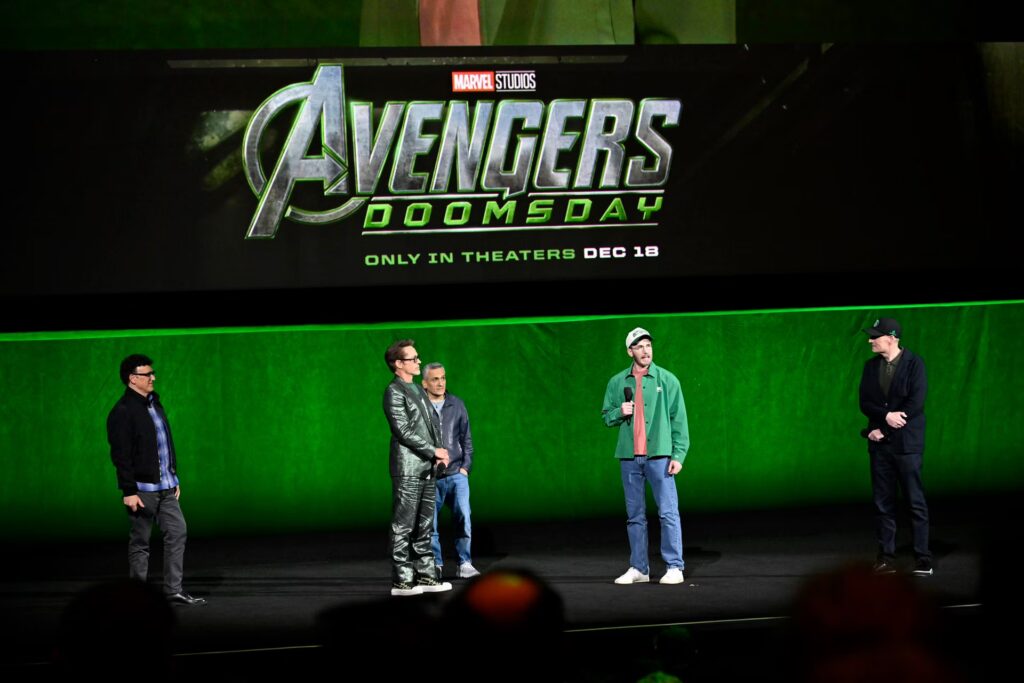
Avengers: Doomsday is scheduled to open theatrically on December 18, 2026. Marvel’s own promotional material has maintained that date, while AP’s September 2026 fall preview also listed the film for December 18. Audiences can expect a crossover involving multiple Marvel teams and cinematic histories, with Robert Downey Jr. appearing as Doctor Doom and the Russos once again directing an Avengers-scale ensemble. AP reported that Doomsday was in scoring and editing in September 2026 while the filmmakers were also beginning early preparation for Avengers: Secret Wars.
The Russos have described the new Avengers story as a major shift rather than an attempt simply to duplicate Endgame. AP also reported that Sergio Leone’s Once Upon a Time in the West served as a particular inspiration as the directors sought to combine spectacle with intimate character moments. The unfinished-script controversy will therefore remain part of the movie’s production story, but the decisive issue is whether that flexible process produces a coherent final film.
Frequently Asked Questions (FAQs)
- Did Avengers: Doomsday really start filming without a finished script?
Yes, according to the September 2026 Associated Press report cited in the article. The revamped production reportedly began shooting while its screenplay was still unfinished. Joe Russo defended this approach by explaining that he and Anthony Russo allow material to evolve through rehearsal, improvisation and performance. However, “unfinished” should not automatically be interpreted as having no story or screenplay, particularly given Kevin Feige’s earlier comments about Marvel beginning productions with full scripts. - Did Avengers: Doomsday start filming with no script at all?
There is no reliable evidence in the reported accounts that the film began without any screenplay. Kevin Feige previously said Marvel had never started a movie without a full script, while acknowledging that Doomsday continued changing during production. A plausible distinction is between a complete working draft and a final, locked screenplay. The filmmakers could have had the overall story written while leaving dialogue, character interactions and scene construction open to further revision. - Why did Joe Russo call the Avengers: Doomsday script a living organism?
Joe Russo was describing a screenplay that continues developing rather than becoming untouchable once filming begins. Rehearsals can reveal stronger dialogue, unexpected chemistry between actors or emotional moments that were less apparent on the page. The Russos want those discoveries to influence the material. His description therefore emphasises responsiveness to performance and collaboration, not the idea that planning is unnecessary or that actors should invent the entire story on set. - Was the Avengers: Doomsday script rewritten during filming?
Yes. Kevin Feige described daily improvements during production as “plus-ing” and confirmed that Michael Waldron was assisting Stephen McFeely with the screenplay. This indicates that writing continued alongside filming rather than ending when cameras started rolling. However, the filmmakers have not provided a public, scene-by-scene breakdown of those revisions. It would therefore be misleading to claim that particular sequences or plot developments were rewritten without supporting documentation. - Did actors contribute to Avengers: Doomsday rewrites?
According to Kevin Feige and Joe Russo, actor input helped the screenplay evolve. Performers who have played their characters repeatedly can bring insight into their personalities, relationships and reactions, while rehearsals allow the directors to assess how an interaction works in practice. Those discoveries could inform revised dialogue or character beats. This does not mean the actors controlled the overall plot; the directors and writers remained responsible for keeping individual changes consistent with the larger story. - Is filming with an unfinished script unusual for Marvel?
Rewriting during production is not unprecedented. Avengers: Infinity War and Avengers: Endgame also underwent revisions during shooting, alongside extensive outlining and interconnected story planning. However, continuing to improve scenes is not necessarily the same as beginning production with significant material unresolved. Doomsday is particularly notable because its screenplay remained unfinished after a substantial creative restructuring. That raises questions about execution, but it does not establish that the film lacked preparation or was destined to encounter problems. - Who wrote Avengers: Doomsday?
Stephen McFeely, a longtime collaborator with the Russo brothers, has been central to the screenplay. Kevin Feige also confirmed during production that Michael Waldron was assisting him as the material continued evolving. McFeely’s involvement extended beyond individual revisions: Anthony Russo said a foundational narrative concept proposed by the writer helped persuade the directors to return. The reported writing process therefore combined an underlying story concept with continued development during production. - Why did Avengers: Doomsday replace The Kang Dynasty?
The fifth Avengers film was substantially reworked after Marvel dropped Jonathan Majors following his assault conviction. Instead of continuing with the previously announced Kang-centred direction, the project shifted towards Doctor Doom, with Robert Downey Jr. taking the role and the Russo brothers returning to direct. This was more than a title change. It represented a major creative reset involving the central antagonist and filmmaking team, followed by further screenplay development during production. - Who is the villain in Avengers: Doomsday?
Robert Downey Jr. plays Doctor Doom, who is positioned at the centre of the film’s conflict. The casting marks Downey’s return to Marvel after his earlier portrayal of Tony Stark, also known as Iron Man. His announced role is therefore different from a straightforward return as the Avengers’ former hero. The film brings that new antagonist into a crossover involving multiple Marvel teams and characters from different cinematic histories. - When does Avengers: Doomsday come out?
Avengers: Doomsday is scheduled for theatrical release on December 18, 2026. That is the date cited in Marvel’s promotional material and the September 2026 Associated Press preview discussed in the article. AP also reported that the film was in editing and scoring that September. The unfinished-script reports concern its production process; they should not, by themselves, be treated as an announcement that the scheduled release has been delayed.
Conclusion
The claim that Avengers: Doomsday filmed without a finished script is accurate when properly defined, but it should not be exaggerated into the claim that Marvel began production without a screenplay or story. AP reported that the heavily reworked movie entered filming while its script remained unfinished, and Joe Russo openly defended that approach. Kevin Feige’s earlier comments clarify the other half of the picture: Marvel had a working screenplay but continued “plus-ing” it throughout production.
The Russo brothers view rehearsals, improvisation, actor knowledge and rewriting as interconnected parts of directing. That method worked alongside extensive revisions on Infinity War and Endgame, although Doomsday presents a still larger ensemble and comes after a particularly significant restructuring of Marvel’s fifth Avengers film.
Whether the strategy was inspired or dangerous will ultimately depend on the completed movie. What can already be established is that the Russos did not accidentally find themselves without a locked script and then invent an excuse. They are defending an intentionally flexible production philosophy; one that considers the script essential, but never untouchable.
Sources and Citations
- Associated Press. Russo Brothers Discuss Avengers: Doomsday, Its Evolving Screenplay, Ensemble Structure, Doctor Doom and December 18 Release. September 2026.
https://apnews.com/ - The Hollywood Reporter. Kevin Feige on Marvel’s Script Process and Daily Avengers: Doomsday Revisions.
https://www.hollywoodreporter.com/movies/movie-news/ - GamesRadar+. Even Though Avengers: Doomsday Has Been Filming for 3 Months, Marvel Boss Kevin Feige Says the Script Is Still Being Worked On.
https://www.gamesradar.com/entertainment/marvel-movies/even-though-avengers-doomsday-has-been-filming-for-3-months-marvel-boss-kevin-feige-says-the-script-is-still-being-worked-on-theres-plus-ing-happening-every-day/ - Marvel. Avengers: Doomsday Official Movie Page — December 18, 2026 Release.
https://www.marvel.com/movies/avengers-doomsday - Marvel. Kevin Feige Teases the Fantastic Four in Avengers: Doomsday and Discusses the Film’s Ensemble.
https://www.marvel.com/articles/movies/fantastic-four-first-steps-avengers-doomsday-kevin-feige - AGBO. Russo Brothers — Official Filmmaker and Production Company Information.
https://agbo.com/ - GamesRadar+. The Avengers: Infinity War Writers Talk Juggling a Big Cast, Rewriting, and the Russo Brothers’ Creative Process.
https://www.gamesradar.com/the-avengers-infinity-war-writers-talk-juggling-a-big-cast-focusing-on-thanos-and-what-to-expect-from-avengers-4/ - Vanity Fair. Avengers: Endgame Coverage — Russo Brothers, Production Secrecy and Screenplay Access.
https://www.vanityfair.com/hollywood/avengers-endgame
Recommendations
- Avengers Doomsday Script
- Marvel Cinematic Universe
- Ucupaint for Beginners: How to Texture Paint With Layers in Blender (Step-by-Step)
- Shiva Baby Leaving Netflix: Why Rachel Sennott’s 77 – Minute Anxiety Thriller Is a Must Watch Breakout Before It Disappears
- A Palworld Horror-Themed Dating Sim Spinoff Is on the Way: What We Know About More Than Just Pals
- A Beginner’s Guide to The View Keeper Add-on for Blender
- Substance 3D Painter’s Role in Modern Pipelines: Why It Still Matters
- Sea of Remnants Offers Ocean Exploration and Piracy in a Gorgeous Open World
- Obsession Box Office Second Weekend Surge: How the Horror Film Beat Hollywood Norms and Sold More Tickets than Its Opening Weekend
- Lootbound Makes Inventory Management the Main Event in a Tactical Fantasy Roguelike



































































































