









In This Article (8 sections)
Blood Dungeon Release Date, Platforms, Game Pass, Pricing, and System Requirements
Blood Dungeon officially launched on August 25, 2026, bringing Messhof’s distinctive combination of bullet-heaven combat and movement-heavy 2D platforming to PlayStation 5, Xbox Series X|S, Nintendo Switch, Nintendo Switch 2, and PC. Messhof developed and published the game, following its earlier work on Nidhogg. The launch occurred simultaneously across its major platforms rather than through a staggered console rollout. Steam records August 25 as the PC release date, PlayStation lists the same date for PS5, Nintendo confirms it for both Switch generations, and Xbox lists August 25 for Xbox Series X|S, Windows PC, and cloud access.
There are no official PlayStation 4 or Xbox One versions. The PlayStation release is a PS5-only title, while the Xbox edition is optimized for Xbox Series X|S. Nintendo is the exception to the broader current-generation focus because Messhof released versions for both the original Switch family and Nintendo Switch 2. The game is fundamentally a single-player experience across all platforms, with its competitive elements built around daily challenges, achievements, global high scores, and leaderboards rather than direct multiplayer.
Blood Dungeon launched as a day-one Xbox Game Pass release. Microsoft included it in the August 2026 Game Pass lineup for cloud, Xbox Series X|S, and PC, with access through Game Pass Ultimate and PC Game Pass. Eligible subscribers did not need to purchase the game separately while it remained in the service. This subscription arrangement applies specifically to Microsoft’s ecosystem. The PS5 version is sold through the PlayStation Store, while Nintendo’s editions are available through the eShop.
The Xbox version includes:
- Xbox Play Anywhere
- Xbox achievements
- Xbox cloud saves
- Xbox Cloud Gaming
- Support for frame rates of 60 FPS or higher
- Compatibility across Xbox Series X|S and supported Windows devices
Xbox Play Anywhere allows a qualifying Microsoft Store purchase to work across compatible Xbox and Windows systems without requiring a second copy. Cloud saves help carry persistent progression, unlocked characters, arena access, Bone Shop purchases, and achievement progress between supported devices. The Xbox version includes 45 achievements, matching the broader progression and challenge structure available through Steam.
The PS5 edition supports offline play for one player and provides access to the complete nine-character, six-arena experience. PlayStation Portal cloud streaming is also listed where the appropriate PlayStation Plus Premium functionality is available. No PS5-exclusive arenas, characters, weapons, or progression systems have been announced, so the core game remains consistent with the Xbox, PC, and Nintendo versions.
Both Nintendo editions support the same main content, but Nintendo Switch 2 provides an enhanced version. The original Switch release supports TV, tabletop, and handheld modes, one local player, and Save Data Cloud through Nintendo Switch Online. Nintendo lists its file size at approximately 263 MB. The dedicated Switch 2 Edition is listed separately and adds improved graphics, enhanced screen effects and particles, and a better frame rate. Nintendo does not provide an exact numerical performance target, so claims of a specific resolution or locked frame rate would go beyond the published information.
The Switch 2 Edition currently has a listed file size of approximately 282 MB. Nintendo also references an Upgrade Pack, while its August 2026 download information described the upgrade from the original Switch release as available without an additional charge. The portable formats suit the game’s run-based structure particularly well because even shorter sessions can contribute Bones, quests, weapon unlocks, character progression, or leaderboard scores.
The standard United States price is $9.99 across Steam, PlayStation, Xbox, and Nintendo storefronts. A 15 percent introductory discount temporarily reduced the price to $8.49 on several platforms, including Steam, through September 8, 2026. That promotion has ended, so players should check the current price rather than expecting the launch discount to remain active.
Official and reported storage figures include:
- Nintendo Switch: Approximately 263 MB
- Nintendo Switch 2: Approximately 282 MB
- Steam: Approximately 300 MB of available storage
- Xbox and Windows: Approximately 506 MB according to achievement-tracking services, although the exact figure can change between builds
- PS5: No reliable current size is exposed through the indexed store listing
The Steam version supports Windows and macOS, along with achievements, Steam Cloud, Steam Leaderboards, Family Sharing, and a downloadable demo. Messhof said progress from the pre-release demo transfers to the full game. That demo offered one arena, two characters, and a restricted weapon selection rather than the complete launch package.
The minimum Windows requirements are:
- Windows 10, 64-bit
- Intel Core i5-4570T or AMD A10-5800K APU
- 8 GB RAM
- Nvidia GeForce GTX 650, AMD Radeon HD 7750, or Intel Iris Pro Graphics 580
- DirectX 11
- Approximately 300 MB of available storage
Messhof describes this configuration as targeting 60 FPS at 720p using the Low quality setting. The macOS requirements are macOS 11 Big Sur, an Apple M1 or Intel Core i5 processor, 8 GB RAM, and approximately 300 MB of storage.
Blood Dungeon Gameplay, Auto-Shooting, Platforming, Weapons, and Enemy Hordes
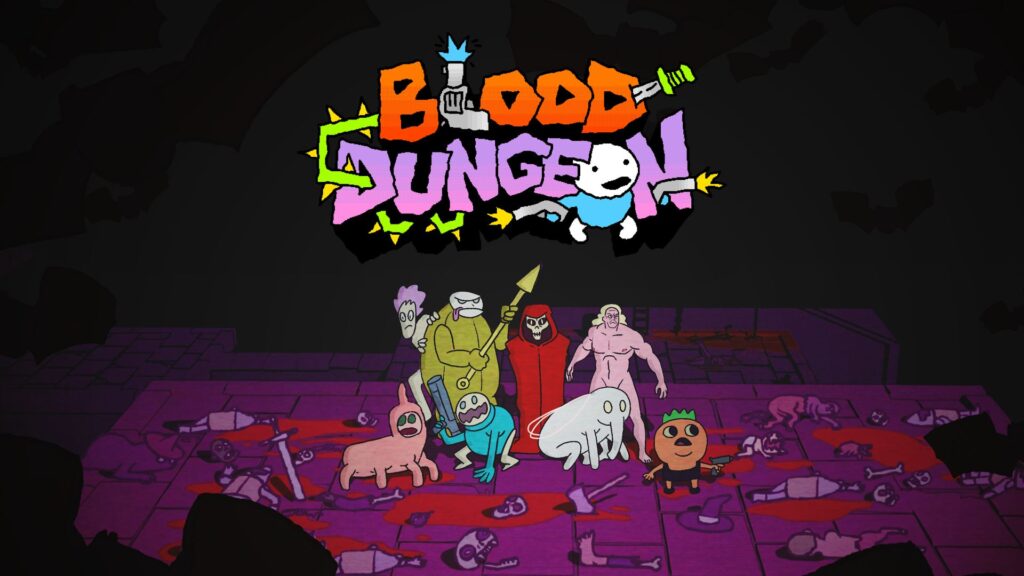
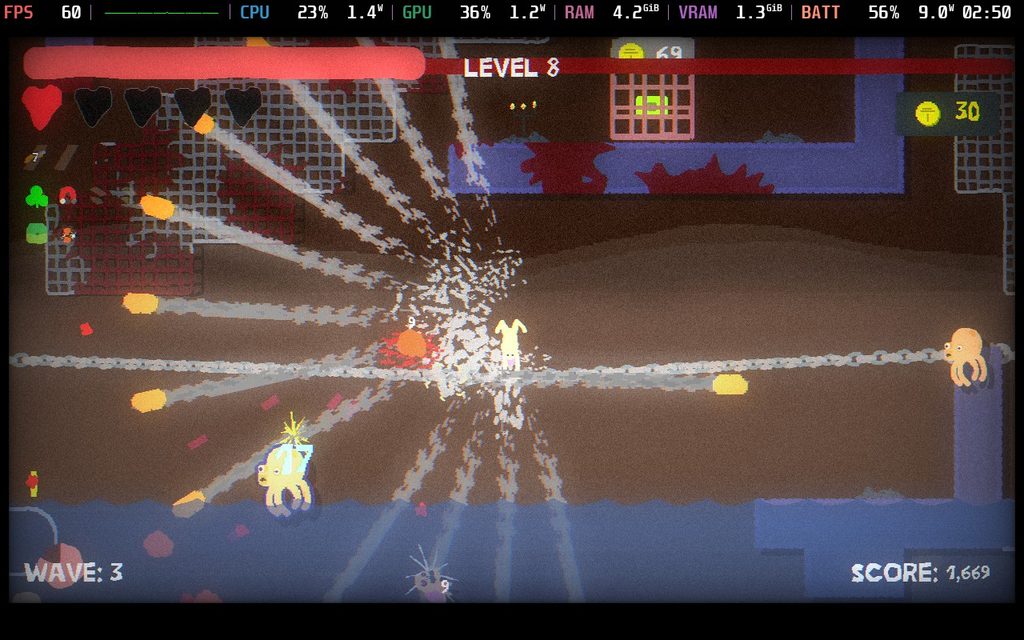
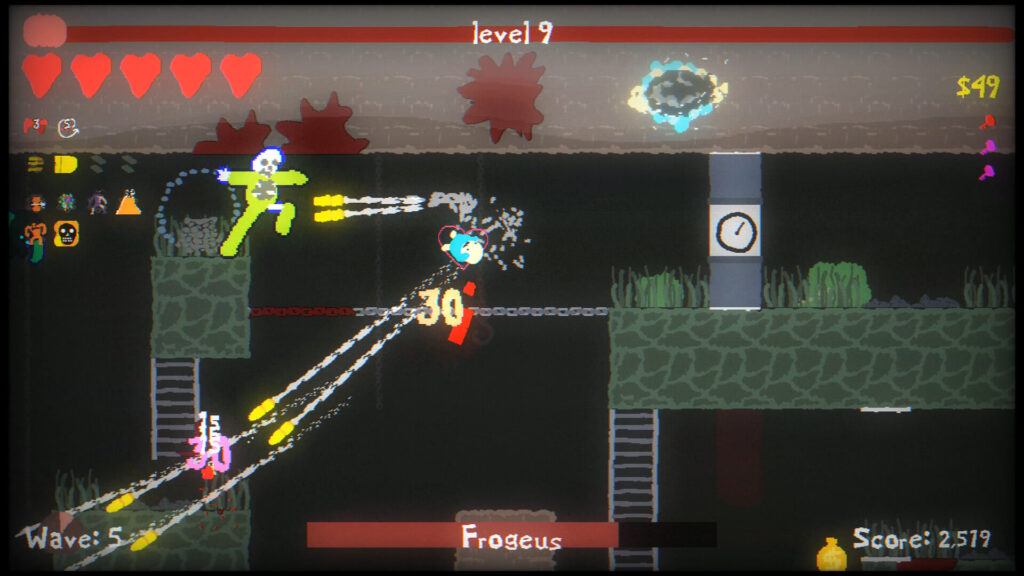
Blood Dungeon is a 2D platforming autoshooter and bullet-heaven roguelite. Messhof describes it as a “feverish bullet heaven platformer,” combining automatic weapon fire and escalating enemy hordes with far more active movement than most games in the genre. Instead of circling monsters across an open top-down field, players run, jump, climb, cling to walls and ceilings, cross grates and chains, swim through water, and use each arena’s architecture to escape increasingly dense attacks.
Weapons fire automatically, allowing the player to focus on movement, survival, positioning, route selection, and upgrades. This does not remove mechanical skill from the game because the side-view arenas contain substantial verticality and traversal challenges. Even after a build becomes extremely powerful, the player still needs to understand how platforms connect, where enemies can enter, which surfaces can be climbed, and which routes provide an escape when the screen becomes crowded.
The movement system includes actions and environmental interactions such as:
- Running and jumping between platforms
- Climbing walls and environmental structures
- Clinging to surfaces
- Moving across ceilings, grates, and chains
- Swimming through water
- Using character-specific movement abilities
- Navigating around terrain-dependent enemy behavior
Enemies do not all obey the same movement restrictions. Messhof highlights bats, centaurs, exploding eyeballs, and other creatures within a roster exceeding 100 enemy types. Some can fly through walls, some walk or cling to surfaces, and others bounce through the arena. A platform that protects the player from one creature may offer no safety against another capable of ignoring terrain.
This variety prevents the player from relying on one route or camping spot indefinitely. Successful movement depends on recognizing which enemies are present, predicting how they will interact with the environment, and choosing a path before the horde closes off safer exits.
Defeated enemies drop Blood, which acts as the main temporary progression resource during a run. Collecting enough Blood raises the current Blood level and produces opportunities to acquire new weapons, improve existing equipment, or add abilities. Chests and designated weapon-drop locations provide additional ways to expand the active build.
The game contains more than 100 unlockable weapons and upgrades. Steam achievements reference a broad selection of offensive, defensive, and movement-related equipment, including:
- Machinegun
- Double Deagles
- Laser
- Magnum
- Axe
- Grenade
- Artillery
- Zombie Ring
- Vampire Ring
- Shield
- Jetpack
The arsenal is not limited to ordinary firearms. Rings, defensive items, explosives, melee weapons, and movement upgrades allow runs to develop in substantially different directions. One attempt may become centered on rapid projectile fire, while another may depend on area damage, orbiting weapons, defensive protection, or increased aerial mobility.
The Machinegun functions as one of the foundational ranged weapons. Steam achievements include firing 25 bullets before reloading and reaching its maximum upgrade level, illustrating how individual weapons have their own mastery goals. Other challenges encourage players to test less conventional combinations and behaviors rather than using the same equipment every time.
The game contains more than 100 quests alongside its achievement system. These objectives encourage different approaches, including avoiding damage, remaining airborne, fully exploring arenas, defeating bosses, killing large groups rapidly, or progressing with particular characters. Achievements and quests are not necessarily identical systems in every case, but together they illustrate how Messhof pushes players toward unusual strategies.
Survival depends on balancing damage output with movement. A powerful build can clear large groups, but arena knowledge remains important because different monsters approach through walls, water, platforms, or open air. Players need to know when to climb, when to drop to a lower route, and when moving toward an enemy is safer than retreating into another horde.
The combination produces two overlapping kinds of skill. Build knowledge determines which upgrades work together, while platforming ability determines whether the player can survive long enough to use those upgrades effectively. This prevents Blood Dungeon from becoming a game in which late-run power eliminates all need for active play.
Blood Dungeon Characters and Six Survival Arenas
Blood Dungeon contains nine playable bunkmates, each offering a different starting setup, movement advantage, weapon style, or unusual ability. Messhof’s official material directly highlights Leggy, Bug, and Skinja, while launch coverage, achievements, and hotfix notes identify the broader character lineup.
The nine playable characters are:
- Gun Man
- Barbarian
- Skinja
- Baby
- Hypnomancer
- Leggy
- Bug
- Powder Keg
- Revivalist
Messhof has not published one comprehensive official breakdown of every character’s starting weapon, exact statistics, and unlock method, so details that are not clearly documented should not be treated as confirmed.
Gun Man is the most straightforward ranged starting archetype and is associated with the Machinegun. The character provides an accessible introduction to the game’s automatic-fire systems and upgrade structure.
Barbarian uses a close-range style centered on circling swords. Reviews describe the character as one of the more visually absurd early options and a contrast to Gun Man’s direct ranged attacks.
Skinja emphasizes speed and a shotgun-oriented approach. One Steam achievement requires the player to avoid damage for two minutes while using Skinja, while another is awarded for reaching Level 5 with the character. The speed advantage makes Skinja suited to players who rely on constant repositioning.
Baby is associated with a powerful Magnum-style weapon and additional money according to launch coverage. The Baby achievement requires purchasing 10 items from the Bone Shop, connecting the character with permanent progression.
Hypnomancer is linked with progression through the Boiler arena. Steam states that defeating Boiler’s second boss awards the Hypnomancer achievement. Launch descriptions associate the character with a gas-based attack style.
Leggy creates climbable webs, giving the player new traversal routes as well as combat utility. The ability can alter how arenas are navigated by creating access to surfaces or escape options that other characters lack. Leggy’s achievement requires killing 50 spiders.
Bug specializes in flight. Messhof explicitly identifies flying as Bug’s defining movement advantage, while the related achievement requires remaining airborne for five seconds. Flight can bypass certain ground routes and hazards, although aerial enemies can still create pressure.
Powder Keg and Revivalist are named in Messhof’s post-launch hotfix notes. The developer addressed bugs involving both characters on August 26 and later issued an additional Revivalist fix. Public documentation does not provide enough reliable detail to state their exact starting weapons or unlock conditions, so the current in-game bunkhouse remains the best source for those specifics.
The game contains six main survival arenas:
- Catacombs
- Pit
- Corridor
- Boiler
- Tombs
- Flood
The arenas are unlocked through a clear progression chain. Catacombs is the starting location. Defeating its first boss unlocks Pit, Pit leads to Corridor, Corridor opens Boiler, Boiler unlocks Tombs, and Tombs leads to Flood.
Each arena is more than a different visual background. Reviews describe horizontal areas, vertical spaces, water-heavy environments, and levels where navigation becomes as dangerous as the enemies. Their layouts make different character abilities more or less useful.
For example:
- Flight can make large gaps or vertical routes easier to cross.
- Leggy’s webs can create additional climbable surfaces.
- Speed can reduce the danger of long repositioning routes.
- Water changes movement and escape options.
- Wall-traversing enemies can invalidate seemingly safe platforms.
Map knowledge becomes increasingly important because players need to understand where routes reconnect, where vertical movement is possible, and which parts of the arena can become traps once the horde grows. Pickups, keys, weapons, and other resources may vary between attempts, but the broad structure remains consistent enough for repeated play to improve route planning.
Bosses provide progression goals beyond unlocking new areas. Steam achievements include objectives for defeating the final boss in each of the six arenas, along with special encounters such as Boiler’s second boss. Reaching Flood once does not represent full completion because different characters, builds, quests, and achievement conditions encourage revisiting earlier locations.
The arenas and characters are designed to affect one another. A player is not simply choosing a visual avatar before entering the same challenge. Movement traits, starting equipment, and arena architecture can substantially change how a run unfolds.
Blood Levels, Bones, Bone Shop Upgrades, Daily Dungeons, and Replayability
Blood Dungeon contains separate temporary and persistent progression systems. Blood improves the current run, while Bones support permanent advancement between attempts. Understanding that distinction is central to the game’s roguelite structure.
During a run, defeated monsters drop Blood. Gathering it increases the character’s current Blood level and allows the player to improve the active build. Those weapons, upgrades, and temporary power increases largely belong to that specific attempt. A successful run may transform a weak starting character into an overwhelmingly powerful build, but much of that strength is lost once the attempt ends.
Bones persist between runs. Messhof directs players to visit the Dogmancer, pay the “bone toll,” and purchase lasting improvements through the Bone Shop. Those upgrades make future attempts more manageable before the player begins collecting Blood again.
The overall progression rhythm is:
- Enter an arena with a selected bunkmate.
- Kill enemies and collect Blood.
- Gain temporary weapons and upgrades.
- Complete quests and search for useful drops.
- Defeat bosses or survive until the run ends.
- Carry earned Bones into the permanent progression system.
- Purchase upgrades from the Dogmancer.
- Begin another attempt with stronger long-term capabilities.
The Bone Shop is tied to several achievements and unlock conditions. Baby’s achievement, for example, requires purchasing 10 Bone Shop items. Permanent upgrades can affect survivability, damage, movement, and broader progression as players move into more difficult arenas.
Messhof has continued fixing the system after launch. An August 26 hotfix corrected a problem involving Bone Shop powers after players completed a daily run, demonstrating that the permanent progression layer is intended to function consistently across both ordinary and challenge modes.
Daily Dungeons provide a rotating challenge separate from standard arena progression. Steam advertises daily runs alongside global high scores, and the Vampire Ring achievement requires playing the Daily. These challenges give experienced players reasons to return even after unlocking the principal arenas.
Global leaderboards support score competition rather than direct PvP. A player’s score depends on several interacting variables:
- Character selection
- Weapon availability
- Upgrade combinations
- Route efficiency
- Enemy control
- Survival time
- Boss performance
- Risk-taking
- Arena knowledge
Messhof has also addressed leaderboard issues through patches. The August 26 hotfix corrected placement numbers being cut off, while an August 30 update fixed an offline crash linked to leaderboard functionality.
Steam includes 45 achievements covering characters, weapons, arenas, bosses, quests, and unusual combat conditions. The most demanding completion goals require substantial mastery, including clearing every level with every character in the bunkhouse. With nine playable characters and six principal arenas, complete mastery involves far more than finishing Flood once.
Long-term replayability comes from several overlapping systems:
- Nine characters with different movement and combat traits
- Six arenas with distinct layouts
- More than 100 enemy types
- More than 100 quests
- More than 100 weapons and upgrades
- Bone Shop progression
- Daily Dungeons
- Global leaderboards
- Character-specific achievements
- Boss challenges
- Randomized build development
- Persistent unlocks between runs
A failed run can still produce Bones, quest progress, knowledge of an arena, weapon familiarity, or progress toward another unlock. Death therefore does not always mean that the attempt contributed nothing.
The soundtrack reinforces the escalating intensity. Messhof describes Thomas Hoey’s dynamic music as “dungeon dnb,” with the audio shifting alongside the pace and density of a run. The presentation combines grotesque character designs, cartoon blood, strange enemies, and intentionally exaggerated visual effects.
The United States PlayStation listing rates the game for Blood, Nudity, and Violence. Steam notes that Streamer Mode can disable character nudity, while cartoon blood can also be turned off. These options make it easier for players to adjust the presentation without altering the underlying combat or progression.
Ultimately, Blood Dungeon distinguishes itself by refusing to let automatic attacks replace movement skill. Permanent upgrades and powerful weapon combinations can make future attempts easier, but surviving the later arenas still depends on climbing, flying, swimming, route planning, and reacting to enemies that use the environment in different ways.
Frequently Asked Questions (FAQs)
- When did Blood Dungeon release?
Blood Dungeon released on August 25, 2026. Messhof launched the game simultaneously for PlayStation 5, Xbox Series X|S, Nintendo Switch, Nintendo Switch 2, and PC, allowing players across all supported platforms to begin exploring its arenas and progression systems during the same launch period. - Is Blood Dungeon available on Xbox Game Pass?
Yes. Blood Dungeon joined Xbox Game Pass on its release day as a day-one addition. Microsoft made it available through Xbox Game Pass Ultimate and PC Game Pass, with support for Xbox Series X|S, Windows PC, and Xbox Cloud Gaming while the game remains in the applicable subscription catalog. - Is Blood Dungeon available on PS4 or Xbox One?
No. There is no officially listed PlayStation 4 or Xbox One edition. The PlayStation release was developed specifically for PS5, while the Xbox console version supports Xbox Series X|S. Nintendo received versions for both the original Switch and Switch 2. - How many characters are in Blood Dungeon?
Blood Dungeon contains nine playable characters, which the game calls bunkmates. Each character provides a different starting weapon, movement advantage, or combat style. The known roster includes Gun Man, Barbarian, Skinja, Baby, Hypnomancer, Leggy, Bug, Powder Keg, and Revivalist, although Messhof has not published a complete official breakdown of every character’s exact traits and unlock requirements. - How many arenas does Blood Dungeon have?
There are six primary survival arenas: Catacombs, Pit, Corridor, Boiler, Tombs, and Flood. Players unlock them progressively by defeating bosses in the preceding locations. Each arena uses different layouts, hazards, vertical routes, and movement challenges, so success depends on learning the environment as well as creating a strong weapon build. - Does Blood Dungeon have multiplayer?
No. Blood Dungeon is designed as a single-player game and does not include direct online co-op, competitive multiplayer, or local split-screen play. Its online features are instead centered on global leaderboards, daily challenges, score comparison, cloud saves, and platform achievements. - What is different about the Nintendo Switch 2 version?
Nintendo says the Switch 2 Edition includes enhanced graphics, better screen effects and particles, and an improved frame rate compared with the original Switch version. The core characters, arenas, weapons, quests, and progression remain the same, but the newer hardware provides a smoother and more visually detailed presentation when the screen becomes crowded. - What are the Blood Dungeon PC requirements?
The Windows minimum specification includes 64-bit Windows 10, an Intel Core i5-4570T or AMD A10-5800K APU, 8 GB of RAM, and a GeForce GTX 650, Radeon HD 7750, or Intel Iris Pro Graphics 580. DirectX 11 and approximately 300 MB of storage are also required. Steam says this setup targets 720p at 60 frames per second using the Low quality setting. - How much does Blood Dungeon cost?
The regular United States price is $9.99 on Steam, PlayStation Store, and Xbox Store, with the Nintendo Switch and Switch 2 editions listed around the same MSRP. The game received a temporary launch discount that reduced the price on some storefronts, but regional prices and future promotions may differ. - What makes Blood Dungeon different from other bullet-heaven games?
Its main difference is the combination of automatic weapon attacks with active side-scrolling platforming. Players must jump, climb, cling to walls and ceilings, swim, and navigate complex arena geometry while avoiding dense enemy hordes. This keeps movement skill important even after the player develops a powerful build, unlike more conventional top-down bullet-heaven games where late-run combat can become largely passive.

Conclusion
Blood Dungeon launched August 25, 2026 on PS5, Xbox Series X|S, Nintendo Switch, Nintendo Switch 2 and PC as one of Messhof’s most unusual departures from the studio’s Nidhogg legacy. Instead of building another competitive dueling game, Messhof combined the rapid progression of a bullet heaven with the mechanical demands of a 2D platformer.
The design works around a simple but expandable loop. Players enter one of six survival arenas, use automatic weapons to eliminate hordes, collect Blood to strengthen the current build, complete quests and gather Bones for permanent progression. More than 100 enemies, more than 100 quests and more than 100 weapons and upgrades provide the numerical scale expected from the genre, while nine playable characters introduce movement and starting-loadout differences.
Its platform support is unusually broad for an indie release arriving simultaneously. PS5 players receive a native single-player version, Xbox players benefit from Game Pass, cloud features and Xbox Play Anywhere, Nintendo players can choose between Switch and an enhanced Switch 2 Edition, and PC players receive extremely modest hardware requirements alongside Steam achievements, leaderboards and cloud support.
Blood Dungeon is also relatively inexpensive at a $9.99 standard US price, while its storage requirements are measured in hundreds of megabytes rather than tens of gigabytes. That makes it an unusually accessible 2026 release from both a hardware and purchase-price perspective.
Most importantly, Blood Dungeon does not rely solely on escalating numbers to distinguish itself. Its walls, ceilings, ladders, water, climbable surfaces and character-specific movement abilities keep the player directly involved even after a build becomes extremely powerful. That combination of automatic combat, active platforming, persistent progression, daily challenges and high-score competition is the defining reason Blood Dungeon occupies a noticeably different space within the increasingly crowded bullet-heaven genre.
Sources and Citations
- Blood Dungeon – Steam Store
Official Steam listing for release date, Messhof developer/publisher details, gameplay structure, nine characters, six arenas, 100+ enemy types, 100+ quests, weapons/upgrades, daily dungeons, global scores, mature-content settings, achievements, and PC system requirements. - Blood Dungeon – PlayStation Store
Official PlayStation Store listing confirming the PS5 version, August 25, 2026 release date, one-player format, and offline/console-sharing information. - Blood Dungeon – Xbox Store
Official Microsoft Xbox Store listing confirming the $9.99 US price, August 25, 2026 release, Xbox Series X|S optimization, 60 fps+, Xbox Play Anywhere, cloud saves, achievements, and cloud gaming. - Blood Dungeon – Xbox Game Pass Announcement
Official Xbox Wire announcement confirming Blood Dungeon’s day-one Game Pass availability on August 25, 2026 for Cloud, Xbox Series X|S and PC. - Blood Dungeon – Nintendo Switch Store
Official Nintendo listing confirming the Switch release, August 25, 2026 date, 263 MB Switch file size, 279 MB Switch 2 file size, supported play modes, single-system play, Save Data Cloud, nine characters, six arenas, 100+ enemies, 100+ quests, and 100+ weapons/upgrades. - Blood Dungeon – Nintendo Switch 2 Edition
Official Nintendo Switch 2 listing confirming the Switch 2 version, 282 MB file size, single-player support, Save Data Cloud, August 25 release date, and platform-specific details. - Blood Dungeon – Switch 2 Edition Upgrade Pack
Official Nintendo source explicitly confirming the Switch 2 enhancements, including enhanced screen effects and particles and an improved frame rate. - Blood Dungeon – Steam Global Achievements
Official Steam achievement database confirming the 45-achievement structure and achievements tied to arenas, characters, weapons, enemies, Bone Shop progression and gameplay challenges. - Blood Dungeon Review – Game Informer
Game Informer’s launch review, covering the August 25, 2026 release, nine-character structure and movement-heavy platforming. - Blood Dungeon – Game Informer Product Page
Game Informer’s Blood Dungeon reference page confirming PC, PS5, Xbox Series X|S, Switch 2 and Switch platforms, one-player support, developer/publisher, and release date. - Blood Dungeon – Steam Community News
Official Messhof Steam Community news archive containing the August 25 launch announcement and August 26/30 hotfixes. It specifically records the Powder Keg and Revivalist fixes, Bone Shop power restoration, leaderboard fixes, memory/stability fixes, screenshot issues and offline leaderboard crash fix. - Blood Dungeon – SteamDB Price History
SteamDB pricing history confirming the $9.99 standard price and $8.49 lowest recorded price, representing the 15% launch discount, plus the August 25, 2026 release record. - Blood Dungeon – Steam Introductory Offer
Steam’s listing showing the 15% introductory offer, reducing the $9.99 MSRP to $8.49. - Blood Dungeon – Xbox Wire August 24–28 Releases
Official Xbox Wire weekly release schedule confirming the $9.99 Xbox price, August 25 launch and Game Pass/Series X|S/Play Anywhere support.
Recommendations
- Bloodmoored Announced for PC: First-Person Psychological Horror Game Set in an Abandoned Factory
- LEGO Star Wars: The Mandalorian Review (Fun but Fleeting)
- Game File: DICE Summit Keynote Honors Vince Zampella, Call of Duty Co‑Creator and Respawn Co‑Founder
- Stars Reach Early Access Launches August 18, 2026: Price, Gameplay and Features
- Dragon’s Dogma 2: Dark Arisen Lets You Explore the Snowy Region of Norgan (Everything We Know)
- Oblivion Remastered Switch 2 Video Shows FPS Drops
- Managing Multiple Camera Settings in Blender with The View Keeper
- Major Pokémon Go 10th Anniversary Broadcast Announced: Date, Time, Twitch Drops, and What to Expect
- Sony Patents a Future PlayStation Controller with Buttons that Harden and Soften During Gameplay
- Lies of P: Complete Edition on Switch 2: Everything You Need to Know



































































































