









In This Article (8 sections)
BOMBANANA! Release Date, Three-Player Co-Op, Platforms, and Developer Details
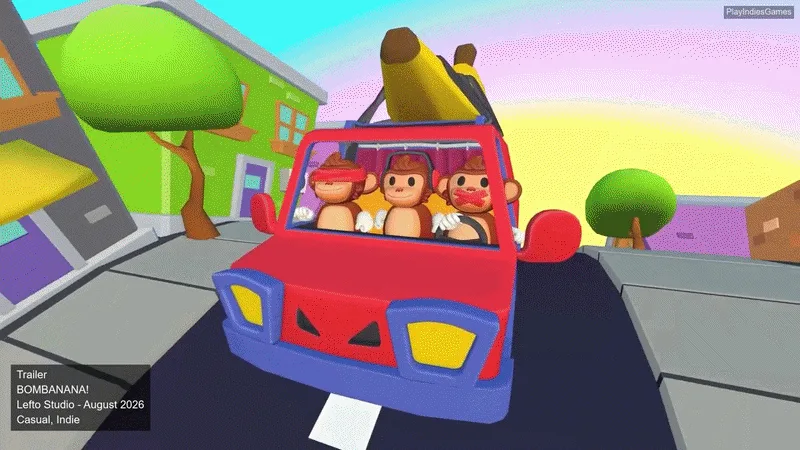
BOMBANANA! launched on Steam on September 2, 2026, with a cooperative challenge designed for exactly three players. One monkey can handle the bomb but cannot see the information needed to solve it, another can read the disposal manual but cannot speak, and the third can see the bomb and the other players but cannot hear them. Defusing each bomb therefore depends on moving useful information through that chain before time runs out.
The three roles make the game more than a race to identify the correct switch because players must first describe a module accurately, determine which manual rule applies, communicate that instruction through the group’s limitations, confirm that everyone understands it, and allow the monkey who can physically operate the bomb to carry out the action. The full release includes a 30-level campaign, a progressively harder Endless mode, and a Custom mode with adjustable challenge settings. Steam lists versions for both Windows and macOS.
September 2 is the release date of the full PC game rather than a date associated only with its earlier demo. Both the Steam listing and launch announcement identify that date, with Steam crediting Lefto Studio as developer and TARK as publisher. The launch announcement described Lefto as an independent development team from Istanbul, Türkiye, while TARK is identified as its publisher and investment partner. The announcement refers to “Lefto Studios” in its team biography, but the formal Steam developer credit is “Lefto Studio.” The developer and publisher credits answer different questions: Lefto Studio is credited with making the game, while TARK handled publishing and launch support. The game’s exact title is BOMBANANA!, including the exclamation mark.
The launch announcement also said the game had already attracted significant attention through its demo, reporting more than one million wishlists and six million demo players by release. Those figures came from the game’s promotional team rather than an independently audited source, so they are best treated as reported launch metrics rather than verified external totals. The announcement also advertised a temporary launch discount, but that should not be confused with the game’s continuing price because Steam prices and promotions can change by region and date.
BOMBANANA! is designed for exactly three players. Steam explicitly says there can be no more and no fewer than three monkeys, and the launch announcement repeats the requirement. The structure follows directly from the game’s design because the bomb handler, manual reader, and visual observer each possess one essential piece of the solution. With fewer than three players, one perspective would be missing, while a fourth player would have no defined role within the advertised three-monkey system.
A group of four friends can rotate between attempts, but all four should not expect to participate simultaneously in the same defusal. Likewise, someone buying the game alone should plan to have two other players available before expecting to experience its central cooperative loop.
Steam lists Online Co-op, and the launch announcement mentions both server browsing and room codes, supporting online sessions with friends. Voice chat and visible interactions are part of the communication tools available, but online play does not remove the role restrictions that make coordination difficult. The group still needs exactly three people, and each player remains limited by their monkey’s particular inability. The available sources do not establish separate console cross-play or an offline local mode. Steam also lists broadband internet as a requirement for both Windows and macOS, which is especially relevant in a timed communication game where delays can directly affect a defusal.
On Windows, Steam lists a 64-bit version of Windows 10 or Windows 11, an Intel Core i3-6100 or AMD Ryzen 3 1200, 8 GB of RAM, Intel HD Graphics 520, AMD Radeon Vega 3, or an equivalent GPU, broadband internet, 300 MB of available storage, and a DirectX-compatible sound card as the minimum configuration. The recommended Windows specification increases the processor to an Intel Core i5-8400 or AMD Ryzen 5 2600, memory to 16 GB, and graphics to Intel Iris Xe, NVIDIA GTX 1050, or AMD RX 560, while keeping broadband internet, 300 MB of storage, and compatible audio.
The macOS requirements are listed separately. Steam gives macOS 11.0 Big Sur or later, an Apple M1 or sixth-generation Intel Core i3 or later, 4 GB of RAM, Apple M1 integrated graphics, Intel Iris Plus Graphics 640, or equivalent, broadband internet, and 600 MB of storage as the minimum. The recommended listing begins with macOS 12.0 Monterey, an Apple M1 Pro or M2 or later, or an eighth-generation Intel Core i5 or later, with 8 GB of RAM and 600 MB of storage. Because Steam’s recommended Mac graphics wording repeats processor-related hardware rather than a conventional standalone GPU specification, it is safest to preserve the published wording rather than invent a more specific requirement.

How BOMBANANA!’s Blind, Mute, and Deaf Monkey Roles Work
BOMBANANA! is a cooperative party puzzle game in which every player controls a monkey with a different communication limitation. The blind monkey can physically interact with the bomb but cannot see its colors or read its screens. The mute monkey is the only player who can read the bomb disposal manual but cannot speak the instructions aloud. The deaf monkey can see the bomb and watch the other monkeys gesture but cannot hear speech. Every successful defusal therefore depends on combining incomplete perspectives rather than allowing any single player to understand and solve the entire puzzle independently.
A typical problem begins with observation. Someone needs to identify what is visible on or inside the bomb, including whatever features distinguish the current module. The team then has to get enough of that information to the mute monkey so the correct rule can be found in the disposal manual. The answer must then be conveyed in a form that ultimately reaches the blind monkey, who is the only player able to operate the bomb. That is the basic information flow rather than a promise that every module follows an identical step-by-step sequence. Different modules have different rules, so the team must continuously adapt the way it describes and communicates information.
The blind monkey effectively serves as the bomb’s hands. Because this player can touch controls but cannot see colors or read displays, any rule depending on a number, symbol, color, or visual arrangement requires help from another player. The role is therefore more demanding than simply following orders. Instructions must identify the intended component clearly enough for the blind monkey to find it and perform the correct action. A vague direction such as “press the right one” is useless when the operator cannot independently verify what “right” means. Teams need a shared language for position, sequence, timing, and confirmation, while also balancing the need for caution against the bomb timer.
The mute monkey controls access to the disposal manual, making this player essential even though they cannot communicate its contents through speech. The difficulty lies in both interpreting and transmitting the rule. The mute monkey first needs an accurate enough description of the bomb to determine which instruction applies, because one missing visual detail can produce the wrong conclusion. Once the rule is known, the player has to communicate it without simply reading it aloud. Steam’s description leaves room for gestures, pointing, waving, and other visible interactions, allowing each team to develop its own conventions instead of prescribing one universal communication method.
This limitation is what prevents the manual from making the game trivial. In a conventional bomb-disposal puzzle, the player reading the instructions might simply tell the operator exactly what to do. In BOMBANANA!, knowing the answer is only one part of the problem. That information must survive interpretation, nonverbal communication, and relay before the correct player can use it. A team can therefore understand the underlying rule perfectly and still fail because the instruction is communicated badly or arrives too late.
The deaf monkey provides the strongest visual perspective. This player can see the bomb and watch teammates gesture but cannot hear anything said aloud. That makes the role an important bridge between visual observation and nonverbal instruction. The deaf monkey can identify details the blind monkey cannot perceive, observe the mute monkey’s response, and help pass actionable information onward. However, seeing the bomb does not mean this player automatically knows the solution because the mute monkey alone has access to the disposal manual. The deaf monkey also cannot rely on a shouted correction, so teammates need to make their instructions visible and verify that they were understood.
The challenge becomes more interesting when visually similar controls appear together. A description may sound precise while still leaving uncertainty about orientation, color, sequence, or position. Good teamwork therefore depends on identifying which detail the current rule actually requires rather than trying to describe everything at once. Rotating roles between attempts can also reveal how different the communication problem feels from each perspective. A player who found the manual role easy to understand conceptually may discover that expressing its rules without speech is much harder than expected, while someone who previously gave visual descriptions may realize how little information reaches the bomb handler without careful wording.

BOMBANANA! Communication, Puzzle Modules, Campaign, and Endless Mode
Communication is the central puzzle in BOMBANANA!. Steam mentions voice chat, pointing, waving, gestures, an emote wheel, slapping, and other playful interactions, including throwing bananas. These tools do not give all three players equal access to information because each role filters communication differently. Spoken instructions will not reach the deaf monkey through hearing, the mute monkey cannot solve confusion by reading an instruction aloud, and the blind monkey cannot independently verify visual details. A signal that works perfectly between two players may fail completely when the third player must act on it.
A disciplined information exchange can make the team more reliable under the timer. The visual observer can focus on one module and describe only the features needed to distinguish it, while the manual reader signals whether the information is sufficient or if a detail needs clarification. Before the operator acts, the team can confirm the intended control and the action required. This is a useful strategy rather than a mandatory sequence imposed by the game. BOMBANANA! is deliberately designed to let groups invent their own systems, and part of the fun comes from discovering which gestures, phrases, and routines actually survive the three-role communication chain.
Environmental hazards can disrupt even a well-practiced system. Steam mentions power outages, obstructions, and loud interruptions among the possible complications, while the launch announcement says the full release added new environments and modifiers. These conditions can temporarily undermine a familiar way of communicating, forcing players to adapt rather than relying on the same routine for every bomb. A run may fail even when the team knows the correct module rule because information reaches the wrong player, a gesture is misread, or an instruction arrives too late. Reviewing where communication broke down can therefore be more useful than simply trying to perform the same actions faster.
Steam confirms that bombs contain different puzzle modules with different rules, and the launch announcement says the full release expanded the experience with additional puzzles and modifiers. However, the cited official descriptions do not provide a complete authoritative catalogue of module names, exact solutions, switches, wires, codes, or procedures. What is clear is the function those modules serve: each creates information that must be observed, interpreted through the manual, and manipulated by the bomb handler. Custom mode also lets players adjust module types, confirming that module selection itself can be part of the challenge setup.
The most transferable skill is therefore not memorizing one specific module but developing a repeatable process for handling unfamiliar ones. Players need to identify what is visible, work out which details the manual requires, relay the instruction clearly, and confirm that the blind monkey has located the intended component before acting. That process remains useful even as individual module rules change because it addresses the game’s underlying information problem.
The campaign contains 30 handcrafted levels that increase in difficulty, with successful defusals unlocking additional stages. The 30-level count refers specifically to designed campaign content rather than Endless mode’s potentially continuing sequence. The rising difficulty matters because the group is effectively learning two systems simultaneously: the bomb puzzles themselves and the team’s own communication habits. Early stages can help a trio establish simple signals, while later challenges reveal whether those conventions remain precise under greater pressure.
The campaign can also encourage role rotation. Replaying a level with different responsibilities can expose where a team’s earlier explanations were unclear. A player who once watched gestures may discover how difficult it is to express the same instruction while holding the manual, while someone who previously operated the bomb can better understand why visual descriptions need to be precise. The 30-level total should not be confused with a universal completion-time estimate because playtime will depend heavily on how quickly each group learns the puzzles, how often it fails, and how effectively it communicates.
Endless mode takes the same three-player structure into procedurally generated, wave-based challenges that become progressively harder. Instead of ending after the campaign’s fixed stages, a trio can continue testing its coordination against an escalating sequence. “Procedurally generated” refers to how the mode creates its levels and does not guarantee that every possible bomb is unique, while “Endless” describes the continuing format rather than promising that a particular team can survive forever.
The format gives experienced players a different objective from simply finishing a campaign. As difficulty increases, vague descriptions and inefficient gestures become more costly, pushing the team to compress familiar explanations without introducing new ambiguity. The official descriptions do not establish a final wave, an exact scoring formula, or specific milestone rewards, so the most reliable description is that Endless mode provides increasingly difficult wave-based challenges for groups that want to see how long their communication system can hold together.

BOMBANANA! Custom Mode, Online Play, and Adjustable Challenge Options
Custom mode gives a trio direct control over several parts of the BOMBANANA! challenge in BOMBANANA!. Steam says players can adjust bomb difficulty, the timer, module types, environmental hazards, and the number of mistakes allowed. This makes BOMBANANA! Custom mode the main option for groups that want something different from the campaign’s predefined levels or Endless mode’s escalating waves, whether they are learning the game, practicing a particular kind of puzzle, or deliberately creating a more demanding session.
Adjusting the timer changes how much room the group has to describe modules, interpret manual rules, verify instructions, and act in BOMBANANA!. More time can help a new trio establish reliable signals without immediately being overwhelmed, while a shorter timer can challenge experienced teams whose BOMBANANA! communication is already efficient. Changing the number of permitted mistakes can similarly make a BOMBANANA! session more or less forgiving. The store summary confirms that these categories are adjustable but does not provide exact numerical ranges, so those should be checked directly in the current BOMBANANA! game menus rather than inferred.
Module selection lets a group focus on particular types of puzzle information in BOMBANANA!, while environmental hazards change the conditions under which that information must be exchanged. Steam’s examples include power outages, visual obstructions, and loud interruptions. A team can therefore use BOMBANANA! Custom mode either to simplify the environment and concentrate on communication fundamentals or deliberately introduce disruptive conditions to test whether its usual signals still work when the situation becomes chaotic.
Custom mode can also function as a BOMBANANA! practice tool. If a specific class of module repeatedly causes confusion, players can alter module availability and spend more time working out how to describe and relay it. If the timer is the main problem for inexperienced players, they can create a less pressured BOMBANANA! session while learning the three roles. The confirmed feature is the ability to adjust the listed categories, while the exact options available within each category may depend on the current version of BOMBANANA!.
Online play complements this flexibility in BOMBANANA!. Steam lists Online Co-op, while the launch announcement mentions room codes and server browsing. Room codes are especially useful when three friends want to meet in the same BOMBANANA! session, while server browsing provides another route to locating available rooms. The available descriptions do not document every current invitation step, so players should follow the interface shown in their installed version of BOMBANANA! rather than rely on an assumed menu sequence.
The released game also expands beyond its earlier demo through additional puzzles, modifiers, emotes, player interactions, environments, and improvements to joining BOMBANANA! sessions. That broader feature set reinforces the game’s central idea rather than changing it. Whether players are progressing through handcrafted BOMBANANA! campaign levels, surviving procedural BOMBANANA! waves, or creating their own BOMBANANA! Custom challenge, the fundamental task remains the same: three monkeys with different limitations must build a communication system strong enough to defuse the bomb before time runs out.

Frequently Asked Questions (FAQs)
- When was BOMBANANA! released on PC?
BOMBANANA! launched on Steam on September 2, 2026. Both its Steam store listing and launch announcement give the same date, so September 2 is the confirmed release date for the full PC version rather than a date associated only with its earlier demo or promotional period. - Can two people play BOMBANANA! together?
No. The advertised cooperative game requires exactly three players because its blind, mute, and deaf monkey roles are designed to function together as one complete team. Each player holds information or abilities the others lack, so removing one role would break the intended communication chain. The official descriptions do not list a two-player replacement, solo mode, or AI substitute for the missing third role. - Which monkey actually touches the bomb?
The blind monkey is the player who can physically interact with and operate the bomb. However, that player cannot see colors or read text on the bomb’s screens, so they depend on teammates for the visual details needed to act correctly. The challenge is therefore not only carrying out the instruction but also making sure the blind monkey understands exactly which control or component the team means. - Which monkey reads the bomb disposal manual?
The mute monkey is the only player who can read the bomb disposal manual. That gives this role access to the rules needed to solve each module, but the player cannot simply speak those instructions aloud. They must first receive enough accurate information about the bomb to identify the correct rule, then communicate the answer through gestures or other nonverbal methods. - What can the deaf monkey do?
The deaf monkey can see the bomb and observe the other players’ gestures but cannot hear spoken communication. This makes the role important for identifying visual details that the blind monkey cannot access and for reading nonverbal signals from the mute monkey. The deaf monkey does not have access to the disposal manual, so visual information still has to be matched with instructions from the manual reader before the bomb can be safely handled. - How many campaign levels does BOMBANANA! have?
The campaign contains 30 handcrafted levels that become progressively more difficult. Successful bomb defusals unlock additional stages, giving the trio a structured progression through increasingly demanding challenges. The 30-level count applies specifically to the campaign and should not be confused with Endless mode, which uses procedurally generated waves instead of a fixed set of handcrafted stages. - Does BOMBANANA! have modes beyond the campaign?
Yes. In addition to the 30-level campaign, BOMBANANA! includes Endless and Custom modes. Endless mode generates wave-based challenges that become harder as the team progresses, while Custom mode lets players adjust factors such as bomb difficulty, timer length, module types, environmental hazards, and the number of mistakes allowed. These modes change the structure or difficulty of the challenge without removing the core three-player communication system. - Can friends join one another online?
Yes. Steam lists BOMBANANA! as supporting online co-op, and the launch announcement mentions both server browsing and room codes. Those options allow friends to find or join the same session, but the team still needs exactly three players before it can use the game’s full blind, mute, and deaf monkey setup. - Is BOMBANANA! playable on Mac?
Yes. Steam provides separate macOS requirements alongside the Windows specifications. The minimum Mac requirement begins with macOS 11.0 Big Sur or later and includes support for both Apple silicon and qualifying Intel hardware. This means a three-player group can include Mac and Windows users as long as each player’s system meets the relevant Steam requirements and can access the game online. - Who made BOMBANANA!?
Lefto Studio is the credited developer of BOMBANANA!, while TARK is the credited publisher. The September 2 launch announcement describes Lefto as an independent development team from Istanbul, Türkiye, and identifies TARK as its publisher and investment partner. Steam uses the formal developer credit “Lefto Studio,” which is the name that should be used when identifying who created the game.

Conclusion
BOMBANANA! arrived on Steam for PC on September 2, 2026, with a sharply defined cooperative premise: exactly three players must solve and defuse bombs while each has access to only part of the necessary information. The blind monkey handles the bomb, the mute monkey reads the manual, and the deaf monkey sees the bomb and visual signals. Its 30-level campaign, procedurally generated Endless mode, and adjustable Custom mode give that communication challenge several ways to develop. Windows and macOS requirements are published on Steam, and online co-op is a listed feature.
The crucial skill is not simply solving a module in isolation. It is getting an accurate observation to the manual reader, turning the rule into a message the others understand, and guiding the bomb handler to act before time expires. BOMBANANA! leaves teams room to invent that language together, which is why the same bomb can feel like a logic puzzle, a test of teamwork, and a party game all at once.
Sources and Citations
- Steam — BOMBANANA! — Official Steam store listing with the September 2, 2026 release date, Lefto Studio/TARK credits, three-player co-op structure, monkey roles, game features, accessibility information, and Windows/macOS system requirements. BOMBANANA! on Steam
- PressEngine NewsDesk — BOMBANANA! Launch Announcement — September 2, 2026 launch announcement covering the development team, demo, launch additions, server browsing, room codes, wishlist milestone, and demo-player figures.
“Chaotic co-op bomb defusal game BOMBANANA! Blasts onto Steam!” - Steam Community — BOMBANANA! — Official community hub containing developer announcements and launch updates, including the post-launch feature information.
BOMBANANA! Steam Community
Recommendations
- Fairgame$: Everything We Know About PlayStation’s Competitive Heist Shooter
- Zen UV 5.3.1 For Blender Released: Blender 5.1 Support and Hotfixes Explained
- Zenless Zone Zero 3.0: 10 Minutes of Deep-Dive Gameplay Breakdown, New Agents, Combat Changes, and Everything We Know
- Modern Warfare 4 Promises No Silly Skins Again, But Questions Remain About AI Content
- One Of The Best Call Of Duty Games Just Came To Game Pass: Modern Warfare 2019 Explained
- Everything Coming to Netflix in July 2026: Complete Release Schedule for Movies, TV Shows & Originals
- Dune: Part 3 Trailer Breakdown: Who’s Who, Robert Pattinson’s Scytale, and How Denis Villeneuve May Change Dune Messiah
- The Blood of Dawnwalker Launch Issues: PC, PS5 and Xbox Fixes
- Mega Man: Dual Override Gamescom 2026 Trailer Targets 2027 on PlayStation, Xbox, Switch and PC
- Acornia: Mirror Worlds (Splashteam’s 2027 Bake-and-Brawl Management Adventure)



































































































