







In This Article (8 sections)
BioEden Release Date, Platforms, Demo, and PC Availability
BioEden launched on PC through Steam on September 3, 2026. The planet-restoration game asks players to repair a barren world, build connected ecological reserves, and create suitable habitats for animal species that have disappeared. It is also available on PlayStation 5, Xbox Series X|S, and Nintendo Switch 2. The console launch deserves particular attention because Focus Entertainment changed its plans between announcement and release. In June, the publisher said the PC version would arrive on September 3 while console versions would follow later, but its September 3 launch announcement instead confirmed that all four platforms were available that day.
Current PlayStation and Xbox store listings also give September 3 as their release date, so the earlier announcement accurately reflects the original plan rather than what ultimately happened at launch. The Nintendo listing specifically identifies Nintendo Switch 2 and should not be interpreted as confirmation of an edition for the original Nintendo Switch. Nintendo’s product page lists TV, tabletop, and handheld modes for the Switch 2 edition. That provides a portable alternative to desktop play while retaining the same one player premise. The distinction is useful for readers comparing platforms: console availability is no longer merely a future plan, and the Nintendo version specifically belongs to Switch 2 rather than the original hardware.
Steam lists BioEden as a full PC release rather than an Early Access title and maintains a separate listing for BioEden Demo, which launched earlier on June 6, 2026. The free demo includes the tutorial and an introductory sample of the game’s resource management, exploration, construction, and animal-care systems, while also introducing Charles, the robot companion who accompanies the Keeper during the opening. Focus Entertainment states that demo saves are not compatible with the full game, so progress does not transfer after purchase, although players who have already completed the tutorial can skip it in the released version.
The demo is therefore most useful as a way to judge BioEden’s balance between relaxed pacing and resource management before buying. BioEden itself is strictly single-player according to Steam and Nintendo’s official listings, with Nintendo specifying one player on a single system. The Cosmic Collective is part of the game’s fiction rather than a representation of other human players. The US Steam listing used for the article shows the full game at $21.99, but regional prices, currencies, promotions, and sales may differ.
For prospective PC players, the most useful approach to the demo is to follow a complete chain of activities rather than judge the game only by its colorful environments. Try collecting materials, connecting essential services, and preparing an animal habitat before deciding whether the underlying routine appeals. This gives a clearer sense of how often the game asks players to move between the wider landscape and individual reserves. Since tutorial progress does not carry forward, the lasting benefit is understanding those relationships rather than accumulating resources for the full release.
BioEden is developed by Broken Arms Games and published by Focus Entertainment. The publisher’s June 8 FAQ describes the developer as an Italian studio of 11 people, with earlier releases including Hundred Days: Winemaking Simulator and Under Par Golf Architect. BioEden continues that management focus with a different subject: planetary recovery. The Steam version also lists achievements, trading cards, Steam Cloud, and Family Sharing. Its language table covers 11 interface and subtitle options, with full audio listed for English. The other text options include French, Italian, German, Spanish from Spain, Brazilian Portuguese, Russian, Japanese, Korean, Simplified Chinese, and Traditional Chinese.
On PC, Steam lists Windows 10 or Windows 11, 64-bit, and an SSD as requirements for both the minimum and recommended configurations, with 3 GB of available storage required in either case. The minimum specification consists of an AMD Ryzen 3 1200 or Intel Core i5-4690K, 8 GB of RAM, and an AMD Radeon RX 460 or Nvidia GeForce GTX 960 with 4 GB of VRAM. Steam associates this configuration with 30 frames per second at 1920 × 1080 using the Low preset.
The recommended specification lists an AMD Ryzen 5 1600X or Intel Core i7-7700K, 16 GB of RAM, and an AMD Radeon RX 580 or Nvidia GeForce GTX 1080 with 6 GB of VRAM, targeting 60 frames per second at 1920 × 1080 on the Ultra preset. These are the published performance targets rather than guarantees that every combination of hardware will perform identically.
The PC requirements are best read as two different performance profiles rather than a simple list of compatible parts. Someone targeting the minimum specification should compare expectations with the stated Low preset and 30 frames per second, not the recommended Ultra target. Testing the demo also provides an opportunity to assess menu readability, camera navigation, and how comfortably the opening systems run on the intended computer before committing to the full game.

What BioEden is About and How Planet Restoration Works
BioEden is about restoring a planet whose ecosystems have collapsed. Players become a Keeper sent by the Cosmic Collective to bring life back to barren land by recovering useful materials from debris, cleaning damaged environments, establishing functioning infrastructure, and creating reserves where lost animal species can thrive. Focus Entertainment describes the larger journey as transforming wastelands into living habitats while uncovering the mystery of an event called the Great Unraveling.
The official descriptions do not reveal exactly what caused that event, but they establish its aftermath: a damaged planet, disappeared animal species, and a Keeper responsible for creating the conditions necessary for life to return. Restoration therefore happens as a staged process rather than simply placing animals into an empty landscape. Buildings need electricity and water, domes must be connected and supplied, and individual species require appropriate conditions before they can flourish, making environmental repair and animal care parts of one connected system.
Steam’s description adds another layer through five guilds within the Cosmic Collective. Each has its own identity, abilities, and guiding philosophy, so the Keeper’s affiliation influences the approach to restoration rather than changing the overall aim of healing the planet. This gives the collective a practical role beyond providing background lore. Players are choosing how to pursue the mission, with different organizational priorities sitting alongside the shared ecological objective.
The Keeper’s work begins with debris scattered across the world. Steam says these sites can be searched and recycled into resources, which then support early infrastructure such as solar power generation and water distribution. As more structures are connected, the network becomes capable of supporting wider restoration projects and additional habitats. Environmental repair also involves direct intervention in the landscape, including purifying lakes and rivers, restoring soil, reclaiming ruins, and recycling structures that have outlived their usefulness.
Focus Entertainment’s FAQ explains that the first water cleaner works on lakes, while a separate river cleaner becomes available later through progression. An early river-cleaning task that cannot yet be completed should therefore not be mistaken for a missing ability because BioEden gradually expands the Keeper’s toolkit as restoration progresses.
Construction creates the central management problem because every new structure consumes resources and energy while also increasing pollution. A building may help extend a network, support a habitat, or open access to another part of the map, yet it can simultaneously create additional pressure on the recovering environment. Focus Entertainment says earlier decisions can be reversed through recycling, allowing structures that were useful at one stage to be removed later. The challenge is therefore not to build as much as possible but to construct enough to support progress and then continually reevaluate what remains necessary.
The Keeper’s responsibilities span exploration, planning, construction, cleanup, resource management, and animal care, linking individual habitat decisions to the wider planetary network. A well-designed dome still depends on electricity, water, materials, research, and surrounding infrastructure, which is why BioEden is more than a landscape-decoration game. Its habitats are designed to function within a larger ecological economy, and while the game has no fail state, the relaxed structure reduces pressure without eliminating the need to plan. The official FAQ also offers a simple explanation for buildings that appear connected but are not producing: the game may be paused. Players should check the time control in the upper left corner before rebuilding their network.

BioEden Ecosystems, Animal Restoration, Resources, and Progression
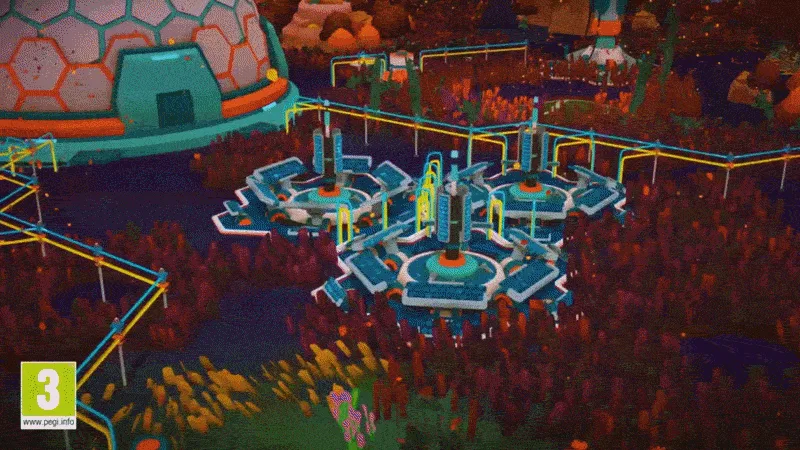
Players build ecosystems through interconnected domes that act as reserves for returning animal species. Focus Entertainment describes each dome as an environment that must be balanced for its inhabitants while remaining connected to the broader water, power, resource, and progression systems supporting it. The task is to create a functioning habitat rather than merely make an area look green. Steam says BioEden includes suitable biomes for dozens of animal species, with different creatures requiring different conditions before they can flourish. Expanding a reserve therefore requires attention to the intended species, available space, unlocked structures, and the infrastructure needed to support the environment.
Steam identifies temperature, humidity, and vegetation as specific habitat considerations, and its description also refers to placing cocoons during animal restoration. Those details make biome preparation more concrete: a visually attractive dome is not necessarily ready for its intended species. The player must shape the conditions around the creature, so habitat design involves understanding environmental requirements rather than treating every reserve as an interchangeable enclosure.
Research trees determine which habitat components are available, and Focus Entertainment’s FAQ explains that objects seemingly missing from a dome may need to be unlocked through biome research. Progression is therefore directly tied to ecosystem design: players learn what a species requires, unlock the necessary options, create suitable conditions, and maintain the wider network supporting that habitat.
The process of returning extinct animals follows the same interconnected logic. Focus Entertainment says players gather DNA samples, prepare the conditions required by each animal inside a dome, care for the creatures, and eventually release them into the wild. Restoring a species is therefore more involved than pressing a single button, and the system should be understood as fictional game design rather than a representation of real-world de-extinction science. Dozens of species give habitat construction a reason to grow more varied as the game progresses, since a biome that works for one animal should not automatically be assumed to suit another.
Players must respond to each creature’s stated needs using the structures, research options, and resources currently available. The thematic purpose is equally important because BioEden frames animal restoration as part of rebuilding an entire living system. Returning wildlife is connected to soil repair, water purification, infrastructure management, recycling, and resource use rather than treating animals as isolated collectibles. Animal feeding introduces another dependency. The official FAQ explains that an empty carnivore feeder can result from a shortage of orbs, the game’s little helpers. After checking that the relevant factory is operating, players can address that shortage by building an orb factory.
Resource management begins with recycling debris into construction materials, while solar equipment generates electricity and water networks distribute another essential supply. As the number of domes and facilities grows, players must balance supply and demand across an increasingly interconnected network. Pollution adds another constraint because extending infrastructure can help the Keeper reach new areas and support restoration while also placing additional pressure on the environment. Research and new tools expand the available solutions over time, with the progression from an initial lake cleaner to a later river-cleaning tool illustrating how capabilities grow.
These systems create overlapping dependencies: a player may have enough resources for a reserve but lack the necessary research unlock, or may have the right habitat structures without sufficient electricity or water. Expanding the network can solve one problem while increasing pollution elsewhere. Because there are no fail states, players have room to experiment, recycle inefficient structures, and gradually improve the system rather than discovering one perfect layout immediately.
A practical way to plan a reserve is to work backward from the animal being restored. Identify its habitat requirements, check whether the relevant research is available, and then consider the resources and services needed to support that design. This separates a missing unlock from a supply problem and helps avoid spending materials on facilities that cannot yet fulfill their purpose. The same reasoning applies when a habitat stops progressing: diagnose the unmet requirement before assuming the entire reserve needs to be rebuilt.

BioEden’s Solarpunk Setting and Cozy Strategy Gameplay
Focus Entertainment describes BioEden as a colorful solarpunk game, and its setting combines visible technology with ecological restoration through solar energy, connected water systems, managed reserves, recycling, and habitat recovery. The demo similarly presents nature and technology as intertwined rather than opposing forces. The planet is not an established utopia when the Keeper arrives, however. It begins damaged, filled with debris and neglected land, and the hopeful element comes from the possibility of repair and the player’s ability to participate in that transformation.
Solar systems power infrastructure, domes shelter returning species, waterways can be cleaned, and recycled materials support new construction. Technology therefore serves environmental recovery, but the game does not present development as automatically harmless because even useful infrastructure consumes resources and can increase pollution. That tension gives the solarpunk setting a strategic dimension by repeatedly asking how much infrastructure restoration actually requires and whether older construction remains necessary as the world recovers.
One useful way to understand the design is that successful management does not necessarily mean leaving the largest possible settlement behind. An efficient network is valuable because of what it enables, not simply because it occupies more land. The setting turns construction into a means of recovery rather than an end in itself. For players accustomed to measuring progress by the number of buildings on a map, that changes the central question from how quickly the settlement can grow to how effectively the landscape can recover.
BioEden is both a cozy game and a strategy game. Focus Entertainment describes it as a cozy management experience, while Steam categorizes it under Simulation and Strategy. Its cozy qualities include an unhurried pace, colorful environments, nature sounds, animal care, and the absence of a fail state. Focus Entertainment says players can take the time they need, while recycling allows earlier construction decisions to be reversed.
The strategic layer comes from the systems beneath that relaxed presentation, since players still need to balance electricity, water, resources, pollution, research progression, habitat requirements, and the connections between structures and domes. A calm pace therefore does not mean those choices disappear. Focus Entertainment’s FAQ estimates approximately 15 to 20 hours to finish BioEden, while a more leisurely approach may extend playtime to around 40 hours. That makes the expected duration dependent on how closely a player follows progression compared with time spent observing and refining the world.
The core gameplay loop repeatedly moves between exploration, recycling, construction, restoration, research, and animal care. Players locate debris, convert it into resources, build infrastructure, clean damaged environments, establish habitats, unlock new tools, and restore species once suitable conditions have been created. As the ecological network grows, earlier decisions may need to be reconsidered.
Infrastructure that once opened access to a new area may become unnecessary, a reserve may require additional research before another species can live there, and a network extension may solve one supply problem while increasing pollution elsewhere. Recycling gives players room to respond to those changes without turning experimentation into punishment, so BioEden asks players to refine their system as the planet evolves rather than expecting every decision to be correct on the first attempt.
The mystery of the Great Unraveling gives this restoration work a narrative context. The Keeper is not simply improving an anonymous sandbox but exploring the aftermath of an event that damaged the planet, while official descriptions intentionally leave the mystery unresolved so players have another reason to explore beyond resource collection and habitat management. Charles, the robot companion introduced in the demo, helps guide players through the opening systems, with the tutorial covering resource and space management, exploration, construction, and animal care. For players unsure about BioEden’s balance of cozy pacing and management strategy, the free Steam demo provides the clearest introduction, while the full game expands those interconnected ecological systems considerably.

Frequently Asked Questions (FAQs)
- When was BioEden released on PC?
BioEden was released on Steam for PC on September 3, 2026. That date refers to the full paid game. A separate free BioEden Demo became available earlier, on June 6, 2026, giving players a chance to try the tutorial and sample the main systems before the complete release arrived. - Is BioEden available on consoles now?
Yes. BioEden is available on PlayStation 5, Xbox Series X|S, and Nintendo Switch 2 alongside the PC version. Focus Entertainment originally announced that the console versions would arrive after the September 3 PC launch, but its launch-day announcement confirmed that all four platforms became available on September 3 instead. The later announcement therefore superseded the original release plan. - Is the BioEden demo free?
Yes. Steam lists BioEden Demo as free to install. The demo includes the tutorial and introduces the game’s core activities, including exploration, resource and space management, construction, and animal care. It also introduces Charles, the robot companion who helps guide the Keeper through the opening systems. - Does progress from the demo carry into the full game?
No. The demo save is not compatible with the released game, so progress made there does not transfer into a purchased copy. The demo is intended primarily as a way to learn the mechanics and decide whether BioEden’s management systems and pacing are appealing. Focus Entertainment says players who already understand the tutorial can skip it when beginning the full version. - Can two people play BioEden together?
No cooperative mode is listed in the official information. Steam identifies both the full game and demo as single-player, while Nintendo’s listing also specifies one player on a single system. BioEden is therefore designed as a solo planet-restoration experience in which one player manages the Keeper’s infrastructure, habitats, resources, and environmental recovery. - What is the main goal in BioEden?
The Keeper’s main objective is to restore a barren planet whose ecosystems have collapsed. This involves recycling debris into resources, cleaning damaged environments, generating power, distributing water, managing pollution, building sustainable reserves, and creating suitable habitats for returning animal species. The restoration effort also takes place alongside the mystery of the Great Unraveling, which players can investigate as they explore. - How are animals brought back in BioEden?
Focus Entertainment says players first gather DNA samples for lost species and then prepare suitable conditions for those animals inside connected domes. Each species has needs that must be met through habitat design, infrastructure, and research. Once the animals have been restored and properly supported, they can eventually be released into the wild. The system connects animal recovery directly to the wider planet-restoration process rather than treating it as a single-step action. - Can you lose in BioEden?
BioEden is described as having no fail states, so players are not forced to restart the experience because of an inefficient decision. Focus Entertainment says players can work at their own pace and reverse earlier construction choices through recycling. However, that does not remove the management challenge. Resources, power, water, pollution, research, and animal requirements still need to be balanced for the ecological network to function effectively. - What does BioEden cost on Steam?
The US Steam listing viewed for the article showed the full game at $21.99. That figure should be treated as the displayed US price rather than a universal amount because regional pricing, currencies, temporary discounts, and promotions can change what individual players pay. The separate BioEden Demo remains free. - Do you need an SSD to play BioEden on PC?
Yes. Steam lists an SSD as a requirement for both the minimum and recommended PC specifications. Both configurations require 3 GB of available storage. The minimum target is listed as 1080p at 30 frames per second on the Low preset, while the recommended hardware targets 1080p at 60 frames per second on Ultra, but actual performance can still vary depending on the complete PC configuration.

Conclusion
BioEden reached Steam on September 3, 2026, and its console versions launched that day as well, despite an earlier announcement that placed them later. Broken Arms Games’ single-player restoration game combines a calm, colorful setting with decisions about power, water, resources, pollution, research, and animal habitats. Its free Steam demo offers the tutorial as a way to try those systems, with the clear limitation that demo saves do not transfer. For players drawn to rebuilding a living world through patient management, the released game is available on PC, PS5, Xbox Series X|S, and Nintendo Switch 2.
Sources and Citations
- Focus Entertainment, Reveal Announcement, June 6, 2026 : Official announcement introducing Broken Arms Games’ ecological management game, its planet restoration premise and the free Steam demo. It explains interconnected power and water networks, animal habitats and resource management, while documenting the original plan for a September 3 PC launch followed by console versions later. Focus Entertainment
Citation: BioEden: A New Cozy Management Game Blooms September 3 on PC, Demo Available Now. (Focus Entertainment) - Focus Entertainment, Launch Announcement, September 3, 2026 : Official release announcement confirming that BioEden launched on Steam, PlayStation 5, Xbox Series X|S and Nintendo Switch 2 on September 3. It describes gathering animal DNA, developing progression trees and restoring interconnected ecosystems, providing the updated launch information that supersedes the earlier announcement’s plan for later console releases. Focus Entertainment
Citation: BioEden Launches Today: Revive a Barren Planet and Save Long Lost Animal Species. (Focus Entertainment) - Focus Together, BioEden FAQ, June 8, 2026 : Official community FAQ explaining the tutorial, research unlocks, pollution management, recycling and common progression problems. It confirms that demo saves do not transfer and estimates approximately 15 to 20 hours to finish, with longer play possible at a relaxed pace, while also providing background on Broken Arms Games and its development approach. Focus Together
Citation: BioEden FAQ. (Focus Together) - Steam, BioEden Official Store Page : Official PC listing confirming the September 3, 2026 release, developer and publisher, supported languages and minimum and recommended system requirements. It also documents Steam achievements, cloud saves and single player support, alongside detailed explanations of ecological restoration, animal care, guild choices and the balance between expanding infrastructure and limiting pollution. Steam Store
Citation: BioEden on Steam. (Steam) - Steam, BioEden Demo Official Store Page : Dedicated listing for the free demo released on June 6, 2026, offering access to the tutorial and an introduction to the robot companion Charles. It explains the resource management, exploration, construction and animal care activities available, while listing the demo’s own system requirements and confirming that its saves are incompatible with the full game. Steam Store
Citation: BioEden Demo on Steam. (Steam) - Focus Entertainment, Official Game Page and PlayStation 5 Confirmation : Publisher’s official game overview listing PlayStation 5 alongside Xbox Series X|S, Nintendo Switch 2 and PC, with September 3, 2026 as the release date. It identifies Broken Arms Games as the developer and summarises habitat construction, research progression, water purification and ecosystem restoration, providing a direct publisher reference for supported platforms and advertised gameplay. Focus Entertainment
Citation: BioEden Official Game Page. (Focus Entertainment) - Xbox, BioEden Official Store Page : Official Microsoft storefront listing confirming the Xbox Series X|S version’s September 3, 2026 release, single player format and console optimisation. It also lists supported languages, Xbox achievements, cloud saves and the regional purchase price, making it useful for checking the Xbox edition’s availability and platform features separately from the PC version. xbox.com
Citation: BioEden on Xbox. (Xbox) - Nintendo, BioEden Official Switch 2 Store Page : Official Nintendo listing confirming the September 3, 2026 release, single player support and compatibility with television, tabletop and handheld modes. It also provides the 3.2 GB download size, supported languages, age rating and Save Data Cloud support, alongside the publisher’s description of restoring habitats and bringing extinct animal species back to life. Nintendo Co., Ltd.
Citation: BioEden for Nintendo Switch 2. (Nintendo) - Focus Together, Community Reveal, June 6, 2026 : Community announcement expanding on the reveal with practical details about collecting debris, connecting solar power and water systems, and recycling buildings to reduce environmental impact. It also explains how animal habitats depend on temperature, humidity and vegetation, while introducing DNA collection, cocoons and the tutorial content available in the Steam demo. Focus Together
Citation: BioEden: Demo Out Now and Launch on September 3!. (Focus Together)
Recommendations
- Until Dawn 2 Finds Horror in the Sun: Tropical Setting, Trailer Breakdown, and 2027 Release Window
- Bulgarian Government Rejects Proposal to Tighten Online Gambling Regulation
- The View Keeper Add-on: Why Every Blender Artist Needs It for Optimized Rendering Workflows
- Star Wars Zero Company Luco Best Build, Weapons and Focus Guide
- Ghost Recon Wildlands 4K 60 FPS Update and New Last Rites Mission: Everything We Know
- Zelda: Ocarina of Time Teaser Sparks “Hire this Man” Meme Trend as Fans Roast Realistic Link and Star Fox Remake Style
- What Is Gaussian Splatting? A Complete Guide to This Revolutionary Rendering Technique
- Elden Ring Movie Filming Reportedly Done Ahead of 2028 Release
- Vacation Cafe Simulator Launches August 20, 2026: Release Time, Gameplay, Co-Op and PC Details
- Intel’s New Handheld Gaming PC Chips Are Here at Computex 2026: Arc G3, Panther Lake Power, and the Next Wave of Portable Gaming



































































































