











In This Article (9 sections)
The Social Reckoning Trailer Breakdown: Jeremy Strong’s Mark Zuckerberg and the Franchise’s Darker Shift
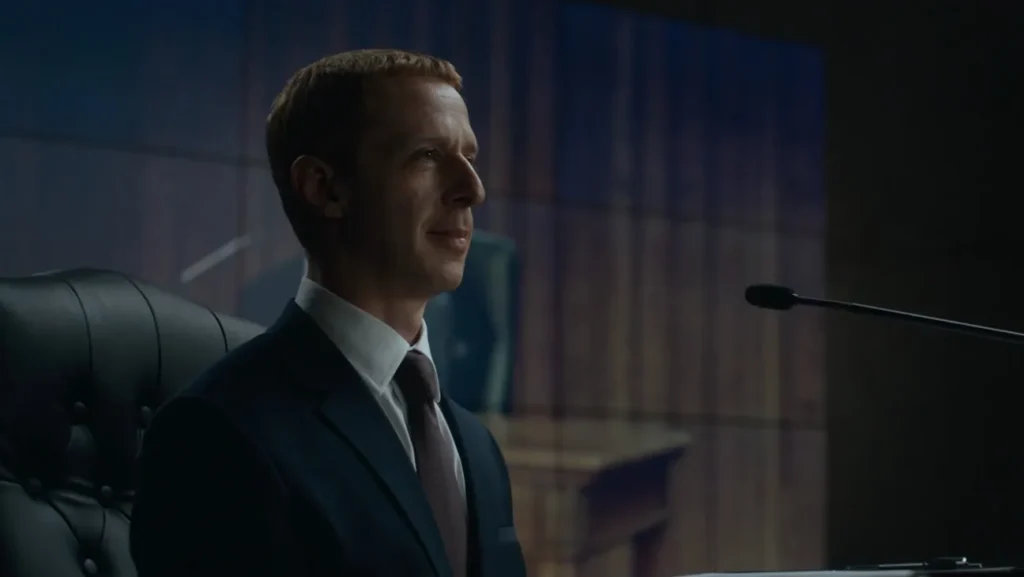
The first trailer for The Social Reckoning immediately establishes a darker, more confrontational tone compared to earlier Silicon Valley dramas, positioning the story as a direct escalation of the events and themes introduced in The Social Network (2010). From the opening frames, Jeremy Strong’s portrayal of Mark Zuckerberg signals a radical reinterpretation of the tech founder: less socially detached genius, more strategically defensive corporate titan under siege. The trailer opens with tightly framed shots of corporate boardrooms, congressional hearing footage, and fragmented social media feeds, using those visual cues to evoke surveillance, accountability, and fragmentation in modern digital communication.
Strong’s Zuckerberg is shown speaking in controlled, measured tones, but with visible tension beneath the surface, suggesting a man aware that control over narrative and platform perception is slipping. Unlike previous portrayals, this version of Zuckerberg is not purely reactive; he is shown actively shaping public discourse, preparing legal defenses, and engaging in internal company restructuring. The trailer emphasizes institutional pressure and reputational collapse, positioning the film as a high-stakes character study wrapped in corporate political thriller aesthetics.
The recasting of Mark Zuckerberg from Jesse Eisenberg to Jeremy Strong reflects a deliberate tonal shift in the franchise. Eisenberg’s portrayal in The Social Network emphasized intellectual arrogance, social detachment, and rapid-fire verbal dominance, while Strong brings a more internalized, emotionally contained intensity shaped by his acclaimed dramatic roles in prestige television.
This shift is not simply cosmetic but narrative-driven: the Zuckerberg of The Social Reckoning is no longer a young founder navigating growth disputes, but a global corporate figure facing regulatory scrutiny, whistleblower revelations, and geopolitical implications tied to social media influence. Strong’s immersive emotional realism aligns with the film’s focus on psychological pressure and institutional accountability, reinforcing the idea that Zuckerberg has evolved from a disruptive innovator into a defensive strategist managing the consequences of platform dominance.
The Social Reckoning Trailer Explained: Key Moments, the Social Network Connections, and Aaron Sorkin’s Return
Several key sequences define the tone and direction of The Social Reckoning trailer, including a tense boardroom confrontation in which internal executives debate damage control strategies following leaked documents and fragmented press coverage showing protests and global criticism of social media practices. A recurring motif is silence: long pauses between dialogue, interrupted by notification sounds, camera shutters, and broadcast static. This stylistic choice reinforces the idea that modern communication is overwhelmed by noise, yet lacking clarity or accountability. The trailer also includes brief flashes of whistleblower testimony, suggesting a narrative centered on internal revelations about platform operations, intercut with Zuckerberg’s controlled public appearances to create a dual structure of public image versus internal reality.
The Social Reckoning functions as a thematic continuation of The Social Network (2010) rather than a direct chronological sequel. While the earlier film focused on the creation and early expansion of Facebook, the new installment examines its global consequences after reaching unprecedented scale. The connection between both films lies in their exploration of ambition, control, and unintended consequences: where The Social Network centered on invention and personal conflict, The Social Reckoning expands the lens to systemic impact, including misinformation, regulatory pressure, and ethical accountability. The evolution of Zuckerberg’s character across both films symbolizes the broader transformation of tech founders from idealistic entrepreneurs into custodians of global digital infrastructure.
Aaron Sorkin’s return as both writer and director reinforces the film’s dialogue-driven intensity and political undertones. Known for sharp, fast-paced exchanges and moral interrogation of institutional power, Sorkin brings continuity in thematic structure while expanding narrative scope. In The Social Reckoning, he shifts focus from interpersonal conflict to systemic critique, with dialogue scenes structured around ethical debates rather than personal rivalry and characters often representing ideological positions as much as individual motivations. The direction emphasizes contrast between public statements and private communications, corporate messaging and internal memos, and legal framing and moral consequence, positioning the film as both courtroom-adjacent drama and corporate political thriller.

Frances Haugen, the Facebook Files, and Jeff Horwitz’s Investigative Role in the Social Reckoning
A central narrative thread in The Social Reckoning involves Frances Haugen, portrayed as a key whistleblower figure whose disclosures shape public understanding of internal platform practices. Her storyline is grounded in real-world events where internal documents were revealed, sparking global debate about social media responsibility. Within the film, Haugen’s character is depicted as methodical and principled, navigating internal ethical concerns before escalating her disclosures externally. Her arc highlights the tension between corporate loyalty and public accountability while also exploring the personal cost of whistleblowing, including isolation, legal pressure, and public scrutiny, adding emotional depth to the broader political and corporate narrative.
The narrative foundation of The Social Reckoning draws heavily from investigative reporting commonly referred to as the “Facebook Files,” which examined internal research and company practices related to platform impact on users and society. These investigations revealed complex internal debates regarding algorithmic influence, content moderation challenges, and the psychological effects of social media engagement. The film translates these findings into dramatic structure, using them as the basis for conflict between internal teams, legal departments, and external regulators. Rather than presenting a single scandal, the story frames the investigation as an ongoing systemic exposure, where each revelation leads to deeper questions about responsibility and transparency.
Jeremy Allen White portrays investigative journalist Jeff Horwitz, a key figure responsible for uncovering internal documentation and connecting disparate findings into a cohesive narrative. His character functions as the audience surrogate within the film, guiding viewers through complex technical and ethical issues while balancing journalistic urgency with analytical rigor. Horwitz is shown working under pressure to verify sensitive material, and his interactions with whistleblowers and internal sources highlight the tension between journalism and corporate secrecy, emphasizing the role of media in shaping public accountability.
Mikey Madison’s Frances Haugen, Zuckerberg’s Defiance, and the Social Reckoning Release Strategy
Mikey Madison’s portrayal of Frances Haugen emphasizes restraint, intelligence, and moral conviction. Rather than dramatizing whistleblowing as a singular explosive act, the film presents it as a gradual accumulation of ethical concern. Her performance is characterized by controlled emotional expression, reflecting the internal conflict between professional obligation and moral responsibility. The trailer positions her as a catalyst for broader institutional exposure rather than a traditional protagonist, and her storyline intersects with both journalistic investigation and corporate response, creating a triangulated narrative structure.
Zuckerberg’s defiance in the trailer is framed not as aggression but as strategic resistance to external pressure. He is depicted as maintaining corporate stability while facing simultaneous legal, political, and public scrutiny. This defiance is expressed through controlled public messaging, refusal to concede narrative framing, and calculated responses during hearings and interviews. The character’s demeanor suggests a shift from visionary founder to institutional defender, allowing the film to explore broader questions about leadership responsibility in systems that scale beyond individual control.
The release strategy for The Social Reckoning is positioned as a major theatrical event, reflecting the film’s prestige-drama status and cultural relevance. The premiere rollout is expected to prioritize major international markets, followed by expanded global distribution. Marketing emphasizes its connection to real-world technology debates, positioning the film as both entertainment and socio-political commentary, while the trailer release itself functions as part of a broader awareness campaign highlighting digital accountability themes.

Social Media Impact, Ensemble Cast, and Fan Reactions to Jeremy Strong’s Zuckerberg
A central thematic pillar of The Social Reckoning is the role of social media platforms in amplifying misinformation and shaping public discourse. The narrative explores how algorithmic systems influence content visibility, engagement metrics, and user perception. Rather than presenting a simplistic critique, the film examines structural complexity, showing how business incentives, user behavior, and technological design intersect to produce unintended outcomes. The story also addresses global implications, including political polarization, information integrity, and societal trust in digital platforms.
The ensemble cast expands the film’s narrative scope beyond Silicon Valley executives. Bill Burr is expected to bring a disruptive, grounded energy to corporate or advisory roles, often serving as a voice of external skepticism. Wunmi Mosaku contributes dramatic depth in regulatory or investigative contexts, reinforcing the film’s focus on institutional oversight. Supporting cast members populate legal teams, engineering divisions, media organizations, and governmental bodies, with each character functioning as part of a larger systemic network rather than as an isolated narrative arc.
Early reactions to Jeremy Strong’s portrayal emphasize its intensity and psychological realism. Viewers have noted the contrast between this version of Zuckerberg and earlier interpretations, particularly in terms of emotional restraint and controlled delivery. Discussions frequently focus on how the performance reframes Zuckerberg as a figure shaped by consequence rather than ambition alone. The trailer has also sparked debate about authenticity, dramatization, and the ethics of portraying real-world tech figures in fictionalized narratives.
Frequently Asked Questions (FAQs)
- What is The Social Reckoning about?
The Social Reckoning explores the consequences of Facebook’s global expansion and the ethical, legal, and societal issues surrounding social media platforms. Its story focuses on institutional pressure, public accountability, misinformation, whistleblower disclosures, and the broader impact of digital platforms once they reach global scale. - Is The Social Reckoning a sequel to The Social Network?
It is presented as a thematic sequel rather than a direct continuation of the early events shown in The Social Network. While the earlier film focused on Facebook’s creation, founder conflict, and rapid growth, The Social Reckoning examines the long-term consequences of that growth, especially the platform’s social, political, and regulatory impact. - Who plays Mark Zuckerberg in the new film?
Jeremy Strong portrays Mark Zuckerberg in The Social Reckoning. His version of the character is framed as more controlled, defensive, and psychologically pressured, reflecting Zuckerberg’s shift from young tech founder to global corporate figure facing intense scrutiny. - Why was the actor for Zuckerberg changed?
The recasting reflects a shift from origin story drama to institutional and psychological conflict. Jesse Eisenberg’s portrayal emphasized youthful arrogance and social detachment, while Jeremy Strong’s performance is positioned around restraint, pressure, and strategic resistance in the face of legal, political, and public challenges. - Who is Frances Haugen in the film?
Frances Haugen is portrayed as a whistleblower whose disclosures help drive the central investigation narrative. Her storyline focuses on ethical concern, corporate loyalty, public accountability, and the personal cost of revealing internal information about platform practices. - What is the “Facebook Files” connection?
The story draws inspiration from real investigative reports known as the “Facebook Files,” which examined internal platform research and company practices. In the film, this material becomes the basis for dramatic conflict involving internal teams, legal departments, regulators, journalists, and whistleblowers. - Who directed the film?
Aaron Sorkin directs and writes The Social Reckoning. His involvement reinforces the film’s emphasis on sharp dialogue, moral debate, institutional critique, and the contrast between public messaging and private corporate communications. - What themes does the movie explore?
The movie explores misinformation, accountability, corporate ethics, social media influence, and the impact of digital platforms on society. It also examines how business incentives, algorithmic systems, user behavior, and institutional decision-making can combine to create large-scale consequences. - Is Jeff Horwitz a real person in the story?
Yes, Jeff Horwitz is portrayed as an investigative journalist uncovering internal documents and connecting complex findings into a broader narrative. His role helps guide viewers through the technical, ethical, and journalistic dimensions of the investigation. - When will the film be released?
The film is scheduled for a major theatrical release window with a global distribution rollout. Its release strategy is positioned around prestige-drama appeal and cultural relevance, with marketing focused on the film’s connection to real-world debates about technology and accountability.
Conclusion
The Social Reckoning positions itself as a modern corporate-political drama examining the long-term consequences of digital platform dominance. Through its portrayal of whistleblowers, journalists, executives, and regulators, it constructs a multi-layered narrative about accountability in the digital age. Jeremy Strong’s interpretation of Mark Zuckerberg anchors the film’s psychological and institutional tension, while Aaron Sorkin’s direction ensures a dialogue-driven exploration of power, ethics, and responsibility in contemporary technology culture.
Sources and Citations
- Deadline “The Social Reckoning Trailer Aaron Sorkin Returns”
https://deadline.com/2026/06/the-social-reckoning-trailer-aaron-sorkin-facebook-1236952527/ - Variety “The Social Reckoning Trailer Jeremy Strong as Mark Zuckerberg”
https://variety.com/2026/film/news/social-reckoning-trailer-jeremy-strong-mark-zuckerberg-1236626411/ - The Guardian “First Trailer for Aaron Sorkin’s Facebook Sequel The Social Reckoning”
https://www.theguardian.com/film/2026/jun/10/the-social-reckoning-aaron-sorkin-trailer - The Wrap “Jeremy Strong Is an Uncanny Mark Zuckerberg in The Social Reckoning Trailer”
https://www.thewrap.com/creative-content/movies/the-social-reckoning-trailer-jeremy-strong-mark-zuckerberg-aaron-sorkin/ - IndieWire “The Social Reckoning Trailer Jeremy Strong Stars as Zuckerberg”
https://www.indiewire.com/news/trailers/the-social-reckoning-trailer-jeremy-strong-aaron-sorkin-1235199353/ - Entertainment Weekly “The Social Reckoning Release Date Trailer and Cast”
https://ew.com/the-social-reckoning-release-date-trailer-cast-11994818 - Business Insider “Everything We Know About The Social Reckoning”
https://www.businessinsider.com/the-social-reckoning-cast-trailer-release-date-facebook-mark-zuckerberg-2026-6 - Motion Picture Association “The Social Reckoning Trailer Reveals Jeremy Strong as Mark Zuckerberg”
https://www.motionpictures.org/2026/06/aaron-sorkins-the-social-reckoning-trailer-reveals-jeremy-strong-as-mark-zuckerberg-in-social-network-sequel/ - Esquire “The Social Reckoning Trailer Reveals Jeremy Strong’s Mark Zuckerberg”
https://www.esquire.com/entertainment/movies/a71546720/the-social-reckoning-trailer/ - IMDb “The Social Reckoning”
https://www.imdb.com/title/tt37510326/
Recommended
- DualSense Touchpad Support in UE5: Setup, Input Mapping, and Troubleshooting Guide
- Temtem: Pioneers Is Another “Love Letter,” Not a Replacement — What the New Survival Temtem Game Actually Is
- SAG-AFTRA Do Not Work Order Against Capcom Explained: Mega Man: Dual Override and the Signatory Process
- Crimson Desert Controls Backlash Explained: Why Mixed Steam Reviews Keep Focusing on One Major Problem
- Slay the Spire 2 Record Metrics: Steam Player Peaks, China Popularity, and the Deck-Building Roguelike Genre in 2026
- Switch 2 and PS5 Versions of Mewgenics Teased by Developers: Release Date, Gameplay, and Console Plans Explained
- Assassin’s Creed Black Flag Resynced Real-Life Treasure Hunt Details Explained
- Metahuman Creator in Unreal Engine: How to Build High-Fidelity Digital Humans Step by Step
- New Details On Unreleased Breaking Bad VR Game Emerge: What We Know About Sony’s Canceled PSVR Project
- Warner Bros. Wants Bradley Cooper to Write, Direct, and Star in the Ocean’s Eleven Prequel



































































































