







In This Article (8 sections)
Castle Away Gameplay, Flying Fortress Building and Auto-Battler Strategy
Castle Away is a run-based fortress-building strategy game in which the player’s castle functions as the build itself. The fantasy premise begins in a demon-cursed realm, where discovering a mysterious crown causes the surrounding ground to rise into a floating keep that becomes the vehicle for an expedition toward the Archdemon. Instead of directly controlling an individual fighter during combat, players arrange structures, develop combinations between offensive, defensive and supporting pieces, enter automatic battles, collect rewards and continue improving the fortress until the run ends. The strategic challenge comes from making the castle function as a coherent system rather than simply filling every available space with individually powerful buildings.
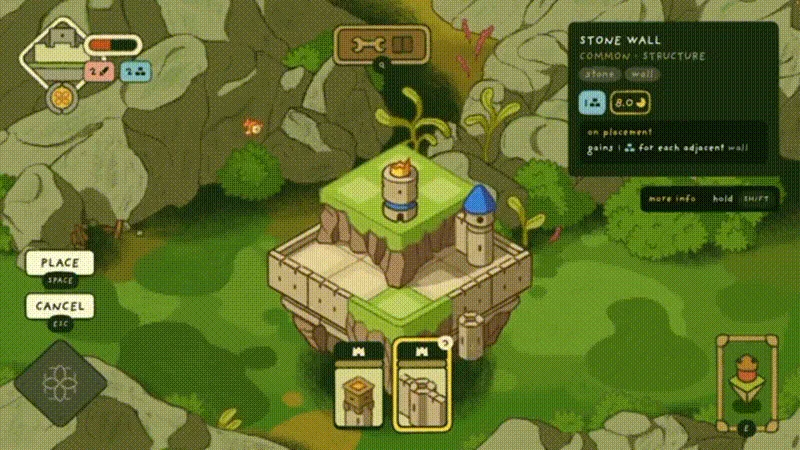
The fortress begins with a three-by-three construction grid that expands over the course of a run. Placement matters because structures can receive adjacency bonuses, while other effects operate across rows or according to specific relationships. This makes the grid more than an inventory presented visually. A useful building must contribute to the current plan, occupy a position that supports the intended interactions and justify any relationships it displaces when moved. Expansion should therefore trigger a reassessment of the entire layout because newly available space can strengthen older structures, create better combinations or reveal that a previously essential component no longer fits the fortress’s developing identity.
Automatic combat acts as the testing stage for those construction decisions. Developer Sim Kaart has explained that the team deliberately kept the focus on building rather than direct combat control, so each fight shows whether the chosen arrangement actually works. Watching battles still matters because players can observe which structures activate, whether their timing is useful, which effects arrive too late and which parts of the build contribute least. After a loss, the most useful question is not simply which structure dealt the most damage, but what change might have altered the outcome. A fortress that dies before its strongest weapon activates needs a different solution from one that survives easily but cannot finish enemies.
One confirmed synergy links walls and Cannon Towers. The developer’s example says a Cannon Tower gains one attack for each unit of Bulwark generated by walls, meaning defensive structures can also contribute to offensive scaling. That interaction still depends on timing because the Cannon Tower needs time to charge before striking. Banners create another layer because some affect structures across an entire row rather than only direct neighbours. These systems reward layouts built around relationships, preparation and reliability instead of simply stacking the largest numerical bonuses.
Crafting provides another way to develop a run. Players collect resources, buy materials from travelling merchants and use those materials to construct structures between battles. A published Workshop screenshot shows a Furnace schematic requiring Stone plus a material from an “Any Rare” category, illustrating how recipes can combine specific and rarity-based requirements. Crafting should still be judged by what the resulting structure contributes to the actual fortress and what other improvements become unavailable when those resources are spent. The development team has also experimented with different reward rhythms, including material-heavy versions and more immediate systems where defeated monsters can provide structures, so crafting is not the only source of new buildings.
The demo includes Stone and Dirt castle-grid choices, while development material also identifies an Obsidian Keep for the broader game. A published Stone Keep description grants Bulwark at combat start for each stone structure, demonstrating that material identity can influence mechanics rather than serving only as decoration. The public demo’s named regions are the Cradle and the Steppes, described as lush and barren respectively, while Frozen Peaks has been announced for the developing main game. World-map tiles allow encounters and environmental elements to be rearranged between runs, creating a semi-procedural structure that preserves authored locations while still changing route decisions.
Demon bosses add pressure to that progression. Choosing encounters brings a demon boss closer until the fortress is eventually forced into a major confrontation, with the Archdemon positioned as the ultimate objective. August coverage describes ten monster types and five demon bosses in the advertised content, although those figures should not automatically be treated as a guarantee that every enemy appears in the public demo or in every run. Boss preparation is therefore best approached as an analysis of the current build’s strengths and weaknesses rather than as a search for one universal strategy.

Castle Away Free Demo, Release Window and Roguelite Progression
Castle Away’s free public Steam demo launched on August 24, 2026 after earlier playtesting and is available as a preview of the developing game rather than the finished commercial release. Players can find the game on Steam, use the dedicated demo download option, install it and launch it from their library. For a first session, the most useful approach is to learn how the starting keep, structures and placement rules interact rather than immediately trying to reproduce a particular build from a screenshot or video. Demo progress should also be treated as a learning opportunity rather than assumed to transfer into the eventual full game because save compatibility has not been established in the supplied information. Pasted text
The demo has already received post-launch improvements. A September 4 update refined enemy information, tooltip placement and hit feedback while addressing interface and localisation issues. It also changed burn and poison so their initial damage occurs only after their full duration has elapsed and fixed a problem that could prevent very fast structures from activating. These changes matter when comparing current play with older recordings because successful builds can depend not only on total damage but also on exactly when effects occur and whether individual structures behave as intended.
The full release currently has a broader 2026 listing on Steam, while the development team has described Q4 2026 as its intended launch window. That points to October through December rather than to one confirmed release day. Earlier stages included the game’s March announcement, an April open playtest connected to Steam’s Medieval Fest and the later August demo, so different public descriptions can refer to different stages of development. Until the team publishes a specific date, claims about an exact launch day, countdown or release-week schedule go beyond what has been confirmed. The same caution applies to final pricing, editions and other commercial details.
Roguelite progression extends beyond a single successful run. The game connects different castle types with distinctive structures, banners and materials, while higher-difficulty ascension runs provide additional unlocks. The public demo announcement names Survivor and Explorer as its two available difficulties, while Crusader is identified separately as a third difficulty for the developing main game. June playtest notes had already introduced the Obsidian castle and Crusader difficulty, but a playtest feature should not automatically be treated as part of the later public demo unless the demo announcement confirms it.
Progression should also be separated from player understanding. Unlocking more structures expands the available options, but learning why a previous run succeeded or failed is just as important. Before moving to a harder difficulty, it helps to identify which interaction produced the main damage, what supported survival and which purchases contributed least. That makes ascension a test of adapting to changing rewards rather than simply reproducing one fortress indefinitely.
For route planning, the current castle should guide encounter choices. A reward that completes an important synergy may be more valuable than a generally strong reward with no role in the existing build. At the same time, exploration has value during early play because unfamiliar regions and encounters teach how the systems work. The balance between discovery and conservative decision-making can therefore change depending on whether the goal is learning the game or completing a difficult run.

Castle Away Art Style, Godot Development and System Requirements
Castle Away uses a hand-drawn two-dimensional presentation and is being developed with Godot. An April developer post identified Godot 4.6 as the engine version being used at that stage, while later discussion described the game as entirely 2D with hand-drawn artwork. The castle uses a TileMapLayer component to track tiles and selection, although the finished fortress is not visually drawn as a rigid collection of separate tiles. This allows the game to maintain precise spatial rules underneath while presenting the castle as one cohesive illustrated structure.
That visual approach serves a practical gameplay purpose as well as an artistic one. Players need to recognise a growing collection of structures and understand how they relate spatially, so the artwork and interface must communicate function rather than merely decorate the board. Kaart has described his responsibilities as covering the visual art as well as interface legibility, the learning curve, exploration and the overall player experience. The floating-fortress concept has been compared editorially with Howl’s Moving Castle, but that comparison should not be interpreted as confirmation of a licensed relationship or documented direct influence.
The published system requirements are relatively modest. Minimum memory is listed at 4 GB, with 8 GB recommended, while storage is listed at 400 MB. The minimum graphics requirement calls for Vulkan 1.0 compatibility and the recommended configuration for Vulkan 1.2 support. On Windows, the minimum operating system is Windows 10, with either an x86 processor supporting SSE2 or an x86-64 processor, while the recommended specification calls for x86-64 with SSE4.2.
For macOS, the listed minimum is macOS 10.15 with support for both Intel x86-64 and Apple Silicon processors. Linux begins at 64-bit Ubuntu 20.04 or an equivalent distribution with a dual-core x86-64 processor, while the recommended Linux setup lists Ubuntu 22.04 or newer, or SteamOS 3.0, with a quad-core processor. Native Mac and Linux support is supported directly by a May developer announcement that introduced those platforms to the playtest rather than being inferred only from Godot’s cross-platform capabilities.
These specifications are publisher-listed requirements rather than independent performance measurements, so testing the free demo remains the most practical way to judge a particular machine. Performance alone is not the only consideration for a strategy game of this type. Interface readability, controller comfort, display size and viewing distance can also affect the experience even when the game runs smoothly.
Castle Away Developers, Design Philosophy and What to Expect from the Full Game
Castle Away credits René Slump, Sim Kaart and Matthijs Koster as its developers, with Renegade Games and WhisperGames as publishers. The team’s public communication describes Slump as responsible for programming and game systems, Kaart as the artist who also helps shape the overall experience, and Koster as responsible for sound and music. Tom Schoen handles marketing, partnerships and business, explaining why public descriptions sometimes refer to three core creators while other material discusses a four-person team.
The game’s design is centred on understanding interactions between structures rather than collecting isolated upgrades. Every major system reinforces that idea. Grid placement creates adjacency and row relationships, crafting asks players to spend limited resources on structures that fit the current fortress, automatic battles reveal whether the arrangement works, changing regions provide different reward opportunities and ascension difficulties test whether players can adapt when the same pieces do not appear again.
This also means that older screenshots, playtests and development posts need to be interpreted in context. The demo currently advertises Stone and Dirt castle choices, while Obsidian has appeared in development material. Some banners visible in older footage were removed from demo shops in the September update. A Workshop screenshot can reveal how one recipe worked in a particular build without proving that every recipe will remain unchanged. The same distinction applies to regions, bosses, difficulties and structures that have appeared during development but are not necessarily part of the current public demo.
The full game is expected to expand the run-based framework with additional castle types, materials, banners, structures, regions and higher-difficulty progression. Steam currently lists a 2026 release and developer communication points to Q4, but no precise launch date has been established. The free demo is therefore the best current way to evaluate the core systems while recognising that it represents only part of the planned commercial release. Pasted text
The developers’ broader philosophy can be seen in how the game asks players to learn. Strong combinations can be enjoyable without proving that they are universally dominant, and difficult encounters can expose weaknesses without proving they are impossible. Useful feedback therefore benefits from specific context such as operating system, input method, faction, difficulty, structures involved and whether a behaviour can be reproduced. That level of precision is particularly valuable in a strategy game where the challenge comes from interactions among many individual components rather than from one isolated mechanic.

Frequently Asked Questions (FAQs)
- What kind of game is Castle Away?
Castle Away is a run-based castle-building strategy game in which the fortress itself functions as the player’s build. Players place structures on a growing grid, create useful relationships between offensive, defensive and support pieces, collect rewards and improve the castle between automatic battles. Combat is used to test whether the layout works, so the main strategy comes from construction, placement and synergy rather than directly controlling a fighter. - Is the Castle Away Steam demo free?
Yes. The public Steam demo launched on August 24, 2026, and the developers describe it as free to download and play. It serves as a preview of the developing full game rather than the commercial release itself. Players can use it to learn the castle-building, combat and progression systems, but the reviewed material does not confirm that demo progress will transfer into the final version. - When will the full version of Castle Away release?
The full game is currently targeted for 2026, with developer communications narrowing that to Q4 2026. That means the intended window is between October and December, but no exact launch day has been confirmed in the reviewed sources. The free demo is already available, while pricing, final editions and a precise release schedule remain separate from the broader Q4 target. - Which factions are included in the Castle Away demo?
The demo announcement identifies Stone and Dirt as the two available castle or faction choices. Their rules can affect how a fortress develops, so players should read the current keep descriptions rather than assume one layout works equally well for both. Obsidian has appeared in development and playtest material, but the public demo announcement treats it as part of the broader developing game rather than one of the demo’s advertised faction selections. - Which regions can players explore in the demo?
The two named demo regions are the Cradle and the Steppes. The developers describe the Cradle as lush and the Steppes as barren, giving the demo some environmental variety as players move through encounters and rewards. Frozen Peaks is named separately as an additional region for the developing main game, so it should not automatically be treated as part of the public demo’s confirmed region list. - Can players fight the Archdemon in the demo?
Yes. The developers explicitly describe defeating the Archdemon on Survivor difficulty and then attempting Explorer, which confirms that the Archdemon challenge is part of the demo’s playable progression. Reaching that fight still depends on surviving the run and developing a fortress capable of handling the escalating encounters that lead toward the final challenge. - Does Castle Away support Mac and Linux?
Yes. Native macOS and Linux support was explicitly announced during the game’s playtesting period, alongside Windows support. The published requirements list macOS 10.15 or newer at minimum and Linux beginning with 64-bit Ubuntu 20.04 or an equivalent distribution, while SteamOS 3.0 appears in the recommended Linux configuration. Controller-focused interface improvements were also discussed as part of the wider platform support work. - How does crafting work in Castle Away?
Players collect materials and use them to craft structures that can strengthen or reshape the current fortress. Materials can also be purchased from travelling merchants between battles, giving players another way to prepare a needed recipe. The important decision is not simply whether a structure can be crafted, but whether it fits the current grid, improves an existing synergy and is worth the materials that could otherwise be spent on another upgrade. - Is Castle Away really made in Godot?
Yes. A developer specifically identified Godot 4.6 during the April playtest period, confirming that Castle Away is being built with the Godot engine. Later developer discussion also described the game as entirely two-dimensional with hand-drawn artwork. The castle uses a TileMapLayer-based system for tile tracking and selection underneath the illustrated presentation, showing how the visual style and the internal grid logic work together. - Is Castle Away multiplayer or cooperative?
The current Steam listing identifies Castle Away as a single-player game. The reviewed official material focuses on individual run progression, fortress construction and automatic battles, and it does not establish a multiplayer or cooperative mode. Based on the available information, players should therefore treat the game as a single-player strategy experience unless the developers announce additional modes later.

Conclusion
Castle Away combines a clear fantasy premise with a strategic construction system: build a flying fortress whose components cooperate, then let battle reveal whether the plan works. Its public demo provides a playable introduction, while the developing full release remains targeted for late 2026.
The most useful way to approach it is experimentally. Read the rules, make purposeful placement decisions, observe the result, and revise the weakest part of the arrangement. A successful fortress should be more than a collection of individually attractive structures.
For anyone evaluating the game, the essential distinction is between what can be played now and what has been discussed for the full release. Keeping demo content, earlier playtests, promotional screenshots, and future plans separate produces a clearer picture of Castle Away’s current offering, and a better basis for deciding whether its particular blend of crafting, spatial planning, and automatic combat is appealing.
Sources and Citations
- Steam, Castle Away Official Store Page: Provides the planned 2027 release, single-player classification, free demo availability, gameplay features, supported platforms, controller compatibility and published PC system requirements.
https://store.steampowered.com/app/4362480/Castle_Away/ - Steam Community, Castle Away Official Developer Announcements: Documents the August 24 demo launch, Cradle and Steppes regions, Stone and Dirt castle types, Survivor and Explorer difficulties, platform support and September gameplay fixes.
https://steamcommunity.com/app/4362480/allnews/ - Renegade Games, Castle Away Official Game Website: Explains the expandable 3-by-3 castle grid, crafting mechanics, structure adjacency bonuses, Bulwark interactions, automatic combat, demon boss pressure and roguelite progression.
https://renegade.games/game/ca - Retro Handhelds, Jim Gray, July 4, 2026: Developer interview with René Slump, Sim Kaart and Matthijs Koster examining combat design, reward pacing, structure balancing, banners, procedural encounters, artistic direction and visual readability.
https://retrohandhelds.gg/interview-castle-away-gotta-storm-em-all/ - Renegade Games via Games Press, August 24, 2026: Official demo launch announcement confirming two playable regions, two castle factions, Survivor and Explorer difficulties, the development team and the original Q4 2026 release target.
https://www.gamespress.com/ja-JP/Hand-Drawn-Roguelite-Auto-Battler-Castle-Away-Launches-Public-Steam-De - Renegade Games via Games Press, October 19, 2026: Official Steam Next Fest update introducing asynchronous multiplayer rivals, Relics, avatar customization and combat speed controls, while revising the full release target to Q1 2027.
https://www.gamespress.com/es/Renegade-Games-Deploys-Asynchronous-Multiplayer-and-Strategic-Relics-t - SteamDB, Castle Away Demo: Documents the August 24, 2026 demo release, Godot Engine technology, Windows, macOS and Linux compatibility, controller support and historical application information.
https://steamdb.info/app/5065010/ - 80 Level, Stephanie Almogabar, August 25, 2026: Contemporary coverage of Castle Away’s hand-drawn presentation, flying fortress mechanics, crafting systems, monster encounters and development in Godot, including visual examples of castle construction.
https://80.lv/articles/this-hand-drawn-roguelite-will-have-you-building-your-own-flying-fortress - GamingOnLinux, May 4, 2026: Reports on the public playtest, native Linux and macOS support, controller improvements, structure synergies, strategic banners and the game’s evolving design.
https://www.gamingonlinux.com/2026/05/build-and-command-a-flying-fortress-in-the-playtest-of-castle-away/
Recommendations
- ‘One Fateful, Horrifying Night’: Here’s the First Trailer for the Resident Evil Movie — Feedback, Reactions, and Everything We Know (2026)
- Starsand Island Hits Game Pass August 20, 2026: Release Date, Features, Platforms and What to Expect
- Was Senua Used to Attract Buyers? the Ninja Theory Acquisition Debate Explained
- Arnold 7.4.5 Is Out: Release Notes, New Line Shader, Nearest Points Shader, and Faster OpenVDB Volumes
- Best Drag Cars in Forza Horizon 6 for Maximum Straight-Line Speed
- Lost Castle 2: Ethereal Nightmare Explained – Unlocks, Rewards, and Best Strategies
- The Creators of Will Publish Third-Party Games: Explained
- Marathon Open Beta Announced: Everything We Know About the Server Slam Dates, How to Join, Rewards, and Launch Details
- A Star Wars Expansion Is Coming to PowerWash Simulator 2: Everything You Need to Know About the Galactic Cleaning Adventure
- Modern Warfare 4 Faces a ‘Call of Duty Tax,’ Activision Says



































































































