










In This Article (7 sections)
Claude Max and Ultra Subscription Changes, New Plan Names, Pricing and Account Verification
Claude Max and Ultra are Anthropic’s renamed premium individual subscription plans, replacing Max 5x and Max 20x. As of November 2, 2026, their advertised US web prices remain $100 and $200 per month, respectively. The main functional change is that verified Ultra accounts no longer have a five hour usage cap, while weekly limits continue to apply. This distinction matters because a subscription can offer more flexibility without becoming unlimited. Someone working through an intensive coding task may benefit from being able to concentrate their allowance into a longer session, while someone who already exhausts their entire weekly allowance faces a different constraint.
Understanding the changes therefore requires looking beyond the new names. Subscription price, verification status, session restrictions, weekly allowances, model specific limits and optional additional spending all affect the experience. For existing subscribers, the immediate task is to understand what their renamed plan includes. For prospective subscribers, the useful comparison is how each plan fits the timing and intensity of their work. A higher monthly price only makes sense when its additional capacity or flexibility solves a recurring problem.
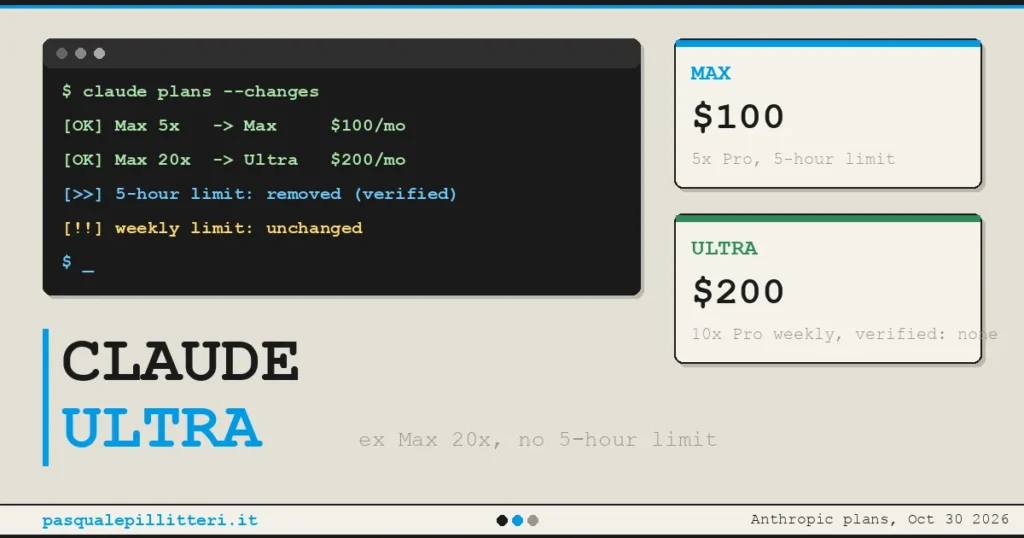
Anthropic announced the change on October 30, 2026. Max 5x became Max, while Max 20x became Ultra. Its announcement confirmed that subscription prices and weekly limits remained unchanged, but it did not provide a detailed explanation of the branding decision. The practical effect is a clearer separation between the two premium plans. Instead of choosing between two subscriptions carrying the Max name and different multipliers, customers now choose between Max and Ultra. One interpretation is that simpler names make the plans easier to discuss while allowing Anthropic to describe their restrictions separately.
That remains an interpretation rather than a confirmed explanation of the company’s internal reasoning. The old multipliers also need context. Anthropic’s earlier Max documentation described the 20x figure as a multiple of Pro’s per session allowance. It should not automatically be read as a promise of twenty times Pro’s weekly capacity. Comparing an old plan name with a current weekly multiplier can therefore produce a misleading conclusion. A meaningful comparison must use the same measurement period and distinguish historical marketing terminology from the current entitlement.
Claude Max costs $100 per month, while Claude Ultra costs $200 per month at the advertised US web subscription rates. Applicable taxes are additional, and mobile subscription prices can differ. Anthropic’s help pages currently describe both premium plans as monthly subscriptions. The difference is $100 per month. Over twelve months at those unchanged base prices, Max would cost $1,200 and Ultra would cost $2,400 before taxes. These are annualized calculations rather than advertised annual subscription offers. Price alone does not establish which plan represents better value.
A subscriber who rarely encounters restrictions may gain little from moving to the more expensive tier, while another might find that interrupted development sessions repeatedly delay paid work. A useful way to assess the difference is to compare it with an actual pattern of disruption. If interruptions cost several productive hours each month, additional flexibility may justify the higher fee. If they happen only occasionally and can be worked around easily, the cheaper plan may remain sufficient. The amount shown at checkout is the relevant figure for an individual purchase, particularly where local currency, tax or app store billing affects the total.
Existing subscribers do not need to repurchase their subscriptions to receive the new names. Anthropic said the transition required no action, with the five hour restriction removal beginning for most existing verified Ultra subscribers. For someone previously using Max 5x, the first visible difference may simply be the Max label. For someone previously using Max 20x, the Ultra name accompanies a potentially more meaningful change in how work can be scheduled. A renamed subscription should be evaluated separately from a deliberate upgrade. Moving from the lower priced plan to the higher priced plan is a purchasing decision, while receiving a new name for an existing subscription is a migration.
This distinction is useful when reviewing a billing page or comparing an older receipt with the current interface. Different wording does not independently demonstrate an unexpected charge or a change in the purchased tier. Subscribers can also compare their experience before and after the transition. Someone who previously stopped during a concentrated task may notice fewer session related interruptions, while someone whose main problem was exhausting the week’s allocation should assess whether that underlying constraint has changed for their account.
A verified Ultra account is one Anthropic has automatically assessed using factors including account and payment history. The company describes this process as a measure against fraud and abuse. It does not publish a complete eligibility formula or guaranteed verification timetable in the Ultra help article. That makes verification different from a conventional application process with a published checklist. The available documentation does not establish that a particular account age, number of payments or amount of activity guarantees approval. For planning purposes, the key distinction is between purchasing the plan and receiving the associated verification status. Those events should not be assumed to happen simultaneously.
A subscriber preparing for an important development session should therefore assess the account’s current condition rather than relying on another customer’s experience. Two people paying for the same tier can temporarily have different session restrictions. Verification also should not be interpreted as a professional credential or a statement about a subscriber’s technical ability. In this context, it concerns Anthropic’s account assessment and the application of a particular usage restriction.
Phone verification and Ultra verification serve different immediate purposes. Anthropic’s phone verification guidance describes entering an SMS code to establish access to a phone number during account creation. Its Ultra guidance explicitly says that completing phone verification does not remove the temporary session restriction. The terminology can be confusing because both processes use the word verification.
Completing one does not establish completion of the other. Receiving a text message and entering its code should not be taken as confirmation that every Ultra entitlement has finished activating. This distinction also helps when contacting support. A useful description identifies the subscription tier, the session restriction still visible and whether the concern relates to account creation or Ultra eligibility. Simply stating that an account is already verified leaves room for misunderstanding because it may refer only to the phone number step. An onboarding check, payment confirmation and account assessment used for a subscription benefit can be separate processes even when they appear during the same customer journey.
The central changes to Anthropic’s premium subscriptions can be summarized as follows:
- Claude Max: The renamed Max 5x subscription, retaining its advertised $100 monthly US web price.
- Claude Ultra: The renamed Max 20x subscription, retaining its advertised $200 monthly US web price.
- Existing subscriptions: Automatically transition to the new names without requiring another purchase.
- Ultra verification: Determines whether the account qualifies for removal of the five hour session restriction.
- New Ultra accounts: May temporarily retain session restrictions while automatic verification is pending.
- Weekly usage: Remains subject to Anthropic’s existing limits despite the removal of Ultra’s short period cap.
- Phone verification: Remains separate from the assessment used to remove Ultra session restrictions.
- Additional spending: Eligible subscribers can purchase usage credits separately when they need capacity beyond their included allowance.
These changes make it important to distinguish subscription identity, account verification and actual usage entitlement. The renaming itself does not establish a higher weekly allowance, while the removal of Ultra’s session restriction provides additional flexibility for accounts meeting the verification requirements. Subscribers should therefore evaluate the practical benefits according to their existing work patterns rather than assume that the new names represent entirely different subscription products.
Claude Ultra and Max Usage Limits, Five Hour Restrictions, Weekly Allowances and Claude Code Integration
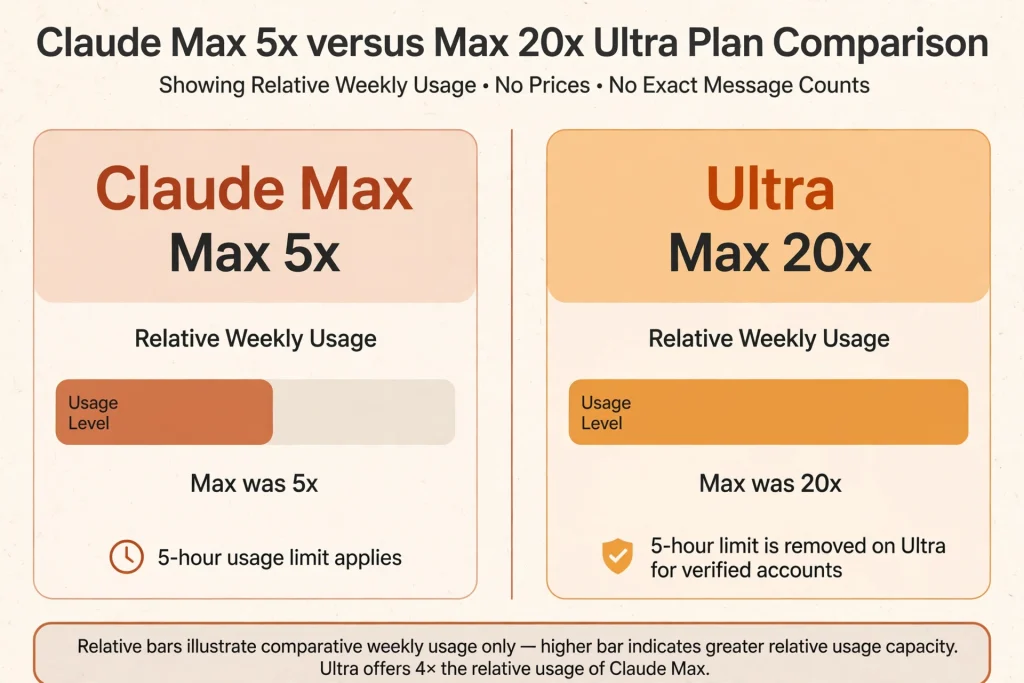
Anthropic describes the five hour limit as an allowance for a window that begins with the first message and replenishes five hours later. Verified Ultra accounts are exempt from this session restriction, while weekly controls remain separate. The five hour wording does not mean subscribers receive exactly five hours of continuous computing. It describes a period during which a certain amount of usage is available, and a sufficiently intensive workload can consume that allowance before the period ends. Consider a hypothetical developer working on a difficult migration.
They might spend a concentrated morning asking Claude to inspect code, propose changes and investigate test failures. Under a session allowance, they could reach the short period restriction while still having capacity available for the rest of the week. Removing that restriction gives them more freedom to concentrate their available usage around the task. It does not establish a guaranteed task duration because coding requests can vary substantially in complexity. The practical benefit is scheduling flexibility, allowing the subscriber greater control over when to use available weekly capacity.
Anthropic’s announcement says newer Ultra accounts retain a temporary restriction until verification and that users receive an email when it is removed. The company connects this temporary measure to preventing fraud and abuse. A new subscription should therefore not be treated as a guarantee that the short period cap disappears immediately. This matters most when buying Ultra for an urgent project. A developer subscribing shortly before a major release might expect to work through an extended debugging session immediately. If verification is still pending, that expectation may exceed the account’s current capabilities.
There is no reliable basis for assigning every new subscriber the same waiting period. Statements suggesting that all accounts are verified after a particular number of hours would require a published commitment that the documentation does not provide. A sensible planning approach is to separate confirmed capabilities from anticipated ones. Work that depends on uninterrupted access should be scheduled around what the account currently shows. The temporary restriction also should not automatically be interpreted as a billing failure because an account can have an active Ultra subscription while still awaiting the verification associated with session cap removal.
Anthropic currently advertises Ultra as providing ten times Pro’s weekly usage. Its pricing presentation also includes Fable access for up to half the weekly allowance, and the Ultra documentation identifies a separate weekly Fable limit. These distinctions mean weekly usage is not always a single interchangeable pool for every possible activity. A model specific restriction can matter alongside the overall allowance. Weekly replenishment follows an account assigned day and time. Anthropic says that schedule does not move according to when someone begins working or when the subscription starts.
For workload planning, the remaining allowance and the time until replenishment need to be considered together. Using a large share shortly before a reset has different consequences from doing the same thing immediately afterward. A hypothetical subscriber who completes most of their week’s work on Monday may prefer that concentration, while another who needs dependable assistance every weekday may want to preserve capacity for later tasks. Neither pattern changes the underlying weekly allocation. Removing a shorter restriction allows different spending patterns within the same broader period, improving flexibility while making deliberate pacing more useful.
The current Max plan includes five times Pro’s usage over both five hour sessions and weekly periods. Max retains these two layers of limits, so the remaining session allowance and weekly allowance both matter. A session reset does not mean the weekly account of usage has disappeared, while substantial weekly capacity does not guarantee that more usage is available within the current session. Imagine a researcher completing several demanding document reviews in one morning. They might encounter the session restriction even though their total activity for the week is relatively modest.
Now imagine the same researcher spreading heavy work across several days. Each individual session might remain within its allowance, while the combined workload eventually reaches the weekly boundary. These are different situations with different implications. The first concerns the concentration of work, while the second concerns its total volume. This is why the most useful upgrade question is specific: which restriction regularly interrupts the work? Someone encountering short period limits needs a different comparison from someone whose usage is consistently high across the entire week. Max can be sufficient for frequent work when both the intensity of individual sessions and the total weekly workload fit its allocation.
Claude and Claude Code share subscription usage limits when accessed through the same subscribed account. Anthropic’s documentation also says supported IDE usage draws from that shared allocation. Changing interfaces does not create another independent allowance. This can explain why a subscriber’s usage appears higher than expected after looking at only one application. A morning spent on research in Claude and an afternoon spent developing software in Claude Code contribute to the same broader pattern.
For someone who writes content and maintains a website, drafting articles, reviewing source material, analysing information and requesting development assistance should be considered together when assessing subscription needs. There is also an authentication distinction. Anthropic warns that an ANTHROPIC_API_KEY environment variable can make Claude Code use API authentication instead of the subscription, resulting in API charges. That detail matters when observed costs do not match expectations. A developer may need to establish which billing route is active before concluding that subscription usage has been accounted for incorrectly. The application being used and the account being billed are related questions, but they are not always identical.
Open Settings and select Usage to inspect the account’s consumption. Anthropic describes a Plan usage limits area containing relevant progress bars and reset information, alongside information about usage credits. Verified Ultra accounts do not display the five hour session limit. The dashboard is most useful when read as a planning tool. A percentage tells only part of the story, while the reset time and the restriction it belongs to provide the rest.
For example, a heavily used session allowance does not mean the weekly allocation is equally depleted. Similarly, a low session percentage does not rule out a nearly exhausted weekly balance. Before beginning an unusually large task, compare the remaining capacity with the amount of work expected. The estimate will not be exact, but it can reveal whether the timing is sensible. It can also help to observe consumption around representative tasks over several days. A typical article research session, code review or spreadsheet analysis provides a more useful reference than an unusually short question. Those observations should be treated as personal planning evidence rather than universal benchmarks because another subscriber may use different models, files, settings and workflows.
Without additional usage enabled, reaching a weekly limit produces a message identifying when access will replenish. Anthropic distinguishes these warnings from other errors, including context length problems and temporary capacity constraints. Paid subscribers can enable usage credits to continue beyond included limits at consumption based rates. These credits are billed separately from the subscription, and continued access depends on available funds and configured spending controls. That changes the decision from capacity management to cost management. Waiting preserves the subscription only budget, while continuing may help complete urgent work but adds expenditure.
A useful comparison considers how often this occurs. Occasional additional spending may be manageable for an irregular workload, but repeatedly paying for substantial extra consumption warrants a broader assessment of the subscription and working pattern. Before enabling automatic replenishment, a subscriber can decide what maximum monthly total is acceptable. That creates a clear boundary for tasks that may take more iterations than expected. The wording of an error also matters. An exhausted weekly allowance, an overly large message and a capacity related response do not have the same cause. Paying for more usage should not be assumed to resolve every interruption.
The different restrictions and usage arrangements can be distinguished as follows:
- Five hour session allowance: Limits the amount of work available within a shorter usage window.
- Weekly allowance: Controls total included usage over the account’s assigned weekly period.
- Verified Ultra exemption: Removes the five hour session restriction while retaining weekly limits.
- Model specific limits: May apply separately to certain models, including Fable.
- Shared subscription usage: Combines activity across Claude, Claude Code and supported IDE integrations.
- Usage dashboard: Displays applicable consumption levels and reset information.
- Additional usage credits: Allow eligible subscribers to continue beyond included usage at separate consumption based rates.
- API authentication: Can result in separate API charges when Claude Code uses an API key rather than subscription authentication.
These distinctions help explain why two subscribers can encounter different restrictions despite using the same product. The actual experience depends on subscription tier, verification status, model selection, workload intensity and remaining allowances. Understanding which restriction applies makes it easier to evaluate whether an upgrade or additional usage spending would meaningfully improve productivity.

Claude Max vs Ultra for Coding, API Credits, Subscription Value and Heavy User Workflows
For long coding sessions, the most useful comparison begins with the nature of the interruption rather than the subscription name. A developer who repeatedly encounters the short period cap has a different requirement from someone who consumes the entire weekly allowance through continuous development work. The amount of usage a task consumes depends on factors such as model choice, effort level, conversation length, file size and tool activity. Anthropic’s guidance therefore does not support converting every subscription into a guaranteed number of productive coding hours. Consider two hypothetical developers.
One spends most of the week implementing changes manually and uses Claude intensively during a single difficult debugging session. The other delegates substantial work throughout every day. The first may place a high value on flexibility during a concentrated period, while the second needs to assess total weekly capacity and the cost of any additional consumption. Task organization remains relevant under either plan. Defining the expected result, narrowing the scope of a change and deciding how completion will be checked can make a development session easier to evaluate. The appropriate measure is successful work completed with acceptable review effort. A longer uninterrupted session has limited value if it produces changes that require extensive correction or cannot be verified confidently.
Start with a representative week of work when comparing subscriptions. Record what was being done when an interruption occurred, which limit was reached and how much the delay affected completion. That evidence is more useful than choosing the most expensive plan on the assumption that it must be necessary. Compare the checkout price with the total likely spend, including any usage credits. Also consider whether additional features have practical value for the work actually being performed. Max and Ultra currently include $100 and $200 in monthly Claude Platform API credits, respectively, subject to eligibility and claiming requirements.
Anthropic says these credits are separate from subscription limits and do not pay for interactive Claude Code or extra usage in Claude. New eligible subscribers must have been on the plan for seven days before claiming. API credits can matter to someone building an application or agent, but they may add little practical value to someone who exclusively uses the chat application. The published seven day API credit rule should not be confused with an Ultra verification timetable because they concern different benefits. Finally, inspect the upgrade terms shown for the account. Anthropic documents prorated charges when moving from Max to Ultra, but the exact transaction should be evaluated through the relevant billing interface.
The changes make the timing of consumption an important part of the premium plan comparison. Heavy users are not a single group. Some work in occasional intensive bursts, while others sustain high demand throughout the week. A writer preparing a major publication, a developer investigating a release blocking defect and an analyst processing a large collection of documents may all value the ability to concentrate work. Their total weekly needs can still differ considerably. The remaining uncertainty is how the allowance translates into each person’s actual output. Subscription multipliers are useful for comparing advertised capacity, but they cannot predict the number of completed projects.
There are also operational limits beyond personal consumption. Anthropic’s troubleshooting documentation distinguishes temporary capacity constraints from service incidents and account usage restrictions. A premium subscription should therefore not be interpreted as a guarantee that every request always runs immediately. For heavy users, the strongest evaluation combines cost, completion rate, interruption frequency and review effort. Tracking whether the subscription helps finish meaningful work reliably provides more practical evidence than focusing on advertised usage multipliers alone.
The practical comparison between Max and Ultra depends on several factors:
- Monthly subscription cost: Max costs $100, while Ultra costs $200 at advertised US web rates before taxes.
- Session flexibility: Max retains five hour usage restrictions, while verified Ultra accounts are exempt.
- Weekly capacity: Max provides five times Pro’s weekly usage, while Ultra advertises ten times Pro’s weekly usage.
- Verification requirements: Ultra session cap removal depends on Anthropic’s automatic account assessment.
- Model access and restrictions: Model specific allowances may affect the amount of work possible within each plan.
- Claude Code activity: Coding usage contributes to the same subscription allocation as other supported Claude interfaces.
- API credits: Eligible subscribers receive separate Claude Platform credits that do not increase interactive subscription allowances.
- Additional usage spending: Consumption beyond included limits can create separate charges when enabled.
- Workload requirements: Intensive coding, research, document analysis and other tasks can consume allowances at different rates.
- Productivity benefits: The value of an upgrade depends on whether it reduces meaningful interruptions and improves completed work.
For subscribers who already use Claude frequently, the most important distinction is between concentrated usage and sustained weekly demand. Removing a session cap can make it easier to work through a demanding project without interruption, but it does not create additional weekly capacity beyond the plan’s stated entitlement. Someone who consistently reaches the weekly limit may still need to manage consumption or consider the cost of additional usage. Conversely, a subscriber who rarely reaches either limit may find that the lower priced plan meets their requirements without unnecessary spending.
The October 2026 renaming simplifies Anthropic’s premium subscription structure while introducing a meaningful scheduling benefit for verified Ultra users. Max remains the lower priced option with session and weekly restrictions, while Ultra offers greater weekly capacity and removes the shorter cap for accounts that satisfy verification requirements. Neither subscription should be described as unlimited, and their practical value depends on how each subscriber uses the available allowance.
Ultimately, the most useful comparison is based on actual work patterns, interruption frequency and total cost. A higher priced plan is valuable when its additional capacity or flexibility helps complete important tasks more reliably. For coding, research, writing and other demanding activities, understanding the applicable limits provides a clearer basis for choosing between Max and Ultra than relying on subscription names or historical multipliers alone.
Frequently Asked Questions (FAQs)
- What happened to Claude Max 5x?
Anthropic renamed Claude Max 5x to Claude Max on October 30, 2026. The change was part of an update intended to distinguish the company’s two premium individual subscription tiers. Existing Max 5x subscribers automatically transition to the Max name without purchasing another subscription. The advertised US web price remains $100 per month, and the plan continues to include five hour session limits and weekly usage restrictions. - Is Claude Ultra the replacement for Max 20x?
Yes. Claude Ultra is the new name for Anthropic’s former Max 20x subscription. The plan retains its advertised $200 monthly US web price and continues to offer a larger weekly usage allowance than Max. The main additional change is that verified Ultra accounts are exempt from the five hour session restriction. However, weekly limits and other applicable controls remain, so the new name does not represent unlimited access. - How much do Claude Max and Ultra cost?
Claude Max costs $100 per month, while Claude Ultra costs $200 per month at the advertised United States web subscription rates. These prices exclude applicable taxes, and mobile app billing or regional pricing may produce different checkout amounts. At the same base prices, twelve months of Max would cost $1,200 and twelve months of Ultra would cost $2,400 before taxes. These are annualized calculations rather than advertised annual subscription plans. - Is Claude Ultra unlimited?
No. Claude Ultra is not an unlimited subscription. Verified Ultra accounts no longer have the five hour session restriction, but the plan still includes weekly usage limits and certain model specific restrictions, including a separate Fable allowance. This means subscribers can concentrate more of their available usage into longer sessions without removing the total weekly controls. Heavy users may still reach their weekly limits and need to wait for replenishment or use separately purchased usage credits. - Why does an Ultra account still show a session limit?
An Ultra account may continue showing the five hour session limit because Anthropic’s automatic verification process has not yet been completed. Newer accounts can temporarily retain the restriction as part of the company’s fraud and abuse prevention measures. Anthropic says users receive an email when the restriction is removed, but it does not publish a universal verification timetable. An active Ultra subscription therefore does not guarantee immediate removal of the session cap. - Does phone verification unlock unrestricted Ultra sessions?
No. Phone verification and Ultra account verification are separate processes. Phone verification generally involves receiving and entering an SMS code to confirm access to a phone number. Ultra verification involves Anthropic’s automatic assessment of account and payment related information for eligibility to remove the five hour restriction. Completing the phone verification process does not automatically change the account’s Ultra session limits, and the account may remain subject to temporary restrictions until the relevant assessment is complete. - Does switching from Claude to Claude Code provide more allowance?
No. Claude and Claude Code share the same subscription usage limits when accessed through the same subscribed account. Supported IDE integrations also contribute to that shared allocation. Moving between the chat interface and coding tools does not provide a separate allowance or reset existing consumption. Developers should also distinguish subscription authentication from API key authentication because using an API key can result in separate API charges rather than drawing from the included subscription capacity. - When does the weekly allowance reset?
Anthropic assigns each account a specific weekly reset day and time. The schedule does not necessarily begin on Monday or coincide with the subscription payment date. Subscribers can check the Usage section in their account settings to see the applicable reset information and remaining allowances. Understanding this schedule is important when planning demanding tasks because using a large portion of the allowance shortly after replenishment can affect access for the rest of the week. - Can the included API credits cover extra chat usage?
No. The monthly Claude Platform API credits offered to eligible Max and Ultra subscribers are separate from their interactive Claude subscription allowances. These credits are intended for eligible API usage and do not pay for extra chat consumption or subscription authenticated Claude Code activity. Anthropic also has specific claiming requirements, including a seven day eligibility period for new subscribers. Users who want to continue beyond their included chat limits must use the appropriate additional usage option rather than relying on API credits. - Which plan is better for intensive work?
The appropriate plan depends on how frequently a subscriber works, how concentrated their sessions are and which limits cause interruptions. Claude Max may be sufficient for regular research, writing and coding when usage fits within its session and weekly allowances. Claude Ultra provides greater weekly capacity and removes the five hour restriction for verified accounts, making it potentially more suitable for demanding work sessions. However, subscribers should compare the additional monthly cost with their actual usage patterns, interruption frequency and productivity needs before deciding.

Conclusion
Claude Max and Ultra are easier to compare when subscription pricing, session flexibility, weekly usage allowances and account verification are considered separately. The October 2026 renaming simplifies Anthropic’s premium subscription structure, but it does not mean existing plans have become unlimited or that every new account immediately receives identical benefits. Verified Ultra subscribers gain greater flexibility for intensive work sessions, while weekly usage limits and other applicable restrictions remain in place. For prospective subscribers, the most useful approach is to evaluate their actual workloads, identify which restrictions cause interruptions and compare the total expected cost with the potential benefits of completing tasks more efficiently and reliably.
For existing subscribers, the priority is understanding their renamed plan, reviewing current entitlements and monitoring usage through the account dashboard. Greater session flexibility can make demanding coding, research, writing and analytical tasks easier to schedule, but effective workload planning still depends on knowing how much capacity remains and when it replenishes. Ultimately, the value of Claude Max or Ultra depends on whether its pricing, usage allowances and flexibility match the subscriber’s working patterns. A more expensive plan is beneficial when its additional capabilities solve recurring productivity problems rather than simply providing higher advertised limits.
Sources and Citations
- Anthropic / Claude, October 30, 2026: Anthropic announced that Max 5x was renamed Max and Max 20x was renamed Ultra, with prices remaining at $100 and $200 per month. It also announced that verified Ultra accounts would no longer have the five-hour limit, while weekly limits would remain. Anthropic’s current Ultra documentation confirms the rename and automatic migration for existing Max 20x subscribers. Advance Intelligence
Claude Ultra plan details - Claude Plans & Pricing: Plans & Pricing
Claude’s official pricing page lists Max at $100 per month with five times Pro usage every five hours and every week, while Ultra costs $200 per month, removes the five-hour limit for verified accounts and provides ten times Pro usage per week. It also lists $100 in monthly API credits for Max and $200 for Ultra. Claude - Claude Help Center, Max Plan: What is the Max plan?
Official documentation confirms the $100 monthly web price, five times Pro usage every five hours and every week, a weekly Fable limit, Claude Code access and monthly API credits. It also explains that moving from Max to Ultra is billed on a prorated basis. Claude Help Center - Claude Help Center, Ultra Plan: What is the Ultra plan?
Confirms that Max 20x became Ultra, existing subscribers migrate automatically without a price change, and Ultra provides ten times Pro’s weekly usage. Verified accounts have no five-hour restriction, while unverified accounts can temporarily retain one. Anthropic says verification uses factors such as account and payment history, and phone verification is a separate process. Claude Help Center - Claude Help Center, Usage and Length Limits: How do usage and length limits work?
Explains the distinction between five-hour session limits, weekly limits and conversation-length limits. It confirms that weekly limits reset at a fixed account-assigned time and that verified Ultra accounts are exempt from the normal five-hour limit. Claude Help Center - Claude Help Center, Claude Code: Use Claude Code with your Pro, Max, or Ultra plan
Confirms that Claude and Claude Code share the same subscription usage limits. Pro and Max retain five-hour and weekly limits, while verified Ultra users have only the applicable weekly restrictions. Max and Ultra also have a separate weekly Fable limit. Claude Help Center - Claude Help Center, Usage Best Practices: Usage Limit Best Practices
Explains how message length, attachments, conversation length, tool usage, model choice and artifact creation can affect consumption. It also recommends planning conversations and reducing unnecessary context to stretch available usage. Claude Help Center - Claude Help Center, Phone Verification: Why do I need to verify my phone number?
Anthropic says phone verification is used to help prevent spam and abuse. Ultra documentation separately clarifies that completing phone verification does not itself remove the temporary Ultra session limit. Claude Help Center - Claude Help Center, Usage Credits: Manage usage credits for paid Claude plans
Explains how Pro, Max and Ultra users can continue beyond included limits by switching to pay-as-you-go usage credits. Users can set monthly spend caps, enable auto-reload and monitor spending in Settings > Usage. These charges are separate from the subscription itself. Claude Help Center - Claude Help Center, Monthly API Credits: Monthly API credits for Max, Ultra, and Team plans
Confirms monthly credits of $100 for Max and $200 for Ultra. New subscribers generally become eligible after seven days on the plan. These credits cover the Claude API, Claude Managed Agents, Agent SDK and Console playground, but do not cover interactive Claude Code or extra Claude app usage. Claude Help Center - Claude Platform Documentation: API credits for Max, Ultra, and Team plans
Provides the same API-credit amounts and explains that credits refresh each billing cycle, do not roll over and are separate from normal Claude and Claude Code subscription limits. Claude Platform - Claude Help Center, API Billing: How do I pay for my Claude API usage?
Explains prepaid API credits, billing for successful requests, credit balances and auto-reload. It also distinguishes normal API billing from the included monthly API credits provided to Max and Ultra subscribers. Claude Help Center - Claude Help Center, Error Messages: Troubleshoot Claude error messages
Explains usage-limit messages and how accounts with usage credits enabled automatically switch to paid credits after exhausting a session or weekly allowance. This helps distinguish plan-limit warnings from other errors or service issues. Claude Help Center
Recommendation
- Paramount Closes $111B to Warner Bros. Deal: WB Games Uncertain
- Final Fantasy X/X-2 HD Remaster Switch 2 Release Guide and New Features
- Blender DLSS (2026 Guide): Enable DLSS Ray Reconstruction for Faster Cycles Viewport Denoising
- Steam Controller Hidden Easter Egg Explained: Why It Screams When Dropped and What It Means
- ANBERNIC RG DDS: 3DS-Inspired Handheld Starts at $299.99
- Anthropic’s $660M Charity Match Bill Could Reach Billions After IPO
- Ghostly Whiskers Faces Haunted Paws Copycat Allegations on Nintendo eShop
- Chaos releases V-Ray 7.4 for Houdini
- Marvel Rivals “Daredevil’s Shadowed Start” Costume Trailer Explained: Release Date, Event Details, Skin Rewards, and Everything We Know
- Horror Romance Visual Novel This Game Is Not Real Gets Rejected By Steam For “Not Meeting Platform Criteria”



































































































