










In This Article (9 sections)
Company of Heroes 3: Final Stand Reimagines the Series as a Standalone Wave-Defense Strategy Game
Company of Heroes 3: Final Stand is a standalone roguelite wave-defense strategy experience from Relic Entertainment that takes the tactical World War II combat of Company of Heroes 3 and reshapes it into a faster, more repeatable survival format. Revealed for PC via Steam, Final Stand focuses on holding defensive positions against escalating enemy attacks, fighting powerful boss units, reacting to dynamic battlefield events, and building a custom battlegroup through both run-based choices and persistent faction progression.
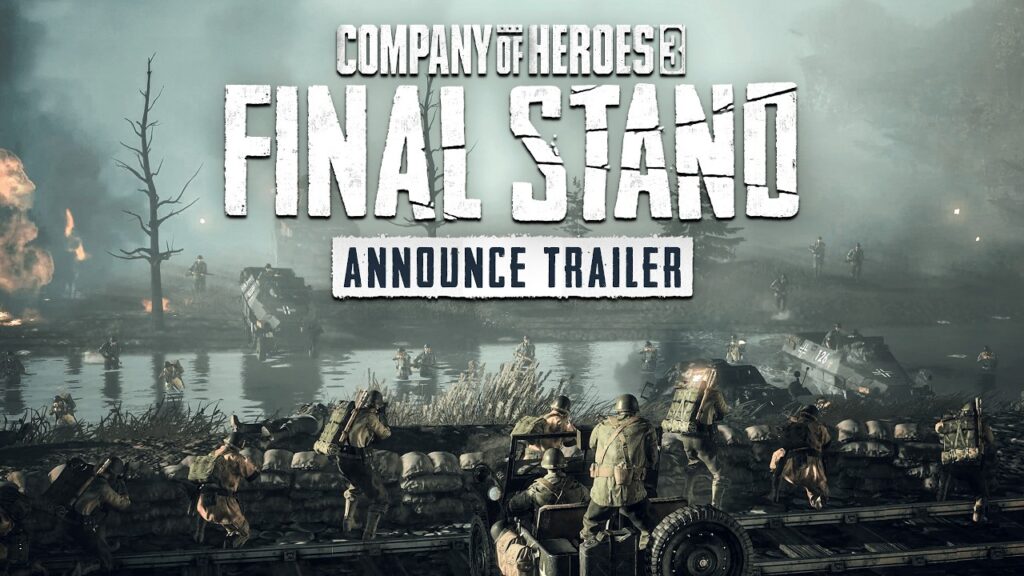
The official announcement trailer frames Final Stand as a compact, action-focused reinterpretation of Company of Heroes rather than a traditional campaign expansion or standard multiplayer map pack. Instead of centering the experience on broad campaign management, long skirmish buildup, or competitive territory control, the trailer emphasizes immediate battlefield pressure. Players are placed into defensive scenarios, build and reinforce their force, make choices after each wave, and try to maintain their line as the enemy threat becomes more dangerous.
That shift in structure is the main reason the announcement stands out. Final Stand is not being presented as a full campaign sequel, a normal multiplayer add-on, or a simple collection of maps. It is a separate standalone product built around survival encounters, custom battlegroup development, faction upgrades, solo play, and two-player online co-op. The official Steam materials state that players do not need to own Company of Heroes 3 or any previous Company of Heroes title to play it, which makes Final Stand accessible to newcomers while still offering a focused side experience for existing fans.
The confirmed feature list gives the game a defined scope. Final Stand is scheduled to launch on July 29, 2026, on PC via Steam. It includes single-player and cooperative gameplay, four playable factions, 12 escalating waves, Endless Mode, 36 boss units, 18 dynamic in-game events, eight difficulty levels, five wave-defense battlegrounds, faction-specific progression trees, cosmetic skin packs, and new announcer voice-over performances.
The central message of the announcement is that Final Stand keeps the tactical identity of Company of Heroes 3 while changing the rhythm of play. The familiar factions, battlefield presentation, tactical combat, and World War II setting remain important, but the structure is closer to survival defense than standard RTS conquest. For players deciding what Final Stand actually is, that distinction matters. It is not simply more traditional Company of Heroes content. It is a standalone, run-based wave-defense experience designed around replayable challenge, short-term adaptation, and long-term progression.
Standalone Access, Wave-Defense Gameplay, Solo Play, and Co-Op
Company of Heroes 3: Final Stand is best understood as a standalone release. The official Steam page describes it as an all-new standalone wave-defense experience and states that ownership of previous Company of Heroes titles is not required. Players who do not own Company of Heroes 3 can still buy and play Final Stand through its own Steam page, with its own planned release date and purchase path.
Some third-party coverage describes Final Stand as a standalone DLC or standalone expansion because it is connected to the Company of Heroes 3 name, factions, and systems. For players trying to understand access, however, the practical point is straightforward: Final Stand is not locked behind the base game. Existing Company of Heroes 3 owners may receive a discount, but ownership is not required to play.
That standalone structure supports the game’s more direct format. Final Stand is built around wave defense, with players preparing positions, reinforcing units, building layered defenses, and surviving 12 increasingly difficult rounds. The objective stays clear throughout each run. Players must hold the line as enemy pressure increases, bosses appear, and battlefield conditions change.
Wave defense changes the normal rhythm of Company of Heroes. Traditional RTS matches often involve territory capture, resource harassment, tech progression, map control, and constant movement across a shifting front line. Final Stand compresses that tactical identity into a survival structure where the central challenge is preparation, efficiency, upgrade selection, unit preservation, and adaptation across successive waves. The player is not simply trying to dominate an entire map. The main question is whether the current battlegroup can withstand the next pressure spike.
This format may also make the experience more readable for new players. A standard RTS can require knowledge of build orders, faction matchups, resource timing, and map control before a player feels comfortable. A survival-wave mode can teach through immediate pressure. Players learn to build defenses, counter armor, preserve infantry, manage repairs, use abilities, and understand battlefield threats because each decision is tested quickly. That does not make the mode shallow. It simply makes the objective easier to understand: survive.
Final Stand supports both single-player and two-player online co-op. The Steam page lists Single-player and Online Co-op among the supported features, and the official announcement FAQ describes the game as designed for single-player or two-player cooperative play. Co-op is not presented as mandatory, so players who want to experiment with faction builds, learn systems at their own pace, or chase higher difficulty clears alone should be able to do so.
The two-player co-op structure is especially important because it positions Final Stand as a cooperative PvE experience rather than a primarily competitive RTS release. Many players enjoy Company of Heroes mechanics but avoid ranked multiplayer because competitive RTS play can be demanding. Final Stand gives those players a way to engage with tactical squads, vehicles, abilities, and faction identity without entering a head-to-head ladder environment.
In co-op, the wave-defense setup naturally encourages shared tactical responsibility. One player may focus on infantry screens, repairs, and defensive positioning while the other handles anti-armor, artillery, or mobile counterattacks. Relic has not publicly detailed every co-op rule, so specific team mechanics should not be assumed. What is confirmed is that Final Stand supports two-player online co-op and is built around surviving escalating waves together.
Roguelite Battlegroups, Faction Progression, 12 Waves, and Endless Mode
The roguelite progression system is one of the main features separating Final Stand from a standard Company of Heroes match. Players build a custom battlegroup from the ground up to suit their preferred style, then choose between randomized units or abilities after each wave. Those choices persist for the duration of the run, which means every attempt can develop differently.
This gives each session its own tactical identity. A player may begin with one plan but be pushed in another direction by the upgrades offered after a wave. One run might become infantry-heavy and defensive. Another may lean on armor support, artillery, mobility, or ability-driven battlefield control. Because the available choices are randomized, the game is designed to reduce repetition and reward adaptation rather than fixed build execution.
Final Stand also includes persistent progression between runs. The official materials describe powerful perks and unique abilities unlocked through faction-specific progression trees. These upgrades are not limited to a single match. They are intended to support long-term mastery and change how each faction plays over time.
That creates two linked layers of progression. The first is temporary run progression, where randomized units and abilities shape the current attempt. The second is persistent faction progression, where unlocks affect future runs. This combination is central to the roguelite structure because it lets short-term decision-making and long-term improvement work together. A failed run can still contribute to future progress, while a successful run depends on how well the player adapts to the tools available in that attempt.
Final Stand includes four playable factions: US Forces, Wehrmacht, British Forces, and Deutsches Afrikakorps. Each faction has faction-specific progression trees with impactful upgrades. The faction list matters because it gives the game a broad tactical base from the start, using established Company of Heroes 3 identities in a new wave-defense context. Instead of using these factions primarily for campaign objectives or standard multiplayer, players use their tools to survive escalating enemy pressure.
Faction choice should not be treated as cosmetic. Third-party coverage notes that each faction has unique strategies, units, abilities, and progression paths. If the progression trees meaningfully change how each faction plays, the four-faction structure adds replay value beyond clearing the same waves with different visual presentation. Players can learn one faction, unlock its progression tree, experiment with builds, then move to another faction or increase the difficulty.
The standard run structure is built around 12 escalating waves. This creates a defined arc for each attempt. Early waves can test basic defense and unit control. Middle waves can pressure resource management and upgrade choices. Later waves are likely to demand stronger counters, better positioning, and cleaner unit preservation. Relic has not published the exact wave-by-wave enemy composition, so detailed claims about specific enemy sequences would be speculative. What is confirmed is the 12-wave structure, with bosses and dynamic battlefield events layered into the experience.
Endless Mode adds a second kind of replayability. While the 12-wave format gives players a completion target, Endless Mode gives them a survival benchmark. Instead of ending the challenge after a normal clear, it lets players test how long their faction choices, upgrades, co-op strategies, unit preservation, and defensive planning can withstand pressure that continues beyond the standard structure.
For long-term players, Endless Mode may become the clearest test of mastery. Roguelite defense games often gain depth when players move beyond basic completion and start optimizing for increasingly severe conditions. In Final Stand, that means seeing whether a battlegroup can keep functioning when the pressure no longer stops at the twelfth wave.

Boss Units, Dynamic Events, Difficulty Levels, and Wave-Defense Battlegrounds
Company of Heroes 3: Final Stand includes 36 boss units with special abilities and rewards. Boss units are important in a wave-defense mode because they prevent the challenge from becoming a simple increase in enemy numbers. A boss can force specific counterplay, disrupt an established defensive line, punish a one-dimensional build, or demand an immediate shift in target priority.
Relic has not released a full catalog of all 36 boss units, so their exact abilities and reward structures should be treated as unrevealed until more information is published. The confirmed details are that these boss units exist, that they have special abilities, and that rewards are tied to those encounters. Within the structure of Final Stand, they appear to function as major pressure points that test whether a player’s battlegroup can handle more than routine waves.
The game also includes 18 dynamic in-game events. These events are described as battlefield events unique to Final Stand, which suggests that runs will not depend only on fixed enemy waves. Dynamic events can alter tactical priorities, increase pressure, create opportunities, or force players to rethink defensive positioning during a run.
Together, bosses and dynamic events are central to replayability. Randomized unit and ability choices already make runs vary, but bosses and events add external uncertainty. A strong build may still be challenged if a battlefield event changes the situation or if a boss appears with abilities that counter the player’s defensive structure. This is where Final Stand’s roguelite identity can become meaningful rather than decorative.
Final Stand includes eight difficulty levels, ranging from newcomer to veteran. That range matters because skill levels in RTS-adjacent games vary widely. A newcomer may need time to understand unit counters, suppression, armor facing, cover, repair timing, and ability use. A veteran may want demanding wave pressure that requires efficient planning and precise execution. Eight difficulty levels allow the game to support both audiences without forcing every player into the same balance profile.
The game also includes five battlegrounds designed for wave-defense gameplay. This is an important detail because wave-defense maps require different design priorities from standard RTS maps. A traditional competitive map may focus on territory lanes, resource nodes, flanking paths, and spawn balance. A wave-defense battleground needs to support layered defense, escalating attacks, clear enemy approaches, and meaningful repositioning under pressure.
The five-battleground count gives Final Stand room for environmental variation, but Relic has not yet detailed the layout or tactical identity of each battleground. The safe conclusion is that Final Stand launches with five maps built specifically around its survival-defense format rather than simply relying on standard competitive layouts.

Price, Discounts, Steam Features, Languages, and PC Requirements
Company of Heroes 3: Final Stand is priced at $29.99 USD. Additional regional pricing reported from announcement materials lists £23.99 GBP and €28.99 EUR. Relic’s announcement FAQ confirms a 10 percent launch-period discount and a 20 percent discount for players who already own Company of Heroes 3.
The owner discount is important because it recognizes existing Company of Heroes 3 players without making the game exclusive to them. New players can buy Final Stand as a standalone release, while current owners receive a pricing benefit. The official wording confirms both discounts, but it is best not to assume a specific final stacked checkout total before Steam displays the price at launch.
At $29.99, Final Stand is priced below a typical full-price PC release. That fits the scope Relic has described: a focused standalone wave-defense experience rather than a full campaign sequel. The value question will depend on how much players engage with its roguelite progression, co-op play, faction mastery, higher difficulty levels, Endless Mode, boss encounters, dynamic events, and five battlegrounds.
Steam lists several supported features for Final Stand, including:
- Single-player
- Online Co-op
- Steam Achievements
- Steam Workshop
- Stats
- Family Sharing
The inclusion of Steam Workshop is notable, although the official materials do not yet explain the full extent of Workshop support. It should not be assumed that every form of modding or map support will be available until Relic provides more details. What is confirmed is that Steam Workshop appears among the supported features on the product page.
The Steam listing identifies the genre as Action and Strategy and includes user-defined tags such as Strategy, Wargame, Action RTS, Roguelite, World War II, Co-op, Singleplayer, Online Co-op, RTS, Real-Time with Pause, Real Time Tactics, Tactical, Military, War, Survival, and Top-Down. These tags are not the same as official genre labels, but they show how the game is being categorized for discovery on Steam.
Language support includes English with interface, full audio, and subtitles. The game also supports interface and subtitles for:
- French
- Italian
- German
- Spanish-Spain
- Czech
- Japanese
- Korean
- Polish
- Portuguese-Brazil
- Russian
- Simplified Chinese
- Traditional Chinese
- Turkish
- Ukrainian
The minimum PC requirements are Windows 10, an Intel i5 6th-generation processor or AMD Ryzen desktop processor with four cores at 3 GHz or equivalent performance, 8 GB of RAM, an NVIDIA GeForce GTX 950 or AMD Radeon R9 370 or equivalent graphics performance, DirectX 12, and 40 GB of available storage.
The recommended PC requirements are Windows 10 64-bit, an Intel i7 8th-generation processor or AMD Ryzen desktop processor with eight cores at 3 GHz or equivalent performance, 16 GB of RAM, an NVIDIA GeForce GTX 1660 or AMD Radeon RX 5600 or equivalent graphics performance, DirectX 12, and 40 GB of available storage.
These requirements are useful because Final Stand is standalone, but it is still connected to the technical foundation of Company of Heroes 3. Players should not assume that the smaller wave-defense structure means very low requirements. The official listing still calls for DirectX 12 and 40 GB of storage. Steam’s mature content note also states that the game features violent content and some gore, which is consistent with a World War II tactical combat game.

Frequently Asked Questions (FAQs)
- What is Company of Heroes 3: Final Stand?
Company of Heroes 3: Final Stand is a standalone roguelite wave-defense strategy experience from Relic Entertainment. It uses the tactical foundation of Company of Heroes 3 but reshapes it around survival runs, escalating enemy waves, boss encounters, dynamic battlefield events, and custom battlegroup development. Players build their forces during a run while also unlocking persistent faction upgrades over time. - When is Company of Heroes 3: Final Stand coming out?
Company of Heroes 3: Final Stand is scheduled to release on July 29, 2026, on PC via Steam. Relic’s announcement materials also state that it launches alongside the Company of Heroes 3 version 2.5.0 update. - Do I need to own Company of Heroes 3 to play Final Stand?
No. Final Stand is a standalone release and does not require ownership of Company of Heroes 3 or any previous Company of Heroes game. Existing Company of Heroes 3 owners may receive a discount, but the base game is not required to access or play Final Stand. - How many players does Company of Heroes 3: Final Stand support?
Final Stand supports single-player and two-player online co-op. Steam lists Single-player and Online Co-op among its supported features, and the official FAQ describes the game as designed for single-player or two-player cooperative play. - Which factions are playable in Company of Heroes 3: Final Stand?
The playable factions are US Forces, Wehrmacht, British Forces, and Deutsches Afrikakorps. Each faction has its own progression tree, and the official materials describe persistent upgrades that can meaningfully shape how each faction plays across future runs. - How many waves are in Company of Heroes 3: Final Stand?
The standard structure includes 12 escalating waves. These waves are designed to become increasingly difficult as the run progresses, with bosses and dynamic events adding extra pressure. Players who want a longer challenge can also take on Endless Mode. - Does Company of Heroes 3: Final Stand have bosses?
Yes. Final Stand includes 36 boss units with special abilities and rewards. These bosses are part of the wave-defense structure and are designed to create major tactical challenges. The game also includes 18 dynamic in-game events that add variation to runs. - How much does Company of Heroes 3: Final Stand cost?
Final Stand is priced at $29.99 USD. Reported regional prices include £23.99 GBP and €28.99 EUR. Relic’s announcement FAQ also confirms a 10 percent launch-period discount and a 20 percent discount for players who already own Company of Heroes 3. - What languages does Company of Heroes 3: Final Stand support?
English has interface, full audio, and subtitles. The game also supports interface and subtitles for French, Italian, German, Spanish-Spain, Czech, Japanese, Korean, Polish, Portuguese-Brazil, Russian, Simplified Chinese, Traditional Chinese, Turkish, and Ukrainian. - Will Company of Heroes 3: Final Stand receive post-launch DLC?
Relic’s official FAQ says the team is not actively developing post-launch content at the time of the announcement, with the immediate focus placed on post-launch quality and bug fixing. The same FAQ notes that additional content could be considered if there is strong community support.

Conclusion
Company of Heroes 3: Final Stand is a standalone Steam release that reframes Company of Heroes 3’s tactical combat as a roguelite wave-defense survival game. The announcement confirms a July 29, 2026 PC launch, single-player and two-player online co-op, four factions, 12 escalating waves, Endless Mode, 36 boss units, 18 dynamic events, eight difficulty levels, five battlegrounds, persistent faction progression, and post-wave randomized unit or ability choices.
The most important practical detail is that Final Stand does not require Company of Heroes 3. It is connected to the Company of Heroes 3 identity, but it is sold and presented as a standalone experience. That makes it more accessible to new players while still offering a discount path for existing Company of Heroes 3 owners.
The main appeal is clear: Final Stand offers the pressure of Company of Heroes battles without requiring a full campaign commitment or competitive multiplayer environment. Its success will depend on encounter variety, faction depth, progression balance, co-op stability, and how well the 12-wave and Endless Mode structures hold up over repeated play. Based on what has been revealed, it is one of Relic’s most direct attempts to turn Company of Heroes tactical combat into a replayable survival format.
Sources and Citations
- Official Steam Store – Company of Heroes 3: Final Standhttps://store.steampowered.com/app/4836540/Company_of_Heroes_3_Final_Stand/ (Steam Store)
- Official Steam Community Announcement & FAQ – Announcing Company of Heroes 3: Final Standhttps://steamcommunity.com/app/4836540 (Steam Community)
- PC Gamer – The new Company of Heroes is a wave-based defense game that throws prospective generals straight into the actionhttps://www.pcgamer.com/games/rts/the-new-company-of-heroes-is-a-wave-based-defense-game-that-throws-prospective-generals-straight-into-the-action/ (PC Gamer)
- OC3D – Relic Entertainment unveils Company of Heroes 3: Final Standhttps://overclock3d.net/news/software/relic-entertainment-unveils-company-of-heroes-3-final-stand/ (OC3D)
- GamingOnLinux – Company of Heroes 3: Final Stand announced as a standalone roguelite RTS spin-offhttps://www.gamingonlinux.com/2026/07/company-of-heroes-3-final-stand-announced-as-a-standalone-roguelite-rts-spin-off/
Recommended
- Disney Dreamlight Valley 2026 Summer Showcase Live Updates: Honeyglow Woods, Ralph and Everything Announced
- Avatar Legends: The Fighting Game – Official Sokka Developer Overview, Gameplay Breakdown, and Full Character Mechanics Explained
- Streamers and Voice Actors Refuse to Work With Neverness to Everness Over Gen AI Concerns: Ironmouse Sponsorship Fallout, Alleged AI Assets, and Hotta Studio Response
- Bubsy 4D Official Accolades Trailer Breakdown, Gameplay Details, Reviews, and Platform Release Guide
- How to Render Anime Style Art in Blender: A Complete Guide for Stylized 3D Renders
- Assassin’s Creed PVP Multiplayer Spin-Off’s Recent Playtest Reportedly Didn’t Go Well: Invictus Leak, Possible Delay, and What it Means
- Blender Frizz Hair Curves Geometry Nodes Preset: Comprehensive Guide & Best Practices
- Avatar: the Last Airbender Cast on Finding Toph and Bringing Ba Sing Se to Life (behind-the-Scenes Insights)
- Cartesian Caramel Geometry Nodes Tests: How Sound Can Be Visualized with Blender Geometry Nodes



































































































