







In This Article (8 sections)
CRASH KEYS Studio Launch, Kotaro Uchikoshi’s Leadership, and Founding Team
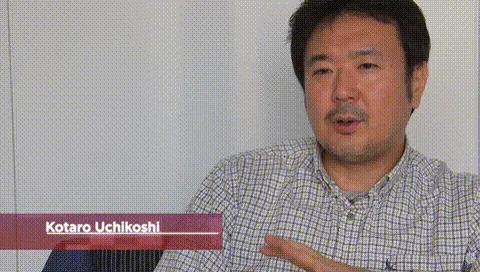
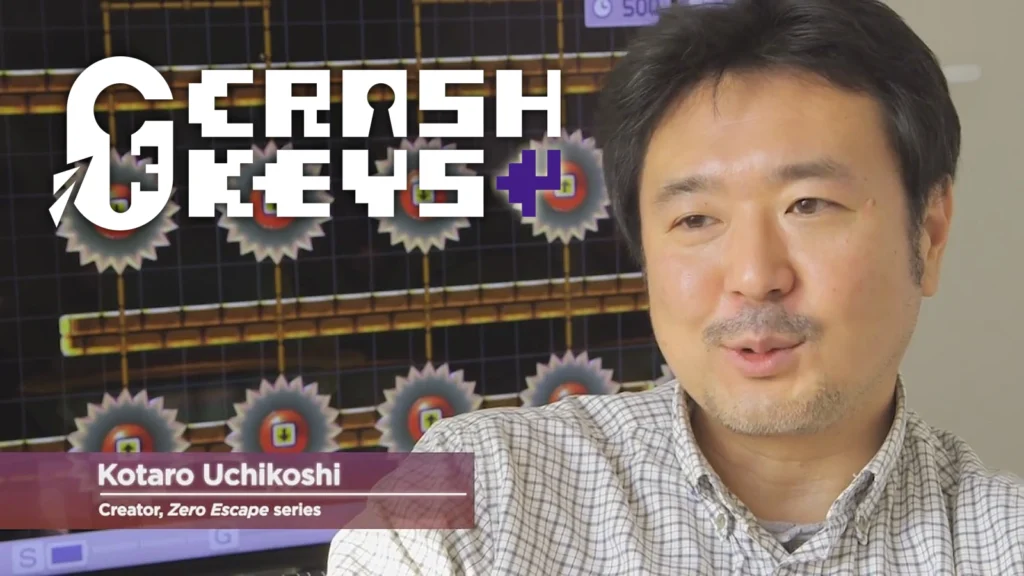
Kotaro Uchikoshi has publicly revealed CRASH KEYS, a Japanese creative studio focused on game planning, direction, and narrative writing, while also listing work involving film, animation, and related entertainment projects. The formal announcement was issued in Japan on October 15, 2026, although Uchikoshi explained that the company itself had already been established in March 2025.
That means CRASH KEYS operated privately for roughly nineteen months before being introduced publicly, and the company’s establishment date should not be confused with its announcement date. The formal release appeared at 1:00 a.m. Japan Standard Time on October 15, which also explains why some English-language coverage carries an October 14 date in other time zones. CRASH KEYS is headquartered in Shibuya, Tokyo, with Uchikoshi identified as representative director and CEO.
The company’s public identity emphasizes creative development rather than presenting CRASH KEYS as a studio that has already announced a complete internal production pipeline. Its listed activities include game planning, direction, scenarios, original concepts, structure, and scripts for games, film, and animation, which leaves room for several types of commercial collaboration. A studio offering those services could lead its own project, contribute creatively to another developer’s production, or work alongside publishers and external specialists depending on the arrangement.
The announcement does not establish the scale of its programming, art, animation, audio, testing, or other internal technical departments, so those capabilities should not be assumed. The most accurate description is therefore a creative company built around shaping interactive and narrative projects rather than a publicly defined full-service developer with every production discipline already documented.
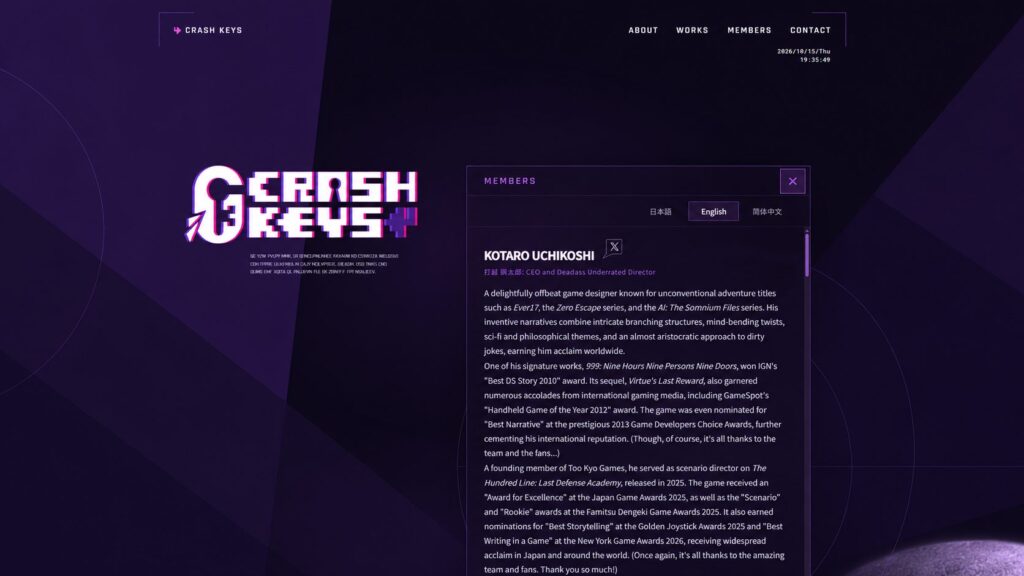
The founding member profiles identify Kotaro Uchikoshi, Akira Mine, and Muri Sasaki as the visible creative core of CRASH KEYS. Uchikoshi brings the strongest public recognition through his work on Zero Escape, AI: The Somnium Files, and earlier visual novel projects, while Mine and Sasaki contribute additional experience in writing and interactive storytelling. Mine’s profile references work on role-playing game scenarios as well as The Hundred Line: Last Defense Academy and Danganronpa 2×2, while Sasaki’s profile includes writing for games and animation, independent work, and contributions to gameplay sections in Zero Escape and AI: The Somnium Files.
These profiles establish a strong narrative emphasis, but they should not be treated as a complete employee count or proof that every future project will be written and directed by the same combination of people. Game production can involve permanent staff, contractors, external specialists, publishers, and partner studios, so future credits will need to establish the actual responsibilities on each project.
Uchikoshi’s role as CEO and representative director adds a business responsibility to his creative reputation, but the announcement does not provide a detailed organizational chart or describe how daily management, negotiations, staffing, production oversight, and creative approval are divided. His relationship with Too Kyo Games also remains relevant because follow-up reporting says he continues to be affiliated with that company and maintains a positive relationship with its members.
The establishment of CRASH KEYS should therefore not be described as evidence of a hostile departure or as something that automatically rewrites his earlier professional relationships. Company affiliation, project credit, and intellectual property ownership remain separate matters that must be assessed through their own evidence. CRASH KEYS gives Uchikoshi a formal business structure through which to pursue new creative work, but the success of that structure will depend on how its ideas are financed, staffed, and turned into actual productions.
Why CRASH KEYS Was Revealed Early and What Happened to Its Canceled Game
Uchikoshi originally intended to announce CRASH KEYS alongside a new game in 2027, but that plan changed after the project his team had been developing was canceled. He said the team had worked on the game for approximately a year and a half before the cancellation, prompting him to reveal the company earlier than intended. Instead of launching CRASH KEYS publicly with a title, trailer, or release date, he introduced an available creative team and appealed to prospective clients, collaborators, and investors.
This makes the announcement unusual because it combines the public launch of a studio with the disclosure of a major development setback. The early reveal should therefore be understood partly as commercial outreach rather than a conventional game marketing campaign.
The canceled project remains largely undisclosed. Uchikoshi has not publicly identified its title, platform targets, publisher, budget, genre, release window, or whether it was based on an existing intellectual property. Spending approximately eighteen months on a project also does not establish how close it was to completion because game development can include concept work, writing, prototyping, production planning, testing, and other stages whose duration varies substantially between projects.
The overlap between CRASH KEYS being founded in March 2025 and the approximate eighteen-month production period may appear suggestive, but it should not be converted into a precise development start date without additional evidence. The known facts are limited to the approximate duration, the cancellation, and the effect that cancellation had on the timing of the company announcement.
Uchikoshi’s follow-up comments about artificial intelligence require the same caution. Reporting from Famitsu describes him discussing changes in the development environment and AI as an indirect influence while still withholding the specific circumstances that caused the cancellation. That should not be simplified into a claim that one publisher canceled the game because of a particular AI requirement or policy. The available information does not identify one definitive cause, and assigning one would go beyond what Uchikoshi has disclosed.
The possibility that the project could eventually return under different circumstances also remains unresolved, since a canceled production can theoretically be revived but no revival has been announced. The strongest account therefore remains that CRASH KEYS lost an unnamed project after substantial development and is now seeking a way to replace that opportunity.
The cancellation helps explain why CRASH KEYS is actively looking for investment partners and new work. The company says it wants to advance original projects and strengthen its business foundation, inviting companies and investors to discuss project concepts, business direction, and possible investment. Investment and commissioned work can solve different problems, since a client might pay for a defined writing or direction assignment while an investor could support a broader project or business strategy under longer-term commercial terms.
The announcement leaves those structures open and does not establish a completed funding agreement, named investor, or confirmed replacement project. It also does not announce a public crowdfunding campaign, so fans should not interpret the request for investment as an invitation to purchase shares or directly fund an unnamed game.
The immediate business challenge is therefore converting CRASH KEYS’ creative reputation into funded work. A studio with strong narrative credentials can attract attention, but recognition alone cannot finance development, maintain staff, or guarantee that a pitch becomes a commercial release. Original projects may require prototypes, production documents, scripts, or other materials before a publisher or investor is willing to commit, but those are general possibilities rather than disclosed CRASH KEYS spending plans. Creative alignment will also matter because complex interactive mysteries require partners who understand how narrative structure affects production scope and cost. The studio’s public announcement establishes that it is available for those discussions while leaving their eventual form and outcome unresolved.
Zero Escape References, CRASH KEYS Mysteries, and Future Game Speculation
The name CRASH KEYS immediately attracted attention because Crash Keys already exists within the fictional world of Zero Escape as an organization associated with Akane Kurashiki. A preserved version of Uchikoshi’s Virtue’s Last Reward questions and answers explicitly identifies the organization by that name, making the connection more than a coincidental similarity noticed by fans. The official CRASH KEYS website also includes “RHIZOME-9,” another recognizable reference for people familiar with Virtue’s Last Reward, alongside cryptic text and unusual presentation. These choices demonstrate that the company is deliberately acknowledging material connected to Uchikoshi’s earlier work. They do not, however, establish the licensing or production arrangements necessary for a new Zero Escape game.
The website has consequently encouraged speculation about a sequel, related project, or alternate reality game. Siliconera highlighted unusual member entries and other Zero Escape-like references as reasons audiences have interpreted the site as possibly containing puzzles or hidden clues. It is reasonable to describe those elements as suggestive because they appear deliberately constructed to invite attention and interpretation. It is not reasonable to turn them into a confirmed game title, release date, platform list, or development announcement before CRASH KEYS or the relevant rights holders provide one. The existence of intentional puzzles, the presence of Zero Escape references, and the production of a new commercial Zero Escape game are separate propositions that require different levels of evidence.
An alternate reality game interpretation is also possible without proving that a new game is being developed. ARG-style campaigns commonly use websites, codes, fictional organizations, and material outside a normal game interface to invite players to investigate, but cryptic presentation alone does not establish the complete purpose of such a campaign. The website could function as playful company branding, a puzzle for longtime fans, a teaser for future work, or some combination of those possibilities. The cancellation announcement should likewise not be dismissed as fictional marketing merely because the site contains mysteries, since legitimate business communication and playful narrative presentation can coexist. Until CRASH KEYS explains the material directly, speculation should remain clearly labeled as speculation.
Uchikoshi’s career provides the context that makes those theories compelling. His earlier work includes projects at KID such as Ever17 and Memories Off, followed by the Zero Escape series and AI: The Somnium Files, as well as his involvement in founding Too Kyo Games. Spike Chunsoft’s The Nonary Games collects Nine Hours, Nine Persons, Nine Doors and Virtue’s Last Reward, games built around dangerous situations, escape-room challenges, investigation, and consequential decisions.
Publisher information dates 999’s original Japanese release to 2009 and Virtue’s Last Reward to 2012, while AI: The Somnium Files released in 2019 and its sequel, nirvanA Initiative, followed in 2022. This history explains why audiences naturally expect elaborate narrative structures and mysteries from CRASH KEYS without proving what its first publicly announced production will actually be.
CRASH KEYS has said it intends to pursue original projects, but no confirmed debut lineup has been revealed. That leaves a meaningful gap between creative ambition and actual product information because ideas, pitches, early writing, or prototypes are not the same as funded productions ready for public announcement. Platforms should not be inferred from Uchikoshi’s past releases, and a mystery adventure should not be treated as confirmed simply because it would align with his reputation. A substantive future announcement would need to establish a title, premise, development partners, supported platforms, and release plans, while gameplay footage could clarify how the project actually functions. Until then, the company’s ambitions are public, but its next game remains unidentified.

CRASH KEYS Narrative Services, Creative Ambitions, and Where to Follow Future Updates
CRASH KEYS publicly identifies game planning, direction, and scenario writing as central activities, alongside creative contributions to film and animation. These disciplines cover different but closely connected parts of development, with planning establishing the central experience, direction maintaining cohesion, and scenario work shaping situations, dialogue, characters, and narrative progression. Interactive writing often requires more than producing polished prose because information must be delivered in ways that respect player choice, route order, puzzles, and the knowledge characters possess at different points. A revelation that works in one sequence may create contradictions if players can encounter related information earlier through another route. That makes structural narrative design particularly important for projects built around mystery and branching storytelling.
The backgrounds of Uchikoshi, Mine, and Sasaki fit that emphasis because their experience involves constructing stories that interact with gameplay rather than existing only as conventional scripts. A puzzle can contribute to narrative understanding, while dialogue can simultaneously develop character, communicate clues, and react to previous discoveries. Branching scenarios also require careful management of repeated information so that returning material feels intentional rather than redundant. These examples illustrate the types of problems CRASH KEYS’ stated skills could address, but they are not a published price list or contractual guarantee of specific services. Companies interested in working with the studio would still need direct discussions to define responsibilities, schedules, deliverables, and commercial terms.
The official CRASH KEYS website is the principal company destination identified in the establishment announcement and includes contact information for prospective partners. Uchikoshi’s Japanese and English social accounts have also been used to communicate information around the reveal, making those channels useful for following future announcements. Readers should prioritize original company statements over unattributed screenshots, reposts, or speculative summaries, particularly when the subject involves funding, cancellation details, or cryptic website material. Dates and context matter because a translated or shortened social post can sound more definite than the original statement. Comparing reputable coverage can also help identify where interpretation has been added to what CRASH KEYS or Uchikoshi actually said.
The most meaningful future updates will be those that resolve one of the studio’s current unknowns. A named project, confirmed investor, development partner, platform announcement, explanation of the website’s mysteries, or direct statement about the canceled game would materially change the available picture. Such information would allow audiences to move from discussing creative potential to evaluating an actual production and its commercial structure. Until then, the company’s verified facts, its canceled project, its search for funding, and Zero Escape speculation should remain distinct topics. This approach allows enthusiasm for Uchikoshi’s future work without presenting theories as established announcements.
CRASH KEYS begins its public life with an unusual combination of established creative credibility and immediate business uncertainty. Uchikoshi and the other named founders bring experience in narrative-driven games, while the company’s services give it several possible ways to participate in future productions. At the same time, the cancellation that triggered its reveal demonstrates that creative experience does not remove the commercial risks involved in securing and maintaining game projects.
The Zero Escape references give fans something intriguing to investigate, but the studio’s next concrete step will depend on obtaining work, investment, or another production arrangement that can support its ambitions. What CRASH KEYS ultimately becomes will therefore be determined not only by the mysteries surrounding its website, but by the projects and partnerships it is able to turn into finished work.
Frequently Asked Questions (FAQs)
- What is Kotaro Uchikoshi’s new studio called?
His newly revealed studio is called CRASH KEYS. The company presents itself as a creative studio focused on game planning, direction, and narrative writing, with additional work extending into film, animation, and related entertainment projects. Kotaro Uchikoshi serves as CEO and representative director, giving him both a creative and business leadership role within the company. The studio’s public identity therefore goes beyond simply being “Uchikoshi’s next game team” and leaves room for original productions as well as collaborative work with outside partners. Its future projects will determine how broadly those stated capabilities are ultimately used. - When was CRASH KEYS established?
Uchikoshi said CRASH KEYS was established in March 2025. That date is separate from the company’s public unveiling, which took place in October 2026. This means the studio had existed privately for roughly nineteen months before audiences were formally introduced to it. During that period, the team was already working on a project that was later canceled after about a year and a half of development. Keeping the establishment date and announcement date separate helps explain why the company appeared publicly with an existing production history rather than as a newly created business. - Why is the announcement dated October 14 in some reports and October 15 in others?
The formal announcement was issued on October 15, 2026 in Japan. Because it was published at 1:00 a.m. Japan Standard Time, the same moment still fell on October 14 in some other time zones. That is why English-language coverage can legitimately display either date depending on where the publication was based. The difference does not indicate two separate studio announcements or conflicting establishment dates. For the Japanese company announcement itself, October 15 is the relevant local date. - Where is CRASH KEYS based?
CRASH KEYS is headquartered in Shibuya, Tokyo, Japan. That gives the company a clear corporate location, but it does not reveal the full scale of its development operation or how future teams will be organized. A project could involve permanent staff, contractors, partner studios, publishers, or other external specialists depending on its needs. The company’s stated focus on planning, direction, and scenario work also means it may participate in projects without handling every technical production discipline internally. Future project credits will provide a clearer picture of how its development structure works in practice. - Why did Uchikoshi announce the studio ahead of schedule?
Uchikoshi said he originally planned to reveal CRASH KEYS alongside a new game in 2027. That plan changed after a project the team had worked on for approximately eighteen months was canceled. Losing that project meant the company no longer had the intended game announcement to introduce itself with, so Uchikoshi brought the studio reveal forward. He used the announcement to make the team publicly visible and invite potential collaborators, clients, and investors to get in touch. The early reveal was therefore partly a response to a business setback rather than a conventional marketing campaign for a finished product. - What was the canceled CRASH KEYS game?
The canceled project has not been publicly identified in the reviewed announcement material. Uchikoshi has not disclosed its title, platforms, publisher, budget, release window, or whether it belonged to an existing intellectual property. The fact that the team spent around eighteen months on it also does not establish how close the game was to completion, since that period could include concept work, writing, prototyping, planning, or other development stages. Familiar references on the CRASH KEYS website have encouraged theories about specific franchises, but those theories do not identify the canceled game. Until Uchikoshi or CRASH KEYS provides direct confirmation, naming it as a particular sequel would be speculation. - Who are the publicly identified founding members?
The published founding profiles identify Kotaro Uchikoshi, Akira Mine, and Muri Sasaki. Uchikoshi is presented as CEO and director, while Mine and Sasaki bring additional experience in writing, scenarios, and interactive storytelling. Their backgrounds reinforce the company’s public emphasis on narrative design and creative direction rather than presenting CRASH KEYS as a studio centered only on Uchikoshi’s name. However, those three profiles should not be treated as a complete employee count or proof that they will personally fill every major role on future projects. Additional developers, contractors, and production partners may be involved depending on the scope of each game or assignment. - Did Uchikoshi leave Too Kyo Games?
No departure is established by the material discussed here. Uchikoshi’s follow-up explanation says he remains affiliated with Too Kyo Games and continues to have a positive relationship with its members. The creation of CRASH KEYS therefore should not be interpreted as evidence of a hostile split or falling-out. It is possible for a creator to maintain one professional affiliation while also establishing another company for different work or opportunities. Future project credits will be more useful than assumptions when determining how his involvement with each company develops. - Has CRASH KEYS announced Zero Escape 4?
No. The reviewed material does not confirm a game titled Zero Escape 4 or any other new Zero Escape release. The studio name itself references Crash Keys from the Zero Escape universe, and the official website contains additional familiar material such as “RHIZOME-9,” which naturally encourages speculation among longtime fans. Those references may be intentional puzzles, branding, or hints of some kind, but they are not the same as a formal commercial game announcement. A confirmed Zero Escape project would require a direct statement identifying the title, development status, rights arrangement, or other concrete production details. - Has CRASH KEYS announced a debut release date?
No. CRASH KEYS has not publicly named its first release or provided a debut launch date in the establishment announcement. The company has stated that it wants to pursue original projects and is seeking investment and work opportunities, but that does not establish that a specific production is fully funded or scheduled. A future reveal would need to provide details such as the game’s title, premise, development partners, platforms, and release timing before those points can be treated as confirmed. For now, the studio’s creative ambitions are public, while its first actual release remains unannounced.
Conclusion
Kotaro Uchikoshi’s CRASH KEYS announcement introduces a new creative company at an uncertain but important stage of its development. The studio enters public view with a recognizable founder, experienced creative collaborators, and an ambition to pursue original projects, yet it does so without a confirmed debut title or release schedule. The cancellation of the project that occupied the team for roughly eighteen months explains why CRASH KEYS was revealed earlier than originally planned and why its first public message also serves as an appeal for new work and investment.
That gives the announcement both a creative and commercial dimension, since the company now needs partners and funding capable of turning its ideas into sustainable productions. Its future will therefore depend not only on the reputation of its founders, but also on the business arrangements that allow those creative ambitions to become finished games.
For Zero Escape followers, the CRASH KEYS name, RHIZOME-9 reference, and cryptic website material provide plenty of reasons to speculate about what Uchikoshi may be planning next. Those references are meaningful because they deliberately connect the new company with imagery and terminology familiar from his earlier work. However, they remain different from an official announcement of Zero Escape 4 or any other confirmed sequel.
The most accurate reading preserves that distinction while still recognizing why the clues have generated so much interest. CRASH KEYS is now a publicly established studio with a clear narrative focus and an experienced creative core, but the identity, scale, partners, platforms, and release timing of its first game remain unknown. The next major development will come when the company turns its intriguing public introduction into a concrete production announcement.
Sources and Citations
- Source: CRASH KEYS Establishment Announcement on Prerele: The company-issued release provides the formal announcement, company location and activities, leadership information, and invitation for potential business and investment partners.
Citation: CRASH KEYS, company establishment announcement, published through Prerele, October 15, 2026. Read the announcement. - Source: CRASH KEYS Official Website: The studio’s official website provides its public-facing company information, member profiles, contact form, and cryptic text that has prompted speculation about possible connections to its games.
Citation: CRASH KEYS, “Official Website.” Visit the website. - Source: Gematsu — Kotaro Uchikoshi Establishes New Studio CRASH KEYS: Reports the studio’s establishment, its original game-development plans, the search for investment partners, and profiles of founding members.
Citation: Sal Romano, Gematsu, “Kotaro Uchikoshi Establishes New Studio CRASH KEYS,” October 14, 2026. Read the report. - Source: AUTOMATON WEST — Zero Escape Creator Kotaro Uchikoshi Announces New Studio CRASH KEYS Earlier Than Planned After Sudden Game Cancellation: Provides context about the early announcement, the cancelled project, Uchikoshi’s continuing affiliation with Too Kyo Games, and his plans to develop original projects through CRASH KEYS.
Citation: Keiichi Yokoyama, AUTOMATON WEST, “Zero Escape Creator Kotaro Uchikoshi Announces New Studio CRASH KEYS Earlier Than Planned After Sudden Game Cancellation,” October 15, 2026. Read the report. - Source: Siliconera — Kotaro Uchikoshi Mentions New Studio CRASH KEYS and ‘Canceled’ Game: Examines unusual website details, including encoded text and references associated with Zero Escape. It discusses the possibility of an alternate reality game (ARG), but that connection remains speculation rather than a confirmed announcement.
Citation: Jenni Lada, Siliconera, “Kotaro Uchikoshi Mentions New Studio Crash Keys and ‘Canceled’ Game,” October 14, 2026. Read the report. - Source: Spike Chunsoft — Zero Escape: The Nonary Games Official Game Page: Official publisher information on 999: Nine Hours, Nine Persons, Nine Doors and Virtue’s Last Reward, supporting background references to the Zero Escape series and its fictional Nonary Game premise.
Citation: Spike Chunsoft, “Zero Escape: The Nonary Games.” Official game page. Read the game information.
Additional citation: Gematsu — CRASH KEYS Studio Profile, providing the studio’s founding information and related coverage. View the profile.
Recommendations
- Avatar: The Last Airbender Season 2 Review, Earth Kingdom Arc, Ba Sing Se Conspiracy, and Toph’s Live-Action Debut Explained
- Netflix’s FIFA Replacement Game Launches During the World Cup: Everything to Know
- Clawed: Release Date, Dinosaur Survival Horror Gameplay, and Everything We Know
- Arnold Schwarzenegger Teases Conan 3, Commando 2, and a New Predator Movie: What We Know So Far
- GTA 6 Developer Freedom: Schreier Explains Rockstar’s Hidden Details
- Dead by Daylight Devs Celebrate 10 Years of Eldritch Evil and Hope for Many, Many More
- Starseeker: Astroneer Expeditions Guide – Co-op Gameplay, Missions, Planets, and Station Systems Explained
- Final Fantasy VII Revelation Could Be at Gamescom 2026
- Adobe Releases Photoshop 27.5: What’s New, Firefly Boards Integration, and How to Update
- LEGO Batman: Legacy of the Dark Knight, Complete Vehicle Guide (All Batmobiles, Batcycles, Unlocks & Locations Explained)



































































































