







In This Article (8 sections)
Final Fantasy Resonance Famitsu Scores, Campaign Length, and Release Details
Final Fantasy Resonance received four 9/10 scores from Famitsu, producing a combined result of 36/40. That format matters because Famitsu uses four reviewers, so the 36/40 total represents four separate evaluations rather than a single critic assigning one score. Nintendo Everything’s coverage of the review emphasizes the game’s traditional JRPG identity, including familiar Final Fantasy elements such as crystals, jobs, summons, and airships presented through a modern HD-2D adventure.
The matching scores suggest strong agreement within that particular review panel, but they should not be treated as evidence of universal critical consensus across unrelated publications. For prospective players, the score is most useful when considered alongside the game’s design, campaign structure, and personal preferences rather than as a standalone guarantee of enjoyment.
The main campaign is reported to take approximately 20 to 30 hours, with the frequently repeated description of a 25-hour story representing the midpoint of that range rather than a precise completion time. Instant Gaming’s October 15 reporting uses that approximate 25-hour framing while also providing the wider range, while VGC’s earlier September hands-on feature described the game as a 30 to 40-hour adventure. Those estimates differ, and without a common documented testing method there is no reliable basis for forcing them into one definitive figure.
Reading speed, exploration habits, difficulty, and time spent experimenting with party builds could all influence individual playtime, but those are general explanations rather than confirmed reasons for the difference between the reports. For scheduling purposes, the 20 to 30-hour range is the relevant estimate attached to the Famitsu coverage, while players who explore more slowly should expect additional time.
A larger completion estimate of around 70 hours has also been reported, with Push Square attributing the figure to Genki’s coverage of the Famitsu review. That number should remain understood as a reported completionist estimate rather than a measured average from a large group of players. Main-story completion and broader completion answer different questions, because one concerns reaching the narrative conclusion while the other includes a larger amount of optional activity.
The 70-hour estimate should not automatically be interpreted as a guaranteed platinum trophy time or proof that every side activity is required. Players mainly interested in Rain’s journey can focus on the central narrative, while those who enjoy character builds, optional bosses, and additional challenges can expect a substantially longer experience.
Final Fantasy Resonance is scheduled to launch on October 22, 2026, for PlayStation 5, Xbox Series X|S, Nintendo Switch, Nintendo Switch 2, and PC through Steam and the Microsoft Store on Windows. October 15 refers to reporting surrounding Famitsu’s review and campaign-length information rather than the game’s actual launch date. Square Enix lists a US suggested retail price of $49.99 for the standard edition and $59.99 for the Digital Deluxe Edition, although regional prices can differ.
Platform availability also does not establish identical performance across every system, so resolution, frame rate, loading behavior, and other technical differences require their own evidence. Buyers should therefore consider preferred hardware, portability, save continuity, and how the demo performs on their intended platform rather than assuming every version provides an identical technical experience.

Story, Brave Exvius Adaptation, Characters, and Exploration
Final Fantasy Resonance adapts the first story arc of Final Fantasy Brave Exvius, but Square Enix presents it as an extensively rebuilt console and PC RPG rather than a direct mobile port. The story follows Rain and Lasswell, knights of Grandshelt who investigate trouble at the Earth Shrine before confronting an overwhelmingly powerful armored enemy and witnessing the destruction of the Earth Crystal. The threat later reaches Grandshelt itself, establishing the wider conflict and the need to protect the remaining crystals.
Rain serves as the central protagonist, while Lasswell is both his childhood companion and fellow knight, giving the opening party an established relationship from the beginning. Fina adds another mystery through her lost memories and unexplained abilities, creating a familiar Final Fantasy structure in which personal relationships develop alongside a larger threat to the world.
The connection to Brave Exvius explains why Rain, Lasswell, and Fina form the foundation of the adventure, but returning knowledge is not required. Square Enix told Nova Crystallis that newcomers can approach Resonance without having played the mobile game, while existing fans can recognize characters and story elements from the source material. VGC’s hands-on coverage also reports that the mobile game’s gacha mechanics have been removed, which is an important distinction for anyone concerned that the new release might reproduce a mobile character-acquisition model inside a conventional paid RPG.
Calling Resonance an adaptation is therefore more accurate than calling it a port, because the material has been restructured for a different gameplay and commercial format. Its announced scope also concerns the first story arc, so players should not assume that every later storyline, collaboration, event, or character from Brave Exvius has been reproduced.
Exploration follows a familiar classic RPG structure built around travel between towns, paths, dungeons, and other destinations. VGC’s preview describes movement across a world map, visible settlements and routes, chocobo travel, and random encounters, creating a journey that feels more like a traditional console RPG than a sequence of battles selected through a mobile interface.
A world map gives players a geographical relationship between locations and can make returning to familiar regions feel different as the party gains new abilities and story context. Random encounters may be appealing to players who enjoy uncertainty and resource management, while others may prefer games where enemies are visible before combat begins. The published material establishes the overall structure but does not justify claiming that every town or dungeon is equally memorable, since that would require sustained evaluation across the full game.
Optional content extends the adventure beyond the central story, with Square Enix naming Gilgamesh, the Colosseum, the Chamber of Arms, and a confrontation with Ultima Weapon among the additional attractions. These activities help explain why the completionist estimate is considerably longer than the main-story range, but their existence does not reveal exactly how many hours each one requires. Optional encounters can also provide a place for stronger party builds and more demanding strategies than a mandatory story path needs to require from every player.
Their value depends on more than difficulty, since useful rewards, progression benefits, memorable character moments, or satisfying mechanical challenges can all contribute to whether they feel worthwhile. The larger optional layer therefore gives players room to continue experimenting after the story, while allowing those who prefer a more focused experience to stop after reaching the narrative conclusion.
Turn-Based Combat, Visions, Legacy Characters, and HD-2D Presentation
Final Fantasy Resonance uses strategic turn-based combat built around exploiting weaknesses, staggering enemies, and creating additional opportunities to act. The official Steam description identifies these systems as central to combat alongside powerful Resonance attacks, while Nova Crystallis’s preview describes a visible action order and battles where timing, support abilities, and coordinated attacks matter. Staggering an entire enemy group can create a bonus phase for the party and an opportunity to use a Resonance ability, making control of the encounter as important as immediate damage.
This means a move that interrupts a dangerous enemy action can be more valuable than the strongest attack available at that moment. The system’s tactical appeal therefore comes from deciding when to create openings, when to preserve resources, and how party members can work together rather than simply selecting the highest-damage option each turn.
Visions expand that strategy by allowing party members to equip abilities and benefits associated with other Final Fantasy characters. PlayStation Blog’s hands-on coverage describes Visions gaining mastery points through victories, with additional bonuses and abilities becoming available as they develop. Its Noctis example illustrates how a Vision can influence both combat options and longer-term progression, giving the system similarities to traditional job customization.
Players can use Visions either to strengthen an existing role or to cover a weakness in the party, creating different approaches to the same encounter. The system becomes most interesting when several combinations remain useful rather than reducing customization to one clearly dominant setup, although the published material alone cannot establish how balanced every possible combination will be.
Legacy characters are also a major part of Resonance’s identity, with Square Enix specifically naming Cloud, Tidus, and the Warrior of Light among the familiar figures represented in the game. PlayStation Blog additionally discusses Terra, Lightning, and Sephiroth, describing legacy Visions as preserving recognizable attacks, animations, and musical associations from their original appearances. These characters should be distinguished from the central narrative cast because encountering Cloud or Sephiroth as a Vision does not transform Resonance into a continuation of Final Fantasy VII.
For longtime fans, recognizable attacks and animations can provide nostalgia, while newcomers can simply treat those same characters as useful customization options. The strongest version of this system allows nostalgia to serve gameplay by making familiar characters mechanically meaningful rather than using them only as references.
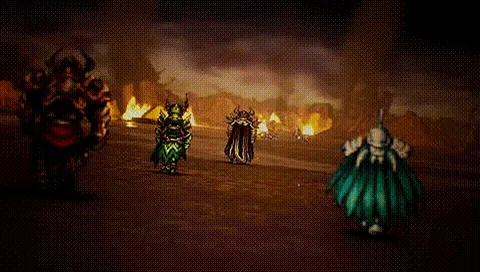
The game is also presented as the first Final Fantasy title in Square Enix’s HD-2D lineup, combining cinematic pixel art, dynamic camera angles, and pixelized 3D models. The visual concept explores how a pixel-based Final Fantasy presentation can be staged with modern lighting, depth, animation, composition, and effects that were not available to older hardware. Nintendo Everything’s coverage places Resonance within the broader HD-2D tradition associated with Octopath Traveler, although that comparison concerns visual lineage rather than identical combat or storytelling.
Visual spectacle still needs to preserve combat readability, particularly when players must follow targets, action order, status information, and the results of attacks. The demo therefore provides a stronger way to judge the presentation than screenshots alone because movement, interface clarity, cinematic effects, and battle readability are easier to assess during actual play.

Soundtrack, Demo Save Transfer, and Whether Final Fantasy Resonance Fits Classic JRPG Fans
Square Enix’s soundtrack listing describes a four-disc collection containing 120 tracks, including 33 tracks in addition to music from Brave Exvius. The size of the collection confirms a substantial musical component in Final Fantasy Resonance and preserves a direct connection to the source material, but track count alone does not determine quality. Music in Final Fantasy Resonance gains meaning through placement, whether establishing the mood of a town, sustaining battle energy, or returning during emotionally important moments.
Familiar music can also help existing Brave Exvius fans recognize the setting while giving newcomers to Final Fantasy Resonance a consistent musical identity for the new adaptation. Final Fantasy Resonance therefore uses music as another bridge between its mobile origins and its reconstructed console-style presentation.
The official Steam page for Final Fantasy Resonance lists both English and Japanese audio, while other supported languages include interface and subtitle options without necessarily providing full voice acting. That distinction is important because text-language availability and voice-language availability are not the same thing. Voice performances in Final Fantasy Resonance can add tone, hesitation, humor, confidence, and emotional weight to dialogue, particularly in a character-driven RPG. However, the existence of dual audio does not establish a unanimous critical judgment about the quality of every performance in Final Fantasy Resonance. Players who care strongly about language presentation should check the exact audio and subtitle combination they prefer before starting.
The Final Fantasy Resonance demo covers the opening of the game through the end of Chapter 1, and Square Enix confirms that saved progress can carry into the full release. That makes the Final Fantasy Resonance demo particularly useful for a story-driven RPG because time spent learning the mechanics and following the opening does not necessarily need to be repeated after purchase. The store description also notes that level restrictions apply, meaning the Final Fantasy Resonance demo is a substantial introduction rather than unrestricted access to the entire progression system.
Save transfer in Final Fantasy Resonance should not automatically be interpreted as cross-platform save compatibility, since carrying progress from the demo to the full game does not prove that saves move freely between different storefronts or hardware families. Players should therefore use the Final Fantasy Resonance demo as a way to evaluate combat pacing, dialogue, visuals, and customization on the same platform where they expect to continue.
For players who enjoy traditional party-based JRPGs, the published material gives Final Fantasy Resonance a strong foundation. Famitsu’s four matching 9/10 scores, the turn-based combat, Vision customization, world-map exploration, crystals, summons, legacy characters, and optional bosses in Final Fantasy Resonance all align closely with established Final Fantasy and classic JRPG traditions. Its approximately 20 to 30-hour reported main story can also appeal to players who want a substantial Final Fantasy Resonance adventure without committing to every optional objective, while the broader 70-hour estimate leaves considerable room for those who want more.
Players primarily interested in real-time action or unrestricted exploration may find Final Fantasy Resonance’s announced structure less closely aligned with their preferences, so the positive review score should not substitute for considering personal taste. The most practical way to judge Final Fantasy Resonance is to combine the reported critical reception with the transferable demo, using direct experience with the opening hours to decide whether Final Fantasy Resonance’s combat, characters, presentation, and pacing create enough interest to continue.

Frequently Asked Questions (FAQs)
- What score did Final Fantasy Resonance receive from Famitsu?
Final Fantasy Resonance received 9/9/9/9 from Famitsu’s four reviewers, giving it a combined score of 36/40. The commonly used 9/10 description refers to each reviewer independently awarding the game nine points out of ten. It is therefore not a separate fifth rating or an average taken from several unrelated publications. Four identical scores indicate agreement among that specific Famitsu panel about the game’s overall quality. They should not, however, be treated as proof that every critic or player will reach the same conclusion. - Is Final Fantasy Resonance exactly 25 hours long?
No. Reporting surrounding the October Famitsu review gives an estimated main-story range of approximately 20 to 30 hours. The frequently repeated 25-hour figure is simply the midpoint of that range and provides a convenient shorthand for headlines. Individual playthroughs can differ depending on reading speed, combat pace, exploration, difficulty, and time spent experimenting with character builds. Players should therefore treat 25 hours as a rough planning estimate rather than a fixed completion time. - How long does full completion take?
Coverage of Famitsu’s review suggests approximately 70 hours for players pursuing the wider game beyond the central story. That figure reflects a completionist estimate and should not be interpreted as a guaranteed time for every player. Optional bosses, side activities, exploration, character progression, and experimentation can all influence how long someone continues after the main campaign. It also does not automatically mean that 70 hours is the exact time required for every achievement or trophy. The useful distinction is that broader completion appears substantially longer than simply reaching the story’s ending. - Why do some reports mention a 30 to 40-hour story?
Earlier preview coverage, including VGC’s September feature, described Final Fantasy Resonance as a 30 to 40-hour adventure. Later reporting surrounding Famitsu’s review gave the shorter 20 to 30-hour main-story estimate. The available material does not describe a common testing method that would allow those figures to be directly reconciled. Differences in what each source counted, how much optional content was included, or how the estimates were obtained may matter, but those explanations have not been specifically confirmed. The most accurate approach is therefore to preserve both estimates with their original context rather than pretending that one was universally established. - Do players need to finish Brave Exvius first?
No. Nova Crystallis reported that Square Enix said players do not need previous experience with Final Fantasy Brave Exvius to understand Resonance. The game adapts the first story arc while rebuilding it as a standalone console and PC RPG, providing newcomers with an entry point into Rain, Lasswell, Fina, and the wider conflict. Existing Brave Exvius players may recognize characters, locations, or story elements, but that familiarity is additional context rather than a requirement. Resonance should therefore be approached as an adaptation designed to work for both returning fans and people encountering this story for the first time. - Does Final Fantasy Resonance include gacha mechanics?
VGC’s hands-on coverage states that the gacha mechanics associated with Final Fantasy Brave Exvius have been removed from Resonance. The new release is presented as a conventional paid RPG for consoles and PC rather than as a recreation of the mobile game’s character-acquisition model. Familiar Final Fantasy characters still appear through the Vision system, but their presence should not automatically be interpreted as evidence of mobile-style gacha. This distinction is particularly important for players interested in the adaptation but concerned about inheriting monetization systems from its source material. The published information instead emphasizes party customization, progression, and turn-based combat within a traditional premium RPG structure. - What are Visions in Final Fantasy Resonance?
Visions are equippable manifestations of characters that provide party members with additional combat abilities, bonuses, and progression options. They include familiar Final Fantasy figures such as Cloud, Tidus, the Warrior of Light, Noctis, and others mentioned in official or hands-on coverage. PlayStation Blog describes Visions gaining mastery points through victories, allowing additional abilities and benefits to become available over time. This gives players a way to specialize an existing party role or provide a character with tools that cover a weakness elsewhere in the group. Visions therefore function as a major customization system rather than simply serving as nostalgic character appearances. - Does demo progress transfer to the full game?
Yes. Square Enix confirms that save data from the Final Fantasy Resonance demo can carry forward into the full release. The demo covers the opening portion of the game through the end of Chapter 1, meaning time spent learning the combat system and following the early story does not necessarily need to be repeated after purchase. The demo also has progression limitations, so it should still be understood as an introductory version rather than unrestricted access to the entire game. The save-transfer announcement does not automatically establish that saves can move between different platforms or storefronts. Players planning to continue their progress should therefore use the appropriate version of the demo for the platform on which they expect to play the full game. - Does Final Fantasy Resonance have English voice acting?
Yes. The official Steam language information lists both English and Japanese as supported audio languages. Other supported languages may provide interface text and subtitles without necessarily including full voice audio, so those categories should be checked separately. This gives players a choice between the two confirmed voice tracks while allowing additional localization through text options. The availability of English voice acting does not by itself establish the quality of every performance, since that remains a matter for individual or critical evaluation. Players who care strongly about presentation can use the demo to hear the available voice work before choosing how they want to experience the full story. - When does Final Fantasy Resonance release?
Final Fantasy Resonance is scheduled to release on October 22, 2026. Square Enix has announced versions for PlayStation 5, Xbox Series X|S, Nintendo Switch, Nintendo Switch 2, and PC through Steam and the Microsoft Store on Windows. The October 15 date appearing in some coverage relates to reporting about the Famitsu review and playtime estimates rather than the game’s launch. Platform availability should also not be interpreted as proof that every version will have identical resolution, frame rate, loading times, or other technical characteristics. Players should choose their version based on their preferred hardware and any platform-specific information available around release.

Conclusion
Final Fantasy Resonance enters release with an encouraging Famitsu result, earning four individual 9/10 ratings for a combined score of 36/40. Its reported length also suggests a relatively focused main adventure without limiting players who want a much larger commitment. The 20 to 30-hour story estimate makes the widely repeated “about 25 hours” description a useful approximation, while broader completion is reported at roughly 70 hours. Earlier preview coverage placed the adventure closer to 30 to 40 hours, so none of these figures should be treated as an exact promise for every player. Together, they indicate a game designed to support both a direct story playthrough and considerably deeper exploration.
The larger appeal comes from how Resonance rebuilds the opening Brave Exvius story as a traditional console and PC RPG rather than simply transferring the mobile experience to new hardware. Rain, Lasswell, and Fina provide the narrative foundation, while the Vision system brings characters from across Final Fantasy history into party customization and progression. That allows familiar characters to serve a practical gameplay purpose instead of functioning only as nostalgic appearances. Turn-based battles, optional challenges, world exploration, and the HD-2D presentation further reinforce its connection to classic JRPG design. For longtime Final Fantasy players and newcomers alike, the result promises a recognizable style without requiring previous Brave Exvius experience.
For classic JRPG fans, Resonance’s strongest proposition is the balance between a manageable central campaign and substantial optional depth. Players interested primarily in the story can work toward its conclusion without treating every side activity as mandatory, while those who enjoy optimizing builds and tackling additional encounters have reasons to continue well beyond the main route.
Famitsu’s strong scores provide encouraging outside assessment, but personal preferences regarding turn-based combat, random encounters, pacing, and party customization remain just as important. The transferable demo offers the clearest way to test those elements directly before committing to the full adventure. Ultimately, Final Fantasy Resonance will be defined less by a review score or hour count than by whether its combat, characters, exploration, and progression remain engaging throughout the journey.
Sources and Citations
- Source: Square Enix North America — FINAL FANTASY RESONANCE Announcement: Official publisher announcement covering the adaptation’s premise, release date, platforms, North American edition prices, and its description of the game as an extensively rebuilt RPG.
Citation: Square Enix, “FINAL FANTASY RESONANCE, First HD-2D FINAL FANTASY Game, Revealed Alongside…” Official North American press release. Read the announcement. - Source: Nintendo Life — First Review for FINAL FANTASY RESONANCE: Reporting on Famitsu’s review scores and estimated playtime, useful for checking the individual reviewers’ ratings, the combined score, and campaign-length claims.
Citation: Nintendo Life, “The First Review for Final Fantasy Resonance Is In.” October 2026. Read the article. - Source: Steam — FINAL FANTASY RESONANCE Official Store Page: Official product listing confirming supported platforms, release date, available languages, game features, and demo availability. The publisher’s official demo announcement also confirms the opening chapter’s estimated length and save-data transfer to the full game.
Citation: Steam, “FINAL FANTASY RESONANCE.” Official store listing. View the Steam page.
Additional citation: Square Enix, “Free Demo for FINAL FANTASY RESONANCE Now Available.” September 9, 2026. Read the official announcement. - Source: VGC — We Played FINAL FANTASY RESONANCE and It Delivers Classic FF at Last: Tom Regan’s hands-on preview discusses the game’s turn-based combat, HD-2D presentation, demo experience, and overall appeal to fans of classic Final Fantasy. PlayStation Blog adds further firsthand detail about the Visions system and its combat customization.
Citation: Tom Regan, VGC, “We Played Final Fantasy Resonance and It Delivers Classic FF at Last.” September 3, 2026. Read the VGC feature.
Additional citation: Corey Brotherson, PlayStation Blog, “How Final Fantasy Resonance Uses Visions to Change How We See the Series.” October 20, 2026. Read the PlayStation Blog feature.
Recommendations
- Tom Cruise Says Digger Is Unlike Any Film He’s Ever Made
- Lost Castle 2: 8 Best Camp Upgrades Ranked for Every Build
- The Sims 4 is Getting a Massive (and Desperately Needed) Overhaul: How EA is Making it Smoother, More Intuitive, and More Consistent
- Mega Man Voice Actor Drops Out Of Sequel Over Capcom Union Protections Dispute
- Mega Man Voice Actor Drops Out Of Sequel Over Capcom Union Protections Dispute
- HOT WHEELS Infinite Rush Release Date Moved up to September 10, 2026: Everything You Need to Know
- Pokémon Pokopia: Bubbly Basin (How to Get Windup Inkay)
- Assassin’s Creed Black Flag Resynced Reveals Its Release Times for PC, PS5, and Xbox
- Google resolves dispute with Epic Games, reduces app store fees to 20%: Google Play changes in 2026
- Weapon Locations in Beast of Reincarnation: All Swords and Ranged Weapons
- Until Dawn 2 Finds Horror in the Sun: Tropical Setting, Trailer Breakdown, and 2027 Release Window



































































































