







In This Article (8 sections)
Dark Scrolls Overview: Chaotic Action-Platforming, Roguelite Progression, and Indie Appeal
Dark Scrolls is a fantasy action-platformer featuring chaotic gameplay and roguelite progression, making it the clearest way to describe Doinksoft’s newest indie release. The game is a side-scrolling adventure built around fast reflexes, co-op dungeon runs, pixel-art charm, and escalating arcade-style mayhem. Dark Scrolls launched on June 22, 2026, for Windows PC via Steam and Nintendo Switch, with Devolver Digital publishing and Doinksoft developing the game.
Dark Scrolls combines fantasy-themed side-scrolling dungeon movement, shmup-inspired screen chaos, roguelite progression, co-op play, and retro pixel-art presentation. The game has gained attention because it sits at the intersection of several popular indie genres. It is not simply a traditional platformer, and it is not purely a roguelite dungeon crawler either. Its hook is the way it turns every run into a rapid sequence of hand-crafted rooms, enemy waves, branching routes, hazards, secrets, bosses, coins, upgrades, and character-specific abilities.
The phrase “Dark Scrolls action-platformer featuring chaotic gameplay and roguelite progression” matters because it captures the game’s central appeal. Players are not just moving from left to right through predictable stages. They are reacting to traps, projectiles, enemies, route choices, perk opportunities, and boss encounters while trying to survive long enough to build a stronger run. The game’s official descriptions emphasize shmup-style chaos, roguelite progression, secrets, challenge, and charm, which explains why it has become interesting to players who enjoy compact but replayable action games.
Dark Scrolls is also getting attention because of the names attached to it. Doinksoft is known for earlier indie games such as Gato Roboto and Gunbrella, while Devolver Digital has built a strong publishing identity around distinctive, stylish, and often unconventional indie releases. Nintendo Life also identified Doinksoft through Gato Roboto and Gunbrella when reviewing Dark Scrolls, giving the new project useful context for players familiar with the studio’s previous work.
Another reason the game stands out is its directness. Dark Scrolls appears designed around immediate action rather than slow onboarding. The player chooses a hero, enters a run, fights, dodges, collects, upgrades, and adapts. This makes the game easy to understand at a glance but harder to master over time. That structure is especially important in roguelite platformers, where repeated runs must feel fast enough to restart yet varied enough to remain rewarding.

Dark Scrolls Release Details, Gameplay Features, and Roguelite Progression Explained
Dark Scrolls was released on June 22, 2026, for Windows PC via Steam and Nintendo Switch. Steam lists the release date as June 22, 2026, with Doinksoft as the developer and Devolver Digital as the publisher. The Devolver Digital game page also lists Dark Scrolls by Doinksoft with the same June 22, 2026 date and identifies Windows PC and Nintendo Switch as supported platforms.
On Nintendo Switch, Dark Scrolls is listed as download software with a release date of June 22, 2026. The Nintendo listing categorizes it under Action, Platformer, Adventure, and Arcade, while also showing support for handheld mode, tabletop mode, and TV mode. This makes the Switch version especially relevant for players who want short roguelite runs in portable form.
The PC version offers a flexible set of play options. Steam lists Dark Scrolls with single-player, online co-op, shared or split-screen co-op, shared or split-screen play, Remote Play Together, and Family Sharing features. These options make the PC version suitable for solo players, local co-op players, and online co-op groups. Steam also lists English plus nine additional supported interface and subtitle languages: French, German, Spanish, Japanese, Korean, Portuguese-Brazil, Russian, Simplified Chinese, and Traditional Chinese. The Nintendo Switch listing confirms single-system play for one to two players and online play for two players. It also notes that online features require an internet connection and that Switch online play requires a paid Nintendo Switch Online membership.
Dark Scrolls is best described as an action-platformer featuring chaotic gameplay and roguelite progression. This means the game is built around constant movement, danger, improvisation, and gradual mastery. The action-platformer foundation requires players to jump, dodge, attack, avoid traps, and respond to enemies in real time. The chaotic gameplay comes from the game’s shmup-like intensity, where enemies, hazards, and projectiles can crowd the screen. The roguelite progression comes from repeated runs, unlockable heroes, perks, branching routes, secrets, and evolving choices.
The official Devolver description says players hack, slash, and dodge through hordes of enemies and deadly traps in procedurally generated runs made from hand-crafted rooms and levels. This distinction is important because Dark Scrolls is not described as purely random. Instead, it uses hand-crafted screens inside procedurally generated run structures, which can help preserve deliberate platforming design while still changing the flow from one run to the next.
Nintendo’s listing also says each run includes hand-crafted screens, unique bosses, and evolving routes shaped by player choices and quests. That means progression is not only about getting stronger; it is also about choosing where to go, which risks to take, when to spend coins, and how to use a hero’s specific abilities.
Dark Scrolls gameplay revolves around choosing a hero, entering a dungeon-like run, surviving procedurally arranged challenges, collecting coins, upgrading through shops, fighting bosses, and uncovering secrets. Players can charge forward alone or play cooperatively, with the game supporting both local and online co-op. Its official descriptions repeatedly frame co-op as a major part of the experience. Combat is built around hacking, slashing, dodging, and using hero-specific attacks and abilities. This is important because each hero is not simply a cosmetic skin. The game’s marketing emphasizes unique attacks and abilities, while third-party coverage states that nine heroes can be unlocked, each with unique quests, skills, and customizable trinkets.
Coins are central to each run. Devolver’s official page mentions spending coins at Bruce & Goose’s Shoppe to gain perks, devastating attacks, and summoned allies. This creates a mid-run economy where players must survive long enough to purchase meaningful upgrades. It also gives each run a build-crafting layer, because the upgrades a player chooses can reshape their attack pattern, survival plan, and screen-clearing ability. Official descriptions also mention hidden paths, new locations, new heroes to rescue, and other mysteries. These secrets add long-term motivation beyond simply clearing a run, since even a failed attempt may help players learn a route, spot a suspicious area, rescue a character, unlock a hero, or discover a new way to approach future attempts.
Roguelite progression in Dark Scrolls appears to work through repeated runs, unlockable heroes, branching paths, upgrade choices, secrets, and build combinations. Unlike a traditional linear platformer, Dark Scrolls is structured around replaying runs that change in layout, route, enemy arrangement, and opportunity. During a run, players gather coins and use them to buy perks, attacks, and summoned allies. This is the short-term roguelite layer, as each run can become different depending on what the player finds and purchases. A player might build toward screen-clearing damage, safer survival tools, ally summons, or stronger special attacks. Since the game emphasizes “screen-filling destruction,” good upgrade stacking is likely one of the most satisfying parts of progression.
The longer-term progression appears connected to unlocking heroes and discovering secrets. GameGrin reported that Dark Scrolls includes nine playable characters to get, while Rogueliker described nine unique heroes with their own quests, skills, and customizable trinkets. This gives the game a broader progression loop: players are not only trying to win one run, but also expanding the roster and learning how each hero changes the game.
This approach makes Dark Scrolls a roguelite rather than a strict roguelike. It uses repeated attempts and procedural variation, but it also offers unlocks, progression, character variety, and build experimentation. For action-platformer fans, failure is not just a reset; it is part of the process of learning patterns, improving reflexes, understanding characters, and finding stronger combinations.

Dark Scrolls Heroes, Co-Op, Combat, and Boss Encounters
Dark Scrolls features a roster of quirky heroes, with official descriptions emphasizing that each hero has unique attacks and abilities. This is one of the most important parts of the game because hero choice affects movement, combat range, attack rhythm, special abilities, and overall difficulty. Nintendo Life’s review mentions that the game initially gives players a choice of three characters and specifically discusses Pigeon, who attacks and moves quickly, and Grizz, who uses axes with long range and has a ground pound ability that can instantly knock out enemies from above. This gives a clearer picture of how different the characters can feel in actual play.
Pigeon appears suited for players who enjoy speed, quick attacks, and high mobility. However, faster movement can also make hazards and enemies harder to manage, especially for new players. Grizz, by contrast, appears more manageable because of his range and heavier movement style. That kind of contrast is valuable in a roguelite platformer because it lets different players find a rhythm that matches their reflexes.
The wider roster also matters because Dark Scrolls reportedly includes nine playable heroes to unlock. Each hero having unique quests, skills, and customizable trinkets means the game can reward experimentation even after players understand the basics. A player who struggles with one hero may thrive with another, and co-op teams can potentially combine heroes whose abilities cover each other’s weaknesses.
Dark Scrolls supports solo play and cooperative play, including local and online co-op. This is one of the game’s biggest selling points because many roguelite platformers are primarily solo experiences. By allowing two players to take on dungeons together, Dark Scrolls leans into the chaos rather than trying to simplify it. Steam lists online co-op, shared or split-screen co-op, shared or split-screen play, and Remote Play Together, making the PC version accessible for friends playing on the same machine, online partners, and Steam Remote Play sessions.
Nintendo’s listing confirms single-system play for one to two players and online play for two players. It also states that players can bring a co-op buddy, combine powerful attacks, and revive one another if one player falls in battle. This revive mechanic is especially important because it gives co-op more depth than simply adding another attacker. It means teamwork can extend a run, save a mistake, and create clutch recoveries.
Co-op also changes the meaning of character selection. In solo play, a hero must handle every situation alone. In co-op, one player may focus on fast attacks while another uses range, crowd control, or safer movement. The best co-op runs will likely come from players who communicate about routes, coins, shop purchases, revives, and boss positioning.
Dark Scrolls combat is based on rapid attacking, dodging, platforming, and character-specific abilities. The official description frames the game around hacking, slashing, and dodging through hordes of enemies and traps, which makes positioning just as important as damage. Players must think about where they are standing, where enemies are moving, where projectiles are coming from, and how the scrolling pressure affects each room. Weapons and attacks appear tied closely to hero identity. Nintendo Life’s review describes Pigeon as a fast character who tosses knives rapidly, while Grizz uses axes with longer range and has a powerful ground pound. This suggests that each character is designed around a distinctive combat rhythm rather than a universal weapon system.
Skills and upgrades deepen the combat loop. Coins can be spent on perks, devastating attacks, and summoned allies at Bruce & Goose’s Shoppe. These purchases can change how a run feels by adding damage, support, or new ways to clear dangerous screens. Because Dark Scrolls draws on shmup-style chaos, combat is not only about attacking enemies. It is also about reading patterns. Players must learn when to press forward, when to retreat, when to jump, when to use special attacks, and when to prioritize survival over damage. The best players will likely treat each room as a moving puzzle where reflexes, route choice, and ability timing all matter.
Boss fights are a major part of Dark Scrolls. Official descriptions mention unrelenting bosses, unique bosses, and escalating intensity across runs. Nintendo’s page says each run offers hand-crafted screens, unique bosses, and evolving routes shaped by player choices and quests. The boss design likely serves several purposes: bosses test whether a player has understood the combat system, pressure the build choices made earlier in the run, and create memorable endpoints for routes. In a roguelite platformer, bosses must be dangerous enough to make victory satisfying but readable enough that players feel they can improve after losing.
Enemy types appear to include hordes of standard enemies, projectile-heavy threats, trap-based obstacles, and more unusual creatures. Nintendo Life’s review refers to a frog-like enemy with variable jump height, showing that even regular enemies can disrupt movement and punish poor positioning. The combination of enemies, traps, and bosses gives Dark Scrolls its chaotic identity. A single enemy may not be overwhelming, but several enemies, projectiles, hazards, and scrolling pressure can quickly create danger. This is why hero selection, reflexes, upgrades, and co-op revival all matter.

Dark Scrolls Replayability, Pixel Art, Beginner Tips, and Roguelite Platformer Comparisons
Replayability is central to Dark Scrolls because the game is built around procedurally generated runs made from hand-crafted rooms and levels. This means the game can change the order, route, or structure of encounters while still relying on designed screens. Procedural generation works best in action-platformers when it creates variety without destroying readability, and Dark Scrolls appears to address that challenge by using hand-crafted screens inside run-based structures. This allows rooms to feel intentionally built while the run still changes from attempt to attempt.
Replayability also comes from branching paths and secrets. Official descriptions mention new surprises, branching paths, mysteries, new locations, and heroes to rescue, encouraging players to explore rather than simply rush forward. The character roster adds another layer, with nine heroes reported. Players can replay the same general structure with very different movement speeds, attack styles, skills, and trinket options. Dark Scrolls is therefore replayable in several ways: mechanical replayability through combat mastery, structural replayability through procedural runs, strategic replayability through upgrades, exploratory replayability through secrets, and social replayability through co-op.
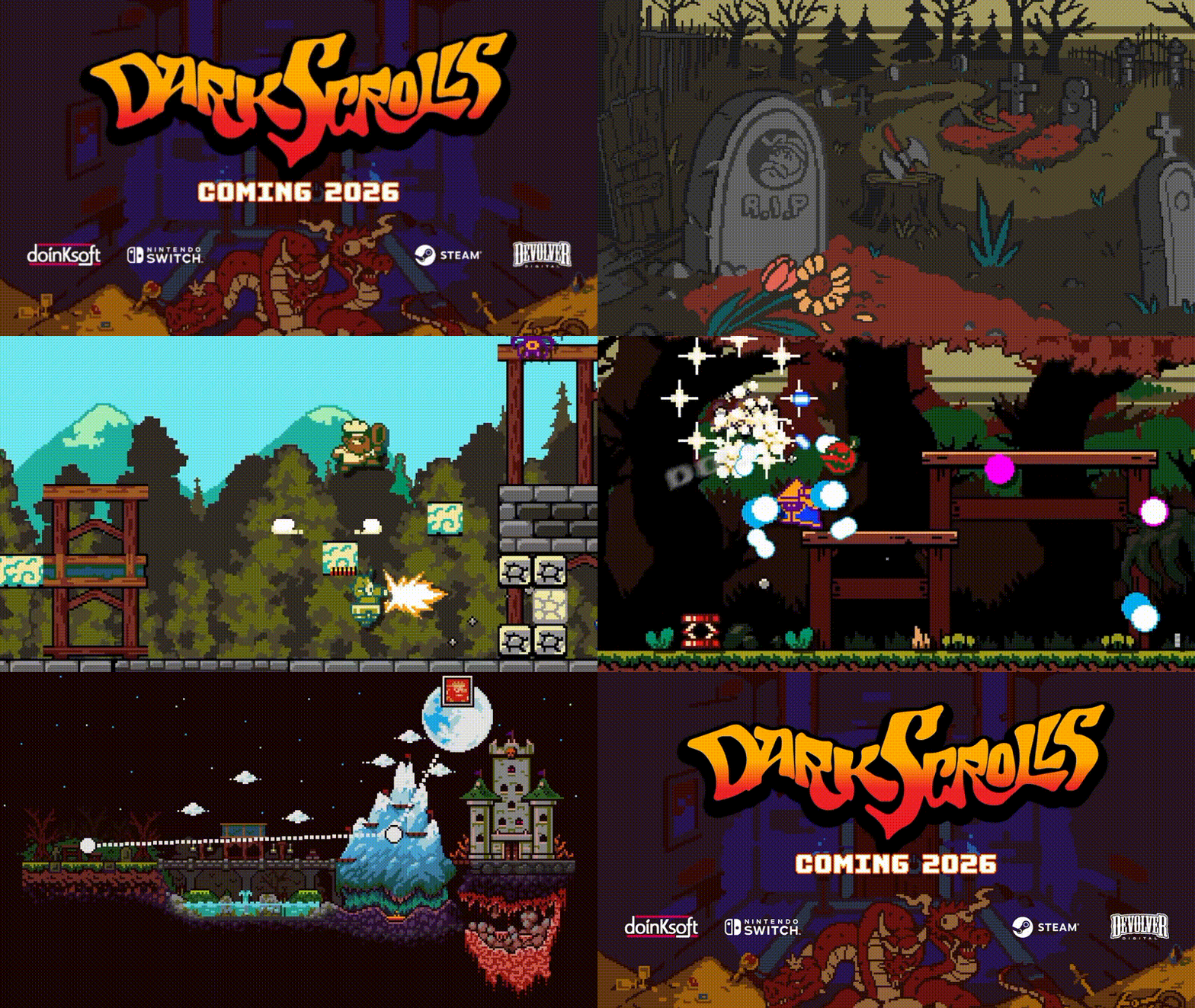
Dark Scrolls uses pixel art and retro-inspired presentation. Steam tags include Pixel Graphics, 1990’s, Old School, Cartoony, Fantasy, 2D Platformer, and Side Scroller, which aligns with the game’s visual identity. The pixel-art style is not just cosmetic; it supports fast readability. In chaotic action-platformers, players need to identify enemies, hazards, coins, projectiles, and platforms quickly. A clean retro style can help make danger readable even when the screen becomes crowded.
Rogueliker compared the pixel art’s feel to retro action and noted that the action evokes classic 1990s run-and-gun shooters like Contra, while other coverage has described the game as a retro co-op dungeon scroller. The retro influence also fits Devolver Digital’s publishing style. Devolver often backs games that combine older arcade traditions with modern design ideas. In Dark Scrolls, that combination appears as pixel-art platforming mixed with roguelite structure, co-op revival, branching routes, and build-based screen destruction.
New players should begin by choosing a hero that feels controllable rather than simply picking the fastest option. Nintendo Life’s review notes that Pigeon’s speed can be difficult early on, while Grizz’s longer range and manageable pace may feel more comfortable. That is a useful lesson for beginners: survivability and control often matter more than raw speed. Players should focus on survival before damage, since Dark Scrolls is built around sharp reflexes and split-second decisions, and official descriptions emphasize that intensity increases as runs continue. Careless aggression can end a run quickly, so a safer approach is to learn enemy patterns, avoid traps, and attack when positioning is favorable.
Coins should be treated as build resources. Spending coins at Bruce & Goose’s Shoppe can provide perks, attacks, and summoned allies, so players should think carefully about what their current hero needs. A fast short-range hero may benefit from defensive or ally-based support, while a slower long-range hero may benefit from upgrades that increase clearing power. In co-op, players should stay close enough to revive each other but not so close that both are hit by the same hazard.
Nintendo’s listing confirms that co-op partners can revive one another, which makes spacing and teamwork essential. Players should also watch for secrets, as Dark Scrolls hides paths, locations, heroes, and other mysteries, so rushing every room may cause players to miss important progression.
Dark Scrolls belongs in the same broad conversation as roguelite platformers such as Dead Cells and Spelunky, but it has a different identity. Dead Cells is known for fast combat, biome progression, weapon builds, and metroidvania-influenced movement, while Spelunky is known for systemic level generation, traps, treasure, secrets, and high-stakes failure. Dark Scrolls shares the run-based structure and replayability of these games, but its emphasis on shmup-style chaos and co-op platforming gives it a more arcade-like flavor.
Compared with Dead Cells, Dark Scrolls appears more compact and more directly chaotic. Dead Cells often revolves around weapon synergies, dodge timing, biome routing, and long-term unlocks, while Dark Scrolls appears more focused on hand-crafted screens, character abilities, shop upgrades, branching routes, and screen-filling action. Compared with Spelunky, Dark Scrolls seems less about physics-driven exploration and more about direct combat. Spelunky’s danger often comes from environmental interactions and unpredictable chain reactions, while Dark Scrolls places more emphasis on hacking, slashing, dodging, enemy hordes, traps, bosses, perks, and co-op revives.
Compared with other roguelite action-platformers, Dark Scrolls’ biggest distinguishing features are its local and online co-op, quirky hero roster, and shmup-inspired pressure. It is likely to appeal most to players who want quick runs, immediate combat, retro art, unlockable characters, and a high level of visual and mechanical chaos.

Frequently Asked Questions (FAQs)
- What is Dark Scrolls?
Dark Scrolls is a fantasy action-platformer developed by Doinksoft and published by Devolver Digital. It combines fast 2D action with shmup-style chaos, roguelite progression, co-op gameplay, hand-crafted rooms, procedural runs, unlockable heroes, and retro pixel art. The game is structured around repeated runs, quick reactions, character variety, and escalating arcade-style action. - When did Dark Scrolls release?
Dark Scrolls released on June 22, 2026. Steam, Devolver Digital, and Nintendo listings all show the same June 22, 2026 release timing, confirming the launch date across its listed platforms. - What platforms is Dark Scrolls available on?
Dark Scrolls is available on Windows PC through Steam and on Nintendo Switch. These are the platforms listed for the game in the supplied material. - Does Dark Scrolls have co-op multiplayer?
Yes. Dark Scrolls supports both solo play and co-op. Steam lists online co-op, shared or split-screen co-op, shared or split-screen play, and Remote Play Together. On Nintendo Switch, the listing includes single-system play for one to two players and online play for two players. - How many heroes are in Dark Scrolls?
Coverage from GameGrin and Rogueliker states that Dark Scrolls includes nine playable heroes to unlock. These heroes are described as having unique quests, skills, and customizable trinkets, giving players different ways to approach runs. - Is Dark Scrolls a roguelike or roguelite?
Dark Scrolls is best described as a roguelite action-platformer. It uses repeated procedurally generated runs, unlockable heroes, upgrades, secrets, and progression systems rather than following a purely traditional roguelike structure. - Is Dark Scrolls good for solo players?
Yes. Dark Scrolls supports single-player, and its hero-based structure makes it playable alone. Solo players can choose a hero, enter runs, learn the game’s challenges, and progress through its roguelite systems. Players who enjoy teamwork may get extra value from the local and online co-op options. - What makes Dark Scrolls different from other platformers?
Dark Scrolls stands out by blending action-platforming with shmup-like chaos, roguelite progression, procedurally generated runs, hand-crafted screens, unlockable heroes, co-op revives, and shop-based upgrades. This combination gives it a more chaotic and replayable structure than a traditional platformer. - Is Dark Scrolls difficult?
Dark Scrolls is designed around challenge, sharp reflexes, and split-second decisions. Official descriptions emphasize escalating intensity, deadly traps, hordes of enemies, and unrelenting bosses, so players should expect a demanding action-platforming experience. - Who should play Dark Scrolls?
Dark Scrolls is best suited for players who enjoy fast 2D action, roguelite replayability, co-op chaos, retro pixel art, boss fights, secrets, and character-based run variety. It is aimed at players who like quick runs, repeated attempts, and action that grows more intense over time.

Conclusion
Dark Scrolls is a focused, chaotic, and replayable indie action-platformer that uses roguelite progression to keep each run fresh. Its strongest identity comes from the way it combines side-scrolling platform combat with shmup-style pressure, procedural run structure, hand-crafted rooms, branching routes, secrets, unlockable heroes, co-op revival, and arcade-like upgrade stacking.
For players searching for Dark Scrolls action-platformer featuring chaotic gameplay and roguelite progression, the game offers exactly that kind of experience. It is not trying to be a massive open-world adventure or a slow narrative RPG. It is built around quick runs, fast mistakes, sharper reactions, stronger builds, and the desire to try again.
The official listings confirm the essentials: Dark Scrolls launched on June 22, 2026, for PC and Nintendo Switch, with Doinksoft developing and Devolver Digital publishing. Steam and Nintendo details also confirm strong support for solo and co-op play, making it flexible for both individual players and two-player teams.
Its appeal will be strongest for fans of games like Dead Cells, Spelunky, Contra-inspired action, arcade platformers, and modern roguelite indies. Dark Scrolls looks especially suited to players who enjoy learning through failure, experimenting with different heroes, discovering secrets, and building increasingly chaotic runs through smart upgrade choices.
Sources and Citations
- Devolver Digital
https://www.devolverdigital.com/games/dark-scrolls - Steam
https://store.steampowered.com/app/2912550/Dark_Scrolls/ - Nintendo
https://www.nintendo.com/us/store/products/dark-scrolls-switch/ - Nintendo Life
https://www.nintendolife.com/games/nintendo-switch/dark_scrolls - Rogueliker
https://rogueliker.com/dark-scrolls/ - GameGrin
https://www.gamegrin.com/news/dark-scrolls-release-date-announced/
Recommendations
- Moonlight Peaks Critters Guide: How to Catch Every Bug and Creature
- Canva Starts Previewing a More Powerful Version of Its AI Assistant (Canva AI 2.0)
- Amazon Raising A Pokémon Game Price To $80 Sparks Backlash Over Pokopia Shortage
- Apple TV’s Widow’s Bay is the First Breakout TV Hit of 2026: Why Everyone is Talking About the Horror Comedy
- Virtua Fighter Crossroads Reveals the Bakunawa Killer in a New Trailer
- This First Look at Diablo 4: Lord of Hatred Prequel “The Lost Horadrim” Has Us Eager for More (Release Date, Story, Characters)
- Game Development Funding Challenges: How Teams Find Investors and Publishers in Today’s Market
- NORCO Game Guide: Story, Gameplay, Walkthrough, Endings, and Review
- How to Use Decals and Stickers in Substance Painter: A Complete Guide for 3D Artists
- Steam Machine (2026): Release Date, Price, Specs, and SteamOS Explained



































































































