






In This Article (9 sections)
Why Atlantis: the Lost Empire Became More Popular 25 Years Later
Two and a half decades after its release, Atlantis: The Lost Empire has undergone a dramatic reassessment, moving from an overlooked experiment to a cult-favorite milestone in Disney animation history. When it debuted in 2001, the film struggled to find a broad mainstream audience, partly because it did not fit neatly into what many viewers expected from Disney animation at the time. Rather than following the studio’s familiar musical and fairy-tale formula, Atlantis leaned into exploration, mystery, science fiction, and adventure, making it feel unusual in its original release context.
Its renewed popularity comes largely from the fact that the qualities once seen as departures now feel like strengths. The film’s serialized adventure structure, genre-blending tone, and emphasis on world-building resonate with modern audiences who are more accustomed to animated stories that move beyond traditional romance or musical formats. Streaming platforms have allowed new generations to discover the movie outside the pressure of its original box office performance, while online fandom culture has amplified appreciation through analysis, fan art, and discussion of its ambitious visual and narrative identity.
The 25th anniversary of Atlantis: The Lost Empire has become an important cultural moment for Disney animation historians and fans because it invites a broader reevaluation of the film’s place in the studio’s evolution. Released during a transitional period, Atlantis represents a bridge between the Disney Renaissance and the more experimental direction of the early 2000s. Its anniversary is not only a matter of nostalgia, but also an opportunity to reconsider its artistic and industrial significance.
The film’s production reflected a major shift in animation technique, combining digital tools with traditional hand-drawn animation to create a hybrid visual style that felt ahead of its time. Its themes also feel increasingly relevant in retrospect, especially its focus on the pursuit of knowledge, the dangers of exploitation, and the tension between discovery and responsibility. Retrospectives often point out that Atlantis feels more contemporary today than it did when it first arrived, particularly because of its interest in technology, archaeology, morally complex choices, and civilizations shaped by both wonder and loss.

Why Atlantis Failed in 2001 but Changed Disney Animation
Despite its ambition, Atlantis: The Lost Empire underperformed commercially when it was released in 2001. One of the biggest reasons was the mismatch between the film and audience expectations at the time. Disney animation was still strongly associated with musicals, fairy-tale romance, and emotionally direct storytelling built around songs, while Atlantis offered a more serious science-fiction adventure. For families expecting a traditional Disney musical experience, the film’s tone and structure could feel surprising or difficult to categorize.
Marketing also played a major role in the film’s initial struggles. Promotional materials emphasized action and adventure, but they did not clearly communicate the film’s identity or define its target audience. The result was a release that seemed caught between different viewer groups. Younger audiences may not have found the film as immediately accessible as Disney’s more musical works, while older audiences may not have fully recognized it as a mature animated adventure worth seeking out in theaters.
The competitive entertainment landscape of the early 2000s added further pressure. Blockbuster live-action films and emerging animation competitors diluted the film’s visibility, making it harder for Atlantis to stand out. Over time, however, its box office disappointment has been reinterpreted less as a failure of quality and more as a case of misalignment. The film is now often described as ahead of its time, with its original commercial struggles reflecting the market’s limited readiness for that kind of Disney animated adventure.
Atlantis also marked a turning point in Disney’s approach to storytelling and production design. It was one of the studio’s earliest major attempts to move away from musical-driven narratives and toward action-oriented adventure filmmaking. That shift opened the door for more experimental formats within Disney animation, proving that the studio was willing to test stories built around exploration, ensemble dynamics, and genre structure rather than songs and romance.
The film also helped push a different approach to animation itself. Instead of centering heavily detailed musical sequences, Atlantis emphasized movement, pacing, cinematic composition, and action staging. This gave the film a more dynamic feel, closer to a live-action adventure movie than a traditional animated musical. Its willingness to explore darker themes, including imperialism, environmental destruction, and ethical responsibility in exploration, also influenced later animated films that aimed to reach older and more diverse audiences.
The Mike Mignola Visual Style and the Cult Appeal of Milo and Kida
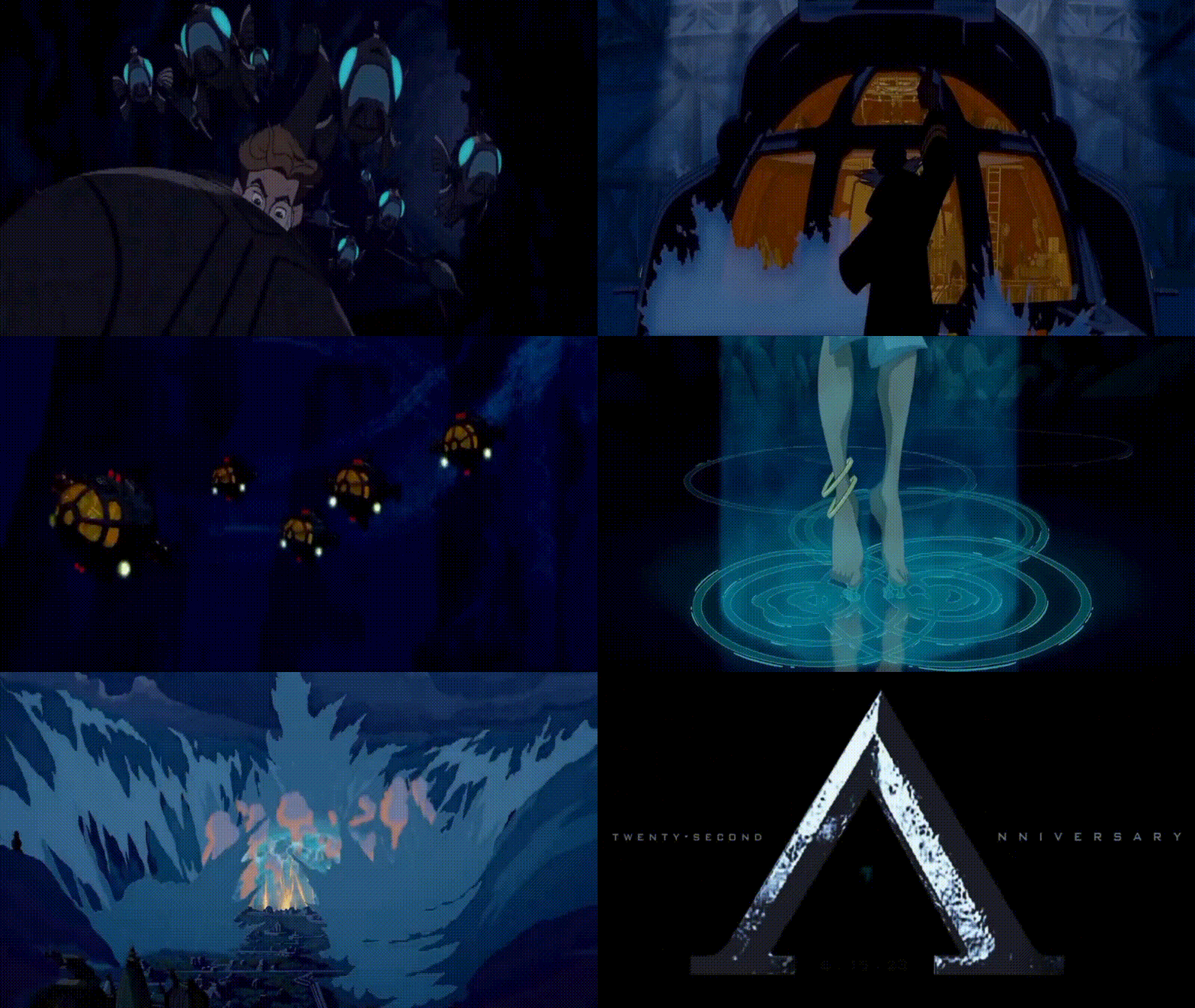
One of the most distinctive aspects of Atlantis: The Lost Empire is its visual identity, which was heavily influenced by the artistic style of comic book creator Mike Mignola. Known for bold shapes, heavy shadows, and graphic composition, Mignola’s influence helped give the film a look unlike the highly polished and rounded designs associated with many Disney films of the 1990s. This visual direction played a central role in making Atlantis feel mythic, mysterious, and closer to a graphic novel than a conventional animated feature.
The character and environmental designs rely on strong silhouettes, simplified forms, sharp contrasts, and angular architecture. These choices reinforced the film’s themes of ancient technology and lost civilization, making Atlantis feel both old and futuristic at the same time. The world of the film blurs mythology and science fiction through its design language, using architecture, machinery, and lighting to suggest a civilization that is ancient but technologically advanced. Over time, this artistic direction has become one of the film’s most celebrated elements.
Atlantis also holds a unique place in Disney history as one of the studio’s earliest full-scale ventures into science-fiction adventure. While earlier Disney films had often used fantasy, magic, or fairy-tale structures, Atlantis grounded its story in pseudo-scientific exploration, archaeology, ancient technology, energy crystals, and expedition mythology. Its narrative follows a team of explorers traveling into the unknown, giving it the shape of a classic adventure story while placing it firmly in the science-fantasy genre.
This genre shift allowed Disney to experiment with storytelling frameworks outside the familiar musical model. By combining the hero’s journey with speculative fiction, Atlantis broadened the studio’s thematic range and showed that animated films could explore ideas usually associated with adventure serials and science fiction. This helped the film develop a lasting appeal among viewers who wanted animated stories driven by discovery, mystery, and world-building.
Milo Thatch has become a major part of the film’s cult following because he differs so strongly from many traditional Disney heroes. He is not defined by physical strength, swagger, or heroic confidence at the beginning of the story. Instead, he is a linguist and scholar driven by curiosity, academic passion, and belief in knowledge. His arc follows his growth from a timid intellectual into a leader capable of making difficult decisions, which has resonated with audiences who value non-traditional representations of heroism.
Princess Kida has similarly gained recognition as one of Disney’s most underrated heroes. As a warrior, leader, and cultural guardian, she is tied deeply to the mythology and survival of Atlantis itself. Unlike many traditional princess characters, Kida is not primarily defined by romance, but by duty, strength, vulnerability, and responsibility to her people. Her combat ability, design, linguistic complexity, and role as a bridge to Atlantean civilization have helped her become a standout figure in Disney’s roster of heroines.

Atlantis Cast, Cancelled Spin-Offs, and Its Influence on Animated Adventure Movies
The voice cast of Atlantis: The Lost Empire contributed significantly to the film’s distinct tone and personality. The ensemble brought depth and individuality to the team of explorers and Atlanteans, helping the film feel closer to a mature cinematic adventure than a traditional animated musical. Each character was designed to reflect a specific expedition archetype, from the disciplined commander to the eccentric engineer and the stoic warrior, and the performances helped ground the film’s fantastical elements in emotional realism.
This casting approach supported Disney’s intention to create a more mature animated experience. Rather than using performances built around musical numbers or broad fairy-tale emotion, Atlantis leaned on character dynamics, mission tension, and ensemble chemistry. The voice work helped define the expedition team as a group of distinct personalities, making the journey into Atlantis feel populated by people with different skills, motives, and temperaments.
After the film’s release, Disney developed several spin-off ideas and related projects that would have expanded the world of Atlantis. One of the most notable unrealized concepts was a television series that would have continued the adventures of the expedition team and explored additional ancient civilizations. These ideas showed that Disney initially saw franchise potential in the film’s world, characters, and mythology.
Those projects were ultimately canceled because of the film’s commercial performance. Even though the broader Atlantis franchise did not materialize as originally imagined, the existence of these plans has added to the film’s mystique. Fans continue to speculate about what a larger Atlantis universe might have looked like if Disney had moved forward with those concepts, especially given how much room the original film left for further exploration.
Atlantis has also had a lasting impact on the evolution of animated adventure films. Its emphasis on serialized storytelling, ensemble casts, world-building, and genre blending can be seen in later animated features across multiple studios. By prioritizing adventure structure over musical formula, it helped point toward a broader future for animation, where films could explore science fiction, action, and speculative worlds with cinematic ambition.
As animation has continued to evolve, Atlantis is increasingly recognized as an early example of the shift toward genre-diverse animated storytelling. Its visual style, thematic ambition, and focus on exploration helped pave the way for later projects that valued world-building and narrative complexity. Although it did not receive immediate commercial success, its influence has become clearer as audiences and creators look back at the early 2000s as a period of risk-taking within Disney animation.
Atlantis Live-Action Demand, Treasure Planet Comparisons, and Streaming Rediscovery
Interest in a live-action adaptation of Atlantis: The Lost Empire has persisted for years among fans. The film’s rich world-building, distinct visual identity, mythological themes, and science-fiction elements make it a strong candidate for reinterpretation in a modern cinematic format. Many fans believe that updated visual effects could fully realize the scale of Atlantis in ways that were not possible in 2001, especially when it comes to underwater environments, ancient machinery, crystal-based energy systems, and the grandeur of the lost civilization itself.
At the same time, fans often express concern about preserving the original film’s tone and artistic identity. Atlantis is not only admired for its story concept, but also for the balance it strikes between science fiction, mythology, and character-driven adventure. A live-action remake would need to maintain that balance rather than reduce the film to spectacle. For many viewers, the appeal of a remake lies in expanding the world while respecting the qualities that made the animated version distinct.
Atlantis: The Lost Empire is often compared to Treasure Planet because both films came from a similar period of experimentation in Disney animation. Each departed from the traditional Disney formula and embraced science-fiction adventure storytelling. While Atlantis focuses on subterranean exploration, ancient civilizations, and archaeological myth, Treasure Planet reimagines space exploration through a futuristic lens. Both films center on discovery, mentorship, and personal growth, but they differ in visual execution and thematic emphasis.
Together, Atlantis and Treasure Planet represent a creative era in Disney animation defined by experimentation and risk-taking. Neither film achieved the level of commercial success Disney likely hoped for, but both have been reexamined as ambitious projects that challenged the boundaries of what the studio’s animated films could be. Their shared cult status reflects a growing appreciation for Disney works that took bold creative swings even when they did not fully connect with audiences at the time.
The rise of streaming platforms has played a crucial role in the resurgence of Atlantis. Easy accessibility has allowed new viewers to discover the film outside its original theatrical context, free from the marketing confusion and box office competition that shaped its first reception. Streaming also encourages repeated viewing, which is especially important for a film with layered world-building, intricate design work, and visual details that may not fully register on a first watch.
Online communities have amplified this rediscovery through discussion, analysis, recommendation culture, and renewed appreciation for the film’s characters and aesthetics. Fans who encountered Atlantis years after its release have helped transform it from a forgotten Disney experiment into a widely discussed cult classic. Its current reputation reflects not only nostalgia, but also a broader recognition that its style, tone, and themes were more forward-looking than many viewers realized in 2001.

Frequently Asked Questions (FAQs)
- What is Atlantis: The Lost Empire about
Atlantis: The Lost Empire is an animated adventure film about an expedition to find the lost civilization of Atlantis. The story follows Milo Thatch, a linguist and scholar, as he joins a team of explorers searching for the ancient city and its secrets. Along the way, the film explores discovery, exploitation, ancient technology, and the responsibility that comes with uncovering a hidden civilization. - Why did Atlantis: The Lost Empire fail initially
Atlantis: The Lost Empire struggled initially because it did not match what many audiences expected from Disney animation in 2001. Viewers were used to musicals and fairy-tale romance, while Atlantis offered a more serious science-fiction adventure. Marketing also failed to clearly define the film’s identity, and competition from other major releases made it harder for the movie to stand out. - Is Atlantis: The Lost Empire a cult classic today
Yes, Atlantis: The Lost Empire is widely regarded as a cult classic today. Its reputation has grown through streaming, online fandom discussions, fan art, and retrospective analysis. Many viewers now appreciate its visual style, world-building, characters, and genre-blending approach more than audiences did during its original theatrical release. - Who is the main character in Atlantis: The Lost Empire
The main character is Milo Thatch, a linguist, scholar, and explorer who believes in the existence of Atlantis. Unlike many traditional adventure heroes, Milo is defined by intelligence, curiosity, and determination rather than physical strength. His journey focuses on gaining confidence and using knowledge as a form of heroism. - Why is Princess Kida important in the film
Princess Kida is important because she represents the heart and survival of Atlantis. As a warrior princess and cultural guardian, she is deeply connected to the history, power, and future of her civilization. Her role goes beyond romance, as she is defined by leadership, duty, and the need to protect her people from outside exploitation. - Did Atlantis: The Lost Empire have a sequel
No official theatrical sequel was produced for Atlantis: The Lost Empire. Disney did develop ideas for spin-offs and a possible series that would have continued the adventures of the expedition team, but those projects were canceled after the film’s commercial underperformance. The unrealized expansion plans have become part of the movie’s lasting cult appeal. - What makes Atlantis visually unique
Atlantis is visually unique because its design was heavily influenced by Mike Mignola’s bold comic art style. The film uses strong silhouettes, angular shapes, heavy shadows, and graphic compositions that differ from the softer look of many earlier Disney films. This gives the movie a distinctive visual identity that blends ancient mythology with science-fiction design. - Is Atlantis: The Lost Empire science fiction or fantasy
Atlantis: The Lost Empire blends science fiction and fantasy. It includes ancient mythology, lost civilizations, and mystical imagery, but it also uses speculative technology, energy crystals, advanced machinery, and expedition-based science-fiction concepts. This mix places the film firmly in the science-fantasy adventure category. - Why do fans want a live-action version
Fans want a live-action version because the world of Atlantis has the scale, mythology, and visual potential to work well with modern effects technology. The underwater environments, ancient machinery, crystal energy systems, and lost civilization could be expanded in a visually immersive way. Many fans also want the remake to preserve the original film’s tone, characters, and artistic identity. - How is Atlantis different from other Disney films
Atlantis is different from many Disney films because it focuses on adventure, exploration, science fiction, and ensemble storytelling rather than musical numbers or romance. Its tone is more serious, its visuals are more graphic and angular, and its themes include discovery, imperialism, environmental destruction, and ethical responsibility. This made it stand apart in 2001 and helped it gain renewed appreciation later.

Conclusion
Atlantis: The Lost Empire represents one of Disney’s most ambitious creative experiments, blending science fiction, mythology, and adventure into a visually distinct and thematically rich film. Although it struggled commercially at release, its legacy has grown significantly over time. Today, it stands as a defining example of how artistic risk-taking can eventually lead to cultural reappraisal and long-term appreciation.
Sources and Citations
- BFI, retrospective on Disney’s “experimental era”: The British Film Institute identifies 1999 to 2008 as an experimental period for Disney animation, covering films such as Atlantis: The Lost Empire, Lilo & Stitch, Treasure Planet, Brother Bear and Chicken Little. It describes the studio as moving away from the Broadway-musical formula, experimenting with new settings and CGI technology, and facing growing competition from Pixar and DreamWorks. This is a strong source for discussing Disney’s broader creative transition in the early 2000s. BFI
Citation: The Many Merry Eras of Disney – BFI - Animation World Network, contemporary analysis of Disney’s transition with Atlantis: Published June 14, 2001, this behind-the-scenes feature explicitly presents Atlantis: The Lost Empire as part of a “new era” for Disney animation. It notes the studio’s shift away from musical storytelling toward action-oriented films and highlights Atlantis’ use of widescreen staging, digital effects and more adventurous visual storytelling. Because it was written during the film’s original release, it is especially useful for explaining how the transition was perceived at the time rather than only in hindsight. Animation World Network
Citation: Atlantis: Ushering in a New Era – Animation World Network - D23, Don Hahn retrospective on Atlantis and comic-book design: Disney producer Don Hahn explains that Atlantis: The Lost Empire drew heavily from bold, angular comic-book artwork, particularly the work of Hellboy creator Mike Mignola. Hahn credits Mignola with influencing numerous visual elements, including Atlantean architecture, creatures, weapons and otherworldly technology. This is one of the strongest first-party sources for claims about comic-inspired visual development. D23
Citation: Producer Don Hahn Explores the 20-Year Legacy of Atlantis: The Lost Empire – D23 - D23, official Atlantis production entry: Disney’s historical archive states that directors Gary Trousdale and Kirk Wise based much of the film’s design on Mike Mignola’s distinctive comic-book style, with Mignola serving as an artistic consultant. It also confirms the film’s June 2001 theatrical release and its blend of science-fiction, adventure and lost-civilization imagery. D23
Citation: Atlantis: The Lost Empire – D23 Disney A to Z - Computer Graphics World, technical study of Atlantis’ hybrid visual design: This 2001 production article documents how Disney mixed traditional hand-drawn animation with Maya, RenderMan, Deep Canvas and other 3D tools. It specifically explains how the movie’s comic-book aesthetic shaped the rendering of light, shadow and 3D elements so they would resemble deliberately drawn graphic forms rather than photorealistic imagery. This is especially useful for animation-design analysis. Computer Graphics World
Citation: Staying Tooned: The Production Technology Behind Atlantis - D23, Treasure Planet and Disney’s hand-drawn/CG experimentation: Disney’s archive explains that Treasure Planet deliberately merged traditional character animation with then-cutting-edge digital technology. John Silver combined hand-drawn and computer-generated elements in a single character, while the film also became the first Walt Disney Animation Studios feature whose backgrounds were entirely painted digitally. This provides direct evidence of Disney experimenting with hybrid animation during the early-2000s transition. D23
Citation: Treasure Planet Is Released – D23 - D23, Ron Clements and John Musker on Treasure Planet’s technology: In a later retrospective, the directors explain that they wanted a dynamic science-fiction look that traditional staging alone could not easily provide. The production developed virtual sets, dimensional environments designed to look like 2D backgrounds, and used CGI alongside hand-drawn characters. John Silver was particularly challenging because his organic half and mechanical half were produced using different animation techniques. D23
Citation: D23 Celebrates 15 Years of Treasure Planet with Ron Clements and John Musker - Los Angeles Times, contemporary Treasure Planet production coverage: Published December 6, 2002, the report describes Treasure Planet as technologically innovative despite its weak initial box office. It highlights John Silver as an unusually ambitious hybrid character combining hand-drawn and computer-generated animation, demonstrating how Disney was trying to push traditional animation into new technical territory. Los Angeles Times
Citation: “Planet” Treasured for New Techniques – Los Angeles Times - Box Office Mojo, Atlantis: The Lost Empire box-office performance: Records a reported $120 million production budget, approximately $84.1 million domestic gross and approximately $186.1 million worldwide gross. These figures provide concrete commercial context for discussing the financial challenges facing Disney’s more experimental animated features in the early 2000s. Box Office Mojo
Citation: Atlantis: The Lost Empire Box Office – Box Office Mojo - Box Office Mojo, Treasure Planet box-office performance: Lists a reported $140 million budget, approximately $38.2 million domestic gross, and roughly $110 million worldwide across releases. These figures help explain why Treasure Planet became a frequently cited example of Disney’s ambitious early-2000s experimentation failing commercially despite substantial technical innovation. Box Office Mojo
Citation: Treasure Planet Box Office – Box Office Mojo - BFI, commercial and industrial context for the experimental period: In addition to defining the era, BFI notes that Disney’s stylistic risks did not always translate into financial success and specifically contrasts the studio’s experimentation with increasing competition from Pixar and DreamWorks. It identifies Treasure Planet as a particularly serious commercial disappointment, making the article useful for connecting artistic experimentation with the larger industrial transition occurring at Disney. BFI
Citation: The Many Merry Eras of Disney – BFI - Entertainment Weekly, retrospective on Lilo & Stitch and Disney’s early-2000s strategy: This retrospective contrasts Disney’s expectations for the expensive science-fiction production Treasure Planet with the unexpectedly strong cultural performance of Lilo & Stitch. It also discusses the studio’s changing response to competitors such as Shrek and the broader shift away from the assumptions that had driven the Disney Renaissance. EW.com
Citation: 2002 Rewatch: Lilo & Stitch Still Packs an Emotional Punch – Entertainment Weekly
Recommendations
- Echoes of Aincrad Crafting Guide: Recipes, Materials and Unlock Requirements
- Did Christopher Nolan’s Depiction of the Gods Pay Off in The Odyssey?
- Castlevania: Belmont’s Curse Runs at Only 30 FPS on Nintendo Switch
- EA Sports College Football 27 Preview: Defense Wins Championships
- Jurassic World Evolution 2 Complete Edition Comes to Nintendo Switch 2 on July 30, 2026
- Unity-Based Tool for JRPG Game Development: RetroGig’s Retro JRPG Template for SNES/PSX-Style RPG Systems
- Keanu Reeves & China Miéville BRZRKR: Light Draws Breath — Release Date, Story, Creative Team & Variant Covers
- CD Projekt Raises Profit Goals with Witcher 4, 5, and 6 Coming: 5 Billion PLN Target Explained
- Creepshow Official Announcement Trailer Reveals a New Anthology Horror Game Experience
- GTA 6 Leans Into Vice City’s Influencer Hustle Where Looks Matter



































































































