







In This Article (6 sections)
Gemini Live 3.8 Avatar Adds Real Time Video to Google’s Conversational AI
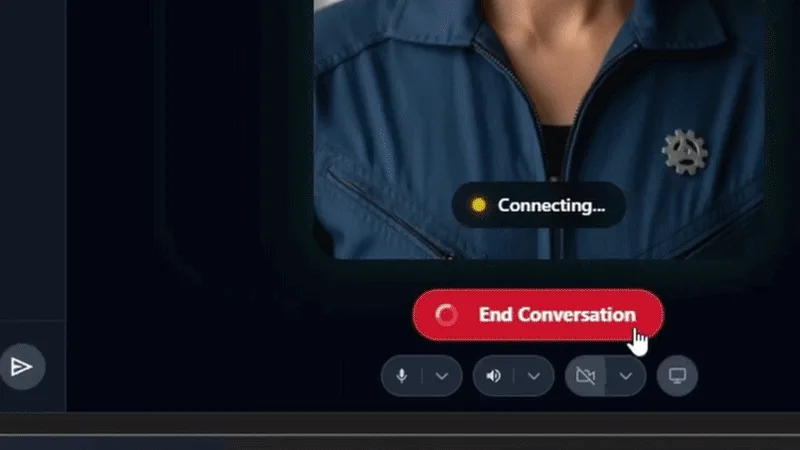
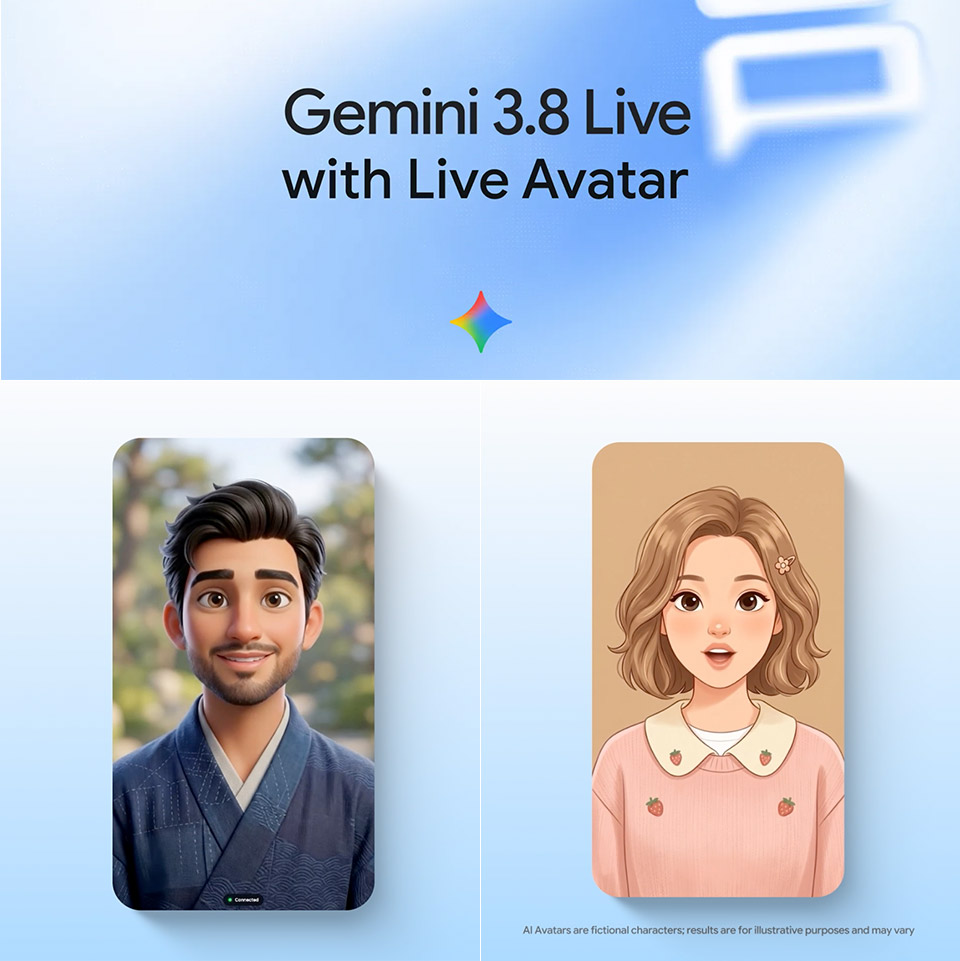
Google has expanded Gemini 3.8 Live with Live Avatar, a conversational video capability that combines native speech dialogue with a synchronised visual avatar. Announced on September 24, 2026, the feature gives voice agents an on screen presence capable of speaking, reacting and interacting in near real time rather than returning only text or audio. Google says the system generates facial expressions and lip movements aligned with Gemini’s spoken responses, while automatically detecting and transitioning between 97 languages during conversation.
Live Avatar is more than a conventional animated face placed over a voice assistant. Google describes Gemini 3.8 Live as a bidirectional streaming model that processes speech, live video and text while producing coordinated audio and avatar video. The model renders the avatar directly without requiring an external rendering pipeline, making its visual output part of the continuing conversation rather than a separate prerecorded video product. Users can speak, interrupt, show the agent something through a camera or screen share, and receive audiovisual responses during the same session.
The model operates through a bidirectional real time connection using WebSockets. It can ingest speech, live camera feeds and screen broadcasts while returning generated audio and, when Live Avatar is enabled, synchronised video. Processing visual and audio information together allows an avatar based agent to react to what someone is saying while also interpreting a live camera feed or screen content. Gemini can additionally invoke tools asynchronously, allowing backend operations to continue while the conversational agent remains present and continues speaking.
For technical integrations, the model identifier is gemini-3.8-live. The documented streaming configuration processes audio input as 16 kHz PCM, returns generated speech at 24 kHz and produces Live Avatar video at 24 frames per second. Developers enable avatar output by requesting VIDEO as the response modality and selecting an avatar with a compatible voice. Google’s technical guide describes the resulting video as a 24 FPS MP4 stream, with facial expressions and lip movements aligned with synthesised speech in real time.
Generating speech and facial animation together removes the need to send Gemini’s text to one service, produce speech through another and then pass the result to a separate avatar renderer. The intended experience combines live dialogue with low latency streaming video, allowing the agent to listen, see and speak through a dynamic visual persona. This native audiovisual output is the central distinction between Live Avatar and an application that independently assembles a language model, a speech service and an animated character.
Google has not publicly documented the detailed neural architecture behind the lip synchronisation process. Its documentation does not identify a specific phoneme to viseme system, facial rigging method or proprietary mouth shape algorithm. The supported description is therefore based on the output: speech, lip movements and facial animation are generated as synchronised components of the model’s real time conversation, without a separate external rendering pipeline.
Gemini Live Avatar Language Support, Expressions and Visual Consistency
Google states that Gemini 3.8 Live understands and speaks 97 languages with automatic language detection, while the Live Avatar launch information says lip synchronisation and expressions can transition across those languages. However, the September 2026 documentation does not provide a complete authoritative list naming all 97. Google Cloud’s language and voice configuration documentation separately lists a smaller collection that can be explicitly selected through Live API language settings:
- Egyptian Arabic
- Bengali
- Dutch
- English, India
- English, United States
- French
- German
- Hindi
- Indonesian
- Italian
- Japanese
- Korean
- Marathi
- Polish
- Portuguese, Brazil
- Romanian
- Russian
- Spanish, United States
- Tamil
- Telugu
- Thai
- Turkish
- Ukrainian
- Vietnamese
These figures describe different aspects of the system rather than contradictory language totals. The broader claim concerns automatically understanding and speaking 97 conversational languages, while the named API collection concerns explicit language selection. The smaller configurable subset should not be presented as the complete range of languages Gemini 3.8 Live can understand, just as the broader figure should not be expanded into an unsupported list of 97 language names.
Language changes can take place while a session is already active. Google’s developer documentation says Gemini 3.8 Live can detect and transition between supported languages without restarting the session or requiring manual reconfiguration. A multilingual user can begin speaking in one language and continue in another without the application establishing a separate Gemini session for each change. Live Avatar adapts alongside the spoken response, dynamically adjusting lip movements and expressions as the conversation changes language.
Developers can also restrict Gemini to a particular language through system instructions when an application requires consistent localisation. This supports two different approaches: allowing automatic multilingual conversation for fluid interaction or constraining the agent’s responses when consistent language output is more important. The ability to switch automatically therefore does not require every application to permit unrestricted language changes throughout a conversation.
Expression synchronisation also extends beyond matching mouth movements to words. Affective dialogue is enabled by default in Gemini 3.8 Live, and Google says the model can respond to acoustic prosody, emotional cues, pauses and speech inflection. It can adjust vocal tone, empathy and conversational rhythm according to how the user is speaking, while producing expressive speech and coordinated avatar animation during the same streaming experience. Google does not publicly explain every internal process connecting those vocal cues with facial animation, so the documented description remains functional rather than a complete architectural account.
Google also says Live Avatar can transition across its supported languages without degrading video fidelity or introducing visual drift. The company presents this as part of its native multilingual speech and video synchronisation, with the avatar generated directly within the Gemini experience. Maintaining coordinated speech, expressions and appearance is therefore part of the stated product behaviour rather than a task assigned to an independently operated rendering service.
Because fewer separate systems are involved in coordinating voice and facial animation, the design could reduce synchronisation problems between components. That is an inference from the documented architecture, not a published explanation of a specific algorithm that prevents drift. Google has not disclosed the detailed method used to maintain identity consistency throughout long multilingual conversations or published a universal numerical visual drift score. Its claim should consequently be understood as the behaviour the company says Live Avatar provides, rather than proof that visual inconsistency is impossible in every circumstance.
Gemini Live Avatar Enterprise Access, Custom Identities and SynthID Watermarking
Gemini 3.8 Live with Live Avatar became generally available for enterprise production on September 24, 2026. Google’s model documentation lists US and EU multi region availability alongside us-central1, while its Cloud launch announcement identifies support for US and EU endpoints, provisioned throughput, enterprise compliance controls and data governance capabilities. Organisations can choose from built in avatars and voices, but general availability of the broader service does not mean every customer automatically receives access to custom identity creation.
Custom avatars are limited to selected enterprise customers through allowlisting and verification. Organisations seeking access are directed to contact their Google Cloud account team. For approved customers, Google says a high quality reference image can be used to create a fully animated, responsive avatar while preserving its likeness, brand styling or character identity. Curated avatars are available more broadly, while creating a custom identity requires additional approval.
Custom voices are also available to selected customers. A custom avatar can be paired with either a prebuilt voice or a custom voice, with the documented replication process using a short, authorised PCM recording lasting approximately 10 to 20 seconds. System instructions separately define the agent’s conversational role and behaviour. Google’s Cloud demonstration combines those instructions with a reference image and an audio sample, allowing appearance, voice and conversational behaviour to be aligned around a particular enterprise use case.
Approved organisations can create custom avatars through either the Google Cloud console or an API workflow. In the console, the user opens the real time streaming interface, selects gemini-3.8-live, enables Live Avatar and chooses the option to upload an avatar image. Through the API, developers supply the reference image in the custom avatar configuration included in the session setup payload. Both approaches operate within the feature’s access controls rather than providing unrestricted creation of arbitrary identities.
Google specifies several requirements for the reference image:
- Format and quality: PNG is recommended, the image should use RGB colour and the file must remain under 5 MB. Visible blur and compression artefacts should be avoided.
- Resolution and orientation: The guidance calls for portrait orientation, dimensions of at least 704 by 1280 pixels and an image described as 720p or higher.
- Composition and pose: A head and shoulders or bust composition should occupy most of the frame, with a simple background, a direct camera facing pose and a neutral resting expression.
- Content restrictions: Images of minors, celebrities or offensive content are prohibited under the documented guidance.
Customers are responsible for obtaining the necessary rights and consent for any face or voice material they provide. Google connects use of the feature with its generative AI prohibited use policies, Cloud acceptable use requirements and relevant service terms. Enterprise availability should therefore not be confused with unrestricted permission to reproduce another person’s appearance or voice. The custom avatar process combines technical creation capabilities with additional access, verification and usage requirements.
The supported enterprise applications include branded concierges, customer service personas, training characters and other agents that benefit from a recognisable identity. A reference image establishes the intended appearance, a selected or authorised custom voice shapes the spoken presentation, and system instructions define the conversational role. Google has not disclosed the internal architecture used to preserve the reference identity, so its documentation establishes the intended likeness and behaviour rather than the precise mechanism behind them.
Google says all generated Live Avatar audio and video streams carry SynthID watermarks. These are imperceptible, meaning they are designed not to appear as a visible logo or audible announcement while remaining detectable by Google’s SynthID technology. Google DeepMind describes SynthID as a system that embeds digital watermarks directly into AI generated content, including images, audio, text and video. For Live Avatar, the purpose is to support provenance and transparency by providing a technical method that can help identify content as generated by Google AI.
For video, the watermark is added during generation and is designed to remain detectable after common transformations such as cropping, filters, frame rate changes and lossy compression. Google DeepMind’s documentation also describes submitting images, video or audio to Gemini and asking whether SynthID is present, while a separate SynthID Detector verification system is being tested. These capabilities can support identification of generated material, but they should not be treated as an absolute guarantee that every possible manipulation or transformation will remain detectable. Pasted markdown


Frequently Asked Questions[FAQs]
- What businesses could use Gemini 3.8 Live Avatar?
Google identifies use cases such as customer service agents, digital concierges, virtual tutors and interactive game characters. It has also demonstrated scenarios including hotel check in and claims intake. Because the model can process live visual input and call enterprise tools while the conversation continues, businesses could use it for interactive services that require both communication and access to backend systems. - What is Gemini 3.8 Live Avatar?
Gemini 3.8 Live Avatar is Google’s real time conversational video capability forgemini-3.8-live. It combines Gemini’s speech to speech conversation with generated talking avatar video, allowing the on screen character to speak with synchronised lip movements and facial expressions. The system is designed for ongoing interactive sessions rather than simple prerecorded avatar clips. - Does Gemini 3.8 Live Avatar really support 97 languages?
Google states that Gemini 3.8 Live understands and speaks 97 languages with automatic language detection. Live Avatar can also adjust its lip sync and facial expressions as the model moves between supported languages. However, Google’s launch materials do not currently publish a complete authoritative list naming all 97 languages, so the confirmed figure is the total number rather than a full public breakdown. - Can Gemini Live Avatar change languages during the same conversation?
Yes. Google says Gemini 3.8 Live can automatically detect language changes and transition between supported languages while the same session is still running. This means a user can begin speaking in one language and continue in another without restarting the conversation or manually changing the model configuration. - How fast is Gemini Live Avatar video generated?
Google’s developer documentation specifies Live Avatar video output at 24 frames per second, with generated speech returned at 24 kHz. The video and audio are produced in synchronisation, allowing the avatar’s mouth movements and facial animation to stay aligned with the spoken response during a live conversation. - Can businesses create their own Gemini Live Avatar?
Selected enterprise customers can create custom Gemini Live Avatars using authorised reference images. Google restricts this capability through an enterprise allowlisting and verification process, so custom avatar creation is not automatically available to every organisation. Prebuilt avatars are available more broadly for businesses that do not need a unique visual identity. - Can a custom Gemini avatar use a custom voice?
Yes. Google says a custom avatar can be paired with either one of its prebuilt voices or a custom replicated voice. Custom voice access is limited to selected customers, and organisations must have the necessary rights and consent for the voice sample they provide. This allows businesses to combine a specific visual identity with a matching authorised voice. - Does Gemini Live Avatar use SynthID?
Yes. Google says generated Live Avatar audio and video contain imperceptible SynthID watermarks. These watermarks are designed to help identify content as AI generated without adding a visible logo or obvious audible marker, providing an additional layer of provenance and transparency for generated avatar content. - Is Gemini 3.8 Live Avatar generally available?
Yes. Google listsgemini-3.8-liveas generally available from September 24, 2026, with US and EU multi region availability documented. However, general availability of the model does not mean every related feature is unrestricted. Custom avatars and custom voices remain limited to selected enterprise customers with additional access approval. - Does a developer need a separate lip-sync or avatar-rendering service?
Not necessarily. Google says Gemini 3.8 Live can directly generate synchronised 24 FPS avatar video as part of the model’s output, so developers do not have to rely on a separate lip sync or avatar rendering system for the basic Live Avatar experience. This reduces the number of external components needed to coordinate speech, facial animation and video.

Conclusion
Gemini 3.8 Live with Live Avatar represents an important shift from voice-only AI agents towards integrated real-time audiovisual agents. Rather than requiring developers to independently combine a language model, speech generator and avatar renderer, Google’s gemini-3.8-live model can directly return synchronised 24 FPS avatar video alongside generated speech.
Its multilingual capability is central to that proposition. Google says Gemini 3.8 Live understands and speaks 97 languages, automatically detects language changes and adapts avatar lip movements and facial expressions as users switch languages. The company further claims these transitions occur without degrading video fidelity or introducing visual drift. The public documentation does not yet enumerate all 97 languages by name, so the 97-language figure should be reported without inventing an unsupported full list.
For enterprises, the technology combines visual presence with features needed for functioning AI agents: live camera and screen understanding, interruptions, affective dialogue, asynchronous tools and backend API integration. The model is generally available through Gemini Enterprise with documented US and EU endpoints.
Customisation extends the concept further. Approved enterprise customers can use a high-quality reference image to create a responsive custom avatar and can combine it with prebuilt or authorised custom voices. At the same time, Google restricts custom-avatar access, requires customers to secure necessary rights and consents, and embeds SynthID into generated audiovisual output.
The result is a platform designed not merely to make an AI assistant “look human,” but to make conversational agents visually present, multilingual and operationally connected to enterprise systems. For customer service, hospitality, education, software assistance, interactive entertainment and other conversational applications, Gemini 3.8 Live Avatar provides Google’s most integrated real-time avatar architecture to date.
Sources and Citations
- Google, Live Avatar Announcement, September 24, 2026 : Official reveal explaining how Gemini 3.8 Live combines spoken conversation with generated video avatars, coordinated lip movements and facial expressions. It describes simultaneous audio and visual input, background tool execution and switching across 97 languages, while confirming availability through Gemini Enterprise. These are Google’s announced capabilities rather than independently measured performance results.
Citation: Introducing Gemini 3.8 Live with Live Avatar. (Google Blog) - Google Cloud, General Availability Announcement, September 24, 2026 : Enterprise release announcement describing availability through US and EU endpoints and confirming SynthID watermarking for generated audio and video. It distinguishes preset avatars from custom avatars that require enterprise approval and verification. The article also identifies Gemini 3.8 Live Extended Thinking as remaining in private preview at the time, rather than treating every related feature as generally available.
Citation: Gemini 3.8 Live with Live Avatar Is Now Generally Available. (Google Cloud Blog) - Google Cloud, Gemini 3.8 Live Developer’s Guide : Technical reference covering Live API integration, audio and video formats, tool execution, interruption handling and migration from earlier models. It documents generated avatar video at 24 frames per second and explains requirements for tool responses and streaming audio configuration. This provides implementation guidance beyond the examples shown in the launch announcements.
Citation: Developer’s Guide to Gemini 3.8 Live. (Google Cloud Documentation) - Google Cloud, Live Avatar Configuration Guide : Official instructions for selecting an avatar and voice through the Google Cloud console or configuring them through the Live API. The guide explains how to enable video responses, add instructions controlling the avatar’s behaviour and optionally share a camera feed. Its connection examples show how avatar selection and synthesized speech are configured within the same session.
Citation: Configure Live Avatars. (Google Cloud Documentation) - Google Cloud, Language and Voice Configuration Guide : Official speech configuration reference covering 30 preset voices, language switching, tone and accent instructions, and speech detection for handling interruptions. It also explains custom voice samples, restricts that feature to selected customers and requires the necessary consent and rights for submitted recordings. This distinguishes ordinary voice selection from the more restricted process of replicating a voice.
Citation: Configure Language and Voice. (Google Cloud Documentation) - Google DeepMind, SynthID Official Overview : Official explanation of the watermarking technology used to identify AI generated images, audio, text and video. It describes signals embedded directly into content, their resistance to common modifications and the tools available to check for their presence. The page provides background on how imperceptible watermarking works, distinguishing embedded identification signals from visible labels placed over an image or video.
Citation: SynthID: Watermarking and Identifying AI Generated Content. (Google DeepMind) - Google DeepMind, Text and Video Watermarking Announcement, May 14, 2024 : Research announcement explaining the expansion of SynthID to text and video, including watermarking across video frames and adjustments to token selection during text generation. It acknowledges that watermarking is only one component of identifying AI generated content, rather than a universal detection solution. This is historical research background, separate from the September 2026 Live Avatar launch.
Citation: Watermarking AI Generated Text and Video with SynthID. (Google DeepMind)
Recommendations
- Prime Video’s The Runner Review: Gal Gadot’s London Chase Falls Short
- Call of Duty: Black Ops 7 Season 4 Reloaded Trailer Ft. Nicholas Cage Breakdown and New Content Revealed
- Italian Exotics Dealership Location in Forza Horizon 6
- In This Skyrim Mod, You Have to Debate Dragons to Kill Them: How Blurbs’ Twitch Chat Dragon Debates Work
- GTA VI Physical Disc Edition May Arrive in December After Launch
- Spider-Noir Star Nicolas Cage Designed His Performance for Black and White, but Asked for it to Be Shot in Color to Appeal to Teens: Full Breakdown of the Creative Decision
- What to Expect at Xbox’s Big Summer Showcase Event: Start Time, Predictions, and Rumored Reveals
- Aliens: Fireteam Elite 2 Release Date Confirmed for Summer Launch Window
- How Widow’s Bay Became the Best Slasher Since Halloween (2018): Full Breakdown of the Boogeyman Horror Phenomenon
- Halloween: The Game Launches September 8, 2026 – Release Date, Gameplay, Platforms, and Michael Myers Explained



































































































