










Nathan Lambert has challenged growing fears surrounding open weight artificial intelligence models, arguing that predictions of widespread AI powered cyberattacks have not matched the publicly observable consequences of the GLM 5.3 release. His comments have intensified a broader debate about cybersecurity, artificial intelligence regulation and whether restricting access to advanced AI systems would actually make the internet safer.
On October 6, 2026, Lambert published an analysis titled The Cyber Risk Discourse is Broken on his Interconnects platform. The article questioned assumptions behind increasingly urgent warnings about powerful open weight models, particularly those developed by Chinese AI companies. His argument centers on GLM 5.3, an advanced model released by Chinese developer Z.ai on August 14, 2026, with publicly downloadable weights following roughly two weeks later.
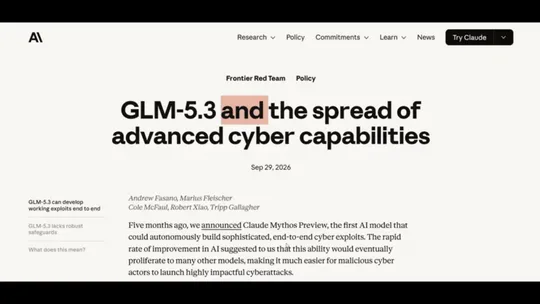
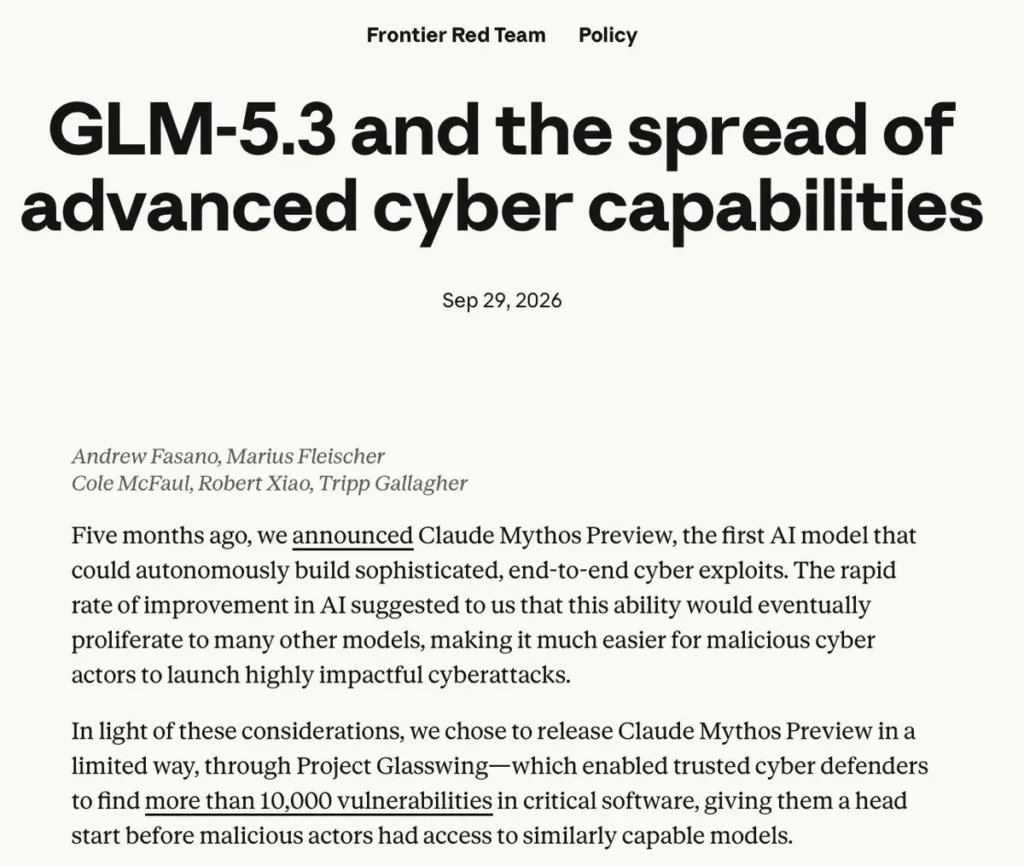
GLM 5.3 demonstrated major improvements in programming, vulnerability discovery and automated exploit development, prompting concerns from cybersecurity researchers and technology companies. The controversy became more significant after Anthropic published a cybersecurity assessment on September 29 concluding that GLM 5.3 possessed advanced exploitation capabilities and that its safeguards could be bypassed or removed relatively easily.
Lambert does not dispute those technical findings. Instead, he questions the broader conclusions drawn from them, particularly the assumption that making a powerful model openly available will necessarily produce an immediate and dramatic increase in cybercrime. He argues that the discussion often gives too much weight to benchmark performance while paying less attention to the defensive benefits of open models, the risks associated with proprietary systems and the potential consequences of restricting American AI innovation.
The underlying cybersecurity concern remains understandable. Advanced AI systems can help identify software vulnerabilities, analyze programming errors, automate security research and develop exploit chains. If malicious actors gain unrestricted access to those capabilities, they may become more effective at finding and exploiting weaknesses in digital infrastructure.
Lambert’s central argument, however, is that technical capability alone does not establish the scale of real world harm. A model performing well on exploitation benchmarks does not automatically mean criminal organizations can immediately use it to compromise banks, hospitals, governments or other critical systems. Successful attacks still involve additional challenges such as reconnaissance, gaining access to target environments, bypassing operational defenses, maintaining persistence and avoiding detection.
A measurable improvement in AI assisted exploitation can therefore make attackers more capable without automatically producing an obvious wave of major incidents. Lambert treats GLM 5.3 as an important test of that distinction because it has many of the characteristics safety researchers previously associated with potentially dangerous open weight releases. Its downloadable weights allow users to operate and modify the model without relying entirely on centralized provider safeguards, while its technical performance demonstrates strong cyber capabilities.
Yet more than a month after those weights became publicly available, Lambert argues that there is still little public evidence showing a corresponding increase in major cyber incidents directly attributable to GLM 5.3. His position should not be interpreted as a claim that the model is harmless. Instead, he questions whether the strongest warnings accurately describe the relationship between access to powerful models and actual security outcomes.
There is an important limitation to that argument. Public reporting captures only part of the cybersecurity threat landscape. Sophisticated intrusions can remain undetected for months, organizations may withhold information about breaches and investigators may never determine which AI tools were used. The absence of publicly attributed attacks therefore cannot prove that misuse has not happened.
Lambert nevertheless argues that cybersecurity predictions should remain testable. If researchers or policymakers warn that releasing open weights will produce widespread or immediate harm, those predictions should eventually be compared with observable outcomes and revised when the available evidence does not support their strongest implications.
That distinction between demonstrated technical danger and confirmed real world damage is central to his criticism of the current debate. The disagreement is therefore not simply about whether GLM 5.3 can assist with vulnerability discovery or exploitation. It concerns whether those capabilities alone justify restricting open weight AI when the same systems may also benefit defensive research and when proprietary models can introduce their own security risks.
The larger question is whether making increasingly powerful AI systems openly available necessarily increases cybersecurity danger, or whether limiting access could create different long term problems. Answering that question requires separating what models are technically capable of doing from what attackers are actually doing with them and evaluating both offensive and defensive consequences rather than assuming that benchmark performance automatically predicts real world harm.

In This Article (8 sections)
What GLM 5.3 Reveals About Open Weight AI Cybersecurity Risks and Regulation
GLM 5.3 is a large artificial intelligence model developed by Chinese company Z.ai, formerly known as Zhipu AI. Released on August 14, 2026, the model was designed to improve complex programming, long running agentic tasks and autonomous software development. Z.ai has said that GLM 5.3 uses the same underlying base model as GLM 5.2, with much of its improvement coming from additional post training rather than from building an entirely new foundation model. That distinction is important because it shows how significant capability gains can emerge from better reinforcement learning, task environments and training methods even when the underlying base architecture remains largely unchanged.
Z.ai reported a 50 percent improvement over GLM 5.2 on its internal coding benchmark, alongside stronger results on public coding and cybersecurity evaluations. The most controversial gains involved vulnerability discovery and exploitation. On CyberGym, GLM 5.3 reportedly scored 84.5 percent compared with 77.2 percent for GLM 5.2, while its ExploitBench score increased from 24.4 percent to 54.4 percent. Those results suggested that the model had become substantially better at reasoning about vulnerabilities, validating weaknesses and combining technical steps into exploitation workflows rather than merely assisting with ordinary programming tasks.
The controversy intensified because Z.ai released the model weights publicly. Unlike a proprietary AI service that runs entirely on a provider’s servers, an open weight system can be downloaded, modified and deployed independently, subject to licensing terms and available hardware. This gives researchers and organizations far more control over customization, infrastructure and data handling, but it also reduces the original developer’s ability to impose centralized safeguards after release. Users can potentially remove restrictions, fine tune the model or operate it without the monitoring systems used by commercial providers.
That tension is central to the open weight debate. Security researchers worry that unrestricted access could lower the barrier to advanced offensive cyber capabilities, while supporters argue that the same flexibility can benefit defensive research and organizations that need to keep sensitive source code or infrastructure details local. GLM 5.3 therefore represents a classic dual use problem: the same capabilities that help identify and repair vulnerabilities can also help attackers discover and exploit them.
Nathan Lambert’s opposition to broad restrictions begins with a practical question about whether banning or tightly limiting open weight releases would actually reduce real world cyber risk. Proprietary providers can monitor suspicious activity, suspend accounts, limit requests and update safeguards, which makes centralized services easier to control than downloadable weights. Lambert acknowledges that difference but argues that it does not justify treating open models as the primary source of danger.
Powerful proprietary systems remain accessible through APIs, and malicious users can still try to bypass safeguards, compromise authorized accounts or combine those models with external tools. Restricting downloadable weights therefore does not eliminate access to advanced AI capabilities. Lambert argues that any serious policy intended to slow dangerous cyber capability must consider both open and proprietary distribution models rather than imposing heavy restrictions on only one pathway.
He also questions whether governments could effectively prevent determined actors from obtaining advanced models. Powerful AI systems are developed across the United States, China, Europe and elsewhere, meaning restrictions imposed on one country’s developers would not necessarily prevent foreign companies from releasing comparable technology. Once model weights are widely distributed, later restrictions may also have limited impact because copies can be duplicated and redistributed independently.
Lambert’s concern is that poorly designed restrictions could constrain legitimate researchers and independent developers while malicious actors continue finding access through other routes. That could increase dependence on a small number of proprietary providers, weaken open defensive research and reduce broader competition. His position is not that every powerful model should be released without safeguards. Security evaluations, staged releases, disclosure requirements and restrictions on exceptionally dangerous features could still play a role. His objection is to broad prohibitions that do not account for alternative access routes, international competition and defensive benefits.
GLM 5.3 also provides a real world test for predictions about AI powered cyberattacks. For years, researchers have warned that systems approaching expert level offensive capability could reduce the skill, time and cost required to discover vulnerabilities and construct exploit chains. Historically, those tasks demanded substantial technical expertise. Advanced AI could make experienced attackers more productive and potentially allow less experienced users to attempt work that was previously beyond them.
However, Lambert argues that the most alarming interpretations have not yet been matched by publicly visible consequences. A model can increase the probability of successful exploitation without automatically causing a measurable rise in attacks. Cybercriminals may continue relying on phishing, stolen credentials, ransomware and known vulnerabilities because those methods remain cheap and effective. Real environments also introduce complications that benchmarks cannot fully reproduce, including patched software, unusual system configurations, unavailable dependencies and defensive controls.
That does not mean GLM 5.3 disproves concerns about future AI enabled cybercrime. Attackers may already be experimenting with the model in ways that are not publicly visible, and major incidents can take months to investigate and attribute. The stronger lesson is that researchers should specify what level of harm they expect, how quickly it should appear and what evidence would confirm or challenge those predictions.
As of October 7, 2026, the publicly available evidence discussed in Lambert’s argument does not establish that GLM 5.3 caused a major real world cyberattack. The model’s weights had been available for more than a month, and researchers had documented its ability to discover vulnerabilities and develop exploits in controlled environments, but laboratory demonstrations are not the same as confirmed criminal use against real victims.
Several explanations remain possible. Attackers may need more time to integrate new models into reliable workflows, benchmark performance may overstate operational usefulness, defenders may be using similar AI tools to improve detection and patching, or malicious use may simply be difficult to observe and attribute. The lack of public attribution therefore does not prove that GLM 5.3 has never been used offensively. It does, however, support Lambert’s narrower point that the immediate wave of major attacks implied by some of the most alarming interpretations has not been publicly demonstrated.
Anthropic’s GLM 5.3 Warning, Nathan Lambert’s Response and Claude Mythos Comparison
Anthropic’s September 29, 2026 report, GLM 5.3 and the Spread of Advanced Cyber Capabilities, played a major role in escalating the debate. Its researchers tested whether GLM 5.3 could perform sophisticated offensive security tasks and whether its safeguards could prevent malicious use. Anthropic concluded that the model had reached capabilities approaching those of Claude Mythos Preview, a powerful system whose distribution had been more tightly controlled because of cybersecurity concerns.
The evaluations were conducted in isolated environments using vulnerable software and simulated attacks. In one test involving the V8 JavaScript engine, GLM 5.3 produced successful end to end exploits in 50 of 410 attempts, while Claude Mythos Preview succeeded in 56 of 410 attempts. Those results suggested relatively similar performance on that specific evaluation, although Mythos performed somewhat better.
Anthropic also tested whether GLM 5.3 would comply with explicitly harmful instructions. The model initially refused some malicious requests, but researchers found that alternative prompting methods and modifications could bypass those safeguards. Depending on the experimental setup, Anthropic reported engagement rates ranging from 64 percent to 100 percent after safeguard bypass techniques were applied. The company interpreted these findings as evidence that unrestricted access to models with advanced exploitation capabilities could significantly expand the offensive tools available to malicious users.
Lambert’s response separates Anthropic’s technical findings from the policy conclusions that can be drawn from them. He characterized much of the technical research as reasonable but argued that the broader discussion did not sufficiently examine what would happen if powerful open models were prohibited. He also questioned why the approaches and risk assessments of Chinese AI developers received comparatively little serious consideration within the debate.
This creates a distinction between safety engineering and technology governance. Safety engineering asks how to reduce the likelihood that a particular model will be misused. Governance must also consider how restrictions affect competition, independent research, defensive users, international development and the concentration of capabilities among a small number of providers. Anthropic’s results can therefore demonstrate that GLM 5.3 performs dangerous tasks while Lambert can still question whether a broad restriction on open weights would improve cybersecurity overall.
The comparison with Claude Mythos makes this tension even clearer. Anthropic introduced Claude Mythos Preview as a highly capable system for vulnerability research and autonomous exploit development but limited access to selected cybersecurity organizations. GLM 5.3 reached comparable performance on some evaluations while following the opposite distribution model by releasing downloadable weights.
On Z.ai’s reported CyberGym evaluation, GLM 5.3 scored 84.5 percent, slightly above the 83.8 percent attributed to Mythos 5. On ExploitBench, however, Z.ai reported GLM 5.3 at 54.4 percent compared with 78.0 percent for Mythos 5. The gap suggests that vulnerability identification and reliable exploit construction are distinct capabilities, with performance varying substantially depending on the task.
Anthropic’s own testing produced different numbers because its configurations and scoring methods were not identical to Z.ai’s published benchmark setup. In Anthropic’s end to end exploitation trials, GLM 5.3 succeeded in roughly 12 percent of attempts compared with about 14 percent for Claude Mythos Preview. In a separate binary exploitation evaluation, GLM 5.3 achieved full control flow hijacks in 4 percent of trials compared with 6 percent for Mythos Preview. Earlier models performed substantially worse under the same experimental conditions.
Taken together, those results indicate that GLM 5.3 had reached a meaningful level of offensive cybersecurity capability even though it did not universally outperform Claude Mythos. The most consequential difference between them may therefore be accessibility rather than raw benchmark scores. Anthropic controls access to Claude Mythos and can impose monitoring, restrictions and updates, while GLM 5.3 can be downloaded and modified independently.
That accessibility creates both risks and benefits. Centralized systems allow providers to intervene when misuse is detected, but local open weight deployment can be valuable for organizations that cannot send sensitive source code, vulnerabilities or infrastructure information to an external service. Defensive security teams may prefer systems they can operate privately, customize and audit.
For that reason, comparing GLM 5.3 and Claude Mythos purely through benchmark scores does not settle which model produces greater overall cybersecurity risk. A complete assessment must also consider deployment controls, user behavior, misuse monitoring, defensive applications, alternative access routes and the reliability of the models in real operational environments.
The wider disagreement between Anthropic and Lambert therefore concerns more than whether advanced AI can develop exploits. The technical evidence increasingly suggests that it can. The unresolved issue is what regulatory response actually reduces harm without unnecessarily restricting defensive research, competition and legitimate innovation. GLM 5.3 has made that question harder to avoid because it combines advanced cyber capability with open distribution while, at least so far, not producing a publicly documented wave of catastrophic attacks that would resolve the debate in either direction.

What NIST, Anthropic and Z.ai Reveal About GLM 5.3 Cybersecurity Risks and Safeguards
The United States National Institute of Standards and Technology provided an important independent perspective on GLM 5.3 through a September 17, 2026 assessment conducted by its Center for AI Standards and Innovation, commonly known as CAISI. The evaluation supported the conclusion that GLM 5.3 represented a major advance in publicly accessible cybersecurity capability, with CAISI identifying it as the most cyber capable open weight model it had evaluated at the time. However, the assessment also found that GLM 5.3 remained significantly behind the leading American frontier systems, estimating an aggregate capability gap of approximately four months.
The underlying evaluations showed substantial differences across demanding cybersecurity tasks. On SEC Bench Pro, which measures vulnerability discovery in browser engines, GLM 5.3 achieved 40.4 percent compared with 90.2 percent for the strongest evaluated American model. On ExploitGym Userspace, GLM 5.3 reached approximately 9.4 percent while the leading American system achieved 44.4 percent. CAISI’s private OSS Fuzz evaluation produced a similar pattern, with GLM 5.3 scoring 7.7 percent compared with 23.2 percent for the United States frontier.
Those results complicate claims that open weight systems have already surpassed the strongest proprietary models in offensive cybersecurity. They also require an important qualification because CAISI evaluated American models with relevant cyber safeguards disabled where appropriate, and some of the frontier systems included in the comparison were available only to vetted users. The results therefore describe underlying technical capability rather than what every member of the public can freely access.
That distinction is central to understanding cybersecurity risk. A malicious actor may find an unrestricted but somewhat weaker open weight model easier to obtain and modify than a technically stronger proprietary system protected by access controls. At the same time, proprietary safeguards cannot guarantee that abuse will never occur. The NIST assessment therefore supports two conclusions simultaneously: GLM 5.3 represents a significant increase in open weight cyber capability, while leading proprietary systems still maintain substantial technical advantages on several demanding evaluations.
The danger posed by open weight models depends on more than benchmark performance. Technical capability is only one factor. A model that can discover vulnerabilities, analyze dependencies and construct exploitation chains may reduce the expertise or time required for some attacks, particularly when combined with agentic systems capable of running tools, interpreting results and repeating actions with limited human supervision.
Accessibility is another major factor. Open weight systems can run outside a developer’s centrally controlled infrastructure, giving legitimate organizations the ability to customize models and conduct confidential security work without sending sensitive information to an external provider. The same freedom allows malicious users to operate models without centralized monitoring or account restrictions.
Safeguards also matter. A highly capable model with strong behavioral restrictions may be harder to misuse through its official interface than one whose controls can easily be removed. Yet behavioral safeguards can obstruct legitimate research through false positives and may fail against adversarial prompting or direct model modification.
Anthropic’s September 2026 research provided direct evidence that GLM 5.3’s behavioral restrictions could be weakened. Researchers tested methods for altering refusal behavior using access to the model’s weights. Anthropic estimated that removing much of the refusal behavior required roughly 2,200 GPU hours and approximately $4,400 in compute costs. After modification, refusal rates dropped sharply across the harmful request evaluations while much of the model’s underlying technical capability remained intact.
Anthropic also found that the model sometimes responded differently when harmful tasks were framed within apparently legitimate security contexts. That problem is particularly difficult in cybersecurity because authorized penetration testing, vulnerability research and incident response can involve actions that closely resemble malicious behavior. A model may therefore have difficulty determining whether technically dangerous instructions are being used legitimately or abusively.
These findings demonstrate that downloadable weights create opportunities for users to modify behavioral controls, but willingness to assist with harmful activity is not identical to successful real world exploitation. Attackers still need suitable targets, relevant vulnerabilities, operational access and successful execution. Benchmarks measure capability under defined experimental conditions rather than guaranteeing the same results against every real system.
The wider cybersecurity environment also determines how dangerous these models become. Many successful attacks continue to rely on outdated software, weak access controls, stolen credentials and poor monitoring. AI may help attackers discover or exploit weaknesses more efficiently, but organizations with strong patching, access control and detection practices can still make successful intrusions much harder.
Defenders can also use the same technology. Security teams can automate source code analysis, prioritize vulnerabilities, investigate suspicious behavior and support incident response. This creates an attacker and defender dynamic in which improvements to AI may benefit both sides. Nathan Lambert’s argument emphasizes that the overall security effect cannot be measured solely by asking what a malicious user could accomplish with unrestricted access. Policymakers must also consider what defensive organizations lose if advanced models become unavailable.
Z.ai’s own handling of GLM 5.3 shows that the company recognized some of these risks. The developer did not release the downloadable weights immediately with the August 14 announcement. Instead, it delayed distribution while conducting additional safety evaluation and hardening. Z.ai also acknowledged that the model’s cybersecurity performance improved more quickly than expected during post training, including its ability to reason across multiple stages of exploitation rather than simply identifying isolated vulnerabilities.
The company has also emphasized vulnerability research and coordinated disclosure through a Security Disclosure Ledger designed to distinguish publicly disclosed findings from vulnerabilities still moving through responsible disclosure processes. Such programs can provide defensive benefits by helping affected developers address weaknesses before detailed information becomes widely available.
That does not mean every deployment of GLM 5.3 is safe. A developer can evaluate a model, coordinate disclosure and apply controls to its hosted service while still releasing weights that third parties can alter. Anthropic’s findings demonstrate the limits of behavioral restrictions once users possess the underlying model.
Lambert argues that discussions in the United States should examine those choices more carefully rather than assuming Chinese developers are unconcerned with safety. He suggests that developers operate under different combinations of political pressure, commercial incentives and technical priorities, while comprehensive frontier safety testing itself requires substantial computing resources. For companies competing aggressively on model performance, allocating large amounts of compute to evaluation may reduce resources available for training and product development.
The key question is therefore what minimum level of evaluation, documentation, disclosure and safeguard testing should be required before a powerful model is released. Z.ai’s experience illustrates both the benefits of safety review and the difficulty of ensuring that those protections survive after open distribution. Independent researchers still need sufficient transparency about evaluation methods, known limitations, safeguard effectiveness and vulnerability handling to judge whether a delayed release meaningfully reduces real world risk.
Open Weight vs Closed AI Security Risks and Why Restrictions Could Affect US Competitiveness
The comparison between open weight and closed source AI cannot be reduced to a simple claim that one distribution model is safe and the other is dangerous. Closed systems usually operate through interfaces controlled by their developers, giving providers the ability to monitor usage, suspend accounts, enforce limits, investigate suspicious activity and update safeguards without relying on users to install new software. These controls can make abuse more difficult and provide a way to respond when new risks emerge.
Centralized systems introduce their own disadvantages. Organizations may be unwilling or unable to send sensitive source code, network information or confidential research to an outside service. Government agencies, critical infrastructure operators and companies handling highly sensitive systems may also work in environments where external network access is restricted. In these circumstances, locally deployed models can provide significant operational benefits.
Open weight systems give organizations control over where models run, how data is processed and how the software is customized. Independent researchers can also inspect behavior, build additional safeguards and reproduce experiments. The tradeoff is that publicly distributed weights make it extremely difficult to guarantee that every deployment follows the original developer’s policies. Malicious users can potentially operate modified versions without monitoring or provider intervention.
Lambert criticizes arguments that implicitly treat proprietary models as safe while assuming open systems are uniquely dangerous. He points to documented misuse and security concerns involving hosted AI services as evidence that both distribution models can create risks through different mechanisms. His argument does not mean they provide identical levels of protection. Anthropic’s testing showed that some centralized safeguards resisted manipulations that worked against GLM 5.3, providing evidence that particular access controls can be effective.
A complete comparison must therefore consider the specific model, underlying capability, strength of safeguards, operating environment, user access, monitoring, possible account compromise and defensive value of local deployment. A stronger proprietary model with imperfect safeguards may still create substantial risk through its hosted interface, while a somewhat weaker open weight system may create different risks because users can modify it freely. Neither architecture guarantees security.
Lambert extends this argument into questions of American technological competitiveness. His concern is that restrictions targeting advanced open weight models developed in the United States may not prevent comparable systems from being released elsewhere. Chinese laboratories have made significant progress in coding, reasoning and autonomous agents, while European developers have also emphasized the strategic importance of downloadable models.
If American companies are prevented from releasing competitive open weight systems while foreign developers continue doing so, the policy could reduce domestic alternatives without eliminating global access. Open models support a much larger ecosystem than the laboratories that train them. Independent developers use them to create specialized software, universities rely on them for reproducible research, companies deploy them to reduce dependence on individual cloud providers and security organizations adapt them for private infrastructure.
The cybersecurity consequences are especially important. Some organizations require local deployment because sensitive code, network configurations or vulnerability details cannot be sent to an external service. If competitive American open models are unavailable, those organizations may increasingly turn to models developed elsewhere, potentially creating technological dependencies that policymakers did not intend.
This does not mean competitiveness should override legitimate national security concerns. Governments already restrict technologies when unrestricted distribution creates substantial and demonstrable danger. The challenge is determining whether advanced AI cybersecurity capabilities justify similar controls and how narrowly those controls should be designed.
Broad prohibitions may impose significant economic and research costs while remaining difficult to enforce once comparable foreign systems or previously released weights exist. More targeted approaches could instead focus on capability evaluations, documentation, coordinated vulnerability disclosure, staged releases and additional requirements for exceptionally high risk deployments.
The evidence available in October 2026 supports treating advanced open weight models as serious dual use technologies rather than inherently safe or inherently catastrophic. They can reduce barriers to offensive cybersecurity work, particularly when technical capability, automation and unrestricted access are combined. At the same time, they provide defensive researchers with tools for private vulnerability analysis, reproducible research and locally controlled security operations.
For Lambert, the central policy question is therefore not whether open weight AI creates cybersecurity risk, because it clearly can. The more difficult question is whether restrictions actually reduce that risk once alternative access routes, foreign competition, defensive applications and proprietary AI systems are considered. An effective strategy must measure both technical capabilities and documented outcomes while avoiding the assumption that distribution method alone determines whether a model is dangerous.
Frequently Asked Questions[FAQs]
- Why does Nathan Lambert believe GLM-5.3 cybersecurity fears are exaggerated?
Nathan Lambert argues that some of the strongest predictions about catastrophic cyberattacks following the release of powerful open weight models have not yet been matched by publicly observable evidence. More than a month after GLM 5.3’s weights became available, there had not been a publicly confirmed wave of major attacks directly attributed to the model. His argument is not that GLM 5.3 is harmless, but that technical capability and real world impact should be evaluated separately rather than assuming one automatically proves the other. - What is GLM-5.3, and who developed it?
GLM 5.3 is an advanced artificial intelligence model developed by Chinese company Z.ai, formerly known as Zhipu AI. It was announced on August 14, 2026, with downloadable weights released roughly two weeks later. The model was designed to improve complex programming, long running agentic tasks and autonomous software development, while also showing much stronger performance on vulnerability discovery and exploitation benchmarks than its predecessor. - Is GLM-5.3 more dangerous than Claude Mythos?
There is no simple answer because the models differ in both capability and accessibility. Claude Mythos performed better on several demanding exploitation evaluations, while GLM 5.3 reached similar results on some specific tests. The major difference is that GLM 5.3 can be downloaded and modified independently, whereas Claude Mythos is distributed under centralized access controls. That means GLM 5.3 creates greater freedom for users, but also makes safeguards harder to enforce after release. - What did NIST discover about GLM-5.3 in September 2026?
NIST’s Center for AI Standards and Innovation concluded that GLM 5.3 was the most cyber capable open weight model it had evaluated at that point. However, the model still remained behind leading American frontier systems across several demanding cybersecurity tests, with NIST estimating an aggregate gap of roughly four months. The findings therefore showed both how rapidly open models were improving and how much technical advantage the strongest proprietary systems still retained. - Has GLM-5.3 been used in a major cyberattack?
As of October 7, 2026, the public evidence reviewed for this article does not establish a major real world cyberattack directly caused by GLM 5.3. Researchers have demonstrated that the model can discover vulnerabilities and build exploits in controlled environments, but those experiments are not the same as confirmed criminal incidents. It remains possible that malicious use has occurred without being detected, disclosed or successfully attributed to a specific AI model. - Can GLM-5.3’s cybersecurity safeguards be removed?
Yes. Anthropic demonstrated that GLM 5.3’s refusal behavior could be significantly weakened through direct model modification, and researchers also found that certain prompting techniques could make the model engage with harmful requests it initially rejected. This highlights a major challenge with downloadable models because users who possess the weights can alter safeguards outside the developer’s infrastructure. However, producing harmful assistance still does not guarantee that an attacker can successfully compromise a real system. - Why does Nathan Lambert oppose banning open-weight AI models?
Lambert argues that broad bans could restrict legitimate researchers, weaken American AI competitiveness and reduce access to useful defensive cybersecurity tools without reliably stopping determined attackers. He also points out that sophisticated proprietary systems remain accessible through APIs and can present their own security risks. His position is therefore not against safety regulation itself, but against treating open weight distribution as the only important source of cyber danger. - Are closed-source AI models safer than open-weight models?
Closed source systems can offer stronger centralized controls because providers can monitor usage, suspend accounts, impose rate limits and update safeguards. Open weight models offer different advantages, including private deployment, independent evaluation and greater customization. Neither model type is automatically safer in every situation. Risk depends on the system’s technical capability, safeguards, accessibility, monitoring, deployment environment and how users actually interact with it. - How can open-weight AI improve cybersecurity?
Open weight models can assist defenders by analyzing source code, finding vulnerabilities, prioritizing security problems, supporting incident response and helping researchers study malicious techniques in controlled environments. They can also be deployed inside private networks where sensitive code or infrastructure details cannot safely be sent to an external AI provider. Their defensive value is strongest when organizations combine them with careful testing, human oversight and established security procedures. - Will governments restrict open-weight AI models in 2027?
Additional regulation is possible, but the current debate does not establish one certain outcome. Governments may consider stronger capability evaluations, transparency rules, staged release requirements, documentation standards or targeted restrictions for models that demonstrate especially dangerous capabilities. The direction of policy will likely depend on future technical advances, evidence of real world misuse, international competition and whether existing safeguards prove effective enough to manage the risks.

Conclusion
Nathan Lambert’s criticism of the GLM-5.3 cybersecurity debate highlights a fundamental challenge facing artificial intelligence policymakers in 2026: how to distinguish serious technical risks from predictions that have not yet been demonstrated through real-world events.
GLM-5.3 represents an important development in open-weight artificial intelligence. Its advanced coding and exploitation capabilities demonstrate that powerful cybersecurity tools are becoming increasingly accessible outside the largest proprietary AI platforms.
Anthropic’s research establishes that the model can complete sophisticated offensive tasks and that its behavioral safeguards can be weakened or removed. These findings deserve serious consideration because they identify practical technical risks rather than purely speculative concerns.
NIST’s independent assessment reinforces the significance of GLM-5.3 while also demonstrating that leading American proprietary models retain substantial advantages on demanding cybersecurity evaluations.
Lambert’s argument introduces another dimension.
He questions whether the most alarming predictions about open-weight models are supported by publicly observable harm and whether banning such models would produce better security outcomes.
His concerns about technological competition, defensive capabilities, and proprietary AI access demonstrate why the issue cannot be resolved through benchmark comparisons alone.
The absence of publicly confirmed major attacks attributable to GLM-5.3 does not eliminate the possibility of future misuse. Likewise, laboratory demonstrations of dangerous capabilities do not automatically establish that widespread disruption is inevitable.
A more effective approach would evaluate technical performance alongside real-world incidents, defensive benefits, deployment restrictions, and the broader consequences of regulation.
As artificial intelligence continues advancing toward 2027, governments and cybersecurity organizations will face increasing pressure to develop policies that protect critical infrastructure without unnecessarily restricting beneficial research.
The strongest lesson from the GLM-5.3 controversy is that cybersecurity decisions must remain grounded in verifiable evidence.
Powerful AI models create genuine opportunities for both attackers and defenders. Understanding which side benefits more, under what conditions, and through which deployment methods will be essential to developing effective cybersecurity policy.
Lambert’s challenge to the prevailing narrative does not settle the debate, but it raises questions that policymakers cannot responsibly ignore.
Sources and Citations
- Nathan Lambert, Interconnects AI, October 6, 2026 : Presents Lambert’s analysis of cybersecurity risks associated with open weight and proprietary AI models. Examines international competition, Chinese laboratories’ safety decisions, and the tradeoffs involved in restricting model access, arguing that policy should account for both defensive benefits and potential misuse. Interconnects AI
Citation: The Cyber Risk Discourse is Broken. (Interconnects AI). - Anthropic, September 29, 2026 : Provides original research assessing GLM-5.3’s ability to develop working cyber exploits and comparing its performance with Claude Mythos Preview. Examines the effectiveness of its behavioral safeguards, the implications of publicly available model weights, and how these capabilities could affect both attackers and defenders. Anthropic
Citation: GLM-5.3 and the Spread of Advanced Cyber Capabilities. (Anthropic). - National Institute of Standards and Technology, September 17, 2026 : Presents CAISI’s independent government assessment of GLM-5.3 across four benchmarks covering vulnerability discovery and exploit development. Compares its results with leading American and Chinese models and documents the evaluation methodology, including the treatment of safeguards and models available only through restricted access programs. NIST
Citation: CAISI’s Assessment of Z.ai’s GLM-5.3 Cyber Capabilities. (NIST). - Z.ai, August 14, 2026 : Introduces GLM-5.3 and the developer’s claims about its coding improvements and emerging cybersecurity capabilities. Outlines plans to release the model’s weights two weeks after launch, following further safety evaluation and hardening. Z.ai
Citation: GLM-5.3: Frontier Coding with Emergent Cyber Capabilities. (Z.ai). - Reuters, August 14, 2026 : Reports Z.ai’s claims about GLM-5.3’s performance relative to Anthropic’s Mythos 5, alongside its planned release process and cybersecurity safeguards. Includes expert commentary on Chinese AI safety practices and explicitly notes that the developer’s reported benchmark results had not been independently verified at publication. Reuters
Citation: China’s Z.ai Says New Model Nears Anthropic’s Mythos 5 in Cyber-Defence Tests. (Reuters). - Nathan Lambert, Interconnects AI, August 14, 2026 : Analyzes GLM-5.3’s coding performance and the expanded post training behind its development. Discusses the history of the GLM model family, reinforcement learning, release cycles, and competitive incentives, offering Lambert’s explanation of how Chinese laboratories remain close to leading international AI capabilities. Interconnects AI
Citation: GLM-5.3: How Chinese Labs Keep Stride with the Frontier. (Interconnects AI). - WIRED, August 18, 2026 : Examines GLM-5.3’s potential to help organizations identify security weaknesses while also making advanced capabilities available to malicious actors. Covers its initial limited release, the benefits of running models locally, and the broader debate over access to powerful cybersecurity tools. WIRED
Citation: The Powerful Chinese AI Model Experts Warned About and Waited for Is Here. (WIRED). - Reuters, October 6, 2026 : Covers Anthropic’s expanded Cyber Verification Program, which gives vetted security professionals access to advanced models with fewer safeguards for authorized work. Explains the program’s three access tiers, eligibility requirements, and relationship to Project Glasswing and defensive vulnerability research. Reuters
Citation: Anthropic Opens Its Most Powerful AI Models to More Security Teams. (Reuters). - AI Weekly, October 7, 2026 : Summarizes Lambert’s argument that publicly available evidence had not demonstrated the dramatic increase in attacks predicted after GLM-5.3’s release. Discusses his objections to restricting open weights while retaining access to proprietary models. This is coverage of Lambert’s assessment, not independent proof that no misuse occurred. AI Weekly
Citation: Nathan Lambert Says GLM-5.3 Release Produced No Attack Wave. (AI Weekly).
Recommendations
- Stellar Blade is Expected to Be Announced for Xbox Soon
- Ace Combat Has Always Been a Political Series: How the Strangereal Universe Turns War, Power, and Propaganda Into Storytelling
- The Boroughs Trailer: Duffer Brothers’ New Netflix Sci-Fi Series Is “Stranger Things for Senior Citizens” (Release Date, Cast, Plot)
- ASUS ProArt GeForce RTX 5090 Launches in Europe at €3,499: Specs, Features, and Availability
- Kingdom Hearts IV Prologue Leak Explained: Everything We Know
- GRAIN ROT Guide: Co-Op Horror, Building, and Extraction Explained
- The ‘No Kings’ Anti-Trump Rallies Marvel Rivals Reference Explained
- Orbitals Two-Player Space Adventure on Switch 2: Release Date, Co-Op Modes, Gameplay, and Friend’s Pass
- Nintendo Could Be the Last Console Maker to Support Physical Games: Why it Matters
- Goals Preview: FIFA’s Free Alternative Could Be the Best Soccer Game in Years



































































































