








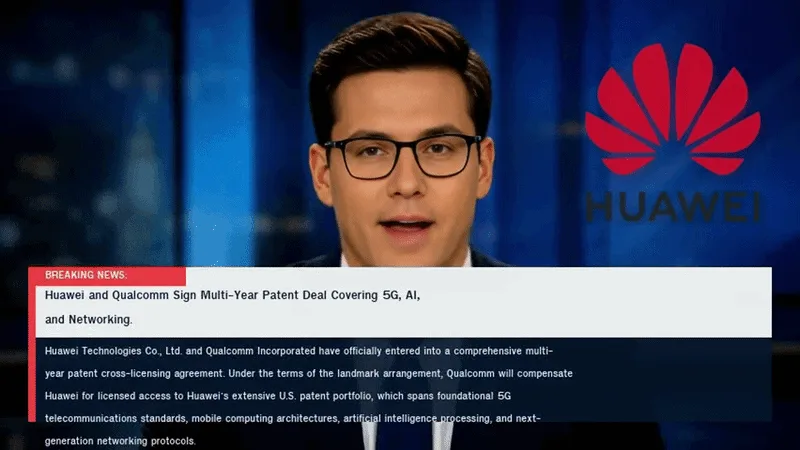
Huawei and Qualcomm have signed a major multi year patent licensing agreement covering 5G, artificial intelligence, computing and networking technologies. Announced on October 5, 2026, the deal marks an important development in the relationship between two of the world’s most influential telecommunications technology companies and establishes a broader framework for how they can use specified intellectual property from each other’s patent portfolios.
The central feature of the agreement is cross licensing. Under this structure, both companies grant each other permission to use certain patented inventions under negotiated contractual terms. This differs from a simple one way license, where one company pays another solely for access to its intellectual property. A cross licensing arrangement recognizes that Huawei and Qualcomm both hold substantial patent portfolios that can be relevant to each other’s products, research and technology platforms.
The agreement is particularly significant because it explicitly extends across broader 5G patent portfolios while also covering computing, artificial intelligence and networking technologies. Qualcomm has long been associated with cellular modems, mobile processors, semiconductor platforms and wireless licensing, while Huawei has built extensive businesses around telecommunications infrastructure, consumer devices, networking equipment and wireless research. Both companies therefore operate in technology ecosystems where products often depend on inventions developed by many different organizations.
That is especially important in telecommunications because interoperability depends on companies being able to implement technologies covered by numerous patents. A modern 5G smartphone, for example, must communicate with mobile networks that may incorporate technologies developed by several different companies. Patent licensing provides a structured way for manufacturers and technology providers to use those inventions without negotiating separately for every individual patent.
The 2026 agreement also contains a separate patent acquisition component. Qualcomm has agreed to purchase certain Huawei patents registered in the United States covering computing, AI, networking and other technical areas. The transaction is subject to required regulatory approvals before it can close. Qualcomm later clarified that the patents involved in this acquisition are non cellular United States patents, making it important to distinguish the purchase from the broader cross licensing arrangement.
The patent acquisition and cross license are therefore connected parts of the same announcement but do not necessarily involve identical intellectual property rights. The broader license allows both companies to access specified technologies under agreed conditions, while the acquisition would transfer ownership of particular Huawei patents to Qualcomm after regulatory approval.
The announcement should also not be confused with a renewed semiconductor supply relationship. Neither company has said that Qualcomm will resume supplying processors to Huawei as a result of the agreement, and nothing in the announcement indicates that existing United States export restrictions have been removed. The deal concerns intellectual property rights rather than an automatic return to normal chip sales or unrestricted hardware cooperation.
Qualcomm issued an additional clarification on October 6, 2026 after some early reporting suggested the company would become a net royalty payer to Huawei. Qualcomm disputed that characterization and also rejected suggestions that the agreement involved Huawei’s LogicFold technology. The precise royalty structure, payment arrangements, patent schedules and complete contractual duration remain confidential.
The deal nevertheless demonstrates how closely connected modern technology companies can remain even when they compete in hardware, software, infrastructure and research. Telecommunications standards rely on inventions contributed by many companies, meaning competitors often still need formal licensing arrangements to ensure that their products and networks can work within the same technical ecosystem.
For Huawei, the agreement provides further recognition of the value of its long term investment in patents and communications research. For Qualcomm, it establishes a framework for managing intellectual property rights across several strategically important areas, including wireless technology, networking, artificial intelligence and computing.
The agreement also represents a new stage in an existing licensing relationship rather than the first patent arrangement between the two companies. Both have spent decades developing technologies used throughout global communications systems, and the new deal broadens the scope of that relationship while addressing newer areas such as AI and advanced computing.
Understanding the significance of the agreement therefore requires separating several different elements. It is a multi year cross license covering important technology portfolios, includes Qualcomm’s planned acquisition of selected non cellular Huawei patents in the United States, remains subject to confidential commercial terms and regulatory approvals, and does not by itself change the separate trade restrictions governing semiconductor exports. Together, those elements make the October 2026 agreement an important intellectual property development without turning it into a broader hardware supply or trade policy deal.

In This Article (8 sections)
Why Huawei and Qualcomm Signed the 2026 Patent Deal and What Technologies It Covers
The October 2026 Huawei and Qualcomm agreement reflects the growing commercial importance of patented technology across modern communications, computing and artificial intelligence. Although the companies have signed licensing agreements before, the new arrangement is notable because it explicitly spans 5G, computing, AI and networking rather than focusing only on traditional cellular technologies.
Both companies have substantial interests in these areas. Qualcomm operates a major patent licensing business alongside its semiconductor operations, while Huawei has invested heavily in telecommunications infrastructure, networking, consumer electronics and research. Clarifying intellectual property rights can reduce legal uncertainty for both companies while allowing each side to commercialize technologies developed through years of research and development.
The agreement also reflects how closely modern technologies now overlap. Connected devices combine cellular communications, processors, signal processing, AI functions and networking systems in ways that make traditional distinctions between wireless and computing patents less clear. A computing platform may depend on technology originally developed for telecommunications, while modern networks increasingly use AI to manage traffic, improve efficiency and reduce energy consumption.
Huawei has also placed increasing emphasis on intellectual property commercialization. Since tighter United States trade restrictions began affecting the company in 2019, Huawei has continued investing in research while looking for ways to generate value from its patent portfolio. Qualcomm, meanwhile, already has a long established licensing business built around wireless and related technologies. Both companies therefore have incentives to reduce disputes, clarify rights and protect the commercial value of their technical contributions.
The agreement does not mean broader political or commercial tensions between the United States and China have disappeared. Instead, it shows that patent negotiations can continue even while other areas of technology cooperation remain restricted. Intellectual property licensing can operate separately from semiconductor export controls, supply restrictions and other trade policies.
The official agreement identifies four major technology categories. The first is 5G, covering patented inventions related to fifth generation wireless communications. These technologies can involve transmitting and receiving signals, encoding and decoding information, managing connections and supporting the broader standards that allow modern mobile devices and networks to communicate.
The second category is computing. This can include inventions connected to processing architectures, system design, memory operations and other technologies used by modern connected devices. However, the companies have not published a complete list of every patent covered, so it would be inaccurate to assume that specific processor architectures or semiconductor manufacturing technologies are automatically included.
Artificial intelligence is the third category. AI related patents can cover computational methods, processing systems and techniques used to support intelligent features. The agreement establishes licensing rights involving AI intellectual property, but it does not provide unrestricted access to either company’s proprietary AI models, software, datasets or confidential engineering knowledge.
Networking forms the fourth category. These technologies can involve communication protocols, connectivity, traffic management and system architecture used across telecommunications infrastructure, enterprise systems and computing environments. This makes the agreement broader than a traditional cellular patent license.
The distinction between patent rights and access to proprietary technology is important. A patent license gives permission to use specified inventions under agreed conditions. It does not automatically provide source code, trade secrets, semiconductor designs, manufacturing equipment or confidential research. The precise boundaries of the Huawei and Qualcomm arrangement depend on contractual terms that have not been publicly disclosed.
AI and computing are especially important because both companies have expanded beyond traditional mobile communications. Qualcomm has increasingly focused on intelligent computing across smartphones, PCs, automotive systems, industrial devices and connected infrastructure, combining wireless connectivity with processing performance, energy efficiency and on device AI. Huawei likewise maintains substantial research activities involving AI computing, cloud infrastructure, telecommunications and enterprise systems.
That overlap creates opportunities for licensing because intelligent devices often combine several patented technologies at once. A single product may use wireless communications, local AI processing, networking features and computing systems covered by different intellectual property portfolios. Broader licensing agreements can provide legal clarity without requiring every relevant patent to be negotiated separately.
The agreement does not mean Qualcomm will begin using Huawei AI accelerators or that Huawei will gain access to proprietary Snapdragon processor designs. It also does not announce a joint AI model, shared research laboratory or semiconductor manufacturing partnership. Its importance lies instead in recognizing that AI, computing and communications patents are becoming increasingly interconnected.
Qualcomm’s Huawei Patent Acquisition, Cross Licensing and the Companies’ 2001 to 2026 Licensing History
A major part of the October 2026 announcement is Qualcomm’s agreement to acquire selected Huawei patents registered in the United States. This transaction is separate from the broader cross licensing arrangement. Under a patent license, the original owner generally keeps the patent while granting another company defined usage rights. A patent acquisition instead transfers ownership of the relevant rights, subject to the terms of the transaction and regulatory approval.
Qualcomm has said the planned acquisition covers non cellular United States patents involving computing, AI, networking and other technical areas. The company also rejected suggestions that the transaction involved Huawei’s LogicFold technology. Neither Huawei nor Qualcomm has disclosed the full list of patents, the number being transferred, the purchase price or their detailed technical scope.
For Qualcomm, ownership of additional patents could strengthen its intellectual property position where computing, AI and networking technologies intersect. Patent ownership can also provide useful negotiating assets in future licensing arrangements with other companies. For Huawei, selling selected assets represents another way to commercialize research without giving up its broader technology portfolio.
The transaction should not yet be treated as completed because it remains subject to regulatory approval. Until the necessary reviews and closing conditions are satisfied, ownership of the affected patents has not formally transferred.
The broader agreement uses cross licensing, a common structure in industries where many companies contribute patented inventions to complex technical standards. In a conventional license, one company grants another the right to use specified technology, often in exchange for royalties, upfront payments or other compensation. A cross license expands this structure by allowing both sides to grant rights to each other.
That model is particularly relevant for Huawei and Qualcomm because both companies hold large patent portfolios. Qualcomm may possess inventions required for certain Huawei products, while Huawei may own patents relevant to technologies used or licensed by Qualcomm. Rather than negotiating every patent individually, the companies can establish a broader framework governing covered technologies, products, geographic rights, licensing periods and payment obligations.
Financial terms can vary widely. Some cross licenses result in one company making a net payment after the relative value of the two portfolios is considered. Others use mutual payments, balancing mechanisms or structures that do not create a publicly identifiable net payer. The existence of a cross license alone therefore does not establish which company ultimately pays more.
That distinction became especially important after the 2026 announcement. Some early reports described Qualcomm as becoming a net royalty payer to Huawei, but Qualcomm publicly disputed that interpretation on October 6. Because the contractual terms remain confidential, there is no verified public basis for stating a specific net royalty direction or payment amount.
Cross licensing can still provide significant benefits even when the financial details are unknown. It reduces legal uncertainty, clarifies rights to patented inventions and can lower the risk of expensive intellectual property litigation. It also supports continued implementation of shared technical standards where companies depend on each other’s inventions.
The 2026 arrangement continues a licensing relationship between Huawei and Qualcomm that stretches back roughly 25 years. One of the earliest major publicly documented agreements dates to 2001, when Qualcomm licensed its Code Division Multiple Access patent portfolio to Huawei for specified telecommunications equipment. That agreement helped Huawei develop and sell products using relevant CDMA technology at a time when Qualcomm was already an important wireless patent holder and Huawei was rapidly expanding its telecom equipment business.
Over the following decades, both companies became much larger contributors to global wireless development. Huawei expanded its research activities and contributed technologies to newer generations of mobile standards, while Qualcomm continued building semiconductor platforms, communications technology and licensing programs.
Their relationship also included disputes. During 2018 and 2019, licensing payment disagreements became an important issue, with Qualcomm’s financial disclosures showing interim royalty arrangements while the companies negotiated a broader settlement.
In July 2020, Huawei and Qualcomm resolved those disputes and signed a new long term global patent license. Qualcomm’s regulatory filings reported approximately $1.8 billion in fiscal 2020 revenue associated with the settlement and royalties under the new agreement, following about $1.2 billion in payments under earlier interim arrangements. The 2020 agreement also included a cross license granting Qualcomm rights under certain Huawei patents.
That history makes the October 2026 deal an expansion of an existing relationship rather than the first time the companies have exchanged patent rights. What distinguishes the new arrangement is its broader scope across 5G, AI, computing and networking, together with Qualcomm’s planned acquisition of selected non cellular Huawei patents in the United States.
The progression from the 2001 CDMA license through the 2020 settlement and the 2026 agreement also illustrates how Huawei’s position has changed over time. The company evolved from being primarily a licensee of Qualcomm wireless technology into a major patent holder capable of negotiating broad reciprocal licensing arrangements. Qualcomm, meanwhile, remains both a major technology developer and one of the industry’s most important intellectual property licensors, making the latest agreement a continuation of a long and increasingly complex commercial relationship.

Huawei Qualcomm Patent Deal Value, Royalty Questions and Impact on 5G, AI and Networking
The exact financial value of the 2026 Huawei and Qualcomm agreement has not been publicly disclosed. Neither company has announced a confirmed total transaction price, annual royalty amount or financial breakdown separating the cross license from Qualcomm’s planned acquisition of selected Huawei patents. Reports referring to billions of dollars therefore require careful interpretation because the figures available publicly do not represent the standalone value of this specific agreement.
Huawei has indicated that the newly announced transaction will help bring the expected cumulative value of its patent licensing agreements above $6.9 billion. That figure refers to Huawei’s broader intellectual property licensing business rather than the amount Qualcomm is paying under the October 2026 agreement. Similarly, historical payments associated with the companies’ 2020 settlement must be kept separate. Qualcomm previously reported approximately $1.8 billion in fiscal 2020 revenue related to the Huawei settlement and royalties under that licensing agreement, but those historical amounts cannot be used to calculate the value of the new deal.
The 2026 arrangement contains several potential financial components. Cross licensing may involve consideration based on the value and scope of each company’s intellectual property, while Qualcomm’s planned acquisition of Huawei’s non cellular United States patents is a separate transaction with an undisclosed purchase price. Other commercial provisions may also exist, but the details remain confidential. Qualcomm’s October 6 clarification is particularly important because the company disputed reports describing it as a net royalty payer to Huawei. There is therefore no publicly verified basis for assigning a specific payment amount or confirmed net royalty direction to the agreement.
The broader claim that Qualcomm is simply “paying Huawei” for licensing rights also requires qualification. What has been confirmed is reciprocal patent licensing and a planned patent acquisition. Qualcomm has acknowledged the value of Huawei’s continuing innovation, particularly its extensive telecommunications research and contributions to technologies associated with modern wireless systems. Even companies with major patent portfolios of their own can require licenses to inventions developed by competitors because standards based industries rely on technologies owned by many different organizations.
The relative value of those rights is normally determined privately using factors such as technical relevance, patent validity, remaining protection periods, geographic coverage, expected product use and other licensing obligations. For Qualcomm, obtaining rights to Huawei intellectual property can reduce uncertainty around relevant patent exposure. For Huawei, licensing provides a way to generate commercial value from research investments. The defensible conclusion is therefore that Qualcomm recognizes the value of Huawei’s patents, not that a particular net payment arrangement has been publicly established.
For smartphones and chipsets, the agreement could provide greater certainty around patent rights associated with 5G devices and related computing technologies. Modern smartphones rely on numerous patented inventions covering wireless communication, signal processing and other functions developed by many companies over decades. Reciprocal licensing can reduce some legal uncertainty and support continued development of standards based technologies.
That does not mean the agreement will automatically make smartphones cheaper. Device pricing depends on processor costs, memory, manufacturing, distribution, software development, competition and demand, with patent royalties representing only one part of the final cost. Even if a licensing agreement changes intellectual property expenses, there is no guarantee those changes will be passed directly to consumers.
The deal also does not confirm the return of Snapdragon powered Huawei smartphones. Patent licensing and semiconductor supply are separate commercial and legal matters. Permission to implement patented inventions does not automatically authorize Qualcomm to ship restricted processors to Huawei, and the agreement does not announce a new Snapdragon chip, Huawei branded chipset or jointly developed smartphone platform. Any product level effect is therefore indirect unless the companies make separate hardware announcements.
The inclusion of artificial intelligence and networking is significant because these areas increasingly overlap with traditional communications technology. AI workloads now operate across smartphones, edge devices, enterprise infrastructure and cloud systems, while modern networks increasingly incorporate intelligent processing to manage traffic, improve performance and reduce energy use. Qualcomm develops technologies for intelligent connected devices and computing platforms, while Huawei has major interests in networking, cloud infrastructure and AI related systems.
Cross licensing can help both companies manage patents that apply to these overlapping areas, but it does not transfer complete AI chip designs, manufacturing knowledge or proprietary engineering systems. A patent license provides legal permission to use specified inventions within an agreed scope. Manufacturing a commercial processor still depends on fabrication processes, specialized equipment, software tools, supply chains and confidential technical knowledge that are not automatically included in a patent agreement.
The same distinction applies to networking. Licensing networking patents does not mean Huawei and Qualcomm have agreed to jointly construct telecommunications infrastructure. Instead, the agreement establishes intellectual property rights that may be relevant as communications, computing and AI technologies become increasingly integrated. Its broader industry significance is that future licensing arrangements may need to cover several previously separate technology categories as intelligent processing becomes embedded throughout connected systems.
How US Restrictions and FRAND Licensing Apply to the Huawei Qualcomm Agreement
United States trade restrictions remain an essential part of the context surrounding the Huawei and Qualcomm agreement. Huawei was added to the United States Entity List in May 2019, introducing licensing requirements for certain exports, reexports and transfers involving items subject to US export controls. Later restrictions further affected Huawei’s access to some advanced semiconductor technologies and related supplies, creating significant challenges for its international supply chain and its relationships with American technology companies.
In 2024, United States authorities revoked several export licenses that had previously allowed suppliers including Qualcomm and Intel to ship certain products to Huawei. That history explains why the October 2026 patent agreement should not be interpreted as a return to unrestricted semiconductor trade. Patent licensing and export authorization operate through different legal frameworks.
A patent license grants defined intellectual property rights. An export license determines whether regulated goods, software or technology can legally be transferred under applicable trade controls. Huawei obtaining rights to Qualcomm patents therefore does not automatically allow it to purchase restricted Qualcomm processors, just as Qualcomm’s acquisition of selected Huawei patents does not authorize every possible form of technology transfer.
Both companies must continue complying with applicable laws and regulatory requirements. Qualcomm’s planned acquisition of Huawei’s United States patent assets is itself subject to regulatory approval, adding another legal process to the transaction. The companies have not publicly identified every approval required, so the patent transfer should not be treated as complete until the relevant conditions have been satisfied.
The arrangement nevertheless demonstrates that intellectual property transactions can continue even when physical technology trade remains restricted. For Huawei, patent licensing provides a potential source of revenue that does not depend on selling telecommunications hardware. For Qualcomm, licensing and acquiring intellectual property can strengthen its patent position without necessarily changing the export controls that govern semiconductor shipments.
FRAND principles are another important part of understanding the agreement. FRAND stands for Fair, Reasonable and Non Discriminatory and is particularly relevant to standard essential patents, commonly called SEPs. These are patents protecting inventions that must be implemented for a product to comply with a particular technical standard.
Cellular communications provide a clear example. A company manufacturing a device compatible with standardized wireless technologies may need to implement patented inventions belonging to numerous companies. Without an appropriate licensing framework, holders of essential patents could create major obstacles for manufacturers attempting to produce compatible equipment.
FRAND commitments are intended to balance the rights of patent owners with the needs of companies implementing standards. Fairness concerns the overall appropriateness of licensing conditions, while reasonableness concerns whether the terms, including financial requirements, are commercially justifiable in context. Non discrimination is intended to prevent unjustified differences in how similarly situated licensees are treated.
These principles do not require every company to receive exactly the same royalty rate. Different agreements can involve different patent portfolios, products, geographic coverage, commercial relationships and cross licensing arrangements. The European Telecommunications Standards Institute, or ETSI, maintains an intellectual property policy covering essential patents associated with its standards and seeks to encourage innovation while maintaining access to standardized technologies under FRAND conditions.
Huawei and Qualcomm explicitly referenced FRAND principles in connection with their October 2026 agreement. That is significant because both companies own intellectual property related to widely implemented wireless standards and therefore participate extensively in the international standards licensing system.
A FRAND commitment does not require every term of the Huawei Qualcomm agreement to become public. Companies can negotiate confidential contracts while still operating under relevant licensing obligations. It is also important to distinguish standard essential patents from other intellectual property included in the broader agreement. Computing, AI and networking patents may not all be necessary to implement a formal cellular standard, meaning FRAND obligations can differ depending on the individual patent and the commitments attached to it.
Together, the continued US restrictions and the reference to FRAND principles show that the 2026 agreement operates within several overlapping legal frameworks. Huawei and Qualcomm can negotiate broad intellectual property rights covering 5G, computing, AI and networking while semiconductor trade remains restricted and standards related patents continue to be governed by established licensing principles. The deal therefore strengthens their patent relationship without automatically changing export controls, guaranteeing new devices or revealing the confidential financial terms behind the arrangement.

Frequently Asked Questions[FAQs]
- What is the Huawei and Qualcomm patent agreement announced in October 2026?
Huawei and Qualcomm announced a multi year patent licensing agreement on October 5, 2026 covering 5G, artificial intelligence, computing and networking technologies. The arrangement gives both companies defined rights to use specified patented inventions from each other’s portfolios. It also includes Qualcomm’s planned acquisition of selected Huawei patents registered in the United States, although that purchase still requires regulatory approval. The exact royalty structure, purchase price and full contractual duration remain confidential. - Is this the first patent licensing agreement between Huawei and Qualcomm?
No. The two companies have had a licensing relationship for roughly 25 years. Qualcomm granted Huawei rights associated with CDMA technology in 2001, while the companies later resolved a major licensing dispute and signed another long term agreement in 2020. The 2026 deal is important because it broadens the relationship across 5G, AI, computing and networking while also adding a separate acquisition of selected Huawei patents. - How much is the Huawei and Qualcomm 2026 deal worth?
The companies have not disclosed a confirmed total value for the 2026 agreement. Huawei has said that its broader expected cumulative patent licensing value will exceed $6.9 billion, but that number includes its wider licensing business and should not be treated as the value of this Qualcomm deal alone. The price Qualcomm is paying for the selected Huawei patents and any payments connected to the cross license remain undisclosed. - Will Qualcomm pay Huawei royalties under the new agreement?
The agreement includes reciprocal patent licensing, which means both companies are granting rights to each other, but the financial structure has not been made public. Some early reports suggested Qualcomm would become a net royalty payer to Huawei, but Qualcomm specifically disputed that characterization on October 6, 2026. It is therefore accurate to say that licensing payments may exist within the agreement, but there is no publicly verified basis for stating which company ultimately pays more. - Does the agreement allow Huawei to purchase Qualcomm Snapdragon processors again?
No such authorization has been announced. Patent licensing and semiconductor supply are separate legal and commercial matters. The agreement gives access to certain intellectual property rights, but it does not automatically remove United States export restrictions or permit Qualcomm to ship restricted Snapdragon processors or other regulated hardware to Huawei. Any renewed chip supply would require separate legal authorization and commercial arrangements. - Which Huawei patents is Qualcomm acquiring?
Qualcomm has agreed to acquire selected Huawei patents registered in the United States that relate to computing, artificial intelligence, networking and other technical areas. Qualcomm later clarified that the patents involved are non cellular assets, which separates them from the broader 5G cross licensing part of the deal. The companies have not disclosed the full patent list, individual patent numbers, exact technical scope or acquisition price. - Does the Qualcomm Huawei agreement include LogicFold technology?
Qualcomm has specifically said that reports connecting the agreement to Huawei’s LogicFold technology were inaccurate. Early coverage associated the patent acquisition with that technology, but Qualcomm rejected that interpretation in its October 6 clarification. LogicFold should therefore not be described as a confirmed part of either the cross licensing arrangement or the planned patent purchase. - What does FRAND mean in the Huawei and Qualcomm licensing deal?
FRAND stands for Fair, Reasonable and Non Discriminatory. These principles are commonly used when licensing standard essential patents, which protect technologies that companies must implement to comply with standards such as cellular communication specifications. Huawei and Qualcomm referenced FRAND principles in connection with their agreement, indicating that relevant licensing practices are intended to align with recognized standards based intellectual property rules. - When will the Huawei and Qualcomm patent transaction be completed?
No exact completion date had been announced as of October 7, 2026. The companies said the patent acquisition will close after the required regulatory approvals and other necessary conditions are satisfied. Until those reviews are completed, the selected Huawei patents should not be described as having fully transferred to Qualcomm, even though the companies have already announced the planned transaction. - How could the Huawei and Qualcomm agreement affect future 5G and AI technologies?
The agreement could provide both companies with greater legal certainty when using patented technologies across wireless communications, AI, computing and networking. That may reduce some licensing disputes and support longer term planning around connected devices and infrastructure. However, the deal does not automatically create new smartphones, AI chips or network products, lower consumer prices, remove export restrictions or establish a joint AI development program. Its most immediate effect is to clarify intellectual property rights rather than announce specific new hardware.

Conclusion
The Huawei and Qualcomm patent agreement announced on October 5, 2026, represents a significant development in international telecommunications intellectual property licensing.
By establishing a broad multi-year arrangement covering 5G, artificial intelligence, computing, and networking, the companies have expanded an established commercial relationship into several increasingly interconnected technology fields.
The agreement also includes Qualcomm’s planned acquisition of selected Huawei United States patents, subject to regulatory approval.
Its importance extends beyond the immediate interests of the two companies.
Huawei and Qualcomm both contribute technologies to industries that depend on international standards, complex patent portfolios, and widespread interoperability.
Their agreement illustrates how mutual intellectual property arrangements can support commercial activity even when companies operate within complicated geopolitical and regulatory environments.
For Huawei, the announcement reinforces the commercial significance of its research investments and intellectual property portfolio.
For Qualcomm, it provides an additional framework for managing patent rights across emerging areas of computing and connectivity.
However, several important uncertainties remain.
The financial terms have not been disclosed, and Qualcomm has rejected claims that it is a net payer under the licensing arrangement.
The company has also clarified that the separate patent purchase concerns non-cellular United States patents and disputed reports connecting the agreement to LogicFold.
Furthermore, the announcement does not remove United States export restrictions or establish a new semiconductor supply partnership.
The transaction’s closing remains dependent on the necessary regulatory approvals.
These qualifications are essential to understanding the actual scope of the deal without exaggerating its consequences.
Looking ahead, the agreement reflects a telecommunications industry in which wireless communications, AI processing, computing systems, and networking technologies are becoming increasingly interconnected.
As these fields continue to develop, intellectual property arrangements will remain important tools for protecting innovation, enabling technology implementation, and managing relationships between competing companies.
The Huawei and Qualcomm agreement is therefore significant not because it resolves every challenge between the organizations, but because it demonstrates the continuing strategic value of patents in a rapidly evolving global technology industry.
Sources and Citations
- Qualcomm — Huawei and QualcommQualcomm — Huawei and Qualcomm Announce Broad Patent License Agreement, October 5, 2026 — Official Qualcomm announcement, including the October 6 clarification.
Qualcomm — Broad Patent License Agreement - Huawei — Huawei and Qualcomm Announce Broad Patent License Agreement, October 5, 2026 — Official Huawei announcement covering the multi-year cross-licensing agreement, 5G, AI, computing, networking and Huawei U.S. patent sales.
Huawei — Broad Patent License Agreement - Reuters — Huawei Agrees to a Multi-Year Patent Licensing Deal With Qualcomm, October 5, 2026 — Reuters coverage of the agreement and its technology scope.
Reuters — Huawei-Qualcomm Patent Licensing Deal - Qualcomm — Commercial License for CDMA Network Products With Huawei, 2001 — Official Qualcomm historical release covering the companies’ earlier CDMA licensing relationship.
Qualcomm — 2001 Huawei CDMA License - SEC — Qualcomm Fiscal 2020 Annual Report — Qualcomm’s 2020 Form 10-K filed with the U.S. Securities and Exchange Commission.
SEC — Qualcomm Fiscal 2020 Annual Report - Huawei — Statement Regarding Patent Licensing Agreement With Qualcomm, July 30, 2020 — Huawei’s official statement on its 2020 patent licensing agreement with Qualcomm.
Huawei — 2020 Qualcomm IP Agreement - ETSI — Intellectual Property Rights and FRAND Licensing Policy — Official ETSI information on intellectual-property rights and its FRAND licensing framework.
ETSI — Intellectual Property Rights - IEEE ComSoc Technology Blog — Huawei–Qualcomm Patent Deal: A Reset for 5G, AI, and Networked Computing IP, October 5, 2026 — Industry analysis of the agreement’s scope and FRAND implications.
IEEE ComSoc Technology Blog — Huawei–Qualcomm Patent Deal - Huawei — Innovation and Intellectual Property — Official Huawei intellectual-property information and patent/licensing overview.
Huawei — Innovation and Intellectual Property
Recommendations
- Capcom Showcase March 2026: Start Time, Where to Watch the Capcom Spotlight, and What to Expect (Pragmata, Monster Hunter Stories 3, Mega Man, Street Fighter 6)
- ONTOS at Gamescom Opening Night Live August 25: Gameplay Reveal
- The Super Mario Galaxy Movie Set For Massive First Weekend At The Box Office: Latest Opening Weekend Projections, Release Date, and What’s Driving the Hype
- AC Black Flag Resynced Grand Cayman Chest Guide: Every Chest Location and Loot Reward
- 2XKO Thresh Release Date: Moves, Playstyle, and How He Fits the Roster
- What is Stranger than Heaven? Full Overview from Xbox Presents Showcase
- Stephen Colbert Is Writing a New Lord of the Rings Film: Everything We Know About The Lord of the Rings: Shadow of the Past
- Mina the Hollower Has a New Release Date and an Aggressively Low Price: May 29 Launch and $19.99 Cost Explained
- How do I set up a scene with multiple cameras in Blender?
- Everplay (Team17 Parent Company) Reports 10% Gross Profit Rise in 2025: Full-Year Results, Revenue, and Outlook



































































































