




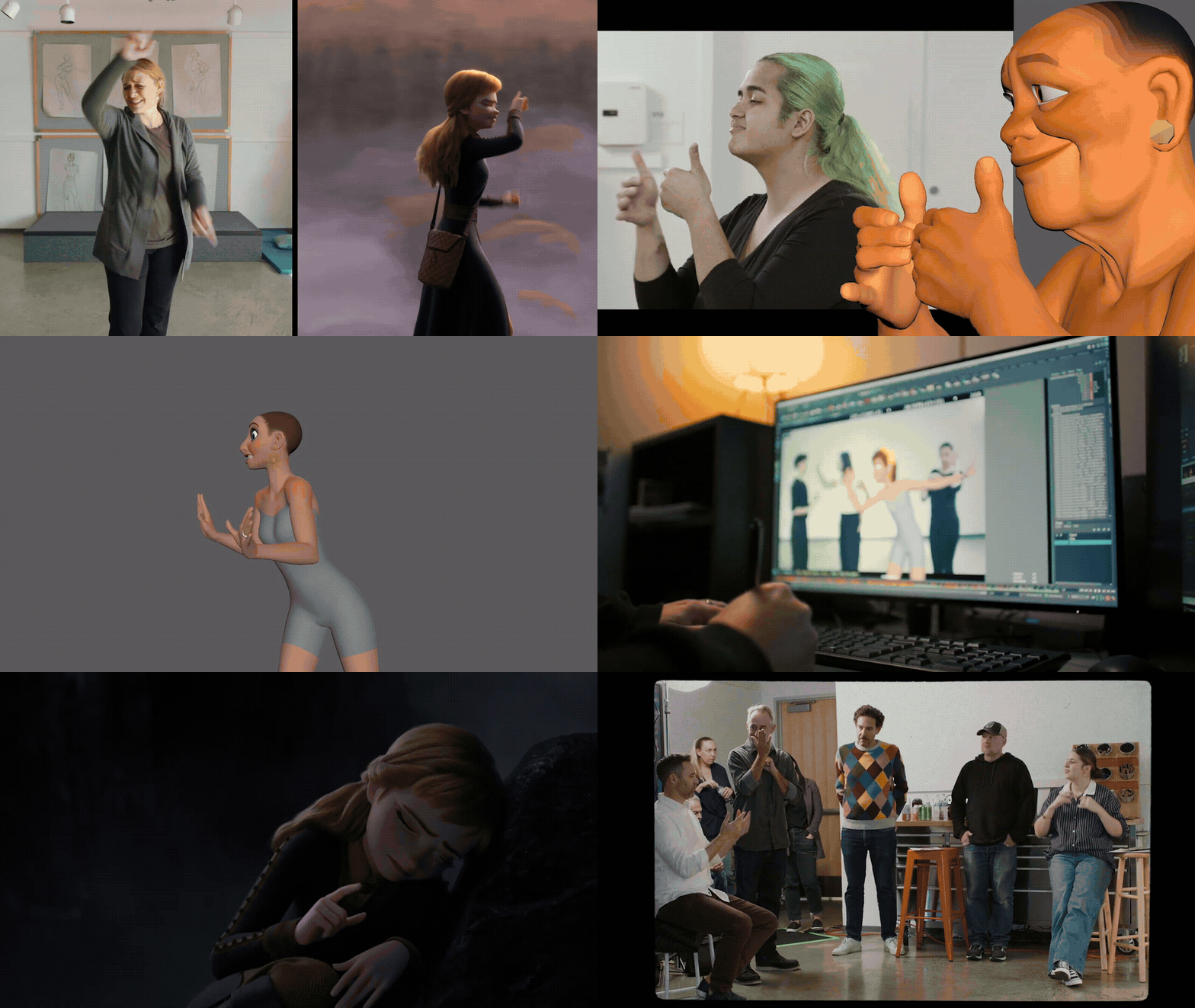
Disney Animation’s Songs in Sign Language is one of the most ambitious accessibility experiments the studio has released in years: three musical sequences from recent animated features were rebuilt in American Sign Language and launched on Disney+ for National Deaf History Month. Official Disney materials describe the project as newly reimagined and animated in ASL, created by director Hyrum Osmond, producers Heather Blodget and Christina Chen, and the team at Deaf West Theatre, with a behind-the-scenes featurette released alongside the shorts.
The reason the project immediately sparked debate is straightforward. ASL is not English on the hands. It is a visual-spatial language whose meaning depends on handshape, movement, body position, facial expression, and the use of signing space. Research on sign-language perception shows that viewers rely heavily on the face for detailed information such as mouth shapes and facial grammar, while broader motion is picked up in peripheral vision. That makes readability unusually sensitive to framing, angle, scale, clutter, and pacing. Disney and Deaf West’s public response has been that cinematic energy and ASL clarity can coexist, but only if the scenes are intentionally designed, tested, and refined around sign-language performance rather than retrofitted afterward.
What “Songs in Sign Language” is and when it releases on Disney+
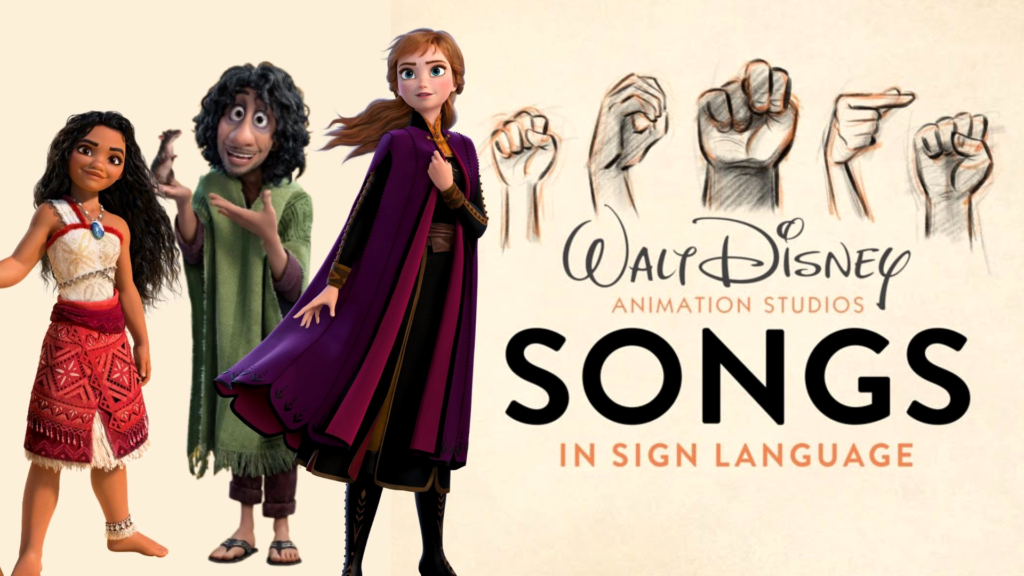
Songs in Sign Language is not a feature film and not a single bonus clip. Disney+ lists it as a 2026 anthology/music/animation title with one season and three episodes, each centered on one reanimated song sequence. Disney first announced that the project would debut on April 27, 2026, and Disney+’s April 2026 release guide likewise lists April 27 as the launch date, with a companion making-of featurette arriving alongside the shorts.
That format matters for SEO and for audience expectations. Disney is positioning the title as a discrete streaming collection rather than as a replacement version of the original films. In practical terms, that means viewers are getting a concentrated ASL animation showcase: short-form musical storytelling designed specifically for sign-language performance, not a partial accessibility layer dropped into existing movies.
Which Disney songs were reanimated in ASL (Frozen 2, Encanto, Moana 2)
Disney officially selected three songs: “The Next Right Thing” from Frozen 2, “We Don’t Talk About Bruno” from Encanto, and “Beyond” from Moana 2. The Disney+ catalog lists them as separate episodes, and Disney’s press materials consistently identify those three titles as the complete launch lineup.
The choice was creative as well as practical. In interviews, the team explained that they wanted range: a quiet emotional solo, a densely staged ensemble number, and a physically expansive adventure anthem. They also wanted recent films whose production assets could still be accessed within Disney Animation’s current toolset. That combination made the trio a proof-of-concept set: grief and restraint in “The Next Right Thing,” crowd timing and comic complexity in “Bruno,” and action-plus-cultural specificity in “Beyond.”
Behind-the-scenes of Disney Songs in Sign Language with Deaf West Theatre
The project’s origin was personal for director Hyrum Osmond, who has said the idea grew out of regretting the communication barriers in his own family and wanting to build something that could reduce those barriers for others. Disney’s official materials say Osmond led a team of more than 20 animators, while Laughing Place and Cartoon Brew report that the idea took years of conceptual work before moving into a compressed production schedule measured largely in months.
The collaboration also did not come out of nowhere. Disney had already worked with Deaf West Theatre on an ASL version of “We Don’t Talk About Bruno” in 2022, and Disney’s CSR reporting later highlighted that partnership. Variety’s reporting on that earlier release noted the use of an all-Deaf Colombian and Hispanic cast and a mix of American Sign Language and Colombian Sign Language, which helps explain why the 2026 project feels like an expansion of an existing creative path rather than a one-off corporate gesture.

Disney Songs in Sign Language readability concerns explained
The core readability concern is not about whether ASL “looks fast.” It is about whether viewers can still parse meaning when the camera keeps cutting, characters keep moving, and multiple visual elements compete for attention. Official and academic sources align on this basic point: sign languages convey meaning through coordinated manual and nonmanual signals, and the face is part of the language, not decoration. When the image is too small, the angle too oblique, or the scene too visually busy, comprehension can suffer.
That explains why early online discussion centered on fast cuts, shifting camera positions, and the absence of conventional lip-sync. 80 Level summarized the concern accurately: unlike spoken dialogue or subtitles, ASL depends on precise handshapes, facial expression, and spatial positioning, so stylized framing can interfere with legibility if it is not carefully planned. This is not a fringe worry. Research on video-based sign communication has long shown that signer size, viewing angle, and visual conditions all affect how easily signed content can be understood.
Deaf West Theatre response to fast cuts in ASL animation
Deaf West Theatre’s public answer has been clear: dynamic editing is not automatically incompatible with ASL. In comments reported by 80 Level, artistic director DJ Kurs said the project was built around a shared vision in which ASL would be treated as the normative storytelling language on screen, not as an accommodation added later. He argued that ASL is flexible enough to carry meaning across a range of shots and angles when the work is designed intentionally and continuously refined in collaboration.
That response matters because it reframes the debate. Deaf West is not saying readability concerns are wrong; it is saying those concerns are exactly why the creative pipeline mattered. The claim is not that speed alone solves anything. The claim is that readability comes from collaboration, review loops, and shot design. In other words, fast cuts are not the point. Constructed visual grammar is the point.
Can fast-paced editing work with American Sign Language on screen
Yes, but the available evidence points to a highly conditional yes. Deaf West says ASL can remain clear through a wide range of shots and angles when the work is intentional, and Disney’s own examples support the idea that action-heavy scenes are possible. Laughing Place’s review singled out “We Don’t Talk About Bruno” as technically audacious and “Beyond” as proof that signing can live inside physical action rather than outside it.
But readability does not become irrelevant just because a scene works artistically. A 2024 Scientific Reports study found that side viewing angles slowed comprehension and reduced accuracy for British Sign Language signers, especially L2 signers, and earlier work in the Journal of Deaf Studies and Deaf Education found that viewers fixate mainly on the signer’s face to interpret small facial and mouth movements. So the best answer is this: fast-paced ASL animation can work when the camera, scale, and motion are serving the signed performance rather than fighting it.

How Disney animators ensure ASL clarity with camera angles and framing
Disney has not published a shot-by-shot cinematography rulebook for Songs in Sign Language, but the public record makes the design logic fairly clear. Deaf West says the sequences were built to let the camera participate in storytelling while remaining readable, and external sign-language video standards consistently recommend eye-level camera placement, stable framing, full visibility of the signing space, strong contrast, and enough screen area to preserve facial detail and hand movement.
Research adds another important constraint: viewing angle matters. The less frontal the view, the harder comprehension becomes for many signers, while signer size is also decisive. A Gallaudet-authored legibility paper argues that, at normal viewing distances, a signer should occupy at least about one-third of the full screen and preferably more. Put together, those sources suggest that Disney’s clarity strategy had to include readable scale, cautious use of nonfrontal angles, and compositions that preserve the face and signing window even in kinetic scenes. That is an inference from the evidence, but it is a strong one.
Why characters don’t lip-sync or sing while signing in ASL animation
Public reporting strongly suggests this choice was intentional. 80 Level summarized the explanation raised in early discussion: ASL has a different syntax from spoken English, and some signs require facial and mouth actions that would be compromised by trying to keep characters simultaneously singing English lyrics in conventional lip-sync.
That explanation is also consistent with sign-language linguistics. NIDCD and CDC both describe ASL as a complete language with grammar distinct from English, expressed through the hands, face, body, and movement. Research on mouth activity in sign languages likewise treats mouth movements as a key linguistic component, not as optional decoration. If Disney had forced synchronized English lip patterns onto characters while they were producing ASL, it would likely have created a conflict between spoken-language mouth shapes and sign-language nonmanual markers. From a readability standpoint, that would be the wrong tradeoff.
How ASL grammar and facial expressions affect animation readability
ASL readability rises or falls on whether the animation captures grammar in the face as well as meaning in the hands. NIDCD states that ASL is expressed by movements of the hands and face, CDC says facial expressions are built into ASL sentence structure, and linguistics research shows facial and head movements operate across multiple levels of sign-language structure. That is why reducing ASL to hand motion alone produces unreadable or misleading output.
Disney’s own behind-the-scenes reporting lines up with that science. Osmond said that after comparing the old footage with a sign-language layer, the team realized how different the result needed to be, because so much sign meaning lives in the face. He said most of the face viewers see is new, with extensive work on eyes, brows, and expression. That is a crucial point for understanding animation readability: the face is not secondary polish. It is a core linguistic surface.
How Deaf West performers influenced Disney’s ASL choreography and timing
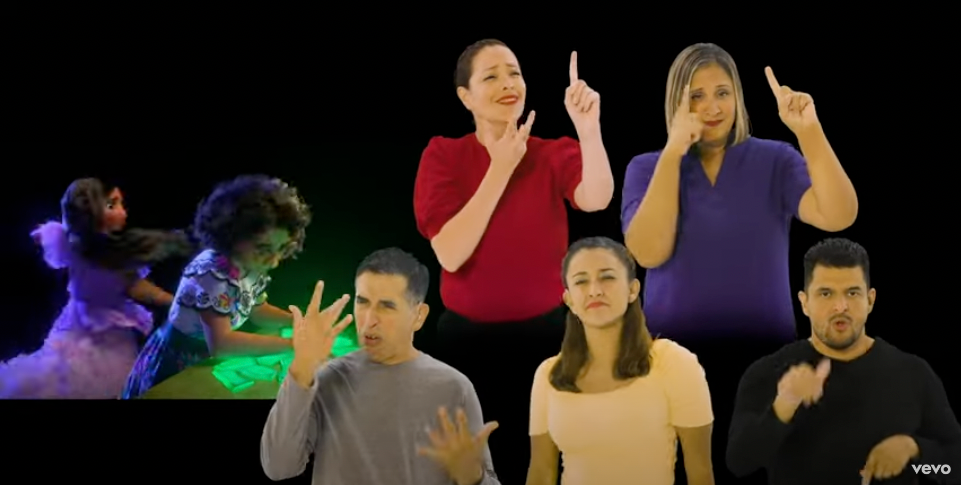
Official Disney materials say DJ Kurs, Catalene Sacchetti, and eight Deaf West performers reimagined the lyrics into ASL by focusing on concepts and emotion rather than word-for-word transcription. Interviews add that the sequences were choreographed, not merely translated, which meant performance choices affected timing, spacing, and the emotional shape of each scene from the ground up.
Their influence extended beyond language into culture and embodiment. For Moana 2’s “Beyond,” the team sought Deaf performers with Pacific Islander heritage; for Encanto’s “We Don’t Talk About Bruno,” they cast Deaf Colombian actors and incorporated Colombian signing influences alongside ASL. That means Deaf West did not simply verify hand accuracy after the fact. The performers affected the scenes’ rhythm, character specificity, and cultural texture.
How Disney tested and iterated ASL scenes for readability
The clearest public description of Disney’s iteration process comes from Kurs’s account that each sequence was designed, tested, and refined together in a tight feedback loop. Laughing Place fills in what that meant on the floor: the team spent years slowly conceptualizing the project because it had to be correct, then used side-by-side comparisons of the original scenes and the ASL versions to discover how much facial and body performance had to be rebuilt.
The project’s comic and dramatic choices also show readability iteration in practice. In the Bruno sequence, the team deliberately chose not to sign one visual-joke beat because signing it at the same moment would have pulled viewers’ attention away from the gag. That is not censorship or simplification. It is screen-language tuning: deciding what the audience should watch, when, and for what effect. In readability terms, it is evidence that Disney and Deaf West were not only asking “Is the sign accurate?” but also “Can the audience process everything on screen without losing the moment?”
What Deaf audiences are saying about fast-paced ASL animation
Because Songs in Sign Language launched on April 27, 2026, the public reaction record is still early and incomplete. There is not yet a stable body of long-tail audience data, and that matters. What is visible so far is a conversation with two strong currents: enthusiasm about finally centering signed storytelling inside Disney animation, and scrutiny about whether all of the visual and cultural choices land equally well.
On the positive side, early reviews described the project as historic and argued that Disney had finally made something in the Deaf community’s own language rather than merely providing access around the edges. On the critical side, public discussion documented by 80 Level raised questions about fast cuts and readability, while Daily Moth-indexed posts surfaced criticism from some Deaf Pacific Islanders who felt the Moana 2 segment did not fully satisfy their expectations of authentic representation. The fairest summary right now is not that reaction is uniformly positive or negative. It is that the project has been welcomed as culturally significant while still being held to a high standard by the communities it aims to serve.

How Disney approached Deaf representation and authenticity in animation
The strongest evidence of authenticity is structural, not promotional. Disney’s own reporting and multiple interviews say the studio did not simply hire consultants to sign off on completed scenes. It built the shorts in active collaboration with Deaf West Theatre, used Deaf performance references created specifically for the project, and treated ASL as the storytelling language of the shorts rather than as a secondary access layer.
That approach also aligns with established production guidance for sign-language media, which recommends Deaf leadership, Deaf coaching, conceptual translation, and linguistic validation during production rather than after it. UNICEF’s sign-language video guidance explicitly recommends Deaf narrators or presenters, Deaf coaching, and conceptual rather than word-for-word translation. Disney’s process, as publicly described, maps closely onto that model. It also builds on the company’s earlier collaboration with Deaf West on “We Don’t Talk About Bruno,” suggesting that the studio has been moving incrementally toward more integrated Deaf-led creative work instead of treating Songs in Sign Language as an isolated experiment.
Accessibility in animation: best practices for readable ASL cinematography
If other animation studios want readable ASL cinematography, the standards are already visible. W3C recommends solid contrasting backgrounds, good lighting, capture of the full signing space, a signer large enough for clear viewing, and the avoidance of important on-screen obstructions. RID recommends landscape orientation, eye contact through the camera, eye-level lenses, stable footage, plain backgrounds, and clothing that contrasts with skin tone. UNICEF’s guidance adds conceptually accurate translation, no cropped signing, minimal camera movement, and Deaf sign-language coaching during filming.
Academic work sharpens those recommendations. Viewers rely heavily on the face for detailed sign-language information, nonfrontal side angles can reduce comprehension, and signer size on screen is a major legibility variable. For animation, that means readable ASL cinematography is not just about smooth character motion. It is about giving the audience enough visual access to the signer’s face, hands, torso, and spatial grammar at every important beat. Best practice is not static staging all the time. Best practice is visual intentionality all the time.
Common ASL readability issues in animation and how studios can avoid them
The most common failure points are now easy to name. Small signing windows, side-heavy camera angles, cropped hands, cluttered or low-contrast backgrounds, shaky framing, and facial performances that do not match the signed meaning all reduce readability. So does literal word-for-word translation, because sign-language songs typically need conceptual adaptation rather than mechanical lyric replacement. Disney’s team effectively demonstrated the opposite approach: rebuild the face, protect the signing space, stage visual jokes so the audience can process them, and cast for both linguistic and cultural authenticity.
Studios can avoid most of these problems by bringing Deaf creators in before storyboards are locked, not after. They should test signer scale on real devices, favor eye-level and mostly frontal views for information-dense moments, keep the signer large enough for facial detail, let captions coexist with sign-language versions when possible, and treat nonmanual markers as part of the performance budget. The broader lesson from Disney’s ASL animation experiment is simple: readability is not something you fix in post. It is something you design into the shot.
Frequently Asked Questions (FAQs)
- Is Songs in Sign Language a movie or a collection of shorts?
It is a short-form Disney+ anthology title with one season and three episodes, each built around a separate reanimated song sequence rather than a full feature-length narrative. - When did Songs in Sign Language arrive on Disney+?
Disney announced April 27, 2026 as the Disney+ debut date, and the platform’s April 2026 release guide lists the same date. - Which songs are included in the launch lineup?
The three songs are “The Next Right Thing” from Frozen 2, “We Don’t Talk About Bruno” from Encanto, and “Beyond” from Moana 2. - Were Deaf artists and Deaf West Theatre directly involved in making it?
Yes. Disney says the project was made in collaboration with Deaf West Theatre, with DJ Kurs, Catalene Sacchetti, and a group of eight Deaf West performers helping reimagine and choreograph the songs into ASL. - Did Disney mostly redraw the animation, or did it just add signing on top of old footage?
Disney and the project’s behind-the-scenes interviews say the majority of the animation was newly created, with substantial rebuilding of facial performance, body movement, and staging rather than a simple overlay. - Why aren’t the characters lip-syncing sung English while they sign?
Public reporting and sign-language research point to the same answer: ASL has its own grammar, and facial and mouth movements are part of that grammar. Conventional sung-English lip-sync would compete with sign-language clarity instead of helping it. - Is the ASL in these shorts a word-for-word translation of the original lyrics?
No. Disney says the team focused on concepts and emotion rather than word-for-word transcription, which matches broader best practice for sign-language song adaptation. - Do captions still matter if sign-language versions exist?
Yes. W3C notes that some Deaf users want sign language and captions at the same time, and not everyone who is deaf or hard of hearing uses sign language in the same way. - Is sign language universal, so could these shorts work the same way everywhere?
No. NIDCD states that there is no universal sign language, which is why ASL-specific shorts are not identical to British Sign Language, Auslan, Colombian Sign Language, or other signed languages. - Has Disney officially announced more ASL song projects or full-length ASL features?
Not yet. In the available April 2026 interviews, the team said there were no official plans beyond the current songs and shorts.

Conclusion
Disney and Deaf West Theatre’s response to readability concerns in fast-paced ASL animation is not a generic reassurance. It is a production argument backed by how Songs in Sign Language was made: Deaf-led choreography, animator-driven reanimation, rebuilt facial grammar, cultural casting choices, and an iterative design-and-refinement process that treated ASL as the center of the scene. The larger lesson is that fast-paced ASL animation can work, but only when readability is built into framing, timing, scale, and performance from the first creative decisions onward. That is what makes Songs in Sign Language more than a Disney+ accessibility extra. It makes it a meaningful case study in what authentic Deaf representation and readable ASL cinematography can look like in mainstream animation.
Sources and Citations
- The Walt Disney Company launch announcement
https://thewaltdisneycompany.com/news/songs-in-sign-language/ - Disney+ press release
https://press.disneyplus.com/news/songs-in-sign-language-to-debut - Disney+ catalog listing
https://www.disneyplus.com/browse/entity-7bfc0d6f-c15d-4ed4-ac64-cb7e356ea4bc - Disney+ April 2026 release guide
https://press.disneyplus.com/news/next-on-disney-plus-april-2026 - Laughing Place interview
https://www.laughingplace.com/disney-entertainment/disney-animation-songs-in-sign-language-making-of/ - Cartoon Brew interview recap
https://www.cartoonbrew.com/music-videos/disney-animations-songs-in-sign-language-bts-260152.html - 80 Level readability report
https://80.lv/articles/can-fast-cuts-work-in-asl-animation-disney-and-deaf-west-say-yes - The Nerds of Color interview
https://thenerdsofcolor.org/2026/04/21/disneys-songs-in-sign-language-reimagines-familiar-songs-through-a-deaf-lens/ - NIDCD ASL background
https://www.nidcd.nih.gov/health/american-sign-language - CDC ASL background
https://www.cdc.gov/hearing-loss-children/treatment/how-people-with-hearing-loss-learn-language.html - W3C sign-language accessibility guidance
https://www.w3.org/WAI/media/av/sign-languages/ - RID ASL video guide
https://rid.org/wp-content/uploads/2022/09/VIEWS-ASL-Video-Guide-and-Requirements.pdf
Recommended
- Best New FREE Blender Addons in 2026: Must-Have Blender Extensions for Blender 4.2 LTS+
- Riot Games Downsizing the 2XKO Development Team: February 2026 Layoffs, Official Update, and What’s Next
- SOL Shogunate: Official “The World of SOL Shogunate” Developer Diary Everything We Know About the Space-Samurai Action RPG
- Ray Gunn: Sam Rockwell, Scarlett Johansson and Tom Waits Join Brad Bird’s Animated Sci-Fi Noir Film – Cast, Plot, Release Date & Everything We Know
- World of Warcraft: Midnight Review So Far (2026) — Early Access Impressions, Housing, Prey System, and What’s Next
- Intergalactic by Naughty Dog: Rumors, Leaks, and What We Know About the Studio’s Potential Sci-Fi Project
- Overwatch 2 Season 2 Post Match Voice Chat: How Lobby Comms Work, Why It’s Controversial, and Blizzard’s Toxicity Warning
- GDC Festival of Gaming 2026 Launches: Registration Opens, Pass Prices, Dates & What’s New
- The 100 Greatest Video Game Quotes of All Time: Iconic Lines, Memes, and Legendary One Liners
- Life Is Strange TV Show Adds a Veteran Emmy-Nominated Director: Karyn Kusama to Helm Prime Video’s First Episodes