










In This Article (9 sections)
What EA Removed from College Football 27 and Why it Matters
EA has removed paid progression options from EA Sports College Football 27 after widespread criticism from players, reversing one of the most controversial changes introduced in the latest entry in its college football series. The dispute centered on real-money advancement appearing outside the traditional Ultimate Team environment and inside Road to Glory and Online Dynasty, two modes many players see as long-form career experiences built around achievement, development and team building rather than monetized shortcuts.
EA Sports College Football 27 launched worldwide on July 9, 2026, after several early-access periods for premium purchasers and members. Soon after players gained access, reports spread that real-money purchases could accelerate created-player and coach development. That discovery quickly overshadowed many of the game’s advertised improvements, including deeper Dynasty strategy, expanded Road to Glory positions, enhanced presentation and refined on-field mechanics.
The controversy became intense because the paid systems affected modes traditionally associated with personal progress and self-contained play. Road to Glory asks players to build a created athlete over a college career, while Dynasty focuses on recruiting, program management and long-term development across multiple seasons. Critics argued that allowing players to purchase advancement could weaken the satisfaction of earning upgrades through performance and decision-making. Others pointed to progression settings that seemed slower than those in previous games, creating the perception that inconvenience had been built into the design to make paid upgrades more appealing.
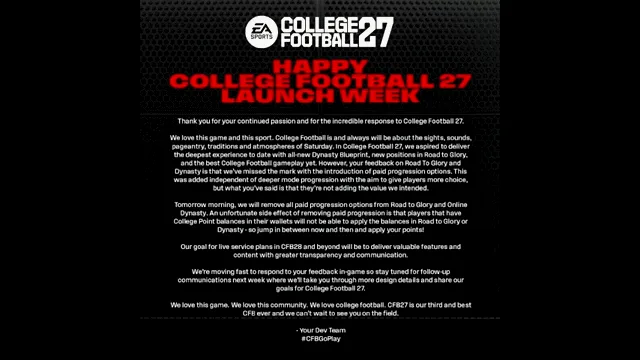
Following organized criticism, refund discussions, negative social media reactions and the spread of the #CFBPlayDontPay campaign, EA acknowledged that it had missed the mark. The company said the paid progression system had been intended to provide more choice independently of normal progression, but it accepted that the implementation did not meet player expectations. EA then confirmed that paid progression options would be removed from Road to Glory and Online Dynasty.
That reversal does not mean every microtransaction has been removed from College Football 27. The change specifically applies to paid progression in Road to Glory and Online Dynasty. College Football Ultimate Team remains a separate mode built around collectible player items, packs, currencies and roster construction, so monetization tied to that environment was not included in the reversal. This distinction matters because some early reactions described EA’s decision as the complete removal of microtransactions from the game, when the more accurate explanation is that EA removed the paid advancement systems at the center of the backlash.
In Road to Glory, players had encountered prompts allowing them to spend money when they lacked enough skill points for an upgrade. In Online Dynasty, the controversy focused mainly on purchasing coach-related progression. Players objected because these mechanics were tied to the development systems that define both modes. EA’s removal of the purchase options addresses the most visible complaint, but the long-term success of the change depends on progression balance. If advancement remains unusually slow after paid options disappear, Road to Glory and Dynasty could still feel restrictive. A complete response requires more than removing a store prompt. It requires making sure players can reach meaningful development milestones through reasonable gameplay.

Why the Paid Progression Backlash Grew so Quickly
The backlash began when players and content creators discovered that Road to Glory and Dynasty included paid progression mechanics that had not been prominently emphasized during the game’s pre-release promotion. Many reviewers and community members had expected microtransactions to remain concentrated in College Football Ultimate Team. Instead, players found real-money upgrade options connected to created athletes and coaches, which led to accusations that the systems had been introduced quietly and without enough transparency.
Road to Glory became one of the biggest sources of frustration because progression is central to the mode’s fantasy. Players create an athlete, begin with limited attributes, earn opportunities, improve ratings and try to build a successful college career. The ability to purchase skill advancement made some users feel that the mode was no longer focused mainly on performance, training and choices. Even in a single-player context, paying to reach higher ratings faster was viewed by critics as skipping the core challenge of the experience.
Dynasty created similar concerns, especially because it can function as a connected multiplayer environment. The mode asks players to recruit athletes, develop a program, manage coaches, navigate the transfer portal and compete across many seasons. Reports that coach progression was slower and that faster experience settings had been reduced or removed led players to suspect that the paid option had influenced the underlying design. In Online Dynasty, the concern became more direct: if one participant could pay to accelerate coach development while another relied only on normal progression, the paying user could potentially gain earlier access to stronger coaching abilities that affect recruiting, development and program performance.
This is why the phrase “pay-to-win” became part of the debate. The term usually describes a game in which spending real money provides a competitive advantage, and College Football 27 complicated that definition because the disputed purchases appeared in both personal career experiences and connected league settings. In Road to Glory, critics argued that spending reduced the time required to overcome the mode’s central progression challenge. In Online Dynasty, they worried that money could affect competitive balance between users in the same league.
Supporters of optional purchases sometimes argue that players with limited free time should be able to accelerate progress. However, that argument becomes controversial when the developer controls both the speed of normal progression and the price of bypassing it. The backlash was therefore not simply about the existence of optional purchases. It was driven by the combination of paid advancement, slower-feeling progression, limited pre-release disclosure and the placement of monetization inside modes historically valued for long-term, earned development.
The #CFBPlayDontPay campaign helped turn that frustration into organized pressure. The campaign encouraged players not to spend money on College Football 27 while paid progression remained in Road to Glory and Dynasty. It gained visibility through social media posts, community discussions and videos from College Football content creators. YouTuber Bordeaux was closely associated with promoting the hashtag and drawing attention to the cost and progression implications of the new systems.
The phrase carried two related ideas. “Play” reflected the community’s enthusiasm for college football gaming, while “don’t pay” urged fans to reject additional spending that could normalize monetization in career modes. Some participants called for a complete boycott of the game, while others encouraged players to avoid microtransactions while continuing to play. That flexibility helped the campaign attract people with different views about the game itself. EA forum discussions reflected the same frustration, with players describing paid progression in offline and connected career modes as unacceptable and calling for greater control over experience settings.
EA responded by acknowledging that player feedback showed the company had missed the mark. The publisher explained that the options had been introduced independently of deeper mode progression and were intended to give players more choice, then confirmed that paid progression would be removed from Road to Glory and Online Dynasty. The response was notable for its speed, since major publishers do not always reverse monetization decisions immediately after launch. Still, the statement left several questions unresolved. It did not establish a permanent franchise-wide policy against paid progression in career modes, did not guarantee that similar ideas would never return in another form and did not fully explain whether progression rates themselves would be adjusted.
How Dynasty and Road to Glory Change Without Paid Upgrades
College Football 27 introduced major changes to Dynasty beyond the controversy over paid coach progression. The mode places greater emphasis on modern program management, including recruiting strategy, Name, Image and Likeness considerations and long-term team identity. One of the most discussed additions is the expanded Blueprint system, which gives coaches more structured ways to shape their programs. Rather than treating every rebuild as the same cycle of recruiting wins and attribute upgrades, the system encourages players to pursue particular philosophies and developmental priorities.
Roster construction is also more strategic. Recruiting is shaped by school prestige, program needs, regional advantages, playing opportunities and the expectations of individual athletes. Transfer decisions add another layer because players can leave when their priorities are not being met. NIL mechanics reflect the changing structure of real college football, though the game does not reproduce every financial and legal detail of real-world NIL arrangements. Instead, it uses the concept to create competition between programs and influence recruiting choices.
This depth made the monetization controversy especially damaging. Dynasty players often invest dozens or hundreds of hours in a single save. Progression is not a small supporting feature in that context. It is part of the reward for making strong decisions over many seasons. Coach development matters because abilities can influence recruiting, tactical growth and roster improvement. If coach advancement is too slow, players may spend many seasons without accessing meaningful parts of the skill system. After the paid options were removed, attention shifted back to whether Dynasty’s coach development, recruiting balance and long-term pacing could deliver a satisfying experience without purchases.
Road to Glory without paid upgrades should return the mode’s focus to performance, choices and gradual player development. The mode allows users to create an athlete, choose a position, navigate high school and college opportunities, compete for playing time and attempt to become a star. College Football 27 expanded the available position selection with tight end, edge rusher and free safety, giving players more ways to experience the game beyond the traditional quarterback, running back and wide receiver paths.
Each position creates different responsibilities. A tight end must contribute as both a blocker and receiver. An edge rusher depends on timing, leverage and pass-rush technique. A free safety must read formations, cover space and prevent explosive plays. Removing paid skill upgrades preserves the meaning of these experiences because a player’s ratings should reflect training, performance and strategic decisions rather than spending. When progression is earned, improvements feel connected to the story of the created athlete.
The remaining issue is balance. Road to Glory careers cover a limited number of college seasons, so advancement must be fast enough to create meaningful development before the player’s eligibility ends. At the same time, progression cannot be so rapid that early ratings and training decisions stop mattering. EA must ensure that skill points can be earned consistently through games, practices, objectives and off-field management. Removing monetization creates an opportunity to redesign the mode around a fairer and more transparent development curve.

How the Update Affects Gameplay, Progression and Community Trust
The removal of paid progression does not fundamentally change passing, running, blocking, tackling or defensive coverage. Its main impact is on how players and coaches advance outside individual games. College Football 27’s on-field improvements remain important, including a more rewarding running game that emphasizes patience and vision, passing additions such as back-shoulder throws and improved defensive-back reactions. Presentation improvements also remain part of the experience, including additional school traditions, more expressive stadium environments and dynamic weather effects.
What the update changes is the relationship between gameplay and progression. Without purchasable advancement, performance becomes more important because games, practices and objectives are the main pathways to improvement. In Road to Glory, that means successful drives, positional assignments and training decisions should determine how quickly an athlete grows. In Dynasty, recruiting, staff management and season results should shape coach development.
Players will be watching closely to see whether progression has been rebalanced after the removal. If upgrade costs and experience rates remain unchanged, the game could become excessively slow. If EA increases earned rewards, the update may improve the long-term experience in a meaningful way. The biggest gameplay consequence is psychological as well as mechanical: players can approach career modes without wondering whether obstacles were designed to sell a solution.
Community reaction to EA’s reversal was largely positive at first. Many players treated the change as proof that coordinated criticism had worked. Supporters of the #CFBPlayDontPay campaign celebrated the removal as a victory for consumers and for the traditional identity of Road to Glory and Dynasty. For those players, the decision showed that enough organized pressure could force a major publisher to respond quickly.
At the same time, the response was not universally trusting. Some players argued that EA deserved limited credit because the company had created the controversial system in the first place. From that perspective, removing paid progression restored an expected standard rather than delivering a generous improvement. Others remained focused on progression pacing, since the disappearance of purchase prompts does not automatically prove that coach and athlete development will feel fair over a full career or multi-season save.
There were also practical questions about players who had already purchased progression. Users wanted clear information about refunds, retained upgrades and competitive fairness in existing Online Dynasty leagues. As a result, the community reaction combined relief, skepticism and continued scrutiny. EA prevented the controversy from escalating further, but the episode may influence how players evaluate future updates and annual releases.
What the Reversal Means for Future College Football and Sports Games
EA has not announced a permanent prohibition against paid progression in all future College Football games. Its response focused on the specific implementation in College Football 27 and said the system had missed the mark. That wording leaves open the possibility that monetized progression could return in another form, whether through cosmetic purchases, time-saving systems or optional development packages with different pricing and disclosure.
Ultimate Team microtransactions are also likely to remain part of the series because they are central to EA’s broader sports-game business model. The current reversal did not remove College Football Ultimate Team or reject monetization as a whole. Future decisions will depend partly on player behavior. If consumers continue to oppose paid progression in Dynasty and Road to Glory, EA will have a strong incentive to keep those modes separate from direct advancement purchases.
Transparency will be especially important. Any future monetization affecting core modes should be disclosed before release rather than discovered by players during early access. Clear communication would not eliminate criticism, but it would allow customers to make informed purchasing decisions. The College Football 27 dispute showed that players are not only evaluating whether a purchase is optional. They are also judging how much time is required without spending, whether rewards feel intentionally reduced and whether paying creates an advantage.
The controversy also affected how College Football 27 compares with previous EA Sports titles. College Football 25 and College Football 26 included monetized Ultimate Team systems, but their career-oriented modes were generally treated as separate experiences. Players could ignore Ultimate Team and still access the main Dynasty and Road to Glory journeys without encountering the same type of real-money upgrade prompts. College Football 27 initially changed that boundary by extending direct paid progression into Road to Glory and Online Dynasty.
That shift invited comparisons with Madden and NBA 2K. Madden has experimented with monetized advancement in career-related systems, while NBA 2K has long connected virtual currency to created-player development. Critics feared College Football was moving toward a similar structure. At the same time, College Football 27 expanded and refined many features, including additional Road to Glory positions, more modern Dynasty program-building systems and stronger presentation that better reflects the atmosphere of college football. This combination made the controversy especially frustrating because many players believed the underlying game was strong, but monetization reduced their willingness to recommend it.
The reversal sends a broader message to the sports-game industry. Players may tolerate monetization in clearly defined optional modes, but they are more resistant when purchases influence traditional career progression. Annual sports games are especially vulnerable to this debate because customers already pay repeatedly for updated rosters, presentation changes and feature improvements. Adding new progression purchases can make each release feel less like a complete product.
Publishers may take several lessons from EA’s experience. Monetization should be disclosed clearly, progression should remain satisfying without payment and connected competitive modes should avoid financial advantages. The episode may also encourage more organized consumer campaigns, since players saw that concentrated criticism produced a rapid response. Similar movements may become more likely when future sports games introduce controversial systems that affect core progression.

Frequently Asked Questions (FAQs)
- Did EA remove every microtransaction from College Football 27?
No. EA removed paid progression options from Road to Glory and Online Dynasty, which were the systems at the center of the backlash. College Football Ultimate Team still has its own monetized structure involving items, packs, currencies and roster building, so the reversal does not eliminate every optional purchase from the game. - Why were players angry about the College Football 27 microtransactions?
Players were angry because real-money progression appeared in career-oriented modes that many fans expected to be based on earned development. The frustration grew because natural progression seemed slower to some users, which created the perception that the game was encouraging spending. Many players also felt the feature had not been clearly highlighted before release. - What could players purchase in Road to Glory?
Players could encounter options tied to upgrading their created athlete when they did not have enough skill points. Instead of earning every upgrade through games, practices and other progression systems, users could spend money to accelerate development. That upset players because Road to Glory is built around the idea of growing an athlete through performance and choices. - What could players purchase in Online Dynasty?
The disputed Online Dynasty system involved paid coach progression. This raised concerns because faster coach development could affect access to coaching upgrades, which may influence recruiting, player development and long-term program strength. In connected leagues, players worried that spending could create an uneven experience between users. - Were the College Football 27 microtransactions pay-to-win?
Many players described them that way because spending could speed up development. The concern was strongest in Online Dynasty, where multiple users may compete in the same connected league and coach progression can affect program success. Even in Road to Glory, critics argued that paying to advance weakened the core challenge of earning growth through gameplay. - What does #CFBPlayDontPay mean?
CFBPlayDontPay was a community campaign that encouraged fans to reject paid progression in College Football 27. For some players, that meant avoiding extra spending while continuing to play the game. For others, it meant supporting broader boycotts or refund discussions until EA removed the disputed systems from Road to Glory and Dynasty. - Did EA apologize for the microtransactions?
EA acknowledged that it had missed the mark with paid progression in Road to Glory and Dynasty. The company said the options were intended to give players more choice, but it accepted that the implementation did not meet player expectations. EA then confirmed that the paid progression systems would be removed from those modes. - Will normal progression become faster after the removal?
EA’s announcement focused on removing the paid options, but the long-term quality of the change depends on how earned progression is balanced. Players are still watching to see whether coach and athlete development rates feel fair without purchases. If progression remains too slow, the main frustration could continue even after the store prompts are gone. - Are microtransactions still available in College Football Ultimate Team?
Yes. College Football Ultimate Team still includes monetized systems because the reversal only applied to Road to Glory and Online Dynasty. Ultimate Team remains a separate mode built around collectible items, packs, currencies and roster construction, so players may still encounter optional purchases there. - Could paid progression return in College Football 28?
It is possible because EA has not announced a permanent franchise-wide ban on paid progression. However, the backlash to College Football 27 gives the publisher a strong reason to avoid reintroducing similar mechanics without major changes and clearer communication. Player response will likely influence how EA handles monetization in future releases.

Conclusion
EA Sports College Football 27 Removes Microtransactions After Player Backlash because the publisher underestimated how strongly fans valued the separation between career progression and real-money spending. The addition of paid advancement to Road to Glory and Online Dynasty transformed an otherwise promising launch into a debate about fairness, transparency and the future of monetization in sports games.
EA’s reversal was rapid and significant. Removing the purchases protects the core identity of two of the franchise’s most important modes and shows that organized player feedback can influence a major publisher. The #CFBPlayDontPay campaign gave the criticism a clear message, while reviews, forum discussions and social media posts demonstrated that the objections extended across the community.
The decision does not resolve every concern. Players still need fair progression rates, clear treatment of earlier purchases and confidence that similar systems will not quietly return. Ultimate Team monetization also remains part of College Football 27, meaning the game has not abandoned microtransactions completely.
The long-term impact will depend on EA’s next actions. If the publisher rebalances progression, communicates openly and preserves earned advancement in Dynasty and Road to Glory, the controversy could become a valuable correction. If similar mechanics return in a future installment, the trust restored by this reversal may disappear quickly.
For the wider sports-game industry, the lesson is clear. Players are increasingly willing to challenge monetization that affects the structure of full-priced career modes. Optional purchases are not judged only by whether they are mandatory. They are judged by the systems surrounding them, the advantages they provide and the problems they appear designed to solve.
Sources and Citations
- Electronic Arts, “EA SPORTS College Football 27 FAQ.”
https://www.ea.com/games/ea-sports-college-football/college-football-27/faq - Electronic Arts, “College Football 27 Road to Glory Deep Dive.”
https://www.ea.com/games/ea-sports/college-football/college-football-27/news/road-to-glory-deep-dive - PC Gamer, “College Football 27 to Remove Microtransactions After Player Backlash.”
https://www.pcgamer.com/games/sports/college-football-27-to-remove-microtransactions-after-player-backlash-though-ea-maintains-they-were-only-added-to-give-players-more-choice/ - Vice, “EA Removes College Football 27 Microtransactions After Player Boycott.”
https://www.vice.com/en/article/college-football-27-microtransactions-removed/ - GameSpot, “College Football 27 Is Pissing Everyone Off.”
https://www.gamespot.com/articles/college-football-27-is-pissing-everyone-off/ - Tom’s Guide, “I Love Playing EA Sports College Football 27, but There’s a Major Reason You Shouldn’t Buy It.”
https://www.tomsguide.com/gaming/i-love-playing-ea-sports-college-football-27-but-theres-a-major-reason-you-shouldnt-buy-it - SB Nation, “College Football 27 Review, The Greatest Meal That Leaves a Bad Taste in Your Mouth.”
https://www.sbnation.com/college-football/24481345/college-football-27-review-microtransactions - EA Forums, “College Football 27 Community Discussions.”
https://answers.ea.com/t5/College-Football-27/bd-p/college-football-27-en
Recommended
- Kitman: New Job Simulator Where You Play as a Soccer Team’s Equipment Manager Announced for PC
- Darksiders: Warmastered Edition PS5 and Xbox Series X|S Release Date Explained
- PlayStation FlexStrike Fight Stick Release Date Confirmed for August 2026
- The 1994 Live-Action Flintstones Flick is Getting a “Stonebook” 4K Blu-Ray: Release Date, Preorders, and Bonus Features
- LEGO Batman: Legacy of the Dark Knight, Complete Batsuit and Outfit Guide (All Suits, Unlock Methods, and Best Costumes Explained)
- Crimson Moon Official Announcement Trailer (State of Play 2026): Community Reaction and Everything We Know
- Roblox Debuts 4D Creation Tool Letting Players AI‑generate Interactive In‑game Objects; “full Scene Generation” Roadmap and Community Reaction
- Redefining Representation: Authentic Black Hairstyles in Video Games
- SAND: Raiders of Sophie, Best Tech Tree Nodes to Unlock First for Fast Progression, Early Game Builds, and Efficient Crown Spending
- Freelance and Indie Commercial License



































































































