









In This Article (9 sections)
Electronic Arts $55 Billion Acquisition and New Ownership Explained
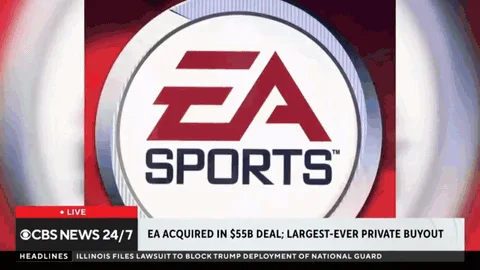
Electronic Arts officially completed its approximately $55 billion acquisition on August 4, 2026, ending a process that began when the agreement was announced in September 2025. An SEC filing dated July 30 confirmed that all regulatory approvals required for completion had been obtained and that EA expected the transaction to close around the end of trading on August 4. With the deal now completed, ownership has legally changed, EA’s publicly traded shares have ceased trading, and eligible shareholders will receive $210 in cash for each share they held when the transaction closed.
The $55 billion headline figure refers to the approximate enterprise value of the transaction. Reuters calculated the equity value at about $52.54 billion when the deal was first announced, illustrating the difference between the value attributed directly to shareholders and the broader enterprise value used to describe the acquisition. The transaction is especially significant because EA spent decades as one of the gaming industry’s most recognizable publicly listed publishers before moving into private ownership.
EA was acquired by an investor consortium consisting of Saudi Arabia’s Public Investment Fund, or PIF, technology investment firm Silver Lake and Affinity Partners, the investment company founded and led by Jared Kushner. PIF is the dominant participant. It already owned approximately 9.9% of EA before the transaction and rolled that stake into the new ownership structure rather than selling it. Reports based on transaction filings have placed PIF’s post closing ownership at approximately 93.4%, Silver Lake’s at around 5.5%, with the remaining interest belonging principally to Affinity Partners.
The ownership structure is therefore substantially different from EA’s previous existence as a Nasdaq listed company whose shares were distributed among institutional and individual investors. Control is now concentrated among a small group of private owners, with PIF holding the overwhelming majority position.
The investment thesis centers on EA’s intellectual property, recurring digital revenue, sports franchises, live services, technology and global player communities. The consortium has highlighted opportunities involving fan engagement, physical and digital entertainment and new growth areas, while EA has described its new owners as providing capital, industry knowledge and global networks capable of supporting its strategy.
PIF has an additional reason for making such a large investment. Gaming, esports, sports and entertainment are strategic sectors within its broader economic diversification strategy. The fund had already owned EA shares for more than five years, giving it familiarity with the company before the takeover. Silver Lake’s involvement reflects its longstanding focus on technology and digital businesses, while Affinity Partners gains exposure to one of gaming’s largest collections of established intellectual property.

Electronic Arts Goes Private With $210 Per Share Buyout and $20 Billion Debt Financing
The most immediate corporate consequence of the sale is that Electronic Arts is now privately held. Its common stock has stopped trading and will be delisted from Nasdaq. EA shareholders receive $210 in cash for every eligible share held when the transaction closed, ending their equity ownership rather than converting their holdings into shares of one of the acquiring companies.
The $210 offer represented a significant premium when the agreement was announced. EA said the price was 25% above its unaffected closing share price of $168.32 on September 25, 2025 and also exceeded the company’s then unaffected record closing price of $179.01 from August 14, 2025. That premium helped provide existing shareholders with an incentive to approve the takeover rather than remain invested in EA’s future growth.
Because the deal is entirely cash based, former shareholders do not retain an ownership interest in EA through PIF, Silver Lake, Affinity Partners or another successor security. Their shares instead convert into the contractual right to receive the agreed cash consideration. For the consortium, paying that premium creates a considerably higher performance threshold because EA must eventually generate enough value to justify the enormous acquisition price.
The financing structure adds another important dimension. The transaction was arranged with approximately $36 billion in equity and $20 billion in debt financing committed by JPMorgan Chase Bank, with around $18 billion initially expected to be funded at closing. Debt makes it possible for investors to acquire a company without contributing the entire purchase price themselves, but it also creates continuing interest and principal obligations that must be supported by EA’s future cash generation.
Reuters noted when the transaction was announced that the $20 billion commitment amounted to almost seven times an expected $2.9 billion of annual EBITDA. This does not mean studio closures, game cancellations or severe cost reductions are automatically required, but it does make dependable cash generation particularly important. Money used for debt servicing competes with other possible uses such as acquisitions, studio investment, employee compensation, marketing, research and game development.
The acquisition has consequently been widely described as the largest leveraged buyout ever completed. Its approximately $55 billion enterprise value surpassed the landmark TXU Energy transaction historically associated with the previous record. EA initially described the deal as the largest all cash sponsor take private investment in history, while reporting also characterized the JPMorgan debt commitment as the largest single bank financing commitment attached to a leveraged buyout.
The distinction from Microsoft’s acquisition of Activision Blizzard is important. Microsoft’s transaction was larger in headline value, but it was a strategic corporate acquisition rather than the same type of sponsor backed leveraged take private structure. EA’s sale is therefore significant not only within gaming but also within the broader history of private investment transactions.
What Electronic Arts Going Private Means for EA Games, Battlefield, The Sims and Apex Legends
For players, ownership has changed much faster than the games themselves. Electronic Arts has not announced that existing titles or franchises will suddenly be cancelled, redesigned or fundamentally altered because the acquisition closed. Andrew Wilson remains Chairman and CEO, EA continues operating its studios, and the consortium’s public messaging has emphasized investment, innovation and long term growth rather than an immediate overhaul of the company’s catalogue.
Going private does change the financial environment surrounding those games. EA no longer has a publicly traded share price responding daily to earnings announcements, delays, guidance changes or investor sentiment. Management may therefore have more flexibility to make investments requiring several years before producing revenue. Large games already take lengthy development cycles, while new technology and infrastructure can demand substantial spending well before players see the results.
However, private ownership does not eliminate financial pressure. Instead of answering to a broad public shareholder base, EA now answers to investors that have committed tens of billions of dollars and expect strong returns. The scale of the acquisition debt could make margins, cash flow and capital efficiency especially important. EA may therefore gain greater freedom to pursue long term initiatives while simultaneously facing stronger pressure to concentrate resources on projects with convincing economic potential.
Battlefield, The Sims and Apex Legends remain particularly valuable in that environment because each supports a different form of recurring engagement. Battlefield combines premium game sales with multiplayer and continuing digital content. The Sims has an unusually durable audience, extensive downloadable content opportunities and long product cycles. Apex Legends operates as an established free to play live service supported through seasonal content and digital spending.
Nothing in the acquisition announcement confirms fundamental changes to those franchises. Claims that private ownership automatically means major redesigns, shutdowns or new monetisation systems would therefore be speculative. A more reasonable conclusion is that owners seeking returns on a $55 billion investment will pay close attention to franchises capable of maintaining large audiences and predictable cash generation.
The same caution applies to development strategy more broadly. Public companies and private companies can both cancel games, close studios, expand teams or take creative risks. The ownership model alone does not determine those decisions. What has changed is the combination of incentives and financing behind them.
Artificial intelligence is one area the new owners have explicitly mentioned. Silver Lake referred to opportunities for AI to enhance development and player experiences, while Wilson has spoken about investing in innovation and the next generation of games. AI could potentially influence testing, animation, production workflows, asset creation, personalization and other parts of development, but EA has not announced a universal implementation plan covering every studio or franchise.
Specific predictions about layoffs, cancelled games or aggressive monetisation changes should therefore remain separate from confirmed information. The acquisition creates conditions that may influence future decisions, but those individual outcomes still depend on EA management and the owners’ evolving strategy.

Why EA Sports FC, Madden NFL and Other Sports Franchises Matter Under PIF Ownership
EA’s sports portfolio could become even more strategically important under its new owners because sports games combine large recurring audiences with predictable annual engagement and significant digital spending. EA Sports FC provides enormous international reach, while Madden NFL remains deeply established in North America. College Football and F1 give the company additional exposure to major sporting audiences.
The connection with PIF is particularly notable because the fund explicitly identifies entertainment and sports as strategic investment areas. EA occupies a valuable intersection between those sectors by combining game technology, licensed sports properties, online communities and digital fan engagement.
That overlap creates several potential areas for future investment. EA could continue developing online infrastructure, personalization, cross platform ecosystems, esports initiatives, new forms of fan engagement and technologies that connect gaming with wider sports entertainment. However, the acquisition terms themselves do not require any particular product or monetisation strategy.
Recurring digital spending also makes the sports portfolio financially important. Ultimate Team modes and other ongoing services allow EA to continue earning revenue after the initial purchase of an annual release. For private owners carrying substantial acquisition leverage, businesses capable of producing dependable recurring cash flow can become especially valuable.
PIF’s involvement should also be understood within its broader international gaming strategy. The fund had already held EA shares for years before participating in the takeover and has made gaming and esports part of its economic diversification program. EA offers durable intellectual property, global distribution, sports relationships, digital revenue and large player communities, giving PIF exposure to several areas it has publicly identified as strategic.
The acquisition has nevertheless attracted wider debate. Critics of Saudi investment in global entertainment businesses have raised concerns involving human rights, cultural influence and the strategic use of gaming and sports investments. Those concerns form part of the broader public discussion surrounding the transaction. At the company level, however, EA has not announced that PIF will impose particular creative restrictions on its games or sports franchises as a consequence of becoming the majority owner.
The relevant confirmed change is ownership, not a newly announced editorial policy. Future EA Sports FC, Madden NFL, College Football and F1 decisions will continue to depend on EA’s management, licensing relationships, development teams, player behaviour and the financial expectations of the new ownership group.
Andrew Wilson Remains EA CEO as the $55 Billion Deal Begins a New Private Era
Andrew Wilson remains Chairman and CEO of Electronic Arts following the completion of the acquisition. His continued leadership was established in the original merger announcement and reaffirmed when the transaction closed, making executive continuity one of the clearest immediate features of EA’s transition into private ownership.
Keeping Wilson gives the consortium substantial institutional continuity at a time when the company’s ownership and financing structure have changed dramatically. He has led EA through the expansion of live services, the transition from FIFA branding to EA Sports FC, the development of Apex Legends and numerous changes across EA’s studio network and portfolio.
His continued position also indicates that PIF, Silver Lake and Affinity Partners did not acquire EA primarily to replace the existing operating leadership immediately. Their public statements instead position the consortium as providing capital, strategic support, expertise and global relationships while existing management continues running the company.
Wilson described the closing as the beginning of a new chapter and said EA was entering it from a position of strength. The consortium has similarly emphasized opportunities to invest in creativity, technology and growth rather than announcing an immediate break from the company’s established strategy.
The longer term outcome will depend on how EA balances those ambitions with the financial structure of the takeover. The company owns some of gaming’s most dependable franchises, substantial live service operations and globally recognizable intellectual property, but its private owners also need to produce acceptable returns on one of the largest acquisition investments ever completed.
That creates a future in which growth and financial discipline are likely to coexist. EA can potentially make longer term investments without the same quarterly public market pressures, while its new owners will simultaneously expect strong cash generation and disciplined capital allocation.
For now, the clearest conclusions are considerably narrower than many predictions surrounding the sale. Electronic Arts is officially private, PIF is its dominant owner alongside Silver Lake and Affinity Partners, former shareholders receive $210 per share, substantial debt helped finance the acquisition, and Andrew Wilson remains in charge. How that new structure ultimately changes EA’s games will become clearer through future decisions rather than through ownership change alone.

Frequently Asked Questions (FAQs)
- What will happen to Electronic Arts now that it is private?
EA will continue operating under Andrew Wilson while working with PIF, Silver Lake and Affinity Partners as its new owners. The consortium has emphasized long term investment, growth, innovation and opportunities involving technologies such as AI. Private ownership could change how EA approaches investment and financial planning, but specific effects on individual studios, budgets, franchises or development projects will depend on future decisions rather than the ownership change alone. - Has the sale of Electronic Arts officially concluded?
Yes. Electronic Arts announced on August 4, 2026 that its acquisition by PIF, Silver Lake and Affinity Partners had successfully closed after receiving the necessary shareholder and regulatory approvals. The completion means the transaction is no longer a proposed takeover: EA’s ownership has formally changed, its shares have ceased trading and the company is being delisted from Nasdaq. - How much was the Electronic Arts acquisition worth?
The transaction was announced at an enterprise value of approximately $55 billion, making it one of the largest acquisitions in gaming history. It has also been described as the largest sponsor backed leveraged take private transaction on record, reflecting both the enormous overall valuation and the substantial amount of debt used to finance the purchase. - Who owns Electronic Arts now?
EA is owned by a consortium consisting of Saudi Arabia’s Public Investment Fund, Silver Lake and Affinity Partners. PIF is by far the largest owner, with transaction filings reportedly placing its post closing stake at approximately 93.4%. Silver Lake and Affinity Partners hold much smaller interests, meaning PIF now has the dominant financial position within EA’s private ownership structure. - How much did EA shareholders receive?
Shareholders are entitled to receive $210 in cash for every eligible EA share they held when the transaction was completed. The acquisition was structured as an all cash deal, so former shareholders do not receive replacement shares in EA’s new owners. Their previous EA shares instead convert into the right to receive the agreed cash consideration. - Is Electronic Arts still publicly traded?
No. EA’s common stock ceased trading following completion of the acquisition and is being delisted from Nasdaq. Electronic Arts is now privately owned, meaning investors can no longer buy and sell EA shares through the public stock market. The company will also no longer operate under the same public market reporting structure that applied while it was listed. - Is Andrew Wilson still the CEO of Electronic Arts?
Yes. Andrew Wilson continues to serve as Chairman and CEO following completion of the acquisition. Keeping Wilson in charge provides leadership continuity as EA moves from public to private ownership, and the consortium has positioned itself as supporting the existing management team with additional capital, expertise and strategic resources rather than immediately replacing it. - How was the $55 billion EA acquisition financed?
The transaction was arranged with approximately $36 billion of equity investment from the consortium, including PIF’s existing EA stake that was rolled into the new ownership structure. JPMorgan Chase Bank also committed $20 billion in debt financing, with around $18 billion originally expected to be funded at closing. The substantial debt component is a major reason the transaction is classified as a leveraged buyout. - Will Battlefield, The Sims or Apex Legends be cancelled because EA was sold?
There has been no announcement that Battlefield, The Sims or Apex Legends will be cancelled because of the acquisition. EA continues to identify all three as important franchises within its portfolio, and they have large established audiences and significant commercial value. Future projects can always change during development, but claims that the takeover itself means these franchises are being cancelled are currently unsupported. - Why is the Electronic Arts deal considered historic?
Its approximately $55 billion enterprise value makes it the largest leveraged buyout on record and what EA described as the largest all cash sponsor take private transaction when the agreement was announced. The $20 billion debt financing commitment was also exceptionally large for a leveraged acquisition, making the transaction significant beyond gaming and within the wider history of private investment deals.

Conclusion
Electronic Arts has completed a corporate transformation that would have been difficult to imagine only a few years earlier. The Electronic Arts sale officially concludes a process that began publicly in September 2025, gained shareholder approval in December and cleared its remaining regulatory requirements before closing on August 4, 2026.
The approximately $55 billion transaction takes one of the world’s biggest game publishers private under a consortium consisting of PIF, Silver Lake and Affinity Partners. Former shareholders receive $210 per share, EA has stopped trading on Nasdaq, and Andrew Wilson remains Chairman and CEO.
Financially, the acquisition is extraordinary. Roughly $36 billion in equity and a $20 billion debt commitment enabled a sponsor-backed transaction that surpassed previous leveraged buyout records. The scale of that financing gives EA access to investors promising significant long-term capital while simultaneously creating powerful incentives for the company to generate reliable cash flow.
For players, however, there is an important distinction between confirmed facts and speculation. EA Sports FC, Madden NFL, Battlefield, The Sims, Apex Legends and the company’s other franchises did not automatically change on the day ownership transferred. The consequences will appear gradually through decisions about development budgets, new projects, live services, artificial intelligence, studio structure and long-term capital allocation.
The new owners have publicly promised investment and innovation. Whether the $55 billion acquisition ultimately produces a more ambitious EA, a more financially disciplined EA or a combination of both will depend on decisions made over the coming years. What is already certain is that the deal has permanently altered the corporate landscape of the video game industry and placed Electronic Arts at the center of the largest leveraged buyout ever completed.
Sources and Citations
- Source: Electronic Arts, “EA Announces Completion of Acquisition by PIF, Silver Lake, and Affinity Partners,” August 4, 2026: EA’s official announcement confirms the deal closed on August 4, identifies PIF, Silver Lake and Affinity Partners as the acquiring consortium, and includes statements from CEO Andrew Wilson and the partners. It also confirms the $210-per-share cash consideration and that EA shares ceased trading on Nasdaq.
- Citation: EA+1
- Source: Electronic Arts, “EA Announces Agreement to be Acquired by PIF, Silver Lake, and Affinity Partners for $55 Billion,” September 29, 2025: EA’s original announcement confirms the approximately $55 billion enterprise value, $210-per-share cash offer, 25% premium and PIF’s existing 9.9% stake. It also outlines the financing, including approximately $36 billion in equity and $20 billion in committed debt financing.
- Citation: EA News+1
- Source: U.S. Securities and Exchange Commission, Electronic Arts Form 8-K, August 4, 2026: The SEC filing is the regulatory record for the closing. It is relevant for documenting the transaction’s completion and associated corporate disclosures.
- Citation: SEC+1
- Source: U.S. Securities and Exchange Commission, Electronic Arts filing dated July 30, 2026: EA’s filing states that all required regulatory approvals had been obtained by July 30 and that the company expected the merger to close around the close of trading on August 4. It also describes the $20 billion debt commitment and the $210-per-share consideration.
- Citation: SEC+1
- Source: U.S. Securities and Exchange Commission, Electronic Arts Definitive Merger Proxy Statement: The definitive proxy statement is the primary shareholder document for the proposed merger. It explains the agreement among Electronic Arts, Oak-Eagle AcquireCo and Oak-Eagle MergerCo, including the $210-per-share cash consideration for eligible shareholders.
- Citation: SEC
- Source: Public Investment Fund, “Electronic Arts Announces Completion of Acquisition by PIF, Silver Lake, and Affinity Partners,” August 4, 2026: PIF’s announcement independently confirms the closing and provides the fund’s explanation of its investment in EA and the gaming and entertainment sectors.
- Citation: pif.gov.sa
- Source: Silver Lake, “EA Announces Completion of Acquisition by PIF, Silver Lake, and Affinity Partners,” August 4, 2026: Silver Lake’s announcement confirms the transaction’s completion and describes its stated intention to support EA’s long-term growth, creativity and innovation.
- Citation: Silver Lake
- Source: Reuters, “‘Battlefield’ Maker Electronic Arts to Go Private in Record $55 Billion Leveraged Buyout,” September 29, 2025: Reuters reports the approximately $52.54 billion equity value, $210-per-share offer, $36 billion equity financing and $20 billion debt financing. It distinguishes the equity valuation from the approximately $55 billion enterprise value.
- Citation: Reuters
- Source: Reuters, “’Battlefield’ Maker Electronic Arts to Go Private in Record-Setting $55 Billion LBO,” September 29, 2025: This syndicated Reuters report provides further detail on the deal’s financing structure, including the $36 billion equity contribution and $20 billion in debt financing. It is useful as a backup if the Reuters original is inaccessible.
- Citation: Investing.com
- Source: Associated Press, “Video Game Giant Electronic Arts Closes $55 Billion Go-Private Sale of Its Business,” August 4, 2026: AP confirms the acquisition’s completion, the $210-per-share payment and EA’s move into private ownership. Its report also discusses the scale of the buyout, the $20 billion debt financing and concerns raised about the new ownership.
- Citation: AP News
Recommendations
- How to Get All the Eeveelutions in Pokopia’s Palette Town
- Meccha Chameleon Multiplayer Guide: How to Play, Win Matches, and Master Hider & Seeker Strategies
- A Collaboration Between NARUTO Shippuden and EFootball Has Been Announced: Everything We Know so Far and Fan Reaction
- Harvest Moon: Echoes of Teradea Launches October 15, 2026 on PS5, Xbox, Switch 2, Switch, and PC
- God of War Trilogy Remake Announced: Original Kratos Voice Actor TC Carson Returns – Fan & Community Reaction
- Halo: Campaign Evolved Release and Download Times Revealed by Xbox
- Hunt: Showdown 1896 Legacy Chronicle Trailer Breakdown: 15 Biggest Reveals and Everything We Know
- Pokémon Legends Z-A Mega Dimension Romance Avec Purrloin Side Mission Walkthrough
- Trine 6 Delayed to March 4, 2027 After Private Playtest Feedback
- Persona 4 Revival: One Year Later Rumors, Xbox Games Showcase Speculation, and What Fans Expect from the Remake



































































































