









In This Article (9 sections)
What is Freefall ’95? Roguelite Freefall Game Explained
Freefall ’95 is a high-intensity roguelite skydiving action game concept centered around survival during an uncontrolled descent from 30,000 feet after a catastrophic airborne disaster. The game blends arcade-style reflex challenges with procedural roguelite systems, forcing players into repeated freefall scenarios where no two drops are ever identical.
At its core, the experience is about controlled chaos. Players are dropped into a rapidly deteriorating aerial environment filled with debris, turbulence zones, burning fuselage fragments, and dynamic weather shifts. The objective is not simply to survive the fall, but to maximize style, score, and progression efficiency before impact.
Unlike traditional survival games that emphasize grounded exploration, Freefall ’95 is defined entirely by vertical movement. The player is always descending, always reacting, and always adapting to unpredictable airborne hazards. Each run represents a compressed narrative of panic, improvisation, and skill expression.
The roguelite structure ensures that failure is permanent for each run but progression carries forward through upgrades, unlocks, and evolving abilities that change how future freefalls unfold.
Freefall ’95 Gameplay Overview: Surviving a 30,000-Foot Plane Disaster
The gameplay loop of Freefall ’95 begins moments after a catastrophic mid-air incident. Players are ejected or forced out of a disintegrating aircraft at cruising altitude. From that moment forward, survival depends on split-second decision-making.
The descent is divided into atmospheric layers, each presenting different challenges:
- Upper stratospheric turbulence zones with low visibility
- Mid-air debris fields from the collapsing aircraft
- Storm layers with electrical discharges and wind shear
- Lower atmospheric high-density air corridors requiring precision control
Players must steer their character through freefall using limited directional control, momentum shifting, and situational tools like temporary stabilizers or aerial grapples.
The core challenge is maintaining survival while optimizing “style chains,” which reward risky maneuvers such as spins, flips, object dodges, and mid-air interactions with environmental hazards.
A single run typically lasts only a few minutes, but those minutes are densely packed with escalating tension and rapid mechanical decisions.

Freefall ’95 Gameplay: Roguelite Progression, Arcade Action, and 30,000-Foot Survival
Freefall ’95 combines roguelite progression systems with arcade reflex gameplay to create a fast, replayable survival experience built around mastery, risk-taking, and split-second decision-making. The gameplay loop begins moments after a catastrophic mid-air plane disaster. Players are ejected or forced out of a disintegrating aircraft at cruising altitude, turning the entire descent into a high-speed survival challenge.
Each run is procedurally generated, meaning:
- Aircraft failure scenarios vary
- Debris patterns shift each time
- Atmospheric hazards change position and intensity
- Enemy or rival skydivers may appear unpredictably
The descent is divided into atmospheric layers, each with different hazards and mechanics.
Key descent zones include:
- Upper stratospheric turbulence zones with low visibility
- Mid-air debris fields from the collapsing aircraft
- Storm layers with electrical discharges and wind shear
- Lower atmospheric high-density air corridors requiring precision control
Players must steer through freefall using limited directional control, momentum shifting, and situational tools such as temporary stabilizers or aerial grapples.
Roguelite progression elements include:
- Permanent unlockable abilities
- Stat-enhancing traits
- Equipment loadouts that modify descent behavior
- Skill trees tied to aerial maneuvering styles
Arcade influence appears through:
- Combo scoring systems
- Timed reaction windows
- High-speed dodge mechanics
- Score multipliers based on risk-taking
The core challenge is surviving the fall while optimizing “style chains,” which reward risky maneuvers such as spins, flips, object dodges, and mid-air interactions with environmental hazards. A single run typically lasts only a few minutes, but those minutes are packed with escalating tension, rapid decisions, and mechanical depth. Failure is not treated as a setback, but as a learning point that helps players refine future runs.
Freefall ’95 Trailer Breakdown, Release Window, and Platform Details
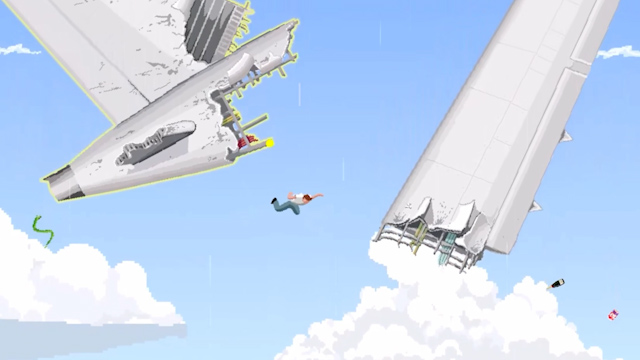
The Freefall ’95 trailer emphasizes cinematic chaos, stylized motion physics, and retro-inspired arcade energy. It opens with a wide shot of a commercial airliner breaking apart mid-flight, followed by rapid cuts of passengers entering freefall.
Key trailer highlights include:
- Fragmented aircraft wings tumbling through clouds
- Players performing acrobatic spins to avoid debris
- Flash cuts of lightning storms piercing cloud layers
- UI overlays showing altitude, speed, and combo multipliers
- Stylized slow-motion impacts into air currents for dramatic effect
The trailer suggests a blend of retro arcade intensity and modern physics simulation. Its tone is reinforced by distorted synthwave beats reminiscent of 90s action aesthetics, giving the game a distinct identity. The trailer also hints at deeper narrative layers, including possible time loops and experimental survival mechanics tied to repeated descents. As a conceptual roguelite title, Freefall ’95 is positioned as an indie-scale release with strong multi-platform potential.
Expected platform distribution includes:
- PC as the primary platform for precision controls
- PlayStation systems with controller-optimized gameplay
- Xbox consoles with an arcade accessibility focus
- Nintendo Switch for portable quick-run sessions
The release window remains speculative in early coverage, but the game’s structure suggests a digital-first launch strategy rather than a physical distribution model. Because of its replay-driven design, procedural systems, and expandable progression mechanics, Freefall ’95 could also support an early access period or episodic rollout.
Freefall ’95 Story, Gameplay Features, and Roguelite Arcade Genre Explained
The narrative of Freefall ’95 uses a fragmented roguelite lore system rather than traditional linear storytelling. Players are caught in a repeating freefall event following a catastrophic aviation anomaly, with each descent revealing new pieces of the mystery.
Narrative fragments may include:
- Audio logs from passengers mid-fall
- Flashbacks triggered by altitude thresholds
- Environmental storytelling embedded in wreckage
- Mysterious recurring symbols appearing in cloud formations
A central theory within the game’s lore is that the protagonist is trapped in a temporal loop, forced to relive the same catastrophic descent repeatedly. Each run uncovers more about the cause of the crash and the strange forces surrounding the event. The story gradually shifts from survival panic to existential mystery, questioning whether escape is possible or whether mastery of the fall is the only true objective.
Gameplay in Freefall ’95 is heavily skill-driven, focusing on expressive movement, fast reactions, and creative aerial control. Mid-air chaos is central to the design, forcing players to adapt constantly to unpredictable hazards.
Core gameplay features include:
- Trick system: spins, flips, barrel rolls, and dives
- Combo chains: chaining evasions and maneuvers for score multipliers
- Environmental interaction: bouncing off debris or riding air currents
- Precision dodging: avoiding high-speed fragments of aircraft
Players must also respond to unpredictable mid-air threats such as:
- Sudden wind shear changes
- Exploding aircraft sections
- Secondary falling objects like luggage or equipment crates
- Rival falling entities competing for score zones
The game rewards risk-taking by encouraging players to perform increasingly dangerous maneuvers to maximize rewards, scores, and progression. Freefall ’95 exists at the intersection of roguelite structure and arcade gameplay. Its hybrid design allows both casual replayability and deep mastery potential.
As a roguelite, it features:
- Procedurally generated runs
- Progression that persists across deaths
- Builds and upgrades that shape future attempts
As an arcade game, it emphasizes:
- Immediate performance-based scoring
- Reflexes and timing
- Short, repeatable runs
This combination creates a gameplay loop where players can enjoy quick sessions or commit to long-term progression optimization. Freefall ’95 blends the tension of survival, the skill expression of arcade action, and the replayability of roguelite design into one fast-paced experience.

Freefall ’95 Aesthetic, Scoring, Combat, and Progression Systems
Freefall ’95 blends a 1990s arcade-inspired identity with early 3D experimentation, creating a nostalgic but modern sensory experience. Its visual style uses low-resolution, pixel-inspired effects combined with modern lighting, while VHS distortion overlays appear during high-impact moments. Neon color grading intensifies storm sequences, and stylized motion blur reinforces the feeling of speed, chaos, and rapid descent.
The soundtrack supports this atmosphere with synthwave and breakbeat influences, high-tempo electronic rhythms, and dynamic audio that escalates as altitude decreases. Distorted emergency radio chatter is layered into music tracks, strengthening the game’s frantic tone and making each descent feel more urgent.
Gameplay motivation is built around a scoring system that rewards survival, risk-taking, and active movement. Players earn points through survival duration in freefall, difficult trick execution, near-miss dodging bonuses, and environmental interaction chains. The “Freefall Combat System” works as a metaphor for how players battle gravity, debris, and atmospheric forces while trying to optimize score efficiency.
Multipliers increase when players maintain uninterrupted trick chains, avoid damage while performing maneuvers, navigate through high-risk zones, and complete consecutive evasive actions. However, score decay occurs when movement becomes passive, collisions interrupt combo chains, or the player enters a stable descent without taking action.
Progression is driven by a layered upgrade system made up of abilities, traits, and loadouts. Abilities include air stabilization bursts, temporary slow-motion activation, mid-air directional boosts, and emergency parachute modulation systems. Traits adjust gameplay behavior by improving spin control accuracy, reducing wind resistance, increasing bonus scoring on risky maneuvers, and enhancing debris detection range.
Loadouts allow players to customize their descent style by balancing speed against control, risk against reward, and stability against agility. Each run contributes to unlocking deeper progression layers, encouraging experimentation and giving players more ways to refine how they survive, score, and descend through the chaos of Freefall ’95.

Freefall ’95 Level Design, Multiplayer Structure, and Developer Philosophy
Freefall ’95 structures its level design vertically rather than horizontally, turning the descent itself into a sequence of escalating gameplay phases. Each sky zone introduces a different type of challenge, beginning with the aircraft breakup zone, which acts as the initial chaos layer, and moving into the storm corridor, where high turbulence disrupts control. The cloud fragmentation field adds visibility challenges, while the terminal descent zone demands high-speed precision as players approach the final stage of the fall.
Hazards evolve dynamically throughout the descent, keeping each run unpredictable and mechanically demanding. Players may encounter rotating debris fields, electrical storm pulses, pressure shifts that alter movement physics, and sudden aerodynamic “drop pockets” that force quick reactions. Because each zone functions as a distinct phase within one continuous fall, the level design maintains momentum while steadily increasing tension.
Freefall ’95 is primarily designed as a single-player experience focused on mastery, replayability, and personal progression. However, multiplayer-inspired systems may still be present through ghost runs from other players, competitive score ladders, asynchronous challenges, and shared event modifiers. This design allows players to feel connected to a broader competitive ecosystem without requiring direct real-time multiplayer interaction.
S-Bend Games, as the conceptual developer identity behind Freefall ’95, emphasizes experimental gameplay built around vertical movement systems and physics-driven arcade mechanics. Its design philosophy centers on ideas such as “every second is gameplay,” “failure is progression data,” and “movement is the core narrative.” Rather than prioritizing linear storytelling, the development approach focuses on replayability, mechanical depth, and systems-driven progression, making each fall feel like both a challenge and a learning opportunity.
Pixelhair and the View Keeper: Visual Style Influence in Freefall ’95
Pixelhair and the View Keeper represent hypothetical stylistic or mod-influenced visual frameworks that could appear in Freefall ’95 expansions, lore updates, or visual overhaul mods. Both concepts build on the game’s chaotic 1990s-inspired aesthetic while improving readability and visual expression during high-speed descent.
Pixelhair refers to a stylized particle-based hair simulation system designed for freefall movement. It combines a retro pixel-art look with motion-based physics, creating dynamic trail effects that react to wind resistance, speed, and directional changes. This would allow character movement to feel more expressive while still matching the game’s arcade-inspired visual identity.
The View Keeper refers to a cinematic framing system that stabilizes the camera perspective during chaotic descent. It could use dynamic zoom, tilt adjustments, and velocity-based framing to help players maintain spatial awareness during extreme movement. Visual storytelling overlays may also be used to preserve readability, ensuring that important motion cues, hazards, and environmental details remain visible even during intense falling sequences.
Together, Pixelhair and the View Keeper enhance visual clarity without reducing the game’s sense of chaos. Pixelhair adds stylized motion personality, while the View Keeper improves camera readability and cinematic flow, helping players track movement more effectively in extreme conditions.

Frequently Asked Questions (FAQs)
- What is Freefall ’95 about?
A roguelite skydiving action game focused on surviving and scoring during a 30,000-foot freefall. Instead of exploring levels on the ground, the entire game takes place while your character is falling through the sky. Players must dodge hazards, collect bonuses, manage momentum, and make quick decisions before reaching the end of the descent. - Is Freefall ’95 realistic?
It uses stylized physics inspired by realism but prioritizes arcade chaos over simulation accuracy. The game borrows ideas like air resistance, body positioning, and falling speed, but it exaggerates them for fast-paced gameplay. This means it feels energetic and readable rather than being a strict skydiving simulator. - How long is a run in Freefall ’95?
Most runs last a few minutes but are densely packed with action. Because the game is built around a single continuous fall, each run moves quickly and constantly throws new obstacles or scoring chances at the player. The short run length also makes it easy to retry and improve after mistakes. - Does Freefall ’95 have progression?
Yes, permanent upgrades and traits carry across runs. Even when a run ends, players can unlock improvements that make future attempts more interesting or manageable. This roguelite structure gives the game long-term replay value while still keeping each individual descent unpredictable. - What makes Freefall ’95 different from other roguelites?
Its entire gameplay takes place during continuous vertical descent. Instead of moving through rooms, arenas, or maps, players are always falling downward while the environment changes around them. This creates a unique sense of speed, pressure, and momentum that separates it from more traditional roguelite designs. - Can you control your character freely?
Yes, but control is limited and momentum-based. Players can steer, shift direction, and adjust positioning, but movement is affected by falling speed and aerial momentum. This makes control feel skill-based, because success depends on planning your movement rather than instantly stopping or turning whenever you want. - Is there combat in Freefall ’95?
Indirect combat occurs through environmental interaction and aerial hazards. Rather than using standard weapons in a traditional way, players may damage enemies or avoid threats by steering them into obstacles, triggering hazards, or using the falling environment to their advantage. Combat is more about timing and positioning than direct attacks. - Does Freefall ’95 have multiplayer?
Primarily single-player with asynchronous competitive systems. This means players are mainly focused on their own runs, but they may still compete through leaderboards, ghost data, score challenges, or weekly rankings. It gives the game a competitive edge without requiring live multiplayer matches. - What is the main objective?
Survive, score highly, and master increasingly complex descent mechanics. Each run challenges players to stay alive while collecting points, chaining bonuses, and navigating tougher hazards. Over time, the goal becomes not just reaching the end, but doing so with better control, higher scores, and more efficient movement. - Why is it called Freefall ’95?
It references its retro aesthetic inspiration and stylized 90s arcade design language. The “’95” suggests a throwback to the look and feel of mid-1990s games, including bold visuals, arcade-style scoring, and fast, replayable action. The title helps set the tone before players even begin a run.

Conclusion
Freefall ’95 represents a hybrid evolution of roguelite and arcade design, built entirely around the concept of controlled descent through chaotic airborne environments. Its structure emphasizes replayability, skill mastery, and procedural unpredictability, transforming a simple fall into a layered gameplay system of survival, scoring, and progression. Through its vertical level design, stylized 90s aesthetic, and risk-reward mechanics, it redefines movement-based gameplay as a core narrative and mechanical driver.
Sources and Citations
- Conceptual roguelite game design principles and arcade hybrid frameworks
https://www.gamedeveloper.com/design/roguelite-design-principles - Procedural generation in modern indie games
https://www.gdcvault.com - Arcade scoring systems and combo-based design theory
https://www.igda.org/resources - Vertical level design in action games
https://www.gamasutra.com/view/design/vertical-gameplay.php - Synthwave and retro-futuristic game aesthetics analysis
https://www.vice.com/en/topic/synthwave - Environmental storytelling in interactive media
https://www.narrativeinstitute.org/game-storytelling
Recommended
- Endorphin 3D Animation Tutorial: NaturalMotion Behavioral Physics Workflow (DMS + FBX Export)
- Steam Reviewer Logs 30,000 Hours in Cities: Skylines, Then Calls It “The Most Frustrating Game of My Life”
- Pokémon Scalpers Are Reselling Limited Edition Pop-Tarts: Target Exclusive Boxes, EBay Listings, and What’s Going On
- Paramount Pictures at CinemaCon 2026: Full Reveal Guide
- The Kingdom Come: Deliverance 2 Studio Somehow Has Time to Make a New Sequel and an Entire Lord of the Rings RPG, Warhorse Studios is Also Working on a “New Kingdom Come Adventure” Explained
- Oni Press and The Nacelle Company Join Forces for The Art of The Toys That Made Us Kickstarter
- How to Use Film Grain: A Complete Guide to Achieving a Cinematic Look
- The Animal Crossing Where Villagers Bully You Is Now (Unofficially) Available On PC: How It Works, Download Guide, and What’s Different
- Astro Bot Creators Are Hiring for Their Next Game: Team Asobi Job Listings, New Project Details & What It Means for PlayStation Fans
- The Ivors Academy Announces Ivors Composer Awards With New Video Game Music Category – Everything You Need to Know



































































































