










The Godot game engine has experienced a significant rise in adoption over recent years, according to multiple industry observations and developer community reports. Once considered a niche alternative to mainstream engines, Godot has evolved into one of the most discussed open-source solutions in modern game development. Its growth trajectory is being driven by a combination of accessibility, licensing freedom, and an increasingly capable feature set that now rivals proprietary tools in several key areas.
Developers across indie studios, educational institutions, and even mid-sized commercial teams have been steadily transitioning to Godot due to its lightweight architecture and flexibility. Unlike traditional engines that impose licensing fees or revenue-sharing models, Godot’s MIT license allows full ownership of projects without financial constraints, making it particularly appealing in a market where development costs are rising.
Another major factor in its adoption surge is the rapid improvement of its rendering systems and scripting capabilities. With the release of Godot 4.x, the engine introduced a modernized rendering pipeline, enhanced 3D capabilities, and improved performance optimization tools. These upgrades have contributed to a broader perception shift: Godot is no longer just a beginner-friendly engine, but a serious contender for production-ready games.
What is Driving Godot Engine Adoption Growth in 2026
Several converging trends are driving the adoption of Godot in 2026. One of the most influential is the increasing dissatisfaction with licensing changes in competing engines. Developers are actively seeking stable, transparent alternatives that do not risk sudden policy changes.
Godot’s open-source nature has also made it a favorite among developers who value customization. Because the engine’s source code is fully accessible, studios can modify core systems to suit specific production needs without waiting for corporate updates or approvals.
Additionally, the growth of remote collaboration and indie development ecosystems has made lightweight, cross-platform tools more valuable than ever. Godot’s small installation size and fast iteration cycles align well with modern agile workflows, especially in distributed teams.
Educational adoption is also playing a key role. Universities and coding bootcamps increasingly use Godot to teach game development fundamentals due to its simplicity and lack of licensing barriers, creating a new generation of developers already familiar with the engine.

Godot Game Engine Usage Statistics and Market Share Trends
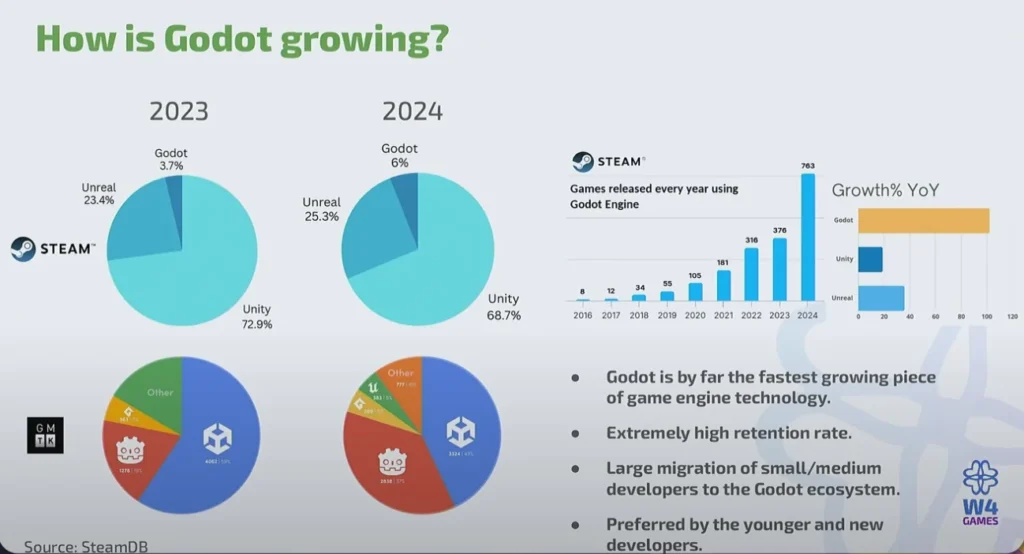
While exact market share figures vary by source, industry analyses consistently show a steady upward trend in Godot usage across global development communities. GitHub activity, download counts, and forum engagement all indicate increasing momentum.
Compared to earlier years where Unity and Unreal Engine dominated nearly all segments, Godot is now carving out a meaningful share in the indie and educational sectors. Some reports suggest that Godot’s adoption rate has grown at a double-digit percentage annually, particularly since the release of Godot 4.
The engine is especially strong in 2D game development, where its optimized tools outperform many heavier engines in efficiency and workflow speed. This has led to a noticeable concentration of Godot projects in mobile, pixel-art, and indie PC games.
Market analysts also note that while Godot is not yet dominant in AAA production, its presence in experimental and prototyping environments is expanding rapidly.
Why Indie Developers Are Switching to Godot Engine
Indie developers are one of the primary forces behind Godot’s rising popularity. The engine’s free licensing model removes financial risk, which is critical for small teams and solo developers.
Another key factor is workflow efficiency. Godot’s node-based architecture allows developers to build game systems quickly without deep reliance on complex scripting structures. This reduces onboarding time and accelerates prototyping.
Developers also appreciate the engine’s strong 2D capabilities, which are often considered more intuitive than those found in competing engines. Features such as built-in animation tools, scene inheritance, and lightweight rendering make it ideal for narrative-driven and stylized games.
Community support is another driving force. Indie developers frequently share plugins, templates, and open-source assets, creating a collaborative ecosystem that reduces development barriers.
Godot vs Unity Comparison in Recent Industry Adoption Reports
Comparisons between Godot and Unity continue to shape discussions in game development communities. Unity remains a dominant force in commercial development, but Godot is increasingly seen as a viable alternative for specific use cases.
Unity offers a more mature asset ecosystem and stronger AAA pipeline integration, but its licensing controversies have pushed some developers to explore alternatives. Godot, on the other hand, provides full transparency and no licensing fees, making it attractive for long-term project stability.
Performance-wise, Unity still holds an advantage in large-scale 3D production environments. However, Godot’s improvements in version 4 have narrowed the gap significantly, particularly in rendering efficiency and shader support.
The key difference lies in philosophy: Unity is a commercial ecosystem, while Godot is a community-driven framework. This distinction is increasingly influencing developer decision-making in 2026.
How Open-Source Game Engines Like Godot Are Disrupting the Industry
Open-source engines are reshaping the game development landscape by decentralizing control away from large corporations. Godot stands at the forefront of this movement.
By offering unrestricted access to its source code, Godot allows developers to experiment, modify, and extend functionality without legal or financial limitations. This has led to a surge in innovation, particularly in experimental game design and niche genres.
Open-source development also fosters transparency. Developers can audit engine behavior, ensuring stability and security in production environments. This level of control is particularly appealing to studios concerned about long-term dependency on proprietary platforms.
The broader industry impact includes increased competition, improved pricing models from commercial engines, and a shift toward community-driven development tools.
Godot Engine Download Growth and Community Expansion Insights
Download statistics and community engagement metrics indicate consistent growth in Godot’s user base. The official repository and distribution channels have reported increasing download volumes year over year.
Community expansion is particularly visible on forums, Discord servers, and GitHub contributions. Thousands of contributors actively improve documentation, engine features, and third-party plugins.
This organic growth model is one of Godot’s strongest assets. Unlike closed ecosystems, its development is driven by direct user feedback and community involvement, which accelerates iteration cycles and feature adoption.
Localization efforts have also expanded significantly, making the engine more accessible to non-English-speaking developers worldwide.

The Role of Game Jams in Boosting Godot Adoption Worldwide
Game jams have played a critical role in introducing new developers to Godot. Events such as Ludum Dare and Global Game Jam frequently feature Godot as a recommended engine due to its fast setup time and ease of use.
Participants often choose Godot for time-limited competitions because it allows rapid prototyping without configuration overhead. This exposure leads many developers to continue using the engine after the event ends.
Tutorials and jam projects shared online further amplify adoption by demonstrating what can be achieved in short development cycles. As a result, game jams act as a gateway for long-term engagement with the engine.
Steam Release Data Shows Increasing Number of Godot Games
Steam release data indicates a growing number of games built with Godot entering the marketplace. While still smaller in volume compared to Unity or Unreal titles, the upward trend is clear.
Many of these games originate from indie developers who value Godot’s flexibility and cost efficiency. Genres such as platformers, puzzle games, and narrative adventures dominate the platform’s Godot-based catalog.
The presence of successful indie titles has also improved perception of the engine’s commercial viability, encouraging more developers to consider it for full releases.
How Slay the Spire 2 Boosted Godot Engine Popularity
The anticipated development discussions around sequels to successful indie titles such as Slay the Spire 2 have indirectly influenced interest in Godot. While not officially confirmed as a Godot project, community speculation and modding ecosystems have drawn attention to the engine’s capabilities in card-based and strategy game development.
This has led to increased experimentation by indie developers looking to replicate similar mechanics using Godot’s flexible scene system and scripting tools.
As a result, search interest and tutorial creation around deck-building and roguelike systems in Godot have increased significantly.

Why Developers Prefer Godot for 2D and Indie Game Development
Godot’s strongest domain remains 2D game development. Its dedicated 2D engine operates independently from the 3D system, resulting in better performance and cleaner workflows.
Features such as pixel-perfect scaling, built-in tilemaps, and animation tools make it especially suitable for indie developers focusing on stylized or retro-inspired games.
The engine’s simplicity also reduces the learning curve, allowing new developers to build complete games faster than with more complex systems.
Cross-Platform Game Development Growth Using Godot Engine
Cross-platform development is one of Godot’s most attractive features. Developers can export games to Windows, macOS, Linux, Android, iOS, and web platforms with minimal configuration.
This capability is increasingly important in a fragmented device ecosystem where developers aim to reach the widest possible audience.
Godot’s lightweight build system ensures faster deployment cycles and reduces compatibility issues, making it a strong choice for multiplatform indie releases.
Godot Engine Community Growth on GitHub and Open-Source Platforms
Godot’s GitHub repository is one of the most active open-source game engine projects in the world. Contributions range from bug fixes to major feature implementations.
The community-driven model ensures continuous improvement, with thousands of contributors participating in development discussions and code submissions.
This open collaboration model strengthens the engine’s stability and accelerates innovation far beyond what traditional corporate development cycles can achieve.

Future Predictions for Godot Engine Adoption in Game Development
Future projections suggest continued growth for Godot, particularly in indie, mobile, and educational sectors. As the engine matures, it is expected to expand further into mid-tier commercial development.
Improved 3D capabilities and tooling enhancements may also position Godot as a more competitive option in broader markets.
Industry analysts anticipate that open-source engines will continue to gain market share as developers prioritize flexibility and cost efficiency.
Challenges and Limitations Facing Godot Despite Rapid Growth
Despite its growth, Godot still faces several challenges. Its asset marketplace is smaller than those of competing engines, limiting ready-made production resources.
AAA studio adoption remains limited due to concerns about large-scale pipeline integration and long-term support.
Additionally, while 3D capabilities have improved significantly, they are still catching up to more established engines in high-end rendering and simulation features.
However, ongoing development efforts suggest that many of these gaps are gradually being addressed.
Frequently Asked Questions (FAQs)
- What is Godot used for in game development?
Godot is used for creating 2D and 3D video games across multiple platforms, including PC, mobile, and web. - Is Godot better than Unity?
It depends on the use case. Godot is better for lightweight, indie, and 2D projects, while Unity is stronger for large-scale commercial 3D games. - Why is Godot becoming popular?
Its open-source license, no fees, and fast development workflow are major reasons for its growing popularity. - Is Godot good for beginners?
Yes, Godot is widely considered one of the most beginner-friendly game engines available. - Can Godot be used for commercial games?
Yes, Godot supports full commercial game development with no licensing restrictions. - Does Godot support 3D games?
Yes, especially with the Godot 4 update, which significantly improved 3D rendering capabilities. - Is Godot completely free?
Yes, Godot is open-source and completely free under the MIT license. - What programming language does Godot use?
Godot primarily uses GDScript, but also supports C#, C++, and visual scripting. - How big is the Godot community?
The community is large and growing rapidly, with active contributors on GitHub and forums worldwide. - Will Godot replace Unity or Unreal Engine?
It is unlikely to fully replace them but is expected to continue growing as a strong alternative, especially in indie development.

Conclusion
Godot’s rapid adoption growth reflects a broader shift in the game development industry toward open-source, flexible, and cost-effective tools. While it may not yet dominate AAA production, its influence in indie development, education, and experimental game design is undeniable. As the engine continues to evolve, its role in shaping the future of game development is expected to expand significantly.
Sources and Citations
- Godot Engine — Official website for engine downloads, documentation, release notes, showcase projects, and developer updates https://godotengine.org
- Godot Engine — Official source-code repository with commits, issue tracking, pull requests, and engine development history https://github.com/godotengine/godot
- Steam — Steam Store listings used for PC game release data, player activity, reviews, and storefront analytics https://store.steampowered.com
- itch.io — Indie game development community platform featuring creator discussions, game publishing trends, and experimental projects https://itch.io
- Open Source Initiative — Open-source development standards, licensing information, and industry trend resources https://opensource.org
Recommendations
- Trish from Devil May Cry – Complete Character Guide
- How The View Keeper Simplifies Multi-Camera Animations in Blender
- Jeff Kaplan on the Reasons for Leaving Blizzard: What He Said About Corporate Pressure, Overwatch League, and His Breaking Point
- Wuthering Waves – Xbox Release Date Trailer | Xbox Partner Preview Showcase 2026: July 2026 Release, Game Pass, and Xbox Play Anywhere
- Elden Ring Movie’s Popcorn Bucket Should Be Iron Fist Alexander, Fans Declare (A24’s Alex Garland Adaptation)
- Secrets to Blender Photorealism: How to Make Your Renders Look Real
- Devil May Cry Anime on Netflix: Release Date, Storyline, Cast, and What to Expect
- Samson Coming To Consoles This Fall: Everything We Know
- Nacon Postpones Game Showcase After Filing for Insolvency: Nacon Connect 2026 Delayed to May