




In This Article (8 sections)
Godzilla Destroy All Monsters Melee Remastered Release DGodzilla: Destroy All Monsters Melee Remastered Release Date, Platforms, Price and System Requirements
Atari has confirmed that Godzilla: Destroy All Monsters Melee Remastered will launch on November 3, 2026, for PlayStation 5, Xbox Series X/S, Nintendo Switch 2 and PC via Steam. Priced at $29.99, the remaster will bring a rebuilt version of the classic Godzilla brawler to modern hardware, while the Nintendo Switch 2 release marks the return of the GameCube experience to Nintendo consoles for the first time since 2002. The launch coincides with Godzilla Day, commemorating the original film’s Japanese theatrical premiere in 1954 and marking the franchise’s 72nd anniversary. Atari and developer Pipeworks deliberately chose Godzilla Day as a tribute to the franchise’s history, treating the release as a birthday present for the King of the Monsters.
According to one report, Nintendo also highlighted the connection between Godzilla’s official birthday and the remaster’s launch. Although Grand Theft Auto VI is scheduled to arrive later in November, the Pipeworks team has indicated in interviews that its proximity did not influence the decision, emphasizing that November 3 was selected to celebrate Godzilla’s legacy rather than respond strategically to other games releasing that month.
The advertised $29.99 price comes with an important qualification for collectors. Physical editions have been announced for PS5 and Nintendo Switch 2, but the Switch 2 physical release costs $39.99, while the PS5 physical edition retains the $29.99 price. The difference concerns the purchasing format rather than an announced expansion or additional monster pack, so the higher Switch 2 retail price should not automatically be interpreted as a deluxe edition. These are US prices and should not be treated as a guarantee of identical pricing across every regional storefront.
PC players will also have an opportunity to try the remaster before launch, as Toho’s August 28 roster announcement confirms a Steam demo scheduled for October 15, 2026, nineteen days before the full release. The announcement does not specify the demo’s playable roster, available stages or whether progress carries into the finished game, and it names Steam specifically rather than announcing equivalent PlayStation, Xbox or Nintendo demos. For returning players, the demo provides an opportunity to judge whether the updated controls, camera and monster movement capture what they remember.
The published minimum PC requirements call for a 64 bit operating system, Windows 10 with Windows 11 preferred, an Intel Core i5 8400 or AMD Ryzen 5 2600, and 16 GB of RAM. Graphics requirements list an Nvidia GTX 1060 with 6 GB of video memory or an AMD RX 580 with 8 GB, alongside DirectX 12 and Shader Model 6 capability. Steam currently lists 6 GB of available storage. These are minimum specifications rather than a guarantee of a particular resolution, graphics preset or frame rate, and a complete recommended hardware target has not been supplied.
On Nintendo Switch 2, the official listing supports TV, tabletop and handheld play, giving the remaster a portable option alongside conventional television multiplayer. Nintendo estimates the download at 3.9 GB, although that should not be treated as a permanent ceiling for future updates. The listing is specifically for Switch 2, so owners of the original Switch should not assume compatibility simply because the game revisits a Nintendo classic. Portable play also does not establish that image quality or performance will be identical across every supported system.
PS5 players receive additional platform specific features through advertised DualSense vibration and trigger effects, while Sony also lists Remote Play support. These additions sit alongside the main remaster rather than changing its roster or progression structure. They provide additional ways to experience the game, but the listing does not describe detailed controller effects for individual monsters or attacks, leaving those specific sensations to be assessed in the finished release.

Godzilla Destroy All Monsters Melee Remastered Features and Monster Roster
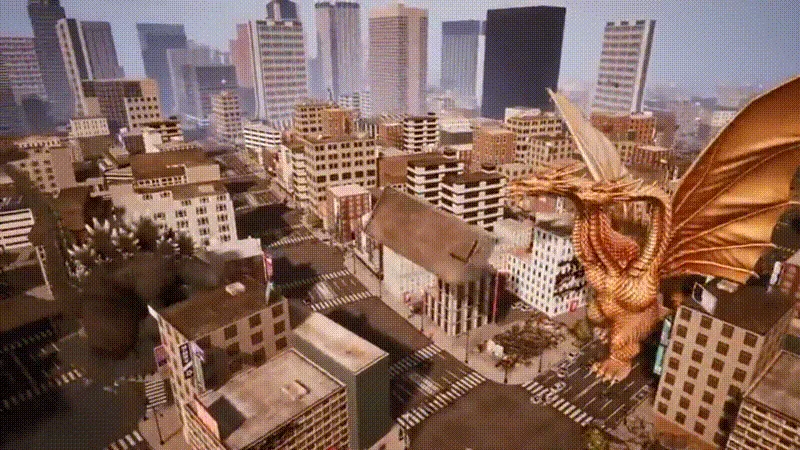
Godzilla: Destroy All Monsters Melee Remastered has been rebuilt from the ground up in Unreal Engine 5, with modernized textures, lighting, and character models for all 12 fighters. The visual overhaul preserves the original’s monster combat and city destruction while introducing online multiplayer for the first time, including cross platform matchmaking. A redesigned unlock system and the new Destroy Mode also expand progression. Players earn a shared in game currency across all modes and can spend it on monsters, levels, and gallery items in whichever order they choose. Each kaiju receives its own single player campaign, giving the remaster more individual content alongside its expanded multiplayer options.
The remaster retains 12 playable monsters, matching the total described for the 2002 original, with one replacement among the returning fighters. The roster includes Godzilla from the Heisei series, Godzilla 2000 from the Millennium series, Anguirus, Rodan, King Ghidorah, Gigan, Megalon, Kiryu (Mechagodzilla 3), Mecha-King Ghidorah, Destoroyah, Orga, and the 1975 Showa Mechagodzilla. That final character replaces the original game’s Heisei Mechagodzilla, while the remaining fighters return. Spanning five decades of Godzilla history, the lineup brings together familiar favorites and less prominent kaiju while preserving the variety of monster designs associated with the GameCube era.
For historical precision, the original roster differed between versions. The Western GameCube release had eleven playable monsters, while the Japanese edition substituted Kiryu for Heisei Mechagodzilla. The later Xbox release included both, bringing its selection to twelve. Consequently, the remaster’s twelve-character total aligns more closely with the expanded original-era lineup than with every individual 2002 GameCube edition. This explains why returning players may remember different Mechagodzilla options.
The environments are a substantial part of the package rather than interchangeable backdrops. Atari confirms eight locations, each with day and night variations, including recognizable cities, Monster Island and the alien Mothership. The distinction between locations and lighting variants matters: this is an eight-arena selection with alternate presentation, not an announcement of sixteen entirely different maps. That mixture gives the game both familiar urban destruction and settings drawn more directly from its science-fiction side.
Buildings and landmarks can be used as weapons, making the arrangement of a city relevant to combat. Rather than treating every nearby structure as something to demolish immediately, a player may have a reason to keep a useful object available for a later exchange. As a tactical principle, that gives positioning another dimension: choosing where to fight can matter alongside choosing which attack to use. The attraction is not simply seeing a skyline collapse, but having the environment contribute to the confrontation itself.
Hands-on reporting from Summer Game Fest describes expanded arenas and a visual direction intended to preserve the original’s character rather than turn it into a completely different, hyper-realistic fighter. Reported improvements include more detailed monster surfaces and cities with additional architectural features. These changes could make the scale of a battle easier to appreciate, particularly when a monster moves past windows, fire escapes and other recognizable structures. Larger arenas also give four-player encounters more room than a closely confined fighting space.
The combat identity remains centered on distinctive melee attacks, ranged energy attacks and Rage Mode moves. Those categories create different decisions: closing the distance, answering an opponent from farther away, or choosing when to use a more dramatic attack. A recognizable monster design is therefore only part of character selection. The useful question is how comfortably a fighter’s individual moves support the player’s preferred approach, rather than assuming the largest or most familiar kaiju must automatically be the strongest.
Having separate Heisei and Millennium Godzilla entries also means that two versions of the headline character occupy their own places in the selection. Meanwhile, the mixture of organic and mechanical monsters gives the lineup considerable visual variety. For a newcomer, that makes experimentation worthwhile before settling on a favorite. For a returning player, it creates a reason to compare familiar choices under the revised presentation rather than judge the entire remaster from a single match with Godzilla.
The practical test for the overhaul will be consistency during busy fights. More detailed monsters and brighter effects are attractive, but players still need to distinguish opponents, incoming attacks and useful scenery when several actions happen together. That is especially important in local multiplayer, where spectacle should not make the action unnecessarily difficult to follow. Engine choice alone cannot answer that question; the demo and final release will provide better evidence of how the visual improvements work during ordinary play.
Why Hedorah Was Removed and Mechagodzilla Was Replaced in the Remaster
Hedorah, the Smog Monster, has been removed from the remaster, although it was never a playable fighter in the original game. Instead, Hedorah served as a hidden stage hazard with a 20% chance of appearing in certain matches. It materialized in the background and interfered with the affected fighter’s health regeneration, without giving players direct control over its appearance. Its nearly transparent graphics made it difficult to notice, leaving players unsure why their fighter was being affected.
According to information from the development team, this lack of visibility and feedback caused frustration, with some players quitting because they believed they had encountered a bug or that another player had interfered with their character. Rather than retain an unpredictable mechanic that could still confuse players, the developers removed Hedorah, as clarifying its behavior would have required a more substantial redesign.
An important mechanical clarification concerns the reference to health regeneration: documentation of the original game describes Hedorah as interfering with energy-bar recharge, rather than health recovery. That distinction matters because energy supports weapon attacks and other abilities, while health determines how much damage a monster can withstand. The original guide also notes that Hedorah could eventually disappear or be driven away with a beam attack, although players did not choose when the hazard initially appeared.
The only replacement within the playable roster concerns Mechagodzilla. The original game’s Mechagodzilla 2, the 1993 Heisei version described as Super Mechagodzilla, has been replaced by the classic 1975 Showa Mechagodzilla. Pipeworks has retained three mechanical fighters: Kiryu, Mecha-King Ghidorah, and the newly introduced Showa version. Compared with the sleeker Heisei design, Showa Mechagodzilla has a bulkier, riveted appearance and rainbow missiles. The change broadens the eras represented among the mechanical characters while keeping the overall roster at 12 fighters.
To support that replacement, Pipeworks rebuilt the Showa Mechagodzilla model from scratch because usable assets for the 1975 robot were not available in modern formats. The team drew inspiration from the practical effects and suit design of Godzilla vs. Mechagodzilla (1974), recreating the character’s distinctive mechanical appearance with the detail needed for Unreal Engine 5. This work gives the replacement fighter a model suited to the remaster’s upgraded textures and lighting while retaining the visual character of the classic Showa design.
These changes illustrate two different questions facing a remaster: whether to preserve an unusual mechanic, and how to represent a familiar character with new assets. Removing a background hazard affects the rules and feedback of a match, while replacing Mechagodzilla affects a selectable fighter’s identity. Treating both as simply “cut monsters” would blur that distinction and make the roster sound smaller than the announced twelve-character selection.
There is also a broader design tradeoff in removing something that veterans may remember fondly. An obscure feature can be entertaining once its behavior is understood, yet still make a poor first impression on someone encountering it without explanation. A successful update needs to balance those memories against readable cause and effect. The important standard is whether players can understand why an encounter changes and respond through their own decisions, rather than needing outside research to explain an unexpected disadvantage.
The Showa replacement should likewise be judged through more than screenshots. Its appearance can strengthen the lineup’s historical variety, but its animations, attack readability and interaction with the other fighters will determine how it works in practice. A newly constructed model does not, by itself, establish that the character has become stronger or weaker. Those are separate balance questions, best assessed through the playable game rather than the model’s additional detail.

Godzilla Destroy All Monsters Melee Remastered Modes, Unlocks and Online Multiplayer
Godzilla Destroy All Monsters Melee Remastered introduces Destroy Mode, rather than “Director Mode,” replacing the original game’s Destruction Mode. Previously, players smashed buildings during timed runs to achieve the highest possible score. The new mode connects that destruction to monster progression, allowing players to earn points through city rampages and spend them on improvements to their kaiju’s health, strength or special moves. This creates a cycle of destroying cities, upgrading your monster and returning with greater power.
According to the designers, smashing buildings becomes part of developing your monster rather than simply chasing scores. Although the full details are still forthcoming, Destroy Mode is expected to reward destructive efforts with stronger stats and new abilities, adding a strategic layer to the original concept.
The remaster also replaces the original unlock requirements with a universal currency system. In the 2002 game, obtaining certain monsters and stages required completing specific modes or campaigns. Now, playing Survival, new campaigns, Destroy Mode and other modes earns currency that can be spent on unlocks in any order. Players can therefore work toward their favorite kaiju or stage without completing a mode they dislike. For example, someone aiming to unlock King Ghidorah can save points earned through their preferred activities and purchase the monster once they have enough. This approach makes progression more flexible, allowing different play styles to contribute toward the same unlock goals instead of tying rewards to particular challenges.
The two progression systems should be understood separately. Purchasing a character, stage or gallery entry expands the content available to the player, while improving a monster within Destroy Mode changes the experience of that particular progression loop. Public descriptions should not be taken as confirmation that every upgrade transfers into standard competitive matches. Likewise, an earnable in-game currency is not automatically evidence of paid currency or microtransactions. The meaningful confirmed change is greater freedom over which unlock to pursue.
That flexibility could make shorter play sessions more satisfying. A player who does not have time to complete a campaign may still be able to contribute toward a longer-term goal through another supported activity. Someone who enjoys trying different modes would not necessarily have to abandon their preferred unlock target when changing activities. The eventual balance will depend on earning rates and item costs, because freedom of choice is most useful when progress feels reasonable rather than excessively slow.
The individual campaigns give solo players another reason to sample the roster rather than reserve every unfamiliar monster for multiplayer. They can potentially serve as a place to learn a fighter’s rhythm before facing another person. However, a separate campaign for each kaiju does not by itself establish twelve long, cinematic story adventures. The official description confirms character-specific single-player content, but does not provide a total campaign length or a detailed breakdown of narrative presentation.
Online multiplayer is another major addition, bringing the original game’s local battles to the internet for the first time. Online matches support two players, with crossplay between Nintendo Switch 2, PS5, Xbox and PC. Players can use random matchmaking to find opponents or arrange private matches with friends across supported platforms. Local multiplayer also remains available, including a tournament mode that allows up to four players to compete in a bracket on one console. The distinction is important: online battles are limited to two players, while the tournament option accommodates more participants locally. Together, these options preserve the game’s couch multiplayer appeal while allowing fans on different platforms to challenge one another.
The local player count is broader than the tournament bracket alone. PlayStation and Xbox both list support for up to four players on one system, while their online listings stop at two. That makes the distinction useful when planning a gaming session: a group of four sharing a console can use the local multiplayer offering, but the advertised online limit does not describe a four-person internet battle. The tournament structure adds organization to local competition rather than being proof of expanded online capacity.
On PS5, PlayStation Plus is required for online play, although Sony explicitly describes online participation as optional. Nintendo’s listing similarly identifies Nintendo Switch Online support for online play and cloud saves. These requirements should be considered separately from buying the game itself. Players primarily interested in solo modes or local matches should also distinguish those activities from the subscription requirements attached to internet multiplayer.
Crossplay is useful for challenging friends who own different supported systems, but it should not be confused with cross-progression. A shared matchmaking pool does not automatically mean that purchased copies, unlocked monsters or saved progress move between platforms. The same distinction applies to platform features such as Remote Play: they provide another access method, not proof that every version shares one universal account or save file.
For replay-minded players, Steam lists achievements, while its language table includes English, French, Italian, German, Spanish and Japanese interfaces and subtitles. Full audio is listed in English. These details help clarify the PC package beyond graphics and multiplayer, especially for players choosing a version around language support or additional completion goals.
Godzilla Remaster Release Timing and Future Godzilla Unleashed Possibilities
Godzilla Destroy All Monsters Melee Remastered is scheduled for November 3, 2026, just over two weeks before Grand Theft Auto VI’s planned November 19 launch. Despite that proximity, the developers have stated that GTA VI did not influence their release schedule. Pipeworks chose November 3 because it is Godzilla Day, with the 2026 date marking the monster’s 72nd birthday. In interviews, staff explained that honoring the franchise drove the decision rather than an attempt to compete with or avoid another major release. The current dates place the remaster sixteen days ahead of GTA VI, rather than in a same day release contest, and the team did not shift its schedule because of Grand Theft Auto VI.
The wider Godzilla calendar gives the early November launch additional significance. Toho has scheduled Godzilla Minus Zero for Japan on November 3, 2026, with the United States, Canada and United Kingdom following on November 6. The game and film therefore arrive during the same week in those markets, making the period particularly relevant to Godzilla fans. However, that shared timing does not make Melee Remastered an adaptation of the new movie or confirm any film related playable characters.
From a player’s perspective, the remaster and GTA VI are also different purchasing decisions, since revisiting a monster arena fighter is not the same commitment as beginning another major release later in the month. The calendar alone cannot determine how either game will perform commercially, so more useful considerations for the remaster include its launch quality, multiplayer reliability and whether its updated progression keeps battles rewarding.
Atari and Pipeworks remain focused on Melee Remastered, and a Godzilla: Unleashed remaster has not been announced, contracted or put into development. Although the developers have expressed interest in reviving other classic Godzilla games, the 2007 Wii title would present separate challenges. Its large monster roster and reliance on motion controls would require substantial work, including redesigned controls and monster models rebuilt from scratch. Those demands make it a separate undertaking rather than something covered by the current remaster. While fans may hope Unleashed could follow, neither company has confirmed such plans, meaning any potential revival remains speculative and would require its own announcement.
Any discussion of later remasters should therefore remain separate from evaluating what Melee Remastered actually includes. Buying the game should be a decision based on its own content rather than an expectation that it purchases a future trilogy or guarantees another project. Interest in Godzilla: Unleashed may demonstrate that an audience exists, but interest is not a release schedule. Any later revival would need its own confirmed platforms, features and development scope before meaningful comparisons could be made.
For now, the strongest reason to watch the November release is its combination of recognizable arena combat and practical modernization. Returning players can judge how faithfully the original experience has been preserved, while newcomers can approach the roster without relying on memories of the GameCube release. The October demo should help answer the first hands on questions before launch, while performance and online stability will remain important tests for the full game.

Frequently Asked Questions[FAQs]
1.Is Destroy All Monsters Melee Remastered worth buying if I own the original?
It could be worthwhile for existing owners who want to revisit the original combat with modern features and presentation improvements. The remaster keeps the core feel of the 2002 game while adding online multiplayer, new modes, a more flexible unlock system, enhanced graphics, and other updates. Its appeal is therefore less about replacing the original with a completely different experience and more about providing a modern and expanded version of the game fans already know.
2.What’s the release date for Godzilla: Melee Remastered?
Godzilla: Melee Remastered releases on November 3, 2026. The developers deliberately selected the date because it falls on Godzilla Day, which celebrates the character’s birthday and marks the franchise’s 72nd anniversary in 2026. This means the timing was primarily intended to connect the remaster with an important date in Godzilla history rather than being chosen in response to other major game releases.
3.Which consoles will Melee Remastered be on?
The remaster will be available on PlayStation 5, Xbox Series X/S, and Nintendo Switch 2, with a PC version also releasing through Steam. Online play supports cross platform matchmaking between these versions, allowing players on different supported systems to compete against one another instead of requiring everyone to own the game on the same platform.
4.What new features does the remaster include?
The remaster expands the original game with online multiplayer, an individual campaign for every monster, and a new Destroy Mode that connects city destruction to character progression. Players can earn points by destroying buildings and use those points to improve their monster, while the redesigned unlock system provides more control over what content is unlocked and in which order. Unreal Engine 5 also provides enhanced visuals, and day and night variations give the stages different appearances during battles.
5.Who are the playable monsters in Melee Remastered?
The roster contains 12 monsters: both Godzilla versions, Anguirus, Rodan, King Ghidorah, Gigan, Megalon, Kiryu, Mecha-King Ghidorah, Destoroyah, Orga, and Mechagodzilla. The remaster therefore preserves the original playable lineup and includes monsters representing several different periods of Godzilla history. One notable visual change involves Mechagodzilla, which now uses its 1975 Showa appearance rather than the 1993 “Super Mechagodzilla” design featured previously.
6.Why was Hedorah removed in the remaster?
Hedorah was removed because its role in the original game could be confusing and frustrating for players. In the 2002 release, Hedorah had a small chance of appearing as a random stage hazard and could interfere with health regeneration without clearly communicating what was happening. The developers decided that properly explaining or improving the mechanic would require a more substantial redesign, so they chose to remove Hedorah instead of recreating the original system unchanged.
7.How does the Destroy Mode work?
Destroy Mode replaces the original Destruction Mode and gives city destruction a direct connection to monster progression. Players earn points by demolishing buildings and other parts of the environment, then spend those points on upgrades to their monster’s statistics and abilities. Instead of destruction simply contributing to the objective or score, it now provides resources that can make the monster more powerful as the mode progresses.
8.Can I play Melee Remastered online with friends on different consoles?
Yes. Online multiplayer supports two players and includes cross platform play between Nintendo Switch 2, PlayStation 5, Xbox Series X/S, and PC. This allows friends using different supported platforms to compete together online. Local Tournament Mode can support up to four players, but that larger player count is specifically for local matches, since online battles remain limited to two participants.
9.Why wasn’t the remaster release date pushed because of GTA 6?
The developers kept the November 3 release because launching on Godzilla Day was considered more important than moving the game because of GTA VI. November 3 celebrates Godzilla’s birthday and marks the franchise’s 72nd anniversary in 2026, giving the remaster a release date directly connected to the series. GTA VI’s planned November 19 launch therefore did not change the schedule, even though the two games release relatively close together.
10.Will there be a remaster of Godzilla: Unleashed?
No Godzilla: Unleashed remaster has been announced, and Atari and Pipeworks have not entered into a contract to develop one. The developers have also indicated that the game would present additional challenges because of its motion controls and much larger monster roster. Those complications do not mean a remaster is impossible in the future, but there is currently no confirmed Godzilla: Unleashed remaster in development.
Conclusion
Godzilla Destroy All Monsters Melee Remastered launches on November 3, 2026, bringing its classic kaiju battles to PS5, Xbox Series X/S, Nintendo Switch 2, and PC. With upgraded visuals, cross-platform multiplayer, individual monster campaigns, Destroy Mode, and more flexible unlocks, the remaster aims to offer more than nostalgia. For returning fans and newcomers alike, its appeal lies in preserving the familiar thrill of city-smashing combat while introducing more ways to play and progress.
Sources
- Atari — Godzilla: Destroy All Monsters Melee Remastered — official product page confirming the November 3, 2026 release, 12-monster roster, enhanced visuals, improved unlock system, local co-op, new online multiplayer, and Pipeworks’ involvement.
Atari — Godzilla: Destroy All Monsters Melee Remastered - Pipeworks — Godzilla: Destroy All Monsters Melee Remastered — developer page covering the remaster, eight locations, enhanced visuals, local co-op, and online multiplayer.
Pipeworks — Godzilla: Destroy All Monsters Melee Remastered - Nintendo — Godzilla: Destroy All Monsters Melee Remastered for Nintendo Switch 2 — official Switch 2 product page confirming the remaster, Pipeworks/Atari, 12 monsters, eight locations, local co-op and online multiplayer.
Nintendo — Godzilla: Destroy All Monsters Melee Remastered - MMO.Net / IGN interview — The Big Godzilla: Destroy All Monsters Melee Remastered Interview: Launching Against GTA 6, Cutting Hedorah, and Staying (Mostly) Faithful to a GameCube Classic — Simon Strange interview covering the remaster’s development, Mechagodzilla replacement, classic gameplay, and new features.
MMO.Net — Godzilla Remastered Interview - VainSoftGames / IGN interview — The Big Godzilla: Destroy All Monsters Melee Remastered Interview — accessible version of the developer interview, including confirmation that the remaster uses the 1975 Showa Mechagodzilla and discussion of the new Director Mode.
VainSoftGames — Godzilla Remastered Interview - Wikizilla — Godzilla: Destroy All Monsters Melee Remastered — detailed reference covering the 12-character roster, Showa Mechagodzilla replacing the 1993 Mechagodzilla, online multiplayer, single-player campaign, local co-op and redesigned unlock system.
Wikizilla — Godzilla: Destroy All Monsters Melee Remastered
Recommendations
- How To Unlock Each Marathon Faction and Level Up Faster in Bungie’s Marathon
- GDC Festival of Gaming 2026 Attendance Drops 30% to 20,000 Visitors After Rebrand
- The Super Mario Galaxy Movie Digital Streaming Release: PVOD Date, Price, and Where to Watch Online
- Pokemon Winds and Waves: Release Date, Gameplay, And Everything We Know So Far (Nintendo Switch 2, Gen 10)
- Last Harbor Reaches 111,000 Wishlists in a Single Day: TinyBuild’s Record-Breaking Steam Launch Explained
- The Alters’ Last Variable DLC Gets New Gameplay Video Ahead of July 13 Release
- Vampire Hunter D: Fortress of Blood Comic Debuts December 16, 2026 From Dark Horse
- Chained Echoes Creator Matthias Linda to Sue First Press Games Over Missing Physical Editions
- How to Turn Any 3D Model into Minecraft 3D Models in Blender
- Sony Patents a Future PlayStation Controller with Buttons that Harden and Soften During Gameplay



































































































