








In This Article (8 sections)
MSI GPU Price Leak Claims, Sources, and What the Report Actually Shows
MSI GPU price leak reports have raised concerns about substantial GeForce RTX 50 series price increases in China, with the largest alleged adjustment reaching 8,000 yuan for certain RTX 5080 cards. The figures concern November 2026 distributor pricing compared with October, according to reporting attributed to the Chinese industry channel ChannelGate. They do not establish a new worldwide retail price list.
This distinction matters because a distributor’s acquisition price, a manufacturer’s suggested retail price, and the amount a customer pays at checkout describe different transactions. Confusing those figures can turn a significant but unconfirmed channel report into a misleading prediction about every graphics card on store shelves. The available information warrants attention, particularly for buyers tracking higher-end MSI cards, but the unusually broad price ranges, missing model-level details, and lack of an independently verified public MSI announcement leave important questions unanswered.
The report alleges that MSI’s November pricing policy raises Chinese distributor prices across several graphics card families. The listed adjustments range from relatively modest increases on lower-tier products to much larger changes for the RTX 5070 Ti and RTX 5080, with an additional increase also reported for the older RTX 3050. These figures describe changes relative to an earlier price schedule rather than complete quotations showing what every affected card previously cost and what it now costs.
Without those starting prices, reliable percentage increases cannot be calculated for individual models. The alleged direction of change is clearly upward, but the consequences depend on which products receive each adjustment, how distributors apply the policy, and what happens to existing retail inventory. A report describing a November policy also does not establish that every seller implemented identical changes on the same date, since different stores can update pricing at different times.
The source trail leads to ChannelGate, also identified as 视博合聚, a Chinese industry WeChat account associated with Board Channels. IT Home published its account on November 10, 2026, reproducing the alleged MSI adjustments alongside separate information about Colorful motherboard pricing. Those two sets of information should not be combined because details about one company’s motherboard retail guidance do not automatically apply to another company’s graphics card distribution policy.
International coverage subsequently discussed the same MSI figures, but multiple articles citing one underlying source do not represent multiple independent confirmations. Hardware information account Harukaze5719 also shared the alleged increases on X on November 10, helping the report reach an international audience by presenting approximate dollar conversions. Those converted figures illustrate scale but do not represent quotations from American retailers or evidence of a matching United States MSI pricing policy.
Short social posts can also compress important context by emphasizing the maximum adjustment while omitting the lower end of a range, the comparison month, or the distinction between distributor and consumer pricing. The yuan figures therefore provide the clearest basis for examining the report because they preserve the original currency and context. Readers should identify whether each number represents an increase or a total price and confirm which product family it concerns before drawing conclusions.
Harukaze5719’s post forms part of the publication trail, but it does not substitute for manufacturer confirmation. The strongest additional evidence would be a complete authenticated pricing document identifying individual MSI product codes, previous prices, revised prices, and effective dates. Distributor invoices could also help establish whether the changes were actually implemented.
Reported MSI RTX 50 Series Price Increases and Differences Between Models
The RTX 5080 attracts the most attention because its alleged distributor-price increase spans 1,300 to 8,000 yuan. Contemporary coverage translated that range into approximately $195 to $1,200, depending on rounding and the exchange rate used. NVIDIA advertised the RTX 5080 with a starting price of $999, which helps illustrate why the maximum reported adjustment attracted attention, but the two figures describe different transactions.
One is a United States starting price and the other is an alleged Chinese channel-price increase. The reported range is also exceptionally wide, with 6,700 yuan separating its endpoints, yet the available account does not identify which exact MSI RTX 5080 model corresponds to each figure. There is therefore no sound basis for treating the 8,000-yuan figure as the normal increase across MSI’s entire RTX 5080 range.
The 8,000-yuan figure represents the upper end of an alleged increase, not the total price of an RTX 5080. It also does not mean that a card previously cost 1,300 yuan and then rose to 8,000 yuan. A hypothetical example shows the distinction: if a distributor previously paid 12,000 yuan and the price increased by 1,300 yuan, the revised price would be 13,300 yuan, while an 8,000-yuan increase from the same starting point would produce a 20,000-yuan price.
These examples illustrate arithmetic only and are not verified MSI quotations. Percentage changes similarly require an actual starting price because a 1,000-yuan increase on a 5,000-yuan product equals 20 percent, while the same increase on a 10,000-yuan product equals 10 percent. The reported maximum should therefore remain attached to the word “increase,” and any proposed final price requires a separate identifiable quotation.
The alleged RTX 5070 Ti adjustment ranges from 800 to 4,000 yuan, which Wccftech’s November 10 coverage expressed as approximately $120 to $600. NVIDIA specifies 16GB of GDDR7 memory for the RTX 5070 Ti, but that specification does not establish what a particular MSI version should cost or how much of a price adjustment relates to memory. The reported RTX 5070 increase is smaller at 500 to 1,000 yuan compared with October distributor pricing.
NVIDIA lists 12GB of GDDR7 memory for the RTX 5070, compared with 16GB for the RTX 5070 Ti, so preserving the “Ti” distinction is important when comparing both price reports and technical specifications. A smaller absolute currency increase does not necessarily mean a smaller percentage increase because the original product price is still required for that calculation. Comparisons with October should also use equivalent transactions rather than placing an October promotional retail price against a November distributor adjustment.
The report separately distinguishes the RTX 5060 Ti 16GB and 8GB models. It lists a 400-yuan increase for the 16GB version and a 200-yuan increase for the 8GB version, while NVIDIA confirms that the RTX 5060 Ti is offered with either 16GB or 8GB of GDDR7 memory.
The 16GB version therefore has twice the reported increase of the 8GB version, but that does not mean the complete 16GB graphics card costs twice as much or that memory alone caused the difference. If two otherwise comparable products received those exact adjustments, their distributor-price gap would widen by 200 yuan, although retail pricing could respond differently. The standard RTX 5060 is reportedly subject to an increase of 200 to 500 yuan and uses 8GB of GDDR7 memory. It remains a separate product from the RTX 5060 Ti 8GB despite the similar naming and shared memory capacity.
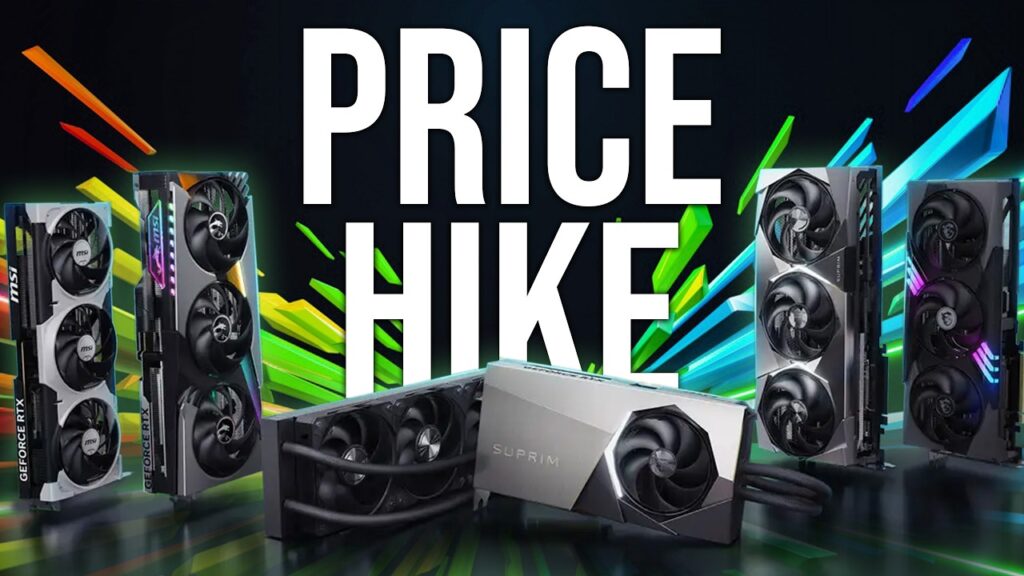
Differences within the same GPU family also matter because MSI sells multiple board designs using the same NVIDIA GPU. The RTX 5080 16G SUPRIM SOC lists a 2,745MHz boost clock and dimensions of 359 × 150 × 76mm, while the RTX 5080 16G VENTUS 3X OC lists a 2,640MHz boost clock and dimensions of 303 × 121 × 49mm. Both use 16GB of GDDR7 memory, but they are clearly different finished products with different cooling arrangements, dimensions, clock settings, and market positioning.
These differences do not explain or verify the enormous spread in the leaked RTX 5080 increase range. Assigning the largest adjustment to SUPRIM or the smallest to VENTUS would require model-specific evidence. Possible explanations such as different inventory positions, previous discounts, procurement arrangements, or product premiums remain hypotheses rather than established findings.
Distributor Pricing, Retail Prices, Regional Scope, and MSI Confirmation
Distributor pricing concerns transactions within the supply chain, while retail pricing concerns the offer made to an end customer. A manufacturer’s suggested retail price is another separate reference point and does not automatically equal either transaction price. A retailer holding inventory purchased before a supplier adjustment could continue selling at an existing price, reduce its margin to remain competitive, or change its advertised price based on expected replacement costs.
A retailer receiving a more expensive shipment could pass through some of the additional cost, absorb part of it, alter a bundle, or stop stocking a particular version. None of those outcomes follows automatically from the leaked distributor figures. A rising store price also does not prove the reported MSI adjustment because an expired coupon, a different marketplace seller, or a move from a basic model to a premium version can independently produce a higher visible price.
As of November 17, 2026, the research did not locate a publicly accessible MSI statement confirming the specific November increase ranges. The figures should therefore remain attributed to the channel report rather than presented as an official MSI retail announcement. Available coverage also describes the information as a leak or rumor, while Club386 specifically questioned the unusually wide RTX 5080 range.
The absence of public confirmation does not prove that the report is false because commercial pricing information can circulate privately between manufacturers and business partners. At the same time, the existence of a screenshot or widely shared summary does not establish that every detail is authentic and universally applicable. Meaningful confirmation would identify the affected market, product codes, pricing level, effective period, and previous comparison prices.
The reported adjustments concern China and do not establish matching increases in the United States, United Kingdom, Europe, India, Nigeria, or other markets. Club386 likewise cautioned that the Chinese figures would not necessarily appear in other regions in the same form.
Currency conversion does not change that geographic limitation because converting 8,000 yuan into dollars, pounds, or naira only expresses the same amount in another currency. It does not show what a local MSI distributor will charge or what a customer will ultimately pay. Regional purchasing conditions can also include shipping, applicable taxes, payment conversion charges, and the availability of local warranty service. Shared supply pressures could influence several markets, but that possibility does not prove a synchronized worldwide pricing policy.
For buyers, the practical question is therefore not whether a leaked distributor range exists but whether the final price of an available card has actually changed. A discounted card from one seller could remain cheaper than a newly replenished card from another seller even when both belong to the same GPU family. Comparing the complete product name, delivery status, warranty coverage, seller, and checkout total is more useful than assuming every card received the maximum reported adjustment.
This is especially important when comparing RTX 5060 Ti 16GB and 8GB versions, RTX 5070 and RTX 5070 Ti cards, or premium and mainstream MSI RTX 5080 designs. The Chinese report provides a reason to watch the market carefully, but it is insufficient evidence for predicting a specific retail increase, implementation date, or final checkout price elsewhere. Claims that MSI publicly announced identical increases for all consumers would go beyond the evidence reviewed.

Memory Supply Pressures and How to Compare MSI GPU Prices Accurately
There is independent industry evidence of pressure on graphics memory supply. In its September 30, 2026 outlook, TrendForce reported that GDDR7 output remained constrained as advanced manufacturing capacity was increasingly allocated to applications such as server DRAM, and it expected graphics DRAM prices to continue rising. That background is relevant because the RTX 50 products discussed in the leak use GDDR7 memory.
However, a market-wide supply forecast does not reveal MSI’s purchasing contracts, inventory costs, or the cost structure of any particular finished graphics card. TrendForce also projected a 10 to 15 percent quarterly increase in conventional DRAM contract prices for the fourth quarter, but that forecast should not be treated as an exact GDDR7 price increase or directly applied to the retail price of a graphics card. If one component represents only part of a product’s total cost, a percentage increase in that component does not automatically create the same percentage increase in the finished product.
Memory constraints may therefore help explain the broader environment in which the MSI pricing report appeared, but they do not independently validate the 8,000-yuan endpoint or establish that memory costs account for the entire alleged adjustment. Confirming such a connection would require a detailed cost breakdown that the public report does not provide. The same caution applies to explanations involving inventory positions, discounts, procurement arrangements, and different premiums across MSI’s product lines.
These factors are commercially plausible, but the report does not provide enough model-level information to establish which one explains each adjustment. The missing model breakdown is particularly important for the RTX 5080 because readers cannot determine whether the highest figure applies to a widely available product, an unusual configuration, a narrowly applied quotation, or an error in the circulated information. The leak can therefore provide market context without supporting precise claims about individual cards.
Comparing reported increases with actual store prices should begin with exact product identification. Record the complete MSI model name, memory capacity, color variant where relevant, and product code because comparing different versions can create the appearance of a price change when the product itself has changed.
Availability should also be confirmed because an out-of-stock page, preorder, marketplace advertisement, and card ready for immediate dispatch represent different purchase opportunities. A low displayed price is less useful if an order cannot actually be completed at that amount. The checkout total provides a stronger comparison because delivery charges, coupons, taxes, and payment conditions can materially change the amount paid. Earlier and later quotations should be compared under equivalent conditions and ideally from the same type of seller.
Percentage calculations should use comparable prices rather than the leaked increase range alone. Subtract the earlier price from the later price, divide the difference by the earlier price, and multiply by 100. A hypothetical movement from 6,000 to 6,600 yuan represents a 10 percent increase, but that calculation does not establish why the change occurred. Comparing several sellers also provides stronger evidence than relying on one unusually expensive listing.
Repeated increases across equivalent, in-stock products can indicate a broader retail trend, although even that remains separate from authenticated evidence of an MSI distributor policy. Keeping distributor prices, retail prices, suggested prices, regional differences, and component-cost pressures separate is essential to understanding what the reported MSI GPU price leak does and does not prove.
Frequently Asked Questions (FAQs)
- What is the MSI GPU price leak about?
It concerns alleged November 2026 increases in Chinese distributor prices for several MSI graphics card families, including RTX 50 series models. The largest reported adjustment affects certain RTX 5080 cards, but the figures describe changes within the distribution channel rather than confirmed worldwide retail prices. Distributor pricing reflects what businesses may pay within the supply chain, while retail pricing is what consumers ultimately see in stores. The report is therefore useful for identifying possible upward pricing pressure, but it should not be interpreted as a complete MSI retail price list or as proof that every affected card will immediately become more expensive. - Is 8,000 yuan the new RTX 5080 price?
No. The 8,000-yuan figure is reported as the upper end of an alleged price increase, not as the new total price of an RTX 5080. To calculate a revised distributor price, the previous price of the exact affected MSI model would first be required. For example, an 8,000-yuan increase would have a very different effect on a card previously priced at 10,000 yuan than on one priced at 15,000 yuan. A consumer purchase price would require even more information, including the retailer’s own markup, taxes, shipping, available discounts, and the specific model being sold. - Does every MSI RTX 5080 reportedly increase by 8,000 yuan?
No. The report presents a range of increases rather than one uniform adjustment across every RTX 5080 model. The highest reported figure is 8,000 yuan, while the lower end of the range is substantially smaller. The available information does not provide a complete model-by-model breakdown showing which MSI RTX 5080 versions receive each adjustment. Applying the maximum increase to every RTX 5080 would therefore exaggerate what the report actually claims. - Has MSI confirmed the leaked figures?
This research did not locate a public MSI statement authenticating the specific figures as of November 17, 2026. The numbers remain reported channel information rather than officially confirmed MSI retail guidance. A strong confirmation would ideally identify the affected market, exact product models or product codes, previous prices, revised prices, and the date the changes take effect. Until such documentation appears, the figures should continue to be described as reported or leaked rather than confirmed. - Why do the RTX 5060 Ti 16GB and 8GB versions need separate comparisons?
They need separate comparisons because they are different product configurations and the report assigns them different price adjustments. The RTX 5060 Ti 16GB version is reported to receive a larger increase than the 8GB version. Combining the two into one price comparison could make it appear that a price difference is caused by a new increase when part of that difference may simply come from the higher-memory model being a different product. Accurate comparisons should therefore match the full model name, memory capacity, and preferably the same retailer or distribution level. - Are the reported increases changes to NVIDIA’s official MSRP?
No. The report concerns alleged MSI distributor-price adjustments in China, which is a different pricing category from NVIDIA’s official suggested retail pricing. MSRP is a recommended reference price, while distributor pricing concerns transactions between manufacturers, distributors, and other businesses in the supply chain. A distributor-price increase can influence retail prices, but it does not automatically change NVIDIA’s official MSRP. Any claim that NVIDIA has revised MSRP would require separate evidence from NVIDIA or another authoritative source. - Will stores immediately pass on the full increase?
Not necessarily. Retailers may already have inventory purchased before the reported distributor changes, allowing them to continue selling at older prices for some time. Others may absorb part of the increase, reduce their margins, adjust promotions, or raise prices only when they restock. Competitive pressure from other sellers can also influence how much of the added cost is passed to customers. The leak therefore cannot establish exactly when retail prices will change or whether stores will pass through the full reported increase. - Does the report prove that graphics cards will become more expensive outside China?
No. The reported adjustments specifically concern the Chinese market, and different regions have their own distributors, inventory levels, taxes, exchange rates, and retail conditions. Shared supply pressures could contribute to higher prices in several countries, but that does not prove that the same increase will occur everywhere or at the same time. Converting 8,000 yuan into dollars, pounds, or naira only shows the approximate value of the Chinese figure in another currency. It does not represent a confirmed price increase for stores in those markets. - Can rising GDDR7 costs explain the entire alleged increase?
The available evidence does not establish that GDDR7 costs explain the full reported increase. Industry reports about tighter graphics-memory supply provide useful background and may help explain why pricing pressure exists. However, a finished graphics card includes many other costs, including the GPU, board design, cooling hardware, manufacturing, distribution, and product positioning. The leaked report does not provide a detailed cost breakdown showing how much of each adjustment comes from memory. GDDR7 pressure may therefore be one contributing factor, but it cannot be treated as the sole verified cause. - What evidence is most useful before buying an affected MSI card?
The most useful evidence is a current, in-stock quotation for the exact MSI model you are considering. Buyers should compare the full model name, memory capacity, seller, checkout total, warranty coverage, delivery cost, and recent price history rather than relying only on the leaked increase ranges. Checking several sellers can also help determine whether a higher price reflects a broader market trend or only one unusually expensive listing. The leak is useful as background information, but an actual available offer provides the strongest basis for deciding whether to buy now or continue monitoring prices.

Conclusion
The MSI GPU price leak points to potentially significant changes in Chinese distributor pricing, but its most dramatic figures require careful interpretation. The reported 8,000-yuan RTX 5080 adjustment represents the upper end of an alleged increase range rather than a new total price, a universal increase across every RTX 5080 model, or a confirmed worldwide retail policy. That distinction is essential because distributor pricing, suggested retail pricing, and final consumer prices refer to different stages of the market.
Important uncertainties also remain. The public information does not provide a complete model-by-model breakdown, MSI has not publicly authenticated the specific figures identified in this research, and the retail impact cannot be calculated accurately without comparable before-and-after store prices for the same products. Wider memory-market research supports the view that graphics hardware is facing genuine supply and cost pressures, but those conditions do not independently verify every number contained in the leak.
For buyers monitoring MSI graphics card prices, the most reliable approach is to track the exact model, preserve the original currency and pricing category, and compare real in-stock offers over time. That makes it easier to distinguish genuine market movement from isolated listings, temporary promotions, or exaggerated interpretations of the reported figures. The leak is worth watching, but purchasing decisions should ultimately be based on verified prices that consumers can actually pay.
Sources and Citations
- IT Home, November 10, 2026 – alleged MSI distributor price adjustments
IT Home reproduces the Chinese channel report attributed to ChannelGate/Board Channels. The reported November adjustments include RTX 5080 increases of 1,300–8,000 yuan, RTX 5070 Ti increases of 800–4,000 yuan, RTX 5070 increases of 500–1,000 yuan, RTX 5060 Ti 16GB at +400 yuan, RTX 5060 Ti 8GB at +200 yuan, and RTX 5060 at +200–500 yuan. These figures concern distributor pricing rather than a new global MSRP.
IT Home – MSI November GPU pricing report - TechPowerUp, November 11, 2026 – MSI RTX 5080 hikes reportedly reach $1,200
TechPowerUp traces the figures to ChannelGate via Harukaze5719 and stresses that they are Chinese distributor-price changes, not new NVIDIA or MSI suggested retail prices. It reports the same 1,300–8,000 yuan RTX 5080 range and says the source does not identify which specific RTX 5080 models correspond to the highest adjustments. TechPowerUp
TechPowerUp – MSI Reportedly Plans RTX 5080 Price Hikes of up to $1,200 in China - Tom’s Hardware Italia, November 11, 2026 – RTX 50 distributor increases
Tom’s Hardware Italia reproduces Harukaze5719’s November 10 post and reports the same MSI distributor ranges. It also highlights skepticism around the very wide 1,300–8,000 yuan RTX 5080 spread and links broader pricing pressure to tight graphics-memory supply. Tom’s Hardware
Tom’s Hardware Italia – Piove sul bagnato per NVIDIA, altri rincari per le RTX 50 - Wccftech, November 10, 2026 – RTX 5080 and RTX 5070 Ti price-hike report
Wccftech reports the alleged MSI increases and converts the top ranges into approximate U.S. dollar values, including roughly $1,200 for the RTX 5080 and $600 for the RTX 5070 Ti. These are conversions of the reported Chinese distributor adjustments, not U.S. retail quotations.
Wccftech – MSI Planned RTX 5080 Price Hike of up to $1,200 - Club386, November 10, 2026 – analysis of the MSI pricing rumor
Club386 discusses the unusually broad RTX 5080 range and cautions against assuming that Chinese channel pricing will translate directly into identical increases in the U.S., UK, Europe, or other markets.
Club386 – NVIDIA GeForce RTX 50 price rises MSI rumour - NVIDIA – GeForce RTX 5080 official specifications
NVIDIA lists the RTX 5080 with 16GB GDDR7, 960 GB/s memory bandwidth, Blackwell architecture, and a starting price of $999. That $999 figure is useful as a reference point, but it is a U.S. starting MSRP and should not be confused with the alleged Chinese distributor-price increases. NVIDIA
NVIDIA – GeForce RTX 5080 - NVIDIA – GeForce RTX 5070 Family
NVIDIA confirms that the RTX 5070 Ti has 16GB of GDDR7, while the RTX 5070 has 12GB of GDDR7. It lists starting prices of $749 and $549 respectively. NVIDIA
NVIDIA – GeForce RTX 5070 Family - NVIDIA – GeForce RTX 5060 Family
NVIDIA’s official specifications distinguish the RTX 5060 Ti 16GB and 8GB variants from the standard RTX 5060 8GB, which is important because the leaked MSI report assigns different alleged price changes to each configuration. NVIDIA
NVIDIA – GeForce RTX 5060 Family - MSI – GeForce RTX 5080 16G SUPRIM SOC specifications
MSI confirms that the SUPRIM SOC uses 16GB GDDR7, a 2,745 MHz boost clock, and measures 359 × 150 × 76 mm. These details show why different MSI cards using the same RTX 5080 GPU are distinct finished products with different cooling, clocks, dimensions, and positioning. MSI India
MSI – GeForce RTX 5080 16G SUPRIM SOC Specifications - MSI – GeForce RTX 5080 16G VENTUS 3X OC specifications
MSI’s VENTUS 3X OC page provides the corresponding specifications for a different RTX 5080 board design. Comparing it with the SUPRIM model supports the article’s point that an RTX 5080 family can contain materially different cards, so the leaked 1,300–8,000 yuan range cannot safely be assigned to specific models without model-level evidence.
MSI – GeForce RTX 5080 16G VENTUS 3X OC Specifications - TrendForce, September 30, 2026 – graphics-memory supply pressure
TrendForce projects 10–15% quarter-over-quarter growth in conventional DRAM contract prices in Q4 2026 and says GDDR7 output remains limited as advanced-process capacity is increasingly allocated toward server DRAM and other AI-related applications. It expects graphics DRAM prices to remain on an upward trajectory. This supports the broader memory-supply context, but it does not independently verify the leaked MSI pricing figures. TrendForce
TrendForce – AI Server Demand Sustains Memory Contract Price Increases in 4Q26
Recommendations
- Paramount Closes $111B to Warner Bros. Deal: WB Games Uncertain
- Final Fantasy X/X-2 HD Remaster Switch 2 Release Guide and New Features
- Blender DLSS (2026 Guide): Enable DLSS Ray Reconstruction for Faster Cycles Viewport Denoising
- Steam Controller Hidden Easter Egg Explained: Why It Screams When Dropped and What It Means
- ANBERNIC RG DDS: 3DS-Inspired Handheld Starts at $299.99
- Anthropic’s $660M Charity Match Bill Could Reach Billions After IPO
- Ghostly Whiskers Faces Haunted Paws Copycat Allegations on Nintendo eShop
- Chaos releases V-Ray 7.4 for Houdini
- Marvel Rivals “Daredevil’s Shadowed Start” Costume Trailer Explained: Release Date, Event Details, Skin Rewards, and Everything We Know
- Horror Romance Visual Novel This Game Is Not Real Gets Rejected By Steam For “Not Meeting Platform Criteria”



































































































